Introduced back in 2010, Adobe Photoshop’s Content Aware Fill promised some revolutionary functionality: repair or replace a large area of a photo with content that could or should have been there but wasn’t. Sounds far-fetched? Well, it actually works! Sometimes, anyway.
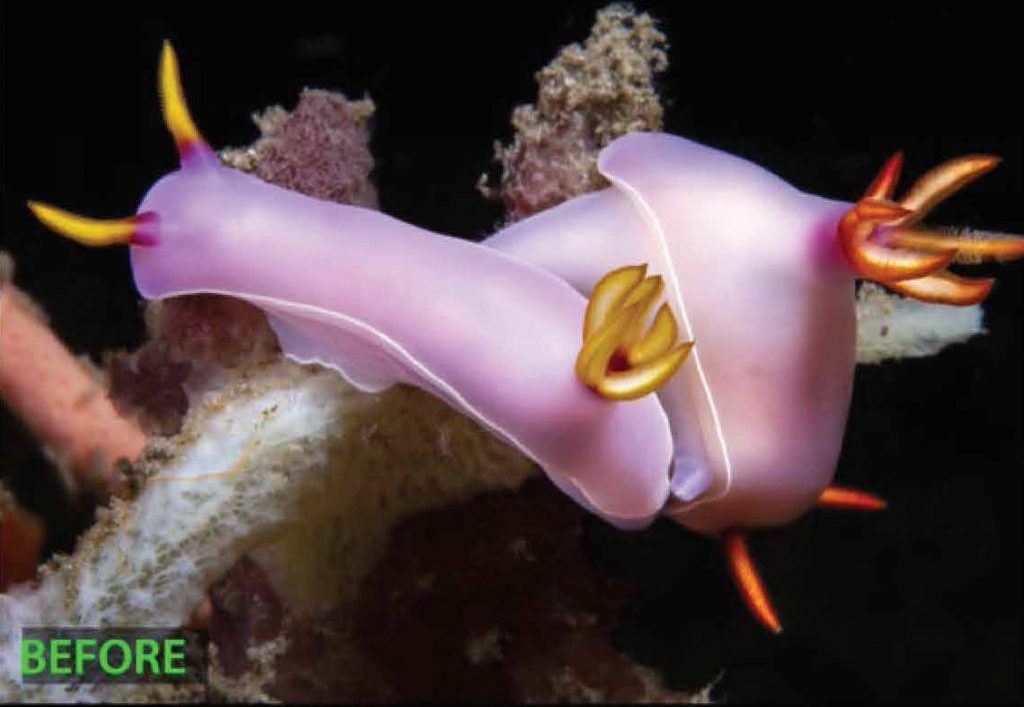
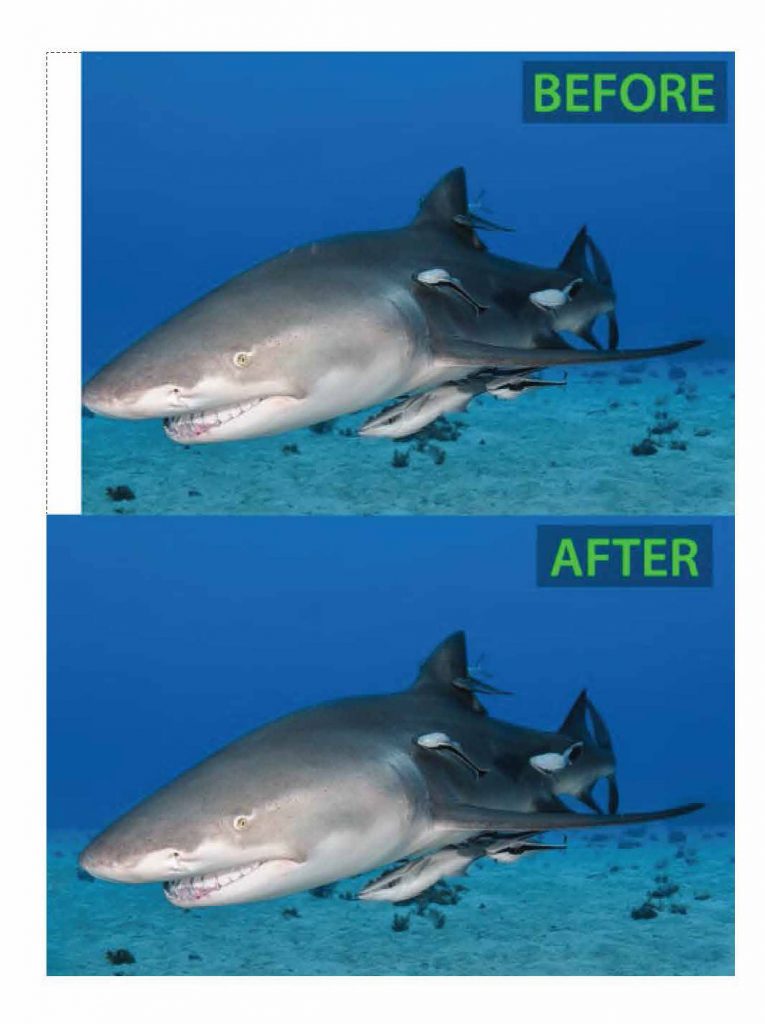
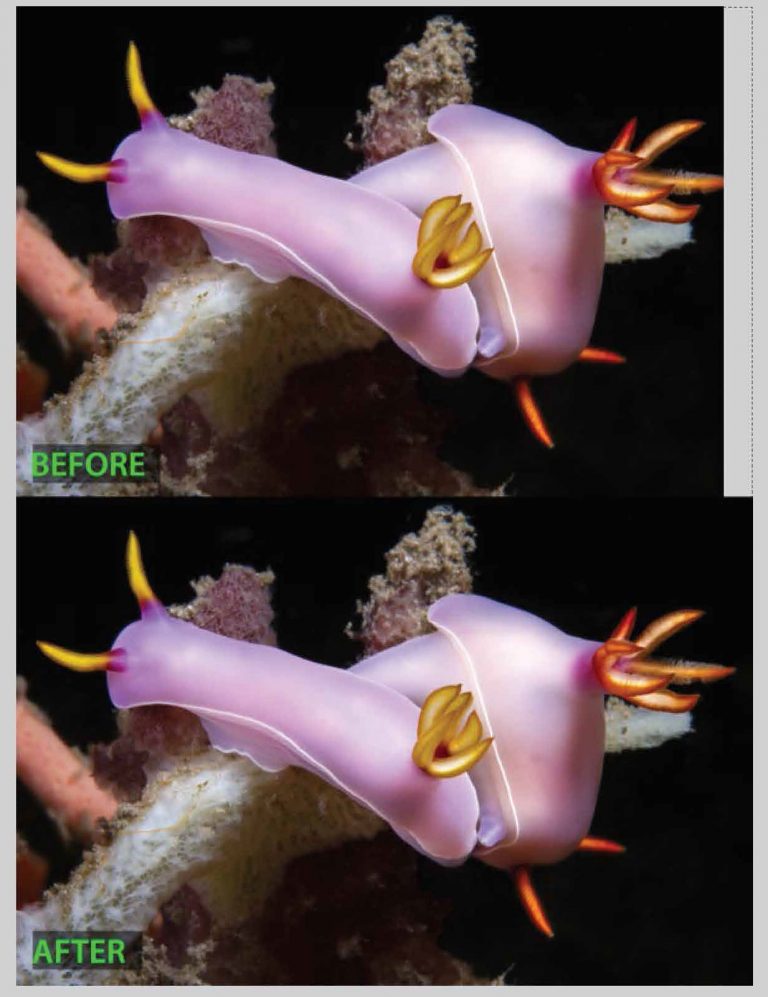
Let’s look at an example where it typically works brilliantly: a shot of an animal subject on a clean background, but one that is a little cramped – in fact, some of the subject got cut off by the edge of the frame.
Before starting this technique, finish as much of your usual editing workflow as possible.
1. Open your image in Photoshop and grab the Crop Tool. The Crop Tool doesn’t only let you clip off part of the picture; it also lets you add area to the canvas.
2. Choose W × H × Resolution from the Tool Options bar dropdown menu to unlock the aspect ratio. Grab the middle crop handle on the edge you want to extend and pull the side of the crop rectangle away from the image to tack on some additional space.
3. Hit Return, Enter, or the Done button to set the crop.
4. Choose the Rectangular Marquee Tool (keyboard shortcut M) to create a selection that includes not just the newly added canvas area, but also a narrow strip of pixels from the original image. This gives Photoshop some image information to work with.
5. Go to Edit > Fill and choose Content Aware from the drop down menu in the dialog box. If you see a colour adaptation checkbox, make sure it’s ticked on. Hit OK.
Now comes the fun part. Photoshop analyses the pixels in your image and tries to guess what you want to fill the selected area with.
For the rest of this article (Scuba Diver Issue 4/2015 OP No.4) and other stories, check out our past issues here or download digital copy here.
The sardine run happens in the winter months from May to August, when millions of sardines, Sardinops sagax, leave the southern Cape waters of the Agulhas bank, to follow the cold, nutrient-rich body of water up the African coast to Kwazulu Natal. This belt of cold water in which the sardines travel is formed by the winter storms of the Cape, pushing the cold water north, while the warm Agulhas current that runs from the north to the south traps this cold water against the coast.
Along the Transkei coast, the continental shelf pushes this cold water into its narrowest strip, concentrating the sardines and the predator load at its highest, creating the conditions for some high-octane action. Film crews, amateur photographers, and ocean enthusiasts all flock to Port St. Johns, Mbotyi and the surrounding areas to get a space on the charter boats that provide the best opportunity for witnessing this event.
Port St. Johns is a small, rustic town on the Wild Coast, a 250-kilometre stretch of coastline which gained its name from its inaccessibility and treacherous shoreline. Although this makes for risky surf launches on the semi rigid inflatables, and hair-raising adventures at the crack of dawn with high-end camera equipment, it makes it all worthwhile when your skipper drops you right in the middle of a feeding frenzy. From the skies to the depths below, predators line up to feast on the protein-rich baitfish.
SCHOOLING TO SURVIVE
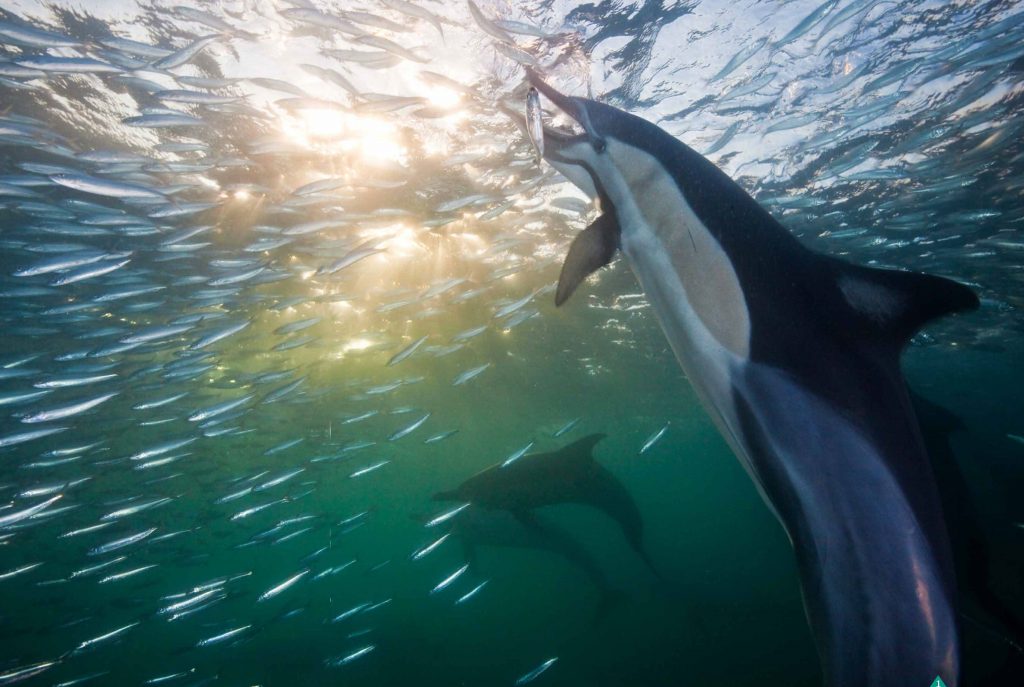
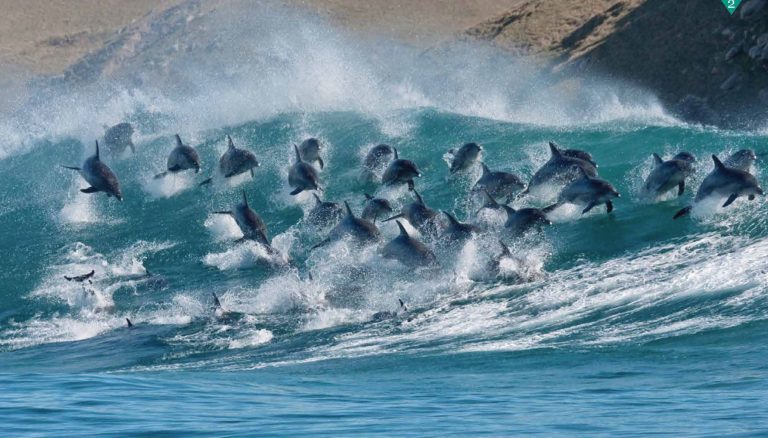
These bait balls form when common dolphins separate a small pocket of fish from the main shoal, and push it up to the surface. The dolphins circle the bait ball for a while, blowing bubbles from below, herding the little fish into a tight swirling mass. They then dart through together in a group to grab as many fish as they can. They will repeat this pattern over and over, until the last sardine is gone. These sardines know, if they lose the group, they are an easy target.
The sharks on the other hand, have no such skilled and organised feeding plan in place. Their strategy is to simply swim through the bait ball, mouth agape, consuming as many mouthfuls of fish as they can. That is why we, as divers, never hang around inside the bait ball! Sometimes that proves difficult, as the sardines often try to use divers as protection.
BATTERED FROM ABOVE
Once the bait ball is visible to the birds in the air, Cape gannets bombard it from every angle, raining down like bullets. When each gannet hits the water, it’s like an explosion below the surface, and one of my favourite moments of the sardine run. These gannets, with their wings folded back, tight as torpedoes, can easily dive to a depth of 15 metres to reach the bait ball, and sometimes grab up to three fish, before returning to the surface. Gannets have been recorded hitting the water at more than 85 kilometres an hour, which has often made me wonder: should I be diving with a helmet…?
For the rest of this article (Scuba Diver Issue 4/2015 OP No.4) and other stories, check out our past issues here or download digital copy here.
Along with DAN Asia-Pacific — which has trained more than 38,000 oxygen providers — diver certification agencies, first aid associations and lifesaving organisations offer oxygen first aid training.
After more than 30 years of teaching oxygen first aid and 22 years of fielding diving emergency calls, I’ve seen and heard about a broad range of errors made by oxygen providers; here I will highlight three of the most common.
ERROR 1: INADEQUATE EQUIPMENT
Every diver’s oxygen unit should include:
• a suitable and well-functioning demand valve that can provide a high concentration of oxygen to a breathing diver;
• a non-rebreather mask fitted with three oneway valves for use with a breathing diver;
• a resuscitation mask for rescue breathing during CPR;
• a supply of oxygen sufficient to last until a doctor trained in dive medicine advises that oxygen first aid should stop or until an alternative oxygen supply is available.
Unfortunately, inadequate and poorly maintained equipment is common, especially in remote locations. I’ve seen many units in the field that are in poor condition or are missing components.
ERROR 2: POOR CHOICE OR USE OF DELIVERY DEVICE
When faced with an emergency, the oxygen provider must choose the most appropriate delivery device for the circumstances.
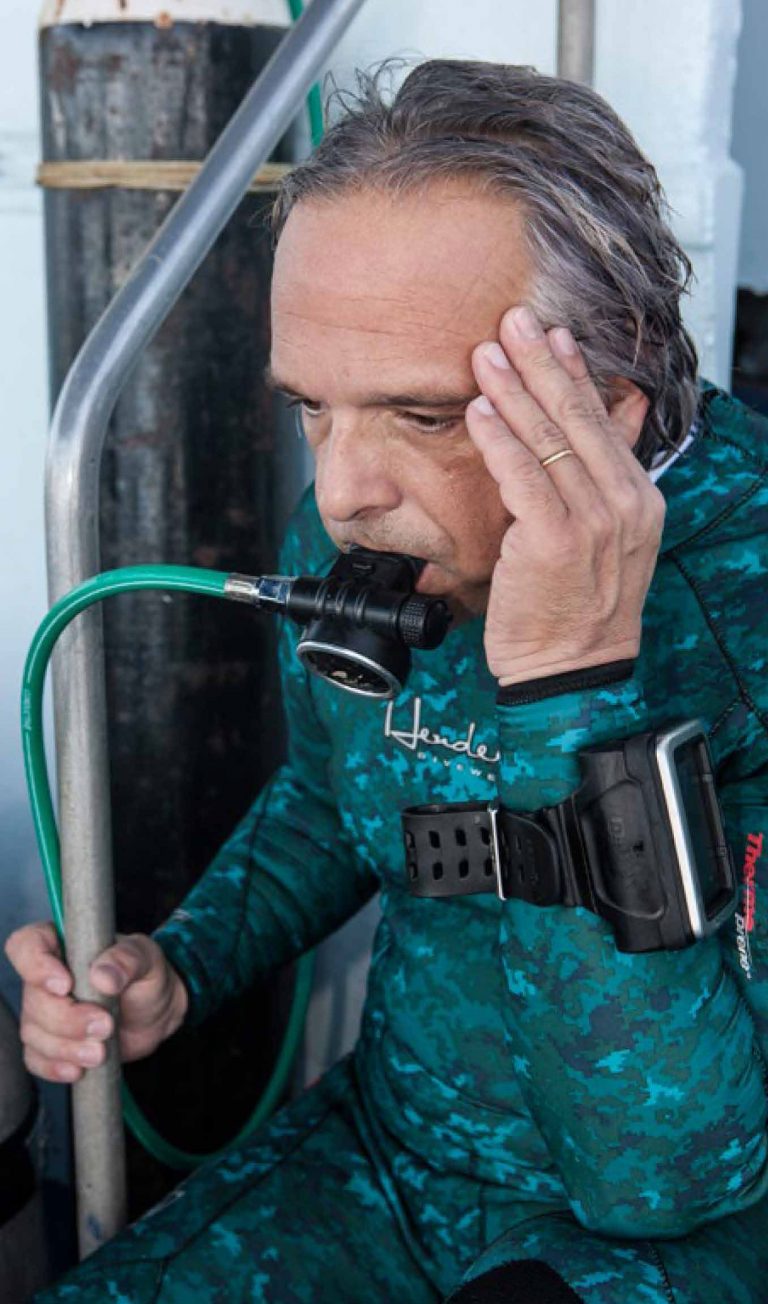
It is generally taught that a demand valve is the device of first choice for use with a breathing diver, usually conscious but not necessarily so. The bottom line is that they need to be breathing strongly and slowly enough to open the demand valve effectively. These are very easy to use, familiar to divers and often relatively economical on oxygen gas. The best demand valves available are the medical valves and an oronasal mask needs to be attached to these to provide an interface and seal between the valve and the diver’s face.
While demand valves have the potential to deliver close to 100-percent oxygen to divers, the reality is that this efficiency relies on the mask seal, the demand valve’s service status and, to some extent, the diver’s position (which should be lying on the back rather than sitting, especially with the head down).
ERROR 3: STARTING OXYGEN FIRST AID TOO LATE AND/OR FINISHING TOO EARLY
Although we are seeing progress in how quickly providers administer oxygen, we still see many situations in which extended delays endanger divers who may have DCI. Generally, these delays have to do with the diver and/or the dive operator failing to recognise that the diver requires oxygen.
The next step is to call a diving accident hotline to get proper advice. Let a dive doctor or medic decide whether continued oxygen is necessary. Hotline operators have considerable experience with DCI treatment and will know more than the dive operator or diver.
A common mistake made at this point, especially if a dive doctor is not in the loop, is that oxygen first aid is stopped too soon. Too often, divers are given oxygen for periods of say 15 minutes to two hours. Sometimes the symptoms improve or completely disappear during this time and this gives an often false impression of safety.
For the rest of this article (Scuba Diver Issue 5/2016 No.87) and other stories, check out our past issues here or download digital copy here.
Stressful situations can affect us both on land and underwater, and feelings of anxiety can, for some, turn into panic. Underwater, panic can be extremely dangerous. There are, however, ways to minimise the chances of panicking underwater, such as making sure your skills are honed, you are prepared for the dive and are diving within your limits.
When Panic Attacks
However, even with all the preparation in the world, occasionally things can still happen that can make you lose your cool. During a stressful situation, our breathing changes: Rather than breathing slowly from our lower lungs, we begin to take rapid, shallow breaths, inhaling only into the upper part of our lungs.
This can cause two things to happen:
1. We don’t exhale fully:
A build-up of carbon dioxide is what triggers the urge to breathe, and so not expelling the CO2 as completely as possible will continue to make you feel as though you can’t “catch your breath”. This compounds the stress response and forces your body into a cycle of rapid, shallow breathing
2. This can then lead to hyperventilation, an anxiety attack, and even full-blown panic.
Sometimes, an anxiety attack can actually be caused by poor breathing in the first place!
What to do?
As certified divers, we all know to STOP BREATHE THINK ACT if things start to feel uncomfortable during a dive. But few of us are taught exactly HOW to breathe – and this is possibly the most important factor in staying calm under pressure.
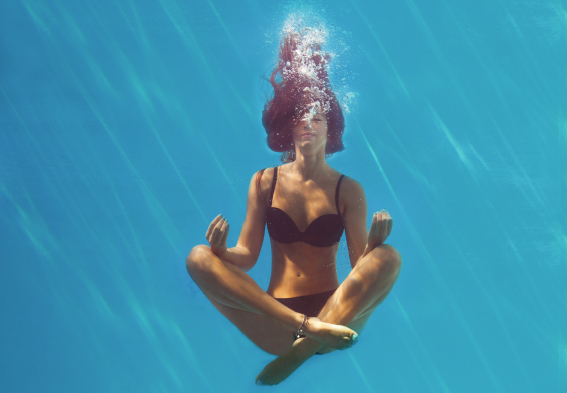
Belly Breathing 101
1. Exhale completely
2.Place on hand on your stomach
3. Inhale deeply, imagining the air entering through your belly button
4. Fill the bottom part of your lungs first. Your stomach should expand as you breathe in
5. Fill the upper part of your lungs last
6. Exhale slowly and completely and begin again!
This breathing pattern stimulates the body’s “parasympathetic response” – the “calming response” – which is the opposite of the emergency response triggered by a stressful situation. Your breathing will slow, your heart rate and blood pressure will drop, and you will feel calmer and better able to think clearly to solve any problem that might have triggered you in the first place!
For the rest of this article (Scuba Diver Issue 5/2016 No.87) and other stories, check out our past issues here or download digital copy here.
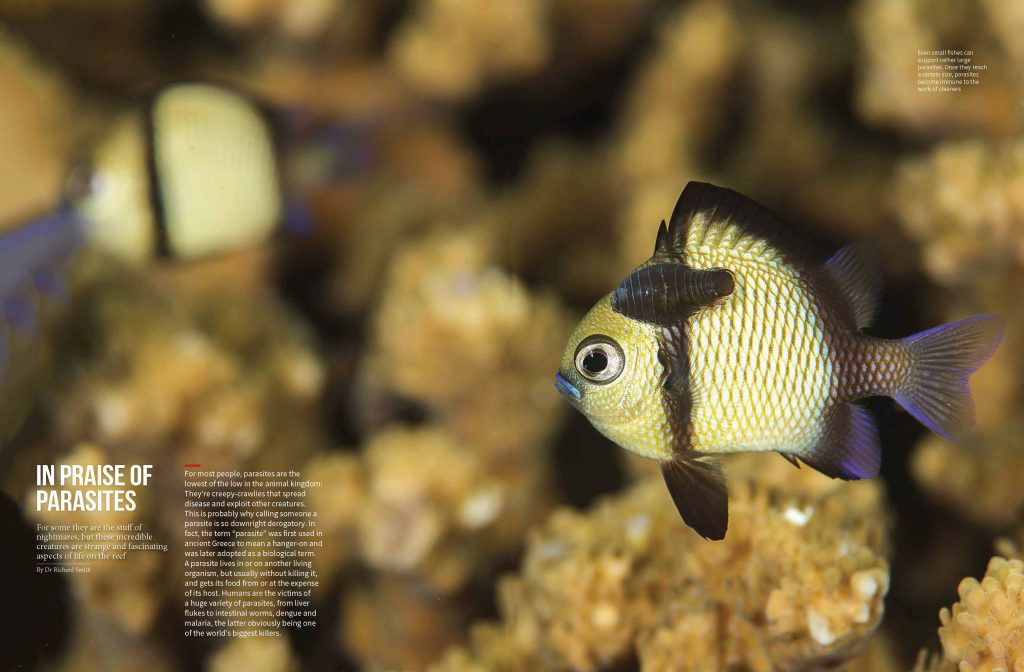
For most people, parasites are the lowest of the low in the animal kingdom: They’re creepy-crawlies that spread disease and exploit other creatures. This is probably why calling someone a parasite is so downright derogatory. In fact, the term “parasite” was first used in ancient Greece to mean a hanger-on and was later adopted as a biological term. A parasite lives in or on another living organism, but usually without killing it, and gets its food from or at the expense of its host. Humans are the victims of a huge variety of parasites, from liver flukes to intestinal worms, dengue and malaria, the latter obviously being one of the world’s biggest killers.
Most likely parasitised by some kind of worm, many internal parasites shut down all non-essential systems in their host to maximise their own nutritional demands. Some parasites even sterilise their host
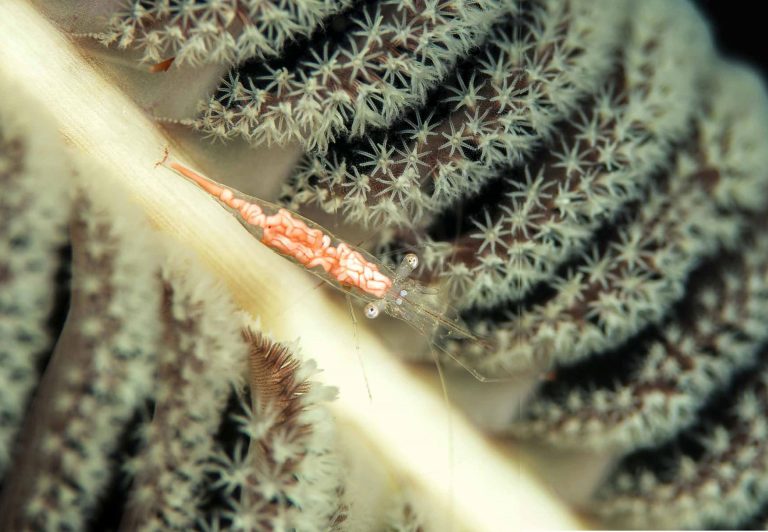
It’s not only humans that suffer at the hands of parasites. Scientists believe that there may be at least one species of parasite for every non-parasitic species on the planet. Even parasites get parasites but because they’re so maligned there has been relatively little research into their diversity. Parasites can live on the outside or inside of their hosts and they tend to be very specific about the host species they infect. Obviously, as divers we’re more likely to see the external ones clamped to the outside of a hapless fish, but if you look closely you might even be able to see one living inside the transparent shell of a crustacean. There’s a real simplicity and finesse to the life histories of parasites that perfectly illustrates Darwin’s theory of natural selection.
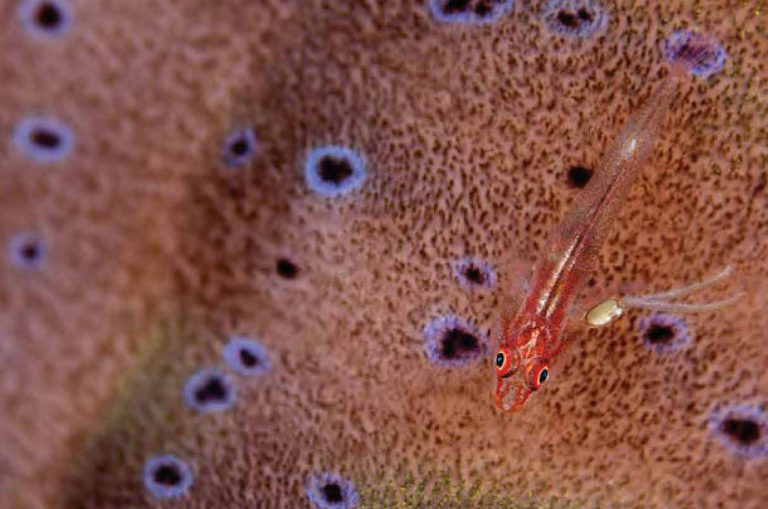
This goby has a large female copepod. The much smaller males are almost impossible to see with the naked eye
THE CAR WASH
Divers might be more familiar with the fishes that work tirelessly to rid other marine creatures of their pesky parasites than the parasites themselves. A diver favourite is the cleaner wrasse, which serves over 2,000 clients per day, removing on average 1,200 parasites. They generally work in pairs, maintaining a territory on the reef. Their work is so valuable that medium- to large-sized fishes visit them every five minutes, and sometimes the cleaners will even refuse a clean to an individual that they think has been exploiting their services. As well as cleaner wrasses, there are around 130 other fishes that are known to clean at some stage in their life, usually when juvenile. Of course there are many shrimps that clean too.
For the rest of this article (Asian Diver Issue 3/2016 Volume 142) and other stories, check out our past issues here or download digital copy here.
Nicknames and legends are usually outlandish exaggerations of certain facts or myths. Very rarely, if ever, does the truth outstrip the fantasy of a myth. Widely known as the land of a thousand islands, you’d think the actual number of islands in Indonesia would be in the high 900s at best – and you would be, well, wrong. By a country mile. In fact, if you take one day to tour one island in Indonesia and continue island-hopping to a different island each day until you finish visiting all the islands in Indonesia, it would take you close to 48 years to finish visiting Indonesia. 47.96 years to be exact. According to the Indonesia Coordinating Ministry for Maritime Affairs, there are 17,508 officially listed islands within the territory of the Republic of Indonesia. Short of asking all 28-year-olds out there to take a trip to Indonesia and expecting them to come back home only when they’re 76 years old, we’ve taken a look at our list of 101 Inspiring Dive Sites and listed out all the compelling must-visit dive sites in Indonesia. Enjoy.
Wonderful Indonesia
THE WORLD’S BEST CORAL DIVES
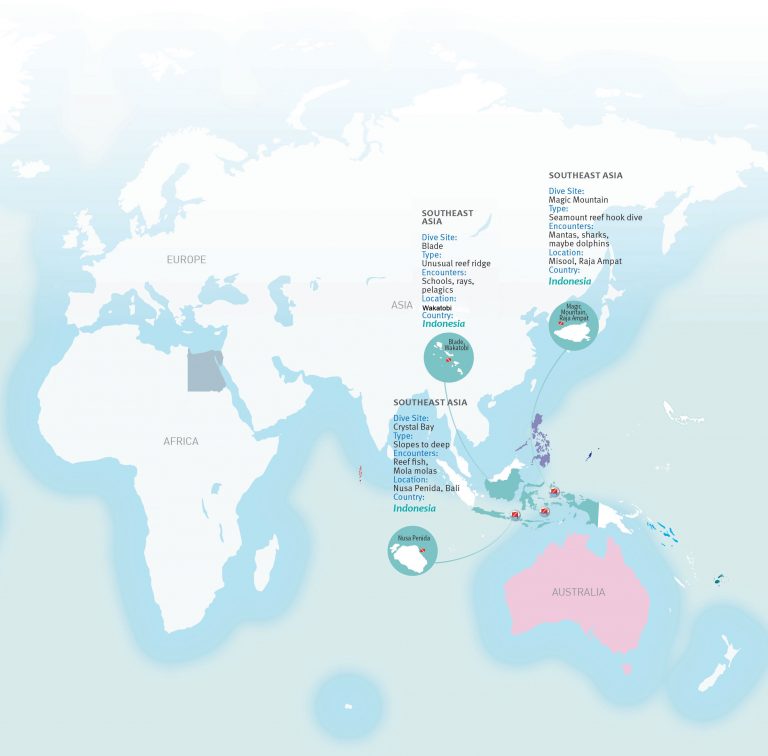
A field of fragile staghorn as far as the eye can see. Radiant soft corals swaying in the shallows. A cliff’s edge staggered by paper-thin plate formations. Everyone’s got their favourites, but our team cast their votes and chose a few of the world’s top dive sites for a pristine coral reef experience. From our list of top coral sites around the world, three are in Indonesia – that’s almost 20 percent of the list.
TREASURED ENCOUNTERS WITH ENDANGERED ANIMALS
Dermochelys coriacea
LEATHERBACK TURTLES
(Text by UW360. Photo by Jason Isley)
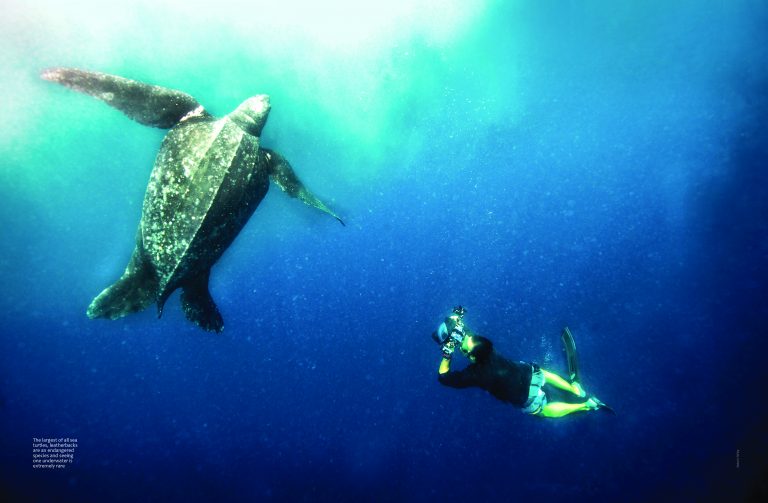
The largest of all turtles, leatherback turtles are an endangered species and seeing one underwater is extremely rare. Location: Kei Archipelago, Indonesia (Photo by Jason Isley)
Each year a remarkable migration takes place and very little is known about it, yet it involves a unique and highly endangered marine creature. Leatherback turtles are the largest of the seven species of sea turtle and are unique in the fact that they don’t have a bony shell. Their carapaces are soft, which gives the animal its name. The combined population of Pacific leatherbacks is thought to be less than 2,500, making them one of the most endangered marine turtles.
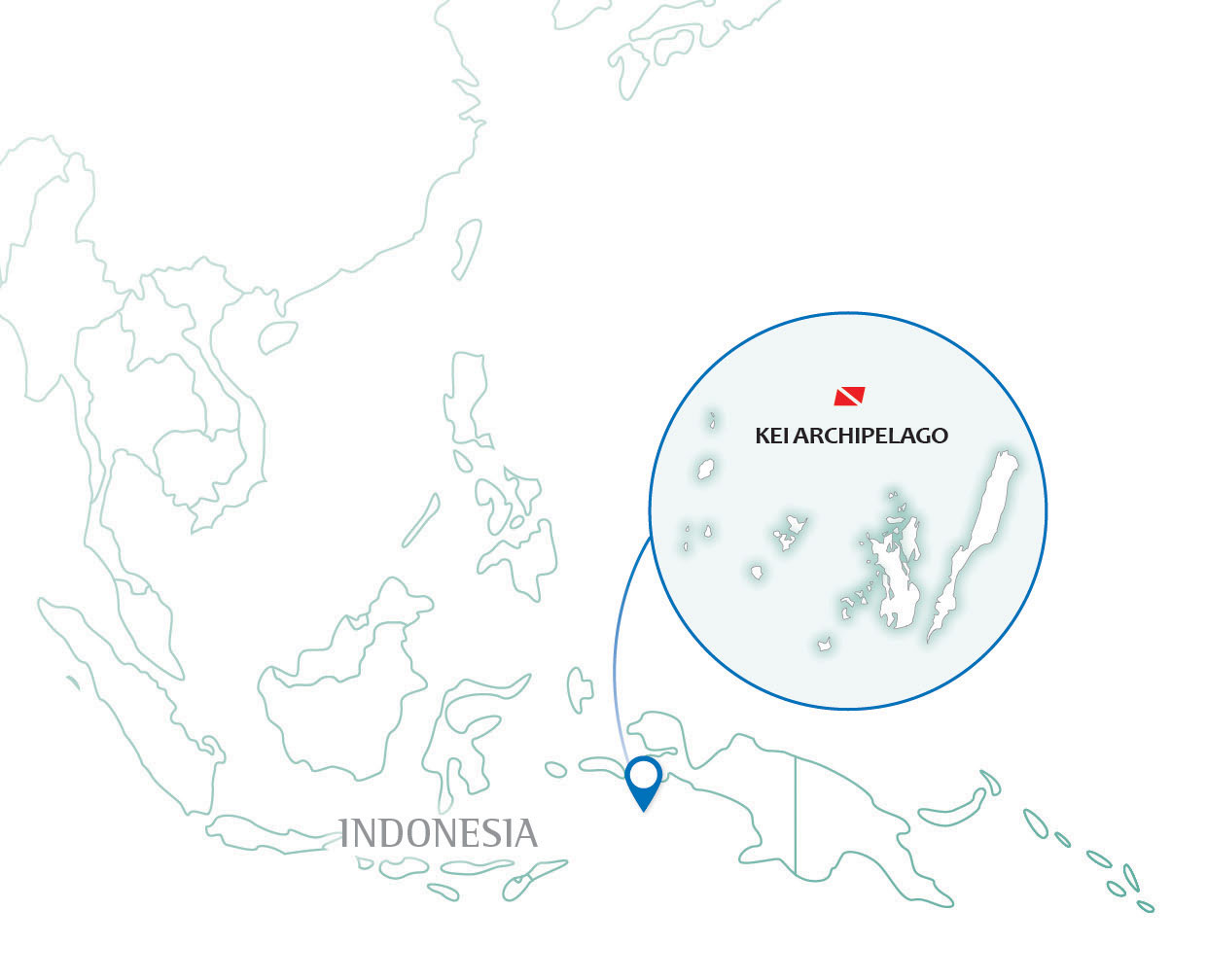
Where : Kei Archipelago, Indonesia
When : During the jellyfish blooms, October–December
Sea Temp : 22–26°C
How : Not easy! Fly to Jakarta. Then onwards to Ambon and finally Langgur
Type : Open water, snorkel/freediving
Pacific leatherback turtles make their way from the west coast of America to feed and breed in the area surrounding the tiny Kei Archipelago in the remote Banda Sea, a journey of thousands of miles for these ancient sea creatures. The Kei Islands are one of the few places in the world where you can encounter leatherbacks underwater and the main reason they can be seen here, and undertake their arduous journey, is to feed on the huge numbers of jellyfish that are swept in every year from the vast surrounding ocean. Given that leatherbacks eat an almost exclusive diet of jellyfish, this is an important feeding ground for these turtles and a feast not to be missed.
A DIP IN DARKWATER
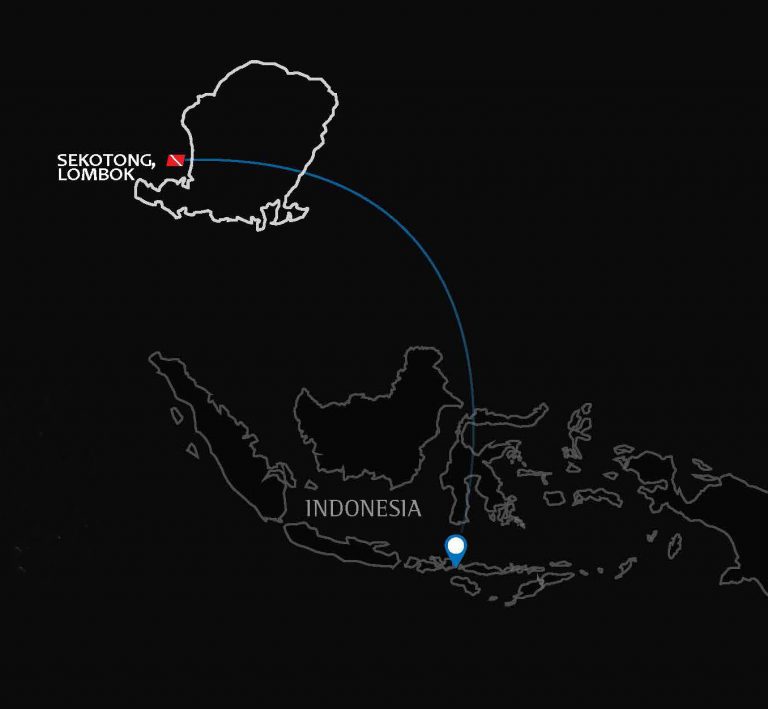
One of the biggest reason why divers visit Indonesia is because of the amazing muck diving sites located at places like Lembeh and Lombok. Lombok, in particular, is also a favourite hunting ground for underwater photographers who love black water photography – diving into deep water in the ocean at night for underwater photography. One of the best proponents of black water photography is famed Singapore underwater photographer, William Tan.
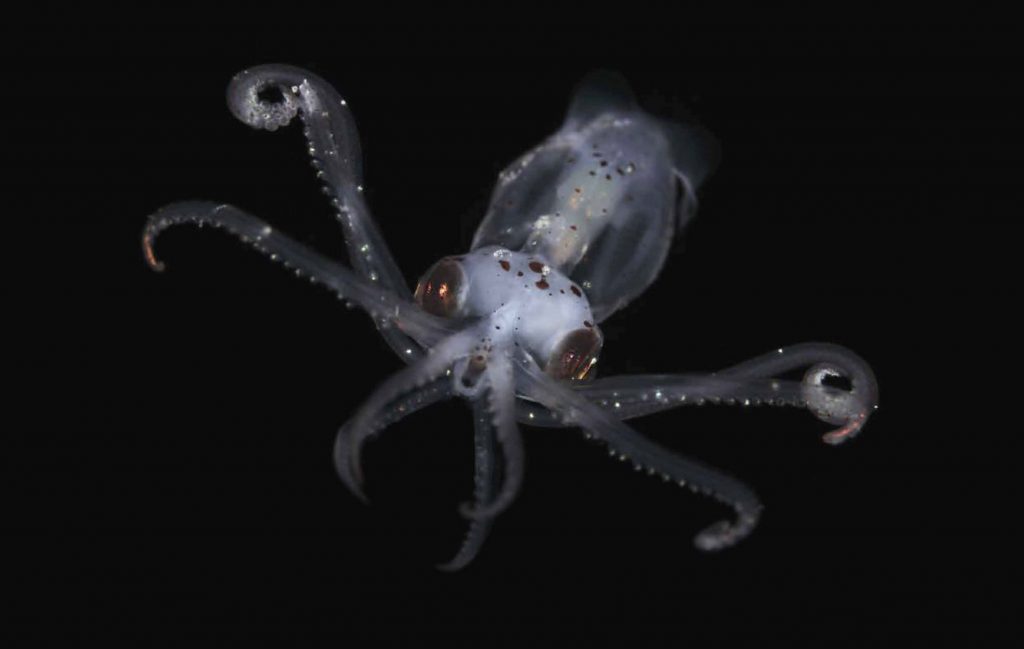
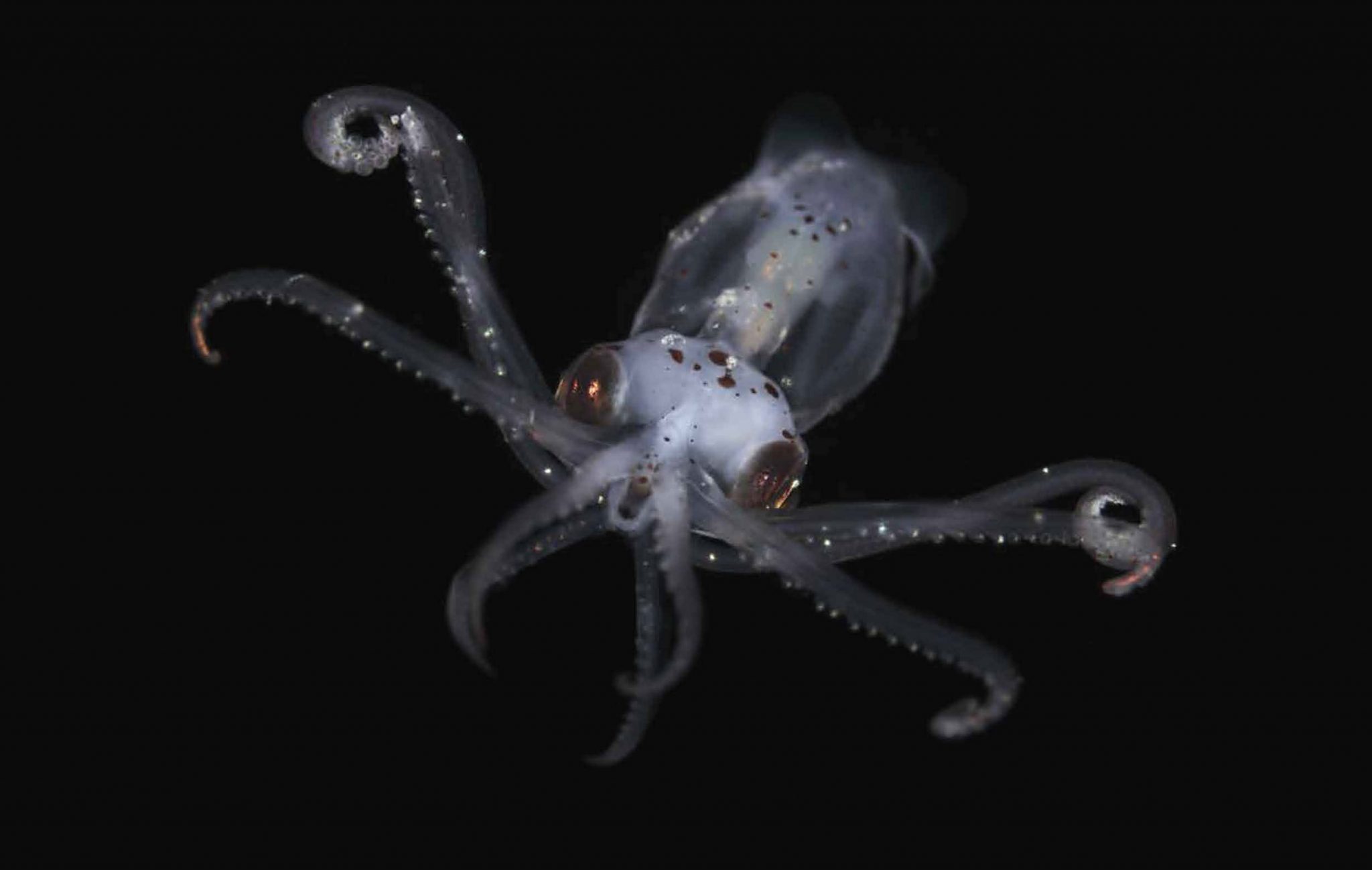
Sharpear Enope Squid Larva (Ancistrocheirus lesueurii) by William Tan Location: Lombok, Indonesia
By : William Tan (Singapore)
Title : Sharpear Enope Squid Larva
(Ancistrocheirus lesueurii)
What : Squid (larvae)
When : June
Equipment : Canon EOS 1DX Mark II, Canon 100mm f/2.8 macro,
Nauticam housing, 2x INON Z-240 strobes,
FIT Pro +10, RGBlue System02 video light
“We were about to surface when the divemaster signalled to me from a distance. He then pointed his torch to what seemed like a tiny tube anemone larva with extra long tentacles and with the ability to change colours rapidly. I only recognised it as a squid larva when I neared the animal. It flexed its tentacles, putting on quite a display in front of the camera. I followed it casually for another 20 minutes until my almost empty and super buoyant tank forced me to end the dive.”
WAKATOBI – EVERYONE’S DREAM DESTINATION
(Text by Karen Stearns. Photo by Henrick Rosen)
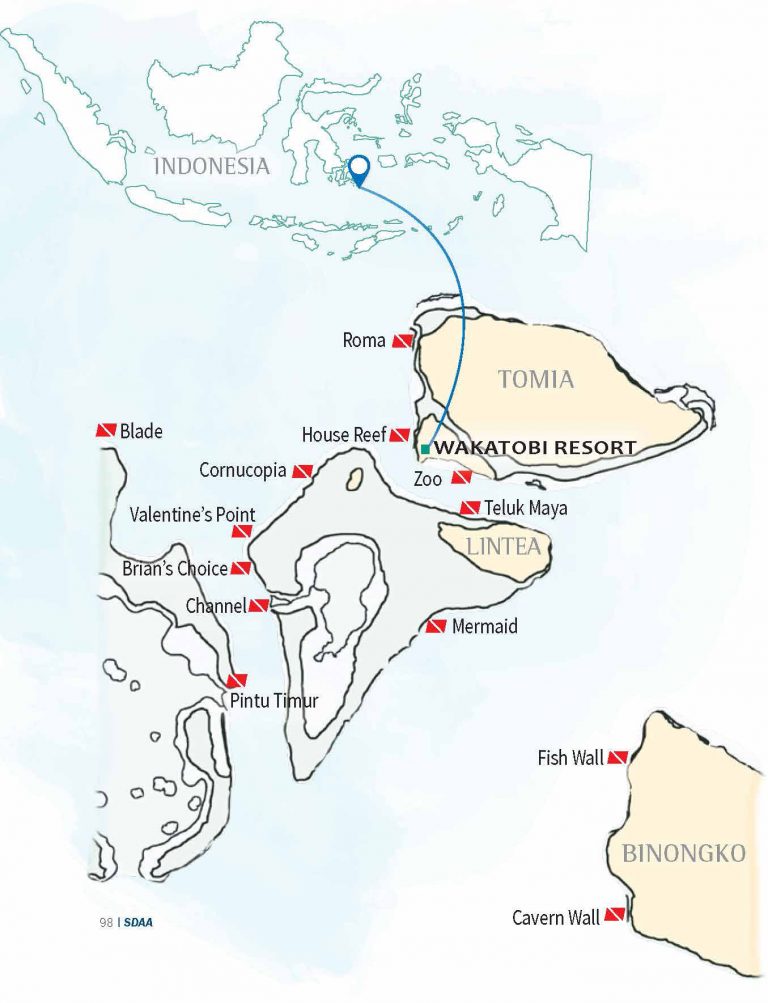
Wakatobi’s House Reef is known around the globe, and often ranks among the world’s very best shore dives. Some 80m from shore, a shallow, coral-encrusted shelf transitions into a series of steep slopes and walls that plummet beyond the range of scuba. Entry to the House Reef is easy, as divers and snorkellers can make the short swim from shore, or descend stairs at the jetty. Pier pilings attract shoaling fish, and clustered nearby are dozens of anemones populated with iconic clownfish. The reef slope is covered with a dense coat of hard and soft corals, sea fans, sponges and tunicates, with overhangs that create resting places for resident turtles. Moving away from the jetty, divers and snorkellers have acres of coral slopes and shallows to explore.
Diving the House Reef from Wakatobi’s beach (Photo by Henrick Rosen) Location: Tomia Island, Indonesia
The face of the drop-off is covered in an impressive collection of hard and soft corals, and large sponges while the shallows are prime hunting grounds for an even more diverse range of subjects. This expansive site is available to divers and snorkellers day and night, and on request “taxi boats” will ferry guests to more distant portions of the House Reef so they can leisurely make their way back to the jetty.
With 17,508 islands, there are incredible dive sites scattered all across Indonesia that are too many to list here. And to think, we’ve only covered the underwater attractions of Indonesia so far. Imagine what wonders await you on land!
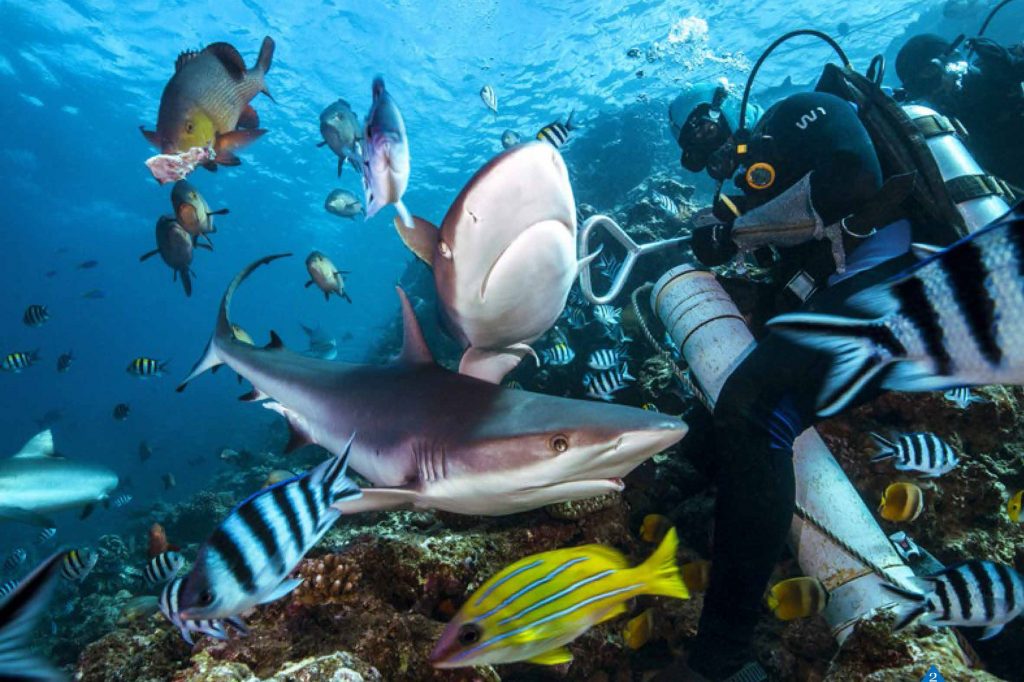
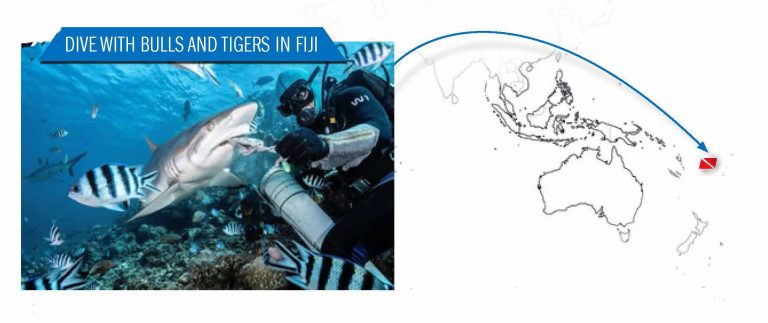
There are many great shark dives in the world, but how many offer a multi-level dive all year round, on which you can have close encounters with up to nine different species of shark – blacktips, whitetips, grey reefs, silvertips, tawnies, sickle fins, lemons, tigers and bulls? The answer is only one.
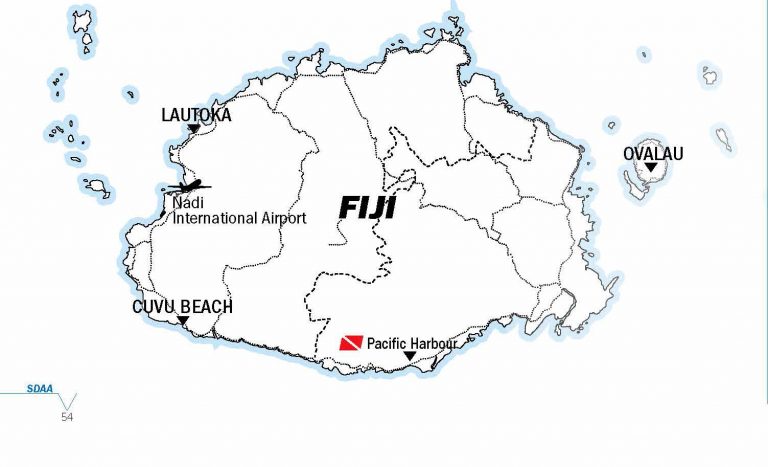
Just 20 minutes by boat from Fiji’s Pacific Harbour lies a very special marine park where, over the years, important shark research and conservation work has brought the marine life back to this once over-fished area. With support from both the Fijian government and the traditional owners of the area, as well as a lot of hard work from Beqa Adventure Divers, Shark Reef Marine Reserve, Fiji’s first national marine reserve, has become a hugely successful eco-tourism shark project. What makes this site especially unique is the impressive numbers of bull sharks that visit the marine park throughout the year, and, although the temptation of food is the main encouragement for these sharks to visit, as I found out over my 12 days here, these sharks are far from being conditioned to just relying on eating fish scraps every day of the year; sharks that I saw at the beginning of my visit were no where to be seen by the end of it.
1. CAMERA TIP: It can be a little dark at this depth first thing in the morning so try and push your ISO up to a maximum level that you know your camera is comfortable with and avoid kicking up the sediment. Fire off some test shots to get your strobe angle and power right before the feeding starts – just be mindful of not illuminating sediment that the sharks stir up.
27 METRES: SHARK ENCOUNTER 1 OF 4 – PUTTING THE BINS OUT
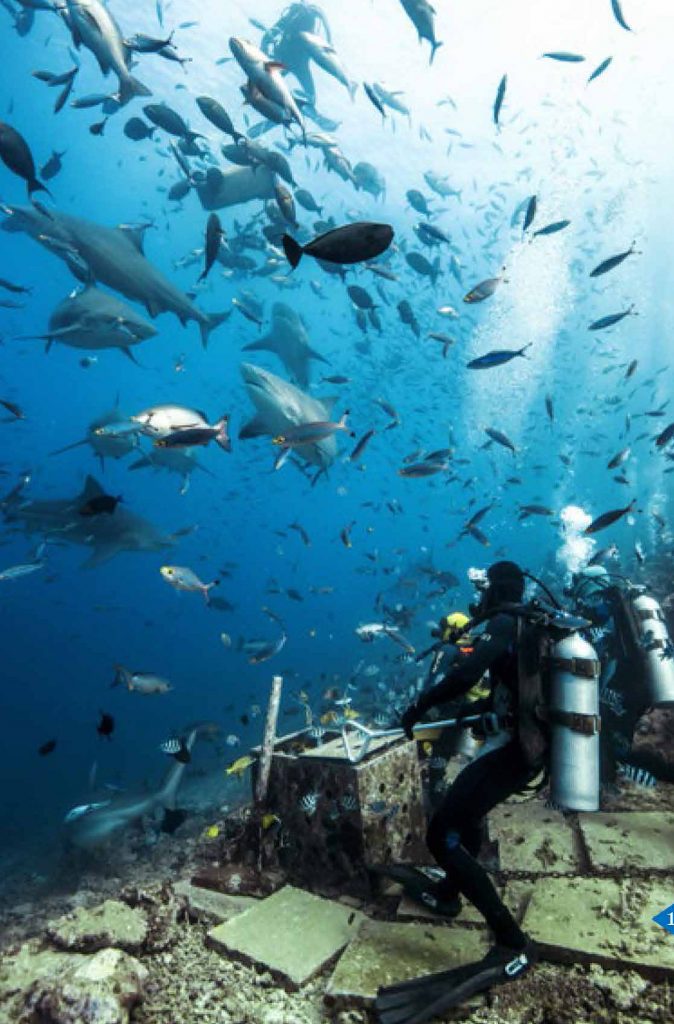
As the group and I descended down the reef slope to the Arena my first bull shark came into view. I had seen nothing from the surface but as we approached the man-made reef wall, the sharks seemed to appear from nowhere. With great efficiency the whole group of divers were quickly guided into position behind the waist high wall by the Beqa Adventure Divers divemasters. Equipped with their aluminum shark staffs, the supervisors spaced themselves evenly behind the group, ensuring that everyone was safe and secure.
Meanwhile, in front of the group, bull sharks of all sizes were now slowly cruising the length of the wall looking at their spectators very closely. From behind the curtain of bubbles created by the line of divers, Fabiano appeared, towing what looked like a wheelie bin. As he hovered 10 metres above the Arena, the sharks become less interested in the divers and more in Fabiano. Surrounded by a dense cloud of reef fish, Fabiano checked the shark’s behaviour and, after being given the all-clear signal from the divemasters, the wheelie bin was inverted and the lid was partially opened. Slowly, several football-sized tuna fish heads tumbled gently into Arena and the languid sharks gave a display of just how fast and manoeuverable they can be as they all rushed to be the first to reach the food. With great busts of competitive acceleration, but without bumping into each other, and in an almost orderly fashion, within moments the food was consumed. The sharks were now a little bit excited and were swimming around more quickly. Fabiano allowed a minute or so for the sharks to regroup and settle.
Constantly monitoring their behaviour and communicating with the divemasters, he dictated the momentum of the feed, ensuring that it was conducted responsibly. As the feeding resumed, Gape, a pregnant, two-and-a-half-metre bull shark shot up vertically to grab the bait first and as the group followed her she snatched one of the fish heads and suddenly changed her course, swimming parallel to the line of spectators with her large mouth open displaying her prize for all to see.
Twenty fish heads later, the dive leader signalled that it was time to ascend to the next stage. We headed for shallower water, the divemasters following, guiding everyone safely to the next vantage point.
NAVIGATOR
Getting there: The international airport is Nadi in the northwest of the main island Viti Levu. From there it is a 2.5-hour transfer by cab to Pacific Harbour on the Southern coast where Beqa Adventure Divers are based. Other local transportation is not recommended.
Best time to dive: All year round. Summer is from November to May and the weather is hot and humid with little wind, warm water and acceptable viz. In winter from June to October it is cool and dry, windy, and the visibility is excellent. The bull sharks leave from October to mid-December to give birth and mate.
Don’t dive without: A 3mm in the summer, 5mm in the winter. For the shark dive a dark, full-body wetsuit and dark gloves.
Essential training: Open water
On arrival: Nationals of most countries can get a four-month permit to stay in Fiji on arrival. Check with your local embassy or consulate.
For more information: www.fijisharkdive.com
Currency: 1 FJD: 0.5 USD
Time zone: GMT +12/13
Languages: English, Hindustani, Fijian
For the rest of this article (Diveaholic/Scuba Diver Issue 1/2015 No.81) and other stories, check out our past issues here or download digital copy here.

 Before starting this technique, finish as much of your usual editing workflow as possible.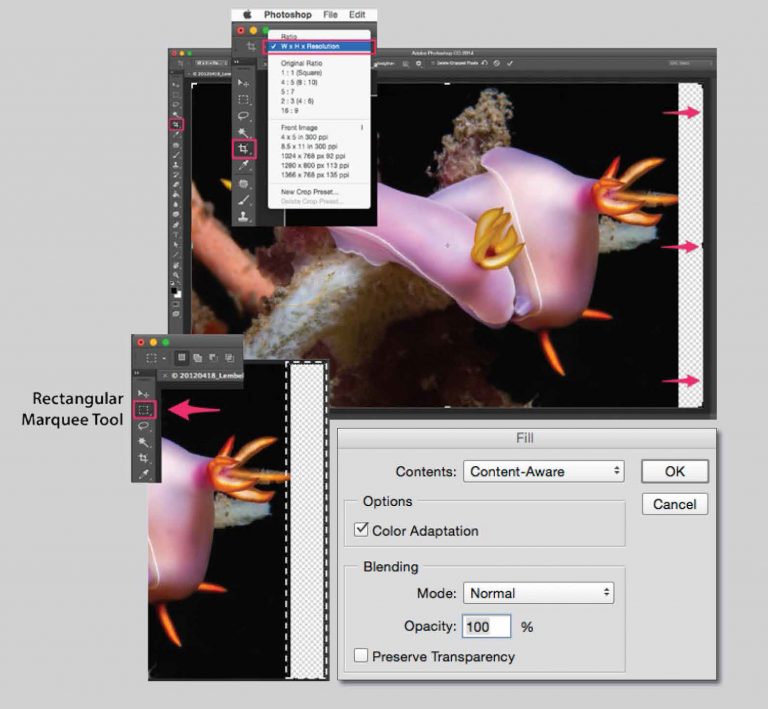


 WAKATOBI – EVERYONE’S DREAM DESTINATION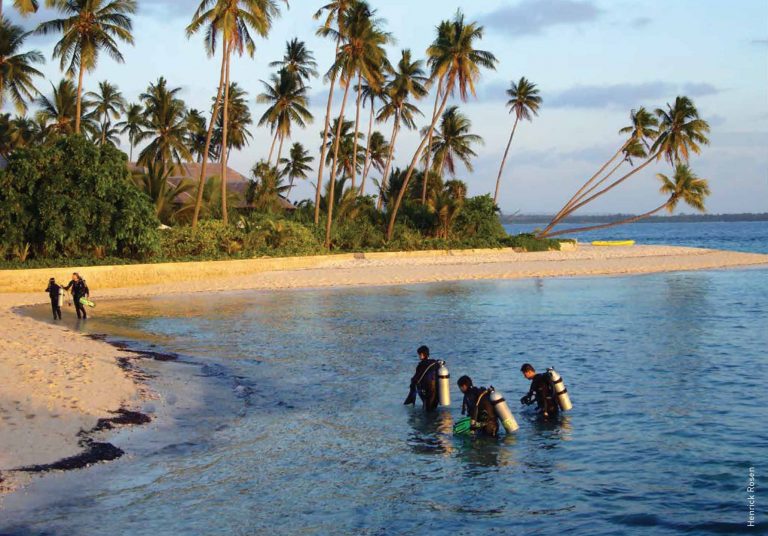

 NAVIGATOR