Home Blog Page 95

Nature’s Mirror

0

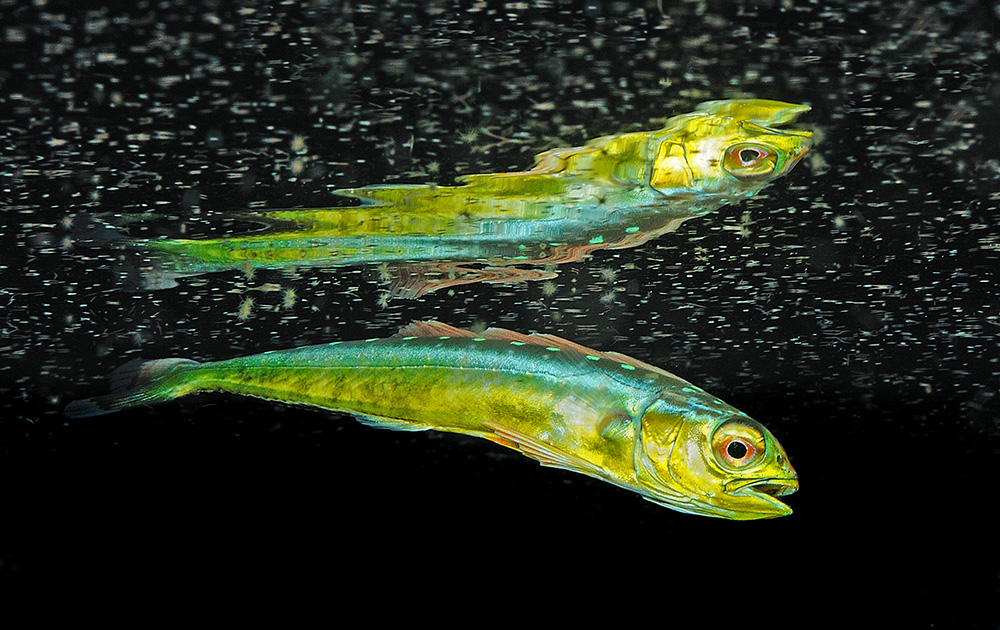
My wife Sonia and I toured Raja Ampat recently on a liveaboard. One memorable day near Misool Island, we had enjoyed four wonderful dives, including a night dive, and were reminiscing about the day’s events with other guests over dinner. At about 9:30, as we were heading to our cabin and ready to call it a night, we noticed several small flyingfish swimming near the surface, perhaps attracted by the lights of our boat. Initially, I was hesitant to go after them because of the late hour, but after a few minutes I understood that it was a unique situation that I could not miss. I mounted a 105mm macro lens on my Nikon D300s and I eased gently into the water to avoid frightening the fish.

The surface of the water was perfectly calm, but a small current disturbed my free dive a little bit. Focusing on subjects was a nightmare! My idea was to take some shots that would look a little different from a simple portrait of a fish. I decided to take only photos of the subjects with their reflections. This was made even more difficult, since angles were not negotiable, which made focusing even more complicated. I had to slightly immerse myself while free diving and then wait for the surface to be calm again. I would hover around 20 centimetres under the surface while focusing on my subjects in darkness, illuminated only by a small pilot light.
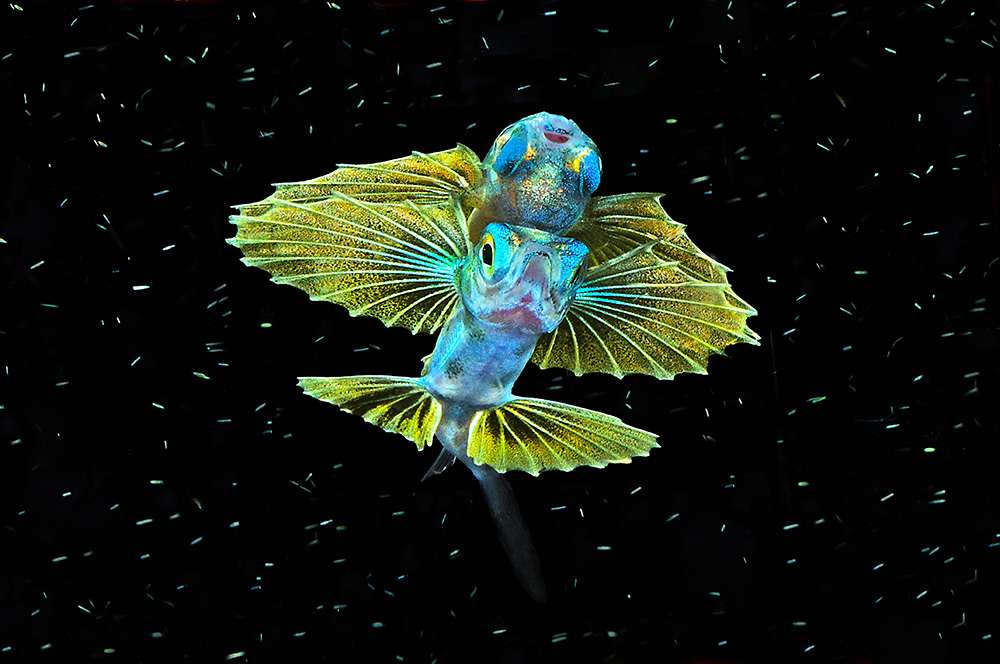


A flying fish shows off its colours during a night dive


In the end, I felt my tenacity paid off over an hour and a half, with some good shots, like one (above at right) that ended up winning in several contests around the world. What makes this image special to me is not only the subject, but the technique used to capture a reflection in the image. As divers, bent over in a face-down position, we are most accustomed to seeing things from above. The simple act of shooting upwards, and seeing things from the other side of the mirror, can give truly impressive results and more appealing underwater images. But before we go out and test ourselves with this technique, it can help to know a little theory behind this phenomenon.
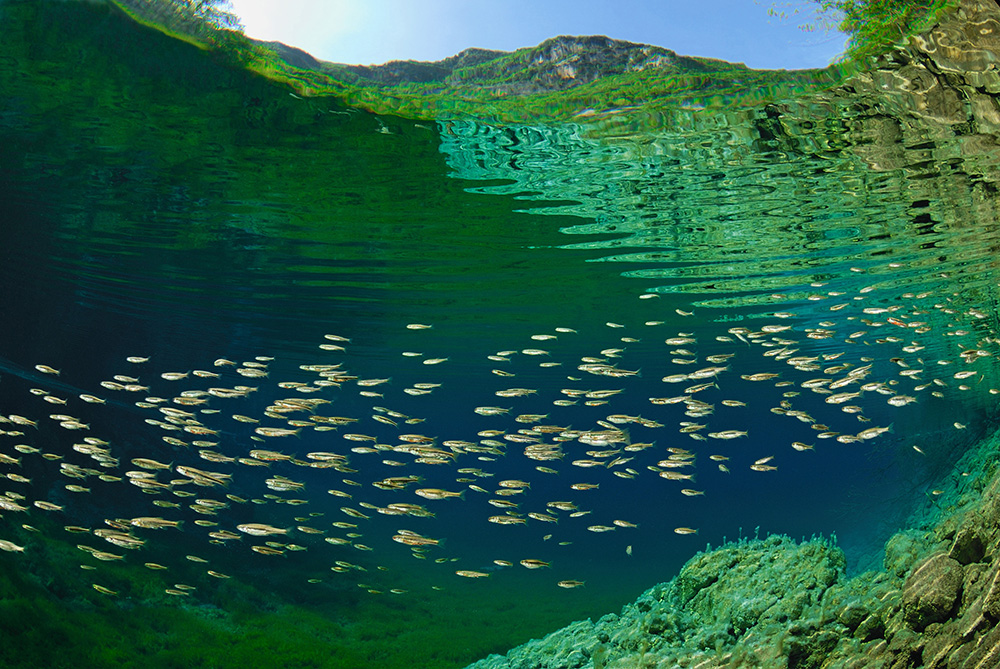


A school of small fishes swims in the shallows of Cornino Lake, Italy


Into the Looking Glass

We have all seen landscapes reflected on the water’s surface many times, perhaps at the edge of a lake when the surface was perfectly flat, or while looking out to sea during a brilliant sunset. We may have never expressed interest in the phenomenon from the physical point of view, beyond the beauty, but the basic information that we can all relate to is that the surface of water acts as a mirror only when viewed from a certain angle.

While this is basically true, the “mirror” is created not by the surface of water alone, but rather the “border” between the air and water – a phenomenon that is said to be due to the difference in “refractive index” between these two elements. The term refractive index describes how light travels in a medium, and is based on the basic behaviour of light in air, which is said to be roughly equal to a refractive index of 1.00 (a measurement with no units). As light travels into water however, light slows down, bends, and is absorbed, and is given a refractive index of 1.33. We witness this phenomenon in front of our eyes on every dive and we likely studied the dancing light during our first diving course. This phenomenon is the reason why objects underwater appear closer and larger through our masks.
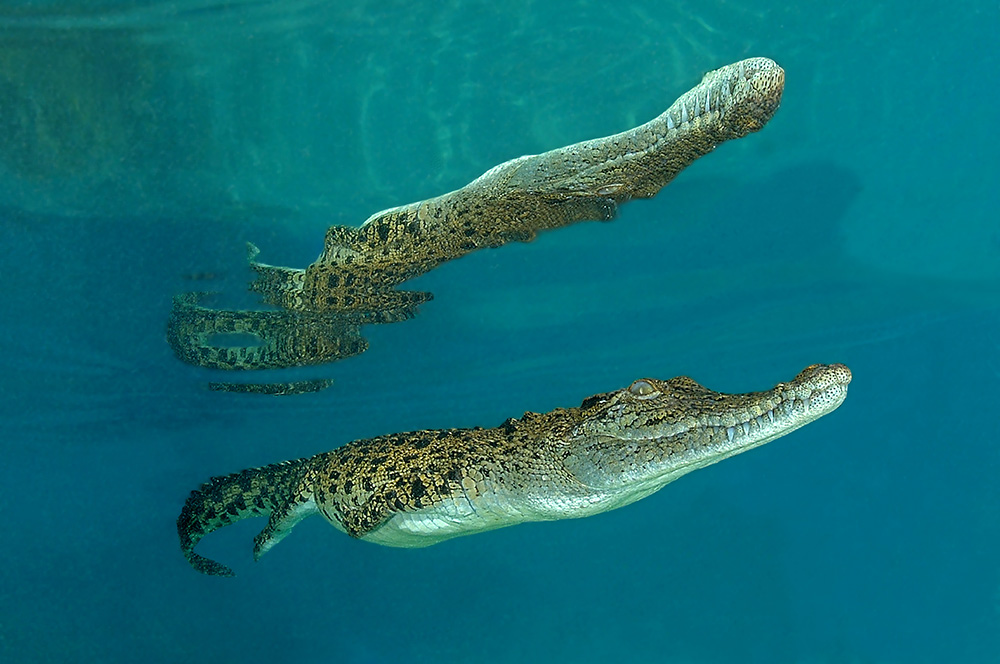


A saltwater crocodile in Papua New Guinea


Let’s come back to the phenomenon from above the water’s surface. The difference between the two refractive indices, and therefore the “deviation” of light, has a critical angle below which all light is reflected. This angle is determined by a mathematical formula known as Snell’s law, but for our purposes, all we need to know is that in the presence of a perfectly flat surface, light on the surface with an angle of less than about 41 degrees is completely reflected, creating the magical mirror. Interestingly, this happens in a very similar way from the opposite perspective under the water’s surface, on “the other side of the mirror.”
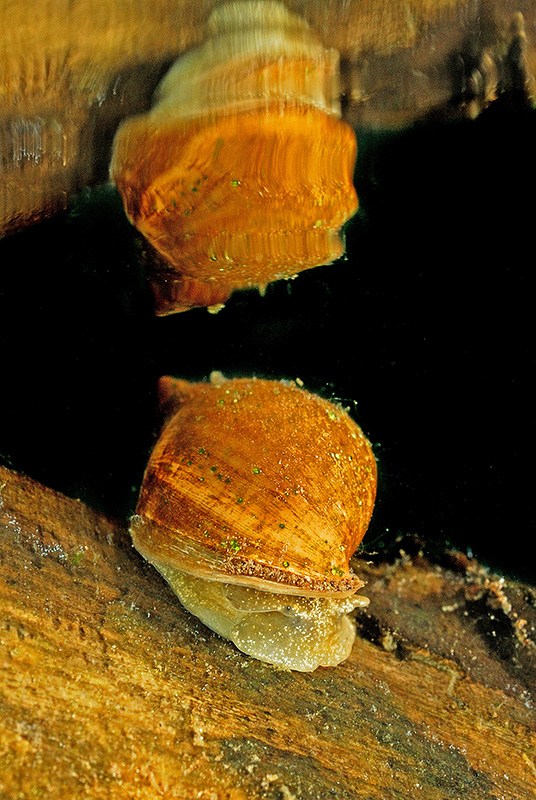


A small snail is reflected on a slightly disturbed surface in Mediana Lake, Italy


Applied Sciences

In order to best apply this phenomenon to our underwater photography, it is extremely important to have a quiet surface, because if the water is choppy, the desired effect can be completely ruined. But a few small waves, in some cases, can enrich the whole scene and improve the image. So the first thing to recognize is that even our own movements at the surface can destroy the perfect mirror. Our bubbles can be even worse. To create these images, snorkelling can sometimes be the ideal choice, as it allows us to be more agile, more hydrodynamic and helps us to avoid having to hold our breath in order to stop bubbles from disturbing the surface. Since there is no need to reach any significant depth, snorkelling can be fine, although it is often necessary to keep perfectly still to ensure a perfectly flat surface.

When we analyse the path that light takes from our subject to our lenses, one key thing to realise is that the path is different for the “real” subject and its reflection. While the light from the subject reaches our camera’s sensor, the path of the light from the reflected image tends to be longer, as it will have a slightly greater distance to travel when compared to the “real” subject. This means that the light from the “reflected” subject will be exposed to more refraction, more absorption and more interference. The result can be a subject that is not as bright as the “real” one.

The good news is that, in many cases, this effect is not very noticeable and most often any loss of intensity in the reflection can be recovered in post production. As a general rule for these types of images, ensure that lighting is optimal, and always take more shots of the same scene than you normally would, since these small details and variations can make all the difference.
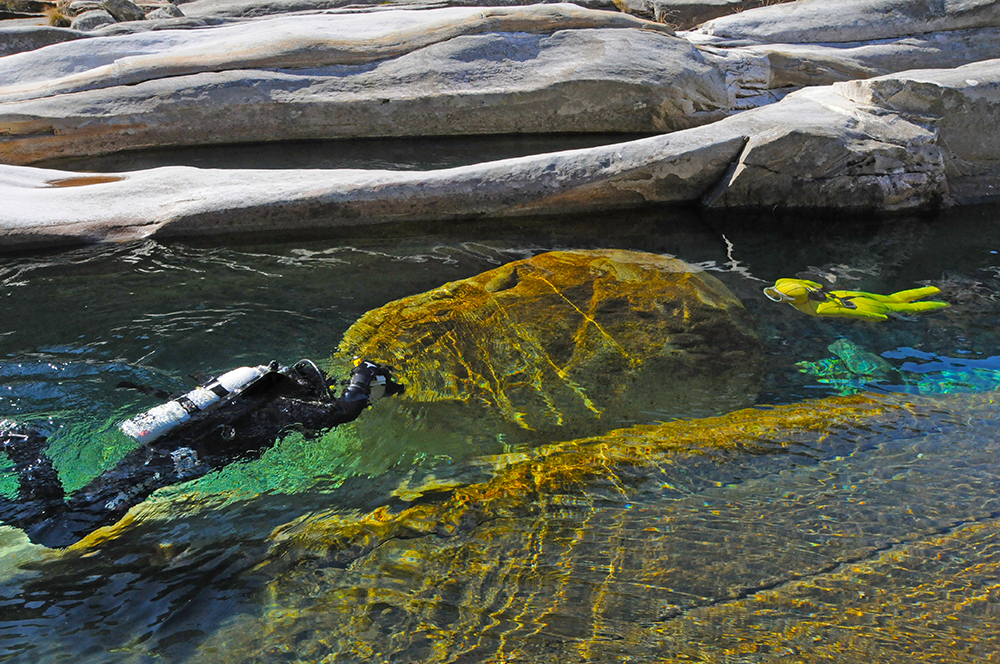


Rivers in the Alps offer very good visibility in late winter, before the snow melts. Because the underwater life is not as rich as in the seas, photographers must work harder for unique images.


Tiny vs. Big Mirrors

When shooting reflections in macro photography, focus and depth of field are an even bigger concern. Reflections follow normal rules of photography where depth of field is restricted to a single plane, from the bottom of the image to the top. Depending on your angles therefore, parts of the reflected image may not align with the corresponding sharp elements of the real subject. While depth of field is not always a major problem, photographers will have to take this into account to avoid losing centres of interest. As a rule of thumb, the use of high magnification for these types of images is risky and should be avoided.

In underwater wide-angle photography, we use lenses that allow viewing angles significantly greater than our natural sight. The wide-angle photos that you see in this article were all taken with a fisheye lens that has an extremely wide viewing angle, almost 170 degrees on the diagonal. With this we can unleash our imagination and creativity and try many different optical effects. For example, in a single frame we can capture three distinct parts of an image: the true underwater scene, blending in with the reflected underwater scene, and even that which is above the water.
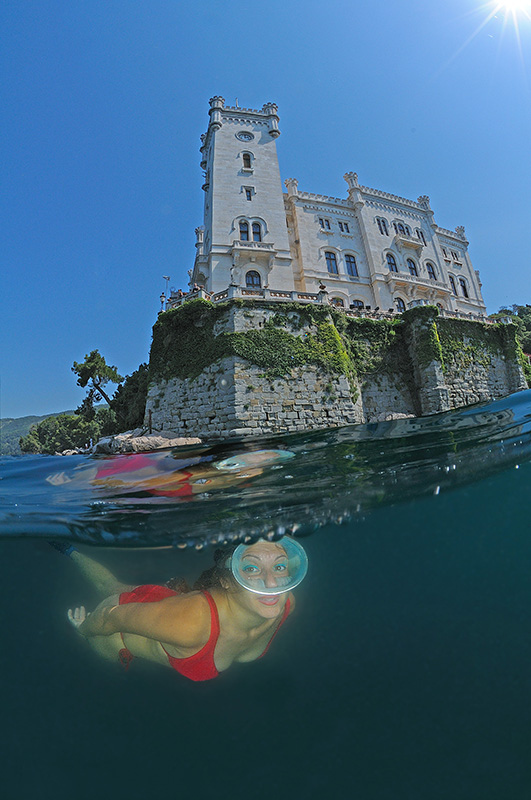


In this case, the subject below the water is visible from the surface


This effect of the “external” part of the image is often visible in vertical photos, but may be absent in horizontal images. Remember, the tilt of the camera affects what you capture of the outside. The more the camera is parallel to the surface, the fewer light rays will pass through to your image, giving you a clearer view of what is outside the water.

And now you are ready. The next time you encounter a flat surface, remember to peer into the looking glass with your camera. One last bit of advice: the phenomenon of the total reflection at the border between air and water is present not only at the surface, but also on the masks of our dive buddies!


Aggressor Liveaboards is the preferred liveaboard of Asian Diver magazine. You can find out more about their liveaboard stays for on your next adventures on their website Aggressor Liveaboards. Their contact information is listed below:

Aggressor Adventures
209 Hudson Trace
Augusta, GA 30907 USA
Freeloaders & Bloodsuckers

0
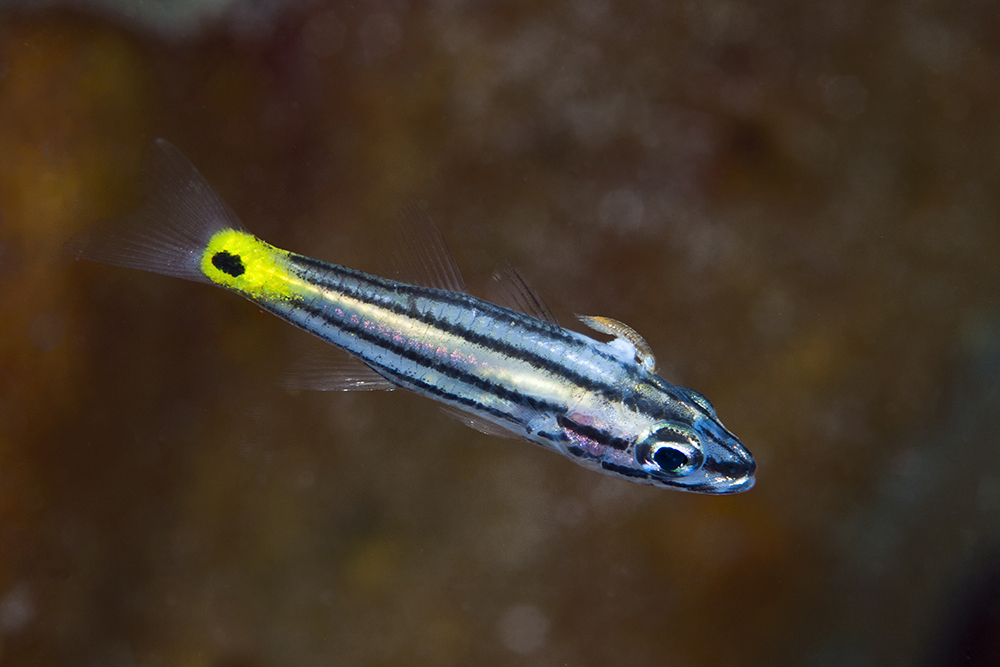
This Apogon lives with a isopod parasite attached to his body. Parasites have an important role in controlling various fish populations.

An extremely high biodiversity with thousands of species living together: that’s the common vision of a tropical coral reef. Like in every society we know, there is always somebody ready to take advantage of the weaknesses of others, using his resources and vital energies to grow up and better survive. And the coral reef is no different.

In a relationship between two species, there is a wide range of interactions that are possible. In some cases, animals behave in ways where both receive some advantage by working or even living together. When species cannot survive without the other, this is called “mutualism”, or mutualistic symbiosis. In some cases, when both species receive an advantage from cooperating with the other, but the benefits are not entirely balanced, this is known as “commensalism”. But when one species takes full advantage of the relationship, sometimes leading to the death of the other species, this is what is called “parasitism”. Examples of parasitism on tropical coral reefs are almost uncountable with some parasites reaching very high degrees of specialisation, and evolving very complex life cycles as a result.

First of all, it’s important to note that the death of the host is not the goal of the parasite. Quite the opposite, a long-living host is the dream of every good parasite — resources that can be used by the parasite for a long time. Evolution drives parasitism in this direction. A parasite can live inside their host (endoparasites) or clinging to the outside (ectoparasites). While endoparasites are almost invisible, ectoparasites are quite easily observable while diving in a rich and biodiverse coral reef.


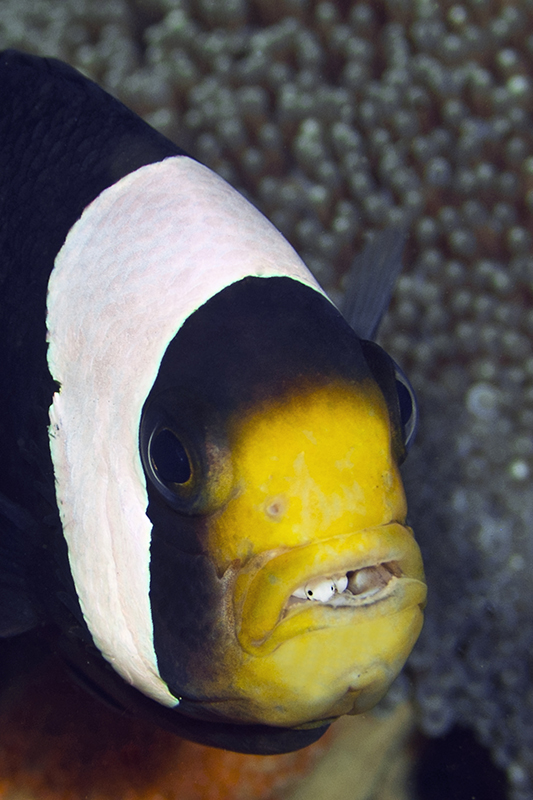
A clownfish with Cymothoa exigua in its mouth – a tongueeating parasite


Crustacean Infection

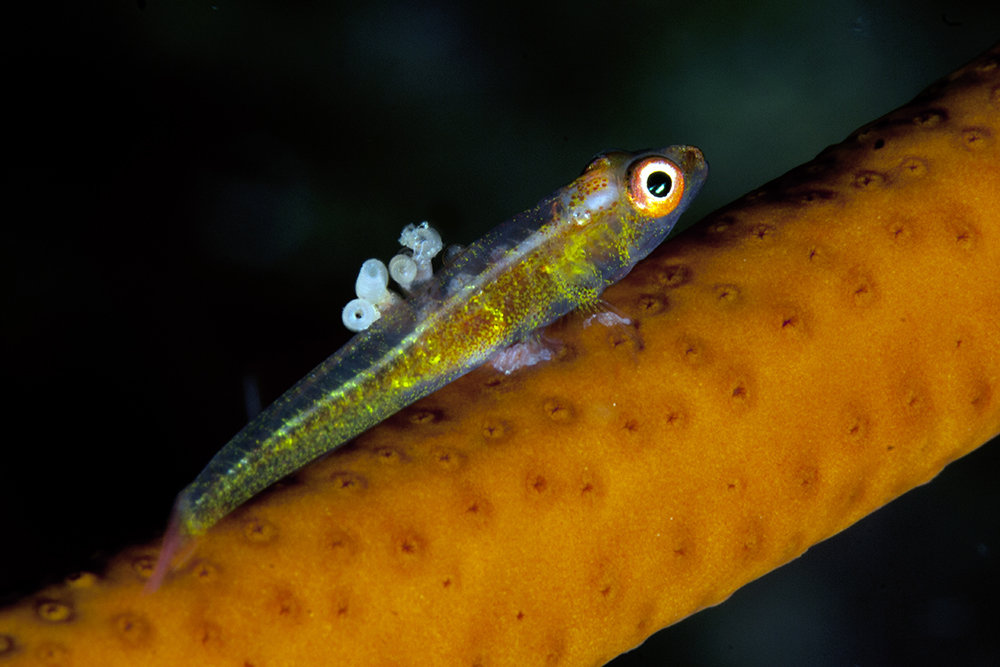
Almost every animal group can be parasitic, and at the same time can be parasitized. While worms are the kings of endoparasites, a large number of marine ectoparasites are crustaceans. A quite common example is the Pennellid copepod, which often infects the Loki’s whip goby, or other small fishes. This family of crustaceans (Pennillidae) contains a large number of species, which can penetrate hosts’ bodies through the gills, probing until reaching the heart to feed on oxygenated blood. The appendages that are observable by divers are the eggladen abdomens of the females. Usually, the poor little infected fish leads a difficult life, swimming in an unbalanced fashion due to the weight of the parasite. The destiny of the infected goby is to die with his parasite, after the release of hundreds of parasite larvae.

Other crustaceans of the Cymothoidae family are external parasites of fish. They are generally less “intrusive” than copepods and they can leave their host and transfer to another in case of necessity. An exception is the “tongue-biter” isopod that infects many species of fish, and has recently achieved some fame in clownfish images. This parasite completely replaces the clownfish’s tongue.


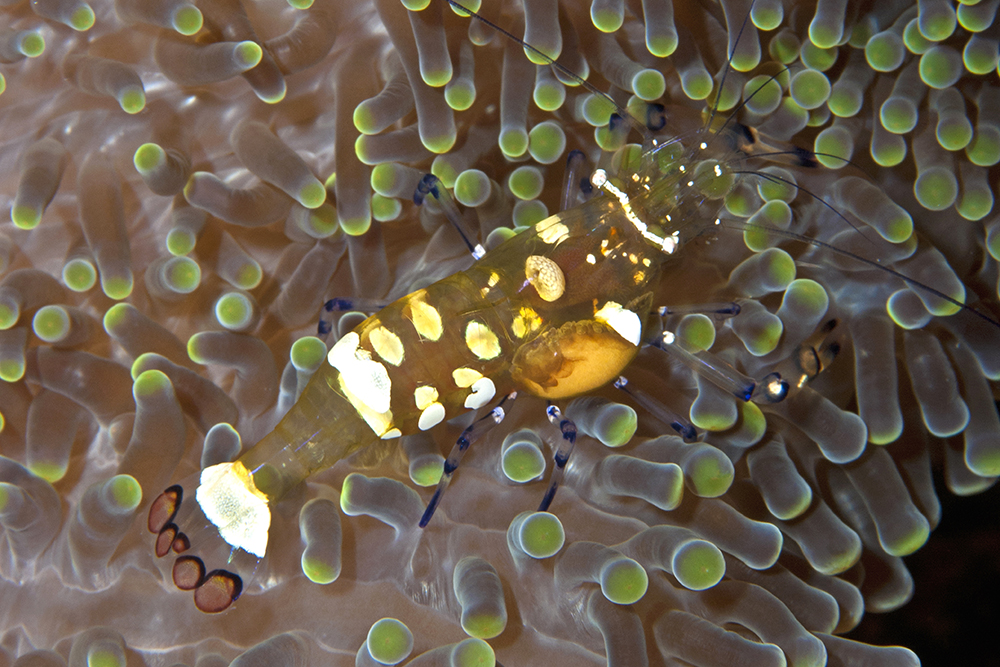
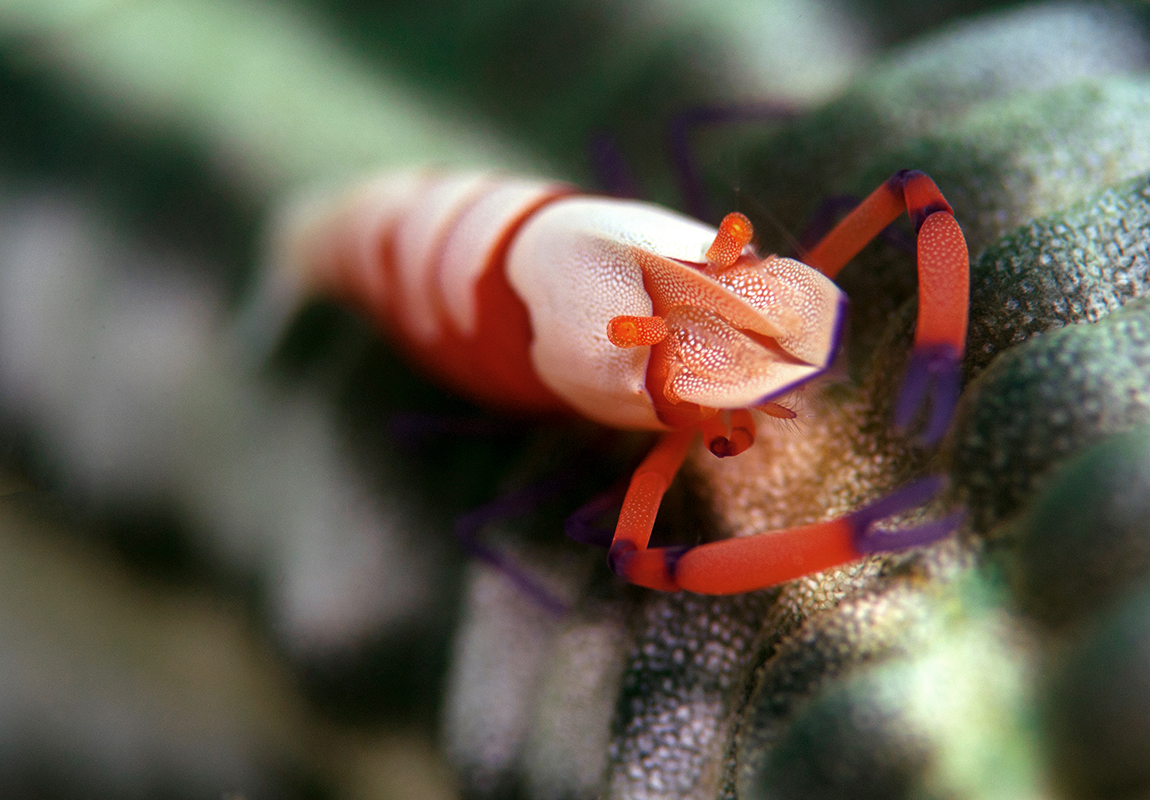
A commensal shrimp (Ancyclomenes magnificus) infected by a Bophirid parasite, forming the characteristic “bulge”.


Copepods and isopods don’t spare other animal groups, targeting crustaceans as well as fish. Isopods of the Bopyridae family are ectoparasites of crabs and shrimps, living on the carapaces or inside the gill chambers, and are often externally observable because of the formation of a characteristic “bulge”. The initial stage of a copepod infection shows the ovigeral process, appearing like longs antennas. It is sad to think that some of these cleaners are not themselves cleaned.

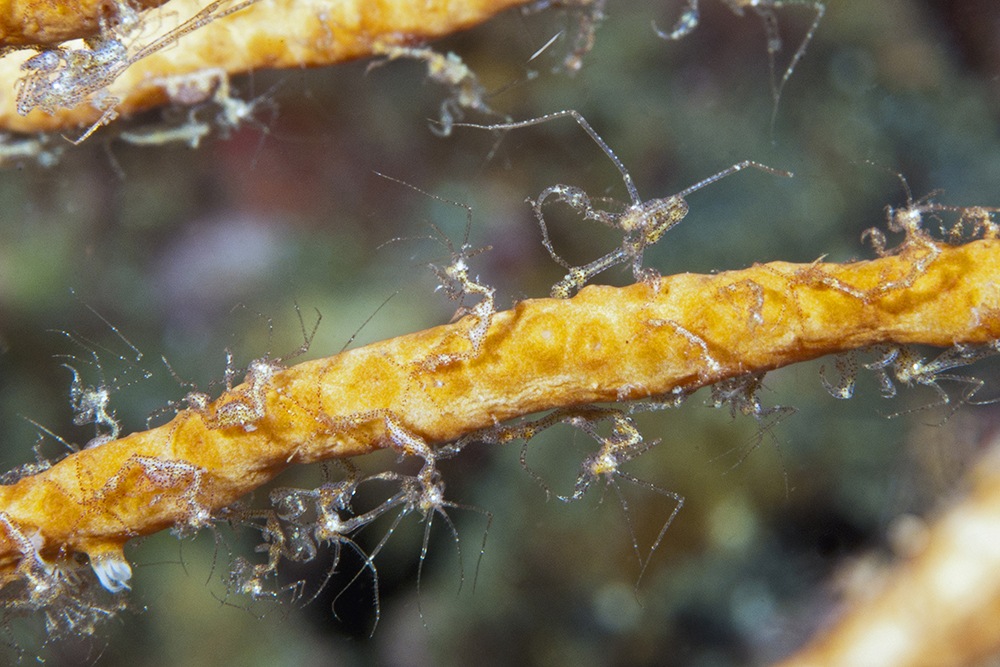
Crustaceans can infect many other animal groups, from gastropods to sea anemones, or even gorgonians. A typical example is the infection by huge colonies of caprellids. Recently, it has been discovered that a caprellid infection was the cause of high mortality of some species of gorgonians in the Bunaken National Park, in Indonesia. Caprellids act as predators of gorgonian polyps, and some intensive infections drive the coral colonies to a fast death.


A Loki’s whip goby infected by several copepod parasites. The parasite sucks the small fish’s blood making him weaker, and even his swimming ability is compromised. The parasite will die together with his host, but before he will have enough time to release a huge number of larvae.


Gross Grazers

Gorgonians are also subjected to another kind of parasite — one that is less deadly. Egg cowries are gastropods of the Ovulidae family and are found in gorgonians, sponges or soft corals all along the Indo-Pacific (Aclyvolva lanceolata and Phenacovolva birostris). These parasites perform something very similar to a grazing activity, eating the host’s tissues, polyps and mucus, while absorbing pigments to closely match the host’s colour. The host continually regrows the lost tissues, so this grazing activity never leads to the host’s death, and the cowry never risks going short on food. In this case the word “infection” usually associated with dangerous diseases, assumes an altogether lighter meaning.


A big colony of skeleton shrimps (Caprellids) infecting a gorgonian. If very numerous, they can drive the gorgonian to the death quite quickly, as these small creatures eat his polyps.


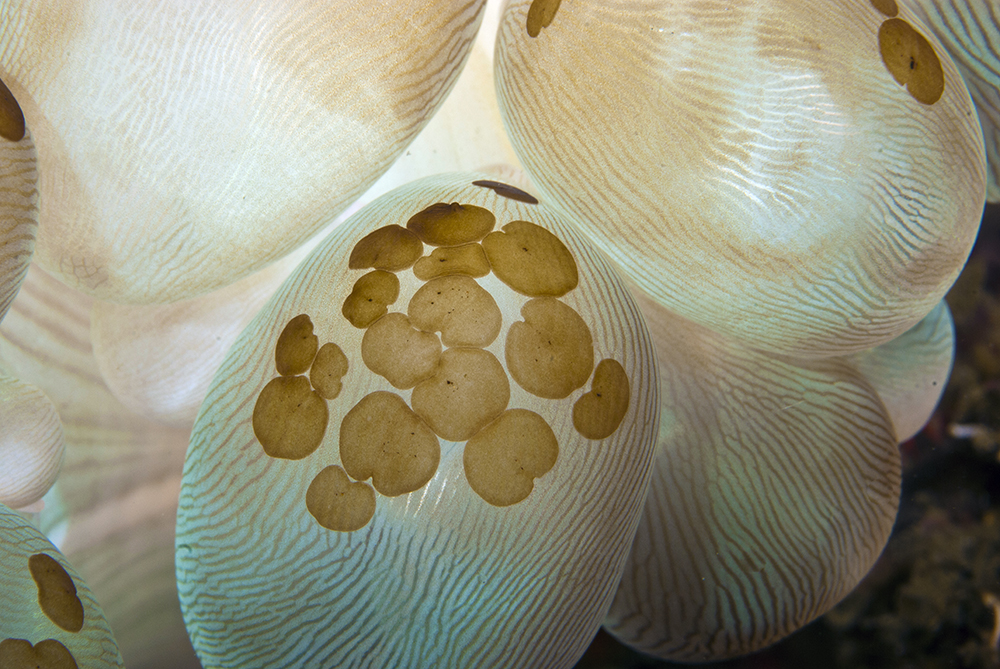
Another kind of strange parasitism is perpetrated by acoel flatworms against bubble coral colonies. Apparently not harmful, these animals most likely feed on organic detritus deposited on the host’s tissues. These small worms can duplicate themselves by a process called fragmentation, where little pieces of the worms can form other individuals. In this way, this kind of infection can be really huge and cover the host entirely.


A coel flatworms infecting the bubble coral Pleurogyra sinuosa. Since they feed on external detritus, this infection is not dangerous for the host and maybe it can better described as a commensalism.


The Animal Kingdom is full of parasites. Almost every animal group can be parasitic upon another, even vertebrates. Birds for example can be parasites of other birds’ nests, while fish can inhabit the internal organs of big holothurians. All of these parasites utilise the host resources, leaving it impoverished, tired, and with a decreased ability to resist other dangers. No animal group can be parasite-free, but it’s important to remember that parasitism plays a very important role in controlling populations of wild species, and driving evolution towards the selection of the fittest.


Taken from ScubaDiver Australasia 03/2012

Filming a Mega-Battle

0

Imagine if you will, standing on a highway. You’re facing the oncoming traffic. That traffic consists of several huge trucks. You can’t see the drivers so you have no idea if they can see you standing there, alone on the highway. They’re moving fast and you have no time to get off the road. Your only hope is that they do notice you and turn away at the last second. You have absolutely no control of the situation.

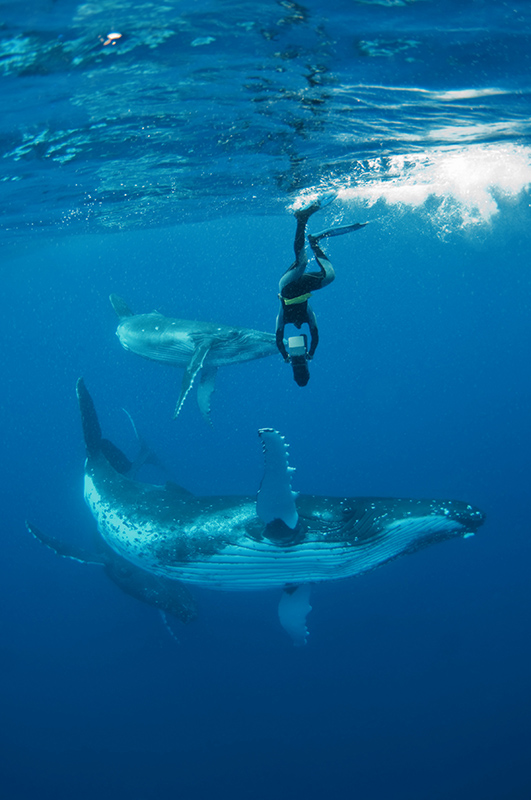
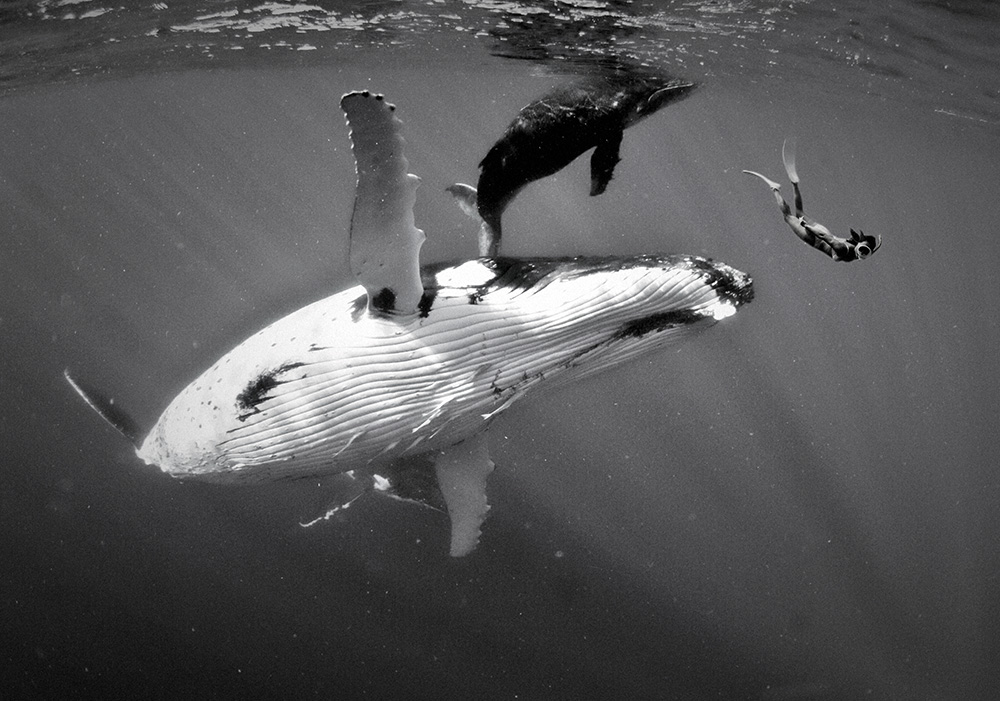
That was a fair summary of my situation. Except for the fact that I couldn’t breathe because I was free diving. I was out in front of the most heavyweight courtship ritual on our planet, the humpback heat run, where – fresh from a several thousand mile journey from their summer Antarctic feeding grounds –multiple 50 tonne male humpback whales were battling it out in a high speed all-action race to become the likely mate of the lucky female whale out front.


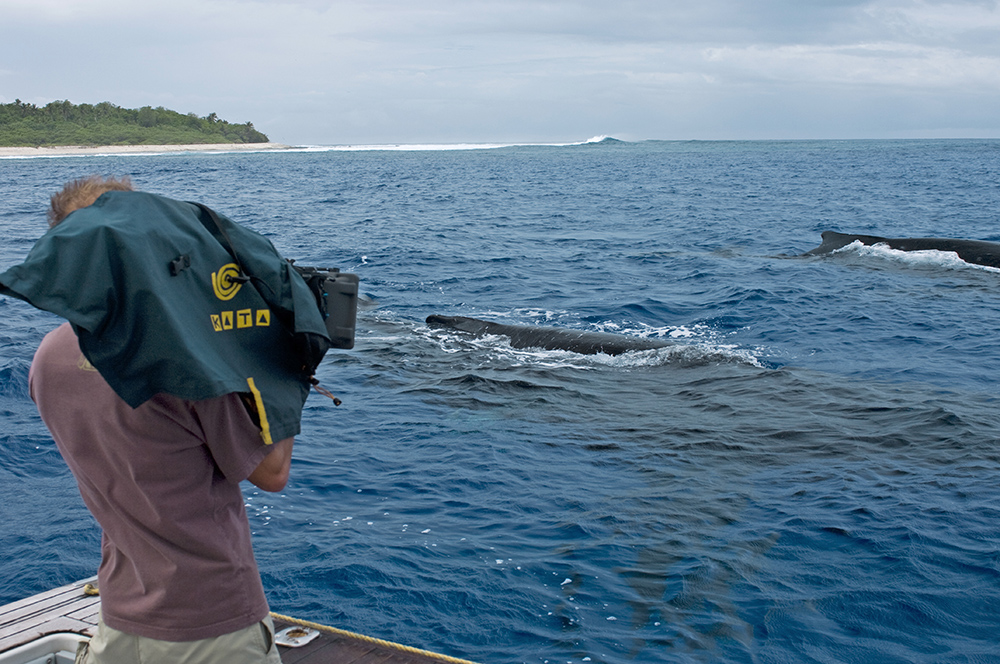
For the coverage demanded by BBC, a topside camera was also necessary


The Crew

I felt all alone down there but we had a pretty big team on hand. We were filming the heat run for the BBC’s eight-part natural history series “Life.” The tagline was ‘Planet Earth set the stage, Life is about the actors’ and our actors were of course the humpback whales. The team consisted of ScubaZoo’s Jason Isley (safety diver and photographer), Nick Guy (topside cameraman), Simon Blakeney (assistant producer) and myself (underwater cameraman). Handling the boat and on-land logistics was former-fireman Al Coldrick of Dolphin Pacific Diving.

We also had air support from a chopper, flown over to our base in Vava’u, Tonga from the nearby kingdom of Fiji. The helicopter was fitted out with a gyroscopic Cineflex camera in order to get rock solid shots even zoomed in from hundreds of metres away. So we had all angles covered and the action was on but it hadn’t always been that way. This was day 17 of a 21-day shoot. The previous 16 days had been a story of small pockets of excitement but mostly frustration.

Conditions for the first few days were set fair and we ploughed the edge of the fringing reef looking for action. Our first good encounter was with a mother and calf. Humpback whales can move at speeds of up to 20 knots, making interactions rather fleeting, but a mother and calf move much slower due to the calf’s small size, lack of stamina, and need to breathe more often. We found this mother and calf inside the reef in one of the sheltered bays that make Tonga so attractive to whales, and had a nice interaction with both animals. Neither were particularly bothered by us so it was a great chance to film the start of our story, setting the stage and explaining why humpbacks came to these waters in such large numbers, to give birth, nurse and of course mate.

Other than that, during the start of the shoot we mostly encountered females with a single escort. All female whales travel with at least one male escort who hopes to take advantage when the female is ready to mate. The whales we saw were generally on the move and in no mood to perform for my camera. To get me close the boat had to manoeuvre several hundred metres ahead of the spot we last saw the whales surface. We’d keep our eyes peeled and if we saw them again, and we were in their direct path I would jump in the water with Jason and swim in the direction that the spotters on the boat were pointing. Then, if I was lucky, a shape would emerge from the blue only to barrel past us and disappear again. Quickly, we’d dash back to the boat, get back on board and head off in pursuit again.


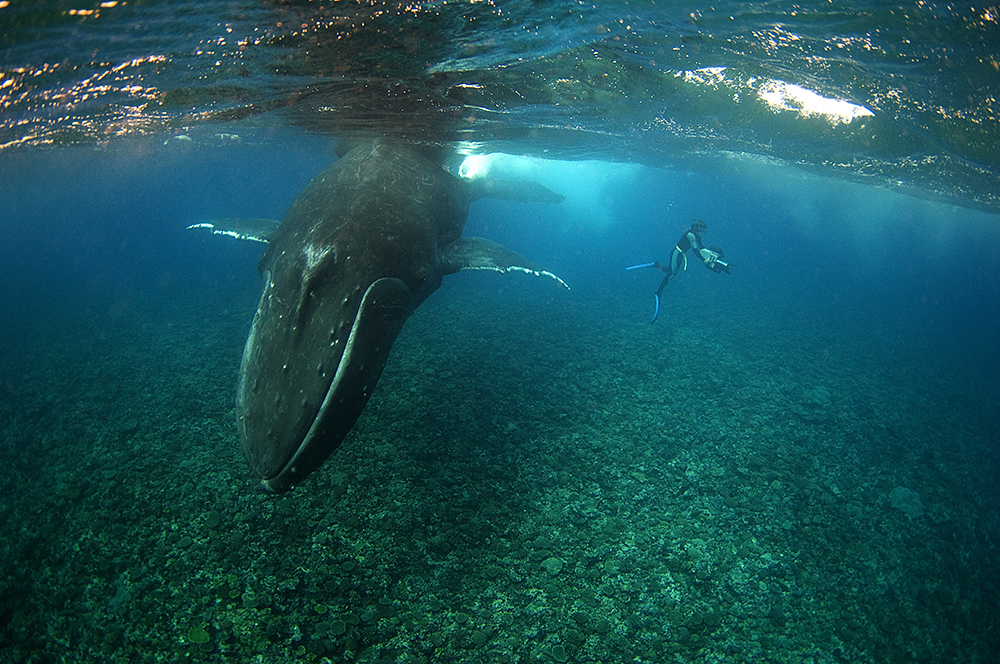
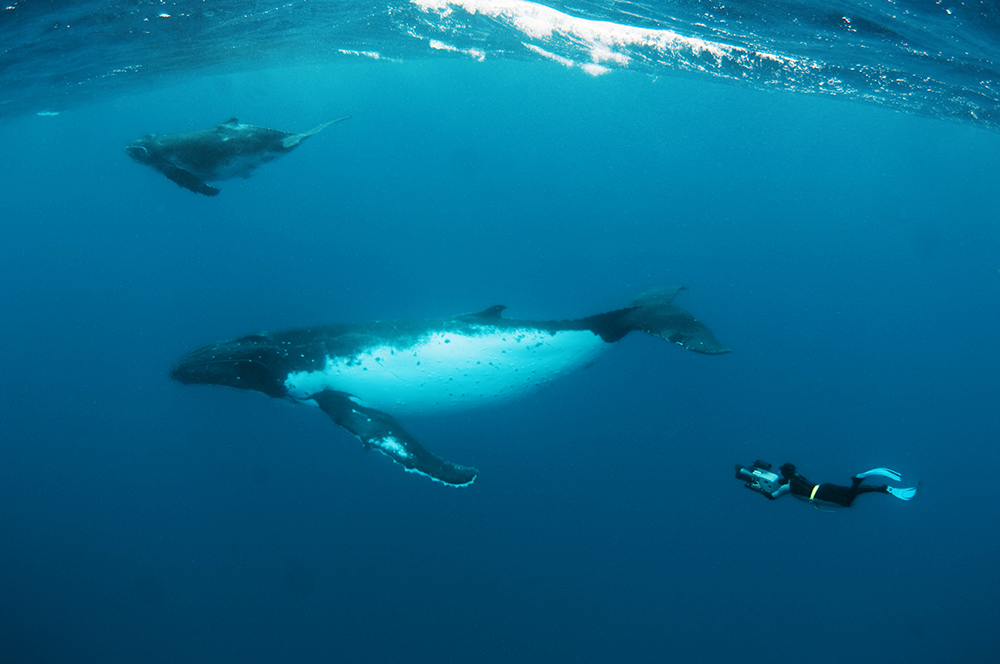
Underwater scenes could only be filmed while free diving, as cameramen needed to be able to move quickly as the whales passed by


On Alert

Often we’d drop in on the same whale 10 or 15 times before we got a couple of good shots. It became almost like a military exercise with orders being shouted to us as we sat on the back swim step facing the stern. We had various states of readiness depending on how recently there had been a sighting. Defcon One was fins and mask on, hand on the camera; Defcon Two was camera on the floor, masks around neck, Defcon Three was sunhat on, head lolling around; Defcon Four was laid out on the floor, hat on face, shifting in and out of an uneasy sleep!

Soon after, the weather turned rough. For several days we continued to head out to sea in choppy water with overcast and sometimes stormy conditions. It was fruitless really but when you’re on a deadline you have to make the most of the time you have. There was still a slim chance of a sighting so we endured some tough times in the hope of a miracle. Finally on our eighth day the storm broke and the sun shone on the Tongan waters once again. Almost immediately on heading out we happened on a juvenile whale shark. Normally we’d have jumped in to get some shots but we had our mission and we stayed focused. It wasn’t long after that when we had our first taste of a heat run.


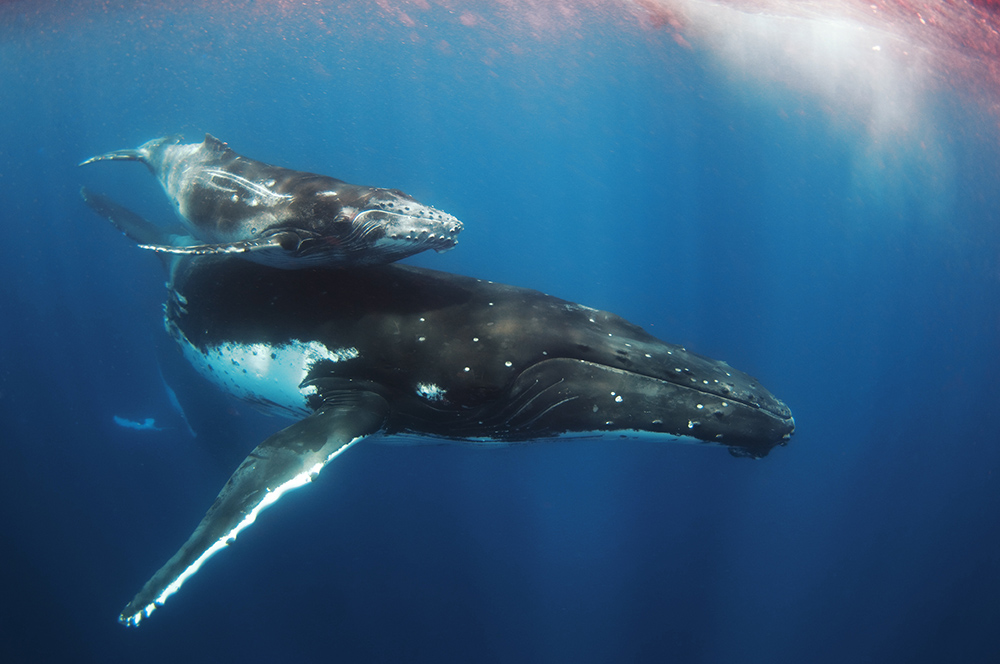
A mother humpback whale supports her newborn calf, as both prepare for a southward migration


“Go” Time

There were several other whale watching boats out with tourists and our captain had got word from a fellow skipper of some activity on the edge of the reef. We were on the spot in minutes and found a mother and calf being pursued by four males. This was it. At a combined weight of around 250 tonnes it was a ‘small’ heat run but my heart was pounding from the adrenaline in my system. It was on.

Jason reluctantly left his camera behind on the boat at the request of the director who was worried for my safety (thanks Simon!) and we dropped smoothly in ahead of the pack. I swam straight down to the reef at about 10 metres and as I looked up there were two whales tearing after the female and her calf. While I filmed them, another whale passed right behind me. It was great action and I was right in the thick of it. We did several dives as the chase continued around the inshore islands until it eventually petered out in the open ocean. It had been a great start but still nothing like what we had hoped for. Still, with some “footage in the can” we had a more relaxed evening and looked forward to the next day with confidence.


The crew’s goal was to film a “heat run” – an unparalleled competition between males for the attention of a female


The Little One

To change things up we started heading 40 nautical miles offshore. An island called Toku was rumoured to have a large congregation of whales. It took two hours each way and reduced our filming time but this location proved a good bet when things were quieter around Vava’u. On one occasion, Al spotted a mother and calf, and given that it had been a slow day up to that point, we decided to slip in and take a look. Nothing up to that point, not even the mini-heat run, prepared me for what we experienced there. The calf swam (bounded is probably a better description) straight up to us and began to show off his complete repertoire of spins and tumble turns! I swear he’d have given us a big sloppy lick if he’d thought long enough about it. We played with him for over an hour, always with the mother watching twenty metres below us.

Although he was friendly he didn’t quite know his own strength so we had to be ultra careful to not get too close to this elephant-sized baby with the mind of a puppy dog. It wasn’t a heat run but it was by far and away the most beautiful animal encounter I’d ever had in my diving and filming career.

With that pleasant distraction behind us we continued our search over the next few days. On the 16th day our helicopter arrived for a five-day stint and it brought with it some luck. The next morning, as they mounted the Cineflex camera to the front of the chopper, the radio crackled with Al’s voice – “Get up in the air guys, it’s on!”


Intimate moments were captured between heat runs


A Mighty Battle

We’d found a heat run. Another boat had alerted us to a building heat run and by the time we reached it there were 11 males chasing a female. The juggernaut was heading out into the open ocean and we repeatedly dived in ahead of them to have them race past us. Eventually the helicopter found us and we continued working as spotters for them for the next few hours until they had to return to land.

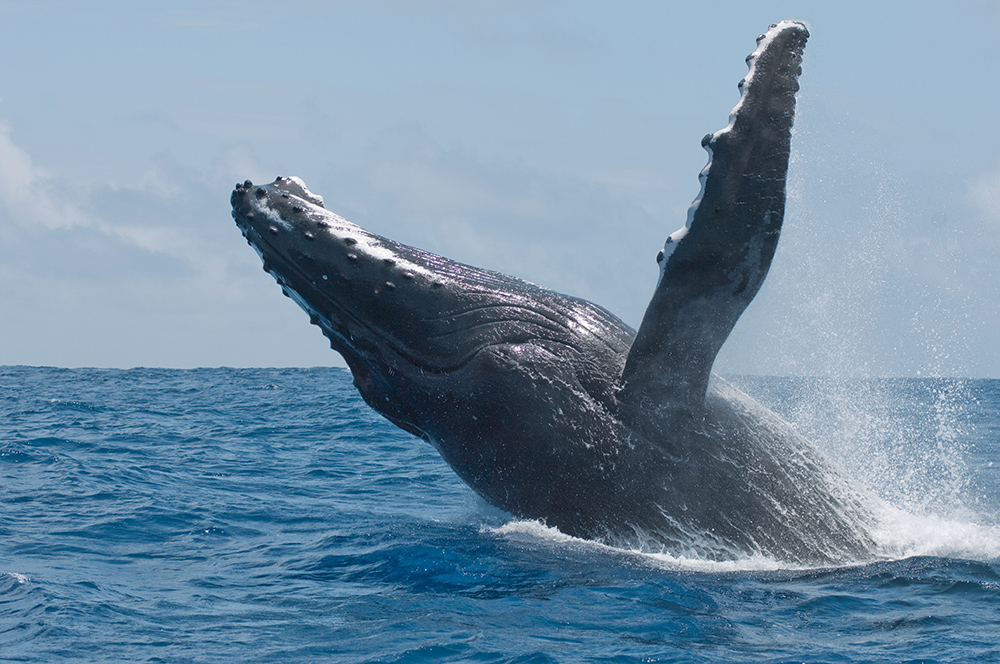
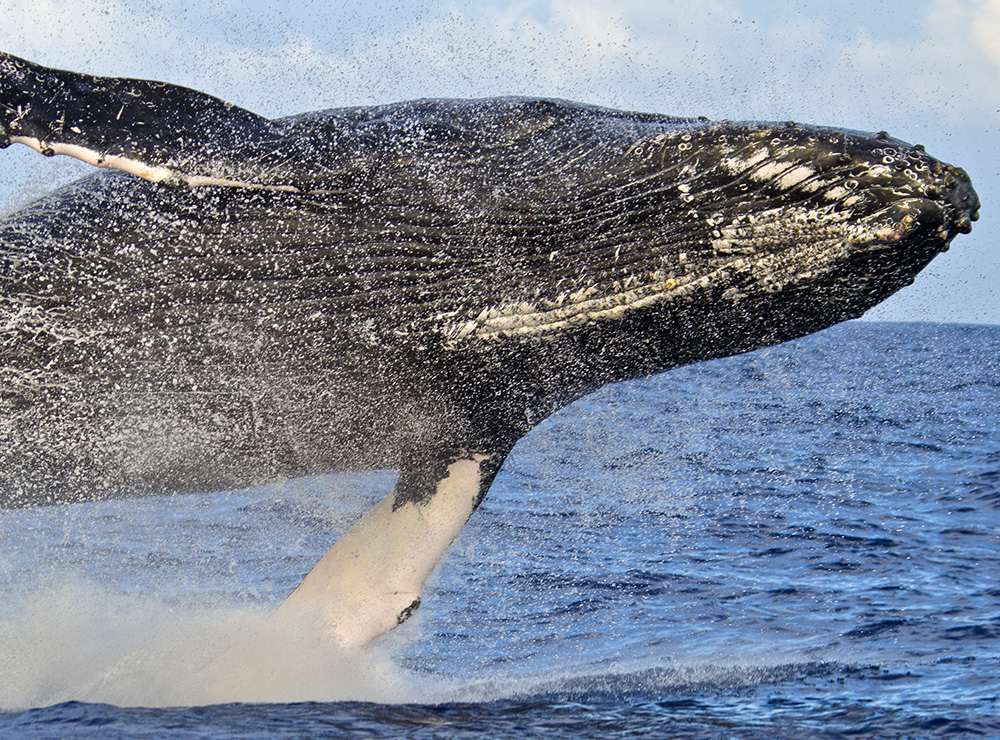
It was a mighty battle with flukes and pectoral fins smashing the waters surface, full-grown males launching themselves out of the water onto the backs of their rivals and even blowing bubbles in each others face to create a disorienting ‘smoke screen’. It was a royal rumble extraordinaire! Back underwater the whale armada crashed past me a final time. I tried to suppress my urge to breathe as the one whale above moved over me and I kicked hard for the surface. We’d got what we came for. I felt suitably insignificant and humbled.


Taken from ScubaDiver Australasia Issue 03/2012

Bluewater Dreaming

0

I’m floating in a blue void, 18 metres (60 feet) below the surfaceof the sea. Behind me, divers are busy exploring the expansive coral reef. But I am hanging silently, breathing lightly and intently listening. The songs of whales have me captivated. I can hear their deep grunts and plaintive moans. I listen here for a half-hour. I can hear the changes in the songs and calls. I look into the blue hoping a humpback will swim into view. They sound so close but they are probably miles away. This is a special ocean occurrence and I savour this dive and the moment.

It’s because of the whales that I am here at this time and at this destination. The district of Kona, on Hawaii’s Big Island, is home to the world’s largest known population of migrating and mating humpback whales for about four months every year. We had already seen a lot of surface action with whales coming very near to our Kona Aggressor yacht. The whales performed tail lobs, pectoral slaps and we even saw some spectacular breaches. When that many tonnes of marine mammal launches itself completely out of the sea, it is just a jaw-dropping experience. But I was about to learn that there is much more to this astounding region than humpbacks.

Hawaii’s Big Island, with snow at thetop of its highest peaks and warm waters in deep blue bays, is the largest and most volcanically active island in the state. Above the surface, the lava fields of this relatively young island can be seen easily from offshore. Rivers of molten lava have hardened into expansive black fields that run down the island’s many slopes and into the clear, blue sea.


Humpback whales migrate to the Hawaiian Islands December through March, they can be seen mating, playing, breaching and raising young calves


Diver Wonderland

The Big Island’s volcanic terrain continues under the sea where molten lava cools its steamy torrents in the tropical seawater. This geographic activty has created a diver’s wonderland. Lava tubes, huge coral heads, arches and vast craters, like the well-known Au Au Crater, create spectacular backdrops for underwater photography.

These waters hold many indigenous fish species, and a good part of the challenge and fun in Kona diving is to identify and digitally capture these critters. There are butterflyfishes and wrasses that are unique to Hawaii. Underwater photographers will also want to seek out less mobile subjects like Spanish dancers, leaffish and frogfish, or capture a postcard-quality image of sea turtles being cleaned by yellow tangs.

The standard Kona Aggressor II scuba itinerary is Saturday-to-Saturday with five and a half days of diving. One nice spot that we visited at the start of our trip was Rob’s Reef, where we saw, among many other things, dragon wrasse, gold-laced nudibranchs, numerous species of moray eels and a red-spotted sand perch. The next day we visited further south to the Maze, where a previously unknown yellow frogfish was discovered. But it was the afternoon that would turn out to be one of the trip’s highlights.


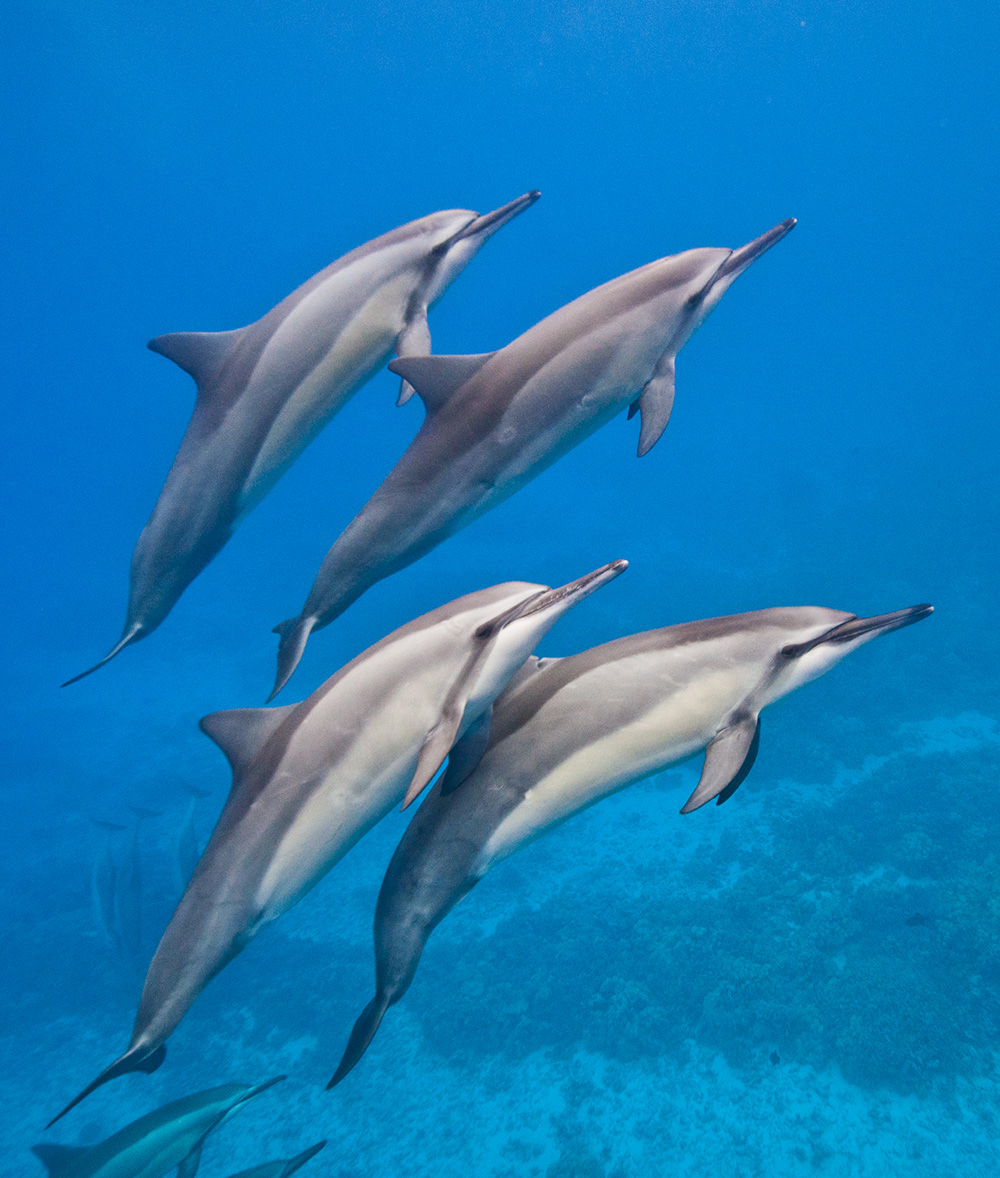
Spinner dolphins rest by day in the sheltered shallow bays around the Big Island and then head out at night to feed

Dolphin Delights

Manuka Bay was to be our afternoon dive site, which sits off a rocky lava flow and a nice state park beach, in the lee of the prevailing swell. Here, we found calm enjoyable conditions, but we weren’t the only mammals seeking shelter. A group of about 120 spinner dolphins joined us in the bay! Spinners are known – more so than most any other dolphin – for their aquabatic jumps from the sea. They leap, spin, twist, turn, and flip in mid-air. This large group of dolphins did not disappoint. They played until the sun went down and also swooped by in amorous schools to the delight of snorkellers.

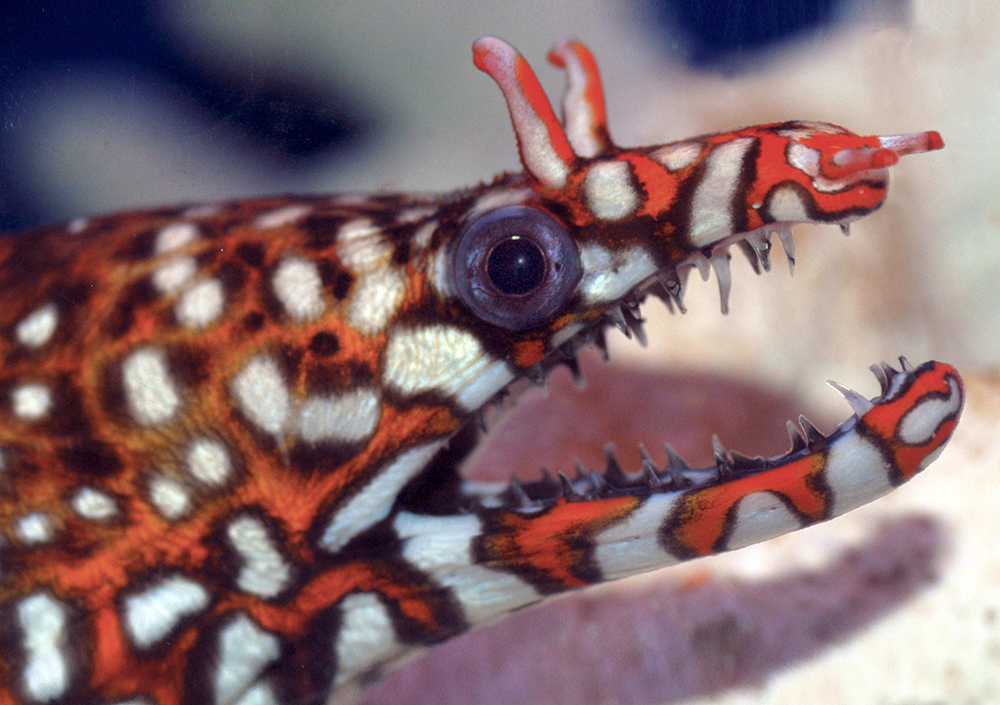
For those of us who did don a tank, Manuka produced its usual fare of critters, including large red frogfish, a lazy spotted eagle ray that gave everyone a chance to see it up close, Latin snapping shrimp, an octopus and various eel species, including a stunning dragon moray eel.

For marine mammal-lovers, there is more to experience here than just Manuka Bay however. There are other dolphin snorkeling operations on Kona that can be fun and produce nice interactions with spinners and other species. The undersea topography of Kona also has a series of deep shelves that attract various whale and dolphin species, as well as rays and whale sharks.

In short, the Big Island is one of the best pelagic venues in the world. Seeing the dive sites of Kona by live-aboard affords the opportunity to get away from the sites near town to some pretty remote spots. For day trips, fast boats, like the one Wild Hawaii uses, are ideal for observing marine mammals far out to sea and getting to their habitat quickly. The beauty of diving here is the ease of photography and reef viewing, and the water is usually extremely clear. Kona is often explored during daytime dives but there are actually two night dives for which the area is most famous.


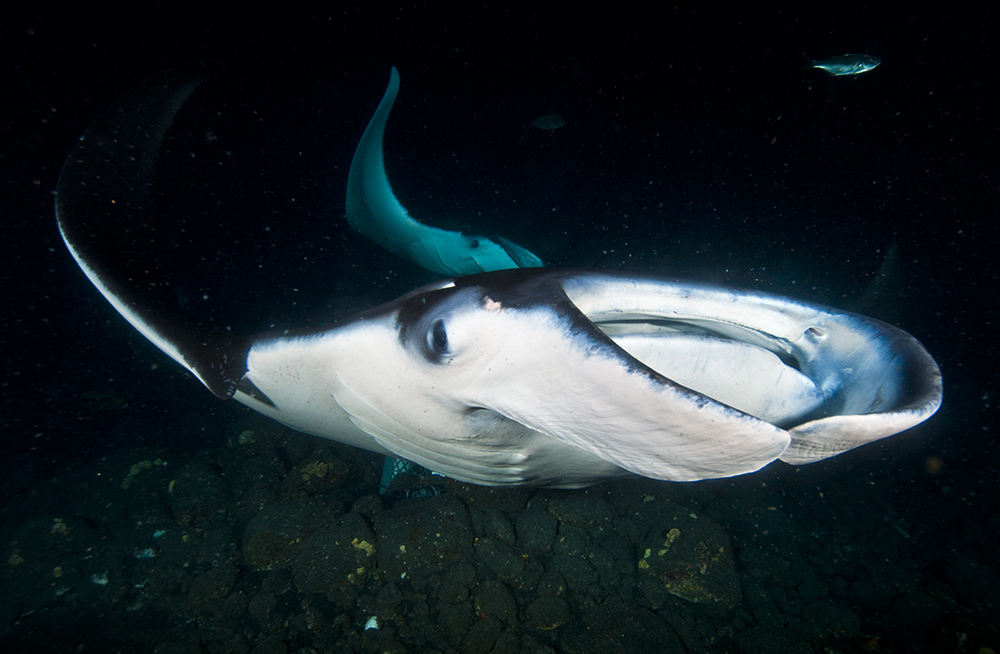
Kona’s amazing manta ray night feed sees snorkellers and divers from all over the world come to watch the action


Kona After Dark

One of the region’s most well-known and bizarre dives is called Pelagic Magic. Your dive boat will take you far offshore for this one, where divers drift with the current. Artificial light illuminates some strange and amazing planktonic critters that are attracted to the glow. But these lights also bring larger marine life closer to shore, for a second dive that should not be missed.

Being the main tourist town in the area, much local development has taken place on old shoreline lava flows in Kona. For years, a hotel that was perched on the water’s edge had lights shining into the sea at night. About 20 years ago, Keller Laros (a.k.a. Manta Man) noticed that the lights attracted plankton, the favourite food of manta rays. He investigated further and soon realised that, sure enough, the mantas were feeding here at after dark, making for a truly amazing night dive.

The experience has progressed into something akin to an underwater rock concert, with the possibility for two dives – one in late afternoon and one at night. I went out with Keller, a charismatic advocate for manta protection and research, who is also one of the owners of Jack’s Diving Locker. First, divers explore the reef as the sun begins to fade, coming up from the dive to view a beautiful Hawaiian sunset. Divers and snorkellers then start to show up in big numbers. With plankton-attracting lights in hand, they descend into darkness. It is then the night life comes alive.


A beautifully patterned dragon moray


Lightshow

Huge manta rays, in numbers that range from 2 to 30, glide in from the darkness to feed. It’s an undersea lightshow as snorkellers shine their torches from above, while down below, the flashes from cameras sporadically illuminate huge rays as they gobble mouthfuls of plankton, just inches from divers. It is just wild.

But all is not well in the world of the mantas. Currently, thousands of manta rays are being slaughtered to supply a market for dried gill plates (or gill rakers) in Asia. Laros has established a foundation to help protect the world’s mantas. These night dives create funding to save mantas through education and are one of the Pacific’s most amazing sights.

At night, Kona is fun. It is full of eateries and rockin’ bars. The climate is normally very pleasant and shopping provides the finest in souvenirs from the ubiquitous T-shirt to some extremely nice marine art, like that featured in the Wyland Gallery. Overall, divers should love a visit to Kona. From whales to mantas, to eels and frogfish, the whole spectrum can be found here in the volcanic land of Aloha.


Taken from SDAA Issue 03/2012

Where Myth Becomes Reality

0

With dinghy oar-turned-spear in hand, our guide ferries the dive tender on and off the sloping shoreline, shouting orders to the local handling the motor. Just inches away, a pair of forked tongues dance on the surface of the water.

“Alright, back it up, back it up. Back!” he shouts, holding the oar between the bow of the tender and the wagging tongues. The dinghy motor kicks in just as the overgrown claws of eightfoot Komodo dragons lift off the pebbled sand in the waters of Indonesia’s Rinca Island. “Just a little closer,” I whisper while peering through my camera’s viewfinder. “Come into the water.”

These shores and their fearsome inhabitants remained hidden from the western world until rumors of a 20-foot dragon lured Dutch sailors to Komodo in 1910. While the sailors failed to find the fire-flinging foe of their nightmares, they soon realized that those same giant monitor lizards creeping into the water towards our dinghy were (and still are) the kings of Komodo. But if the mythical dragons reign supreme on land, then it is the legendary ripping currents swirling about underwater that rule Komodo National Park’s marine reserve.


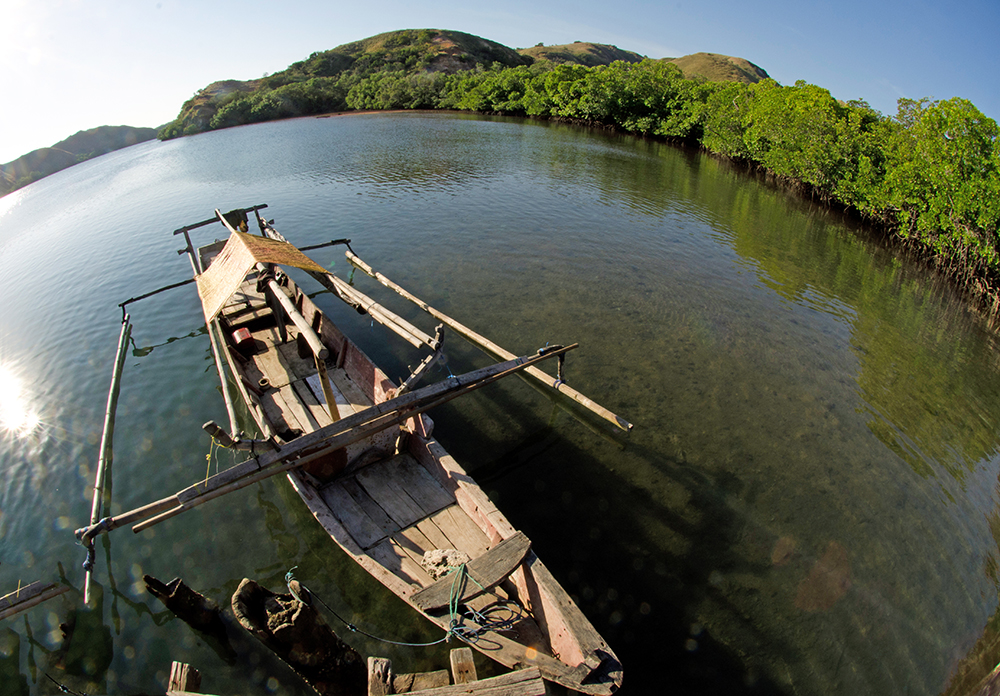
A traditional Indonesian outrigger


‘Current-cy’ of the Realm

Nestled deep in the Coral Triangle, the marine park spans more than 1,000 square miles around the islands of Komodo and Gili Banta in the northwest and Rinca in the southeast. It is the nutrients carried in the non-stop current that give rise to the real draw for underwater photographers in Komodo – the palette of colorful coral, some of the most healthy in the world, which blooms from every wall. The fertile waters of Komodo are home to 260 species of reef building coral, 70 species of sponges and more than 1,000 species of fish.

The currents funneled through Komodo National Park carry with them a diversity of life virtually unparalleled even in this farflung region. There’s weird and wonderful critter diving in pitchblack sand off of Sangeang Island, curious pelagics in the ripping currents off of Gilla Lawa Laut in the north, and flocking mantas in the frigid waters in southern Rinca. When you dive anywhere, your encounters are mostly unpredictable and you never really know what to expect. But in Komodo, there appears to be one constant, and that is the rollercoaster currents that grab you by the BC and take you on the ride of a lifetime.

Dive sites like Gilli Lawa Laut’s Crystal and Castle Rocks, two pinnacles that rise out from the depths into current-laden waters teeming with life, are draped with vibrant soft coral, always open to snag the nutrients carried by the current. But Komodo’s many pinnacle dive sites, like the famous Cannibal Rock, are by no means for the faint of heart or casual underwater photographer.

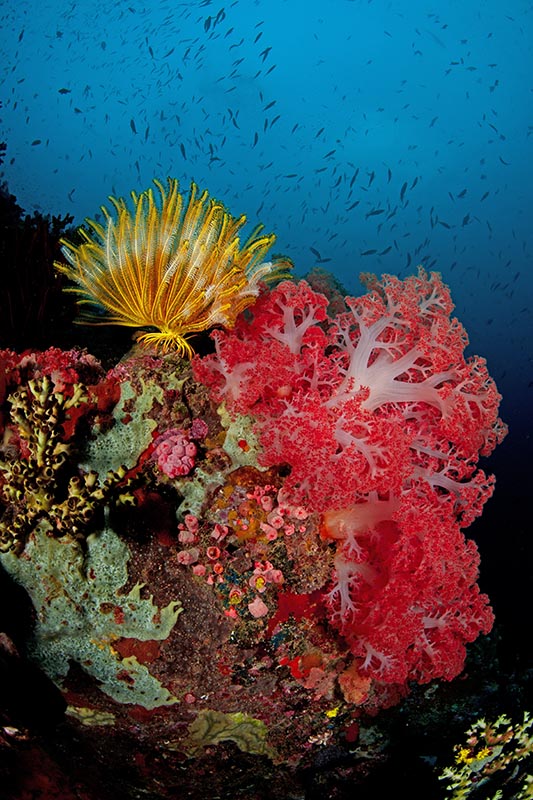
A yellow crinoid complements the red from a soft coral colony, showing off the vibrancy of Komodo’s legendary reefs


Larger Than Life

Those same currents that swaddle the fields of soft coral are so unpredictable that boat captains are often hesitant in predicting the level of difficulty or even the drop site of the dive. Rolling out of the dinghy, it is critical to descend as quickly as possible before being swept out into the blue. More often than not, there is no time to fiddle with your strobe arms.

You know that you’ve reached another class of diving when you can’t even find one inch of barren reef to curl a finger around. Using a reef hook is often the best way to stay on the reef without decimating millions of years of ecological growth. Once latched on with a reef hook, take a moment to look around and pinpoint possible coral subjects. Since moving around the reef to strategically choose a coral subject is usually out of the question, the best subjects will often be the ones just a little shallower on the reef, allowing the photographer to shoot up and incorporate the heaps of glimmering baitfish and fusiliers shifting between the crevices and often blotting out the sun in the sky above.

But pristine coral reefs aren’t the only reason why underwater photographers flock to Komodo time and time again. Lovers of large pelagics and big fish will undoubtedly turn their attention from the ostentatiously decorated walls to the blue, in the hope of catching a glimpse of reef sharks, napoleon wrasse, black spotted stingrays, or the occasional dolphin.

The timid nature of most of the pelagics and the constant crazy current make a wide-angle zoom lens a must because much of the big animal photography in Komodo takes place from the comforts of a reef hook. Filling a fisheye lens’ frame with the subject is nearly impossible and leaving the wall to chase a subject in Komodo’s wild currents would probably result in making landfall somewhere in Australia.

With the intense, unpredictable currents and level of diving experience required, it is best to find the right settings for shooting wide-angle and stick with them. Instead of fumbling with controls in a 4-knot current at 100 feet, use settings you are comfortable with and focus on the countless subjects flying by your dome port, trying to only change settings if the lighting conditions alter dramatically.

The nutrients that keep Komodo’s coral in full bloom also attract ocean-faring mantas, which stop by various cleaning and feeding stations throughout the area. While there is always the chance to see the “big birds” on any given site, the most opportune place for photographers is probably Manta Alley. And while it may seem like every corner of the world has a “Manta Alley” of its own, rest assured that not all alleys are created equal.

Located along the south coast of Komodo, Manta Alley is distinguished by two rocky pinnacles that protrude through the surface at low tide. Beneath the waves, the site is a dramatic series of three wide channels carved out 50 feet below the choppy waves above.

The site is a local haven for mantas, but it is the variety of shooting and diving options that are truly attractive to a photographer. You can spend your time at the very tip of the valley in shallow water (less than 30 feet deep) to try and capture a light blue background with a sunburst effect, as dozens of juvenile mantas fly by.

Of course, the deeper you go, the less light there is to work with; so make sure to boost your ISO as needed. The advantage you get out of venturing into deeper waters is more quality time with larger mantas, as they spin in circles playfully around your bubbles.


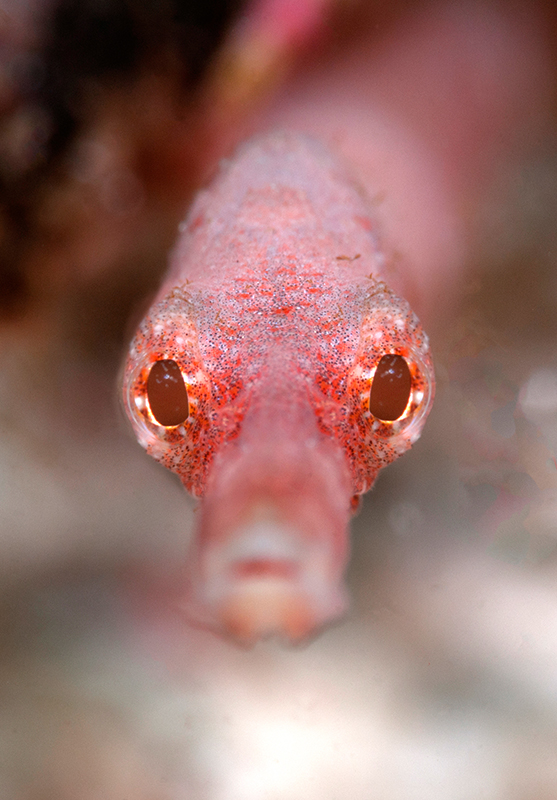
The tiny face of an unidentified pipehorse under magnification


Tiny Wonders

Komodo’s underwater gems are not all mammoths. In fact, some of its most photogenic subjects are small – very small. Photographers fawn over Gammaridean Isopods, a pinhead-sized critter located mostly on the dive site Yellow Wall in south Komodo.

Ladybug isopods, as they are more commonly called, are one of those macro subjects you have to see to believe. These seemingly infinitesimal isopods blanket corals on the wall and can only really be seen with a magnifying lens or a serious external diopter on your macro lens. What makes these miniscule critters especially difficult to shoot is the fact they are often attached to coral overhanging a drop-off that falls to several thousand feet.

It is important that you are comfortable with your buoyancy and macro focusing skills before you venture over the wall’s edge in search of ladybugs. And even in broad daylight make sure to flip on a powerful focus light to give your eye or the camera’s autofocus the best chance possible. You’ll want to keep your focus light charged and macro lens handy throughout Komodo’s waters, which feature some of the best critter diving in the Indo-Pacific region.


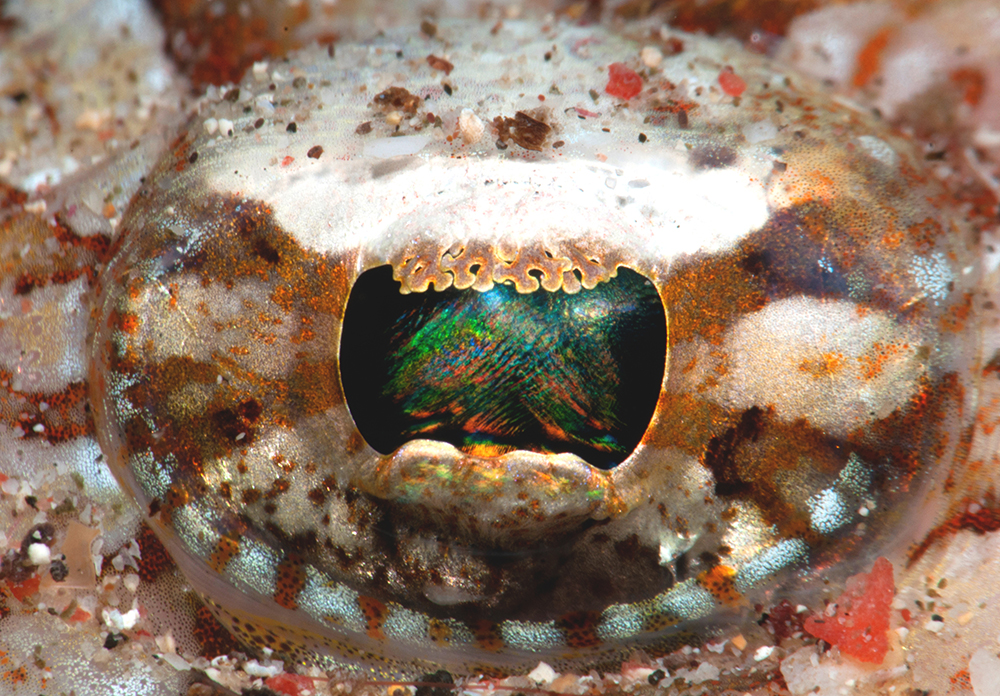
The intricate eye of the crocodilefish (Cymbacephalus beauforti)


The recently popularized pygmy seahorse is a mainstay of Komodo sea fans. Because the pygmys are most often found around the 100-foot mark, the dive leader will often head straight down to their homes in the sea fan. Use this time to prepare your settings for the pygmy shot you have in mind, as you will probably have time for only a handful of frames before reaching your no-deco and/or patience limit of your photo-cohorts.

The charcoal-black sands surrounding Gili Banta and Sangeang Island provide the perfect backdrop for critter hunting. Whip coral gobies and shrimp are the highlights of every dive and they make great macro subjects with texture that pops out with a high depth of field.

Komodo is also home to a variety of prized crabs, like the orangutan crab, which has a habit of nestling in between the bulges of bubble anemone. Then there are zebra crabs, kept nice and warm by the flamboyant fire urchin that are guaranteed to catch your eye even on the richest, most vibrant of reefs. The crabs may use the fire urchin for protection but don’t be afraid to bring your lens and strobes close in to bring out the fiery glow in your shots.

And the list goes on – frogfish hop along the black sand in search of their next meal; the skeletal figures of ghost pipefish hide in clumps of algae, rising from their weedy graves for a few moments; and squat lobsters perch in the branches of colorful crinoids.


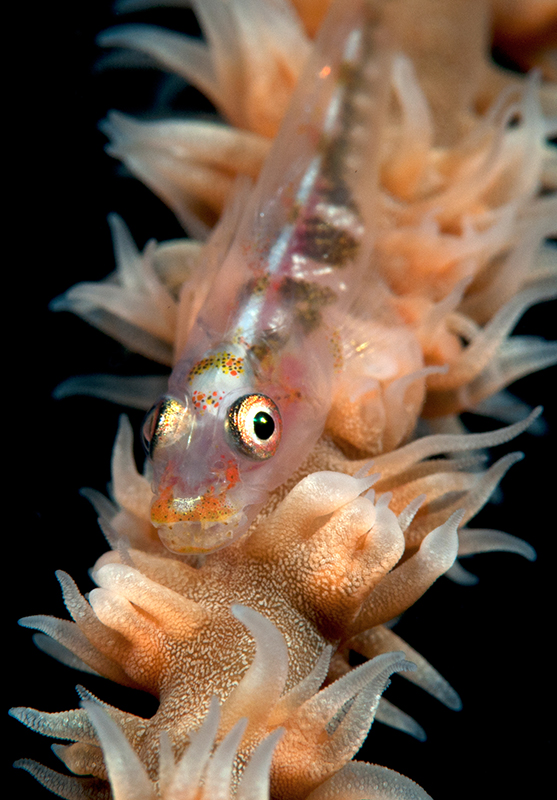
A classic macro image of a whip coral goby (Bryaninops yongei)


Happily Ever After

No voyage to Komodo or Rinca would be complete without snagging some shots of its most famed inhabitants. And as if the idea of a poisonous, aggressive 8-foot lizard isn’t exciting enough, it turns out that the king of Komodo is also king in the water.

Crouched over the edge of the dinghy, my shutter finger barely stops moving as the lizard crawls its way towards the frenzy of photographers behind me. “Come on, get in the water,” my inner underwater photographer waits in anticipation. At the last instant, the creature spins on its tail and scoots back up the beach, out of sight, back into the forest and seemingly, back into myth. But in Komodo, a land where dragons swim, “big birds” fly underwater and ladybugs dive, you might just find that myth becomes reality.


Taken from Scuba Diver Australasia Issue 02/2012[/vc_column_text][/vc_column][/vc_row]

Rocking Palau

0

During a preliminary dive briefing, somewhere off the legendary Pacific Island of Palau, Marc Povey, Captain of the Palau Aggressor II (PAII), says: “The current will gently push you down Ulong channel, which will give you the chance to photograph giant clams at your leisure before we pick you up on the opposite side.” Okay, Marc is a rugged South African bloke, so maybe a four-knot current is gentle to him. I am not ashamed to say it is a bit more challenging for me. The clams will need to be the size of elephants and flashing like neon signs for us to even recognise them in the passing blur of the seascape.

When I grab hold of a rock to try to swing behind it, the surging wall of water whips the rest of my body past and threatens to wrench my arm from its socket if I do not let go. I decide to call it a dive by motioning to Lauren to pull out her surface marker buoy and begin her ascent. She fills the bag with air from her regulator and then gradually allows the line to slide through her gloved left hand at a depth of eight metres. We are just beginning our safety stop when we shoot past the channel opening and out into the blue.

Three minutes pass like three hours. I begin to wonder how long it will take the crew to find us. When my head finally clears the surface, I see Marc waving and grinning like Lewis Carroll’s Cheshire Cat a short distance away. He says, “How did you like that one?” Then it hits me. I had just taken a ride on the Palauan version of an underwater roller coaster – no more, no less. After all, Palau is nature’s theme park for divers.


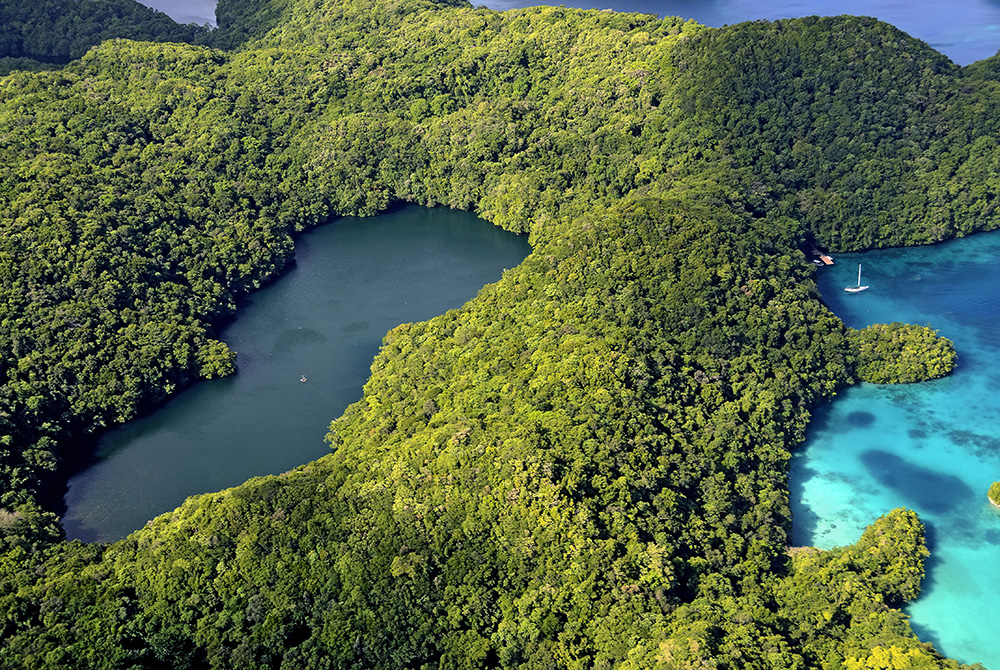
An aerial view of Jellyfish Lake or Ongeim’l Tketau – notice the hill between the dock on the right and the lake on the left


Bird’s Eye View

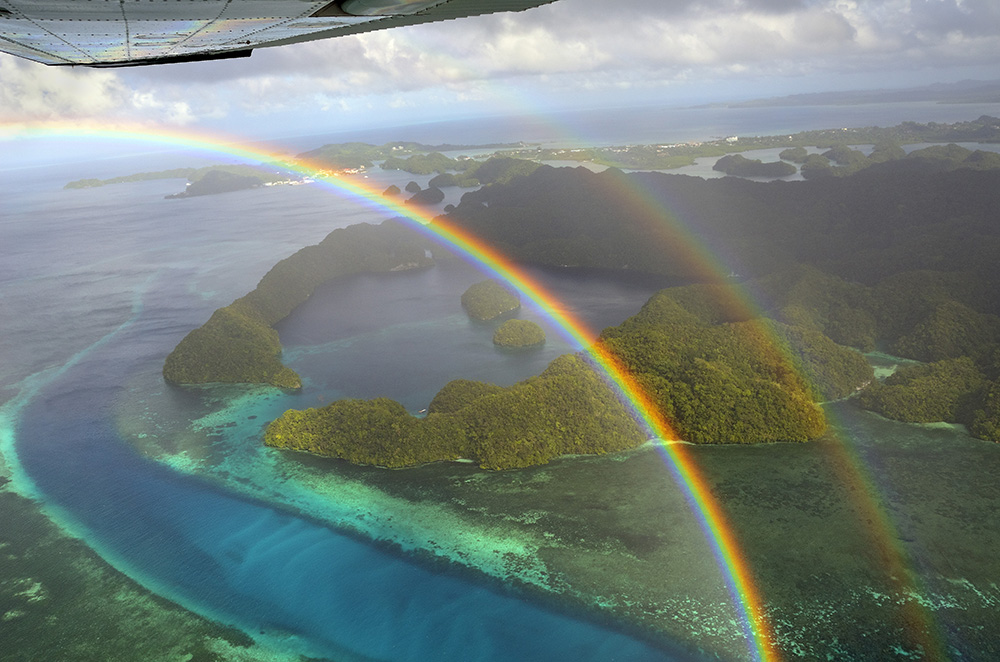
The Republic of Palau is an exquisite collection of over 700 volcanic islands, coral atolls, raised limestone islands and islets in the Caroline Islands, approximately seven degrees north of the equator. This secluded archipelago, which defines the western edge of Micronesia, is bounded by the North Pacific Ocean to the southeast and the Philippine Sea to the northeast.

Known as Belau by Palauans, Palau looks like a tiny, haphazard mark on a map of Oceania. In reality, the island chain stretches over 700 kilometres and offers some of the most breath-taking vistas on the planet. The only way to truly appreciate the fascinating, expansive beauty of Belau is to arrange a low-altitude, sightseeing flight with one of the Cessna or helicopter operators. I began to think of the archipelago as being separated into themed areas as if it were laid-out like an amusement park. Each distinct zone offers its own unique attractions and rides.

The surreal ambience of Blue Holes


The Blues

Blue Holes and Blue Corner are Palau’s most famous dives and also quite easy to spot from the air. Four large holes carved out of the top of the reef off the northwest end of Ngemelis Island clearly mark the openings to the Blue Holes. Likewise, the brilliant, cobalt blue, arrowhead-shaped point south of Blue Holes is Blue Corner. Though the sites are literally side-by-side and within swimming distance of one another on an outgoing tide, they are best experienced during separate, dedicated dives.

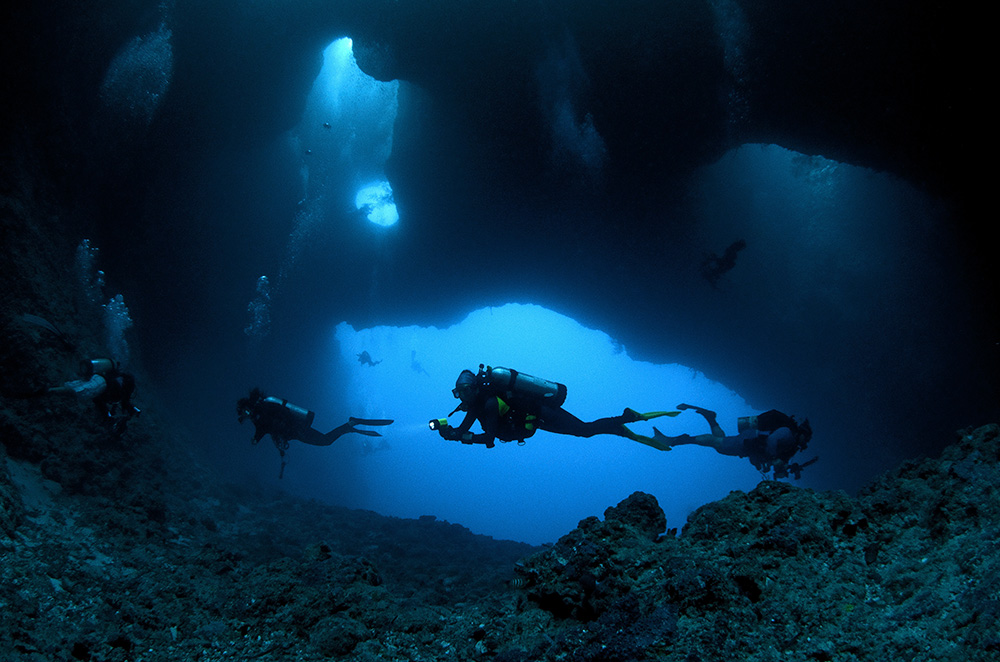
The descent into one of Blue Holes’ shallow-water “mouths” can be disorienting. You literally plunge from bright sunlight into the darkness of a massive chamber that bottoms out at 40 metres. Bubbles streaming from divers’ exhausts back toward the upper entrances add to the surreal, ethereal ambience. Once your eyes finally adjust to the limited light, you can see a small window in the side of the cavern at five metres and a much larger exit at 27 metres. I spent most of my time attempting to frame Lauren against the lighter water of the various openings as she explored the interior. This allowed me to highlight her form while maintaining the mysterious mood of the dark recesses.

Divers from all over the world come to Palau specifically to plant a reef hook at Blue Corner and watch sharks surf the currents, as thick schools of fish hover and rays cruise along the edge of the wall. Imagine a living IMAX production grandly displayed before you, while you and your buddies resemble weird kites fluttering at the end of thin nylon ropes. As long as you dive this site when the current is ripping, your senses will find it almost impossible to keep up with all the action and your coordination will certainly be challenged.

Blue Corner is not exactly camera friendly. The current and reef hooks do and yet do not help. Yes, the current brings the parade of animals, but it also dictates you use a reef hook to stay in one place and limit the damage to the surrounding habitat. But the reef hooks greatly restrict your mobility. You simply cannot perform intricate turns or twists while tethered to the reef in such current.


A reef manta approaches a cleaning station in German Channel


Manta Mania

The “blues” may get the most publicity, but German Channel is every bit their equal for adrenaline-pumping action. This manmade cut through the western barrier reef was completed during the German occupation of the islands in the early 1900s in order to connect the inner lagoon with the open ocean. The resulting water movement through this passage attracts marine creatures of all shapes and sizes. Prodigious schools of red crescent-tail bigeyes sweep over the corals and energetic Clark’s anemonefish bathe in the protective tentacles of a glowing orange anemone.

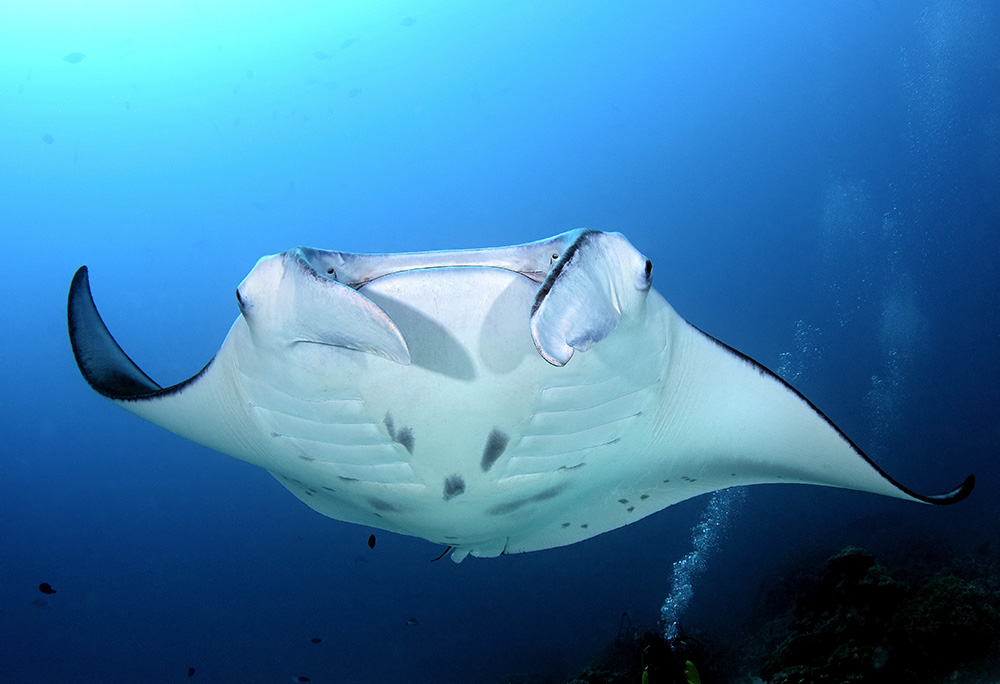
German Channel is also the place to go to watch graceful reef manta rays (Manta alfredi) with four-metre wingspans getting a manicure in the southwest mouth of the cut. Divers are placed kneeling in the sand around the cleaning station so the large rays can glide over the divers’ heads during the alternating circling and cleaning process.

Lauren had a curious manta almost sit on her head and moments later, was all but buried by a sand storm created from an excited diver’s churning fins. Visitors really need to keep their fins still. Visibility can go from clear to nil in seconds if only one diver forgets to heed the “Do not stir the sand!” warning.


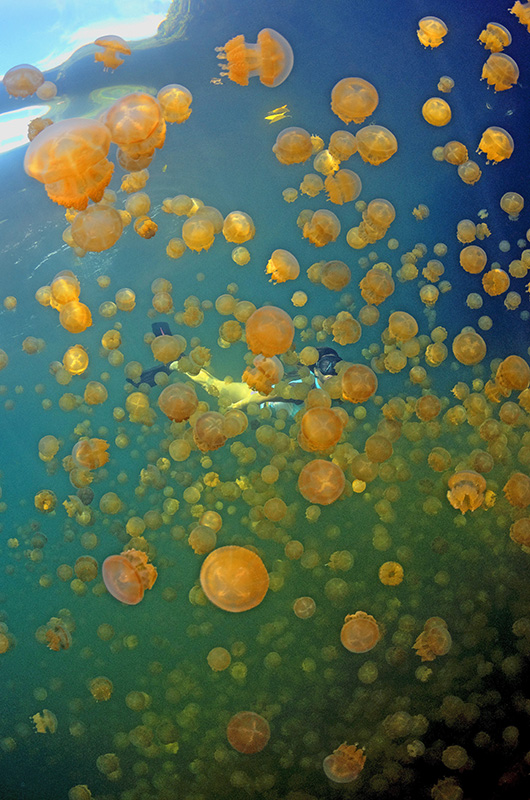
Swimming among the golden jellies in Jellyfish Lake


A Fragile World

The diversity of Palau’s marine organisms and coral structures is as impressive as the entirety of the island nation. Approximately 1,350 species of fish and 650 species of coral populate these waters. Location, habitat variety and conservation are the keys to this proliferation of oceanic life.

The Palau government has launched numerous laws and programmes, such as establishing Marine Protected Areas (MPA) and the world’s first shark sanctuary, to protect their precious natural resources.


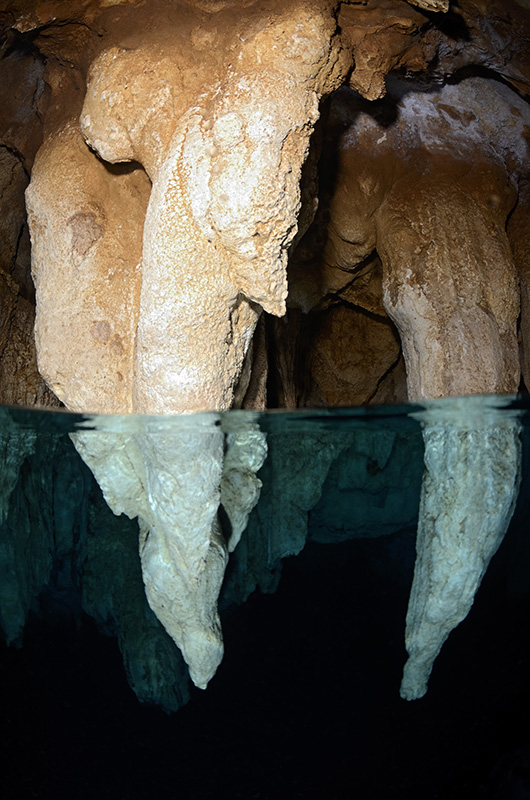
Stalactites in an air chamber in Chandelier Cave


The Walking Dead

There is simply no way around it; a visit to Peleliu, an island 37 kilometres south of the main island of Koror, is a visit to the past. Over 20,000 American and Japanese soldiers died there in World War II during a three-month battle from September 15 to November 27, 1944. Most of those killed were under 20 years of age. Remnants of the war, including tanks, troop carriers and heavy artillery guns, as well as American and Japanese memorials, are intricately woven into the rejuvenated jungle growth. Lauren and I watched a documentary the night before we toured the island. We were in tears during parts of the actual tour as we pictured our own children sacrificing their lives for their country. The brave dead still walk on this island as a reminder for humanity not to repeat the sins of the past.

Dives around Peleliu also provide the chance to spot used artillery rounds and other relics from the fighting. The highlight, however, is the drift dive at Peleliu Corner. Here you jump in one ocean, the North Pacific Ocean, and are picked up in another ocean, the Philippine Sea, or vice versa. How many places in the world can give you the chance to experience two bodies of water on the same dive? The current here can rival the one that rips through Ulong Channel, so be prepared for another Palauan rollercoaster.


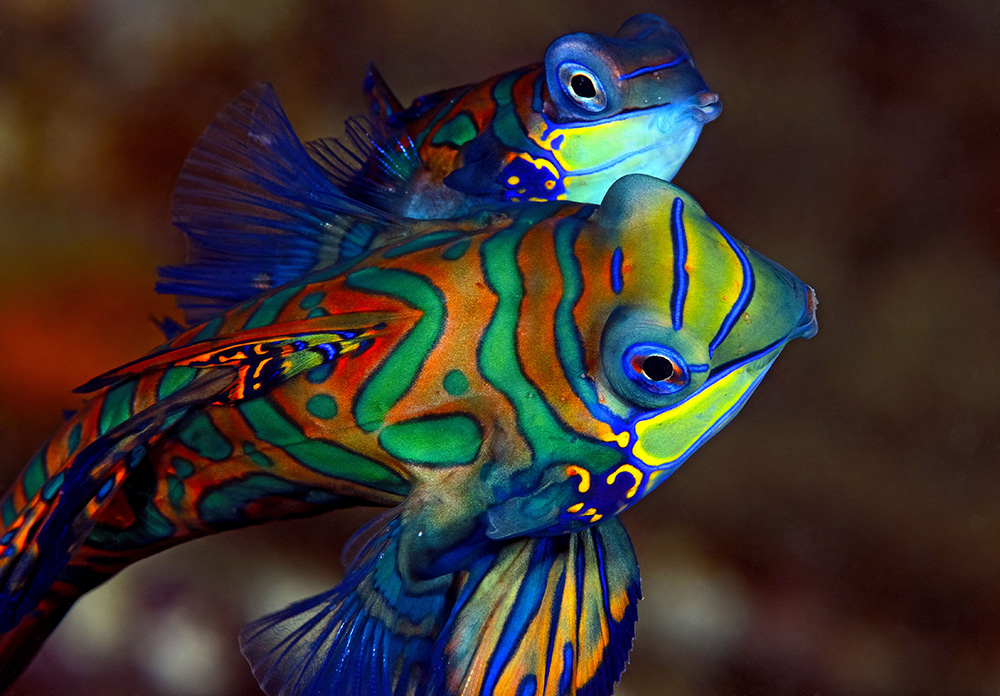
Gorgeous mandarinfish rising to mate off Koror


Rock ‘n Roll

The Rock Islands epitomise the diversity and idyllic qualities of this tropical oasis. They encompass 250 uninhabited islands that are mushroom-shaped and densely forested. These relics of porous limestone coral reefs were thrust upward from the Philippine Plate and exposed by volcanic activity in the Southern Lagoon. Water movement and bacterial activity have gradually eroded the base of the islands, which makes them look top-heavy. A ride among these fanciful formations is a treat, in and of itself. A collection of seventy of the islands, unimaginatively called Seventy Islands, is a special wildlife preserve where turtles can nest and birds can rest without any interference from humans.

Marine lakes are among the hidden treasures of the Rock Islands. These lakes are connected to the ocean via cracks in the surrounding porous limestone. Water and microscopic organisms are carried to and from the lakes through these conduits. Each lake has evolved independently of the other lakes and thus contains a unique collection of flora and fauna, much in the same way as each of the Galapagos Islands developed on its own. Charles Darwin certainly could have formed his theory of natural selection had he first studied Palau’s marine lakes.

Jellyfish Lake or Ongeim’l Tketau is, by far, the most famous of these lakes and the only one open to tourists. Millions of two species of jellyfish inhabit the lake: the golden jelly (Mastigias papua etpisoni) and the less common moon jelly (Aurelia aurita). Many proclaim these jellyfish to be stingless either out of ignorance or to encourage visitors not to fear them. The jellies can certainly sting, but the sensation is nearly undetectable by humans. This is a snorkelling-only opportunity as diving is not allowed in order to prevent bubbles from damaging the delicate bodies of the jellies and also because there is a dangerous concentration of hydrogen sulphide below 14 metres.


Lauren peers from below the stunning growth that characterises Palau’s reefs


Never Enough

Dive and tour operators, such as Fish ‘n Fins and their Ocean Hunter fleet, as well as Sam’s Tours, can carry you to all the prime “themed” dive and terrestrial spots, including The Blues, Manta Mania, It’s a Small World, The Walking Dead and Rock ‘n Roll. We spent a week aboard the Aggressor and then based all of our other explorations from the exquisite Palau Pacific Resort on Koror. I would be remiss in not telling you about the fantastic macro diving in front of the Sam’s Tours’ dock. I spent countless hours there photographing mandarinfish (Synchiropus splendidus), mouthbreeders, banded sea kraits (Laticauda colubrina), razorfish (Aeoliscus punctulatus) and many other fascinating subjects in less than seven metres of water. Above all, the main thing to know about Palau is, like all world-class theme parks, you simply cannot see all the sights enough or ride all the rides enough or soak in all the otherworldly vistas enough in a single visit.

Taken from Scuba Diver Australasia Issue 03/2012

Nudies of Norway

0

Nudibranchs can be found virtually anywhere — from tropical coral reefs to the frigid arctic waters of the Barents Sea. They come in all sizes, from just a few millimeters to well over 30 centimeters (12 inches), and nudibranchs exhibit a variety of colors, bodyshapes, feeding habits and unusual biology seen in few other animal groups.

The word nudibranch means “naked gill,” which is appropriate, as these delicate creatures lack the shells normally found on marine snails and slugs. More than 3,000 species of nudibranchs are already known to science, but there are still lots of undescribed species still waiting to be found.

Often times, just finding nudibranchs is the hardest part to photographing them. When searching for nudibranchs to photograph, it is helpful to know a little about their biology and feeding habits. Most of the species are rather particular when it comes to food and will only eat one or very few specific food sources. Nudibranchs are carnivores, and their diet includes such treats as stinging hydroids, sea squirts, soft corals and even the eggs of other nudibranchs. Getting to know the dietary preferences of your subjects will greatly improve the chances of finding and photographing individual species on your checklist.


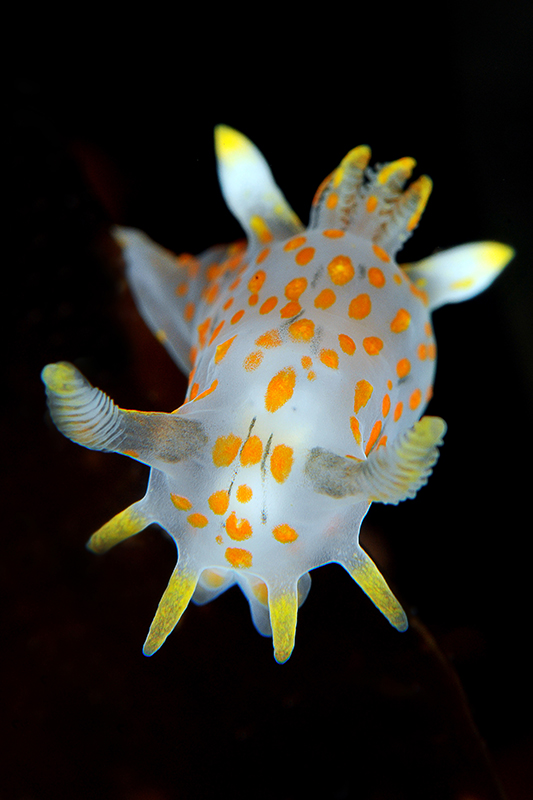
Shooting upwards is a good rule of thumb, but try different angles as well, like this topdown shot


Trickier Than You Think

Once found however, nudibranchs are among the easiest animal subjects to shoot underwater, but they do come with a unique set of photographic challenges. Many nudibranchs tend to stay close to the bottom, making it difficult to compose shots other than top-down images of mostly seafloor. In this case, you’ll want to get really low, so you can create separation between the animal and the seafloor. They don’t move much even with strobes firing multiple times, which certainly makes things easier in terms of composing a nice frame. But on the flip side, don’t sit around and wait for these sea slugs to move into better positions! Always evaluate each situation to make sure you don’t waist valuable dive time on a subject that will never look good, or will use up all your air while you wait for the right pose.

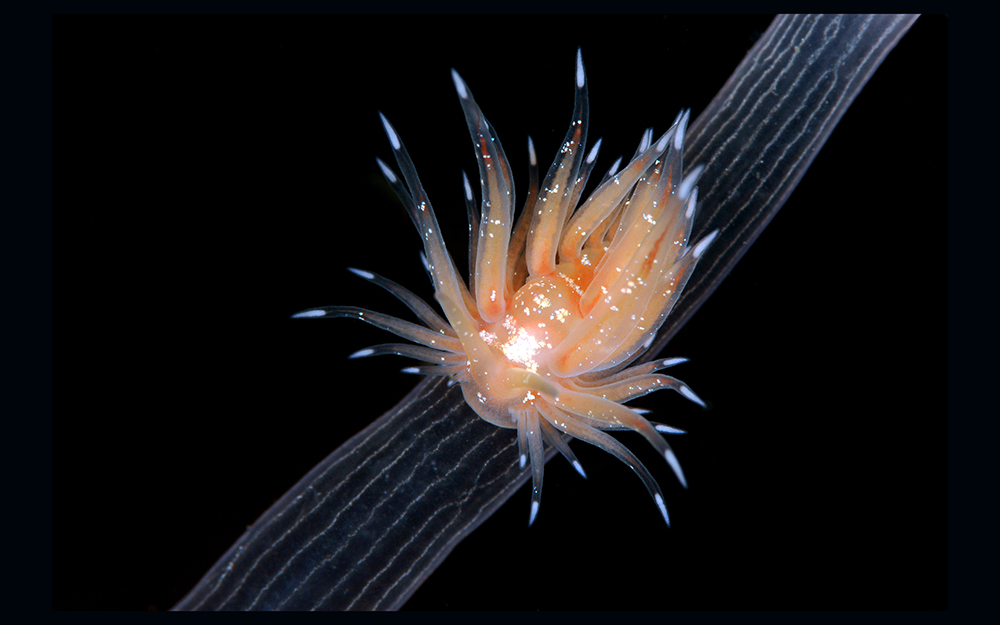
Some species feed on bryozoans that grow on the surface of kelp fronds, but here you have the challenge of shooting a very small subject on a moving target. In either case, patience will be the best strategy to your nudi nuisance.

Because nudies can be as small as one centimeter, it might be difficult to fill your frame with the subject. While a 60mm macro lens will allow the photographer to get extremely close to the subject, it will create a problem when finding space for the strobes. When too close to a subject, it becomes tricky to achieve nice lighting. When visibility allows, a 105mm macro is often a much better choice, as it gives you greater working distance between your camera and the subject for positioning your strobes.


A slight current and good timing transform this sea slug into an eye-catching spider-like form


Magnificent Magnification

To get even closer, which will allow you to fill the frame further, you might consider adding a teleconverter or diopter. As an optical element, the teleconverter will steal one or two F-stops of light, but since macro photography normally involves the use of strobes at close range, this is not a problem. Also, make sure you shoot at really high F-stops, such as f/22 or f/32, to get maximum sharpness with as much depth of field as possible.

A diopter also works like a magnifying glass, and will essentially shorten the focusing distance of your lens by anything from half to almost nothing. These days, several manufacturers offer wet diopters that you can mount or dismount at your leisure underwater, greatly widening the range of possibilities when you’re down below. For instance, you may check out the +5 and +10 SubSee diopters made by ReefNet, but manufacturers like Seacam and Sea&Sea, also produce their own diopters for particular lens and camera configurations. High-quality optical diopters are available that mount via an adapter, fitting most macro ports from most manufacturers, while others screw right into threads at the front of certain macro ports.


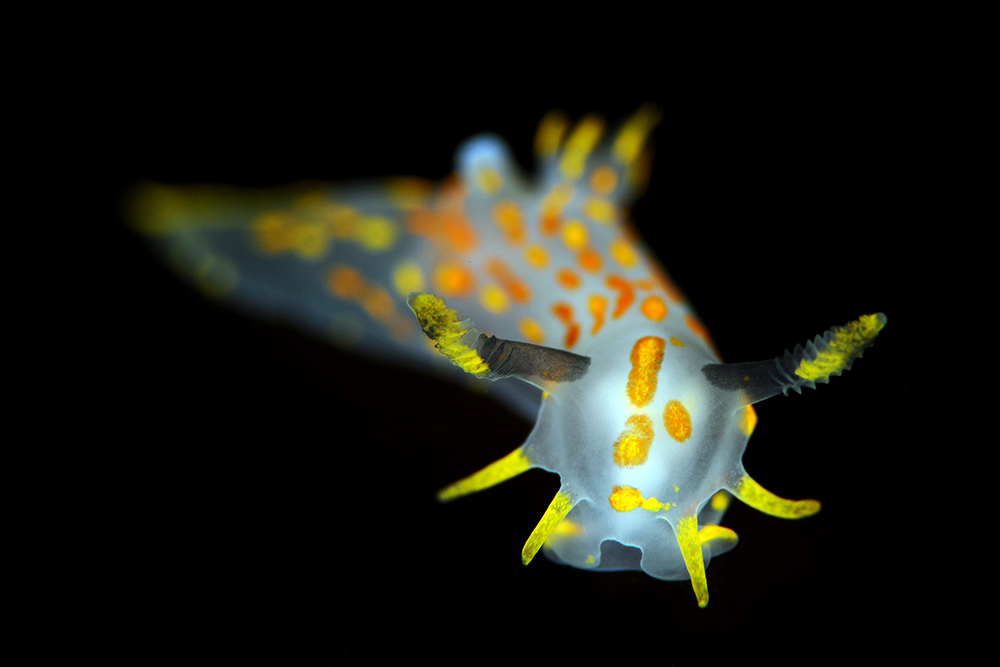
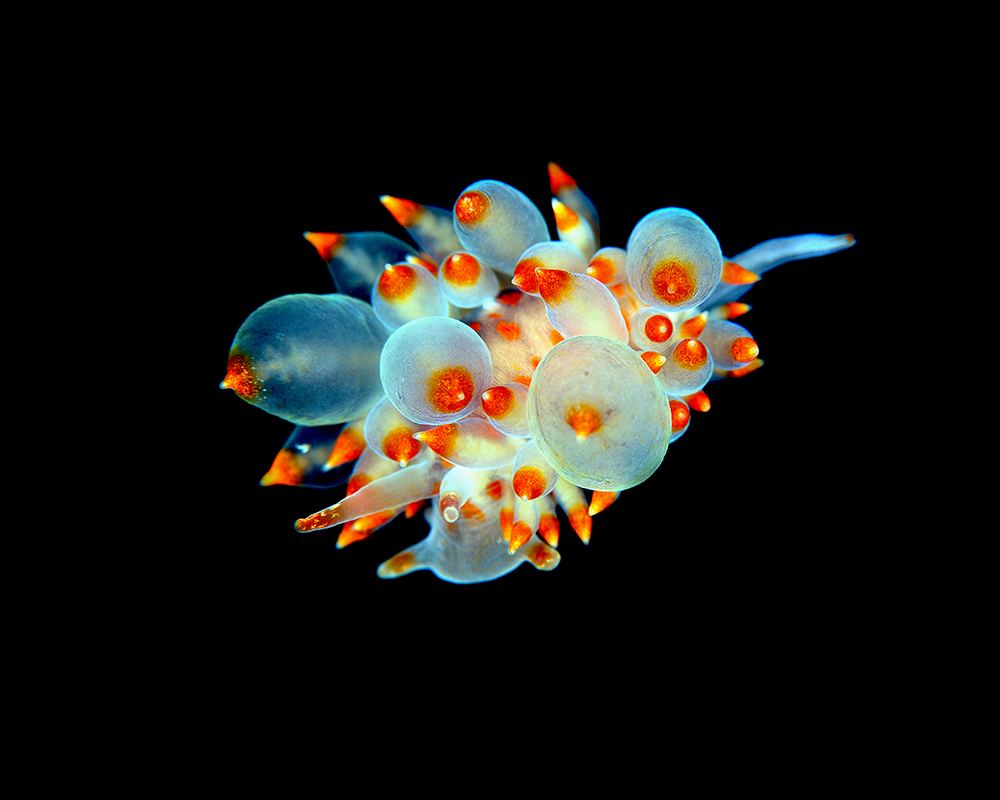
Tiny apertures of f22 or f32 result in black backgrounds and maximize your depth-of-field


Composition is King

Composing dynamic nudi shots when working with especially small subjects is the real challenge. Wave action, current (nudibranchs tend to thrive in current-ridden areas, where their food also thrives), and moving kelp and hydroids all work against you. A couple extra weights, or even ankle weights are useful when shooting close to the bottom in turbulent water.

Try shifting to manual focus and focus bracketing by moving the housing back or forth. Autofocus tends to miss the target slightly when working with really small subjects, which is easy to miss when looking at the camera’s small LCD display. But getting the composition right is often what separates ordinary run-of-the mill nudibranch images from the truly great ones. There are some basic rules you can stick to, like the rule of thirds and diagonals – but don’t forget that rules are meant to be broken at times.

In addition to the general composition of the image – focus and depth of field – it is always important to take into account the background of the image. If the background is cluttered and full of objects and different colors, your subject will not stand out and make a lasting impression on the viewer. Who wants to view an underwater fruit salad?

Finding a calm, uniform background often gives you the best results. A good option is to go for simple black background, which is easy to achieve once you find a nudibranch with a little open water behind him. Use a high F-stop and fast shutter speed to remove all ambient light, and get low so only the water column is in the background. Follow these steps and you will create the perfect black backdrop to complement the brilliance of nudibranchs, whether in Norway, or anywhere else around the world.

Taken from SDAA issue 02/2012