Diving doesn’t have to be a question of pinching pennies, pitching in and bunking down. Diving holidays can be a completely indulgent and special time when the topside amenities compliment, and even enhance, the underwater extravaganza. We’ve explored some of Australia’s top luxury places for those times when you simply want to immerse your senses above and below the watermark.
Lizard Island (Far North Queensland)
Diving doesn’t have to be a question of pinching pennies, pitching in and bunking down. Diving holidays can be a completely indulgent and special time when the topside amenities compliment, and even enhance, the underwater extravaganza. We’ve explored some of Australia’s top luxury places for those times when you simply want to immerse your senses above and below the watermark.
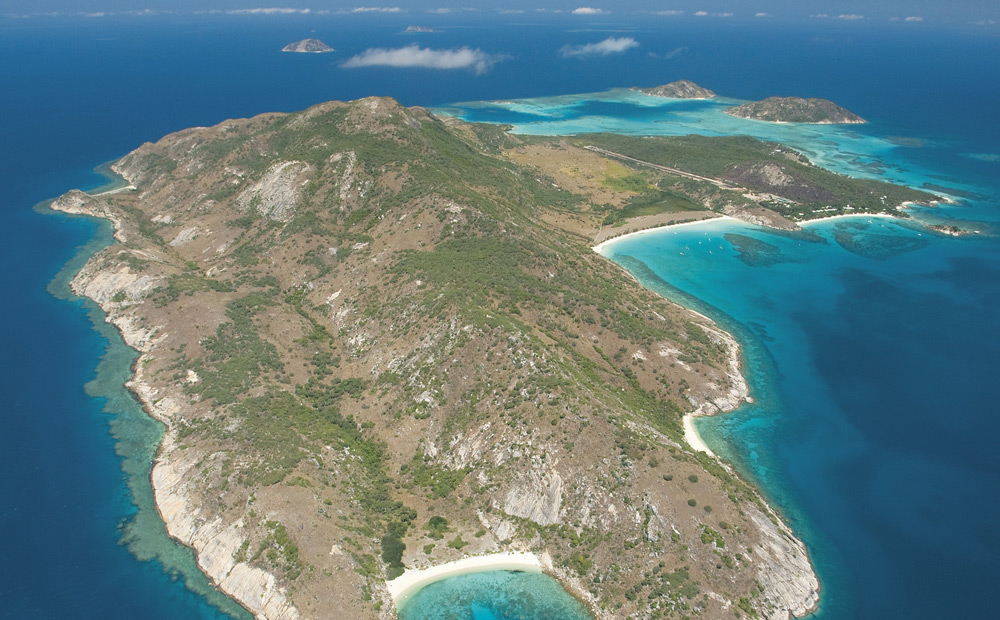
An absolutely stunning retreat on a tiny island far north Queensland, this is the ultimate spot for luxurious seclusion, facilities and diving. Lizard Island is right on the doorstep of the world famous Cod Hole and many other brilliant dive and instructors, you can take your pick of fabulous places to dive and discover. Depending on the time of your visit, you can see humpbacks breaching from the beach, turtles lumbering in the shallows, or manta rays cruising the blue, plus there are always the wonderful reefs and huge ancient clams. Lizard Island is often a springboard to the Outer Reefs and the Coral Sea.
Top 3 dive sites around Lizard Island
1. Cod Hole – Famous for its giant potato cod, Maori wrasse, red bass and many other species, this site is not to be underestimated. A dive here is unique not only for the enormous fish who come to say hello, but there are also lovely corals, schools of sweetlips, plenty of eels, and thousands upon thousands of tropical anthias that dip in and out of the coral tantalisingly. It’s a magical spot.
2. Giant Clam Gardens – Found in Mrs. Watsons Bay, whilst not a deep or challenging dive, this spot is unique because of the enormous 100-year-old giant clams littering the seabed. You can leisurely wind around the coral and clam beds with usual stunning colourful accompaniment of the bright tropical fish, sea stars, sea cucumbers and all the wonders you’d expect on a small shallow reef. Easy to get to, relaxing and utterly entrancing, Giant Clam Gardens is a great little dive site.
3. Ribbon Reefs – Take your pick! There are so many top spots on the Ribbon Reefs, just tell the skipper what you want to see and he will do his best to find the perfect site for you. Choices include sites with swim-throughs, bommies and feeding stations boasting the larger varieties of marine life, including manta rays, which are often seen here. Your local dive guide will be able to advise on the best diving areas based on the daily conditions, taking your wish list into consideration.
Hamilton Island (North Queensland)
Diving doesn’t have to be a question of pinching pennies, pitching in and bunking down. Diving holidays can be a completely indulgent and special time when the topside amenities compliment, and even enhance, the underwater extravaganza. We’ve explored some of Australia’s top luxury places for those times when you simply want to immerse your senses above and below the watermark.
Top 3 Dive Sites around Hamilton Island
1. Bait Reef Marine Park – About 38 nautical miles from Hamilton Island in the Outer Great Barrier Reed, Bait Reef is acknowledge as the most spectacular reef location in the area. Shallow lagoons and coral gardens are abundant, suitable for all levels of snorkellers and divers. For the more adventurous, Bait Reef offers underwater canyons, vertical stepping stones and abundant sea life. Of course, if time is precious, travelling by helicopter or sea plane can certainly offer more dive sites further away and local pilots are aware of height limits for scuba divers.
2. Black Reef – Fifty nautical miles from the qualia base, Black Reef offers a variety of dive sites with soft coral walls alongside healthy hard coral gardens. Expect the enigmatic Maori wrasse to come say hello and probably follow you around while you enjoy the octopus, turtles, reef sharks and all the varieties of rays. These sites are in great condition, and they’re colourful and teeming with life.
3. Knuckle Reef – A popular destination 55 nautical miles from qualia, a pontoon conveniently situated in the Knuckle Reed lagoon. In additional to snorkelling and other mainstream activities, Knuckle Reef is a great dive site away from the madness. Scientific surveys show over 200 different types of fish (Maori wrasse included, of course!) and over 150 types of hard and soft corals, plus all the invertebrates that inhabit the healthy reef systems. You won’t be disappointed.
Ningaloo Reef (Western Australia)
Diving doesn’t have to be a question of pinching pennies, pitching in and bunking down. Diving holidays can be a completely indulgent and special time when the topside amenities compliment, and even enhance, the underwater extravaganza. We’ve explored some of Australia’s top luxury places for those times when you simply want to immerse your senses above and below the watermark.
Ningaloo Reef offers over 500 species of fish, 250 species of coral, and 600 species of mollusc, and is acknowledged as one of the best places on earth to see and swim with both whale sharks and manta rays. It is also a major breeding are for hawksbill, green and loggerhead turtles, which are seen daily in front of the camp. And to top it off, Exmouth – a short drive away – has one of the world’s greatest pier dives.
Top 3 dive sites around Ningaloo Reef
1. Exmouth Navy Pier – This dive site has to be experienced firsthand. With a maximum depth around 14 metres and stretching out into Exmouth Gulf, the Exmouth Navy Pier is right next door to Bundegi Reef. Because the pier had been closed to fishing for a number of years, the marine life had been left in peace to proliferate. As a result, this dive site is packed to the pylons with every fish and critter you can imagine. It simply takes the breath away. Expect wobbegong sharks, whitetip reef sharks, large cods and groupers, lion fish, anglerfish, stonefish, scorpionfish, frogfish, moray eels, octopuses, large school of trevally and baraccuda, and much more. The Exmouth Navy Pier had been rated as one of the top ten dive site in Australia and one of the top ten pier dives in the world for good reason!
2. Whale Shark Snorkelling – Technically this is not a dive but since no one would travel to Exmouth between April and June and not take advantage of one of the world’s most amazing large animal encounters, I felt it had to be included. Carefully protected, visitors are only allowed to snorkel with the whale sharks but it is the most amazing experience to swim with one of the largest fish on this planet. The whale shark is the world’s biggest filter-feeding fish (no-teeth!) growing up to 12 metres long. Swimming with one is a once-in-a-lifetime opportunity that is not to be missed.
3. Ningaloo Reef – There are many glorious sites along the fringing coral reefs and Ningaloo Whale Shark ‘n’ Dive will be able to advise you if you tell them what you want. The waters are clear and simply heaving with marine life, almost like a Disney Movie. There are Octopuses, eels, turtles, mantas and abundant corals. Healthy clouds of small colorful reef fish create a kaleidoscopic master-piece only nature can produce. Diving at Ningaloo makes you realise just how important it is to protect and nurture our rare pristine areas. Australia is blessed but we still need to make sure these precious ecosystems are looked after.
Coffs Harbour (New South Wales)
Diving doesn’t have to be a question of pinching pennies, pitching in and bunking down. Diving holidays can be a completely indulgent and special time when the topside amenities compliment, and even enhance, the underwater extravaganza. We’ve explored some of Australia’s top luxury places for those times when you simply want to immerse your senses above and below the watermark.
Coffs Harbour sits on the doorstep to one of New South Wales’ best dive locations, the Solitary Islands Marine Park. It is the largest marine protected area in New South Wales and also the most unique, created by the mixing of the warmer waters from the southern Great Barrier Reef with the cooler temperate waters from Tasman. This means the Solitaries enjoy an abundance of colorful tropical, sub-tropical, temperate and pelagic fish, curious blue groupers, the loggerhead, green and hawksbill turtles, rays, pretty nudibranchs, giant cuttlefish and los of clownfish, as well as boat-chasing dolphins. The islands also enjoy visits from manta rays in the summer months and the majestic migrating humpback whales in the winter.
Top 3 dive sites around Coffs Harbour
1. Manta Arch, South Solitary Island – Despite the name, this is a big grey nurse shark area and sometimes up to 30 congregate here at around 23 to 28 metres . Swim through the arch with these friendly sharks and enjoy one of the few protected habitats where they still collect in good numbers.
2. Cleaner Station – South Solitary Island – Enjoy a dive ranging from 12 to 24 metres where you’ll often see turtles, red morwongs, plenty of bannerfish, cruising grey nurse sharks, the amazing giant cuttlefish in the winter, as well as big pelagics. This is a great dive you won’t soon forget, when conditions are right.
3. Boulder Wall, South Solitary Island – At the top of the wall in about 8 to 10 metres, lots of schooling fish can be enjoyed, and for the colour-lover, there are nudibranchs in abundance! When you’re ready, you can dive over the wall and drop from 12 to 20 metres where you’ll encounter schooling fish, giant cuttlefish and beautiful eagle rays.
All this at just one of the Solitaries! But there’s also South West Solitary and Split Solitary Islands, great for plate corals and macro life from 5 to 18 metres. In fact, the whole region had much to offer, as it’s a very special area for diving and not to be missed.
Port Stephens (New South Wales)
Diving doesn’t have to be a question of pinching pennies, pitching in and bunking down. Diving holidays can be a completely indulgent and special time when the topside amenities compliment, and even enhance, the underwater extravaganza. We’ve explored some of Australia’s top luxury places for those times when you simply want to immerse your senses above and below the watermark.
Port Stephens’ Nelson Bay is hugged by rugged bush land, rocky bays, and undulating sand dunes, with a bay filled with bottlenose dolphins and a unique combination of temperate and sub-tropical species. For divers, an integral part of this so-called paradise is the remarkable shore diving available literally five minutes from the town centre; no need for a boat to enjoy scuba here.
Top 3 Dive Sites around Port Stephens
1. Halifax Park – Enter via a channel created by divers, a leisurely fin will lead you over a succession of walls at varying depths down to about 26 metres. Each ledge is layered in excessive sponge growth, masses of soft coral, dotted with nudibranchs, harlequin ghost pipefish, spider crabs, olive and mosaic morays. The prolific fish life includes bullseyes, blue wrasse, numb and eagle rays, bream, drummer, stripeys and the tropical butterflyfish.
2. Flypoint – Running parallel to the shore are two ledges with every part of their substrate covered in technicolour sponge gardens in and above which live pineapplefish, yellowtail angelfish, longfin banner fish, nudibranchs, seahorses, tiger pipefish, shovelnose rays, rose bubble shells and even some intrepid garden gnomes
3. The Pipeline – Dave Harasti called it one of his favourite night dives in Scuba Diver AustralAsia’s Black and White Special (Issue 1, 2011), but it’s just as good during the day. If Australia had a muck dive, this would be it; a 250-metre pipeline dotted with concrete blocks and ballasts offering unique ecosystems, bizarre critters and great marco photography. Crawling along the bottom, you may stumble upon decorator crabs, eels, estuarine rock lobsters, rare nudibranchs, blue ring octopus, seapens rising from the sand, and delicate pipefish.
Kangaroo Island (South Australia)
Diving doesn’t have to be a question of pinching pennies, pitching in and bunking down. Diving holidays can be a completely indulgent and special time when the topside amenities compliment, and even enhance, the underwater extravaganza. We’ve explored some of Australia’s top luxury places for those times when you simply want to immerse your senses above and below the watermark.
Underwater, Kangaroo Island is home to 270 different fish species along with sea dragons, seals and dolphins. Whilst diving, you encounter seals about 90 percent of the time and dolphins about 60 percent. The island also boasts some of the prolific areas of soft coral, sponges and gorgonians found in temperate waters, as well as crayfish and abalone. These are unspoilt waters and should be enjoyed in their pristine state. To top it off, Kangaroo Island is home to one of the nature’s most beautiful, amazing small creatures – the leafy sea dragon. Leafies are regarded by many as bring rare and extremely difficult to find and can only be found in certain southern areas of Australia.
Top 3 Dive Sites around Kangaroo Island
1. Pissy Boy Bay – This site is actually three great dives in one: The Cut at a depth of 10 metres; The Amphitheatre at a depth of 17 metres; and The Arch at around 15 metres. The site teems with marine life including colourful soft corals, the breathtaking harlequin fish (found only in South Australian waters), electric blue nudibranchs, eastern blue groupers, and both New Zealand fur seals and Australian sea lions. This is a truly world-class dive site visited by many overseas guests.
2. Portland Maru Shipwreck – The remains of the Portland Maru are slightly west of the cliffs of Cape Torrens and 500 metres from the shore. Broken up over many years, the hull is lying flat on the seabed with a number of straight lines encrusted with sponges and coral. Standing tall in water are two huge boilers and a steam engine covered with colourful growth. There is a large concentration of fish, including red snapper, old wives, long-snouted boarfish, blue devils and a huge assortment of decorator crabs and lobsters.
3. Western River Cove – The rocky shoreline on the west side of the beach drops to just over 15 metres. The east side is a system of gullies where the rocky terrain is covered in kelp. There are swim-throughs, caves, ledges and outcrops inhabited by marine life including lobsters and a friendly blue grouper called Old Blue. Pods of dolphins are also seen around this site from time to time.