Home Blog Page 101

The Lost City of Thonis-Heracleion

0

Thonis-Heracleion (the Egyptian and Greek names) is a city lost between legend and reality. Before the foundation of Alexandria in 331 BC, the city knew glorious times as the obligatory port of entry to Egypt for all ships coming from the Greek world. It also had religious importance as the location of the temple of Amun, which played an important role in rites associated with the continuity of the ruling dynasty.

The city was probably founded around the 8th century BC, underwent diverse natural catastrophes, and finally sunk entirely into the depths of the Mediterranean in the 8th century AD.

Prior to its discovery in 2000 by the European Institute for Underwater Archaeology (IEASM), directed by Franck Goddio, no trace of Thonis- Heracleion had been found. Its name was almost erased from the memory of mankind, only preserved in ancient classic texts and rare inscriptions found on land by archaeologists.

]The Greek historian Herodotus (5th century BC) tells us of a great temple that was built where the famous hero Herakles first set foot in Egypt. He also reports of Helen’s visit to Heracleion with her lover, Paris, before the Trojan War. More than four centuries after Herodotus’ visit to Egypt, the Geographer, Strabo, observed that the city of Heracleion,  which possessed the temple of Herakles, is located straight to the east of Canopus at the mouth of the Canopic branch of the River Nile.

With a unique survey-based approach that utilises the most sophisticated technical equipment, Franck Goddio and his team, in cooperation with the Egyptian Supreme Council of Antiquities, were able to locate, map and excavate parts of the city of Thonis-Heracleion, which lies 6.5 kilometres off today’s coastline. The city is located within an overall research area of 11 by 15 kilometres in the western part of Aboukir Bay.

Franck Goddio has found important information on the ancient landmarks of Thonis-Heracleion, such as the grand temple of Amun and his son Khonsou (Herakles for the Greeks), the harbours that once controlled all trade into Egypt, and the daily life of its inhabitants. He has also solved a historic enigma that has puzzled Egyptologists over the years: the archaeological material has revealed that Heracleion and Thonis were in fact one and the same city with two names; Heracleion being the name of the city for the Greeks and Thonis for the Egyptians.

The quantity and quality of the archaeological material excavated from the site of Thonis-Heracleion show that this city knew a time of great opulence during the peak of its occupation from the 4th to the 6th century BC. This can be seen in the large quantity of coins and ceramics dated to this period.

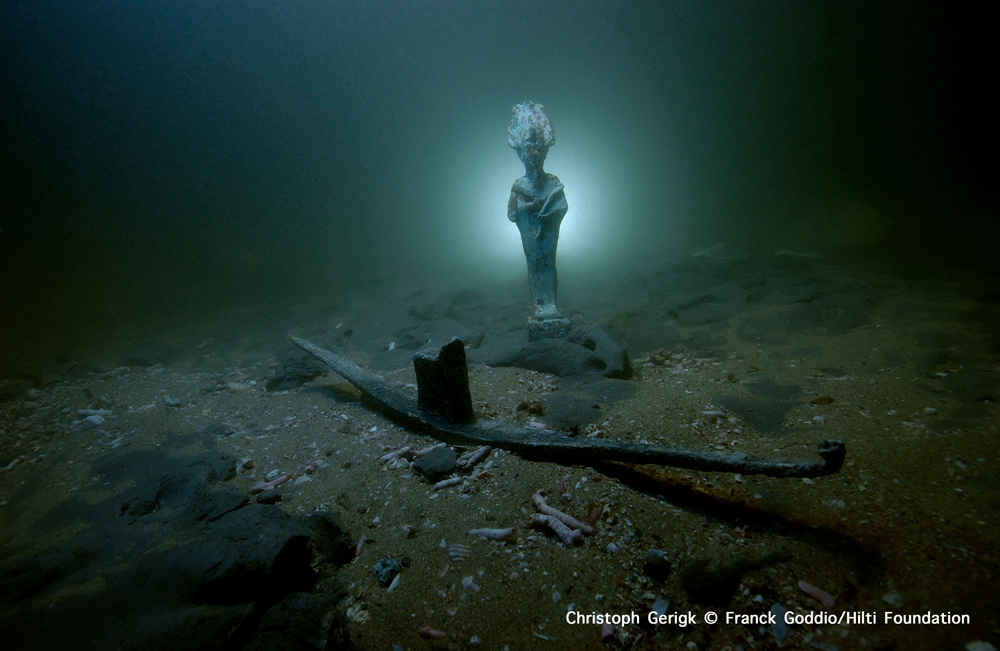
The port of Thonis-Heracleion had numerous large basins and functioned as a hub of international trade; thriving activity in the port fostered the city’s prosperity. More than 700 ancient anchors of various forms, and over 60 wrecks dating from the 2nd to the 6th century BC, are also an eloquent testimony to the intensity of maritime activity here.

The city extended all around the temple, and a network of canals throughout would have given the whole settlement a “lake-like” feel. On the islands and islets, dwellings and secondary sanctuaries were located. Excavations here have revealed beautiful archaeological material such as bronze statuettes. On the north side of the temple to Herakles, a grand canal flowed through the city from east to west and connected the port basins with a lake to the west.

The objects recovered from the excavations illustrate the city’s beauty and glory, the magnificence of its grand temples and the abundance of historic evidence: colossal statues, inscriptions and architectural elements, jewellery and coins, ritual objects and ceramics – a civilisation frozen in time.
This article is an excerpt from Scuba Diver‘s “Lost Worlds”. To read more, purchase a copy of this latest issue or subscribe here at our online shop.
10 Things You Need to know about Wreck Diving

0
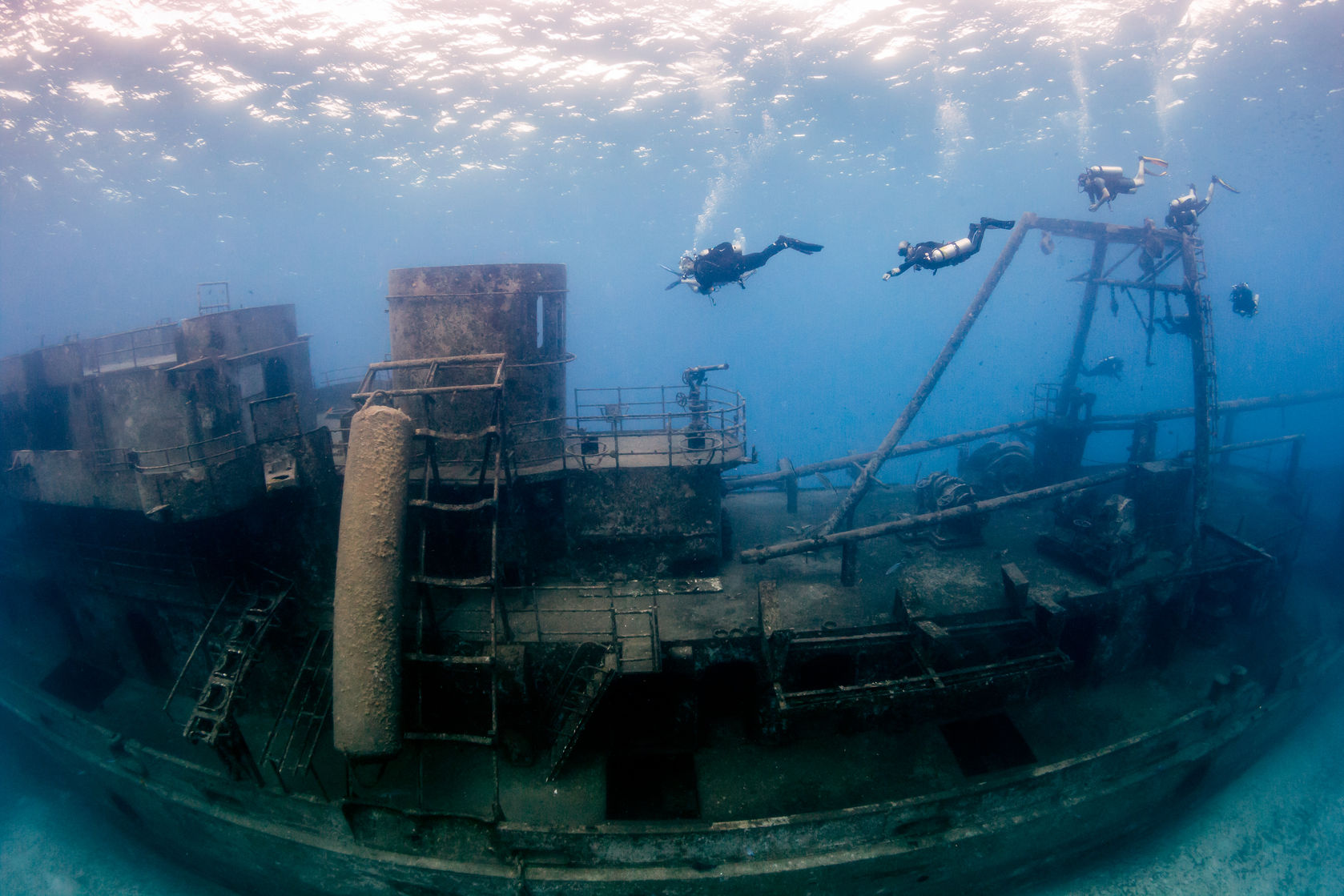
71437073 - scuba divers around a huge underwater shipwreck

Proper wreck diving needs proper prep – good training kit considerations, a little research, and the right dive operator are all vital.

The right dive guide will know the site inside out and will be able to ensure you have a safe and thoroughly enjoyable experience.

Entanglement, lacerations, and getting lost are all very real risks. Be sure you follow point number 2.

Penetrating a wreck requires intensive, specialised training. If you don’t have the experience or skills required,  stay on the outside of the structure and appreciate its beauty from there.

Learning about the wreck you’re diving on will bring the whole experience to life.

If you have the training, make sure you have the right kit – your kit list should include a bright light and a backup, a good cutting tool, a spare air, and a reel and line.

Be sure your standard gear is in excellent working order. Get it serviced if you need to.

Do a check out dive to make sure you are properly weighted and your newly serviced equipment is functioning beautifully.

Practise a modified kicking style; frog kick techniques can help you avoid kicking up sediment and ending up in a “silt-out” situation. Some experienced divers will even use a “pull and glide” technique, while making sure that they are not damaging the structure.

Wrecks are underwater museums, and many are grave sites. Be sure you treat the wreck with respect and definitely don’t remove any “souvenirs”.


4 Lost Worlds You can find Underwater

0

Much of the oceans’ magnetic mystery comes from the fact that the waters of our planet can, and do, swallow parts of our human world. And when they do, they leave little or no trace of their quarry above the waves. There is still so much we don’t know about what lies on the seabed, and the possibilities are endless. But, as we explore ever more of the depths, we find ever more fragments of these “lost worlds”. These preserved pieces of history not only help us understand the past a little better, but more importantly they connect us with the awesome size and power of the ocean, and remind us of our fleeting experience of existence in the vastness of time and space. Some artists, possibly compelled by this “existential stimulation”, are even creating works of art to be installed underwater, a lasting testament to humankind’s relationship with the sea.

The amphorae site consitutes 150 individual antitique amphorae in the bay of La Tour Fondue. It is part of a network of archaeological trails, on land and underwater, in France in the Hyères region of the Mediterranean Sea. Sometime between 70 and 65 BC, a ship transporting 6,000 amphorae filled with wine, travelling from Italy to Spain, sank near the small village of La Madrague on the Giens peninsula. The wreck, with its amphorae, was discovered in the early 1970s, and is in very good condition.

After a lot of preparation work, the more than 2,000-year-old amphores were installed in the bay by AREVPAM (Assocation de Recherches, Etudes et Valorisation du Patrimoine Méditerranéen – Association of Research, Studies and Valorisation of Mediterranean Heritage). They were placed carefully to mimic the situation in which they were found. Experimenting with proper placement since 2012, 30 amphorae were fixed to the sandy bottom of the bay in 2014, and now 120 more have been placed in the bay. Easy to reach at a depth of six to seven metres, the site is open to the public, so that divers, snorkelers and swimmers can share in the feeling of discovery.

Text by Claudia Weber-Gebert

The crystal-clear Caribbean waters of Grand Cayman are renowned for their fantastic reefs and wrecks. But hidden below the surface are two more unique sights: works of art by Canadian sculptor Simon Morris. The gorgeous Mermaid, and imposing Guardian of the Reef, are must-sees in Cayman. Each statue is located via an easily accessible shore dive. At the Sunset Reef, you’ll find Amphitrite, Siren of Sunset Reef, sunk here in 2000. Aficionados of Greek mythology will know her as the sea goddess and wife of Poseidon. Nearly three metres tall and made of bronze, “The Mermaid” as she’s commonly called, is a great subject for photographers and an attraction for divers of all levels.

Up the road in West Bay at Lighthouse Point you’ll find the “Guardian of the Reef” – aptly named as he stands as a reminder to protect the fragile coastal reefs around Cayman. Divers will find the four-metre-tall bronze warrior seahorse statue just a short swim off shore in 20 metres of water. The statue, sunk in 2014, is one of four Guardians by Simon Morris, created to promote environmental awareness and stewardship. With no river runoff clouding the sea, year-round visibility in Cayman averages 30 metres, so you’ll spot these works of art long before you reach them. On your swim out, stay alert for eagle rays, nurse sharks, and turtles that frequent the surrounding reefs. It’s hard to imagine the waters of Grand Cayman being any more inviting, but these majestic statues give you two more reasons to love diving here!

Text by Donald Parker Smith and Susannah H. Snowden-Smith

It is estimated there are more than two hundred shipwrecks around the Island of Sri Lanka. A fraction of those have been explored and documented. Most of the wrecks near Trincomalee are victims of World War II, but two of the ships, the SS Worcestershire and SS Perseus, are found near Colombo and hold a significant place in World War I history. During WWI, the SMS Wolf was singlehandedly responsible for destroying 37 vessels. Two of these were warships and the others were trading vessels. The SMS Wolf dressed in sheep’s clothing by disguising her guns behind false sides, and concealing a single engine biplane which was used to spot potential victims.

In February 1917, she laid a minefield near Colombo harbour. Two ships fell victim to the mines, the Bibby liner, SS Worcestershire, and the SS Perseus, a 6,700-ton steamer. Both were merchant vessels serving Great Britain, and both sustained loss of life. Now, 100 years later, the SS Perseus rests 35–40 metres beneath the surface. It is a hauntingly beautiful wreck. Nearly torn in three, the hull is twisted and contorted, giving the impression that it suffered a brutal death. But in death the ship is given a new life as it has become a lush artificial reef. The wreck is located 15 kilometres off shore, beyond the reaches of a recreational day boat. For this reason it has been dived by very few people.

Text by Brook Peterson

In October 2016, archaeologists from the Centre of Subaquatic Archaeology of Catalonia (CASC) in Spain, with the help of the Catalan submarine, Ictineu3, located a Roman imperial shipwreck lying in almost 50 metres of water off the Illes Formigues, or the “Ant Islands”. Thanks to the support of the submarine, the archaeologists could be deployed on long dives to more than 40 metres, allowing them to assess the ship’s condition and gather information needed to plan a future archaeological excavation campaign. They already know that the ship is from the first half of the 1st century BC, and that it was transporting fish broth. It is also the most well-preserved shipwreck from this era in Catalonia; there are, so far, known to be around 840 shipwrecks littering Catalan waters.

According to Gustau Vivar, the Director of CASC, these types of ships would depart from the south of Spain transporting goods, and head for Marseille or Narbonne (France), from which their goods would be distributed throughout the Mediterranean. Ships like these would carry very large loads of between 1,000 to 2,000 amphorae, and the archaeological team is eager to find out how many amphorae this new ancient wreck was holding. For me, it was a great opportunity to descend with the archaeologists. I watched as some of the ceramic containers were partially unearthed, full of small life, and then, some minutes later, felt the sound of the submarine moving, and gazed into the dark, marvelling at how the powerful lights of the bathyscaphe tear the shadows.

Text by Carlos Virgili/Risck

This article is an excerpt from Scuba Diver‘s “Lost Worlds”. To read more, purchase a copy of this latest issue or subscribe here at our online shop.
6 Useful Finning Techniques to Master

0

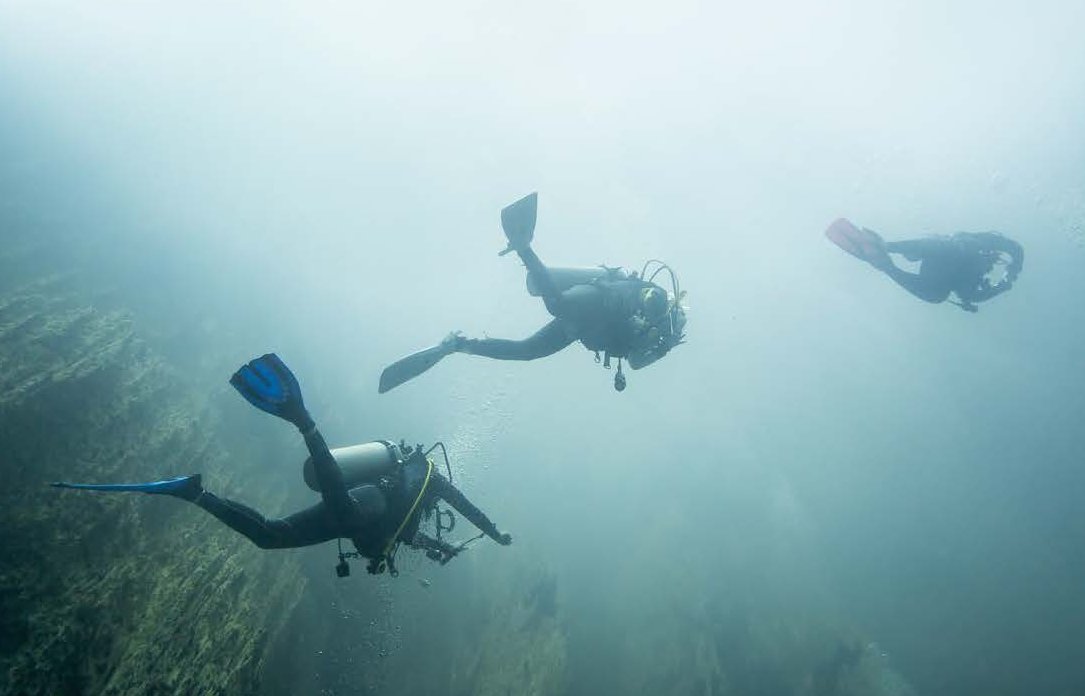
Finning techniques come in a few different forms, and opting for a certain technique is up to the diver. After all, each diver has their favourite style like they do their own mask. Finning techniques can be used in different environments, to conserve energy or save air, and even to escape a territorial titan triggerfish. We bring you six finning techniques that are good to know, and great to master.

Many divers find the frog kick relaxing, seeing it as an ideal cruising kick that they can alternate to between the flutter kick. It’s great for general cruising when close to delicate coral, silty/sandy seabed or marine life (providing you look where you’re kicking), and also when you’re exploring large caves.

The bent-knee cave diver kick works well in small areas such as wrecks and caves, and when close to silty/sandy seabed and marine life. We don’t recommend the bentknee cave diver kick when in strong currents or when you need to get away from something, quickly.

The flutter kick works best with long and gentle strokes – any erratic kicking can prove ineffective and has more chance of disturbing nearby seabed and marine life. The flutter kick is easy to use, and can provide a good forward thrust. It’s best used on the surface during a descent or ascent, when you’re well clear of the seabed and when swimming into a current.

A lot of thrust can be generated by a long, lazy kick. The thrust comes when both legs come together, just like scissors, and this can propel a diver forward whilst saving energy. Scissor/split kicks are great for powerful cruising as an initial kick to get you going forward and to rest groups of leg muscles. We don’t recommend using it when close to silty or sandy seabeds, in confined spaces inside a wreck or cave, or when apex speed is required.

The helicopter turn allows you to pivot or rotate whilst in the horizontal and trimmed diving position – beneficial for quickly changing direction. It enables you to turn and look behind you without changing water position. Slowly move your fins apart horizontally in an opposing back and forth motion, whilst rotating your ankles and fins.

The reverse or back kick is a top skill to master. The ability to move away from a subject whilst still being able to face it is perfect for underwater photographers, instructors and for divers who are fixated on a subject. It’s almost a complete reverse of the frog kick, and requires your fins to scoop water to start you moving backwards.


Underwater Museums: The Raft of Lampedusa

0
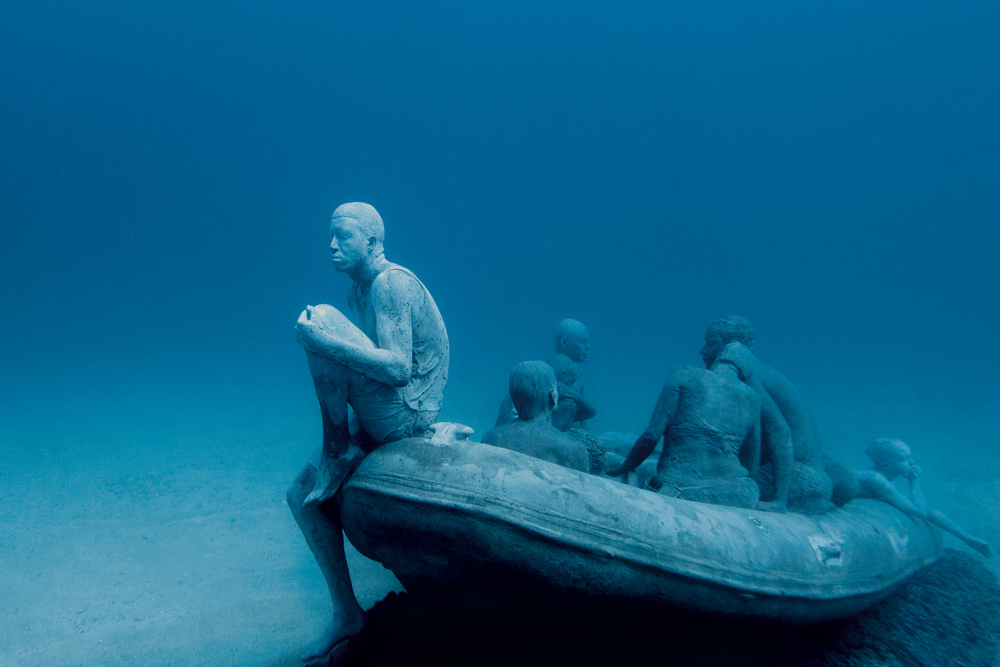
The Raft of Lampedusa by Jason deCaires Taylor

Using the ocean as an exhibition space, British artist Jason deCaires Taylor has created an underwater museum off the coast of Lanzarote, Spain, comprising life-size concrete figures depicting everything from the horrors of the refugee crisis to selfie-taking tourists, sculpture that will transform over time into a thriving marine ecosystem.

Life-sized casts are situated 14 metres below the surface of the water. This is a permanent installation, accessible to divers, snorkelers and tourists in glass-bottomed boats.

The Raft of Lampedusa depicts 13 refugees on a raft, drifting towards an uncertain future. It draws its inspiration from Théodore Géricault’s The Raft of the Medusa, which represents the vain hope of shipwrecked sailors. Despite being able to see the rescue vessel on the horizon, they are abandoned to their fate – much as refugees are today.

Contributed by www.illuminate.org.uk

This article is an excerpt from Scuba Diver‘s “Lost Worlds”. To read more, purchase a copy of this latest issue or subscribe here at our online shop.
15 Tips for Diving Responsibly with Marine Life

0
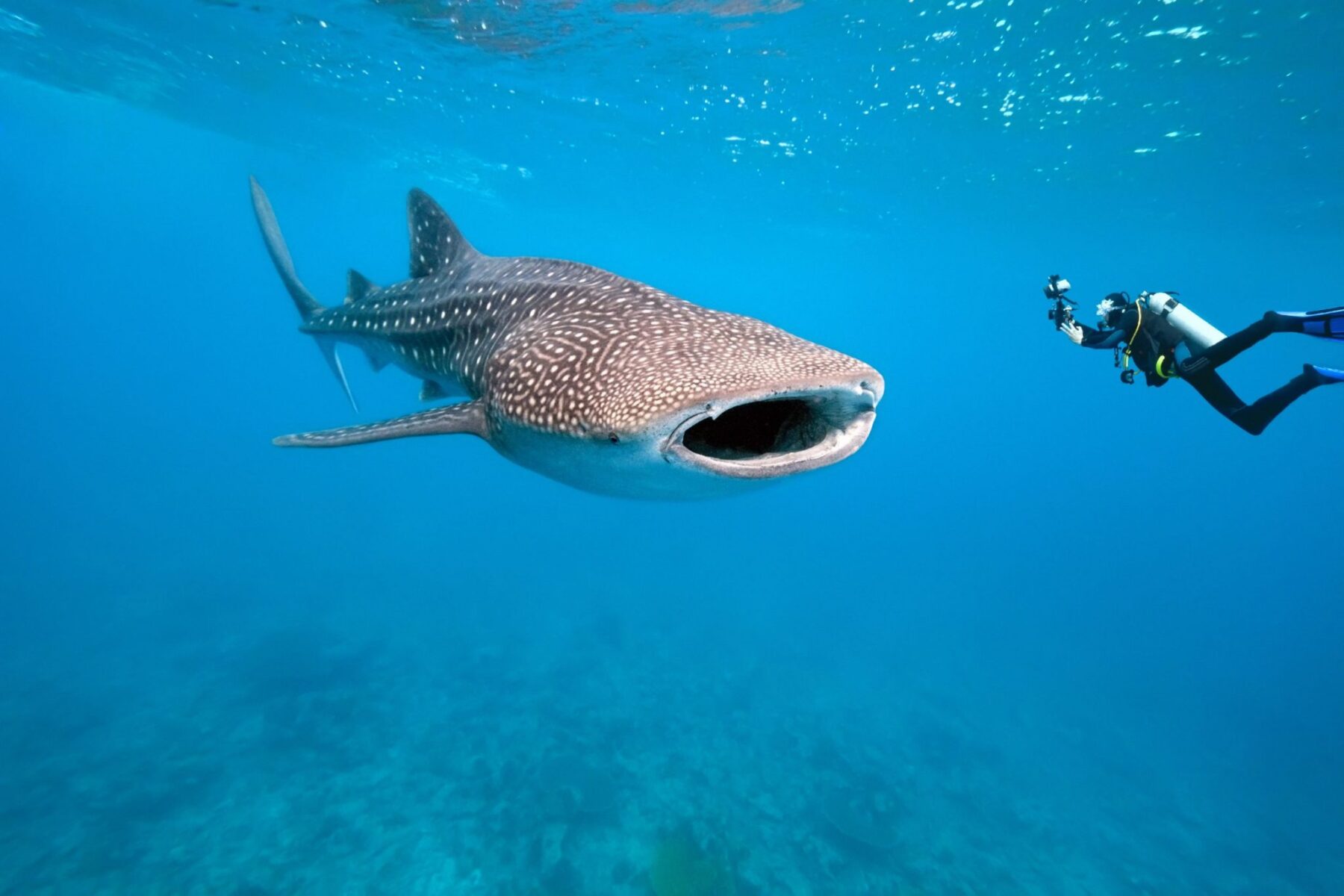
8774140 - whale shark and underwater photographer

As divers, it is important we make informed decisions, both when organising our trips and while we are on them to help ensure we limit our environmental impact. The following 15 tips will help you to ensure your next diving holiday is as environmentally-friendly as possible.

When making enquiries about your stay, you should ask about their conservation ethos. You want to make sure that your dive operator has responsible diving guidelines and takes a proactive approach toward conservation.

NOAA estimates that 4,000–6,000 tonnes of sunscreen washes off our bodies and onto coral reefs every year. Certain ingredients in sunscreens are toxic to corals and reef fishes, and can cause coral bleaching. There are now reef-safe varieties that use alternative compounds that are much less detrimental to the marine environment. To note, you should apply sunscreen at least 30 minutes before you enter the water.

Some of the major dive companies actively support marine conservation, and some actually generate their gear from ocean waste and recycling. This is a fantastic initiative because it not only acts against marine debris, but it also involves and supports local communities.

When encountering marine animals, it is essential that they are respected. Find out what species you are likely to encounter and check with the experts for appropriate behaviour. Following their guidelines will not only ensure you do not disturb the animals, but it will also enhance your encounter with them.

Many major marine conservation organisations rely directly on donations and outside sources to carry out their work. You can support them by donating funds, by volunteering or by offering your skills.

Make effort to ensure that all of your equipment is tucked in before and during your dive. Do not leave hoses or gauges dangling because they can easily catch on corals. Make sure that you are correctly weighted too, since this will make it easier for you to control your buoyancy.

In order to improve your encounters and to give yourself the opportunity to witness natural behaviour, you need to relax, dive slowly and refrain from chasing the marine life. Also, whether it is for personal enjoyment or to show others, touching or harassing marine life is completely unacceptable behaviour. If the current is too strong or if the creature you want to look at is not in an ideal position, you should wait for a better opportunity to present itself before proceeding.

Corals grow slowly and are fragile – they are easily damaged and take a long time to recover. Corals have a natural barrier that protects them from disease. If you touch the coral, you break this natural biofilm, leaving them open to infection. Many divers think gloves give them free reign to touch everything – gloves do not protect coral.

Don’t take a photo at the expense of the natural environment – don’t move animals around in order to get a better shot, and don’t chase after or stress the animals out. Take photos according to your skill level and remember that for some animals, flash photography is a big no-no because it can stress and kill the animal.

“Be the change you want to see in the world” – set an example to others and show them what it is to be a responsible, considerate diver.

If it is found there, it should stay there. Do not collect shells or corals. The same applies for shells on a beach. These provide homes for a wide variety of marine life including crabs and octopuses. You should also dispose of litter properly – leave only bubbles in the ocean and footprints on the beach.

If an opportunity presents itself, you really should try to get involved! There are a range of activities you can do, from reef and beach clean-ups, to coral transplanting as well as data collection.

All species of marine life have a role to play in the marine ecosystem. If some are removed, it will disrupt the natural balance on the reef.

According to the UN Food and Agriculture Organisation, 85% of global fish stocks are “overexploited, depleted or recovering from depletion”. If you want to continue to eat seafood, it is important that you make an informed decision. Find out where it came from, how it was caught and what it is. You should avoid supporting indiscriminate commercial fishing practices, like long-lining or trawling, as well as destructive fishing practices such as dynamite or cyanide fishing. You should also avoid supporting the trade of endangered species.

Share your experiences of conservation and marine encounters online to help raise awareness of eco-friendly operations.

Taken from Asian Diver’s DIVERAHOLIC, volume 145.

The Coelacanth: Lost no Longer

0

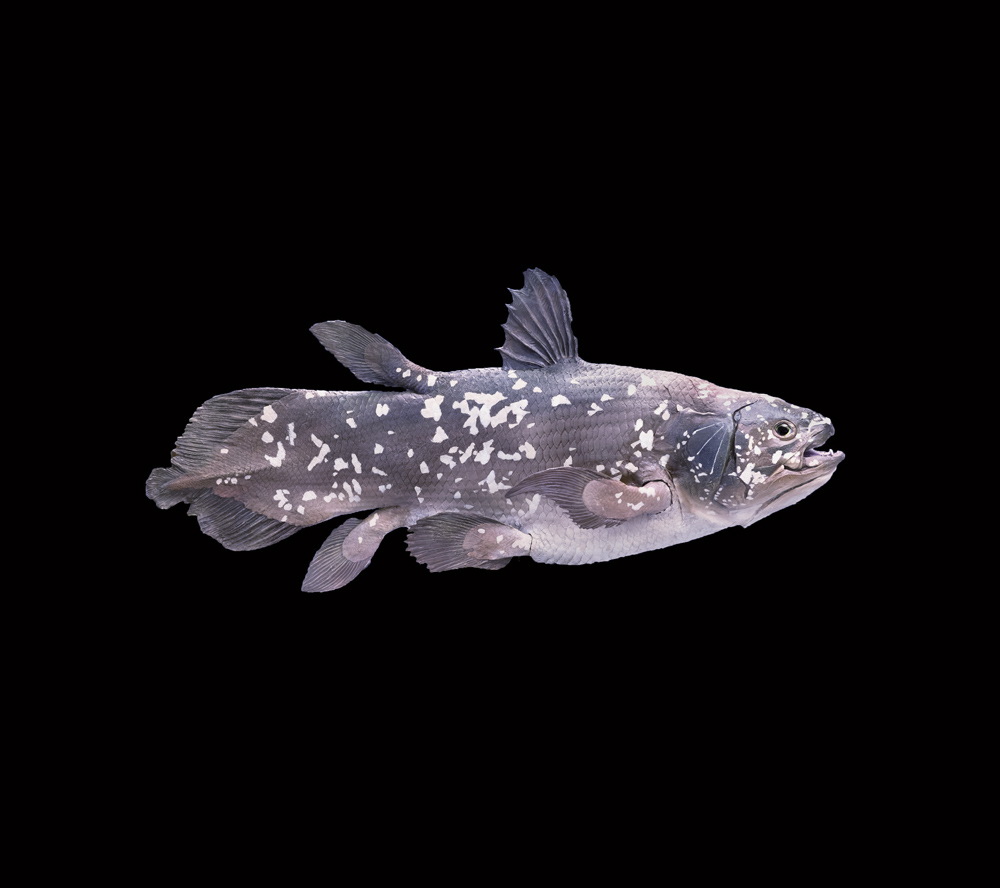
Coelacanths were thought to have been extinct for the last 65 million years, until 1938 when a fisherman found one entangled in his net off the coast of South Africa. 1n 1997, a second species of coelacanth was found in a fish market in Indonesia, though their flesh is not good to eat as it is full of urea and very oily. Their scales also produce mucus, not a very appetising sight! Coelacanths grow to be as much as 2 metres long and can weigh up to 80 kg. They have four fleshy fins which extend away from its body like limbs, and move in an alternating motion, with alternate pairs of fins moving together in a way that is similar to the movement of four-legged creatures on land. Coelacanths are thought to occupy a side branch of the vertebrate lineage, closely related to, yet distinct from, the ancestor of tetrapods (four-legged, land-living animals). Another interesting fact is that the coelacanth has a hinge in its skull that allows its jaw to open incredibly wide for consuming large prey. They live in deep water of more than 100 metres (which partly explains why they “disappeared” for so long!), spending most of their days resting under rocky ledges. They are relatively “social”, found with others during the day. At night, they will travel as much as seven kilometres from their resting places to hunt for food. Their fantastically reflective disk in their eyes helps them to detect tiny amounts of light in the gloom of the deep ocean. They don’t have a backbone, but a “notochord” – a hollow, oil-filled, pressurised tube. In most other vertebrates, the notochord is replaced by the vertebral column as the embryo develops. Their brains are really tiny, taking up just 1.5% of their cranial cavity. The rest is filled with an oily substance. Coelacanths give birth to live young after a gestation period of up to three years!

This article is an excerpt from Scuba Diver‘s “Lost Worlds”. To read more, purchase a copy of this latest issue or subscribe here at our online shop.