Home Blog Page 147

Understanding Remote Control Underwater Photography

0
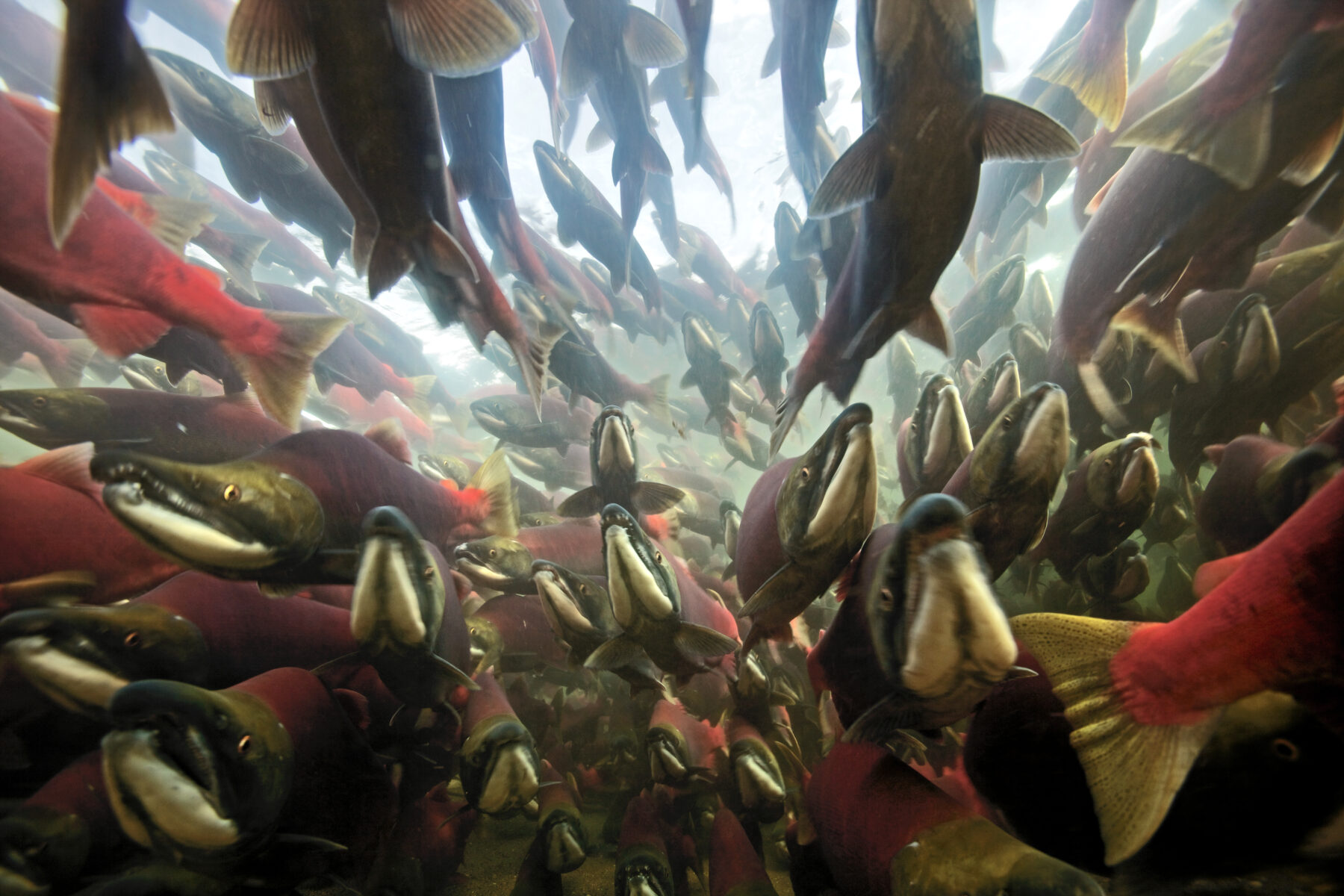
Red, or sockeye, salmon in the Adams River, British Columbia, Canada © Michel Roggo

I started doing remote control underwater photography because I wanted to photograph salmon in Alaska while travelling alone for weeks out in the bush on a canoe. You simply can’t do that easily with diving equipment. So I started very simply: sitting on the shore, just holding a Nikonos V in the water. But of course, it didn’t really work.

The next year I returned with a camera in an underwater housing, put this on the riverbed, rigged up a cable to release the shutter, and waited for fish to swim by. Some shots were quite good, but this didn’t really work either.

I was using slide film, with no autofocus. I had to focus on a certain point, and then wait for a fish to swim into the composition, past the right spot and at just the right distance. Sometimes I waited for days: one image, a wonderful composition of green algae towers with two carp swimming past, took me three days to capture.

The next year I returned with the same system, but this time with a small, built-in video camera that allowed me to see what was happening in front of the lens, and it worked very well.

This might not sound very original, but this was 30 years ago, and I was certainly one of the first (if not the first) to be photographing this way underwater. I have now been shooting regularly in freshwater for about 25 years, travelling all around the world. And I’m still always looking for new and interesting scenes with the most dramatic light – a marsh pond, under the ice in a mountain stream, among algae, incredibly beautiful habitats that are hardly ever seen.
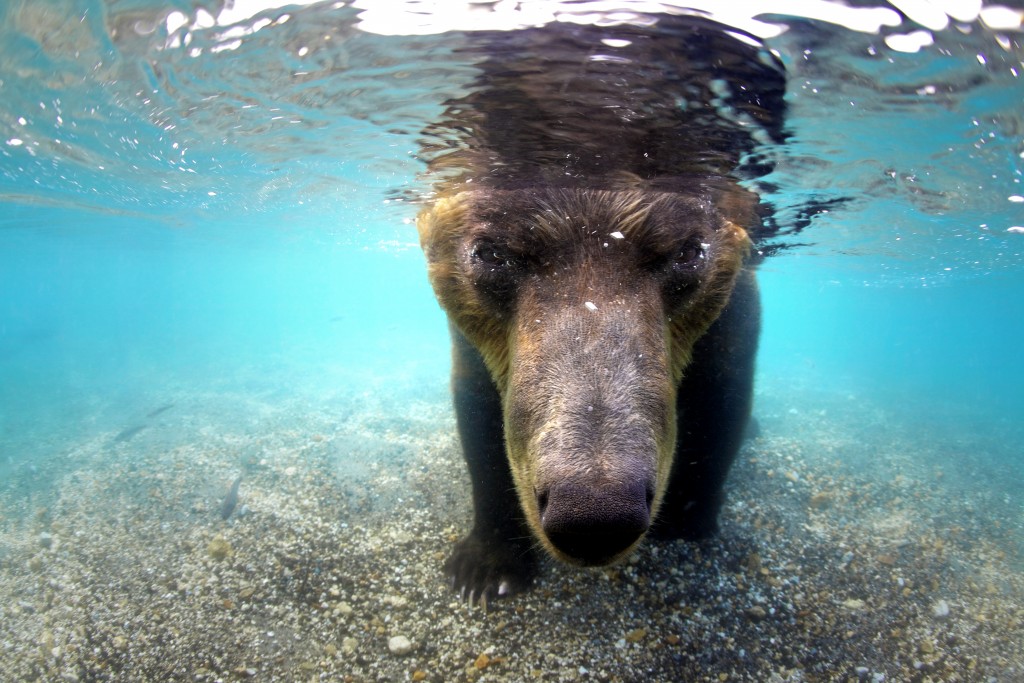
A brown bear in the South Kamtchatka Sanctuary, Russia © Michel Roggo
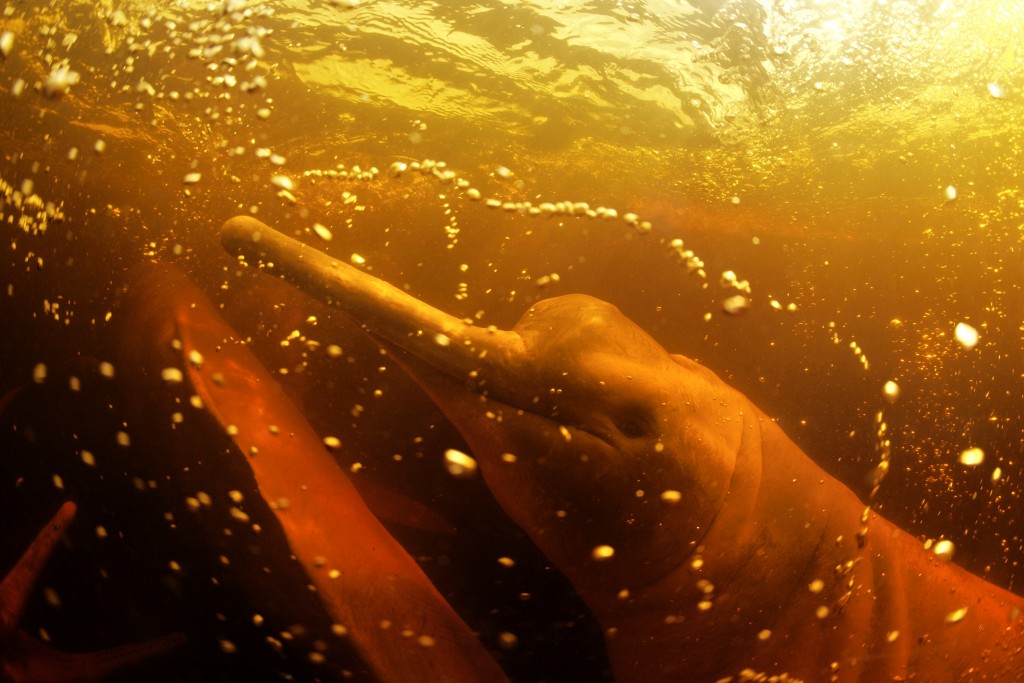
Pink river dolphin in the Rio Negra, Amazon, Brazil © Michel Roggo

Remote Advantages

First comes the image, and then the technique. I don’t make these images because I have a special remote controlled system: I have the remote controlled systems because I had the ideas for the images.

There are many advantages to working like this, especially in rivers. You can wait for hours on the shore for the right shot – something you can’t do freediving or on scuba. You can work in dangerous locations, or with dangerous animals. And animals get used to the housing, so they behave more or less normally.

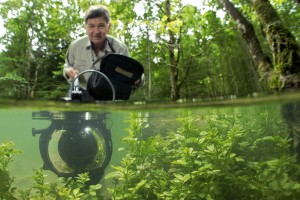
My set-up now consists of a camera in a housing with a small video camera at the viewfinder. It’s best to use one of those tiny lipstick video cameras.

Occasionally I use the underwater housing as a pole cam, but most often I leave it on the riverbed, either fixed on a metal frame with weights, sometimes secured with a ground spike. It depends on how strong the current is. I always shoot in ambient light – I haven’t used flash for over 10 years now.

A cable sends the video signal to the shore, and I can sit on the shore, smoke a cigar and watch TV, the “freshwater network”! When a fish swims into the composition, I release the shutter with the cable. It sounds very easy – but often it doesn’t work.
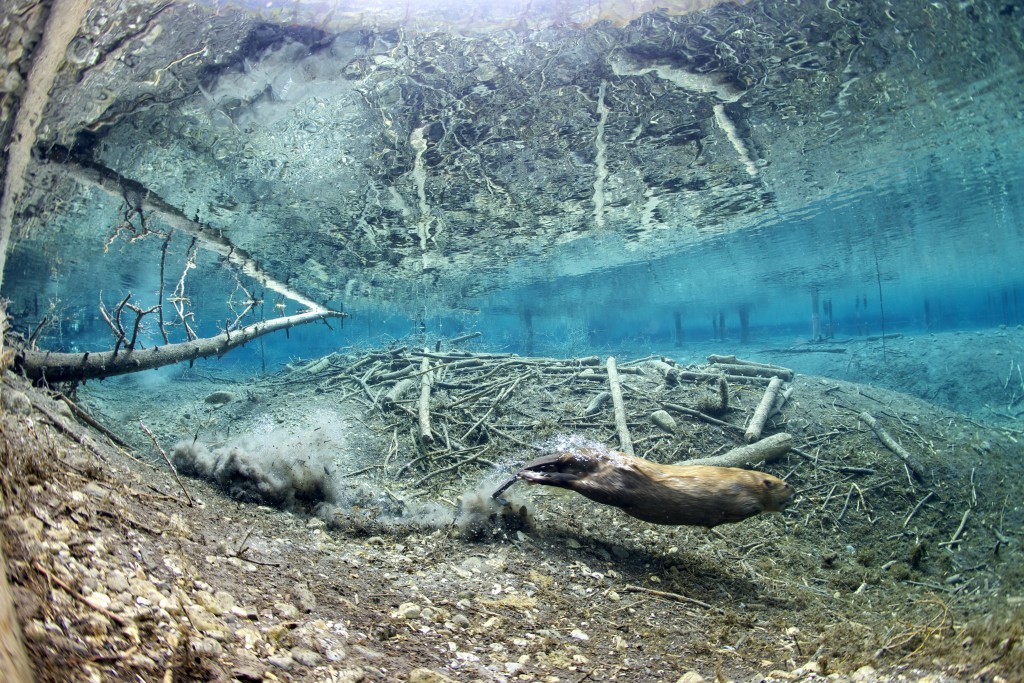
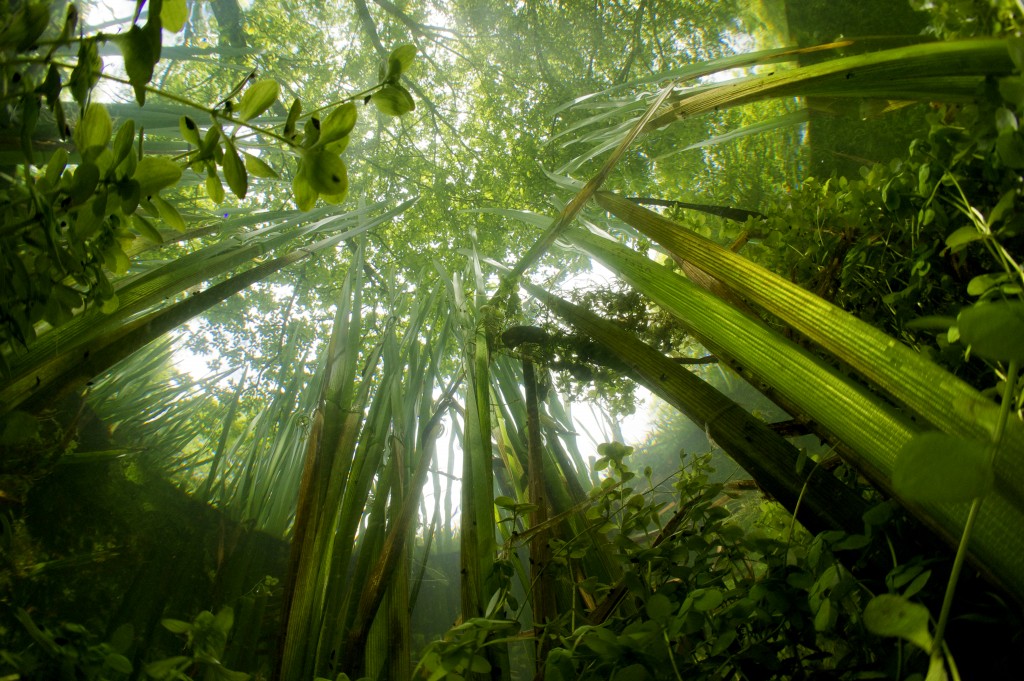
An American beaver displays its aquatic grace in the Northern Rockies, British Columbia © Michel Roggo
A chalk stream, part of the River Itchen in Hampshire, England © Michel Roggo

Fresh Challenges

All too often, something goes wrong. Air bubbles on the dome glass, murky water, shutter speed too slow, the camera focusing on the tail instead of the eye. With this technique good images need lots of time and persistence. For my pictures of Atlantic salmon, for example, I made perhaps 20 trips to different salmon rivers across the globe, before finally getting the perfect conditions: crystal clear water, hundreds of salmon, and bright sunlight for one week. But this was after 20 years of unsuccessful attempts!

Today it’s much easier than it used to be. Now, I can make thousands of images without taking the housing out of the water, autofocus works quite well, and you can push the ISO without too much noise.

But the main challenge is that I have developed this system myself. So I make all the cables, connectors and adapt the housing to my needs. And I use it out in the bush, sometimes under really rough conditions. There are always problems with bad electrical contacts and short circuits, and so on. But, as I’ve built it myself, I can usually fix it again, one way or another. So I never go out in the bush without my Swiss army knife. But these are just the technical challenges.

Working a lot in rivers, sometimes in strong current, I often risk losing my equipment, or scratching or even destroying the dome. And then there are the animals. One day a pikeperch attacked and totally destroyed a brand new dome. But that’s not even the worst of it: I’ve had my underwater housing attacked by crocodiles and brown bears, and sometimes completely wrecked. They are just so powerful, but you’re normally simply happy that you yourself are still in one piece after an experience like that…
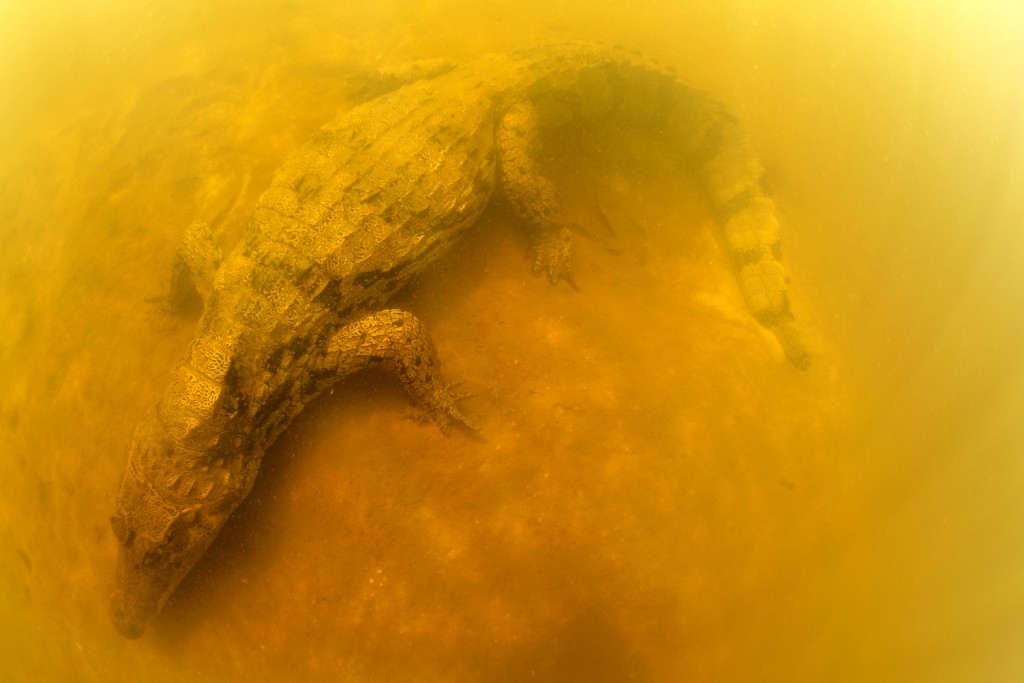
A black caiman rests on the bottom of the Rio Negro, Brazil © Michel Roggo

Want to Control it Remotely?

If you want to try remote control underwater photography yourself, you will probably have to start by building your own set-up and transforming an existing housing. This is the main hurdle.

Then, you should start with something you know very well, something in your backyard – a small creek, your garden pond. Just hold the camera under the surface, explore a small part of the water. I still do this sometimes, walking in a shallow river, holding the camera by hand, without seeing what’s in the frame.

Try everything, long exposures in low light, for example. I sometimes do long exposures in rivers with the camera on a tripod. Go into the middle of an outcrop of plants. Play like a little child. Just go out and do it. But don’t expect it to be easy. I started a few years ago diving and snorkelling for underwater photography, to explore new fields. I have to say that it really is the easier way. To have really good results with a remote controlled system, you have to work very, very hard. But it’s fun!

With photography, essentially you need technique and creativity. And you can only learn one of these. You have to work on your sensitivity to beauty. For me it is much more important to go to museums and galleries (and not only for exhibitions of photography) than to read all the technical stuff.

For me it is even extremely important to listen to good, mostly classical, music. While I was working with the Kamchatka brown bears, at night I was listening to Tchaikovsky, very
loudly, and all the images of these powerful animals were going off like volcanoes in my head. That was really Russia at its best. I couldn’t wait to get out early the next day to make all the images I had seen in my mind.

By Michel Roggo

This article featured in SD OCEAN PLANET “Cold & Fresh


R-110Michel Roggo, from Fribourg, Switzerland, is a professional photographer and member of the International League of Conservation Photographers. iLCP. Michel has had more than 30 exhibitions of his work, won numerous prizes in competitions, including Wildlife Photographer of the Year and European Wildlife Photographer of the Year, and his work has been published by a large number of major international publications. www.roggo.ch


 

Ask the Experts: Preparing for Your Dive Trip

0
© Jayme Pastoric

Preparation for scuba diving begins long before you arrive at the dive site. In addition to the skills required to enjoy the dive, it is important to be in good health and prepared to meet the physical demands of the sport.

In reviewing the data DAN Research has compiled on dive accidents, almost one-third of the diving fatalities were attributed to cardiac incidents; approximately half of these incidents occurred in divers 40-59 years old. What is really disturbing is that 60 percent of those fatalities had signs and symptoms they or others around them recognised as cardiac-related before or during the dive, but they continued to dive anyway.

DAN medics recommend all divers get an annual physical from a physician familiar with diving medicine beginning at age 35 or whenever there is any significant change in health status. An annual physical can help identify heart-related issues and corrective actions to take to reduce the likelihood of experiencing a cardiac-related issue while scuba diving. If you suspect someone is exhibiting signs or symptoms that could indicate a cardiac problem, call the dive or notify the divemaster, trip leader or other authority.

Maintain Your Gear

Thorough preparation also involves making sure your equipment is maintained properly and has been inspected annually by a qualified maintenance technician. In addition, when travelling to a dive site it is good to pack a “Save-A-Dive” kit that includes critical replacement parts. The basic “Save-A-Dive” kit typically includes rubber goods likely to break or wear out such as mask and fin straps, “O” rings and a regulator mouthpiece with tie wraps. If any of your equipment requires batteries, replacements are a good addition. Depending upon the type of diving you do, the equipment you use and how remote your travel is, your “Save-A-Dive” kit may need to be more extensive. If you are a technical or rebreather diver, it would be wise to incorporate redundant replacement parts for any critical or essential equipment.

Preventative Precautions

In order to make sure you don’t forget to pack everything you need, it is wise to make a comprehensive checklist. This same checklist will also be helpful when repacking at the end of your trip to ensure nothing is left behind.

Once you arrive at the dive site, it is important for you and your diving partners to follow a regular pre-dive ritual in preparation of each dive. Pre-dive rituals and the use of checklists are essential and underutilised components in proper dive preparation; they reduce the likelihood of equipment errors that could transform an otherwise enjoyable dive into an emergency situation.

If you are planning a boat dive, it is advisable to configure, assemble and check your equipment before the boat ever leaves the dock. You don’t want to be preparing your equipment when the boat is rocking at the dive site and other divers are rushing to enter the water.

Part of your pre-dive checklist should include ensuring your dive location has all the necessary emergency and first aid equipment such as emergency communications (mobile phone, marine radio, satellite phone, etc.), first aid and emergency oxygen equipment. If you are not bringing first aid equipment to the dive site yourself, you should ask about the availability of this equipment when you travel. When I board a dive boat, part of my pre-dive ritual is to take a look at the first aid supplies and emergency oxygen equipment before we depart.

Pre-dive rituals include configuring, assembling and checking your equipment, review of the dive plan and contingencies, review of hand signals (especially communicating breathing gas management signals), and a review of common emergency procedures such as the removal of weights, managing out-of-air emergencies and buddy separation. Unfortunately, lives have been lost because divers were unfamiliar with critical emergency processes such as how to jettison weights.

Your pre-dive ritual should also include a check of your partner’s equipment to make sure everything is in place and working. This means a thorough inspection to ensure breathing gas is on and the regulator is working, the regulator and octopus are configured and functioning properly, the power inflator is attached and working, and emergency signalling equipment (safety sausages, whistle, etc) is working and in place. Once you’ve done all of this, you’re ready to dive.

Although preparation may not prevent an accident from happening, an effective pre-dive ritual and comprehensive checklist can reduce the likelihood that an otherwise enjoyable dive will turn into a tragedy. As they say in The Royal Air Force, “Learn from your mistakes, better still, learn from others.”

By Dan Orr


Check out this incredible offer from DAN Asia-Pacific and UW360:

1 YEAR DAN Asia-Pacific Membership + 1 YEAR Subscription to Scuba Diver AUSTRALASIA + OCEAN PLANET Want to get your hands on this package? Click here.fd493c7d-1611-41db-b305-7f81ee2c24cc

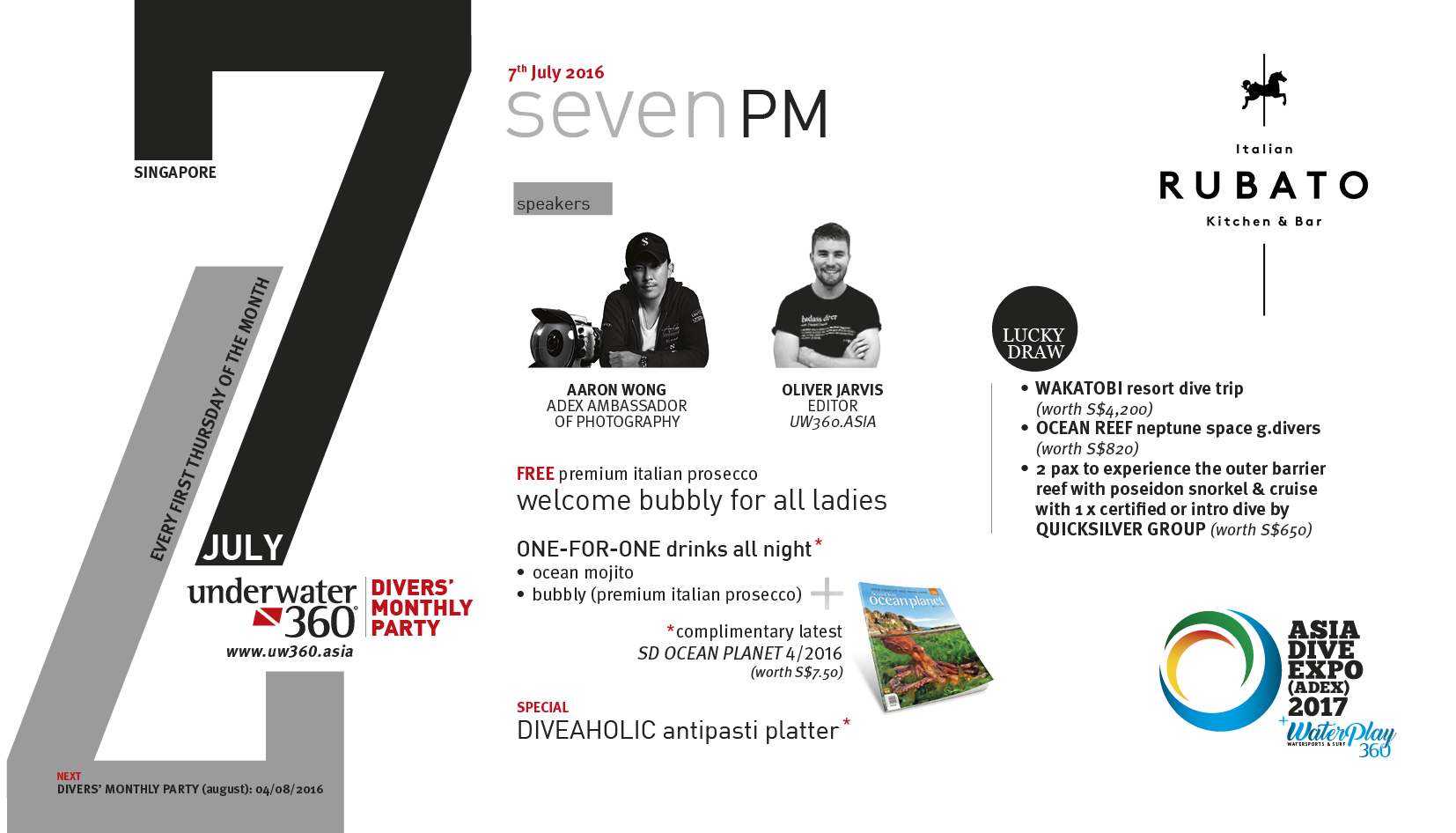
7Seven7: Divers' Monthly Party Launch (July 7, 2016, 7pm)

0


Underwater360
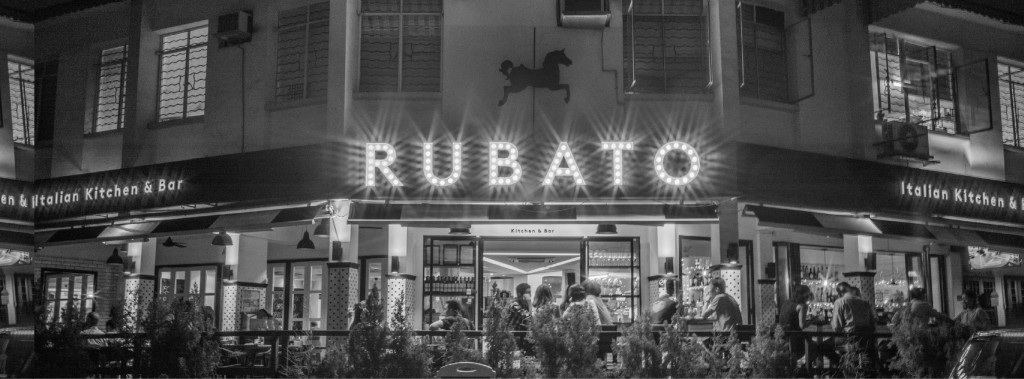
is bringing you the divers party of the month! Taking place at Rubato’s Italian Restaurant and Bar on July 7, 2016 at 7pm, Rubato is a high profile Italian eatery that plays weekly host to His Excellency The President of the Republic of Singapore, and movers and shakers in government, business, law, entertainment etc.

Kicking off our inaugural party will be guest speakers; Aaron Wong (ADEX Ambassador of Photography) and Oliver Jarvis (Editor uw360.asia). Every month will feature brand new speakers, prizes and deals, making it the ideal party to lead up to Asia’s largest diving event, ADEX and the perfect place for divers and non-divers to buddy up.

What’s more, there are fabulous lucky draw prizes to be won from dive trips to dive gears. It’s a party you simply cannot miss!

Prizes:

• WAKATOBI resort dive trip (worth S$4,200)
• OCEAN REEF neptune space g.divers (worth S$820)
• 2 pax to experience the outer barrier reef with poseidon snorkel & cruise with 1 x certified or introdive by QUICKSILVER GROUP (worth S$650)SDOP4cover

Ladies receive a FREE welcome bubbly (Italian Prosecco), and it’s ONE-FOR-ONE on drinks all night long! Taste our very own “Ocean Mojito”, available in both Alcoholic or Non-Alcoholic, and our carefully articulated “Diveaholic antipasti platter”. Those that purchase the “Ocean Mojito”, “Diveaholic antipasti platter” or Italian Prosecco will receive a complimentary latest issue of SD OCEAN PLANET (worth S$7.50).

Located only five minutes walk from Tan Kah Kee MRT, Rubato Italian Restaurant & Bar is also offering complimentary valet parking for party guests.

Address:

RUBATO ITALIAN RESTAURANT & BAR
12 GREENWOOD AVE, SINGAPORE 289204

13131636_1099587130093708_573789464040553962_o


5 Extraordinary Dives You Need to Know About

0
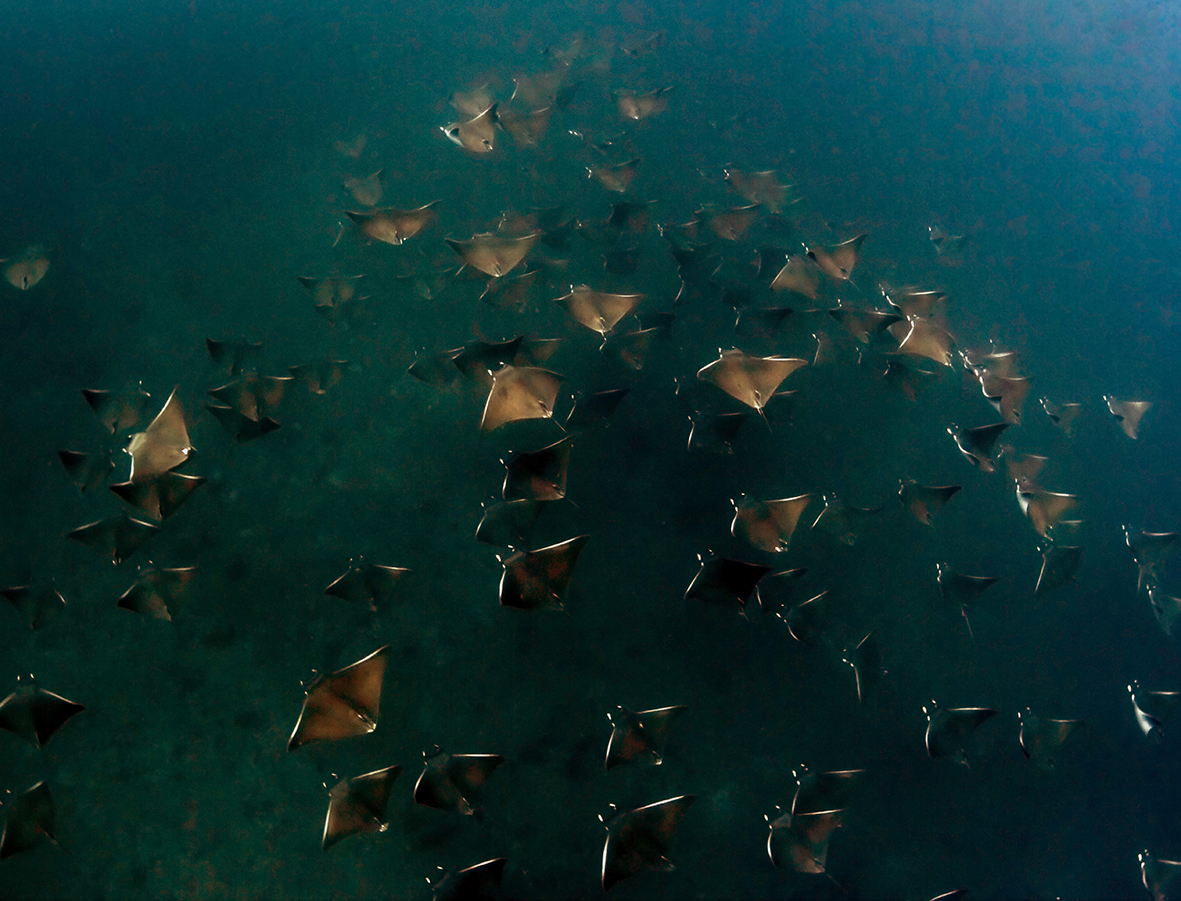
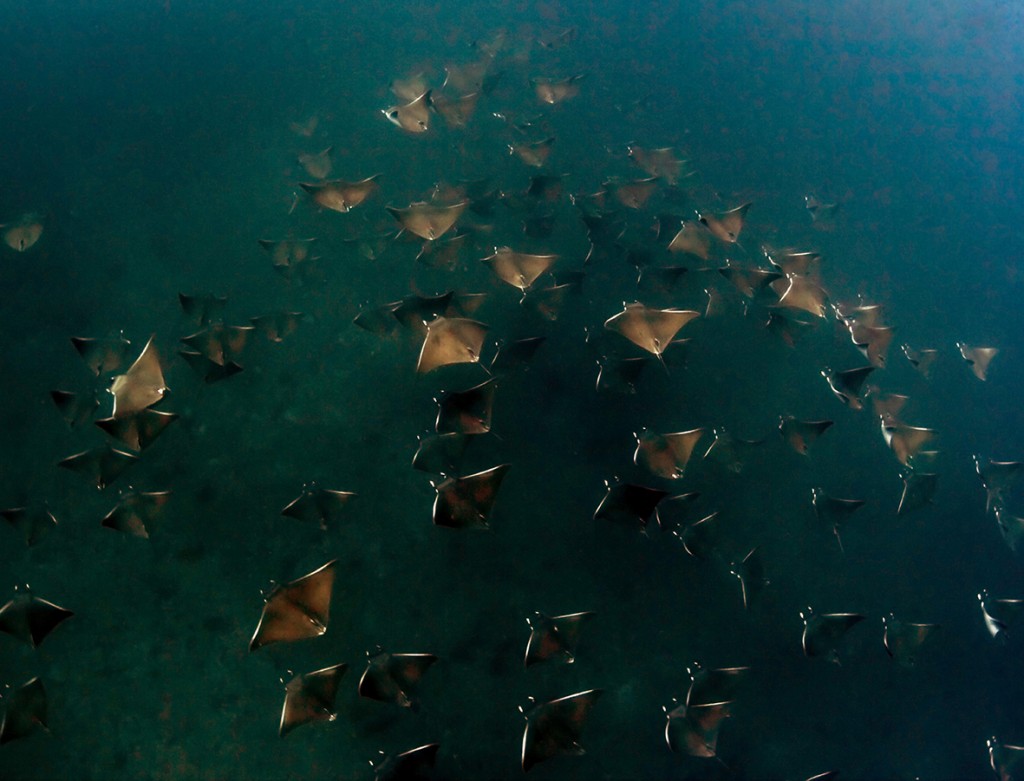
If you're lucky you can spot bow mouth guitar rays, honeycomb rays, reef sharks, dolphins, and humpback whales © Juan Vega

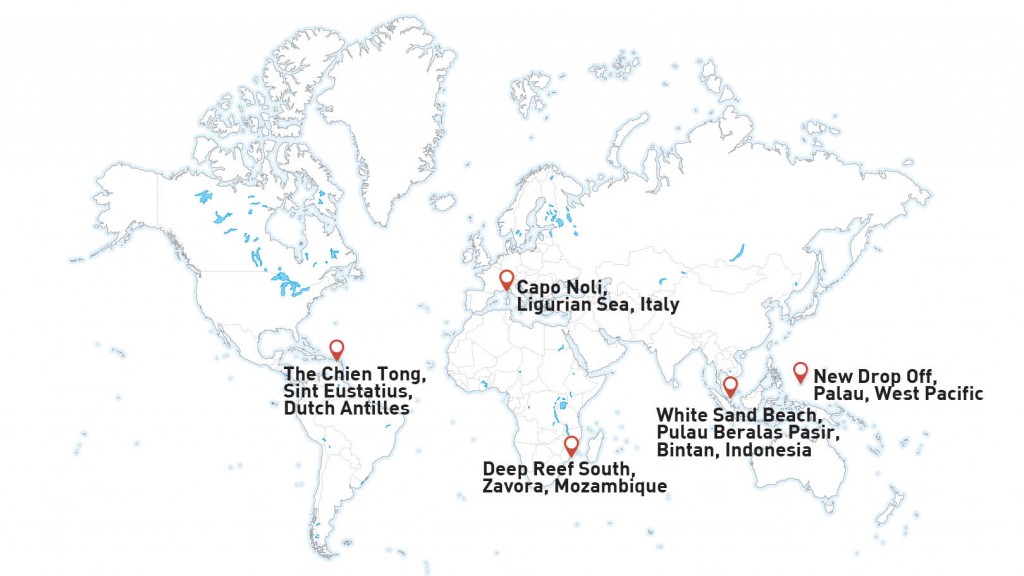
From giant manta rays to minute nudibranchs, we scour the globe to bring you a breakdown of five extraordinary dives that you need to know about:

World Map


Capo Noli, Ligurian Sea, Italy

By Isabella Maffei

Expect
A great muck dive, full of nudibranchs, sea horses, tubeworms, octopus, cuttlefish, and blennies

If you’re lucky
Monkfish and schools of anchovies

When
From June to September Gear A decent wetsuit, especially if you feel the cold

Training
Open Water

Getting there
Fly into Genova and take the train from Genova Porta Principe to Noli

On arrival
No visas are required for CEE citizens. Other nationals please check your country’s agreement

Languages
Italian, English

Time Zone
UTC/GMT +1

Currency
Euro 

For more information www.divenjoy.it, www.airport.genova.it

Expect a great muck dive full of nudibranchs, sea horses and many more © Isabella Maffei

New Drop Off, Palau, West Pacific

By Reinhard Arndt

Expect
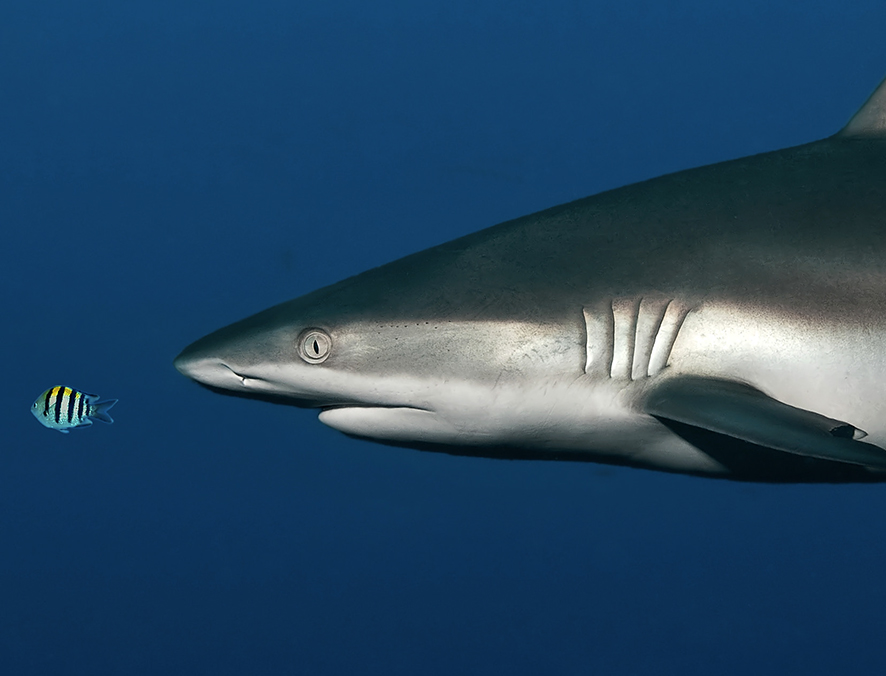
A vertical wall with a plateau at 10 metres, dropping to around 150 metres. Large sea fans, colourful soft corals, grey reef sharks, clouds of pyramid butterflyfish, square anthias, moorish idols, sergeant majors and yellowtail fusiliers. Occasionally turtles, large schools of barracudas and snappers, spotted eagle rays and Napoleon wrasse.

When
November to April, when visibility is between 15 to 40 metres depending on the tides, and water temperature from 28 to 30°C

Gear
November to April, when visibility is between 15 to 40 metres depending on the tides, and water temperature from 28 to 30°C

Training
Novice/Open Water if no current. Advanced if the current is strong.

Dive with
Fish’n Fins, Sam’s Tours

Getting there
From Europe via Manila or Taipei to Korror (Palau), from USA via Guam

On arrival
Citizens of the USA do not need a visa for a stay of up to one year. For most other nationals, a tourist visa is available for free at the airport.

Languages
Palauan, English

Time Zone
UTC/GMT +9

Currency
US Dollars

For more information www.palau.visahq.com, www.fishnfins.com, www.samstours.com

Expect a vertical wall with a plateau at 10 metres, dropping to around 150 metres. Spot large sea fans, colourful soft corals, grey reef sharks and many more" © Reinhard Arndt
Expect a vertical wall with a plateau at 10 metres, dropping to around 150 metres. Spot large sea fans, colourful soft corals, grey reef sharks and many more” © Reinhard Arndt

Deep Reef South, Zavora, Mozambique

By Juan Vega

Expect
Manta rays, turtles, groupers, and barracudas

If you’re lucky
Bow mouth guitar rays, honeycomb rays, reef sharks, dolphins, and humpback whales

When
All year round Winter: water temperature 20°C, visibility 15m. Summer: water temp. 27°C, visibility 20m

Gear
Recreational gear with nitrox if you’re certified

Training
Advanced Open Water

Getting there
Nearest airport is at Inhambane, two hours from Zavora, pick-ups arranged by the dive centre

On arrival
Most nationals require a visa to enter Mozambique, and some cannot be obtained on arrival. Check with your local embassy or consulate.

Languages
Portuguese, some English

Time Zone
GMT +2 Currency Mozambican metical

If you're lucky you can spot bow mouth guitar rays, honeycomb rays, reef sharks, dolphins, and humpback whales © Juan Vega
If you’re lucky you can spot bow mouth guitar rays, honeycomb rays, reef sharks, dolphins, and humpback whales © Juan Vega
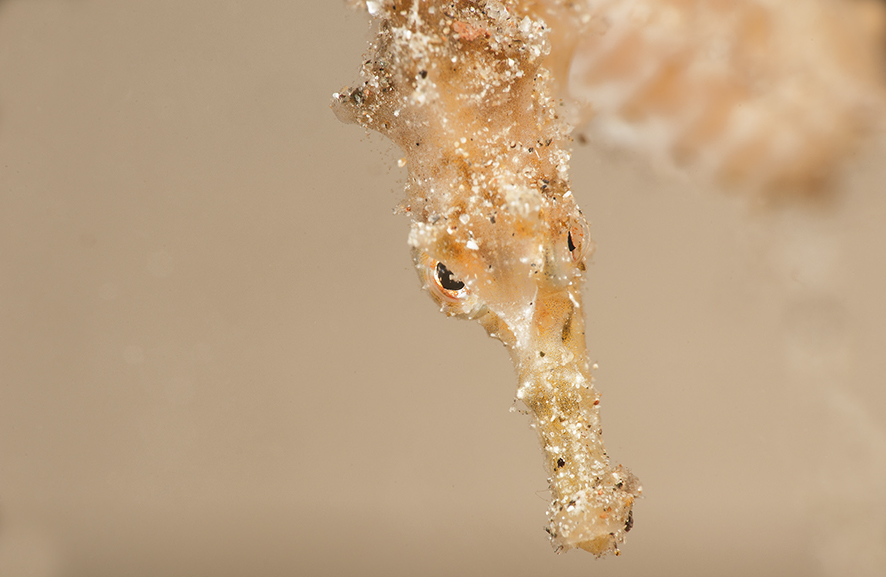
Don't dive without a torch for critter spotting! © Jonathan Lin
Don’t dive without a torch for critter spotting! © Jonathan Lin


White Sand Beach, Pulau Beralas Pasir, Bintan, Indonesia

By Jonathan Lin

Expect
Nudibranchs, pygmy cuttlefish, common cuttlefish, pipehorse, cowries

If you’re lucky
Tiger shrimp, long-arm octopus, coconut octopus, turtles

When
Season is from March to November, though conditions can be unpredictable

Don’t dive without
A torch for critter spotting!

Training
Open Water Dive with Tasik Divers Bintan

Getting there
Easily accessible from Singapore via a one-hour ferry ride from Tanah Merah Ferry terminal, and then one hour by car to the site

On arrival
Visa on arrival for most nationals

Languages
English, Bahasa Indonesia

Time Zone
GMT + 8

Currency
Indonesian rupiah  

For more information www.tasikdivers.com/bintan


The Chien Tong, Sint Eustatius, Dutch Antilles

By Damien Mauric

Expect
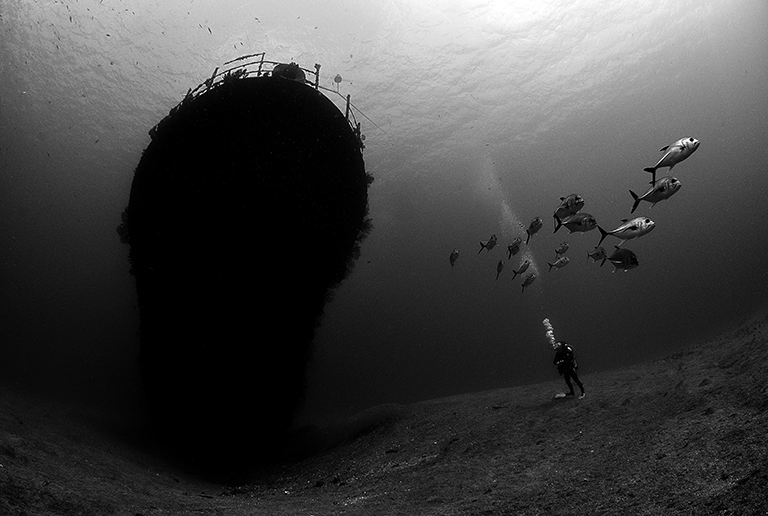
Large schools of jackfish around the wreck, turtles, rays, and moray eels

When
All year round, except during the hurricane season in September. Visibility ranges from 20 to 40 metres. Water temperature will vary from 30°C in July to 25°C in January.

Gear
3mm or 5mm wetsuit

Training
All levels

Getting there
Fly into St. Maarten (Princess Juliana Airport), then on to St. Eustatius with Winair

On arrival
For stays of up to three months, most nationals do not need a visa.

Languages
English, French and Dutch

Time Zone
UTC/GMT -4

Currency
Euro

For more information www.statiatourism.com

Expect large schools of jackfish around the wreck, turtles, rays, and moray eels © Damien Mauric

This article featured in SD Ocean Planet “Let There Be Light”

11 Tiny Creatures to Discover in the Coral Triangle

0
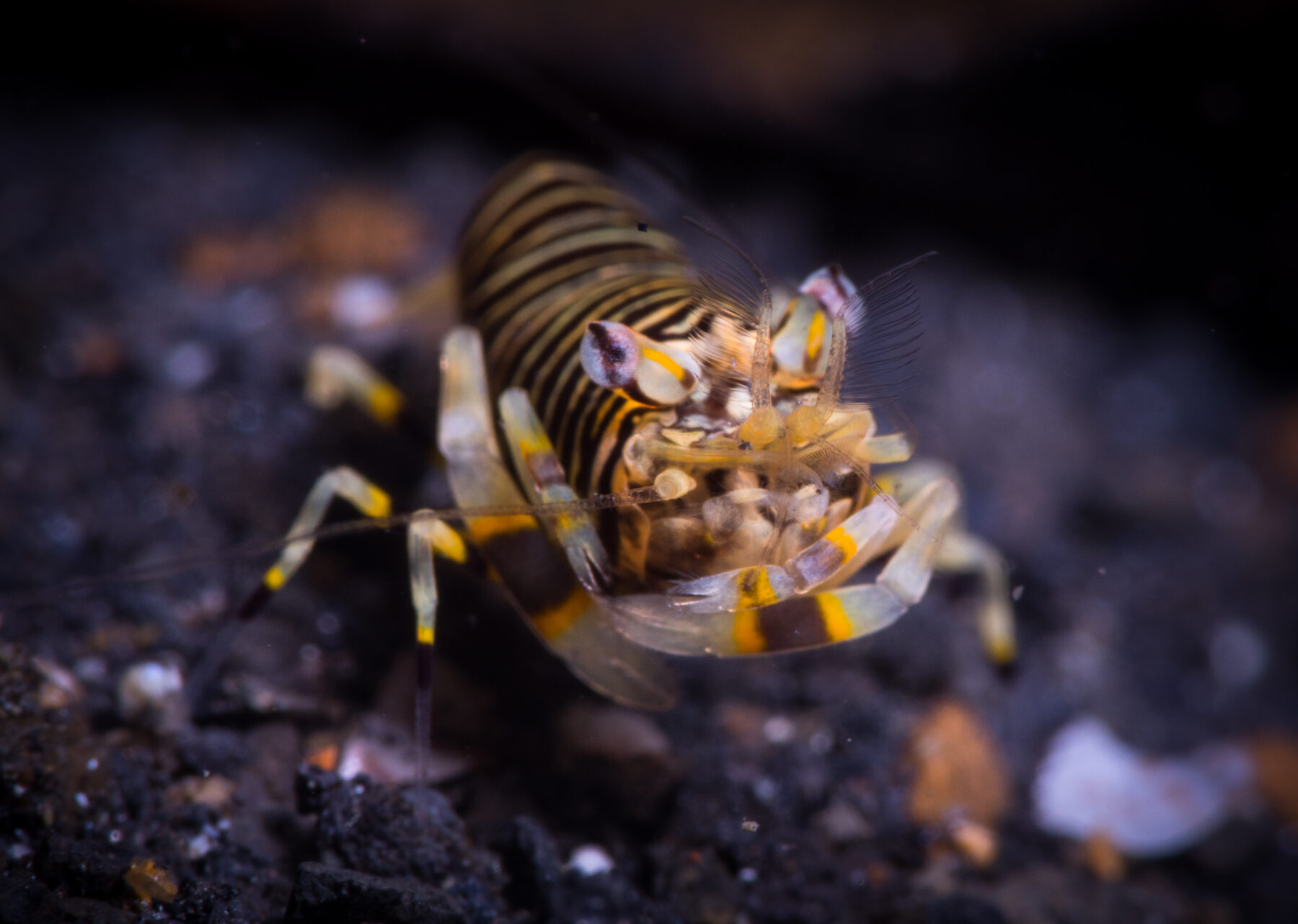
Bumblebee Shrimp © Gill McDonald

The Coral Triangle is a haven for exotic little critters, and underwater photographers flock to its macro hotspots to seek out the rare and the beautiful. Here are 11 of the top critters from the region that should be on every diver’s bucket list:

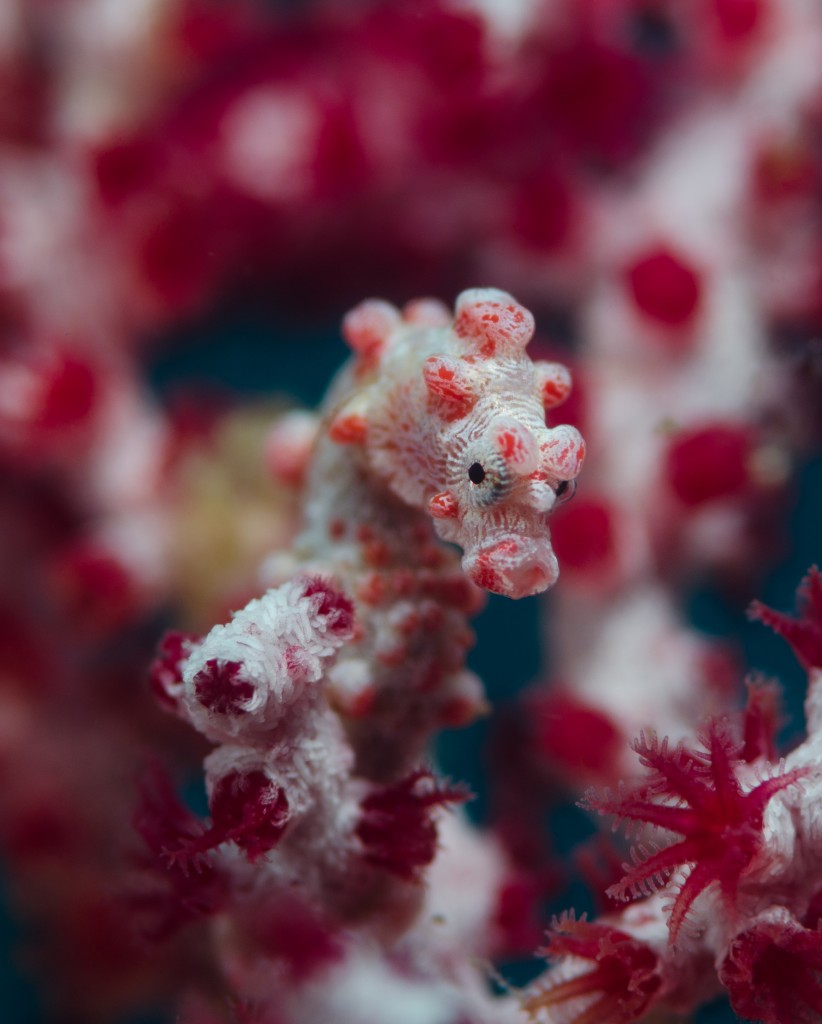
Pygmy Seahorse

© Gill McDonald
© Gill McDonald

The first pygmy seahorse known to science was Hippocampus bargibanti. It was found only when a host gorgonian was being examined in a laboratory. At least six more species were named after 2000. The popular bargibanti, high on all underwater photographers’ bucket lists, lives its entire adult life on a single, specific type of gorgonian fan coral, Muricella.

Weedy Scorpionfish (Rhinopias)

Rhinopias, like most scorpionfish, is a nocturnal camouflage hunter, adapting its many colours to its habitat. It rarely swims, rather it propels itself along the seabed with its fins. A relatively rare critter, divers get very excited when they hear one is around, as experienced guides are usually able to locate it repeatedly once they know its general location.

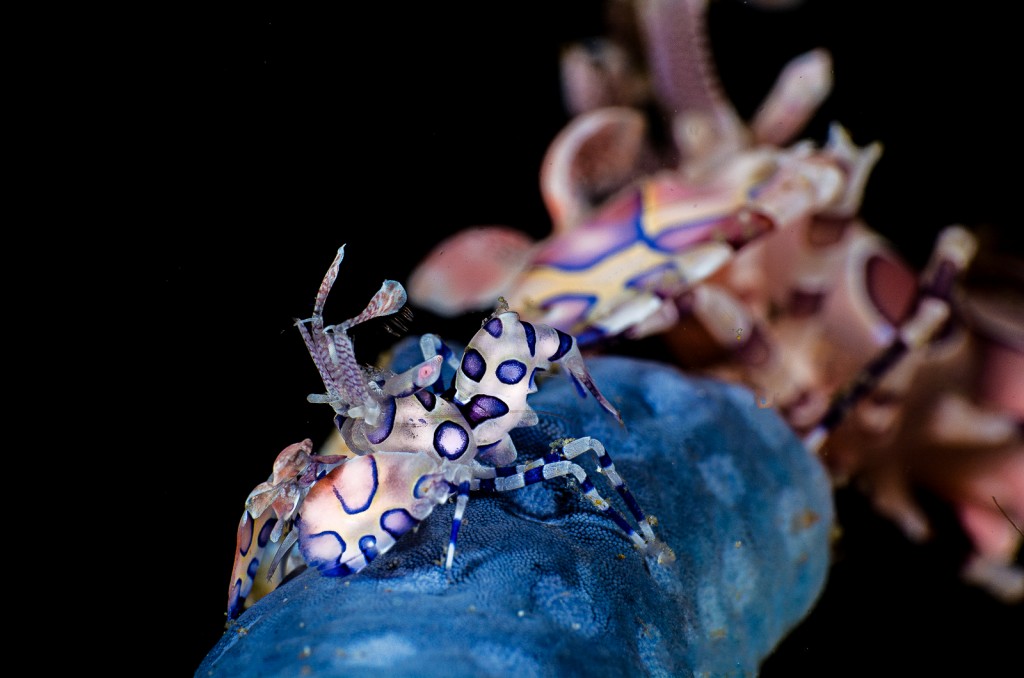
Harlequin Shrimp

These pretty, constantly moving shrimps live in pairs, feeding exclusively on starfish. They often have, respectively, pink and blue markings so appear to be traditionally dressed for their boy/ girl pairing. They maintain a “live larder” – feeding on living, usually slow-moving starfish by flipping them over and then devouring the tube feet and soft tissue.

© Mike Bartick
© Mike Bartick

Wonderpus Octopus

Another “must see” on any tropical muck dive is the lovely little wonderpus. It is often confused with the mimic octopus (see No. 8), which has similar colouring. Normally fairly shallow, the wonderpus emerges very slowly from its discreet hiding hole in the sand and hunts at dawn or dusk, whereas the mimic is out and about in the daytime.

“Shaun the Sheep” Sap-Sucking Slug

A recent entry on the underwater photographer’s wish list, this tiny, leaf-dwelling slug resembles a certain cartoon sheep. With its beady black eyes, floppy “ears” and bizarre looking body, it is undeniably cute, although very difficult to photograph, as it reaches a maximum of 5mm and is often around just 2mm.

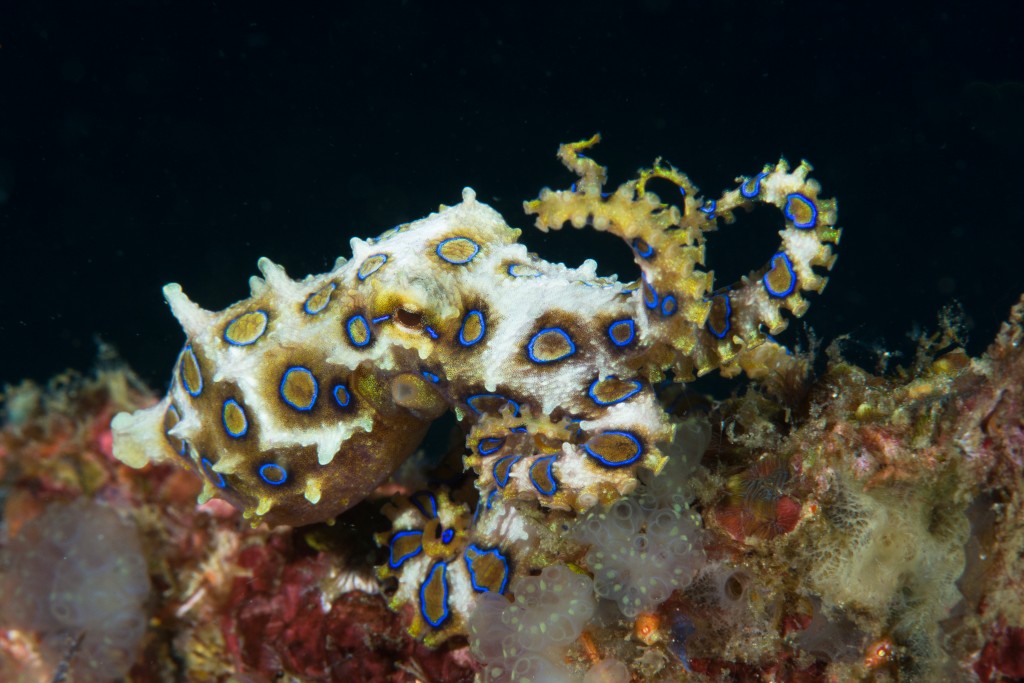
Blue-Ring Octopus

This is among the deadliest animals in the sea. Its venom is similar to the extremely deadly toxin found in the pufferfish. The effect of a bite can be fatal, but if a victim is kept breathing with artificial respiration even up to 24 hours after the event, they can recover. It is barely the length of a pencil and covered with bright, iridescent blue rings.

© Mike Bartick
© Mike Bartick

Mimic Octopus

Discovered as recently as 1998 in Sulawesi, Indonesia, this is one of the all time “wishlist” critters on any exotic muck dive. It is surprisingly small, growing to a length of 60cm including arms. Its “party trick” is being able to change its skin, colour and texture to blend in with the environment and/or mimic other species to avoid or intimidate predators.

Bumblebee Shrimp

This beautiful little shrimp resembles a bumblebee with its yellow and black stripes and strangely truncated, flat face. It seldom swims, preferring to rummage around undercover among rubble and debris. It does not venture far from its habitat so can usually be found by knowledgeable dive guides globally in tropical lagoons and reefs.

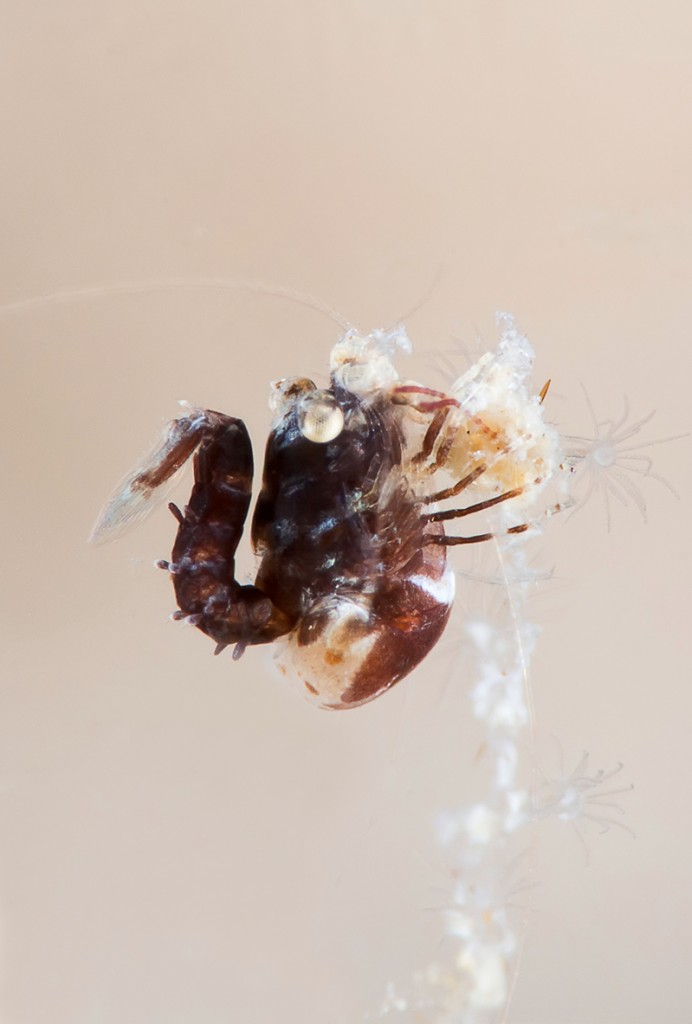
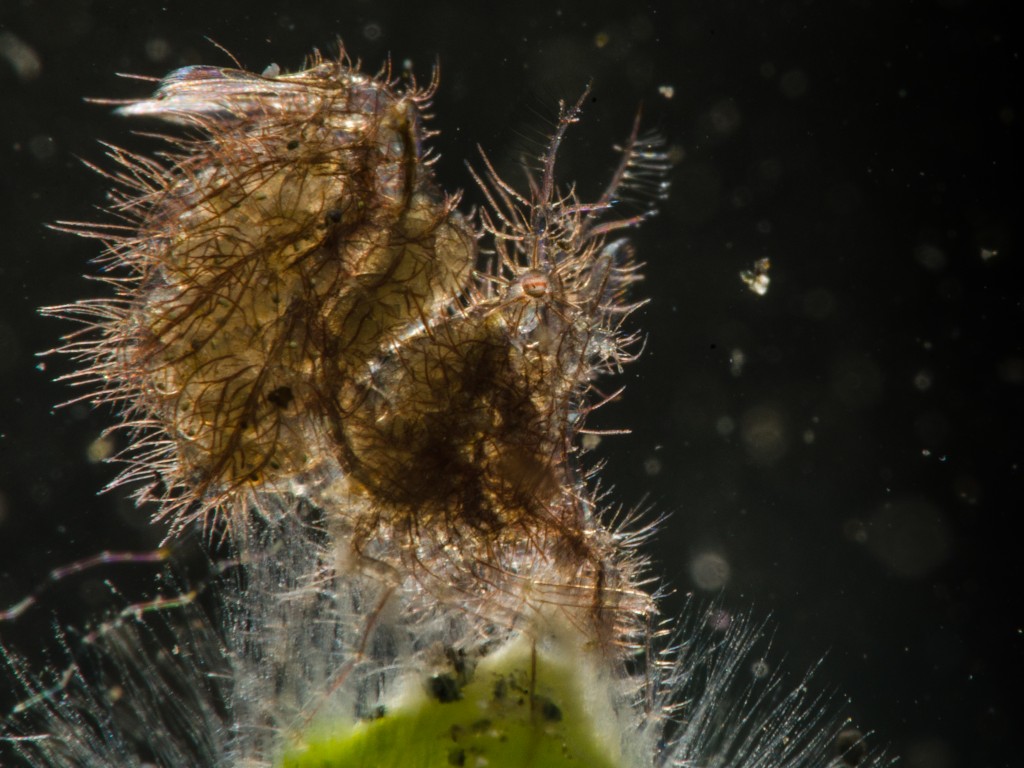
Hairy Shrimp

The hairy shrimp is so tiny it is difficult to discern with the naked eye, resembling nothing more than a dot of algae. An adept dive guide can gently sweep the algae growth on a coral reef to find one. It can be in a variety of colours to blend in with its home. The one pictured is carrying eggs in its tail area.

© Gill McDonald
© Gill McDonald

Candy Crab (Soft Coral Crab)

This adorable little crustacean lives amongst the colourful spikes of Dendronephthya soft coral. It attaches polyps from the coral to its carapace to improve its camouflage, which is already impressive as it mimics the colours of the coral in which it lives. These are normally pink, white, yellow or red.

This article originally featured in SD OCEAN PLANET (Issue 2/2016)

Explore the Big Blue Land of the Seahorse

0
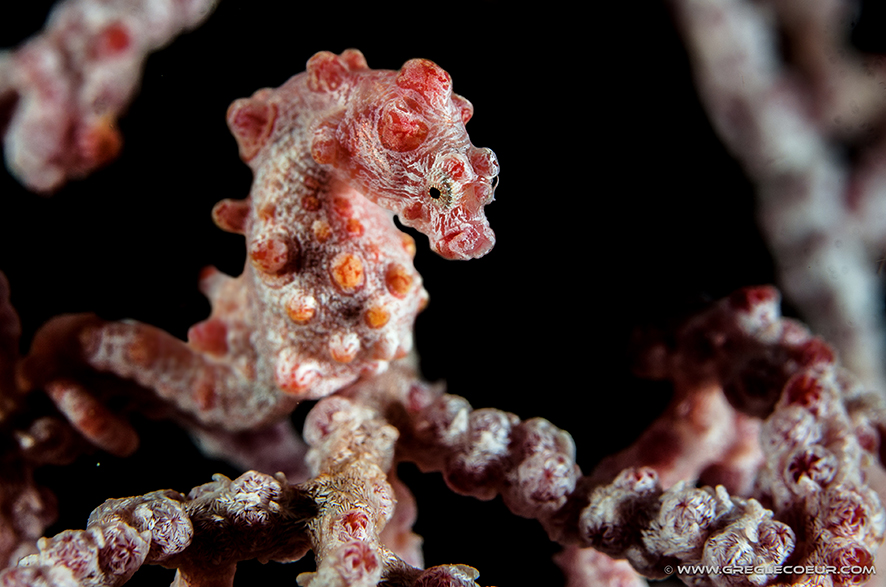
Divers will travel great distances to see critters like this Bargibant's pygmy seahorse © Greg Lecoeur

Asian Diver’s special ADEX edition, The Big Blue Book, is still out there waiting for you to discover it. A fact-packed bumper issue full of inspiring stories and eye-popping images, if you think you know a lot about seahorses, prepare to be schooled!

But this ain’t no ordinary source of information! We’ve got “edutainment” nailed with stories like these…

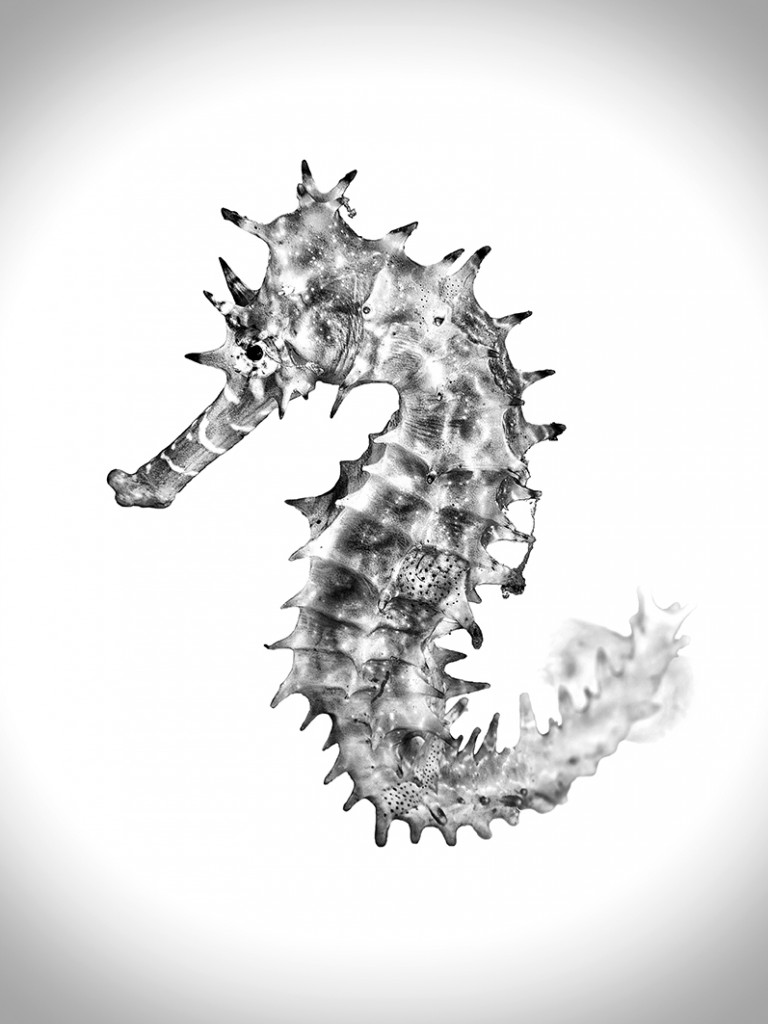
Hippocampus comes (Tiger-tail seahorse) © Andrew Marriott

Gallery

Everyone knows ADEX attracts the world’s best underwater photographers. Wait until you see what these genius aquatic shutterbugs have captured from the world of Hippocamp!

We’ve also gone and thrown in a comprehensive distribution run down for every recorded species of seahorse in the world, so if you’re still tailing a sighting of one particular little critter, let us help you hone in.

Man & Seahorse: Scuba for the Seahorse

Dedicating one of Asian Diver’s newest and best loved sections, Man & Sea, to the ADEX 2016 icon, marine biologist Maarten De Brawuer reveals the incredible impact these unassuming little fish can have on local communities.

Seahorses are one of the most sought after critters in any muck diving location, and, as such, can generate important revenue for coastal populations though the lucrative muck diving industry.

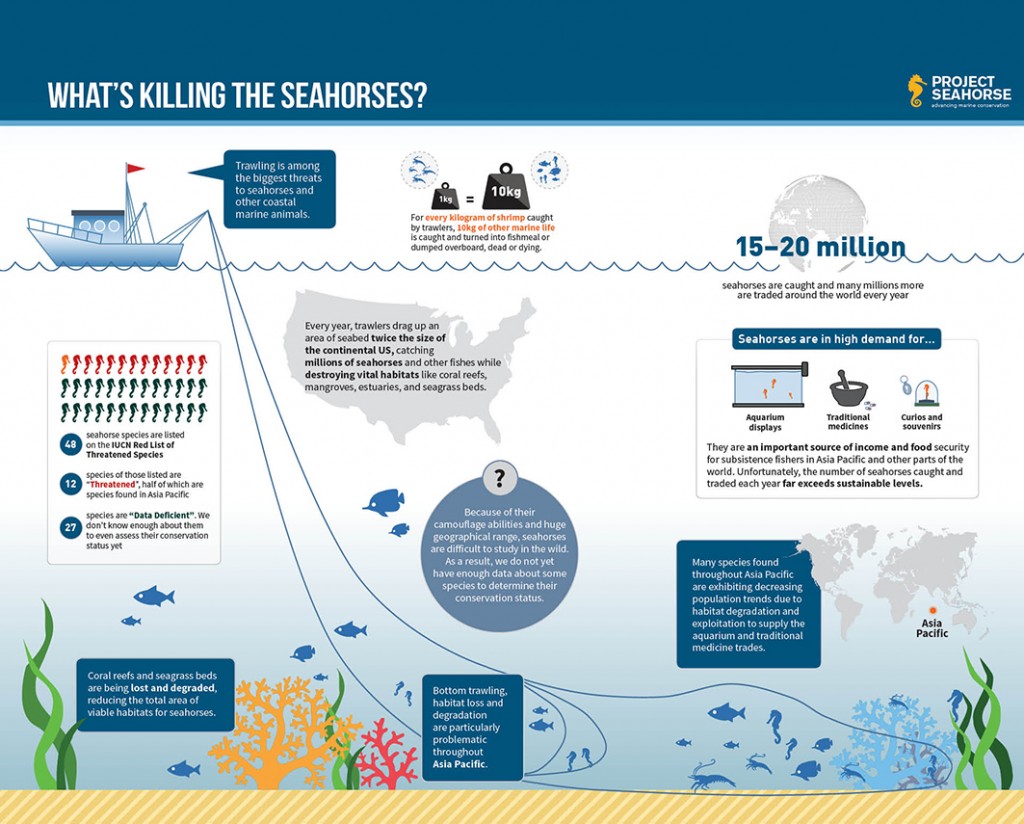
What’s Killing the Seahorses?

Project Seahorse gives it to us straight with the world’s biggest threats to seahorse populations. You love these magnificent little creatures? Better take prawns and shrimp off your menu quick smart…

Infographic

7 Underwater Video Kits You Should Know

0

Looking to bring those incredible dive encounters you’ve been experiencing below the waves to your computer screen or TV? Allow these top-of-the-industry products to bring out your inner Cousteau, and launch a passion that will last a lifetime:

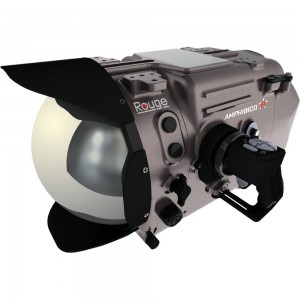
Amphibico RougeAmphibico_rovh0001_Rouge_Underwater_Housing_for_882082

MSRP USD12,995

A state-of-the-art aluminium housing for the RED series of high-end cameras, puts all controls at your fingertips. Designed for professional underwater use, there are no tools required to mount the camera in housing, making for a quick topside ready camera in minutes.

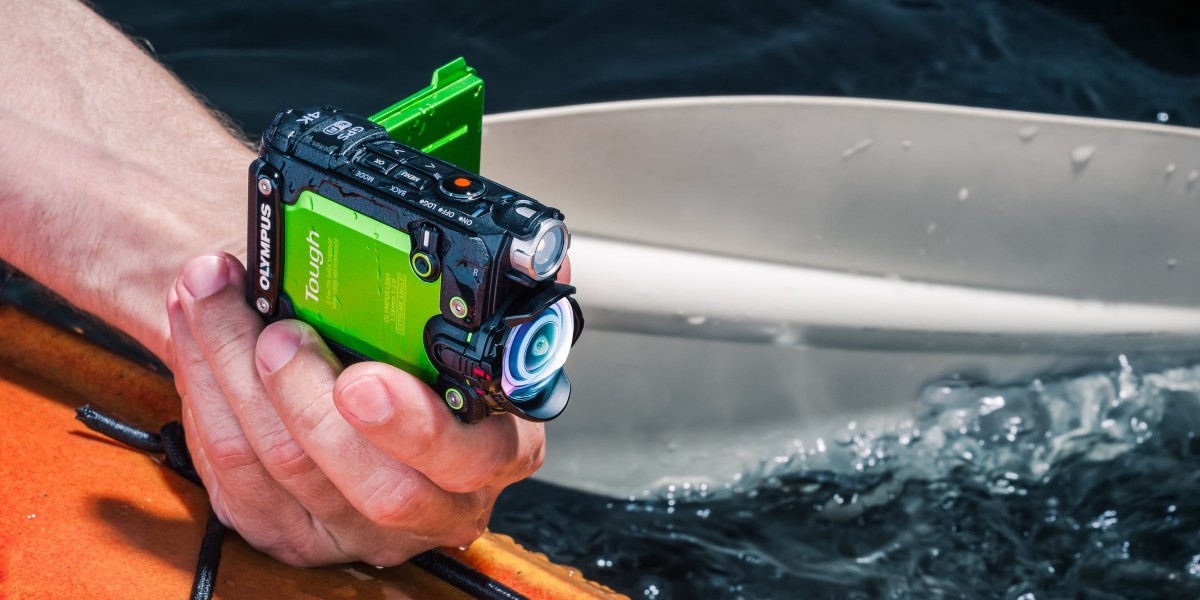
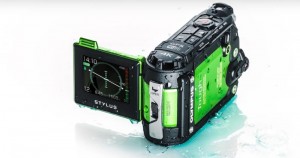
Olympus Tough TG-Trackertoughcam-800x420

MSRP USD350

An action camera that’s tough enough to keep up with any adventure. The pocket-sized TG-Tracker records Ultra HD 4K video using advanced Olympus optics. Being waterproof to 30metres, and freezeproof to -10ºC, the TG-Tracker is perfect for both above and below. The incredible 204º Extreme Angle offers an extremely wide view.

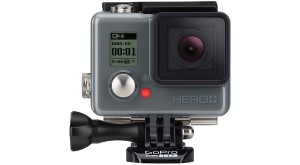
GoPro Hero+gopro-hero-plus

MSRP USD199

The entry level GoPro Hero+ is without an LCD screen, and is waterproof to 40 metres. Offering 60fps at 1080p recording, and 8MP, the Go Pro Hero+ is able to capture time lapse an burst photos. It is Wi-Fi and Bluetooth enabled.

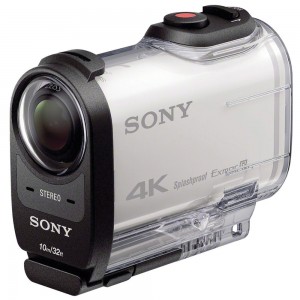
Sony X1000V/ X1000VRsony_fdr_x1000v_4k_action_cam_1109328

MSRP USD650

Offering 4K Ultra HD for four times the detail of Full HD, the Sony’s enhanced Full HD captures crisp, clear images in rich colour. You can also record fast-moving action at Full HD 120p for beautiful slo-mo. The 170º ultra-wide Zeiss Tessar Lens is great for panoramic shots. The Sony X1000V / X1000VR is dustproof, shockproof and waterproof to 10 metres and is Wi-Fi and GPS enabled.

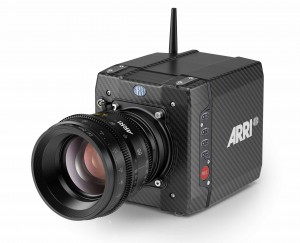
ARRI Alexa Mini Camera Body

MSRP USD45,000

ARRI ALEXA Mini is a versatile additional tool in the world-leading ALEXA camera range of professional video cameras. It’s compact, lightweight and self-contained. It also eliminates the complications of working with third-party cameras for specialised shots and keeping everything within a single system that is trusted all over the world.

Nauticam Housing for ARRI ALEXA Mini CameraARRI-ALEXA-Mini

MSRP USD45,000

This housing applies that Nauticam excellence to the ARRI ALEXA Mini, and includes an N200 250mm optical glass wide-angle port, N200 extension rings 30, 40 and 50, with lens control drive shafts. It is produced in collaboration with HydroFlex, one of the world’s leading underwater cinema equipment rental houses.

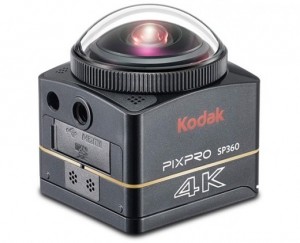
Kodak PIXPRO SP360-4KKodak_PixPro

MSRP USD500

This camera allows you to shoot 360–degree videos in 4K resolution. With a 12MP BSI CMOS sensor and dome-shaped f/2.8 lens, the Kodak has built in Wi-Fi and NFC – allowing you to use the camera with PIXPRO Android and iOS apps. The camera is versatile: It can support several attachments, including a waterproof housing, suction mounts, and remote controls.