Home Blog Page 6

A Painful Lesson

0

WITH BITES AND STINGS FROM MARINE ANIMALS, IT IS ALWAYS PRUDENT TO HAVE THEM LOOKED AT AND TREATED IMMEDIATELY

THE SITUATION
On one of the dives, a diver collected what he thought was an empty moon snail shell. The divers did not realise that a juvenile giant Pacific octopus (Enteroctopus dofleini) had taken up residence in the shell. When the octopus crawled out after the dive, another diver picked it up with her bare hands to return it to the water. But before she could, the octopus bit her three times in the same place, on the back of her left hand. She said the bites felt like bee stings. As the wound bled moderately, the diver rinsed it first with salt water, and then 40 minutes later with soap and fresh water. Swelling appeared within 30 minutes and became severe within about an hour. The diver was a healthy, 32-year-old woman with 130 logged dives. She had no allergies or health problems and had just completed her second dive on day two of her dive trip. Although blue ringed octopus bites are famous for being potentially deadly, bites from most other octopus species are generally not problematic. Recently, however, scientists have come to understand that all octopus bites are venomous to some degree.

IGNORING THE PAIN
About four hours later, this diver went for another dive. Upon surfacing, she felt nauseous and vomited. It must also be noted that she had not previously experienced such symptoms after diving. The nausea receded quickly, however, and the diver went on five more dives over the next two days despite significant swelling and compromised mobility.

INEFFECTIVE SELF-TREATMENT
The diver wore a drysuit and neoprene gloves on every dive. When not diving, she kept the wound dry and applied an over-the-counter antibiotic ointment. She also took an over-the counter antihistamine and applied crushed aspirin to the skin surrounding the puncture site (not directly on the wound), but none of these provided any relief. Significant itching and pain reached their peak five to six days after the incident.

THE CONSEQUENCE OF INFECTION
About three days after the bite, the wound became infected and developed into a dark, quarter-inch lesion surrounded by a raised, reddish area that turned blackish-green nine days after the incident. Moderate pain, significant itching and swelling lasted for more than a month. The lesion took approximately seven weeks to heal, although pain, sensitivity to touch, and itching lasted for three months, with minor flare-ups still occurring four to five months after the incident. The diver’s physician first prescribed a 10- day course of antibiotics. Evolving symptoms and progressive discolouration, however, prompted the doctor to prescribe an additional antibiotic along with an antihistamine for another 10 days to manage the itching. RESULT OF DELAYS IN PROPER CARE The delay in proper wound care may have been a complicating factor. DAN recommends washing marine bites immediately with soap and clean water to minimise the risk of infection. Infection can impair healing and lead to significant tissue damage. Divers should not dive with open wounds because exposure to the aquatic environment, with its myriad of antigens and toxins, can increase further infection.

WATCH FOR SIGNS OF INFECTION
Monitoring the wound is important since signs of infection can appear between a few hours and several weeks following an injury. The immediate swelling the diver experienced may have been a consequence of the initial trauma, but further exposure to the sea on her subsequent dives prolonged the symptoms and likely resulted in a serious infection.

TREAT WOUNDS IMMIDEDIATELY
An additional complication in this case may have been the delay in proper medical care. DAN advises divers to treat wounds caused by marine life like any other animal bite, and seek prompt, medical attention. In this case, the wound was evaluated 10 days after the incident, and the delayed treatment limited the progression of the diver’s recovery. This incident should serve as a reminder that timely treatment of wounds can reduce the risk of serious infection. Whenever possible, divers should photograph their wounds, because images can help medical staff provide more effective and efficient care. Divers should also understand that handling marine life may lead to injuries, some of which can result in serious complications.
World.DAN.org

ADEX Marine Carnival Returns to Beijing with Expanded Offerings and Beer Festival Collaboration, July 12-14, 2024

0

ADEX is set to celebrate the largest marine carnival in Asia, from July 12 to 14, 2024, at the China International Exhibition Center (Shunyi Hall) in Beijing. The event marks ADEX’s return to Beijing after its highly successful show in 2019, and features an expanded and upgraded show, presented as the China International Island Tourism & Marine Sports Expo. Additionally, ADEX will team up with the Beer Festival to create a large-scale municipal event in Beijing, bringing citizens an exciting summer carnival.

ADEX Beijing Dive Fiesta 2024, spanning a total of 50,000 square meters will showcase multiple exhibition areas on-site. It will include an island tourism zone, a marine equipment (technology) zone, a mermaid zone, and a beer culture zone, allowing visitors to experience the fusion of ocean and beer.

As always ADEX will focus on promoting and practicing sustainable marine concepts. The event organizers will actively advocate for a low-carbon and environmentally friendly lifestyle, encouraging visitors to participate in environmental interactive games and public welfare activities, contributing to marine ecological protection.

The island tourism exhibition area will highlight global destinations and highly cost-effective tourism resources, enabling visitors to enjoy the best travel services at the most affordable prices, and plan their island trips easily and comfortably.

The marine equipment and technology zone will feature a series of the latest marine technology innovations and diving sports equipment, from high-performance diving equipment to intelligent ocean monitoring devices.

Visitors can also enjoy exciting underwater dance competitions and mermaid performances.

The Beer carnival will be a visual and auditory feast integrating the charm of the ocean and beer culture. A special beer tasting area will be set up on-site, offering craft beers from around the world, allowing visitors to enjoy fine brews while also appreciating wonderful marine cultural performances and interactive activities.

Please visit www.adex.asia for more details and inquiries.

Asia’s largest diving exhibition “ASIA DIVE EXPO” held for the first time in Japan

0

Singapore – May 25, 2024

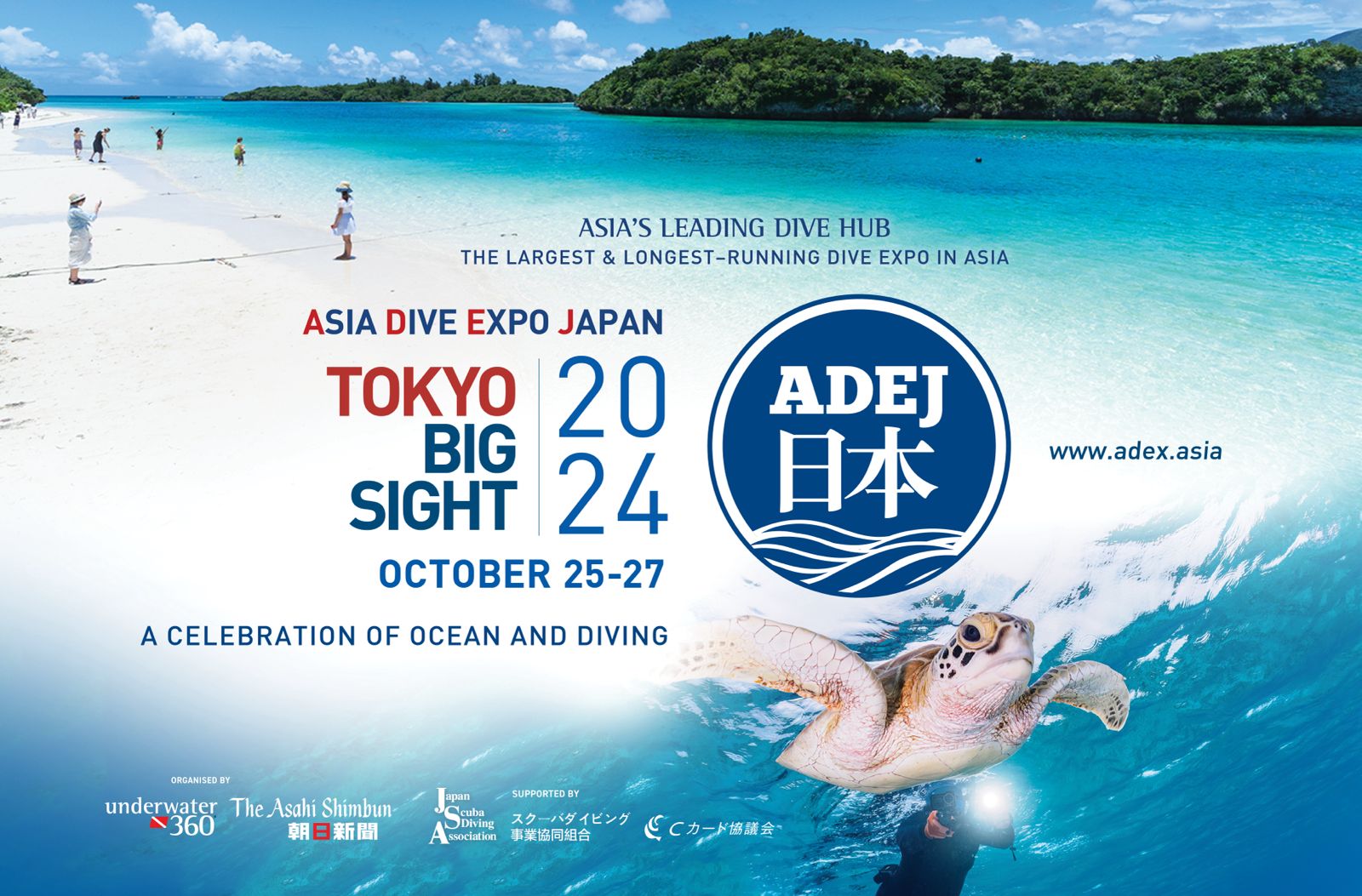
Asia Dive Expo (ADEX), renowned as Asia’s largest and longest-running dive exhibition, celebrates its 30th anniversary in 2024 with an expansion into Japan. For the first time, a celebration of sea and diving, “ASIA DIVE EXPO JAPAN (ADEJ),” is scheduled to be held at Tokyo Big Sight from October 25th to 27th, 2024.

Established in 1995, Asia Dive Expo has transformed into a comprehensive marine event attracting divers, non-divers, students, and families alike. Over the years, ADEX has dedicated each edition to addressing critical marine issues, such as climate change and plastic pollution, while advocating for marine conservation and biodiversity. Based in Singapore and spearheaded by Asian Diver Magazines, Asia Dive Expo is Asia’s leading dive consumer and trade expo, with international and industry recognition.
Jointly hosted by The Asahi Shimbun and Underwater360, Asia Dive Expo Japan promises to enchant divers, dive operators, and marine enthusiasts, offering a platform to share ideas, explore solutions and champion marine environmental protection.
ASIA DIVE EXPO JAPAN embodies the concept of a “festival of the sea and diving,” offering attendees the opportunity to engage with diving-related products, services, and interactive displays. The event will feature expert stage presentations, educational workshops, and appearances by renowned divers, celebrities, and academic experts, addressing vital topics related to the ocean and industry.

The Asahi Shimbun, one of Japan’s premier newspapers, serves as the Co-organizer for ASIA DIVE EXPO JAPAN. Concurrently, the GOOD LIFE Fair, Japan’s largest consumer exhibition on daily life enrichment and sustainability, will enhance the event’s appeal, attracting visitors with a keen interest in diving and marine conservation.

“We want the Japan diving community to grow”, remarked John Thet, CEO, ADEX. “In the past, Japanese divers were seen all over the world, but now we see fewer Japanese divers traveling to different locations. ADEX’s strength is to educate and raise awareness for the ocean, divers, and potential divers in Japan. Join us for this opportunity to be part of the dive community and contribute to the growth of ocean awareness in Japan.”
For further information and updates on ASIA DIVE EXPO JAPAN, please visit the official website at www.adex.asia and https://adex.asahi-expo.jp/


For further inquiries please contact:
Mihiri S Korala
Marketing Department
Asian Geographic Magazines Pte Ltd
mihiri@uw360.asia

Full Moon Party

0

The World’s Largest Camouflage Grouper Spawning

Text and images by Alfonso Ribote

Males and females look for the right partner to spawn

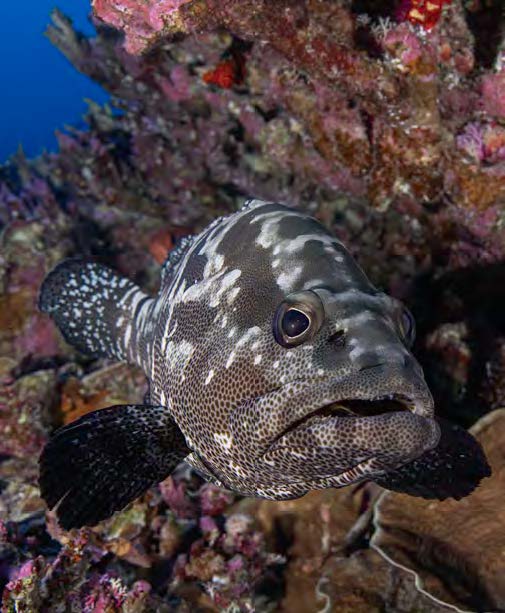
French Polynesia is your typical island paradise of swaying palm trees and white sandy beaches located in the southeast Pacific Ocean and formed by five different archipelagos – Austral, Society, Gambier, Marquesas and Tuamotu. But divers go there for a different type of action that happens only once a year during a full moon – to witness the world’s largest aggregation of the camouflage grouper (Epinephelus polyphekadion) in Tetamanu Pass, Fakarava’s southern channel in the Tuamotu Archipelago. Fakarava has been designated a Biosphere Reserve by UNESCO. 

AN ANNUAL AFFAIR

Between the end of June and the beginning of July, these groupers gather in phenomenal numbers in the channel, waiting for the right time to spawn. Scientists have estimated theaggregation to be between 15,000 and 18,000individuals. The fish gather at the mouth of the channel and wait at the bottom.

WAITING FOR THE RIGHT MOMENT

As the spawning day draws closer, the number of groupers increases so dramatically that they literally cover the entire bottom of the channel. The bellies of the females grow significantly to hold the eggs they will release into the water, and the territorial males fight for the most ideal positions, closest to the most fecund females, who look like they are about to explode.

FISHY ORGY

The right moment happens very early in the morning during the strong outgoing currents of the full moon. As the males change colour to a very light green, and the females have selected their mates, they rise from the bottom together, cheek-to-cheek, and release their load into the water. Many opportunistic males quickly follow after to join the party, creating a white haze of messy love scenes! The fertilised eggs are then carried by the currents, and are at the mercy of the open ocean.

FISH BUFFET

Tetamanu Pass is also known for having the highest population of grey reef sharks in the world – and the number blows up to an estimated 700 sharks during the grouper spawning. Other shark species like oceanic blacktips, lemons, silvertips and whitetip reef sharks are also present, though in much smaller numbers.They are the main predators of the groupers during the spawning. The sharks take advantage of this moment to have a good meal, as the groupers are more vulnerable –away from the shelter of the reef and solely focused on spawning their future offspring. Other groups of predators waiting for their chance to feed are the smaller fishes, which try and eat as many eggs as possible before they are swept out by the currents.

Once the partners are chosen, they slowly rise from the seabed together

LIFE CYCLE

When the fertilised eggs that make it to the open ocean hatch, the baby groupers grow very quickly to a certain size beforere turning to the reef to start the whole cycle again.

A COMMON SIGHT

The species is distributed in the Indo-Pacific, from the Red Sea, along East Africa, south to Mozambique, and east of French Polynesia. You can also find them in the western Pacific, from southern Japan to southern Queensland in Australia’s Great Barrier Reef. You can normally find them at depths of one to 60 metres. This species is only found in big numbers during its reproductive season when they migrate to the spawning areas. Its life span is about 30 years and it reaches sexual maturity at around four to five years.


If you want to enjoy more stories like this, subscribe to

https://shop.asiangeo.com/product/asian-diver-no-167/

The Allure of the Pearl

0

THE WORLD’S ONLY LIVING GEM

Ever since this precious orb was discovered, gleaming inside its oyster, humans have been captivated by its natural beauty and distinct qualities.

A TIMELESS TREASURE

People believe the first pearls were discovered by those looking for food along the seashore. As the world’s oldest gem, revered long before written history, pearls were the first treasures coveted by ancient Chinese, Persian and Roman civilisations, but because they were rare and expensive, it was only the very wealthy who could afford them. Throughout the ages, pearls have been associated with purity and femininity. These lustrous orbs, prized for their beauty and rarity, used in jewellery and adornments for centuries, have shown no signs of waning in popularity.

A SYMBOL OF BEAUTY, GRACE AND SOPHISTICATION

In many cultures, pearls graced the necks of royalty and nobility, who considered them a mark of prestige and status. Their timeless appeal is apparent in both the classic and contemporary world of fashion and jewellery designs. Today, pearls are not just a symbolof luxury, but a versatile accessory that can be worn in various styles, adding a touch of elegance to any ensemble.

IT ALL BEGINS WITH A GRAIN OF SAND…

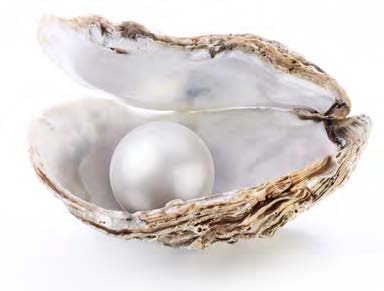
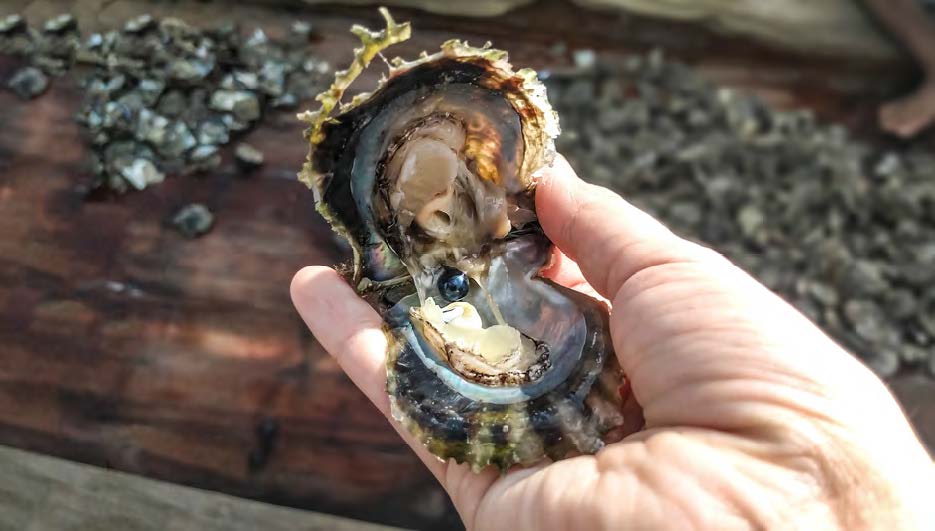
Pearls are formed inside the shells of certain molluscs when an irritant, such as a grain of sand, enters the shell. The mollusc secretes layers of nacre, a combination of calcium carbonate and proteins, to coat the irritant and create a pearl.


TYPES OF PEARLS

Pearls fall into two main categories –natural and cultured. Natural pearls are the rarest and most valuable, take years to form, and are found in the wild. Only one in every 10,000 oysters will produce a pearl spontaneously. Of that number, even fewer will be round and lustrous enough for fine quality jewellery, making them sought after by collectors and enthusiasts. Natural pearls are less round and smaller than their cultured counterparts. In the wild, pearl-producing molluscs have a much slimmer chance of creating a fully-developed pearl due to natural predators or poor water conditions.

Cultured pearls involve the human element of artificially inserting a small bead or tissue into the mollusc to trigger pearl formation, under very controlled conditions. The pearls produced are still genuine and made of nacre. Cultured pearls can be found in a variety of shapes, sizes and colours, and are more readily available and affordable, compared to natural pearls.

TYPES OF CULTURED PEARLS

The introduction of cultured pearls in the 1900s turned the pearl industry on its head, causing the value of natural pearls to plummet initially. Today, nearly 99 percent of all pearls in the market are cultured. Natural pearls are rare now, and are obviously more valuable.

AKOYA PEARLS

Japanese entrepreneur Kokichi Mikimoto, son of a noodle maker, created the first perfectly round, cultured pearl in 1893, and began farming them in 1916. He was responsible for the boom in the cultured pearl industry in Japan and the world.

At the beginning, he had to constantly defend against accusations that his pearls were not “real”. But scientists concurred that these pearls had the exact same properties as those formed naturally, with the only difference that humans “assisted” in their creation under controlled conditions. It finally became widely accepted that cultured pearls were just as valuable as natural ones.

in their creation under controlled conditions.It finally became widely accepted thatcultured pearls were just as valuable asnatural ones.


Kokichi Mikimoto inserts a nucleus in a pearl shell


The classic white pearls sought by customers are produced by the Akoyaoyster, Pinctada fucata. These pearls are typically farmed in colder water than other marine-cultured pearls, and have a thin nacreous coating. Akoya pearl farming isnow present in Japan, China, Vietnam and the UAE.

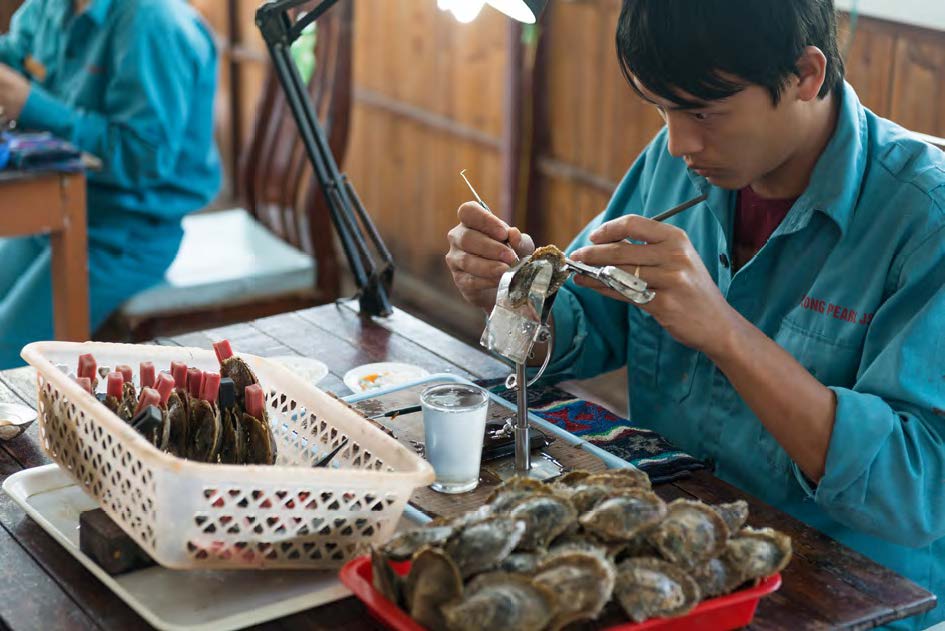
A pearl farm employee “surgically” implants an irritant in the oyster to trigger the formation of a pearl

SOUTH SEA PEARLS

These pearls are larger and thicker than the Akoya pearls, because the oyster, Pinctada maxima, in which they grow, are bigger, and the long growth period allows more nacreous overgrowth. They also come in a variety of colours, from a pearly white to silver, even champagne and gold-tinted ones, depending on the oyster. Where Akoya pearls rarely come in sizes greater than 10 millimetres, South Sea pearls can easily reach sizes of up to 20 millimetres. These pearls are cultivated in Australia, Indonesia, the Philippines and Myanmar.

BLACK PEARLS

Also known as Tahitian pearls, black pearls were successfully cultivated from the black-lipped oyster, Pinctada margaritifera, in French Polynesia in 1961. Though they are termed “black”, they really produce an incredibly wide range of iridescent colours, and can be found in a variety of shapes and sizes, ranging from six to 20 millimetres. Today, they are farmed in French Polynesia,Mexico, Fiji and Micronesia.

A black pearl is cultivated from the Pinctada margaritifera oyster

FRESHWATER PEARLS

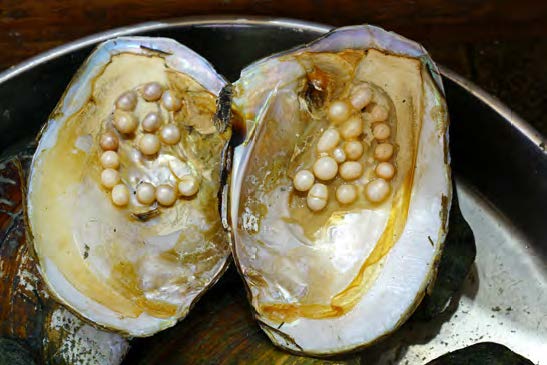
These gems are cultivated in freshwater mussels, Hyriopsis cumingii, in rivers, lakes and ponds. Although it was first started in Japan, China is now the leading producer of freshwater pearls. It is the only tissue-nucleated (instead of the bead) cultured pearl in the world that produces solid, crystalline nacre, making it incredibly durable. The entire soft body of the mussel is seeded with multiple donor tissues on each side of the shell, and one mussel can produce as many as 50 pearls at a time! The sheer volume of pearls produced has certainly overshadowed any other type of cultured pearl in the world.

One other special characteristic of freshwater pearls is their highly irregular shapes. Solid-nacre pearls do not have the “nucleus template” to form the perfectly round shape of marine-cultured pearls, so the majority of freshwater harvests produce baroque pearls. This irregular, uneven nacreous coating makes them one-of-a-kind. Cultured seawater pearls can also be baroque, but tend to be teardrop-shaped because of the spherical “irritant”introduced into the oyster.

One mussel can produce multiple pearls at a time


To learn more about the fascinating history of these precious orbs, subscribe to

https://shop.asiangeo.com/product/asian-diver-no-167/

SEVEN Ways Resorts and Dive Centres can support the Blue Economy

0

By Julia Footnick


At least one billion people depend on fish for their main protein source, and many economic sectors depend on the oceans: fisheries, maritime transport, scientific and technological sectors, and tourism. These resources need to be managed, so they are sufficiently protected and available for future generations, but also continue to sustain the people who rely on them today.

What is the Blue Economy?

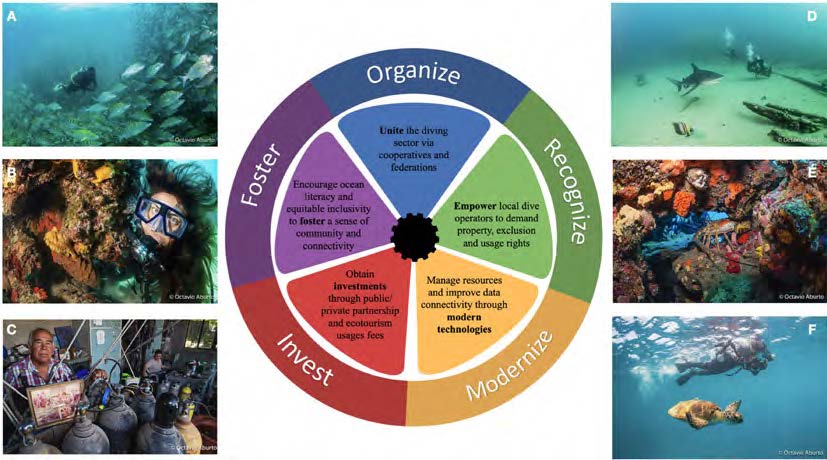
The expression “blue economy” was coined in 2011 to introduce the concept of a new kind of economy based on the efficient use of ocean resources for sustainable development. It became goal #14 in the UN Sustainable Development Goals for 2030: “Life below Water – to conserve and sustainably use the oceans, seas and marine resources for sustainable development”. Marine tourism, and the dive industry in particular, are important participants, significantly contributing to local economies, but also instrumental in supporting improved social wellbeing and livelihoods, and of course, marine conservation.

To find out what these seven ways are, subscribe to

https://shop.asiangeo.com/product/asian-diver-no-167/

Aggressor Adventures and MARES Announce New Partnership

0

Mares becomes exclusive scuba gear supplier

for Aggressor yachts worldwide


Aggressor Adventures has proudly announced a new partnership with Mares scuba and snorkeling gear for 2024. Mares will become the exclusive supplier and brand of diving equipment for Aggressor’s executive management team, staff and guests who need rental equipment aboard all 21 Aggressor Adventures yachts in the world’s most-beautiful diving destinations.

“We are excited to partner with Mares, who shares our high standards, commitment to customer service and passion for adventure travel,” says Aggressor Adventures Chairman and CEO Wayne Brown. “Mares has manufactured exceptional diving gear for over 75 years, and we have been providing adventure travel for over 40 years. We are both committed to the long-term success and growth of scuba diving. We look forward to working together on joint marketing programmes and promotions that will benefit dive centers, travel agents and our customers.”

In the coming months, guests on the Aggressor liveaboards can rent Mares regulators, BCDs, and dive computers on their scuba vacations. If a passenger’s personal dive equipment fails, or their luggage is lost, Aggressor’s onboard staff may provide them “free Mares loaner” gear during their cruise. Mares and Aggressor Adventures will also host joint promotions throughout the year.

Aggressor Adventures reservations can be made through your local travel agent or online at aggressor.com or call 800-348-2628 or 1-706-993-2531.

___