Home Blog Page 98

The Mind of a Mimic Octopus

0

Dr Crissy Huffard pointed down to the shallow seagrass beds. I couldn’t focus on what she was pointing at and we lifted our heads above the water. “Down by the rock, it’s really tiny,” she clarified. Down again and there, almost impossible to see, was the smallest octopus. It hid itself shyly behind a rock as we looked down. The pygmy octopus of Sulawesi that Crissy was studying eyed us suspiciously. Hovering above it, with a surprise I realised we were also being intently studied. Later, we spent time with two other celebrity species, the wunderpus and the mimic octopus, and I began to share Crissy’s passion for these intriguing animals. Octopuses have a reputation for being intelligent and almost mythically so. Scientists have long known that they can solve complex puzzles, navigate through mazes, are masters of disguise and accurately imitate other species. But some scientists go further, suggesting these invertebrates engage in play and even have personalities of their own. Was there more to discover beneath these rocks?

Dr Crissy Huffard is marine biologist with Conservation International in Indonesia. Her love affair with the enigmatic octopus was, like most twists of destiny, an accident. “I’ve always wanted to study invertebrates and originally wanted to study squid,” she says, but the biologist she wanted to study with was busy. It was fortuitous turn of events, as Crissy ended up studying with Eric Hochberg, a world authority on octopuses at the Natural History Museum of Santa Barbara, California. And Crissy has been at the forefront of some of the most exciting research on octopus behaviour ever since.

There are 300 species of octopus around the world and, in Sulawesi, the centre of their diversity, the mimic and the wunderpus stand out. Both species are found in the rich seas of Sulawesi, are well known for their remarkable shape-changing abilities and bizarre mimicking of other species. They do things that we normally would only expect vertebrates to do, and their intelligence is starting to make researchers wonder just how smart these animals are. Undescribed until 1998, the mimic octopus remains something of a mystery to science. Crissy’s research on the mimic octopus, Thaumoctopus mimicus, has revealed some intriguing behaviour and opened further questions about learning and response in invertebrates. It is a showcase for one of nature’s most remarkable abilities: an animal that can impersonate flatfish, lionfish, mantis shrimp and sea snakes, amongst others, to deceive potential predators. Not only does the mimic change its colour patterns and shape, it also adopts a good impersonation of movement, such as the undulating swims along the seabed of a flatfish. The amazing thing about this behaviour, according to Crissy, is that mimics have evolved a defence that relies on predators seeing them, rather than not seeing them, unlike many of their octopus relatives that use camouflage to hide. Perhaps most intriguing however, is that the mimic octopus presents a form resembling what it considers to be the greatest threat to its potential predator. So when attacked by damselfish for example, it mimics the banded sea snake, a known predator of damselfish. But is such behaviour inherited or learned, and how does it decide what to mimic? No one yet knows how mimic octopuses choose to perform one behaviour over another, and the full repertoire of models is still up for debate. It seems that unlocking one of nature’s greatest enigmas may take some time.

The mimic has an impressive number of impersonations at its disposal. “The stomatopod [mantis shrimp] mimicry looks to me like any old octopus sitting at its den entrance,” says Crissy, providing an example. “And the tunicate mimicry could fall under the definition of camouflage.” She points out a critical element in studying behaviour of animals: “What we scientists think doesn’t matter. It’s what the predators think, and none of this has been tested.” To find out more about how such behaviour came about and how much is learned or coded into the animal’s genetics, Crissy has turned her attention to studying its evolution. With colleagues from the California Academy of Sciences, Crissy and the team used DNA analysis to look at how and why this intriguing ability evolved in an animal that usually relies on invisibility to avoid predators. Octopuses are normally masters of camouflage, changing the colour of their skin through chromatophores, the pigmentcontaining and light-reflecting cells found in amphibians, fish, reptiles, crustaceans, and octopuses. Instead of blending in to avoid detection, the mimic gets out and actually displays itself in the most spectacular of ways. Using DNA sequencing to construct a genealogy of the mimic and 35 of its octopus relatives, the team was able to chart the order in which key mimic traits evolved.

First, the mimic’s ancestors used bold brown and white colouration to shock predators when their camouflage was unsuccessful. Later, ancestors developed the swimming method used by flatfish and the longer arms to facilitate this behaviour. The last evolutionary step was combining these abilities; so the mimic, at the end of this particular evolutionary line, can now display bold colouration and swim like a flatfish. It is, they say, a very risky shift in defence tactics. “Somehow through natural selection, being conspicuous has allowed T. mimicus to survive and reproduce more successfully than some of its less showy ancestors, and eventually evolve into its own lineage,” Crissy says. Working out how they select what to mimic is more difficult. “These are fundamental aspects that need to be worked out before we can assess the role of choice in mimicry,” she says. Perhaps even more sensational are revelations that not only do octopuses engage in play, but that they also have personalities in the human sense. Discussions of animal personality are controversial and hard to measure and quantify. Personality is classed as “temperamental differences” between individuals within a species. In humans, for instance, life in an ever-changing environment with numerous threats requires a large variety of responses, and therefore, the evolution of different temperaments or “personalities”. Crissy cautiously agrees that octopus do have personalities: “In the wild, we definitely see evidence that octopuses have different ways of behaving. Call it personality if you like, this variation in behaviour has serious implications for how octopuses mate, find food, and keep them from being eaten.” She is more cautious about studies that suggest play: “None of the data I’ve seen conclusively demonstrates play in octopuses.” But in science, as always, further study is needed.

Intelligent? Well, that all depends on how you define intelligence. Complex? Yes, without a doubt. Work by Crissy and others is challenging our expectations of animal behaviour, especially in invertebrates. Crissy will continue her work on the bizarre octopuses of Sulawesi “not through any special connection”, she says, “but because they play key roles in marine ecosystems, are biologically and behaviourally fascinating and have a lot of potential for discovery.” Those of us with more burning questions will just have to wait and see what else science might soon uncover hiding under the rocks of the Sulawesi seafloor. Taken from Scuba Diver Australasia Issue 03/2011
Artificial Reefs in Asia

0

HTMS Kledkaeo

In the Southern Andaman Sea, off the east coast of Thailand’s Koh Phi Phi Leh, 27 metres deep, lies the wreck of the HTMS Kledkaeo. After ending its service for the Royal Thai Navy, the ship was intentionally sunk in 2014 to create a dive site between Phi Ley Bay and Viking Bay. In just over three years, it has developed into a magnet for marine life, becoming home to huge schools of snappers, nudibranch and reef fish such as damselfish, pufferfish, grouper, trevally, rabbitfish, angelfish and butterflyfish. If you’re lucky, you might spot a frogfish trying to blend in with the rusty metal surroundings, or even a nurse shark resting on the sandy bottom under the hull.

USS Leonard F. Mason

Taiwan’s Green Island is an amazing dive destination with thriving critter colonies and tropical reefs. With over 30 metres of visibility, the water is usually warm and mostly free from currents. Strangely, the USS Leonard F. Mason, which lies at 40 metres, often has very strong currents and is rarely visited. After 30 years of service, it was sold to the government of the Republic of China and thereafter sunk in 2003 to create an artificial reef. Now, the wreck is home to big marbled whiprays and schools of snappers and jacks.

Kubu Wreck

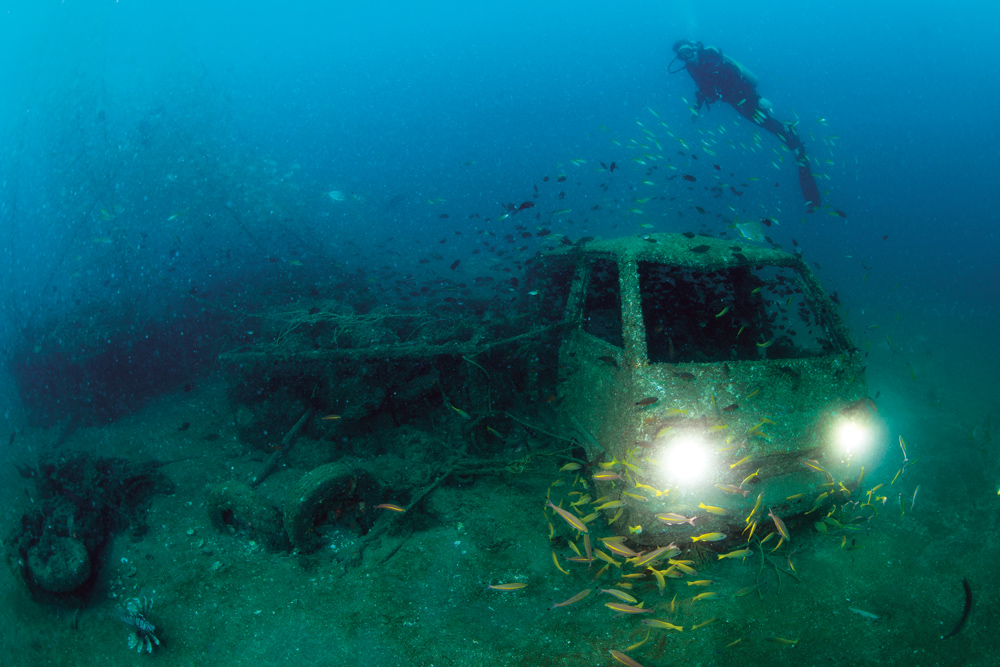
In 2012, a ship was sunk by the Indonesian Government to promote coral growth after she ended her service as a patrol vessel for the Department of Sea Communication. Located just a few kilometres from Tulamben, near the village of Kubu, the wreck is completely intact, reaching a depth of 33 metres. Offering some interesting swim-throughs, the wreck features some photogenic pieces such as a religious statue and an old car in the hull.

Camia Wreck

Despite not being known as a diving destination, Boracay, a small island in the Philippines, offers a few worthy dive sites. The Camia wreck is definitely one of them. It was sunk in 2001 as an artificial reef, just in front of the beach for quick and easy access by dive boats. Sixteen years underwater has transformed it into a beautiful artificial reef. The wreck stands upright on the flat bottom reef, dotted with soft corals and shoals of common tropical fish that seek protection from it. My favourite section is the engine room – it has two easy exits letting in plenty of light and are big enough for advanced divers to safely clear. The wreck reaches a depth of 25 metres, with strong currents during certain parts of the year.

Taken from Asian Diver issue 4/2017, cover image © Umeed Mistry

How We Are Killing the Oceans

0
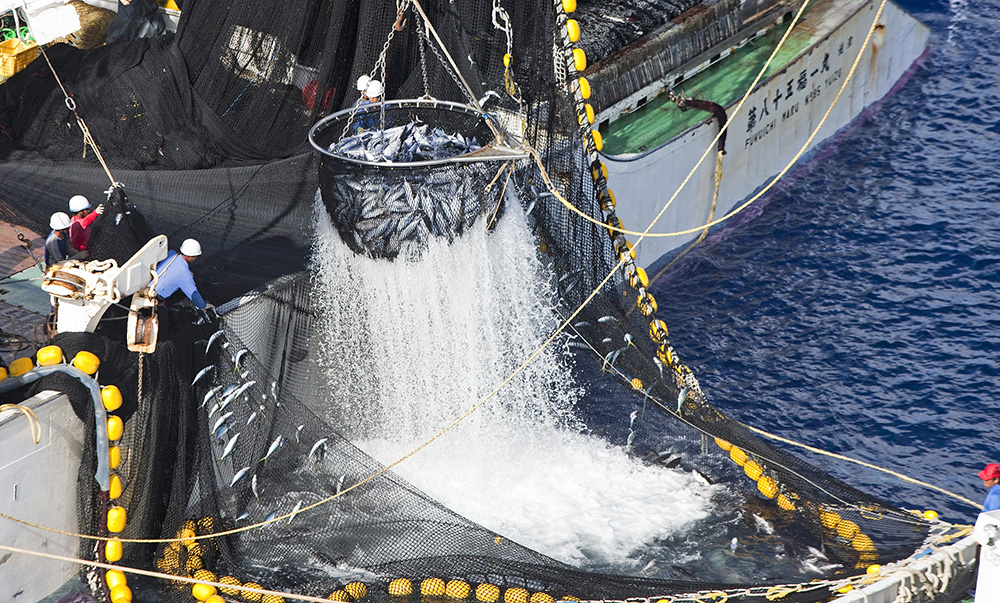
Greenpaece witnessed the Japanese purse seiner Fukuichi Maru scooping up tuna in a pocket of international waters attached to a fish aggregating device (FAD), Western Pacific ocean, 11 Septeber 2009. FAD's are supposedly banned in the Pacific ocean for two months although a gaping loophole in the ban is allowing fleets from Japan the Philippines and New Zealand to continue their plunder of the Pacific. Japan is the world's largest consumer of tuna and is responsible for over a quater of the Pacific tuna taken annually. Greenpeace/Paul Hilton

Hundreds of kilometres from land and at least eight kilometres above the sea floor, I gaze in awe at the scene around me. I know that I am nowhere near a coral reef, yet this is the picture that’s being painted by countless triggerfish, golden trevally and rainbow runners who have all gathered in the same place as if answering some undersea call to arms. But despite their numbers, they are no match for what has actually drawn them here. By day’s end, these unwitting creatures will be in a deep freeze, victims of a man-made mechanism known as Fish Aggregating Device or FAD.

Made from steel drums, ropes, chains, nets, logs, buoys or an array of other objects, FADs are hardly an unusual sight in international waters these days. I swim towards a bamboo structure and I am amazed by what looks to be the oceanic food chain in full-working order  – ironic given that the FAD’s very purpose is to facilitate the removal of the species from the seas and, thereby, from the food chain. I marvel at the schools of rainbow runners about me, while yellowfin tuna and even sharks accompanied by pilot fish pass underneath. In the distance, small fish congregate around the central line. Further away from the line, the fish increase with size, all with a common goal: dinner. Sharks now circle the FAD’s colourful line, followed by hundreds of smaller fish, as if knowing the big kid on the block will clear a path to the prize.

As I surface, reality hits in the form of a Japanese purse seiner fishing vessel not far away. It brings home the hard truth of the dream-like scenario I had witnessed beneath the ocean’s surface just moments earlier. To catch fish using FADs however, requires more than just the device itself. The FADs are part of the fishing process that began in the late 1950s when purse seine tuna fishing started replacing the pole-and-line technique that had been used for decades. Named after the purse shape that is created by encircling the FADs with a net, the technique had a much higher catch rate and a broader range of operations than pole-fishing, successfully increasing the take of valuable fish like tuna. However, the process also had an unforeseen consequence. As is now widely known, schools of tuna were being encircled by the nets along with large pods of dolphins. Many of these marine mammals were subsequently killed in the operation that targeted the tuna and discarded the dolphins.

Fish Magnets

The FAD was born when the fishing industry discovered that some species of tuna collected under natural floating objects like tree trunks, branches, kelps, things discarded by humans, buoys, crates, wooden planks, barrels and the like. So effective were the devices that, for many years there were purse seine fisheries in all oceans using floating objects as fish attractors. According to Martin A. Hall, principal scientist at the Bycatch Programs Inter-American Tropical Tuna Commission, more than half of all tuna catches by purse seiners today are taken on FADs.

Although much of the tuna now sold is “dolphin-safe,” the fisheries – especially those using FADs – have sparked a real problem within the marine ecosystem and primarily for the tuna stocks themselves. According to Sari Tolvanen, Oceans Campaigner for Greenpeace International, up to 10 percent of catches on the purse seiner FADs are unwanted species such as sharks, turtles and juvenile tunas as well as other fish species. This had been especially detrimental to the bigeye and yellowfin tunas. Their stocks are now in sharp decline across all oceans, as the juveniles of these species are caught by FAD fisheries in large numbers before they have a chance to breed.

Alternatively, skipjack tuna could be caught by the pole-and-line method in areas where there are sustainable baitfish resources available. This method is well-suited for the use of coastal communities in tuna-rich coastal states and would also allow these people to participate in the fishery who cannot afford to operate expensive purse seine vessels. The boats can also set their nets on free-swimming schools of skipjack tuna that do not associate with dolphins. These schools contain less of other species and juveniles of bigeye and yellowfin and is, therefore, a much more advisable way of catching tuna than using the deadly FAD fish magnets.

The end of the line

Seafood has always been an integral part of the human diet and people have come to regard the oceans as an inexhaustible source of food. However, the world’s oceans are now in crisis. We are now seeing a steep drop-off of valuable fish stocks and many endangered marine species. Over the past fifty years, rapid technological advances such as stronger and faster boats, on-board refrigeration, sonar and satellites to track fish have led a huge expansion of fishing. Poor fisheries management, illegal fishing and destructive fishing methods such as bottom-trawling, cyanide, dynamite and FAD fishing has harmed untargeted species. It has also produced massive unintended catches of juvenile fish and other precious marine species that are often thrown overboard dead as freezer space is reserved for high-value species. This collateral damage is known as “by-catch”.

According to WWF, the current world fishing fleet is 2.5 times bigger than that which natural fish stock can support. This situation is not only unsustainable for the fish; it’s also uneconomical as these fleets compete for the limited supply of fish left in the oceans. That makes fisheries one of the worst-performing industries with an estimated US$50 billion wasted annually – not to mention the potential for many fish species to eventually disappear entirely from our tables.

Endless appetite for seafood

It is the insatiable and indiscriminate market demand that is ultimately killing our oceans. Seafood is increasingly seen as a healthy choice and the popularity of Japanese-style fine dining is only serving to whet our appetites for seafood. It is of utmost importance that consumers, seafood restaurants, supermarkets and fish wholesalers urgently take our share of responsibility to ensure fish for the future. By eliminating the most-threatened species such as bluefin and bigeye tuna, tuna caught with the use of FADs, sharks and prawns from the menus and replacing them with legally, sustainably and equitably caught products such as pole and line-caught skipjack tuna, markets can take the reins in furthering ocean conservation. As consumers, we can do our part by asking about the sustainability of the seafood we consume and demanding products that have been caught with respect to the oceans. This is paramount in bringing about desperately needed change in our oceans.

Taken from Scuba Diver Issue 3/2011, text and images by Paul Hilton

Canon’s First APS-C Sensor Compact

0
Image taken with the Canon PowerShot G1 X Mark III, f/9, 1/160s, ISO100

For many professional and enthusiast photographers, DSLRs have remained the cameras of choice for various shooting scenarios, from events and news reporting to sports and scuba diving. The very best compact cameras have continued to close the gap in features and performance, but their smaller sensors, more-limited processing power, and other compromises have meant DSLRs still have the edge.

The PowerShot G1 X Mark III
Weighing just under 400g (14oz) – about 27-percent lighter than its predecessor – the new PowerShot G1 X Mark III offers two firsts for a Canon compact camera: a 24-megapixel APS-C sized CMOS image sensor similar to that found in a DSLR such as the Canon EOS 80D, and Dual Pixel CMOS AF, the premium autofocus system featured in the latest Canon EOS-series DSLRs. Add to that its built-in 24–72mm equivalent f/2.8–5.6 zoom lens and a 2.36-million-dot high-resolution electronic viewfinder, and you have a versatile camera that shoots like a DLSR but in a travel-friendly form factor that fits in your pocket. By comparison with the much smaller 1-inch sensor on the typical compact, the APS-C sensor in the PowerShot G1 X Mark III offers underwater shooters advantages that only DSLR users previously enjoyed. With the higher pixel count available in a large sensor, digital noise is controlled much better in situations demanding high-ISO settings, crucial when visibility is reduced at depth or when requiring a fast shutter speed to capture speedy subjects near the surface. Similarly, autofocus speed and accuracy are other areas where compacts often struggle, compared to DSLRs. But combining Dual Pixel CMOS AF with Canon’s powerful latest-generation DIGIC 7 image processor and Dual Sensing image stabilisation, the PowerShot G1 X Mark III aims to perform even when conditions are less than ideal. So whether you want to photograph the low-contrast bulk of a sperm whale or film a speedy sea lion using subject tracking, getting pin-sharp focus promises to be a breeze. And with 7fps continuous shooting with AF tracking (or 9fps with fixed AF), you won’t have to worry about getting that perfect composition.

Less Menu Diving, More Real Diving!
With its separate buttons and dials, and dedicated underwater scene mode for correcting white balance, the PowerShot G1 X Mark III is ideally paired with an underwater housing, such as Canon’s optional WP-DC56. Depth-rated to 40 metres, the waterproof case provides intuitive control over nearly all camera functions, allowing underwater shooters from beginner level and beyond to take advantage of the PowerShot G1 X Mark III’s large high-resolution sensor, fast autofocus, and high-speed continuous shooting in the subsea realm.

Canon Imaging Asia Facebook / Canon Asia Youtube / @canonasia Instagram / Snapshot Canon-Asia 


South and Southeast Asia Regional Headquarters: Canon Singapore Pte Ltd. 1 Fusionopolis Place #15-10 Galaxis Singapore 138522. CANON WEBSITE.  

The Great White Shark

0

Commonly known as the icon of fear, the great white shark is, sadly, a victim of entrenched stereotyping and Hollywood drama. Being the ocean’s Apex Predator, perhaps there is sound reason for the fear they incite, but how much of it is fact over fiction?

In 2016, the International Shark Attack File (ISAF) reported 154 alleged shark attacks worldwide. Upon investigation, 84 of these cases were confirmed to be unprovoked attacks, with the remaining 70 incidents comprising of 39 provoked attacks, 12 boat attacks, one involving post-mortem bites, and the rest were either regarded as not involving a shark, or had insufficient evidence.

Out of the average 100-plus annual shark attacks worldwide, about one-third attributed to great whites. Most cases are not fatal, and new research had found that great whites are “sample biting” out of natural curiosity before releasing their victims. In an article from British newspaper, The Guardian, John West from Taronga Zoo, Sydney explains that great white injuries usually range from minor teeth marks to slashing-type wounds. “However, in these interaction, it would seem that sharks are not intent on feeding on humans and may find human flesh unpalatable. While they do bite people, they rarely eat them,” says West.

Most of the time, shark attacks occur due to humans – particularly surfers – being mistaken for prey such as seals or sea lions. When sharks hunt, they adopt an ambush approach called the Polaris attack. They prowl on the bottom, looking for prey before they barrel out to the surface and attack their chosen target.

But don’t be mistaken, great whites are not homogeneously savage, and are not likely to attack a human. Their behaviour changes depending on motivation, hunger levels, and even the time of the year. Given their unpredictability, quantifying their behaviour had proven difficult, but white shark researchers have become so familiar with their subjects that they can instantly indentify a shark based on it’s appearance and behaviour.

In an interview with Tower Magazine, Dr Rachel Robbins, the Chief Scientist of Fox Shark Research Foundation, explains, “They all seem to have their own little personality. They’re not just this mindless eating machine that people think they are. We have ones that are more curious or more nervous around us than others, while some are really cheeky and others really aloof. It’s just interesting the personalities they have.”


From Scuba Diver Australasia + Ocean Planet Issue 4/ 2017

What it Feels Like: Getting Dumped!

0

Have you ever had a “crappy” dive? I’ve certainly had a few. I remember a divemaster at one Malaysian resort: Thinking he was the last diver, he decided to hang back, remove his wetsuit and feed the fish! Little did he know that we underwater photographers are always the last ones out, so when I swam over the reef ridge, I was confronted by a huge brown cloud and an exposed diver trying to swim away with his wetsuit around his ankles. Back on the boat, he wouldn’t even make eye contact – if only I took a picture!

However, one of the “crappiest” dives I’ve had to endure was in Guadalupe during some amazing great white encounters. We were there to film a “live” event for UK TV and had one week to rehearse the daily activities for the following week. The crew were mainly from the UK with much experience in working on such productions. However, many of them were clearly unseasoned sailors – the 24-hour cruise to Guadalupe saw the entire crew hurling over the side.

Once in Guadalupe, it was time to attend to our specialist kit and get the cages into the water. The boat’s saloon was converted into a TV studio, with hundreds of cables everywhere, multiple monitor screens on the wall, and surface-to-underwater intercommunications running from the camera to the onboard studio. Three of us divers were suspended in separate cages at different depths. I was in the cage to the side of the boat named “the cinema cage”; a cage designed for filming as there were no bars on one section of the cage. It was a major event and everyone was very excited when the first shark made an appearance.

Meanwhile, a sea-stricken crewmember was unloading his beef enchilada into the toilet. Unbeknownst to anyone, the sewage tank onboard was broken, thus once the flush was released, all of its contents went straight under the boat and into my cage!

So there we were testing the kit, checking the cables, and surrounded by great white sharks, when I heard one of my colleagues shouting on the intercommunications just before the first bit of toilet paper started to drift into my cage, soon after, a looming brown cloud followed, threatening to engulf me.

So what was I to do? Swim outside amongst the sharks or stay pout and sit it out? Despite the drop in visibility in the cage, I held on!

From Scuba Diver Australasia + Ocean Planet Issue 4/ 2017

What it Feels Like: Overcoming Disability

0

Could you tell us about your story before you became a diver?
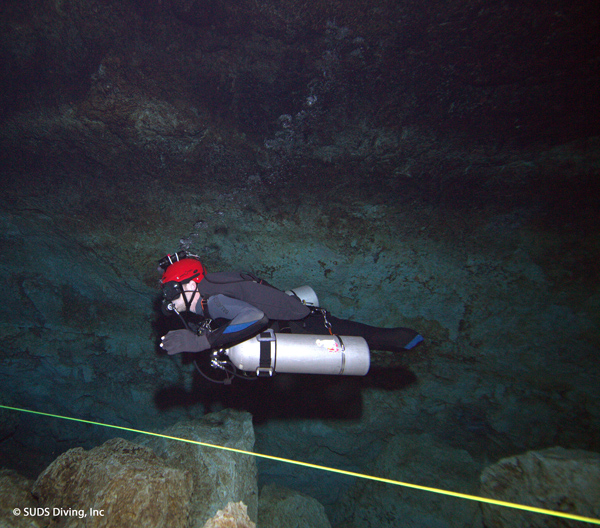
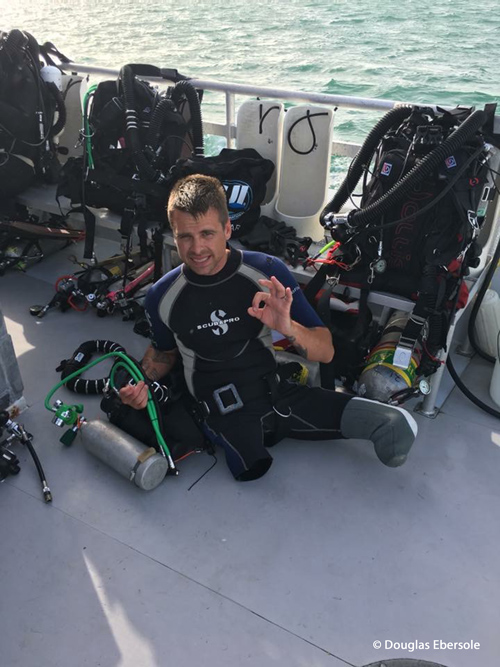
Before I started scuba diving, I spent seven years in the Marine Corps Infantry. My first duty station was Presidential Retreat Camp David, which I did site security for President Bush, followed by President Obama. I was stationed with 1st Battalion, 5th Marines (1/5) in southern California. Shortly after joining 1/5, I had my skull crushed in a training accident, which required eight titanium plates and 40 screws on the skull to repair it.

After eight months of rehab, I was able to re-enlist in the Marines to go to Afghanistan. On May 13, 2011, I stepped on an improvised explosive device (IED) while sweeping for IEDs on a foot patrol, resulting in losing both my legs, my right thumb m and partial index and middle fingers.

How did you get into scuba diving?

I took up scuba diving as part of recreational therapy while I was recovering at Navy Medical Centre Balboa in San Diego. I was certified by a non-profit organisation, Soldiers Undertaking Disabled Scuba (SUDS).

What do you like about scuba diving?

After my Open Water certification, SUDS took me to Fort Lauderdale and I was hooked after my first wreck dive. It was just a recreational swim through an artificial reef ship at a depth of 30 metres, but being able to swim through it on neutral buoyancy was life changing.

Before I lost my legs, I enjoyed running and up to this point, I was a little disheartened at the difficulty and pain of walking in prosthetics. They felt awkward and foreign, and mu ability to get around on dry land was definitely hampered due to the prosthetics. In the water, it was as if my injury disappeared, and I was free to move again. I must thank SUDS for bringing diving into my life.

Technical diving filled the void that I missed from not being an active duty infantry marine. Many approaches of technical diving are similar to how we did things in the military; doing drills like valve shit down and S drills is a common approach used in the military. Spending hours prepping gear before a big dive brought me back to the times we would prep gear before a mission or patrol in the marines.

Could you talk us through what it feels like when you descend underwater?

When I start a dive, I feel a sense of calmness wash over me. When I’m on land, moving around in prosthetics, I look awkward, and you can definitely tell I have a hitch in my step, but diving makes me feel like I am gliding through space. Scuba gives me the opportunity to better myself; it’s something I can still pursue and be good at regardless of any previous injuries I may have had.

What made you want to pursue technical diving?

When I was on that first SUDS trip to Fort Lauderdale, I was paired up with one of the volunteer instructors who ran a technical dive shop in Puerto Rico. His name is Tony Cerezo, and we quickly became good friends. He took me under his wing and taught me cave diving, CCR and trimix diving.

How is technical diving different from open-circuit diving for you?

For me, the main differences between technical and recreational diving is gear setup and level of activity involved. When I do a standard single-tank dive, my gear is like everyone else except that I use webbed gloves instead of fins, but technical diving requires a lot more thought and non-standard gear configurations. For example, I use suicide clips for my stage bottles on the right side so that I can get them off quickly even with webbed gloves on and missing fingers.

I am also very lucky to have met some great people in the diving community. One of those is Mike Young. After I expressed my interest in sidemount CCR, Mike custom designed and developed the Sidewinder rebreather for my diving style. I’ve used several back-mount units, but once I tried the Sidewinder, I was hooked – it made diving much easier and was perfect for my caving style. With a rebreather designed around my diving, it is easier to pursue my diving goals.

What was the training process like? Any difficulties you faced?

I’ve only taken technical dive courses from two instructors, the first being Tony Cerezoa and the second being Mike Young. To pass the courses, I still need to complete the same skills, though some are done differently from others. One of the rules in cave diving is to always keep moving when taking off stages or passing bottles, but I swim with hands, I wear the main light on my helmet instead of holding it in my hands so I won’t be flashing light all around. I think the hardest part of the technical courses is exiting a cave in darkness as with one hand one the line, I only have one free to pull myself along or swim.

What had been your most memorable dive so far?

One of my most memorable dives is when I dove Rubidoux Springs last December. That was my first time diving the Sidewinder, and exploring what I could do in a sidemount unit was amazing.

Could you share some of your future goals with us?

Some of my goals in diving is o become a recreational instructor, I have a small dive club for veterans in northern California as part of a non-profit Ranger Road. We dive the mountain lakes but I’m not qualified to train new divers yet so it would be nice to have my instructor certification.


From Scuba Diver Australasia + Ocean Planet Issue 4/ 2017