Home Blog Page 104

Underwater Photographer of the Week: Brent Durand

0

Growing up in Los Angeles, Brent Durand developed a love for the ocean since young. After graduating college, he got into landscape photography, shooting the Malibu sunset before packing up his camera gear for a night dive. It was only when he realised that he could take his passion for photography beneath the surface that his career in underwater photography bloomed. Recently, he launched “Lens Life”, a monthly newsletter where he shares video tutorials and articles on photography, post processing, gear and more. We talked to Brent to find out more about his journey as an underwater photographer.

What made you want to become an underwater photographer?

Underwater photography was the perfect way to combine two of my passions – the ocean and photography. It’s also challenging, and I’m really attracted to that challenge.

Your first underwater shot?

I believe it was an anemone during a Malibu night dive, using my brother’s SeaLife camera. Even though I was shooting DSLRs on land, I wanted to test the idea of shooting underwater with his camera before starting to piece together my own compact camera and housing from eBay.

The story behind your most memorable underwater shot?

My most memorable shot is one of my first Malibu reefscapes. Generally, we have about 5-6m visibility on a good day, but during the fall months there are usually a few days where the visibility opens up to 10 and even 12 meters. Most of the time, these days fall during the workweek and I’m left to dive at night, but on this one weekend, all the elements lined up. I had a brand new Ikelite 5D Mk III housing, great visibility on a Saturday, warm water and colourful reef scenes. It was one of those “wow, I really love scuba diving” dives.

Where is your favourite dive destination?

Aside from home, it’s La Paz, Mexico. There’s just something very special about the Baja peninsula. I’m also a big fan of sea puppies (sea lions) and whale sharks, so I always have a blast when visiting La Paz.

The site you’d most like to dive, but never have?

Oh man! So many. Anywhere with colorful reefs: Fiji’s Rainbow Reef, Komodo, Raja Ampat, Alor. Then of course my dream is to photograph polar bears from the water.

The weirdest thing you’ve seen underwater?

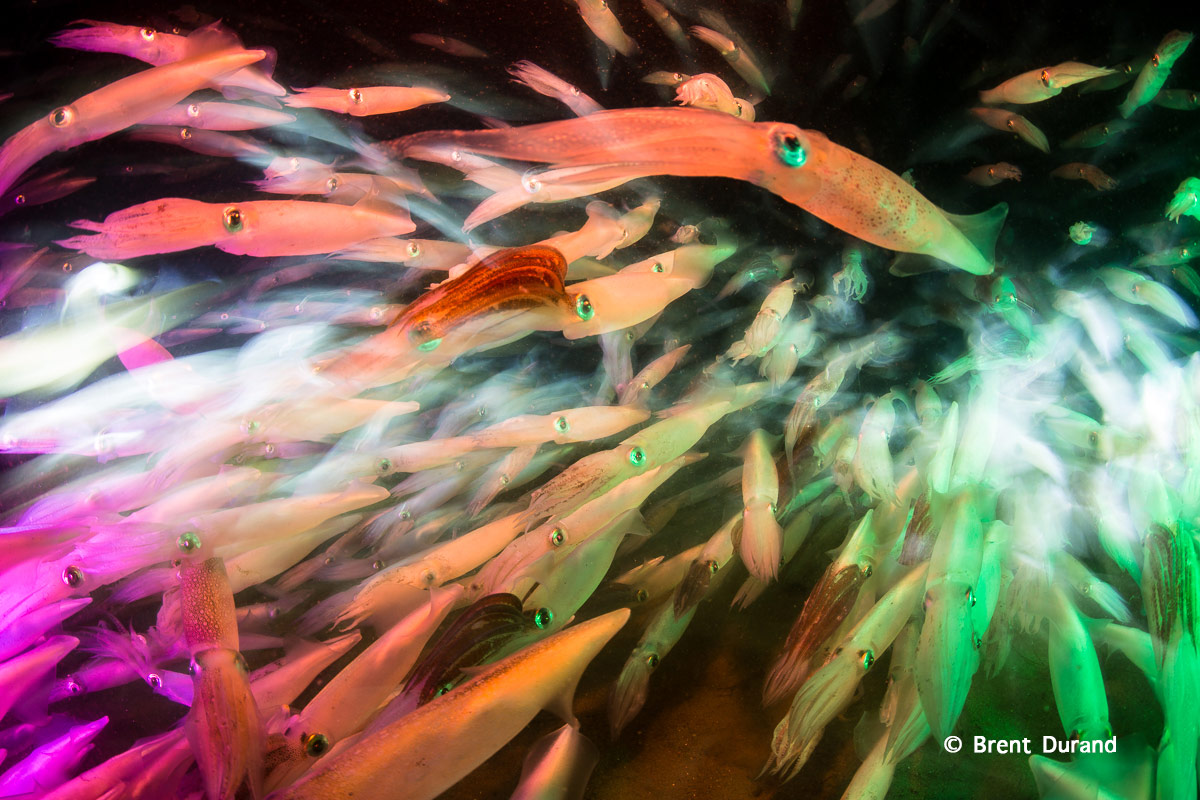
The market squid run in Redondo Beach, California a few years ago. The event itself is not weird at all, but it’s just a very weird experience to be surrounded by thousands of squid trying to mate and lay eggs. The squid were getting stuck in my strobe arms, in my hand when I grabbed my console computer, etc.

What camera equipment are you currently using?

I’m shooting a Canon 5D Mk IV in Sea and Sea housing. I use Sea & Sea YS-D2 strobes and different Kraken Sports Hydra lights for video, macro focus and night dives. The camera and lenses deliver in the areas I want them to while the housing takes the abuse I put it through in the waves, sand, kayak, dusty camping and more. I’m also able to use my 5D Mk III in the housing as a backup body, since redundancy is essential when travelling.

What is the highlight of your career?

I would say that every time someone reaches out with compliments or questions. Underwater photography is a hobby that consumes countless bleary-eyed hours before and after work, so when I see someone enjoy an image, it stokes the fire to keep putting in that work and make new images.

And the low point?

I really don’t have any distinct low points. I always set the bar very high for myself, so I’d say that the general low point is the constant struggle between work and trying to find time to get in the water and shoot, whether local or for a photo workshop / assignment.

Any advice that you’d like to give to aspiring underwater photographers?

Practice, practice, practice. Many folks ask how to improve their photography when they only shoot on their annual dive trip. My answer is always to shoot more! Go shoot some local sports, shoot flowers, shoot the stars. Good underwater photography is about so much more than just some settings, basic composition and pushing the shutter. It requires an intimate understanding of photography, light and the marine life. The learning curve is endless!

Is there any particular shot that you still want to get?

I’ve been dreaming of shooting colourful reefscapes for a few years now. I’ve also got some unique ideas, but naturally, I can’t share those yet!
10 Tips for a Safe and Enjoyable Tek Dive

0

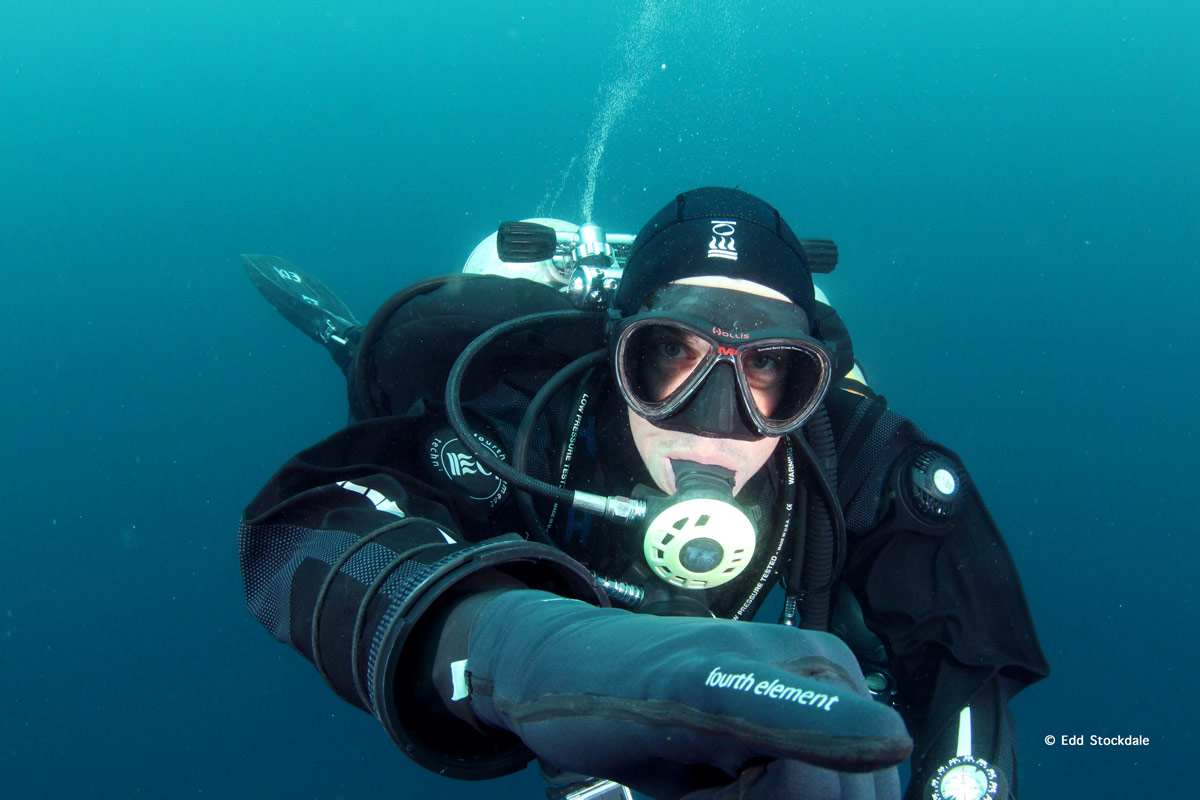
Regardless of whether you are interested in, or are already experienced in this niche area, technical diving requires rigorous discipline and skill. To fully appreciate the beauty of technical diving, it is essential to keep in mind several considerations that are easily discounted. Here are some tips that could help you achieve a safe and enjoyable journey in the depths. The first thing any good diver should do is to keep learning. No one, including the most experienced divers, know it all. There is always room for development, be it by experiencing something new, or keeping up-to-date with the latest research. Our understanding of diving physiology is constantly expanding – studies on decompression is evolving the way divers practice water-safety and pre/ post-dive behaviour. In addition to these new techniques, the ever-changing state of technology is always bringing better gear into the market. Thanks to this, the days of ABLJ diving are over. Train with an instructor who dives regularly outside of training and observe his or her coaching method. Diving schools have regulations for instructors, but these are often minimal, usually set for the sake of liability. Ticking off the boxes is not the same as imparting important knowledge to students learning to dive at an advanced level. The higher the certification, the greater the risk, hence, attending shorter courses or having an uninvested instructor will only add to the stress of technical diving. This might sound like a given but let’s look deeper. Many of us are guilty of rapid qualification advancement. It is only human nature to desire for more, but why not pause for a moment to take in your current achievement. Gain more experience through recreational dives before venturing onto your next certificate. Once you are comfortable and confident, the next steps would be much easier and enjoyable. Why rush to 100m when there are amazing things to see at 45m? Why cram in the qualifications, purely to satisfy a depth requirement or to achieve a goal to boast about at the next après dive?

It is a sad reality that the technical diving world is dominated by the middle to late-aged male. The belittlement of newer divers and the “perfection” of personal equipment has resulted in the alienation of potential new additions to the sport. We all need to do our part in growing the technical diving community, be it through imparting our own knowledge, or daring to bring a fresh change to this community. Some of the best divers out there fall outside this stereotype and are often overlooked. The phrase “any diver can call the dive at any time” is commonly heard, but how often does this actually happen. Many divers will not call a dive for financial reasons, peer pressure, or out of sheer embarrassment. Refusing to concede to a concern during a dive could lead to fatal consequences, especially so for technical diving. Remember, a dive can always wait. A diver who calls a dive as everybody is kitting up, doing surface checks or even during the descent could be saving the whole team from danger. As a rule of thumb, the simpler the equipment, the better. Every piece of gear should have a function. For example, a twin wing set purchase should never be made without assessing the backplate and harness, or considering how the stages operate, despite what the salesman might say. A rash purchase could compromise the configuration. It is a good idea to ask your instructor and teammates while considering what equipment to bring. Assessing the dive conditions and wearing the appropriate exposure suit is paramount in a safe and enjoyable dive. All members of the dive group should be aware of the equipment of each diver. While some schools of thought require the whole team to be identically geared, others allow some flexibility. Technical diving equipment has evolved rapidly over the years, and a standard series of configurations are becoming mainstream through years of practice. This being said, there are various equipment designed for specific conditions, such as cave or cold water regions, that require specialised training and knowledge. In technical diving, shorts and dive skins are highly discouraged, despite their popularity in recreational diving. Recent studies have shown that being cold under decompression is a higher cause of decompression sickness than dehydration. Exposure protection is not just for warmth, but also protects the diver from other factors, such as sharp points of a wreck, poisonous fauna or abrasion. As such, you will never see an experienced technical diver in anything less than a full wetsuit, and more often than not, a dry suit, even in tropical environments. Pretty much all technical diving manuals discuss awareness, yet, it is often overlooked as a vital skill. Every diver should strive to not only be aware of their surroundings during a dive, but to practice it in everyday life. Some questions you should constantly ask yourself are:  What is happening around me right now? Where is my team? Is there an upcoming issue in the dive that I am not paying attention to? Self-awareness is just as important – not only paying attention to your relative position but also being aware of how you feel during the dive. We dive to have fun, but when we put ourselves and the people around us at risk due to negligence, an enjoyable dive could turn into a serious incident. Surprisingly, fitness is often seen as unnecessary in diving – a sport that is generally misconceived as a “relaxing pastime”. Every course following open water places emphasis on good fitness, yet, many a times is ignored by both the instructors and students. When entering the discipline of technical diving, multiple tanks, heavier protection, and decompression conditions demand a higher level of fitness than the average recreational dive. Proper training in target areas help to improve trim and positioning, while cardio benefits the breathing and buoyancy of a diver. Diving is a team sport, especially so in the more advanced levels, where teamwork is inherent. Not only do you have the security of extra gas, extra brains and extra eyes, you also have people to enjoy the experience with; a community of like-minded divers.


Post Report: Hong Kong Divers’ Party, 8 August 2017

0

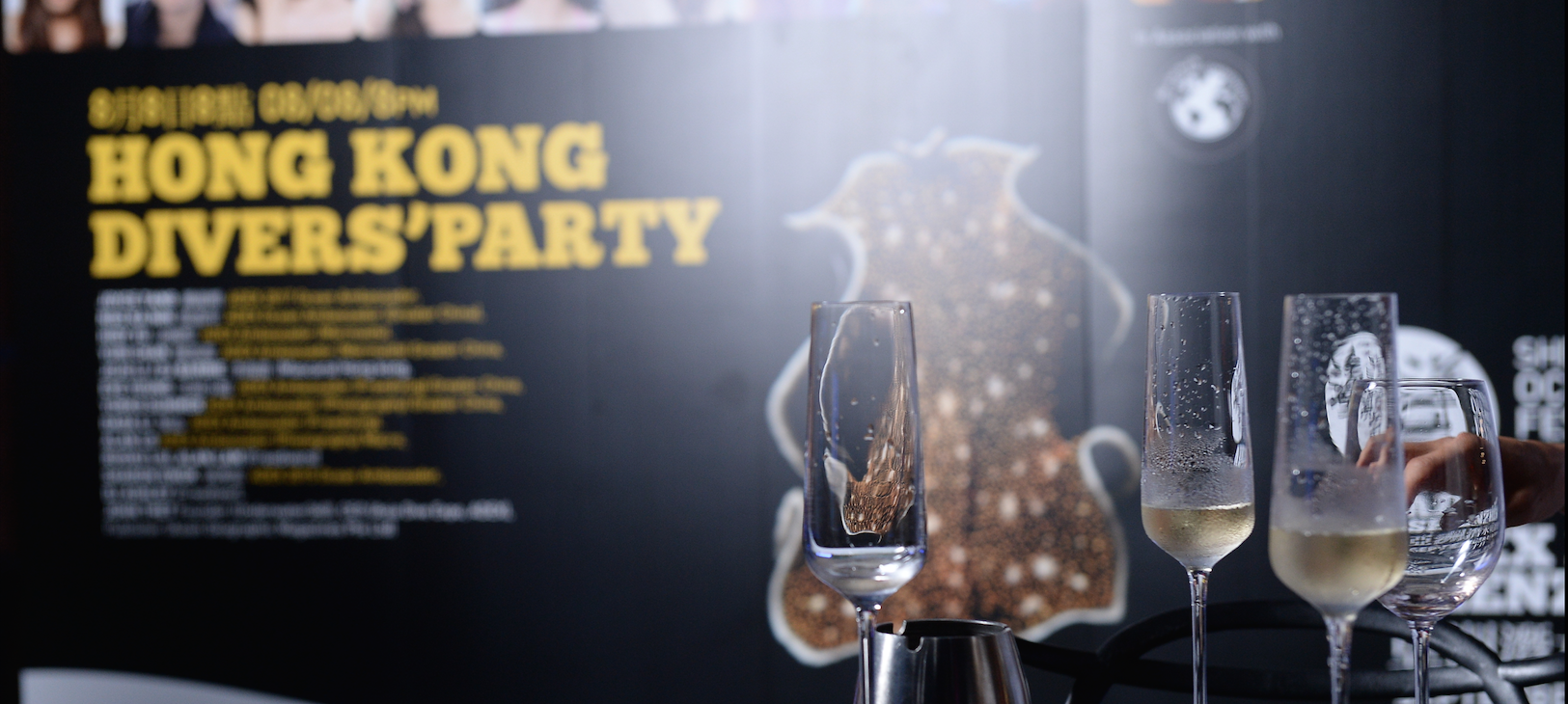
The al-fresco rooftop balcony of Italian bar and restaurant, Shelter Lounge, was packed to the brim on Tuesday night at the Hong Kong Divers’ Party on Causeway Bay, where over 250 diving professionals and enthusiasts gathered to celebrate the upcoming Asian Dive Expo (ADEX). Guests got the chance to mingle and dine with celebrities, ADEX ambassadors and speakers such as Hidy Yu, Yuri Chan, Jojo Li, Eve Young, Yorko Summer, Dada Li, Alan Lo, Ruoxu Liu, Alan Lam, Sharon Kwok and Ashley Cai, who were there to share about their passion for diving. The party began shortly after sunset at 8pm, with a generous flow of bubbly to let guests unwind and relax. Laughter, chatter and joyous smiles continued well through the night as the emcee entertained the guests. The night sky lit up with the surrounding skyscrapers and luminous flowers, creating a stunning backdrop to the party as guests mingled and shared their diving stories. On top of the delicious Italian food, entertaining videos and presentations by celebrity speakers, all dive professionals who attended the event received VIP passes to ADEX Shenzhen and one-year complimentary access to Asian Diver and Scuba Diver Australasia + Ocean Planet e-magazines. The time came for the ever-anticipated lucky draw event, where guests stood the chance to win prizes worth up to HKD 62498. 14 lucky winners walked away with grand prizes including an 11-day luxury live-on-board dive trip on the Indo Aggressor fleet, an eight-day full board dive trip to Palau by Sam Tours, a three-day trip to Summer Bay in Lang Tengah, a XDeep Zen buoyancy control device, dive products from Fourth Element, and two Mahina merfins and a mertail from MFI.

Congratulations to the lucky winners!

We look forward to seeing all our guests again at ADEX China!

Underwater Photographer of the Week: Tanya Houppermans

0
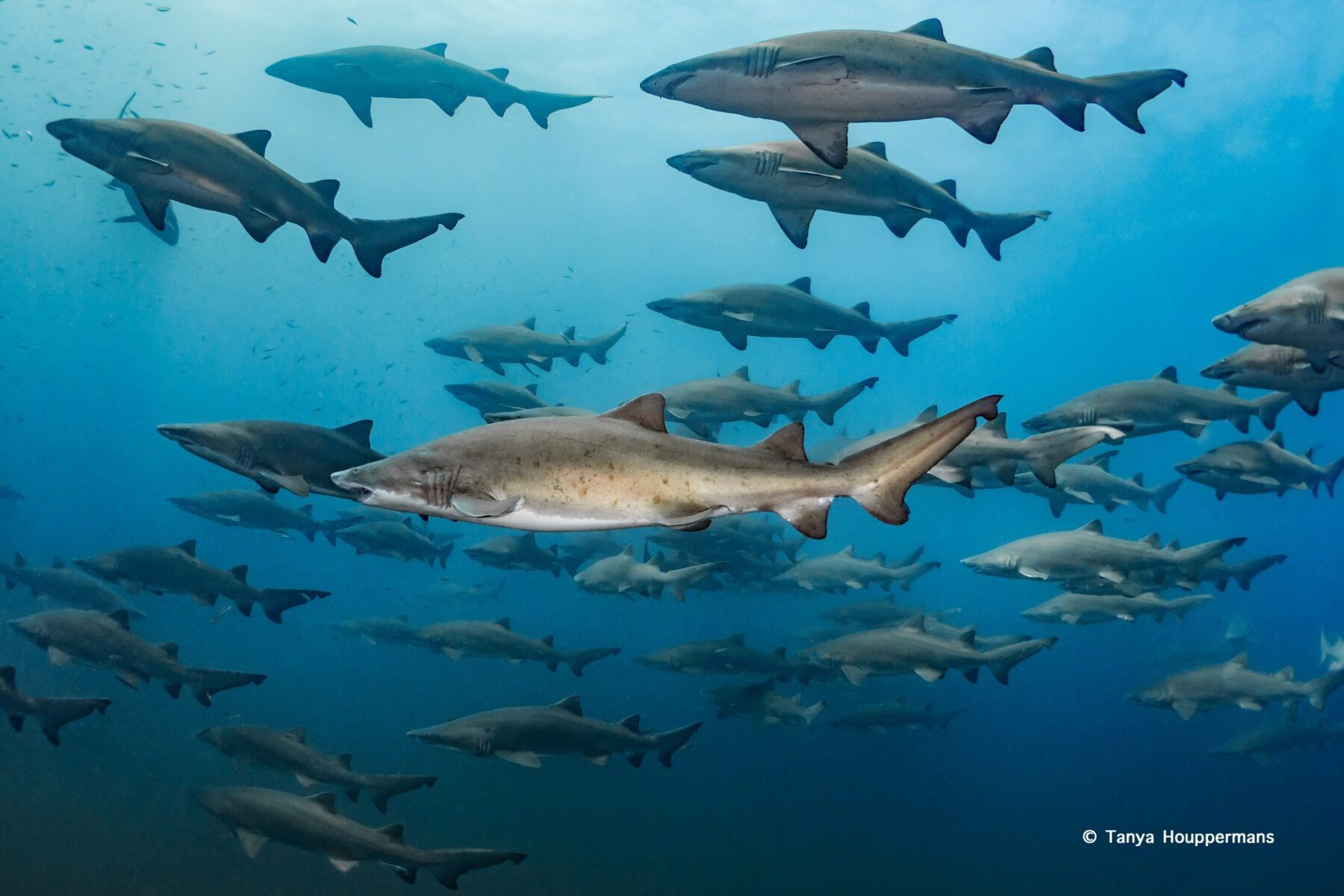
Every summer, large aggregations of sand tiger sharks can be usually be found above the wreck of the Caribsea off of North Carolina

Unlike some other underwater photographers we’ve spoken to, Tanya’s career did not begin in underwater photography, but remained an unfulfilled dream for the most part. In 2009, she finally took her first dive into the water, where her love and fascination for sharks blossomed. Upon realisation of their imminent extinction, Tanya was compelled to reveal the beautiful, intelligent, and fragile side of these misunderstood creatures. In 2015, she left the corporate world to pursue underwater photography and marine conservation full-time, earning numerous major international awards such as two First Place prizes in the categories of ‘Sharks’ and ‘Shipwrecks’ in the 2015 World Shootout, and also being named a Grand Master in Underwaterphotography.com’s 2016 Annual Awards. She currently works with and contributes to several marine conservation and education organisations including Ocean First Institute, Discovery Deep, Mission Blue, and Ocean Geographic Explorers.

What made you want to become an underwater photographer?

There were two reasons that I wanted to become an underwater photographer. The first was to try to show the public how amazing sharks are, and to hopefully convince people to care about and want to protect them. The second reason I got into underwater photography was to document my son’s journey as a diver. My 20-year old son, Richard, has autism, and started diving almost three years ago when he earned his Open Water certification through the Handicapped Scuba Association. I guess a lot of my photography is about dispelling misconceptions – both those that the public has about sharks, and also those about what people with disabilities are capable of.

Your first underwater shot?

My most memorable underwater shot is a recent photo that I took only a little more than a month ago, of a sand tiger shark swimming toward me in a massive bait ball of fish off the coast of North Carolina. I’m still shocked at how well it resonated with the public; I never imagined it would go viral and be seen around the world. The day I took the image, I was diving the wreck of the Caribsea with several friends. As we descended to the wreck, we were treated to the largest bait ball of fish that I’ve ever seen. There were a few dozen sand tiger sharks around, lazily swimming in and out of the bait ball. I slowly drifted into the bait ball where the wall of fish was so thick that it blocked out the ambient light. I noticed this particular sand tiger shark coming toward me when it was about 6 feet away. I started shooting, expecting the shark to turn away as they typically do. But this one moved straight toward me, and didn’t turn away until we nearly made physical contact. As it came toward me, the fish moved out of the way, giving the appearance of the shark swimming though a tunnel.

Where is your favourite dive destination?

My favourite destination is Morehead City, North Carolina, which is great because it’s only a five-hour drive from where I live, so I don’t have to get on an airplane. I really enjoy diving the shipwrecks that line the coast of North Carolina, but most of all I love seeing the sand tiger sharks that frequent the wrecks. There are more than just sharks though; North Carolina has some amazing big marine life, from dolphins to turtles to huge southern stingrays, and even the occasional manta. Every dive is different, and you never know what you’re going to see.

The site you’d most like to dive, but never have?

I’d love to dive the Arctic and Antarctic. I think it would be incredible to photograph the ice formations close-up, and to see all the animals that live in the polar regions, especially the whales! I’m a wide-angle photographer, yet I’ve never been in the water with a whale. I need to do something about that!

The weirdest thing you’ve seen underwater?

The weirdest thing I’ve ever seen underwater is also the saddest thing I’ve ever seen. Last year, while diving the wreck of the Caribsea off of North Carolina, I came upon a sand tiger shark lying on the sea floor who had been stabbed through the back of the head. She was still alive, but paralyzed. She had been hooked, and instead of simply cutting the line and releasing her (which you are required to do by law since sand tigers are a protected species), someone stabbed her before throwing her overboard. She couldn’t move, couldn’t eat, and could only breathe through her left gill. There was nothing we could do for her. Other divers saw her over the next two days, and then she was gone. She probably died and was scavenged. And just last month, nearly a year to the day since this incident, I saw the exact same thing had happened to another sand tiger shark that I found stabbed on the sea floor. She was paralyzed and slowly dying. It absolutely broke my heart. I simply cannot understand such cruelty.

What camera equipment are you currently using?

My camera body is the Olympus OM-D E-M1, and my go-to wide angle lens is the Olympus m.Zuiko 8mm f/1.8 fisheye. I use a Nauticam housing and a Zen DP170 glass dome port, with the Nauticam 4.33” acrylic dome port with 20mm extension ring as my back-up. For the past few years I’ve been using Sea&Sea strobes, but I recently switched to the i-Divesite Symbiosis SS-2 strobes, which I used for the first time while diving North Carolina last month. The SS-2s have video lights mounted to the top of each strobe. I don’t do video, but having the video lights on my strobes may motivate me to finally start learning how to shoot video.

What is the highlight of your career?

The highlight of my career so far was when I was asked to work with researchers in North Carolina to use my photography to assist with their study of sand tiger sharks. The reason I picked up a camera in the first place was to try to help sharks, so to be directly involved in shark research is a dream come true. Knowing more about the health of the populations of sand tiger sharks off the east coast of the U.S. will enable us to better manage their conservation and protection.

… And the low point?

The low points are whenever self-doubt starts creeping in. There are times I feel confident in my work, and other times I start to doubt my abilities as a photographer. When I start to feel this way, I remind myself that it’s not always about capturing stunning images. My ultimate goal is to try to motivate people to care more about the ocean and its inhabitants. That goal is more important than any image I will ever take.

Any advice that you’d like to give to aspiring underwater photographers?

Be your own worst critic. There is room for improvement in every photograph, so try to take an honest look at your work and ask yourself what you could do better. If there is something you want to improve upon but don’t know how, don’t be afraid to ask. Get instruction, attend a workshop, or experiment with different techniques. Keep striving to improve and never stop learning.

Plastic: A growing problem harming marine life

0

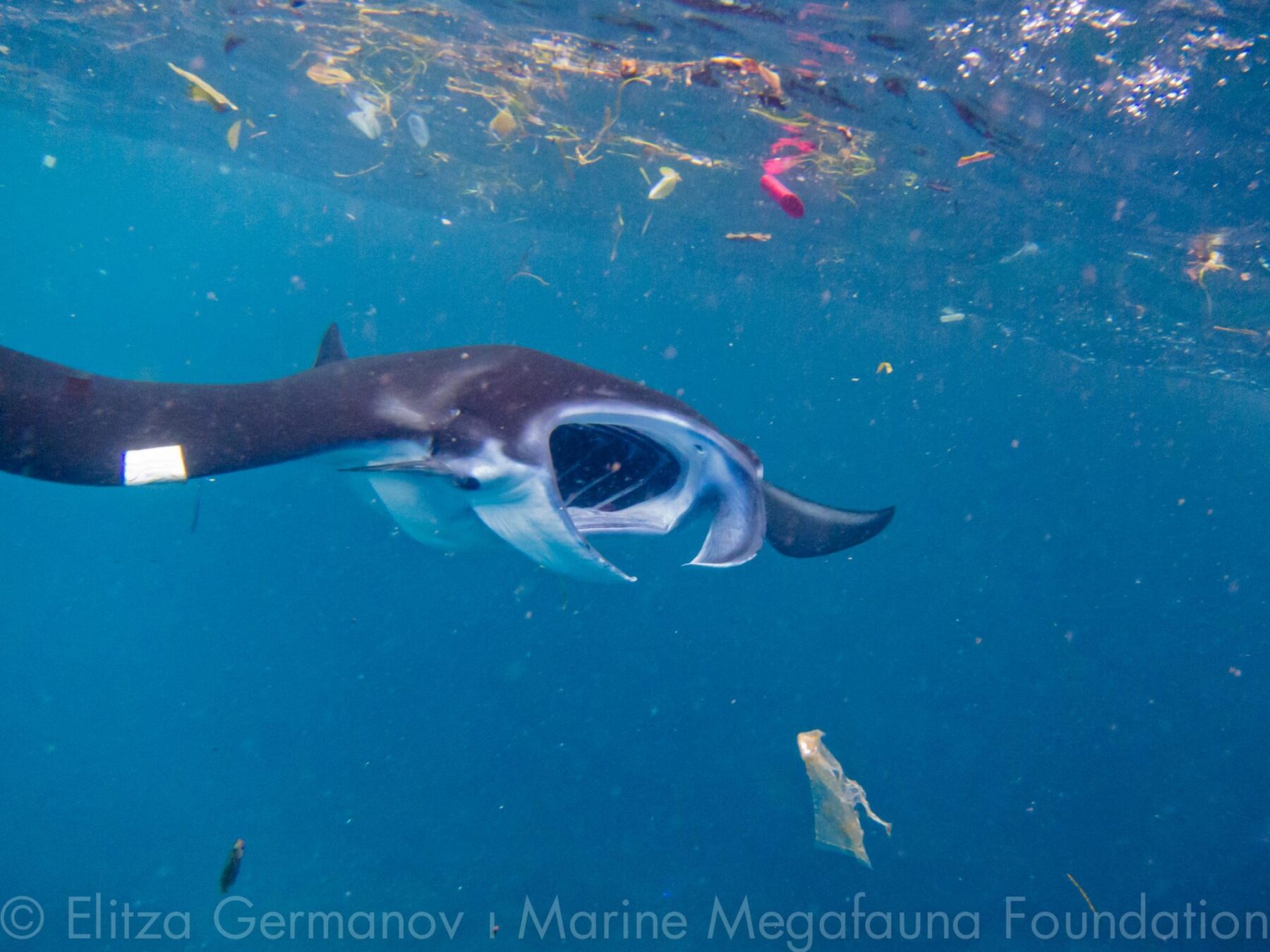
Plastic doesn’t just pollute beaches around the world; an estimated 8 million tons of waste enters our oceans each year. In 2016, a study led by the World Economic Forum and Ellen MacArthur Foundation predicted that by 2050, oceans are expected to contain more plastics than fish (by weight) – if we continue on our current path. With countries such as India, France and Tanzania committed to banning single-use plastic such as take away containers, bottles and carrier bags, there is a positive momentum. However, these plastic products are just the beginning of the problem. Plastic does not easily break down completely, but it does break up into particles as small as sand grains. Microplastics – which are also used in cosmetics such as facial scrubs and toothpaste – are likely to pose a more serious threat than the bigger visible plastic chunks. These tiny pieces end up in our oceans where they are ingested by marine life. Plastic, an indigestible material, can be detrimental to an animal by blocking up its digestive tracts and limiting nutrient absorption. It also attaches and concentrates toxins that may negatively affect regular biological functions, and, for example, may lead to reduced reproductive abilities. Elitza Germanov from the Marine Megafauna Foundation (MMF) is worried about ocean pollution and particularly about how plastics affect her favourite marine animal, the filter-feeding manta ray. Using her PhD study, Elitza and her team investigate the impacts of microplastics on these already threatened giants at their feeding grounds in Nusa Penida and Komodo National Park, Indonesia. As they swim through the ocean with their mouths open to eat as much zooplankton as possible, they inevitably suck in plastic pieces as well. Using a fine-sized net towed by a boat, it is possible to sample water in the surface layer where manta rays are often observed feeding, and to assess the amount of microplastics found. Preliminary findings suggest that manta rays could be ingesting 40-90 pieces of plastic per hour of surface feeding. The majority of plastics found are films, such as shopping bags, food and other household wrappers and small fragments of harder plastic originating in the breakdown of plastic objects and single-use items such as straws, plastic bottle caps and cutlery. Elitza and her team are also examining whether these mantas are exposed to plastic-associated toxins and to what levels, by opportunistically collecting samples of egested material and stomach contents of the animals. Megafauna species such as manta rays and whale sharks are worth much more alive than dead as they attract thousands of divers and wildlife enthusiasts every year to tourism destinations such as Indonesia and its neighbours. Using these iconic species as ambassadors to raise awareness of the issues of marine plastic debris, the ‘Microplastics & Megafauna’ study aims to inform local government and other stakeholders to adapt better waste manage practices. From interviews conducted in the local communities around MMF’s field sites in Indonesia, it is clear that reducing waste is a priority for many of the people asked. However, much work still needs to be done. Tackling the problem on a local level through public engagement activities such as educational talks and beach cleanups can make a true difference and has been an important part of MMF’s project in this country. Earlier this year, Indonesia pledged to turn the tide on plastic by committing up to $1bn a year to reduce the amount of plastic and other marine waste as part of the UN’s Clean Seas campaign. This is a major step forward as Indonesia is not the world’s second biggest plastic polluter. While located at the heart of the Coral Triangle, Indonesian waters are also home to the world’s most biodiverse ecosystems providing food security for millions and a major drawcard for tourists. A plastic-free and healthy ocean is good for everyone, not just the mantas. Website: Marine Megafauna Foundation

Post Report: Singapore Divers’ Party, 3 August 2017

0

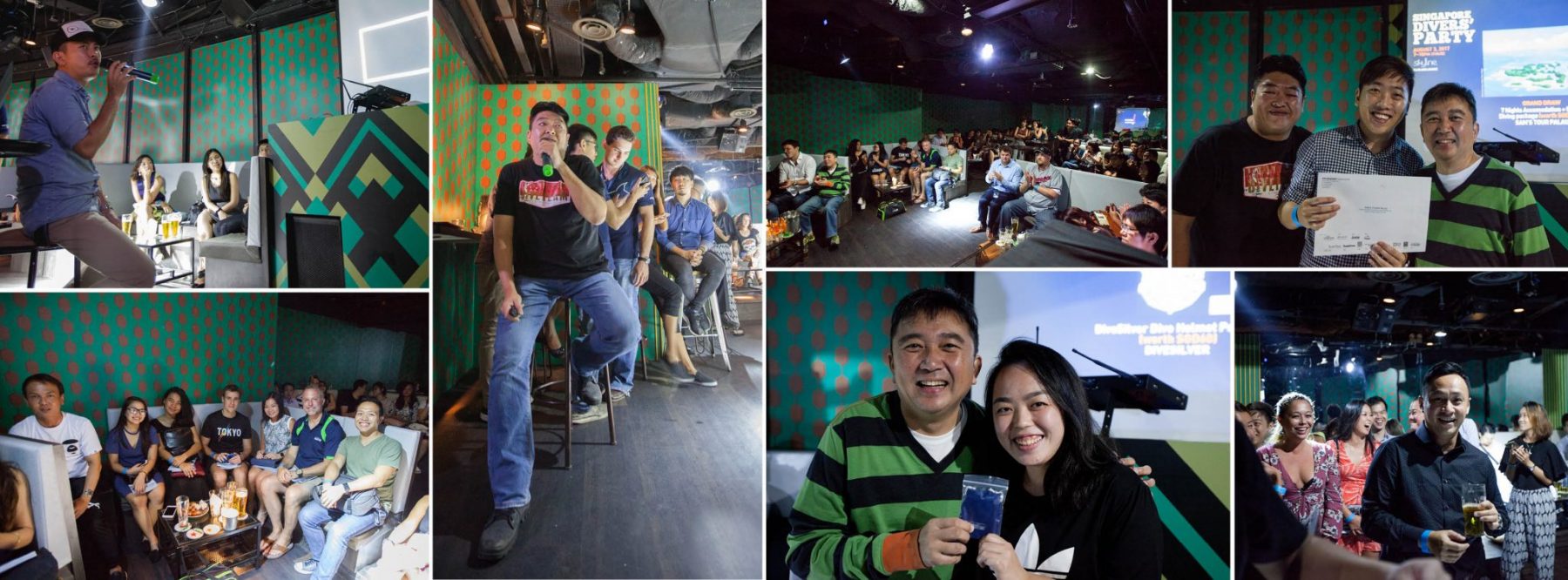
It was a night filled with interesting stories, people, and of course, drinks! Packing the Skyline Club and Lounge, over 100 divers from all over gathered together with their 1-for-1 house pours and Heinekens to hear the exciting and insightful presentations of our speakers – Aaron Wong, Jonathan Lin, and William Tan. Widely recognised underwater photographer, Aaron Wong, kicked off the night with an intriguing presentation of his dive at Truk lagoon, French Polynesia, and Fiji. Sharing his stunning images of sunken wrecks and majestic sharks, he captivated the audience with stories of diving through pitch-black passageways, swimming along a wall of sharks, and hand-feeding nurse and bull sharks. Next, we had long-time diver and established underwater photographer, Jonathan Lin, who shared his passion for macro photography, accompanied with fascinating shots of alien-like critters. The audience had a close-up look at a plethora of micro marine life such as parasites, hatching cuttlefish, and the elusive bobbit worm, all of which were taken from his dives in Manado and Lembeh – places that he fondly refers to as his second home! The night took an interesting turn as William Tan took over the stage – a highly respected professional in the industry who is regularly employed as a judge at underwater photography competitions. He shared his vast knowledge and experience with the audience, passing on tips and tricks to aspiring photographers, and elaborating on the very tricky pursuit of blackwater photography. To conclude his speech, he touched on the ethics of underwater photography, reminding us all to be aware of the impact our photographs have on the public’s perception of the marine world. Our CEO, John Thet, concluded the talks by sharing some important information on the upcoming ADEX China 2017. We look forward to seeing you there! The night drew to a close with the highly anticipated lucky draw. With prizes ranging from the DiveSilver Diver Helmet Pendant to a seven-night accommodation and five-day diving package with Sam’s Tour Palau, the audience was kept on their toes as the drawn numbers were announced. Congratulations to all our lucky winners! We’d like to thank our speakers, VIP guests, and everyone who came down for the evening. See you in October for the next Diver’s party!

So Many Mermaids

0

Want to be part of ADEX China 2017 Shenzhen Mermaid Festival and Challenge? CLICK HERE TO REGISTER!

Mermaid Festival The ADEX sees a long term future in Mermaids & Tritons, and is holding it’s very first Mermaid Festival at the 2017 Shenzhen International Dive & watersport Expo. In total, three Mermaid Schools will attend the festival:

  • Shenzhen Mermaids
  • Guangzhou Mermaids
  • Hongkong Mermaids

During the festival, the Organization will attempt to bring 200 Mermaids together, all with the objective to draw attention to the mythical creature that may just live in all of us – “Mermaids are real.” The Festival will feature the following:

  • A Mermaid Pool in which the tails & flukes can be seen at work in their best way
  • A Mermaid Tank in which Mermaids will perform
  • A Mermaid Cove from which the Mermaids will present themselves

Special mention must be given to OA/MA. Ocean Alliance is an organisation that aims to promote the existing Ocean Conservation initiatives. Mermaid-Alliance is a global organisation that aims to promote Mermaids & Freedivers with the overall objective to take things to the next level. OA/MA plans to build fast moving pool facilities that can be used for demonstration/ interaction purposes. Mermaid-Alliance will have four booths at the Shenzhen show and will organise the following:

  • A Mini cinema with creative UW Mermaid & Freediving footage
  • Mermaid hair, make up and body painting
  • Mermaid silicone tails & accessories
  • Ocean conservation promotion booth

The festival is part the Shenzhen International Dive and Water Sport Expo with programs for:

  • Freedive
  • Mermaid
  • Films/Imagies/Books
  • Music/Art/Science
  • Sailing/Surfing/SUP
  • ATV/UTV

Additionally, there will be a kids’ zone and an Ocean Gallery

The festival is organised by:

  • China: Dada Li – Owner and Founder of the Dada Mermaid (Shenzhen) Ocean Culture Ltd. Company and Co-organiser of the ADEX Shenzhen

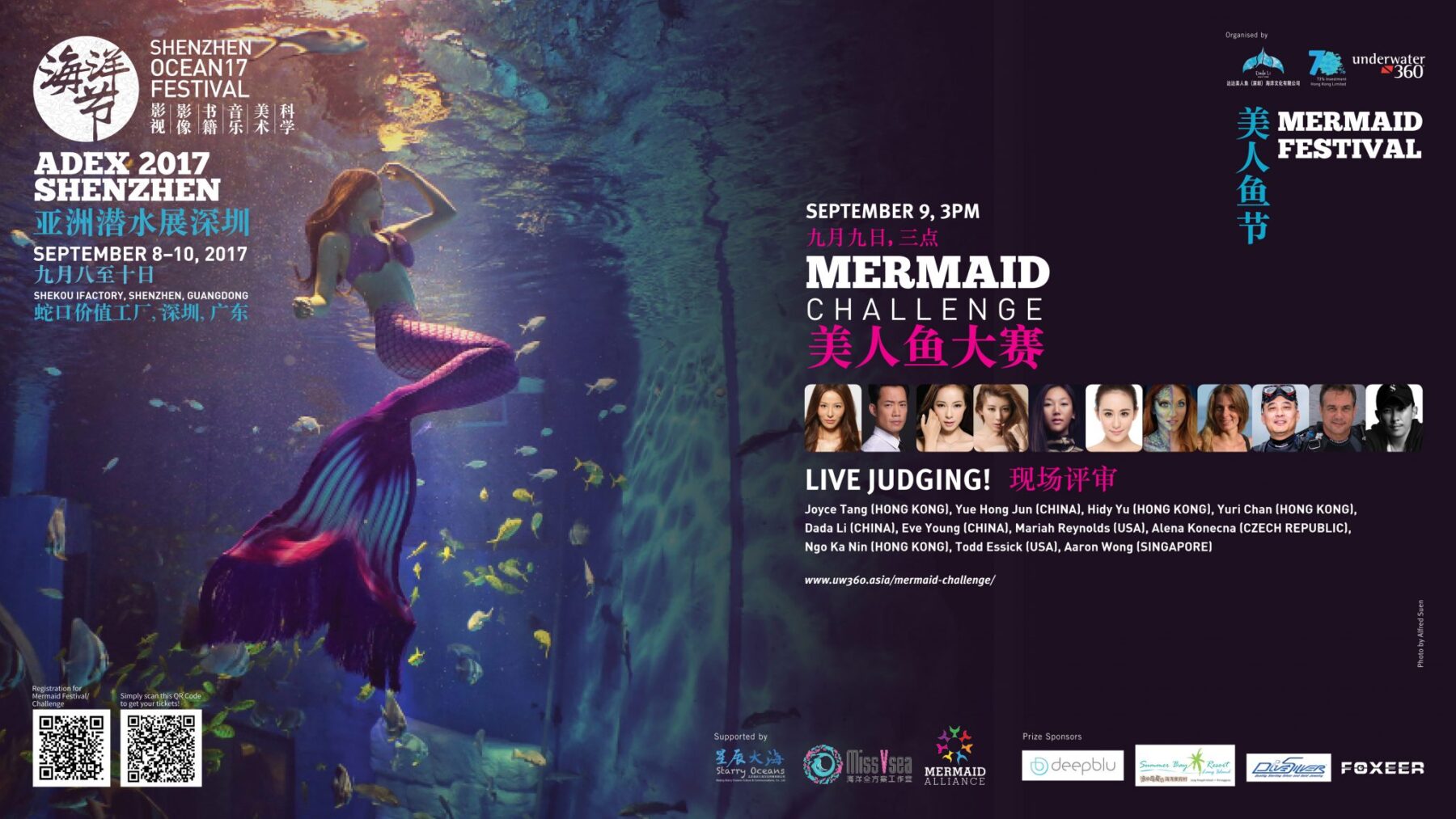
Mermaid Challenge During it’s 2017 inaugural Mermaid Festival, ADEX is planning to hold a Mermaid Challenge. On Saturday 9th of September at 09:00hours, the Mermaid Challenge will commence. Mermaid persona, presentation and swimming skills are rated by judges. It will be the first challenge of it’s kind in Asia. One of the elements of the challenge, the one that can go so horribly wrong if one gets nervous, is to blow a kiss underwater…. Who will be the best, who will be the most comfortable, who has the most natural water connection? And lastly, who will be the most photogenic, and aesthetically attractive and appealing? A 40foot dive tank allows the Mermaids to compete, and the public is encouraged to participate and cheer for their favorite mermaid. A panel of judges, both Mermaids & Tritons, will review the performances, but ONLY after going through the test themselves and showing how it is done! Mermaid Alliance, with representatives on every continent in the world, will produce a video which will be shown the next day, on Sunday 10th of September. Be on time to see both the judges and the contenders in action. The judges are

  • China: Dada Li – Owner and Founder of the Dada Mermaid (Shenzhen) Ocean Culture Ltd. Company and Co-organizer of the ADEX Shenzhen
  • Spain: Pepe Arcos – Photographer, Filmmaker, Freediver
  • USA: Mariah. She is a PADI Dive master, Certified Freediver, Professional Mermaid and the 2017/2018 Mermaid Ambassador for Mermaid Alliance
  • Czech Republic: Alena. She is the current CMAS World Champion Freediving (Constant weight, no Fins) and the 20107/2018 Freediving Ambassador for Mermaid Alliance
  • Brazil: Thais. She is an IMSIA certified Mermaid Instructor and has her own Mermaid School in Brazil, she is one of the partners in Mermaid Alliance


Want to be part of ADEX China 2017 Shenzhen Mermaid Festival and Challenge? CLICK HERE TO REGISTER!