The world has finally reached a historic agreement, aiming to place 30 percent of the seas into protected areas by 2030, to give the marine environment a chance to recuperate, build resilience to climate change and protect the lives and livelihoods of billions of people.
ESTABLISHING THE LIMITS
The High Seas Treaty was formulated on 4 March 2023, after 38 hours of talks, at the UN headquarters in New York. The negotiations had been held up for years over disagreements on funding and fishing rights. This agreement would establish limits on how much fishing can take place, the routes of shipping lanes and exploration activities like deep sea mining – when minerals are taken from a sea bed 200m or more below the surface.
LAW OF THE SEA
The last international agreement on ocean protection was signed 40 years ago in 1982 – the UN Convention on the Law of the Sea. That agreement established an area called the high seas – international waters where all countries have a right to fish, ship and do research – but only 1.2 percent of these waters were protected. Marine life living outside these protected areas has been at risk from climate change, overfishing and shipping traffic.
With the new treaty, the International Seabed Authority will ensure that any future activity in the deep seabed will be subject to strict environmental regulations and oversight to ensure that they are carried out sustainably and responsibly.
SHARING RESOURCES
The agreement took a long time to reach a consensus because the main issue was over the sharing of marine genetic resources. These are are biological material from plants and animals in the ocean that can have benefits for society, such as pharmaceuticals, industrial processes and food.
Richer nations currently have the resources and funding to explore the deep ocean but poorer nations wanted to ensure any benefits they find are shared equally.
Dr Robert Blasiak, ocean researcher at Stockholm University, said the challenge was that no one knows how much ocean resources are worth and therefore how they could be split.
A HISTORIC DAY FOR CONSERVATION
“This is a historic day for conservation and a sign that in a divided world, protecting nature and people can triumph over geopolitics,” Laura Meller, an oceans campaigner for Greenpeace Nordic said.
Countries will need to meet again to formally adopt the agreement and then have plenty of work to do before the treaty can be implemented.
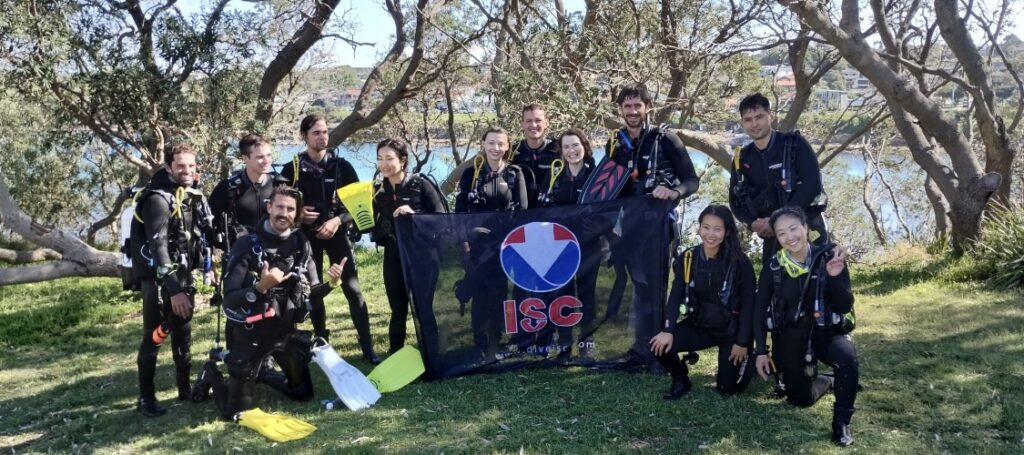
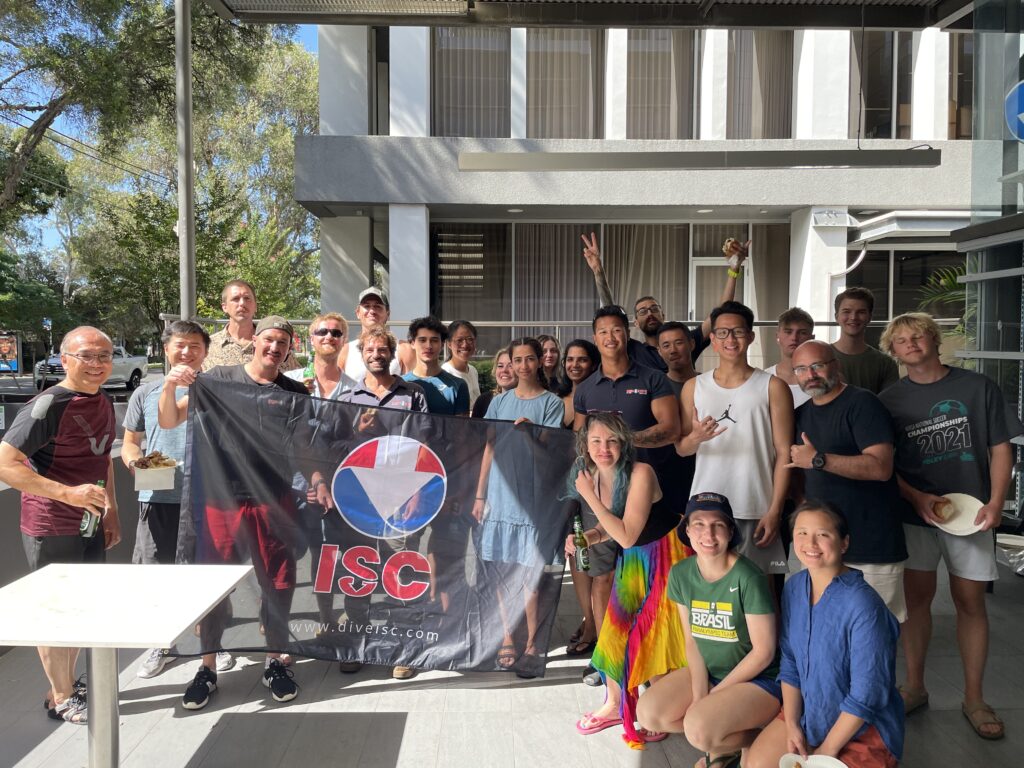
International Scuba Certification (DiveISC.com) is a world-class recreational scuba and Freediving (IFC) training agency certified by the International Standards Organization (ISO). The founders of ISC have over 80 years of experience in the dive industry. This includes running dive centers, teaching and examining instructors, and running a training agency.
Designed for Professionals
ISC is designed for dive centers and dive professionals. They recognise the important role that instructors and dive centers play, and the ISO certification assures students that they are receiving high-quality training that meets the standards set by the industry and accepted by Governments.
Focusing on the Objective
ISC is an outcome-based training agency, meaning there is a degree of flexibility in how skills can be completed to meet the “Objective.” The practical training includes buoyancy as the foundational skill on which all other skills are built. The focus is on the “Objective” that the student must meet, and the instructor is free to decide on the safe method of training that will help the student achieve this objective.
Simple Cross-over Process for Instructors
ISC offers a free, simplified cross-over process that allows instructors to transition to ISC from other ISO-certified training agencies in less than a couple of hours. This streamlined process allows dive centers to access a wide range of experienced instructors, ensuring the best possible training outcomes.
100 Percent Digital Theory and Records
Another key benefit of ISC is the 100 percent digital theory and student record file. This eliminates the need for dive centers to store paper records and ensures that all necessary information is readily available for certification. This digital record system also saves time and reduces the risk of errors, making it easier for dive centers and instructors to manage their records. ISC implements proactive quality control and administration to maintain training standards.
Full Range of Specialty and Freediving Courses
In addition to the core diver training, ISC offers a full range of specialty and Freediving courses. One of their recently launched courses is the Drift Diver course. The course is easy to comprehend, covering important topics such as “Do Not get Lost at Sea” and “Why was I not Seen.” The practical component of the course includes “diving the plan,” underwater buoy deployment, using a reel and line, and buoyancy control.
A Trusted and Reliable Choice
By choosing ISC, dive centers or instructors can save up to 80 percent of certification fees compared to other training agencies. ISC is a world-class recreational scuba and freediver training agency, providing high-quality training and support to dive centers, their instructors, and independent instructors. With its focus on outcome-based training, a flexible approach to skills training, and digital record keeping, ISC is a trusted and reliable choice for all dive professionals.
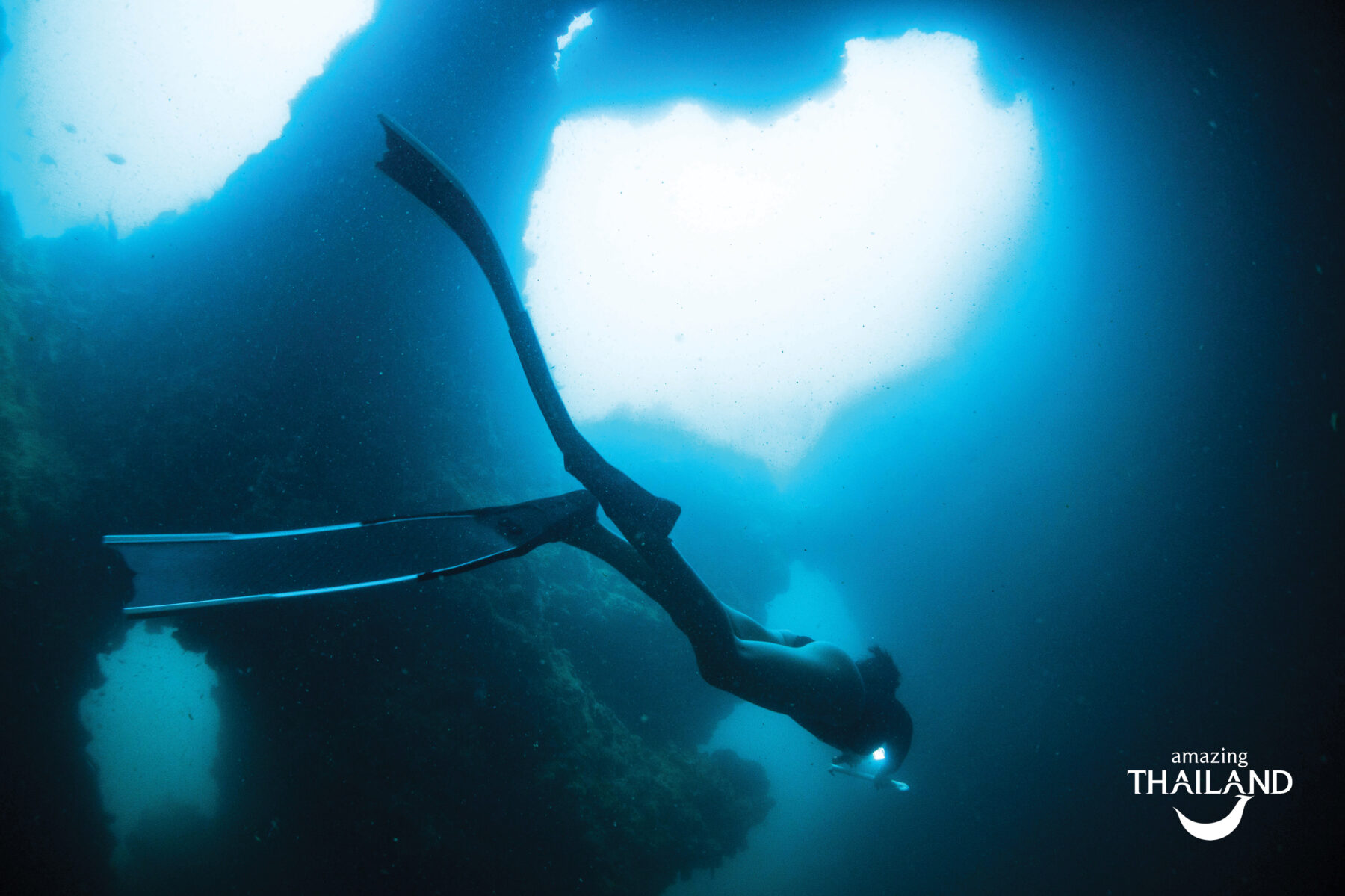
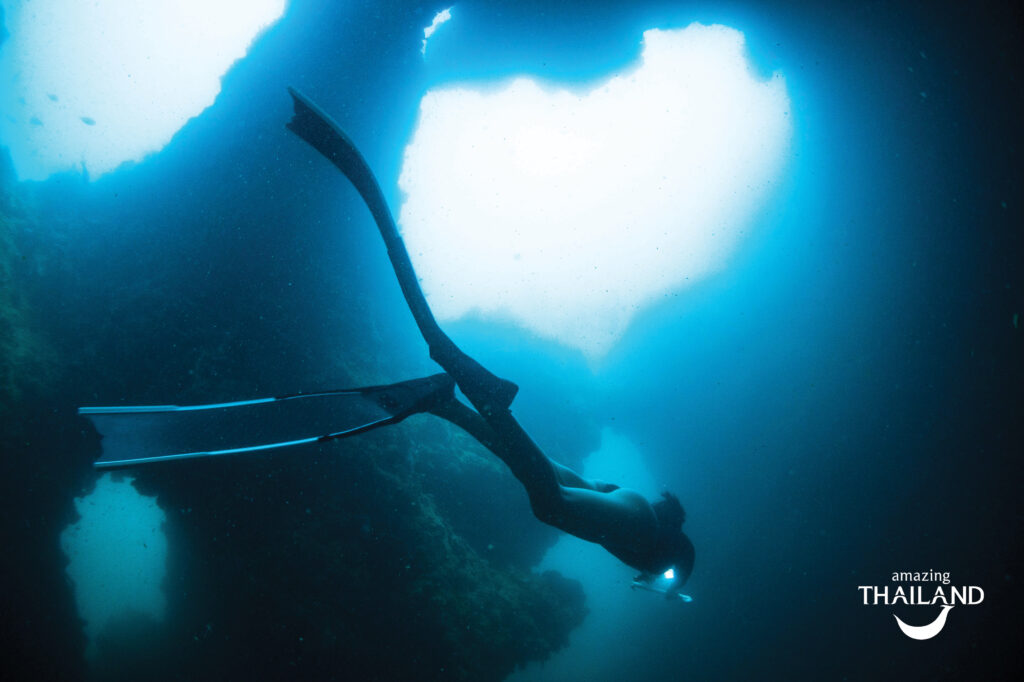
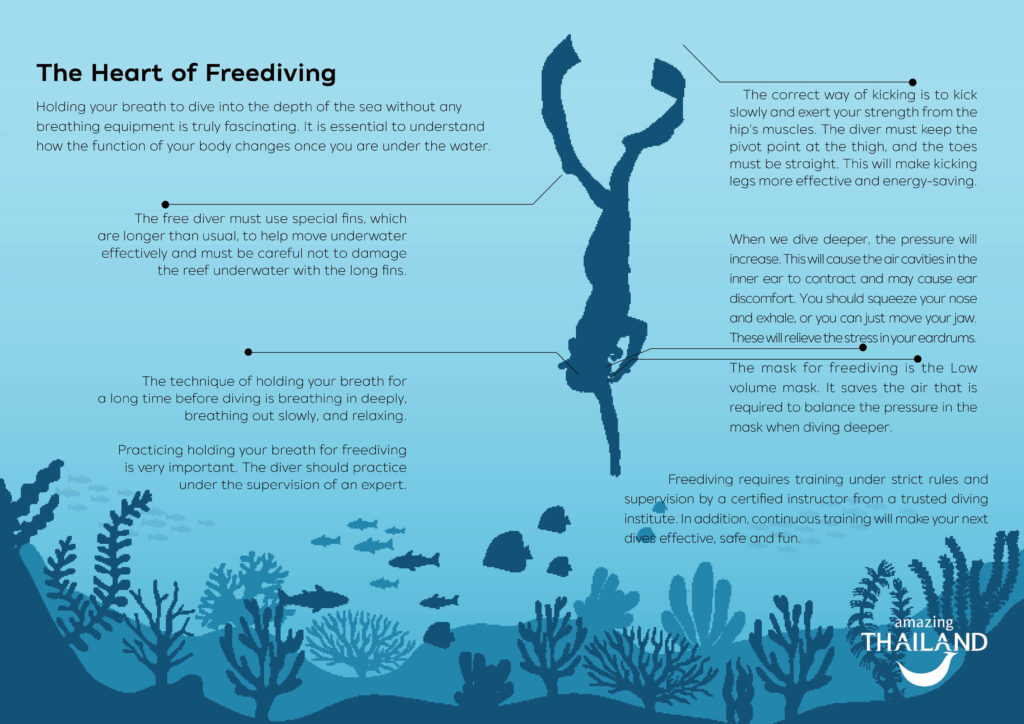
Nowadays, freediving is becoming a popular activity. It allows us to freely experience the world under the sea with minimal equipment, and also challenges our abilities and discipline.
Thailand is by far, one of the top freediving destinations in Southeast Asia. Not only are there plenty of sites abundant with marine life and corals, there is also no shortage of reputable schools.
Some tips on freediving
Popular Freediving Sites in Thailand
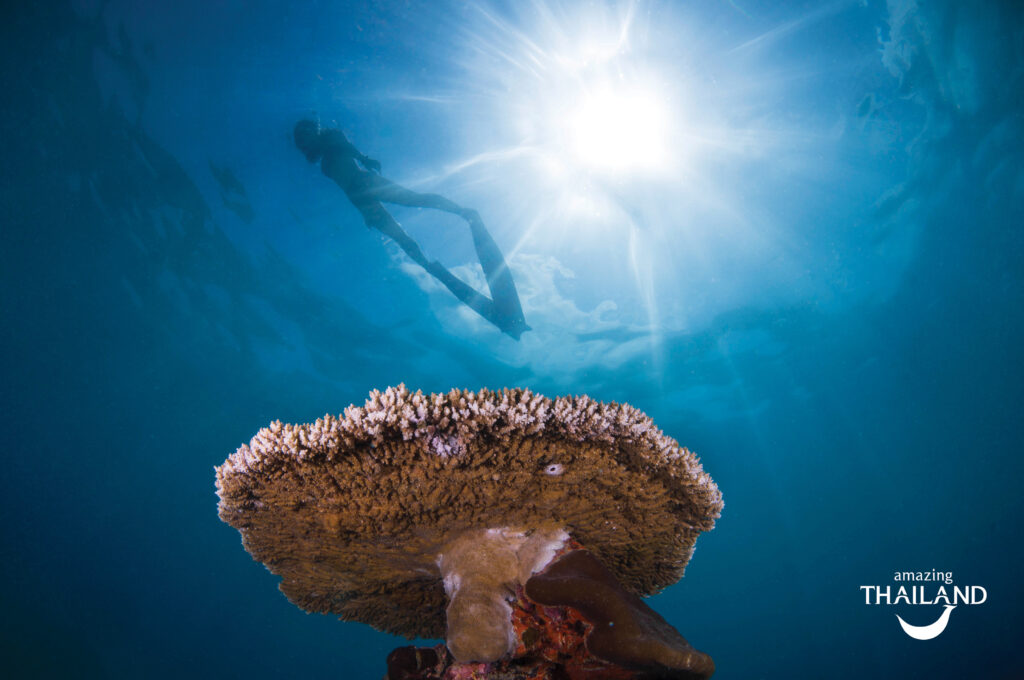
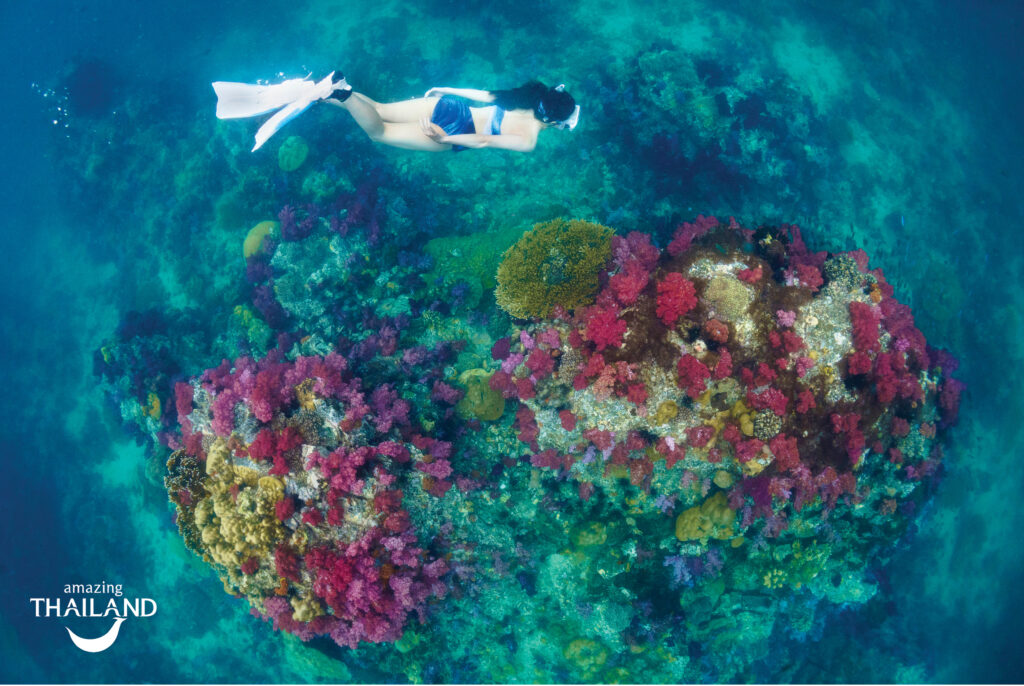
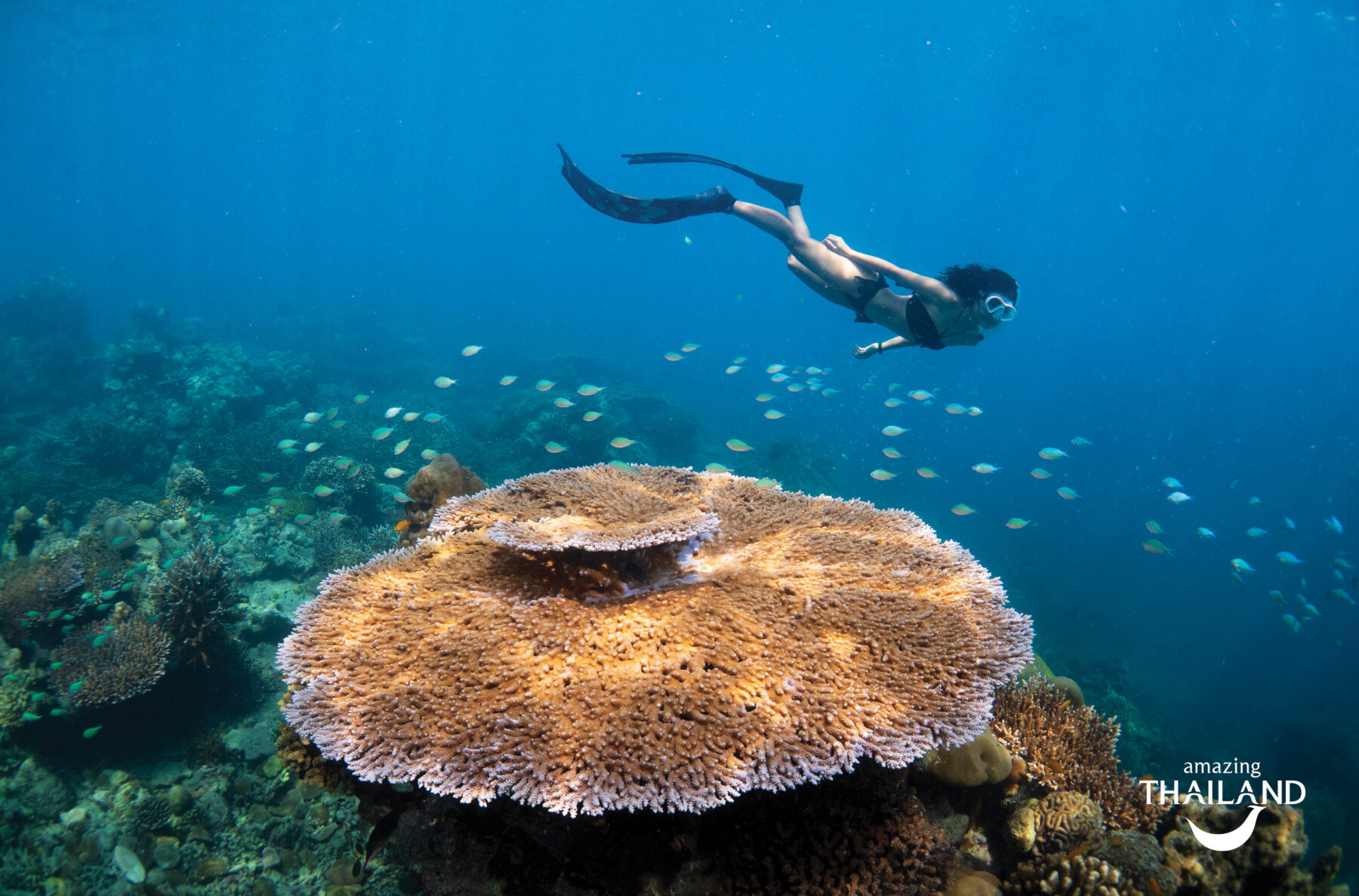
A freediver passes a huge table coral in Mo Ko Surin, Phang Nga Province
Mu Ko Surin, Phang Nga Province
Mu Ko Surin (Surin Archipelago) is a combination of two large islands, Ko Surin Neua (North Surin Island) and Ko Surin Tai (South Surin Island.) Both islands have multiple bays, and all of them are filled with rich, shallow-water corals, which are perfect for freediving.
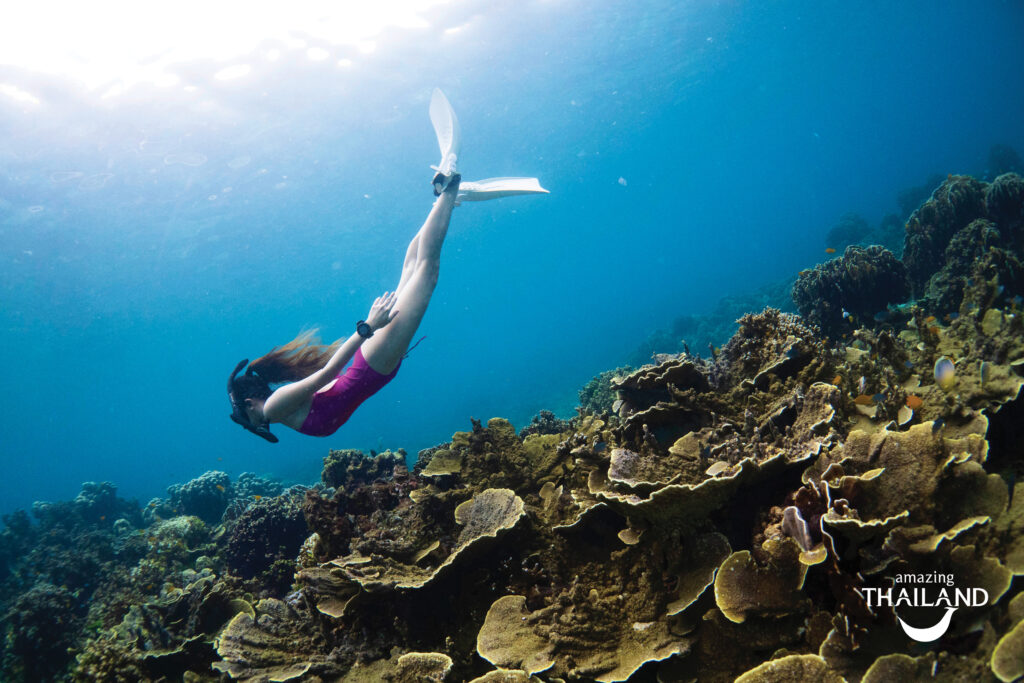
A bed of lettuce coral mesmerises a snorkeler at Mu Ko Racha, Phuket Province
Mu Ko Racha (Racha Archipelago), Phuket Province
Mu Ko Racha (Racha Archipelago) has two islands, Ko Racha Yai (Racha Yai Island) and Ko Racha Noi (Racha Noi Island). These two essential islands among the smaller islands of Phuket Province have some of the most beautiful underwater scenery in the Thai sea. It is also easy to get to, which makes it a top destination for freedivers in Phuket.
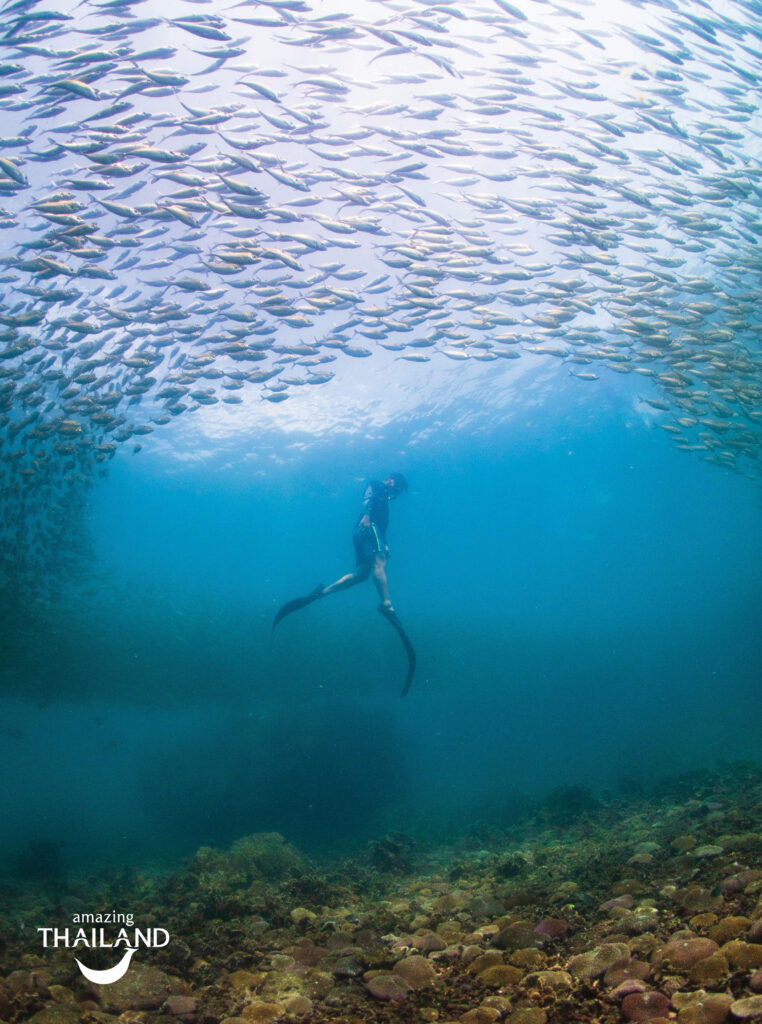
A freediver being ‘one’ with the fish and the ocean
Ko Tao (Tao Island), Surat Thani Province
Ko Tao (Tao Island) is an island in the middle of the Gulf of Thailand. This kingdom of corals is the center of the most vital dive site in the nation, which free divers worldwide are familiar with. Ko Tao (Tao Island) has many dive sites and is a base of many diving institutions. Many people travel here to get certified and log more dives as they enjoy the world under the sea.
An amazing underwater world awaits all ocean lovers at Ko Ran Pet-Ran Kai, Chumphon Province
Ko Ran Pet-Ran Kai (Ran Pet-Ran Kai Islands), Chumphon Province
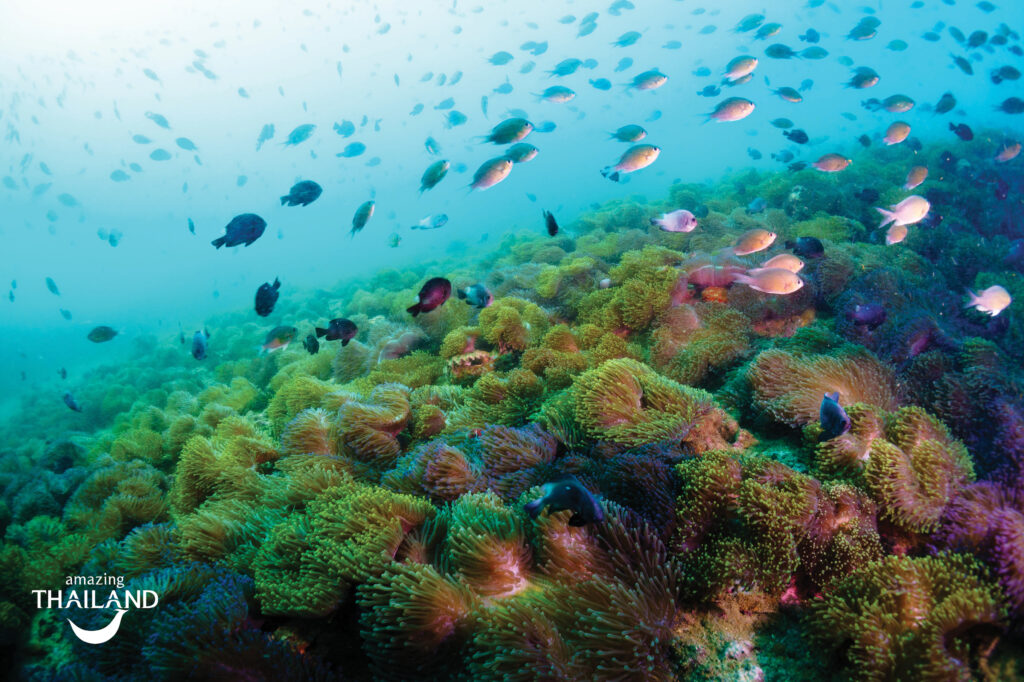
Located in the north of Chumphon province, these twin islands aren’t far from the coast. It is a dive site favoured by many snorkellers, scuba and freedivers alike. The uniqueness of Ko Ran Pet-Ran Kai (Ran Pet-Ran Kai Islands) are the vast fields of sea anemones and skunk clownfish that swim near black coral, purple barrel sponges and red sea whips.
Freedivers utterly enjoy the vibrant corals in Ko Lipe, Satun Province
Ko Lipe (Lipe Island), Satun Province
Ko Lipe (Lipe Island) is one of the Mu Ko Adang-Rawi’s (Adang-Rawi Archipelago) Islands and part of Tarutao National Park. However, it is also the only island where fishing villages, Le-people communities, resorts, hotels, restaurants, and beach bars are situated. It has become a small island city surrounded by nature. Its white sand, pristine waters and many dive sites are always a big draw for tourists.
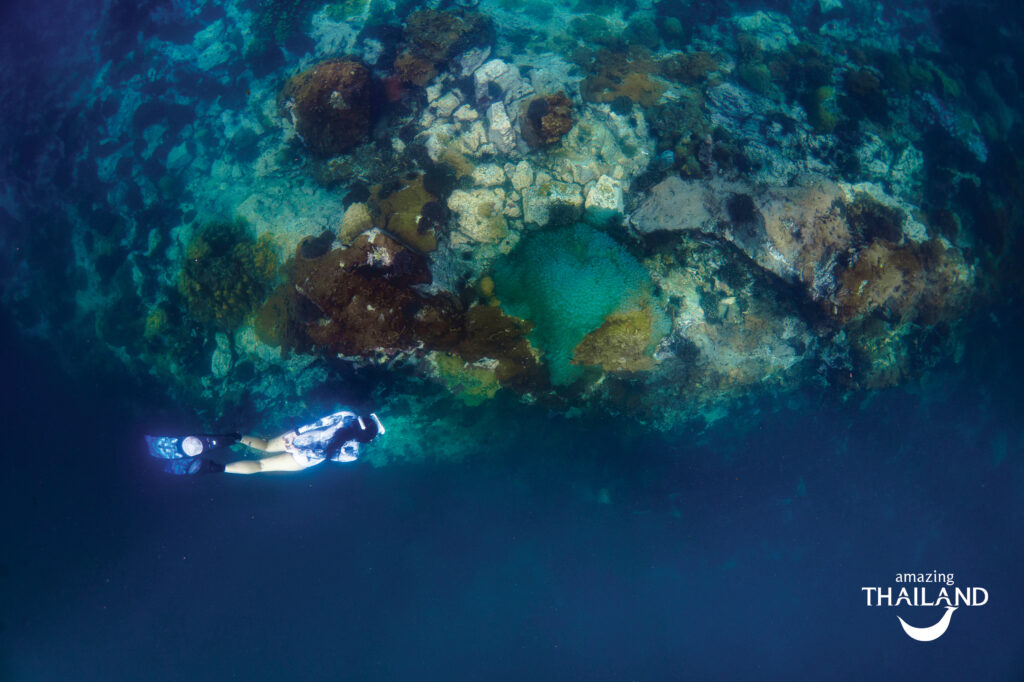
A freediver knows only calm and peace under the water in Samaesarn Bay, Chonburi Province
Samaesarn Bay, Chonburi Province
This is an archipelago with a bay that resembles the Thai alphabet “Ko Kai” (ก) in Thailand’s gulf. As it is on the edge of the Chonburi province, the bay and Samaesarn fishing village are under the protection of the Royal Thai navy, and the beginning of a journey to other dive sites across the archipelago.
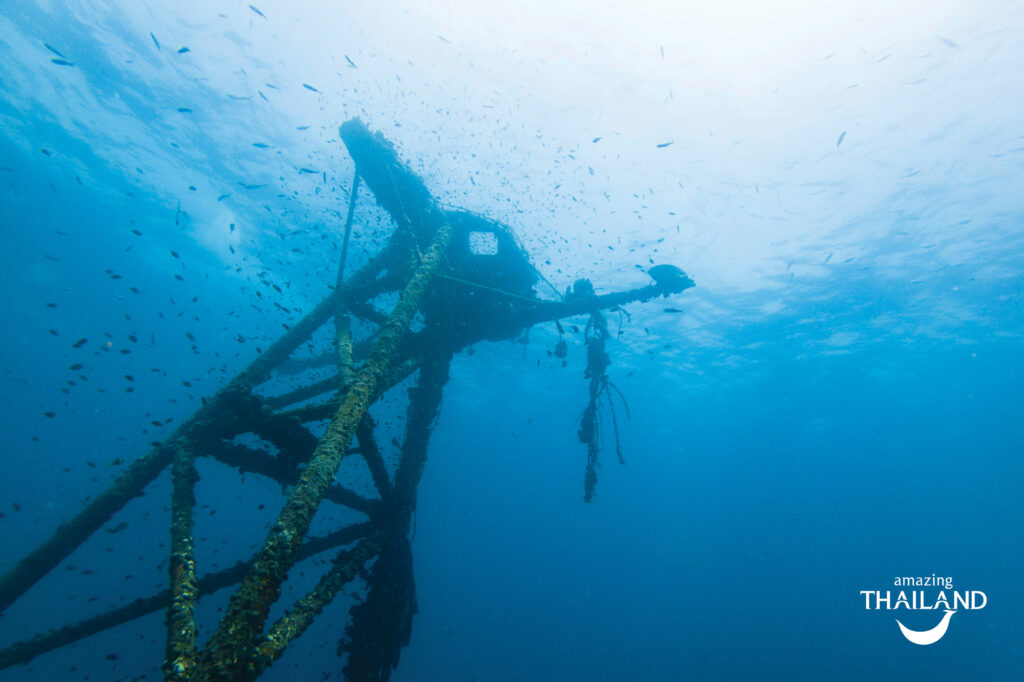
The HTMS Chang is the largest, fully intact wreck in Thailand
HTMS Chang Wreck, Trat Province
HTMS Chang Wreck is located in Trat Province and has become a home to many sea creatures. It is the biggest wreck dive site in Thailand that is still intact. Divers can examine the hull, command bridge tower, mast and deck. Many sea creatures, especially batfish, live here.
Thailand is a country that offers something for every visitor. For lovers of the sea, the southern and eastern regions are perfect for scuba diving, snorkelling and freediving. There are many ideal locations for these activities around the Andaman Sea, like Phuket, Krabi, Phang Nga, Trang or Satun, or in the Gulf of Thailand, like the surrounding islands of Pattaya, Trat, Chumphon and Surat Thani.
We’ve picked 10 of Thailand’s famous and beloved dive sites that you should not miss.
Best time for Diving
The best time for diving in the Andaman Sea and the eastern Gulf (Trat Province) is between October and May for, and between February and October in the southern part of the Gulf of Thailand (Ko Samui, Ko Phangan and Ko Tao)
10 Dive Sites in Thailand not to be missed
Richelieu Rock, Phang-nga
Because Kong Hin Richelieu (Richelieu Pinnacle) lies in the channel between Mu Ko Surin (Surin Archipelago) and the coast, currents carry rich nutrients that feed and nurture all the marine and coral life in the area, making this world-famous dive site one of the most abundant underwater ecosystems in the Thai seas.
Thousands of glass fish swarm a reef at Richelieu Rock.
Tachai Pinnacle, Phang-nga
Tachai Island is an isolated island far away from the other islands of Mu Ko Similan (Similan Archipelago) National Park. This island has a beautiful beach and a well-known dive site called Tachai Pinnacle. It is two massive rocks sitting next to each other in the south of Tachai Island that is also known as Twin Peaks. Currents are very strong here, allowing the beautiful kalam pangha to flourish as it traps the plankton passing through it.
Huge sea fans sprout from a bommie at Tachai Pinnacle.
King Cruiser Wreck, Phuket
This vessel ferried passengers between Phuket Island and the Phi Phi Archipelago until it crashed into Kong Hin Musangnai (Musangnok Pinnacle) in May, 1997. All 500 passengers were rescued. Today, the wreck resembles more of a coral reef than a ship. This is because it lies in the path of strong currents, full of nutrients and marine life, causing a bloom in colourful, soft corals blanketing the entire ship, and ultimately attracting schools of fish and other marine creatures who take refuge in the corals.
The wreck is now encrusted with hard and soft corals, surrounded by all kinds of reef fish.
Koh Haa, Krabi
Experience mountains, caves, and flower gardens under the sea in Mu Ko Haa (Haa Archipelago), which is part of Mu Ko Lanta National Park. Many divers travel from Ko Lanta Yai (Lanta Yai Island) or Ko Phi Phi Don (Phi Phi Don Island), or come on a liveaboard to these limestone islands in the middle of the sea. Whether you view it from the air, above the sea, or under the water, it is an incredible scene.
Divers swim past one of the many caves at Koh Haa.
Hin Muang – Hin Daeng Rock, Trang
Hin Muang and Hin Daeng (Muang Pinnacle and Daeng Pinnacle) are twin pinnacles under the sea. Hin Daeng (Daeng Pinnacle) just peeks a little out of the surface and looks like an ordinary rock in the water. But beneath the surface, this giant rock is covered in many soft, red and purple corals surrounded by many fishes, like barracuda, fusilier, long-nosed hawkfish, and gold belly damselfish. Hin Muang (Muang Pinnacle) slopes down to the bottom into the dark, making the soft red corals look purple.
A diver enjoying the beautiful, healthy corals at Hin Muang – Hin Deang Rock.
Stonehenge Pinnacle, Lipe, Satun
Divers who discovered the site named it Stonehenge Pinnacle for the four granite rocks arranged in a circle, similar to the original Stonehenge in England. The rocks are covered with soft red, purple, blue, white, and yellow corals along with kalam pangha. The site is quite large and will take two dives see all of its beauty.
The four granite rocks stand tall amongst a vibrant display of hard and soft corals.
Losin Pinnacle, Pattani
Ko Losin (Losin Island) is a small island located far away from the coast and takes the longest time to get to. But divers still think it is worth the travel time to see an entire
kingdom of hard corals like mountain coral, cauliflower coral, sea whips, and sponges. In addition, there are hordes of small fishes and large sea creatures like whalesharks that often swim by.
A diver is impressed with the profuse amount of Acropora corals growing in gin-clear waters at Losin Pinnacle.
Sail Rock (Hin Bai), Ko Pha-ngan, Ko Tao, Suratthani
Hin Bai (Bai Pinnacle) is a large stone located between Ko Tao (Tao Island) and Ko Pha-ngan (Pha-ngan Island). The pinnacle slopes to a depth of 35 metres and is known for its large hordes of fish, which always amazes anyone who has seen it. You can expect to see Russell’s snapper, hardtail scad and big fish like whalesharks that commonly live around the area.
Divers get excited when they meet the largest fish in the ocean – the whaleshark– at Sail Rock.
Chumphon Pinnacle, Ko Tao, Suratthani
This site is suitable for experienced divers as the current can be very strong at times. The pinnacle is at a depth of 14 meters, but the average diving depth is 20-25 meters. Divers will find many types of hard coral, sea whips, a large anemone grove, and large schools of fish, such as barracuda and yellow-striped scad. However, the divers’ favorite is the whaleshark, a large, gentle fish that often visits the site.
This large sea anemone grove is a favourite spot for photographers who want to capture a lot of fish action at Chumphon Pinnacle.
Hin Phoeng, Rayong
Many divers agree that Hin Phoeng (Hin Phoeng Pinnacle) is the most beautiful dive site in the eastern region. This pinnacle is far from the coast, and visibility is very good.
Hin Phoeng (Hin Phoeng Pinnacle) is actually two large pinnacles. Many marine creatures can be found here and you will often find yellow-striped scad, batfish, lionfish, bannerfish and whalesharks.
The great visibility at Hin Phoeng greatly amplifies the beauty and colours of the site.
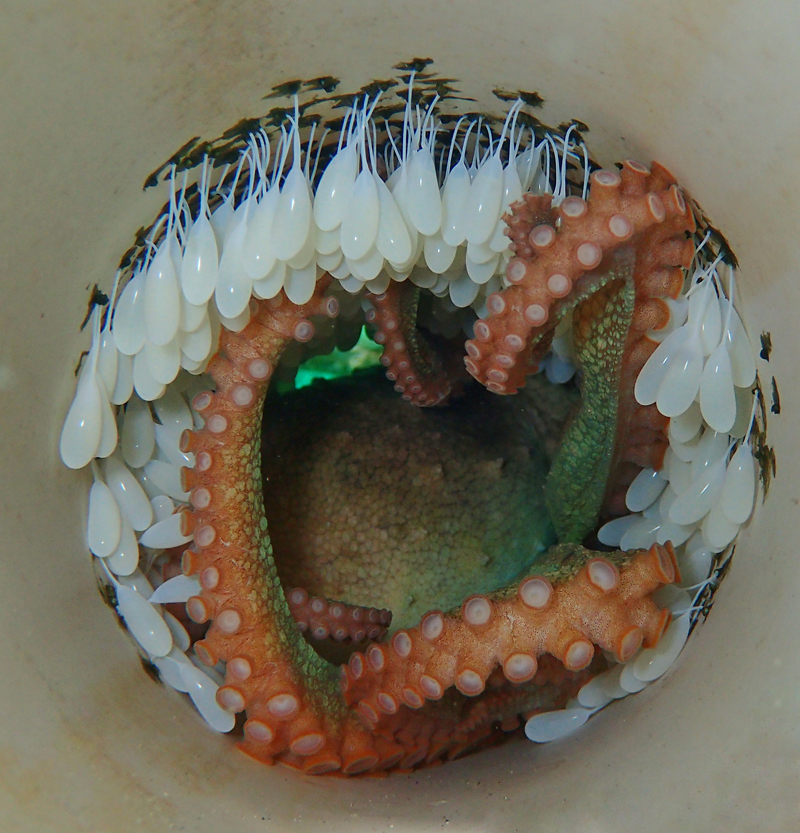
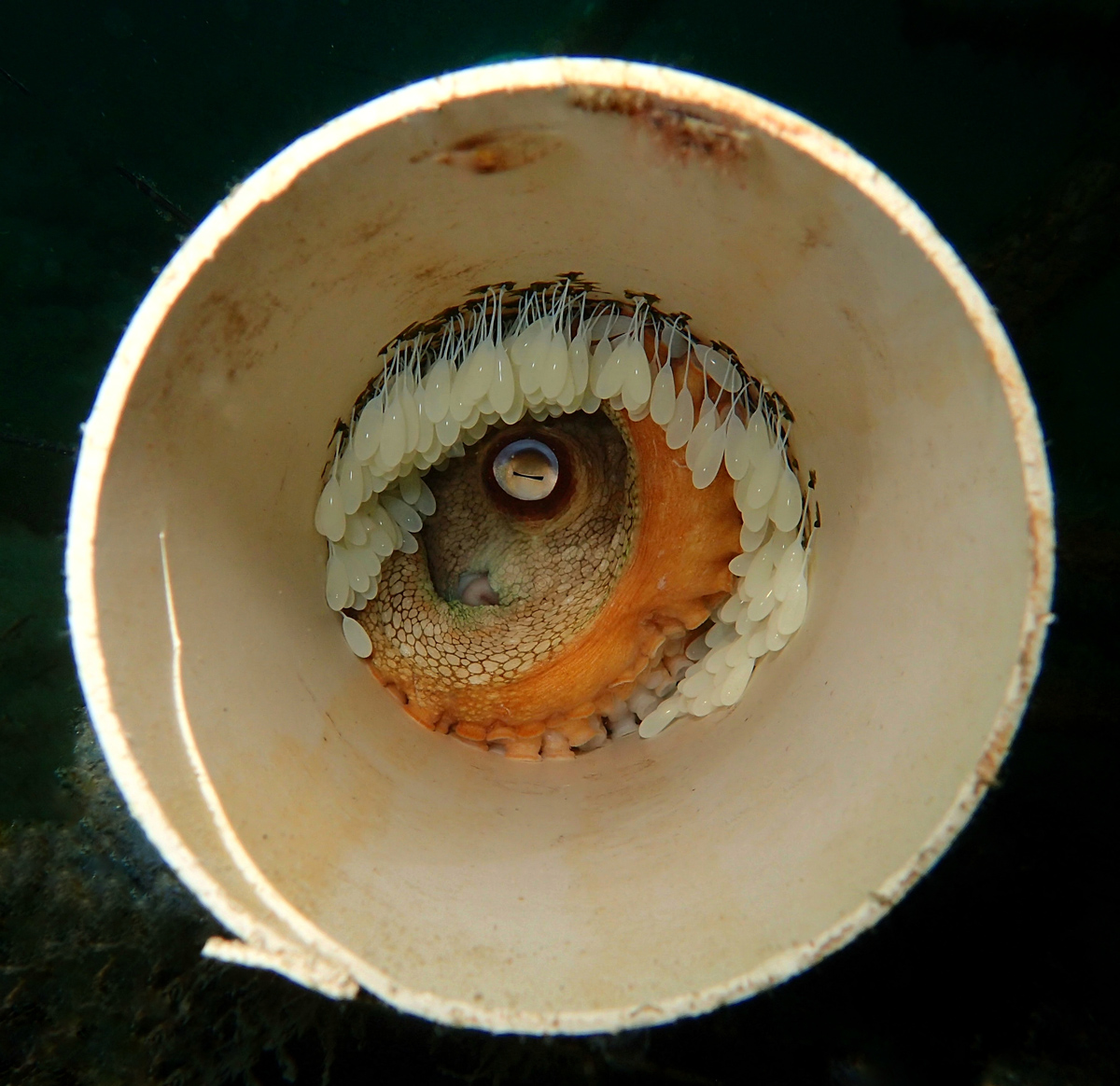
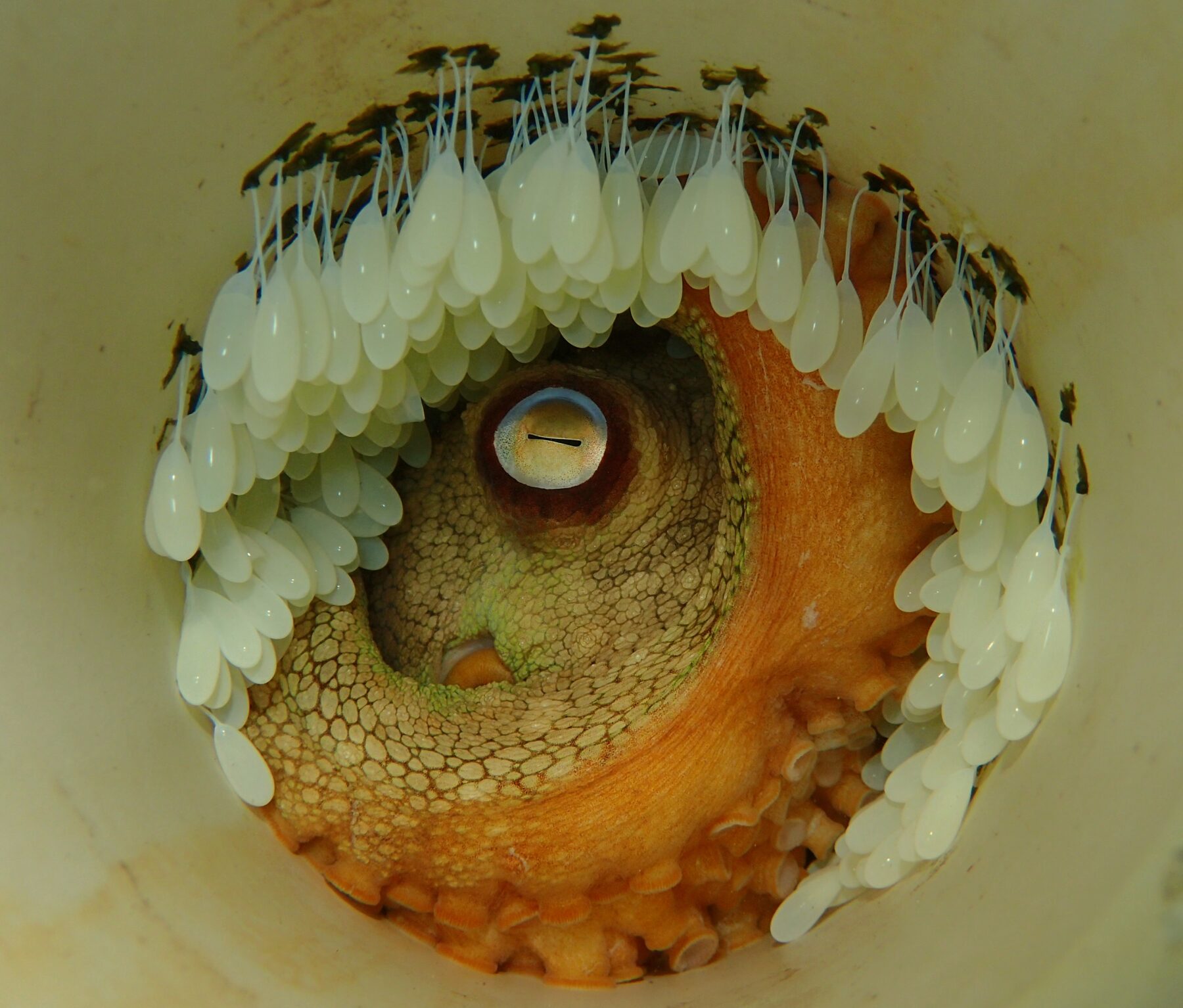
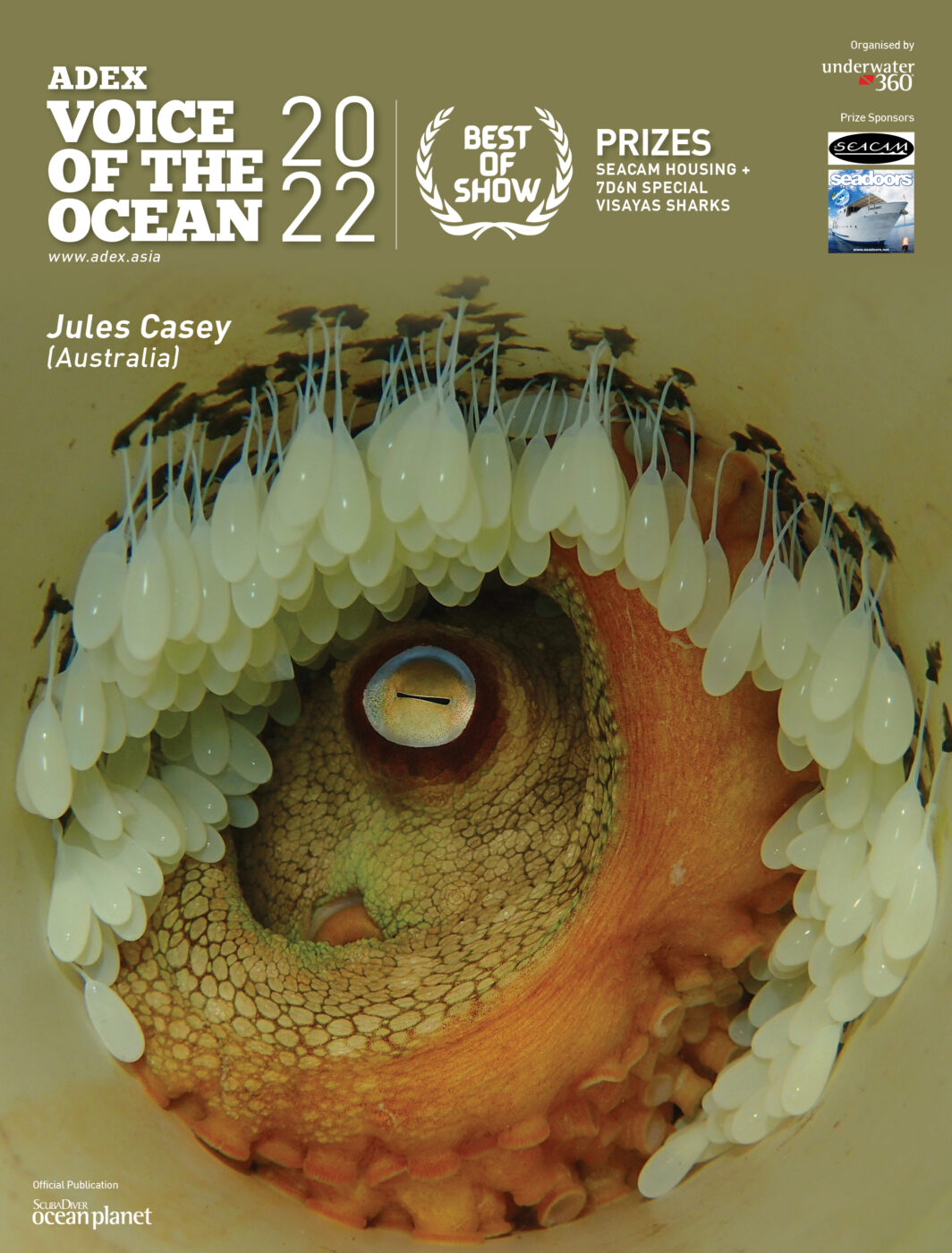
Jules Casey’s “The Circle of Life” won Best of Show in the ADEX 2022 Voice of the Ocean photo/video/art competition.
The Australian photographer talks us through exactly how she captured her shot of the Pale Octopus in a PVC pipe protecting her eggs.
The COVID-19 pandemic caused chaos all over the world, but residents of the state of Victoria in Australia faced tougher restrictions than most. During six separate lockdowns totaling 262 days, I was unable to scuba dive for months, but eventually, as part of the two hours allocated for daily exercise within a five-kilometer radius of home, I was allowed to set up my camera gear and get back underwater.
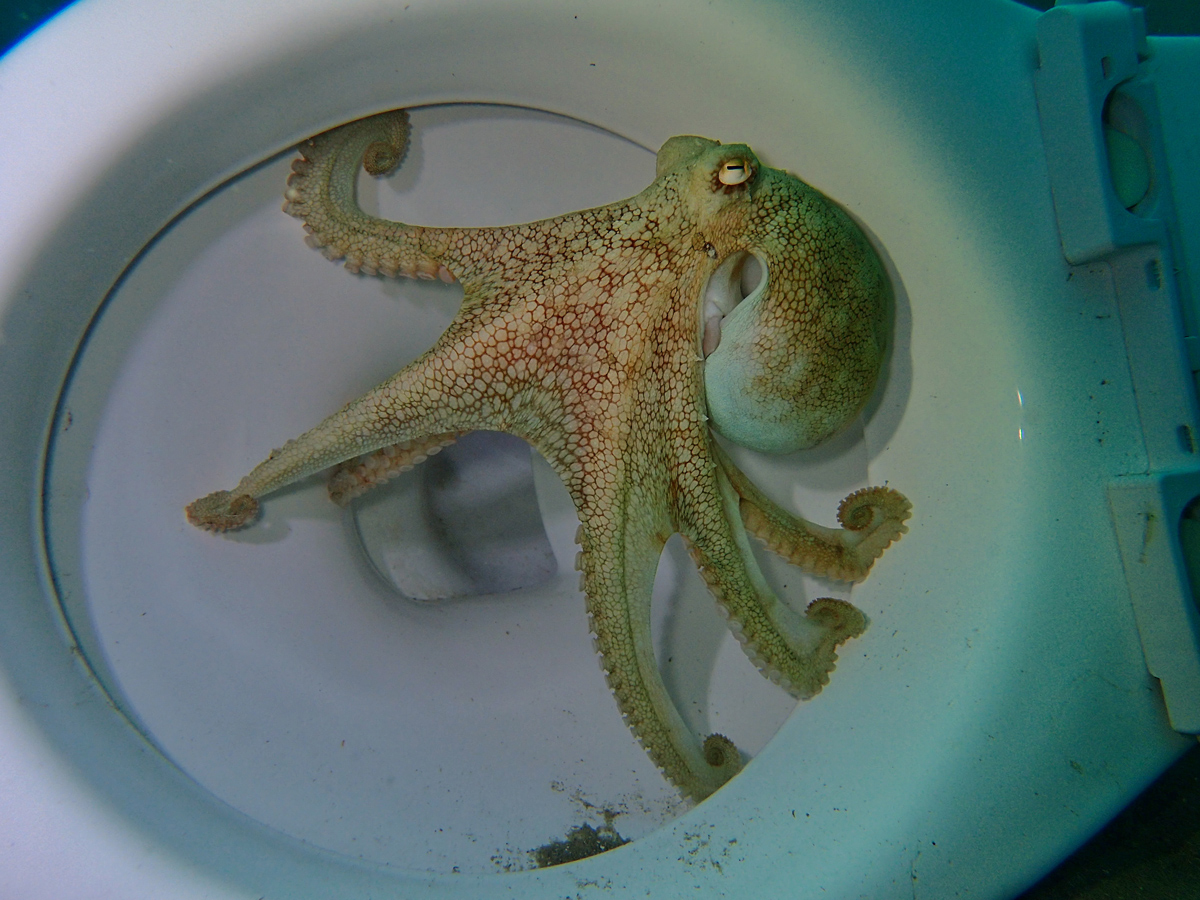
Perhaps inspired by their lack of activity during lockdown, two local divers decided to build an artificial reef close to my home, and although I wasn’t involved in the construction of the reef, I documented every stage of the project as it took shape. After a few weeks, it was suggested that installing a toilet would be a great idea, as it would provide a safe place for octopuses to lay their eggs in the S-bend of the toilet bowl. Within two days of its installation, the first pale octopus
Several PVC pipes were secured around the other structures within the reef and an explosion of activity happened virtually overnight. The octopuses loved their new playground, and at times there would be a dozen or more hiding within the structures. The new reef also attracted a variety of fish and crabs to the area, and as a photographer and videographer, I was thrilled with what was happening and documented behaviors I had never captured before.
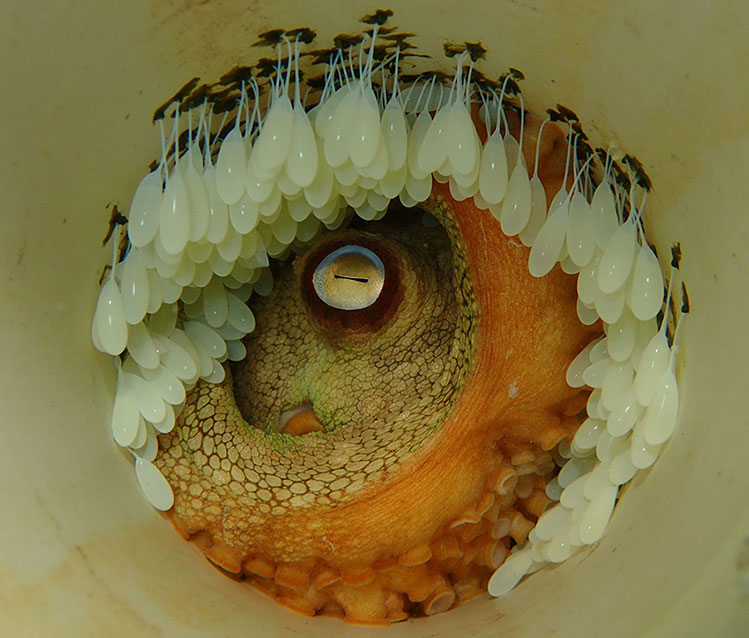
The foreplay of pale octopuses would last for hours and sometimes days. Individuals fighting and mating was a common occurrence, and this continued for months until eventually the females settled in the pipes and laid their eggs. The pale octopus attaches each egg case individually so it hangs within a structure around them, and then continually moves fresh water around her brood for several months until they are ready to hatch. During this time, she does not leave her eggs nor does she hunt for food or eat. I would visit this site almost every day that weather conditions would allow, briefly checking on several expecting mothers and their developing eggs.
My favourite octopus was in a pipe that had been positioned in an extremely tight spot that was impossible to fit my large camera rig with strobes into, so I used a compact camera and a small handheld torch to properly light the shot instead. The octopus was often in front of her eggs protecting them from predators, so it was difficult to capture the image I wanted, but one day my patience paid off and she moved behind her eggs, allowing for the perfect composition.
Sadly, it wouldn’t be long before the eggs would hatch and the caring mother would die after completing her biological life cycle, but I was thrilled to be able to capture her bittersweet story in this one shot—“The Circle of Life.”
One day, she moved into the perfect position to capture my winning shot—here in the uncropped original shot
A close up shot of the eye and her eggs surrounding her
Freediver and scuba diver Jules Casey is an underwater photographer and videographer based in Victoria, Australia.
For more of Jules’ photography, take a look at her Instagram page.
Entitled ‘Circle Of Life’, Jules Casey took this photograph on her Olympus Digital Camera
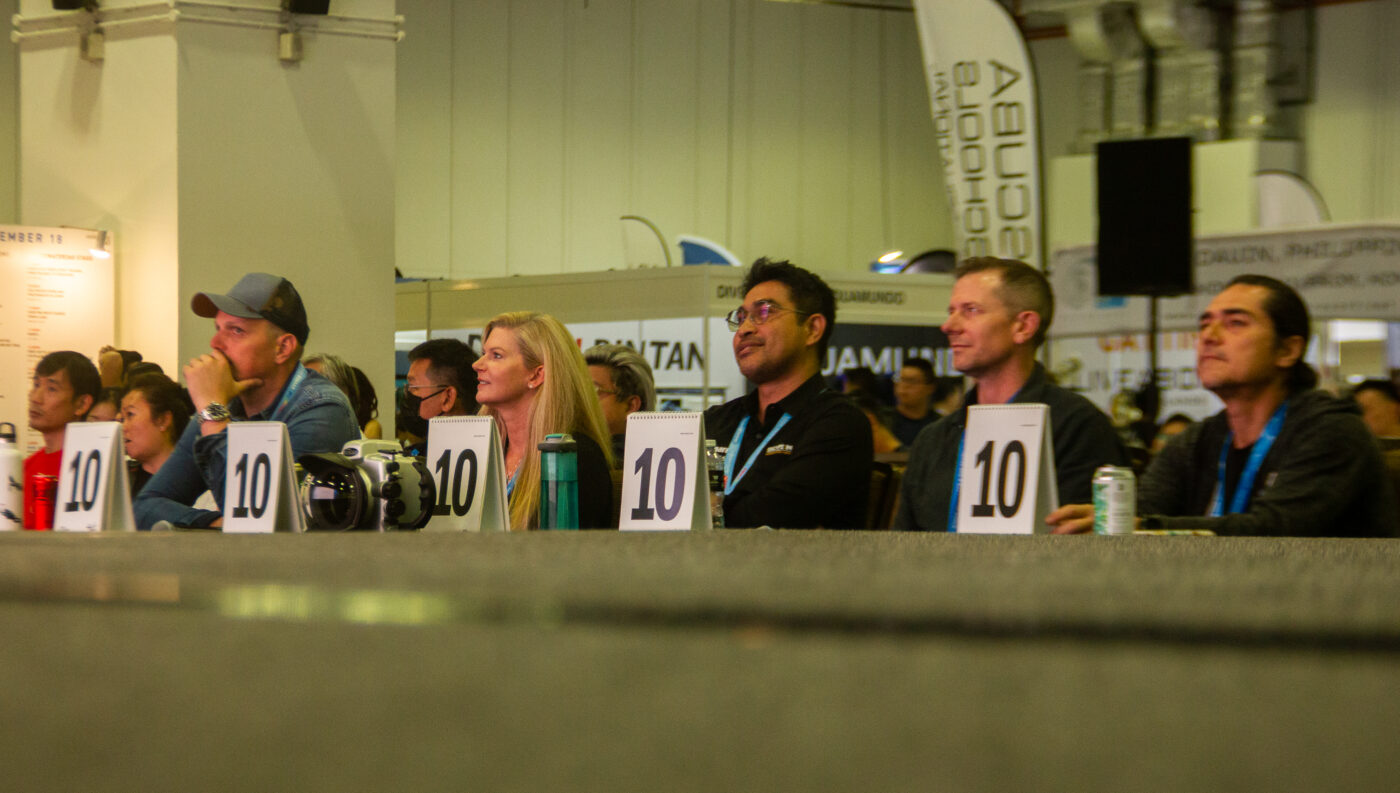
The annual Voice of the Ocean Photo/Video/Art Competition celebrates visual representations of the ocean. The best works by underwater photographers and videographers were presented and judged live by a celebrated panel of distinguished experts at ADEX OCEAN VISION 2022 at the Sands Expo and Convention Centre on the 18th September.
This year competition was tight, with hundreds of entries from 2020- 2022. The panelists were passionate about the finalists, showcasing their scores (with some scoring top 10s across the board!) and had some time to discuss each image too as there were fewer shortlisted this year. We also had a new category of short films which went down a treat!
Thank you to everyone who participated this year and CONGRATULATIONS to our winners! We look forward to the next competition in 2023…
Entry & Category Winner
Best of Show
Jules Casey (Australia)
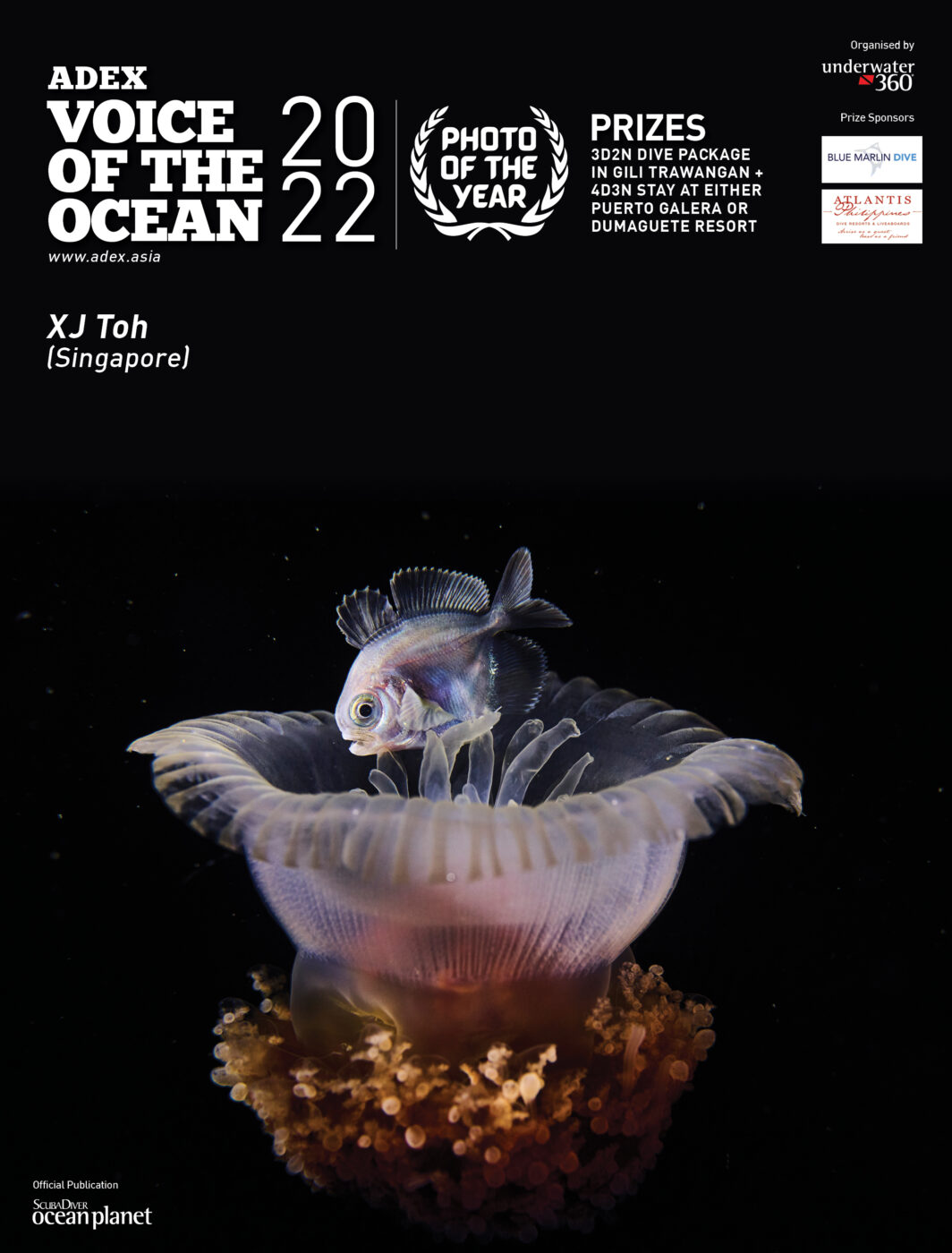
Photo of the Year
XJ Toh (Singapore)
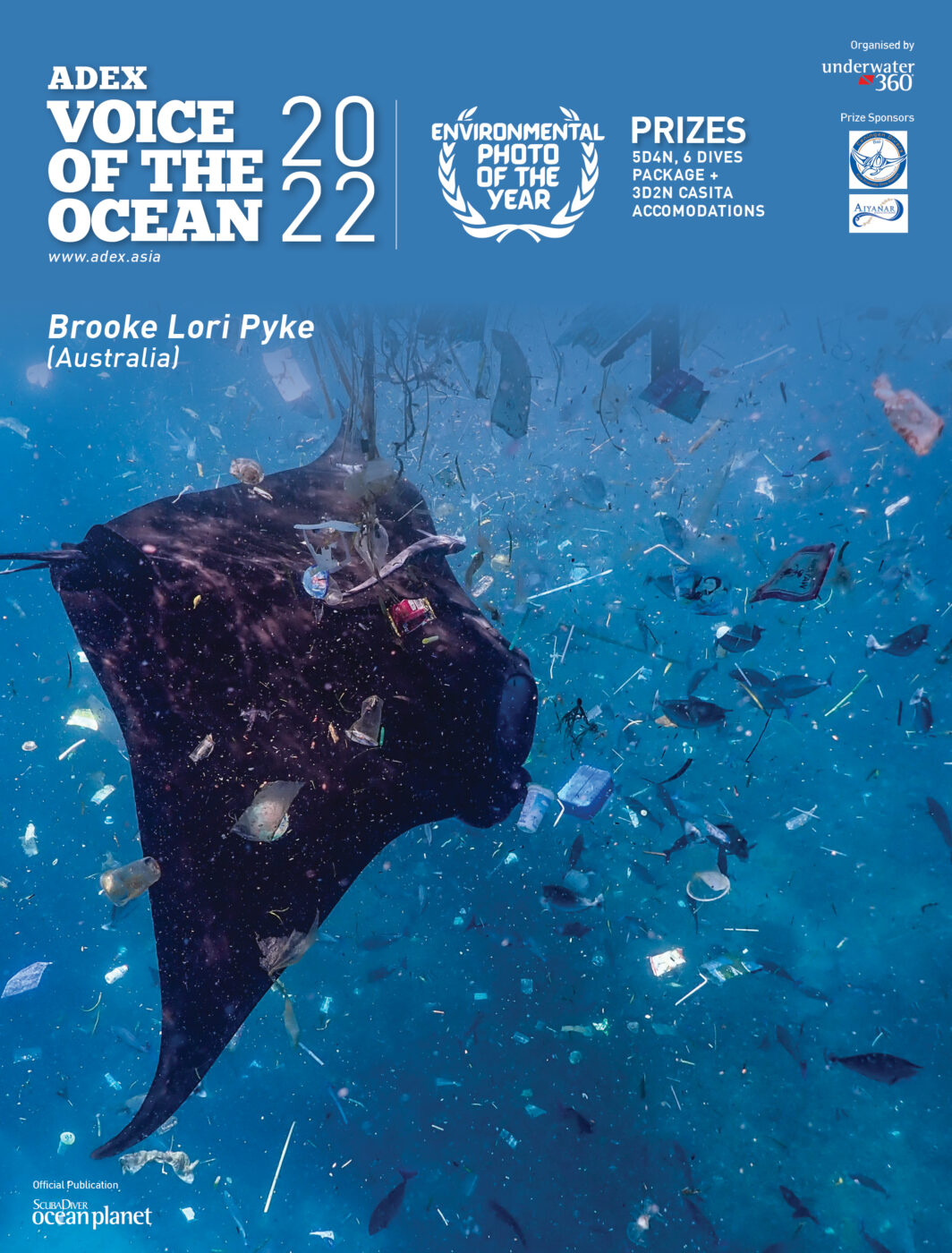
Environmental Photo of the Year
Brooke Lori Pyke (Australia)
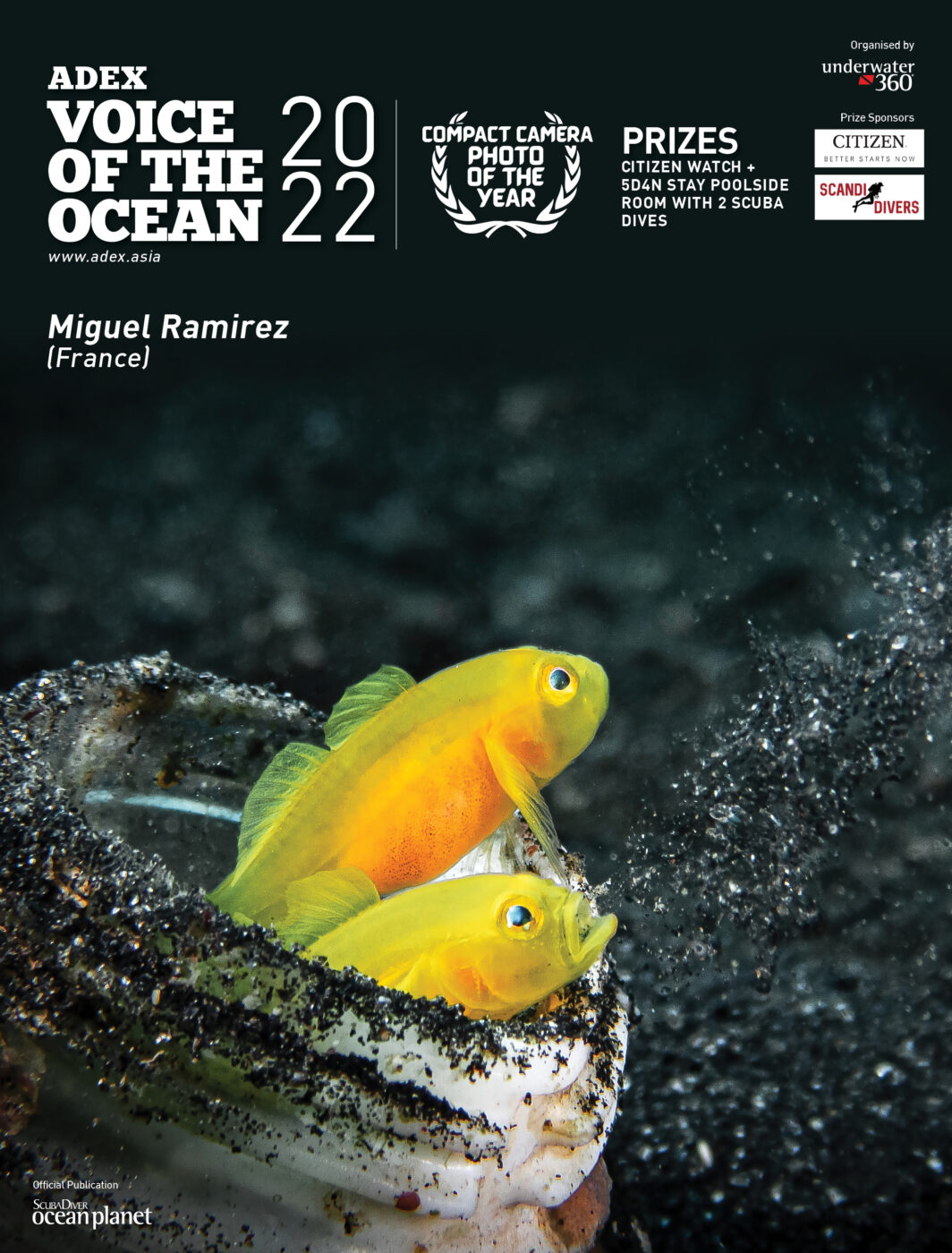
Compact Camera Photo of the Year
Miguel Ramirez (France)
Artwork of the Year
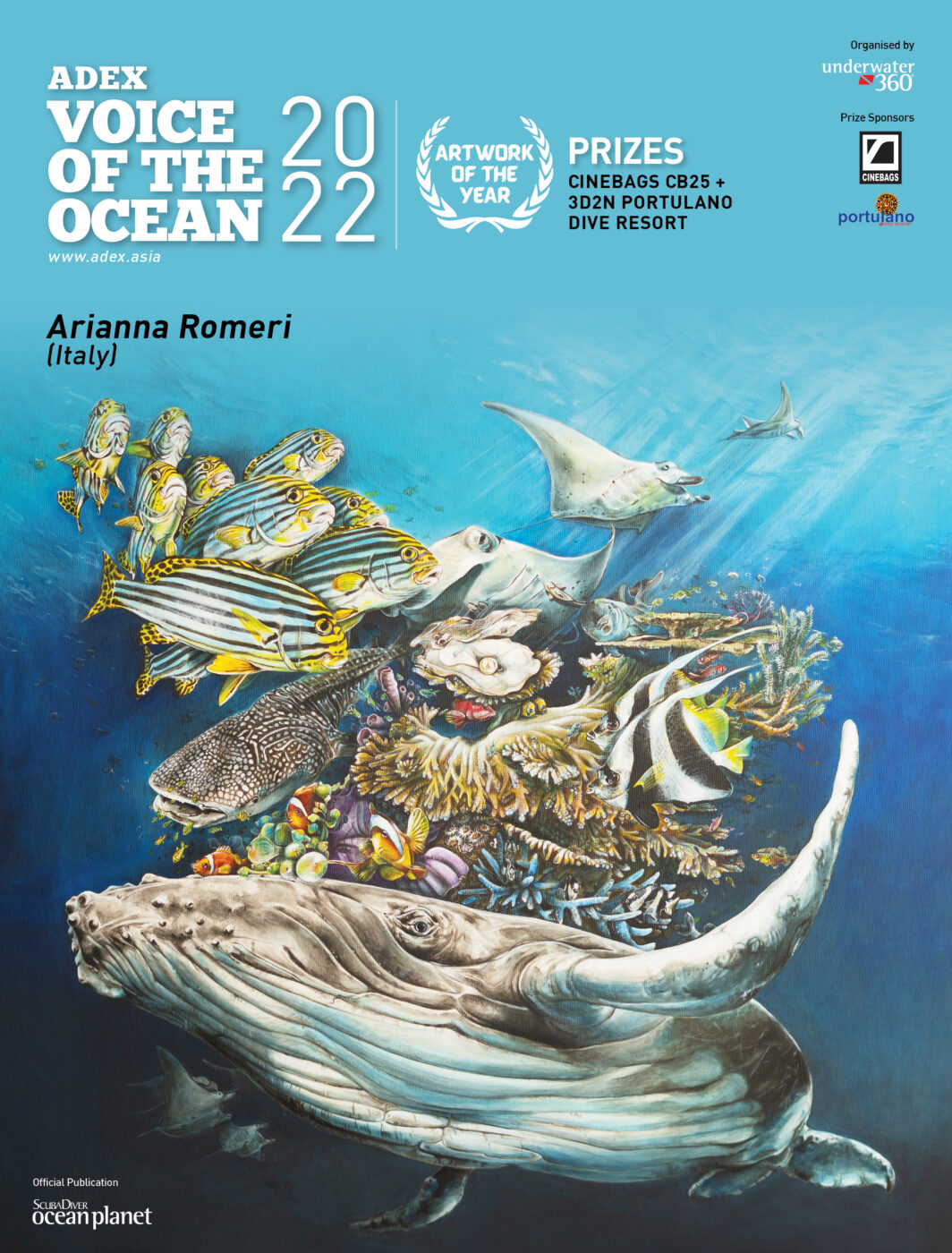
Arianna Romeri (Italy)
Underwater Fashion Photo of the Year
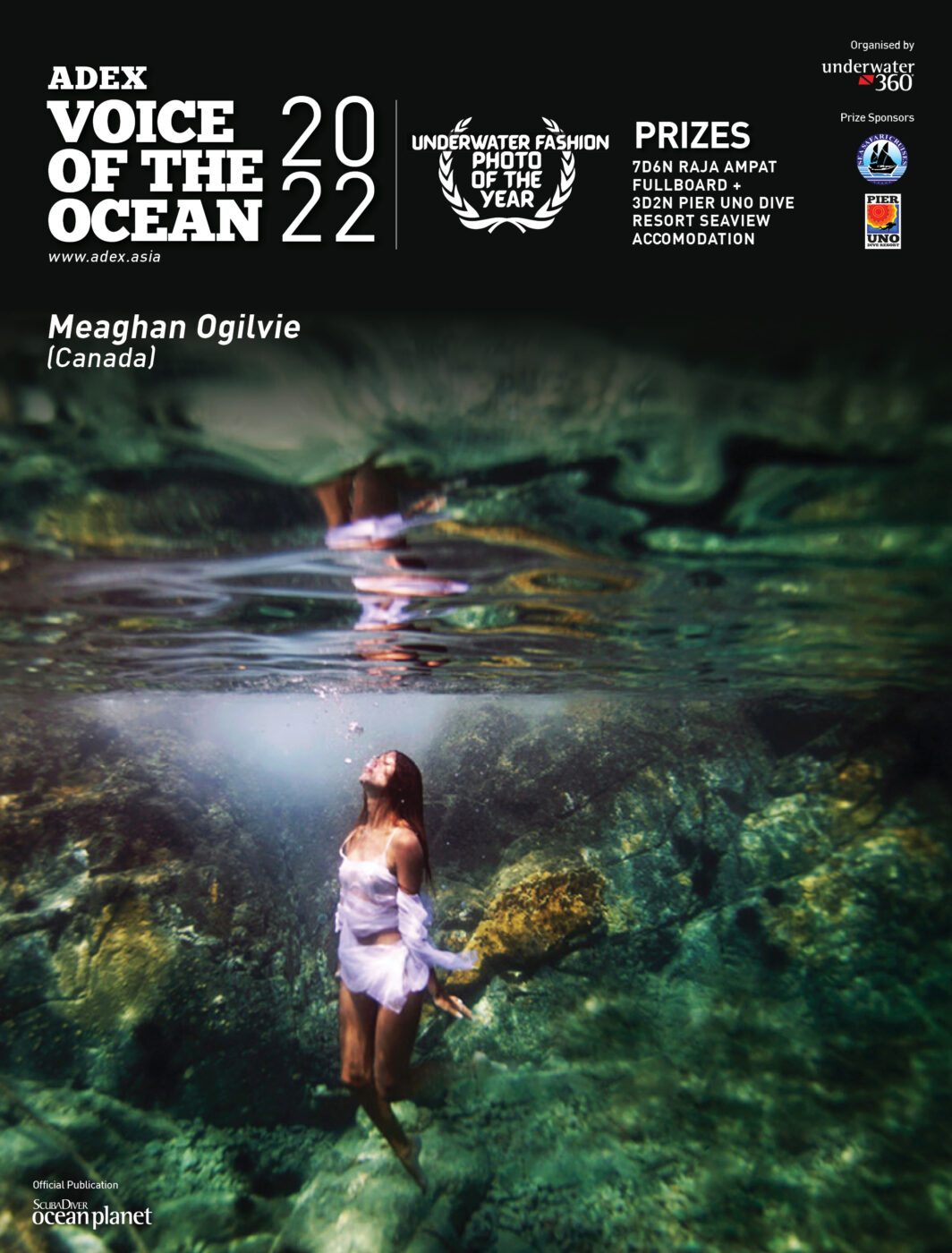
Meaghan Ogilvie (Canada)
Video of the Year
Adil Schindler (Germany)
A beautiful story was told through Adil’s videography. This was selected as the winner as it had the most structured and poignant message about loving our oceans as we love one another and showcased sharks in their best light.
Many thanks to our judges:
Scott Tuason’s passion for photography has brought him on amazing journeys, from throwing himself into a feeding frenzy to dangling off a line in open water at night. The book Anilao, which he co-authored, won the Palme d’Or at Antibes in 2000, and his latest book, Blackwater and Open Blue, picked up Book of the Year at the 2017 Underwater Photographer of the Year Competition.
Renee Capozzola is an award-winning underwater photographer who specialises in wide-angle and split-level images. Renee believes that striking photographs help to increase awareness of our fragile marine ecosystems and encourage others to help protect our oceans. Her images have appeared in leading dive publications and have won over 50 prestigious international accolades including “Underwater Photographer of the Year 2021” in the Underwater Photographer of the Year competition and the “Female Fifty Fathoms Award” from the 2021 Ocean Photography Awards.
Tobias Friedrich is a multi-award-winning full-time underwater photographer from Germany. Several underwater photographic competitions have honoured his work, resulting in over 50 awards. In 2018, he was named “Underwater Photographer of the Year 2018” in the prestigious UPY London competition and “German Photographer of the Year 2019” at the World Shootout. He started taking photographs underwater with a DSLR in 2007 and, since then, his photographs have been published in prestigious scuba diving magazines and newspapers around the world.
Matthew Smith is a UK photographer and ambassador for Nikon Australia & Aquatica Digital Water Housings. After emigrating Down Under in 2007 in pursuit of furthering his photography career, Matty fell in love with the Pacific Ocean and has now made it his permanent playground. He is an Ocean Geographic Magazine Master Photographer and contributor and has won over 25 international photography awards, including the National Geographic Nature Photographer of the Year People’s Choice Award 2017. His works have been used and published by National Geographic, the BBC’s “Blue Planet II” documentary, The Washington Post, The Guardian, and Discovery Channel, amongst many others.
Imran Ahmad is one of Asia’s most internationally published underwater photographers. Capturing life above and below the water’s surface for over 25 years, Imran is best known for his experimental approaches to photography. He spends much of his time travelling the globe giving lectures and presentations, and promoting photography in all its aspects, both as an art form and documentary medium. He leads exclusive photography trips and runs workshops on wildlife, conservation, underwater, and travel photography.
With diving equipment undergoing constant innovation, allowing us to dive deeper and longer underwater, it’s easy to forget that the art of diving began as a simple act of holding one’s breath. Indeed, with the advent of modern underwater breathing apparatuses, the most primitive form of diving is now differentiated by the moniker “freediving”. But breath-hold diving began over 8,000 years ago, evolving over the centuries to its ultra-modern, present-day form. Now, freediving is constantly testing humans’ physical and mental limits, as the sport of competitive freediving continues to gain popularity.
ANCIENT DIVING
The first recorded evidence of freediving can be traced back more than 7,000 years to the Chinchorros, an ancient civilization that lived along the coast of the Atacama Desert (present-day northern Chile and southern Peru).
In a study of Chinchorro mummies, researchers discovered that the bones inside their ears started to grow across the ear canal’s opening, protecting the eardrums from repeated exposure to water. It was clearly a case of exostosis, a condition that afflicts. people whose heads have been frequently dunked underwater. Colloquially called “surfer’s ear”, exostosis is a common condition among people who surf, dive or kayak. Shell-ridden fossils and bone chemistry tests on the mummies have proven that their diet consisted of 90 percent seafood.
Besides the Chinchorro in South America, seashell fossils found on the coast of the Baltic Sea have also revealed that ancient people who lived about 10,000 years ago freedived for clams. There is also plenty of archaeological evidence pointing towards diving in Mesopotamia (present-day Iraq, Kuwait, and Syria), dating back to 4,500 BCE, as well as in ancient Egypt, to around 3,200 BCE.
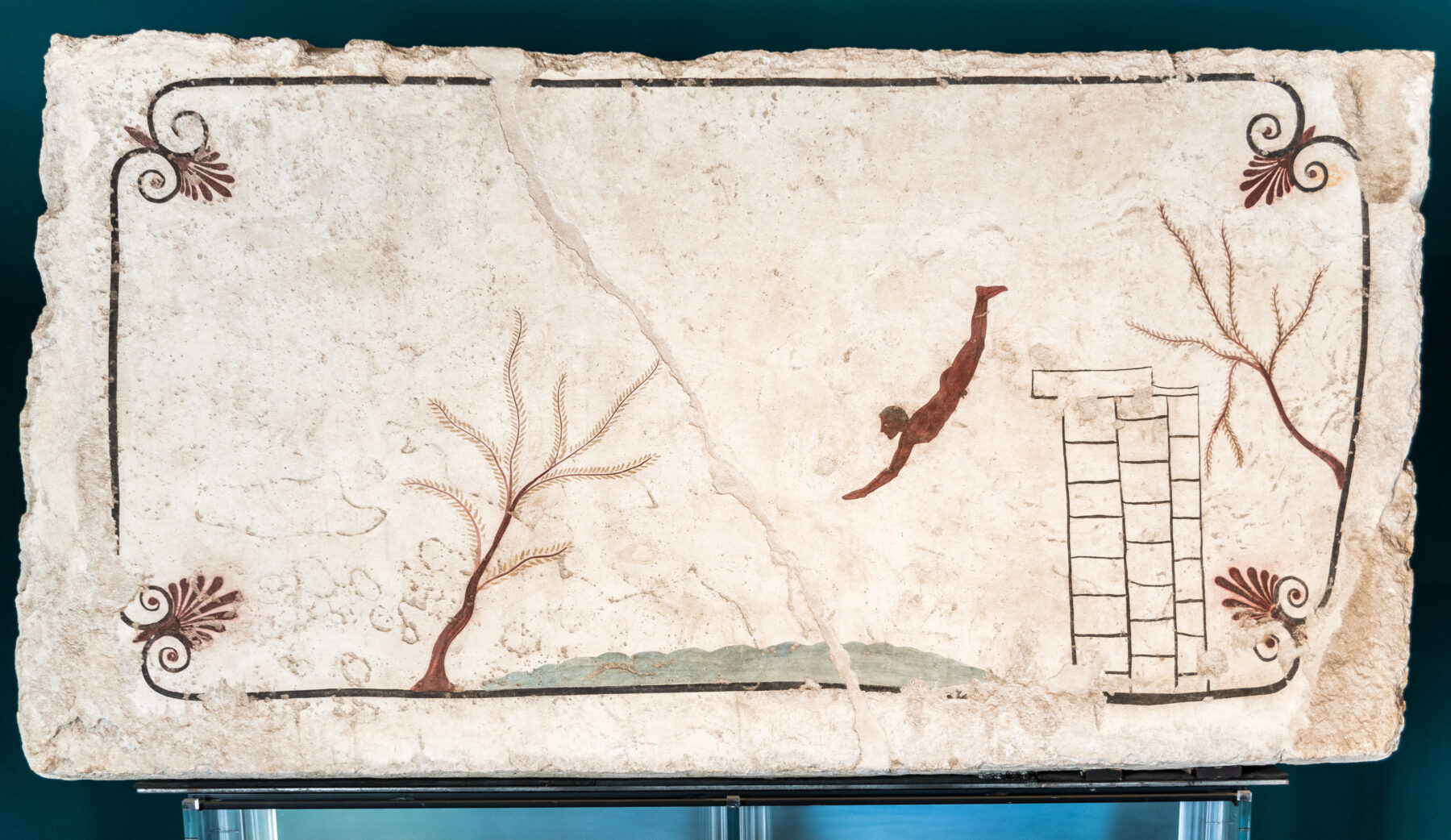
The Greeks have been diving for over 4,000 years. Artefacts and scripts from the Minoan civilisation, which flourished from 2,700 BCE to 1,450 BCE on Crete and other Aegean islands, include figures of seashells as well as colors produced by seashells in Minoan ceramic art.
Ancient Greek Fresco: Diver’s Tomb, Paestum
SRI LANKA (CEYLON)For thousands of years, the Gulf of Mannar, which lies between southern India and western Sri Lanka, was known for the pearls and chanks (large spiral shells) harvested from the waters of Mannar Island by local divers. According to the Mahavamsa, the historical chronicle of Sri Lanka, Prince Vijaya landed in Sri Lanka in 543 BCE and sent a gift of a shell pearl worth twice 100,000 pieces to a Pandu King upon taking the hand of his daughter. The ancient Greeks, specifically Megasthenes, the Greek ambassador to the Mauryan royal court in India, also wrote in the 3rd century BCE about the brilliance of the pearls from Mannar Iceland. In ancient Greece, Sri Lanka was known as “Palaesimoundu”.
Literature from the Sangam Period (3rd century BCE to 3rd century CE) such as the Agananuru, an anthology collection of classical Tamil poetic work dated around the 1st and 2nd century BCE, touched upon a community named Parathavar that fished but also dived for pearls and chanks. Arab traders and divers from the Persian Gulf also ventured into the pearl fishery trade in Sri Lanka between the 7th and the 13th century CE.
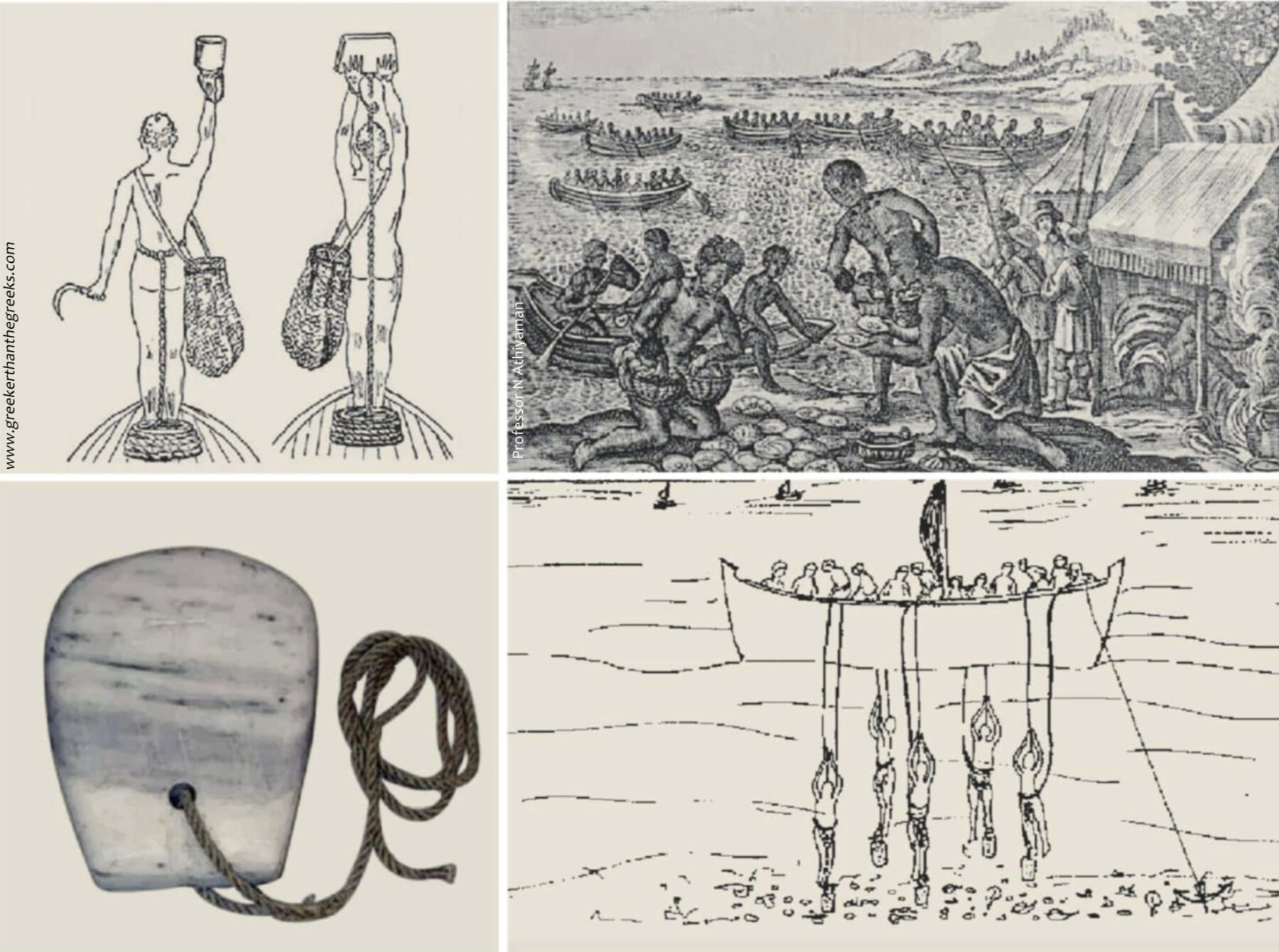
| Clockwise from top left: Greek skin divers with scythe, collecting net and skandalopetra; in Sri Lanka, temporary huts were built along the coast to store the pearls before they were cleaned and sorted; weighed down by stones, divers descend rapidly while their assistants wait to pull the stones back up; a skandalopetra, a centuries-old Greek sponge diver’s weight
Research detailed that the early divers of Sri Lanka would go out to sea in crews as large as 23 in a boat. On each boat would be a tindal, or a steersman; a saman oattee, who was in charge of the boat; a thody, who was tasked with bailing water out in addition to cleaning the boat; 10 miscellaneous including the adappanar, or lead diver; and 10 munduck, or operational assistants. They would pull up the oysters, the stone counterweights and the divers themselves from the seabed and back onto the boat.
The boats would be set out late at night, around midnight. The tindals would have begun preparing to hoist the sails more than an hour or so before, with the adappanar hoisting a light at the masthead as a signal to set off. The divers on the boat would then get ready in the early hours of the morning by attaching the safety ropes around their waist. Stones would be tied to the ropes to act as counterweights for the divers to make a fast descent to the seabed. As the ropes with the weights were released into the water, the diver would take a deep breath and rapidly descend by stepping onto these weights. The moment they reached the seabed, they would start collecting oysters into the nets around their waist, while the weights were simultaneously pulled up to the boat. After about a minute, the diver would tug the rope that was tied to him to signal the completion of his task, upon which he would be pulled up along with his collected oysters.
AMA: JAPAN
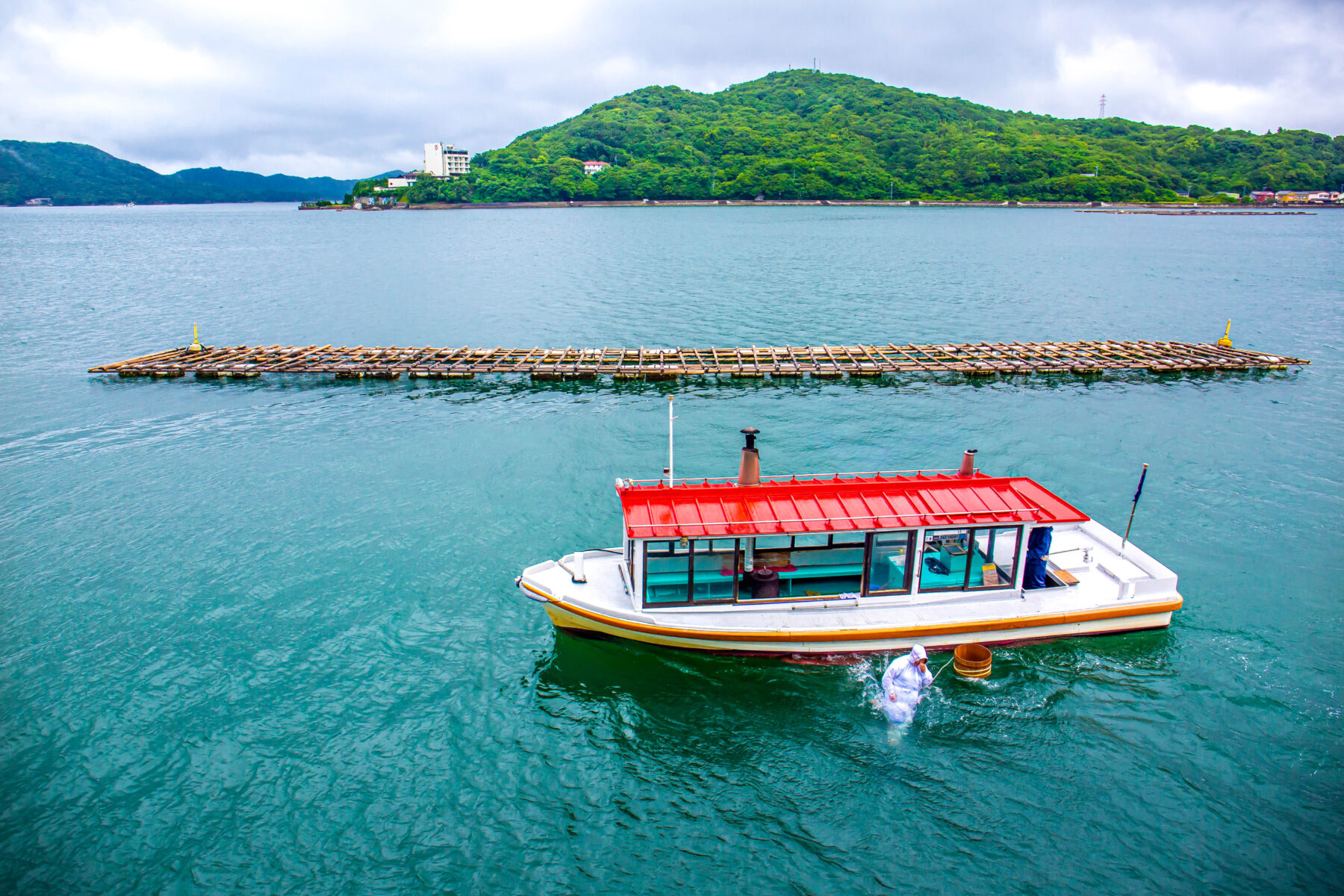
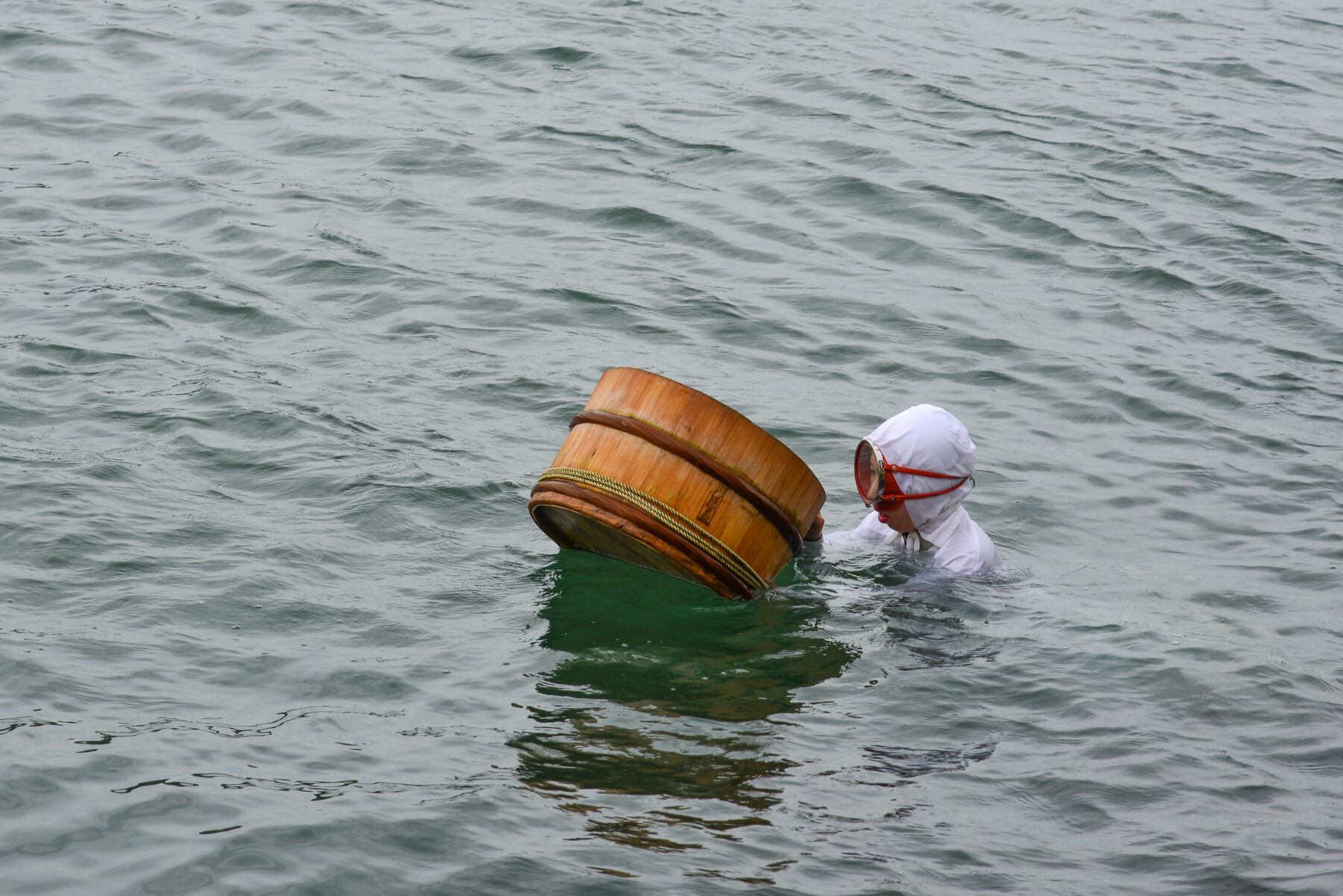
The ama are coastal people residing in Japan who make their living by diving to harvest abalones, turban snails, oysters, and pearls. Japanese literature suggests that the ama have existed for at least 2,000 years. One of the oldest references to the ama divers is the Gishi-Wajin-Den (M), which is believed to have been published in 285 CE. Some of the oldest archaeological evidence from Japan holds that the Japanese have always depended on seabed resources for sustenance.
Female pearl divers called ama who traditionally plants and harvests the oysters in the Mikimoto Pearl Island, Ise, Japan
According to an ancient Chinese chronicle containing sporadic references to Japan, the northwestern part of what is now Kyushu lacks arable land that enables its people to survive on agriculture, compelling them to depend on the sea to barter for staples such as rice. According to Minoru Nukada from the Department of Health and Physical Education at Toho University, male and female ama engage in different diving activities.
Originally, male ama tended to catch fish, either by hand or with a spear, whereas female ama would dive to the seabed to collect seaweed and shellfish. Over time, the men engaged in offshore fishing or became sailors on ships while the female ama stayed at home and dived to supplement the farming harvest. They are also believed to be more adept at holding their breath. The ama are trained as early as 12 or 13 years by the elders. At this stage of their training, they are known as Koisoso or Cachido and dive at shallow depths of only two to four metres.
Traditionally, the female ama dives into a fundoshi (loincloth) for ease of movement with only a tenugui (bandana) covering their hair. These headscarves are sometimes adorned with symbols in order to bring luck to the diver and ward off evil. They use a safety rope attached to a wooden tub or barrel that serves as a buoy to rest on between dives. The barrel is also used to store their catch. Their most important tool, however, is the tegane or kaigane – a spatula-like tool used to pry out abalone between the rocks on the seabed. The Meiji era (1868 1912 CE) introduced goggles, which were adopted by the ama. In the decades following World War II, some ama started wearing a white sheer garb for modesty while others started wearing black rubber wetsuits in the 1960s.
An Ama female diver collecting pearls in Toba, Japan
HAENYEO: KOREA
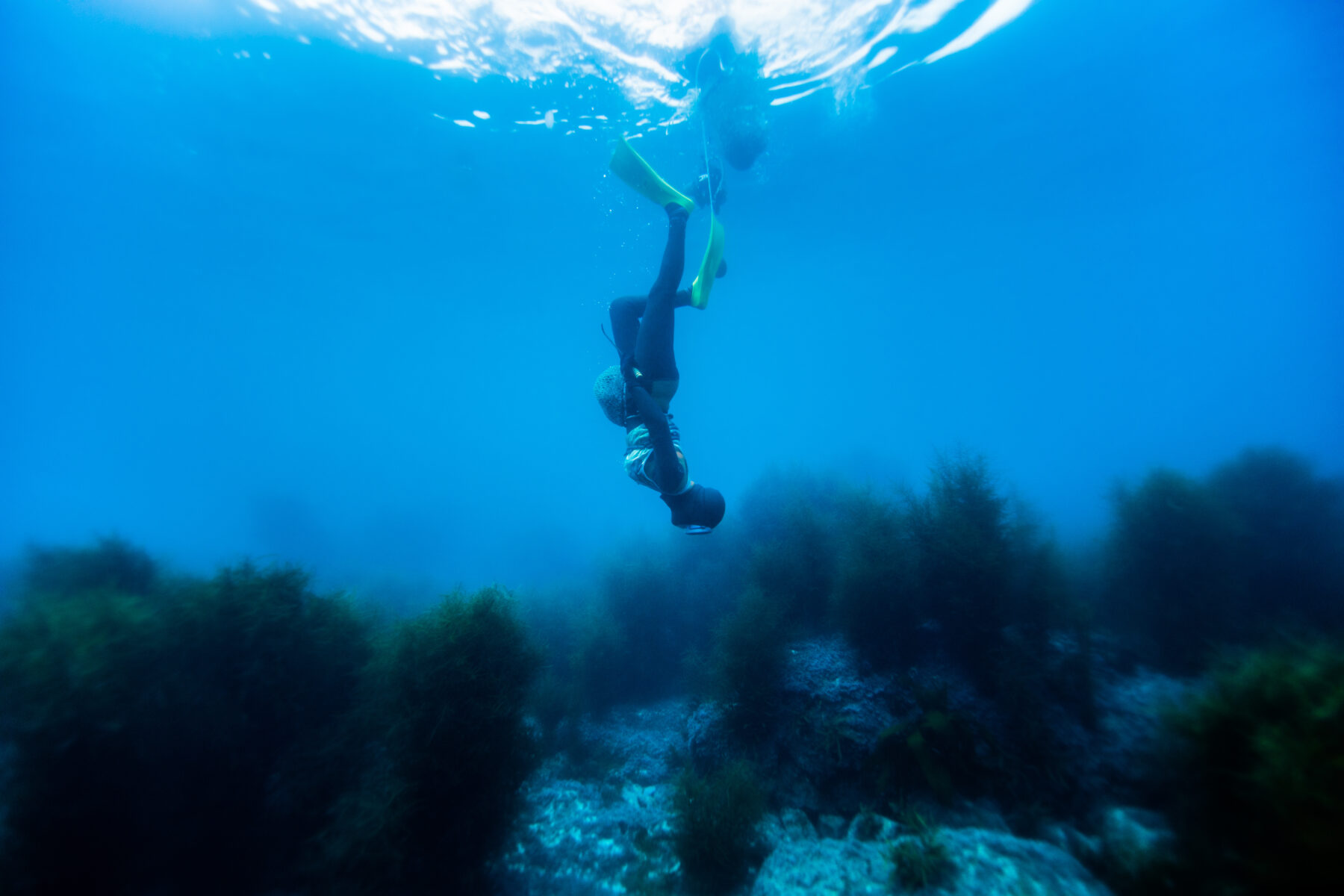
Like the ama of Japan, the haenyeo of Korea are women freedivers who make a living from diving and harvesting shellfish and seaweed from the seabed. The haenyeo are found in the southern part of the Korean Peninsula, particularly Jeju Island. Although the exact conception of freediving in Korea is unclear, Korean history experts collectively agree that Jeju was the place where the haenyeo were first found. Archival records reveal that as early as 434 CE, pearls were found in the Silla Kingdom. Again, it is not known how freediving for seafood came to be a female-only activity. One likely explanation is the physiological advantage that women have. This is greater subcutaneous fat and a perceived ability to withstand the cold better than men. Like their Japanese counterparts, the haenyeo start learning to freedive in shallow waters at 11 or 12 years old and as their skill level progresses, they graduate to an advanced level when they turn 17 or 18.
Jeju ‘haenyeo’ divers sing their traditional work song “Ieodo Sana” before they set out to dive near Seongsan Ilchulbong.
The haenyeo divers wear black swimming trunks and white cotton jackets. Diving goggles were introduced during the 1930s, with eye glasses used for almost two decades before diving face masks became available. They traditionally use hollowed-out gourds about 30 centimeters wide as floats.
A haenyeo who takes an underwater shoot in Chuja Island, Jeju Island.
SAMA-BAJAU: SOUTHEAST ASIA
All freedivers are familiar with the “mammalian dive reflex”, when your heart slows down, blood vessels constrict and your spleen contracts because your body is trying to keep you alive while you are holding your breath underwater.
The Sama-Bajau are a group of sea nomads consisting of several Austronesian ethnic groups who live off the sea in waters enveloping the Philippines, Malaysia, Indonesia and Borneo.
A study on human hypoxia tolerance published by the journal Cell revealed that a genetic mutation has allowed the Sama-Bajau to develop larger spleens, which makes more oxygen available in their blood while diving. With this oxygen boost, the Sama Bajau can freedive to greater depths of up to 70 metres, for as long as 13 minutes. In the human body, the spleen recycles red blood cells and supports the immune system. After previous studies revealed that diving mammals like elephant seals, otters and whales have disproportionately larger spleens, Melissa Llardo, the author of the hypoxia study in Cell was eager to find out if the same was true in humans. Her studies revealed that the median size of the spleen of a Sama-Bajau was 50 percent larger than that of the Saluan people, a related group on the Indonesian mainland. The Sama Bajau were also found to have a gene called PDE10A (which the Saluan did not have) that is thought to control a certain thyroid hormone that in mice is known to be linked to spleen size.
This piece is extracted from our annual photography edition, Scuba Diver Ocean Planet Magazine which is dedicated to the amazing world of freediving and the finalists and winners of the monthly submissions from the Ocean Gallery Vision 20/20. Seek out the art of freediving with a deeper appreciation for its freediving photography coupled with the timeline, history, and record holder.

 LATEST ASSESSMENT
 SHARING RESOURCES
 A HISTORIC DAY FOR CONSERVATION