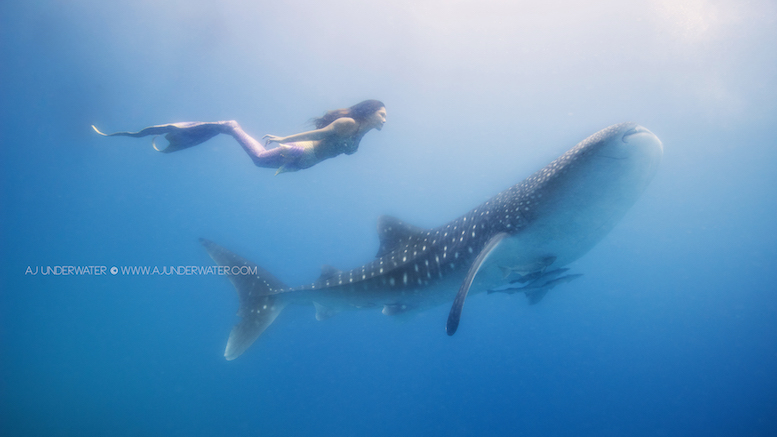
Hong Kong based underwater photographer Andrew Lau offers tips and techniques on how to shoot mermaids underwater:
Shooting underwater models, mermaids in particular, has become very popular in recent years, and many divers are looking to try their hand at this new trend in photography. Here, I share some of my own experiences with shooting models underwater, in the hope that it will help you to test out new ideas and improve on your photography techniques.
Mastering the basics
Finding a model
First of all, you need to find a model who feels very comfortable and natural when she goes underwater. It’s not easy. Many models struggle to open their eyes underwater, and the photographer can easily read from their face that they are uncomfortable, or even suffering, because of the stinging sensation in their eyes.
Facial expression is one of the main factors when shooting models, so you need to find the right candidate as your underwater model.
Picking a location
When you start out photographing mermaids, I suggest doing your shoots in a shallow pool. It’s not good practice to throw your model into the deep end, so to speak.
After you have found the right candidate, let the model do some simple posing or wear the mermaid tail to swim. Allow your model to relax and get used to the water. In the meantime, you can explain the theme of the shoot and take some test shots.
Communication
It is easier to communicate by talking than via hand signals or slate. In shallow water, you and the model can stand up out of water and talk. Practise the pose or theme in shallow water until the model knows exactly what you want to shoot.
After practising in shallow water, you are now ready to hit deep water and start the real shoot.
Shooting in the blue
Understanding motion
Keep in mind that a mermaid tail motion is a completely different motion to that of a long freedive fin, or mono-fin. It is unique. Observe the movement of the tail and how the model swims, catch the rhythm of the motion, angle your shot and wait for the correct pose of the model.
Choosing a lens
A model with a mermaid tail is “big” – three metres or more. You will need an ultra-wide lens or diagonal fisheye lens to reduce the water column between you and the model. A zoom lens with zoom gear will work even better.
Mermaids wear mono-fins inside the tail so that they can move quickly underwater. To catch them at speed, set your lens to the tele-side during the beginning of the shoot, and when the mermaid swims towards you, zoom out to have a wider window of time to shoot.
Shoot as many as you can
You should have a desired picture in mind – shoot until you get that shot. Even after you get the picture that you want, keep shooting.
Sometimes the best shot is not the shot that you wanted, but the shot you didn’t expect.
Using strobes
A good strobe allows you to capture more pictures during the model’s single breath. The model holds her breath to swim or pose, so time is limited. Normally, the best strobes have shorter recycle times. The more pictures you take, the higher the chance of you getting a nice capture. Setting the strobes to a different power level can give the mermaid’s tail more texture.
Shooting mermaids or underwater models is just like other underwater photography: You won’t master it in one or two dives. But the good thing is, it’s easier to communicate with a model!
Practise more and you will get better. Enjoy this exciting trend in underwater photography!
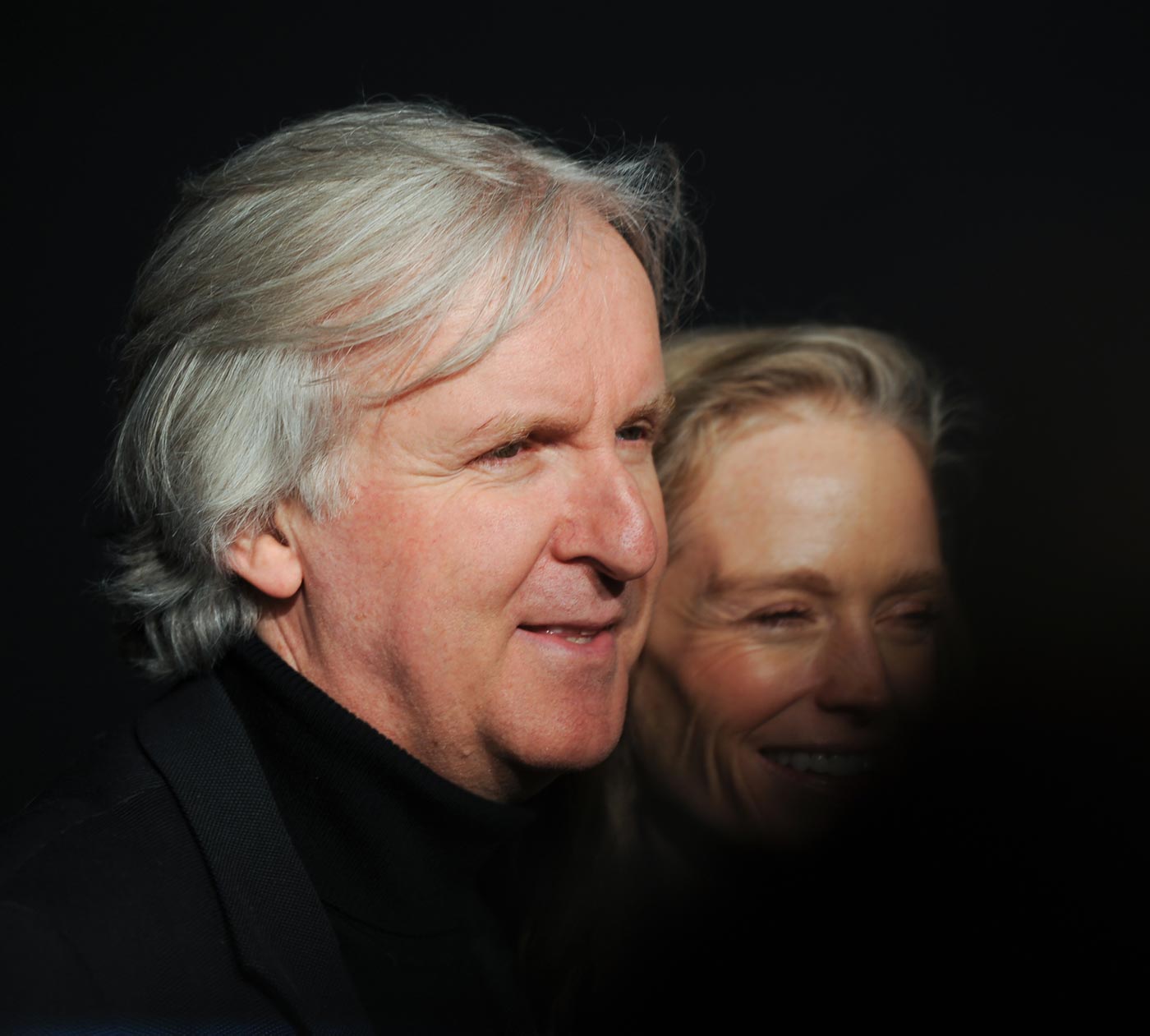
James Cameron is internationally acclaimed for his film industry career during which, among many other things, he has produced the two highest grossing box office films in history: Titanic and Avatar. He has channelled his passion for diving into several works, and was awarded the 2004 Hans Hass Award for his contributions to science and technology. Leslie Leaney introduces our Pioneer of the Week:
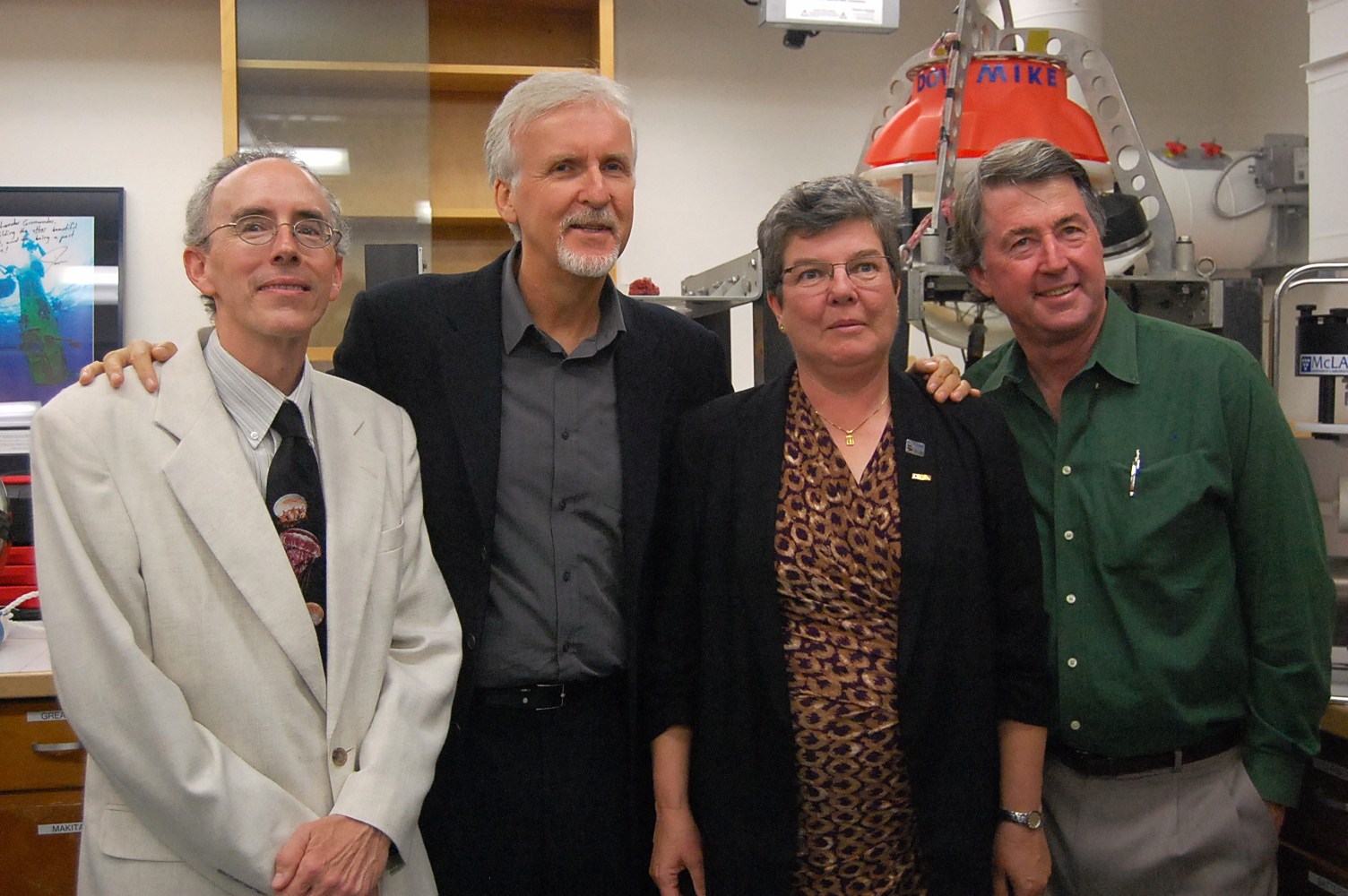
Receiving the Scripps Institution of Oceanography Nierenberg Prize for Science in the Public Interest in 2013.
James moved from his native Canada to California during his teens and pursued a career in the film industry, during which he has often incorporated his passion for diving. After making his international mark with 1984’s The Terminator, which he wrote and directed, he wrote and directed Aliens, which became a huge box office hit.
Aliens gave James serious Hollywood clout and he embraced the challenges of underwater movie making with The Abyss, released in 1989. One technical highlight, which interested divers around the world, was his depiction of a diver in a helmet breathing oxygenated liquids.
This was not just science fiction: A successful American research programme actually existed, funded by the USA’s Office of Naval Research, with Dr. Johannes Kylstra as its lead scientist. Kylstra had successfully tested the theory on rodents and dogs, following which commercial diver Frank Falejczyk became the first person to breathe oxygenated liquid. James was so impressed by a subsequent presentation by Falejczyk, he included the concept in his Abyss script. Several senior HDSUSA members, such as Bob Kirby, Pete Romano, Al Giddings, Ralph White and Emory Kristof were involved in the film, and The Abyss brought James to the attention of divers worldwide.
As filmmaking moved into the 1990s, HDSUSA Advisory Board member Andreas Rechnitzer consulted with James on an upcoming project that would make box-office history: Titanic.
James wrote, produced, and directed Titanic, and the production again included several HDSUSA members. Titanic received 11 Academy awards including Best Picture, Best Director and Best Film Editing, and is at time of writing the second highest grossing movie in world history, with receipts of $2,186,800,000.
Passionate about diving, James accepted the invitation of his friend Andreas Rechnitzer to join the Society’s Advisory Board in 2002.
James Cameron emerging from the single-seat Deepsea Challenger
With the record-breaking success of Titanic behind him, James’ next diving-oriented production, with Andrew Wight, was Expedition: Bismarck, a 2002 documentary produced for the Discovery Channel. Leading a team of explorers, historians and Bismarck survivors, James examined the nearly five-kilometre-deep wreck. Using the Russian MIR submersibles and presenting revolutionary production techniques and high-tech remotely operated vehicles (ROVs), James provided the first glimpse inside the Bismarck in more than 60 years. The movie won an Emmy in 2003 for Outstanding Sound Editing for Non-Fiction Programming.
In 2003, James again hired the Russian MIR submersibles and journeyed back to the wreck of Titanic to film and direct Ghosts of the Abyss. Using state-of-the-art 3D technology developed expressly for the expedition, James and his crew could explore virtually all the wreck, inside and out, as never before. The movie was made especially for IMAX 3D theatres and specially outfitted 35mm 3D theatres.
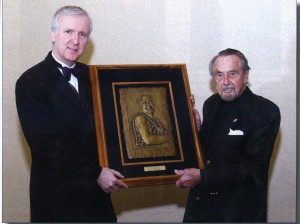
In recognition of his superior body of deepsea exploratory work, the Hans Hass Award Committee selected James Cameron as their 2004 award recipient.
With his hectic Hollywood schedule, it proved very difficult for the Committee to co-ordinate both a venue and time for the presentation. Fortunately, the Committee’s Executive Director had arranged for Professor and Lotte Hass to attend New York’s Beneath the Sea show and arrangements were made with the management for the award to be presented there.
As the world’s most successful film director, James was in very high demand, and closely followed by the media. To ensure his presence was as low key as possible, the Beneath the Sea management agreed no publicity would be given to the award or James’ appearance at the show.
Beneath the Sea fully honoured this and it was an extremely surprised and thrilled audience that watched as James Cameron took to the stage on Saturday, March 25, 2006, to receive the 2004 Hans Hass Award from Professor Hans Hass himself. Speaking to the sold-out audience, James thanked Hans for recognising his career, and mentioned his heart was with the thousands of divers at the show, more so than the Hollywood crowd he spent time with.
James and Hans Hass, New York, 2006
Among the headline speakers at the event were Ernie Brooks, recipient of the first Hans Hass Award, Hans and Lotte’s long-time American friend Stanton Waterman, the award’s designer Wyland, author and technical diving experts Bret Gilliam and John Chatterton, and Richie Kohler of TV’s Wreck Detectives.
Later, James joined the speakers and staff at the after-party where he was able to discuss diving, not Hollywood, with those who had helped make the evening so special – particularly Maria Hults, Bob Rickie and Armand and JoAnn Zigahn of the Beneath the Sea management team. Back at his Los Angeles HQ, James reconfigured his office to centrally display the Hans Hass Award.
The Russian MIRs were deployed again in James’ 2004 film Aliens of the Deep. James journeyed to some of the Earth’s deepest, most extreme and little-known environments in search of strange creatures. It is worth observing the detail in this movie, because what he discovered appears in what would become the world’s biggest movie box office hit a few years later.
Aliens of the Deep was the result of expeditions to several hydrothermal vent sites in the Atlantic and the Pacific. These are violent volcanic regions where new topography is literally being born and where the interaction between ocean and molten rock creates plumes of super-heated, chemically-charged water that serve as oases for animals unlike anything ever seen before.
Always preparing for the next adventure, James then planned to visit the deepest place on Earth, the Mariana Trench. Working with some team members from earlier movie projects, he developed the single-seat Deepsea Challenger submersible. On March 26, 2012, he became only the third person in history to reach the bottom of the Challenger Deep, at nearly 11 kilometres. Deepsea Challenge 3D, a movie of the dive, was released in 2014.
James continues to push his career envelope and is presently working on a series of sequels to Avatar, which include developing an ocean for the planet Pandora.
On April 14, 2016, during CinemaCon, James announced four upcoming sequels to the Avatar franchise. James said each of the four sequels can stand alone, but will together create a saga. His goal is to release Avatar 2 during the holiday season of 2018, then new films in 2020, 2022 and 2023.
His adventure continues.
This article featured in SD OCEAN PLANET “Islands & Liveaboards Edition”, by Leslie Leaney
Iconic shots of iconic places: SD OCEAN PLANET takes you on a tour of some of the world’s most-famous diving locations, through the eyes of some of the world’s greatest underwater photographers. Covering shots from all corners of the world, our January 2017 Special Edition promises to be one of our best yet. Here are five reasons why your brand needs to be in the SD OCEAN PLANET Special Edition:
The best representation of your diving region
A jaw-dropping image of the underwater world your region has to offer is the best selling point to attract divers to your destination. We’ve invited the top dogs in the underwater photography industry to capture the amazing life below the waterline in your region to entice divers to visit.
Showcasing the gear that the professionals use
Behind every great photograph is an awesome camera kit, and to help our readers get the most out of their photography, we detail the equipment that the professionals use. This is the perfect opportunity for your brand to showcase the latest models in your range.
It’s a collector’s edition
This is much more than just a regular issue in a dive magazine. It’s a special edition for subscribers and buyers to display proudly on their bookshelves. Beautifully designed and showcasing the best underwater photographs in the world, this Special Edition is an issue that will be cherished by readers.
Promoted through ADEX
Alongside continuous promotion on our social media and online platforms, the magazine will also be heavily featured at Asia’s largest dive show, the Asia Dive Expo (ADEX). The perfect opportunity for readers to get copies of the issue signed by attending photographers, the magazine will be one of the major talking points of the show.
We cover the world
Featuring your location alongside stunning dive sites from around the world will help promote your local dive site to readers across the globe. Both dive travellers and budding underwater photographers will be keen to get a copy, so get your brand out there!
To find out how to get involved, please contact Account Manager Anne Low: anne@uw360.asia.
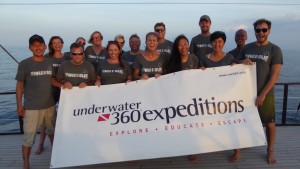
Avid diver and Nature writer Rachel Mason is back with part two of her report on the Underwater360 Expedition to the Banda Sea. After encountering whales and dolphins, the team are back in the blue for some incredible hammer action:
Part two: A hint of the hammers…
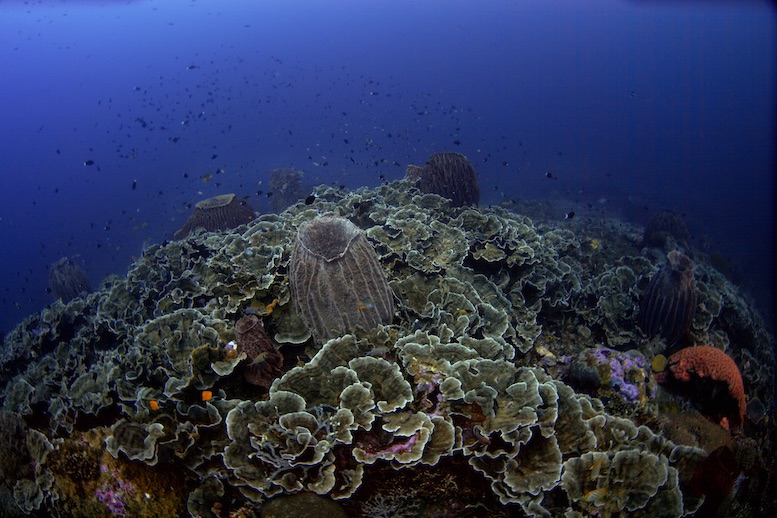
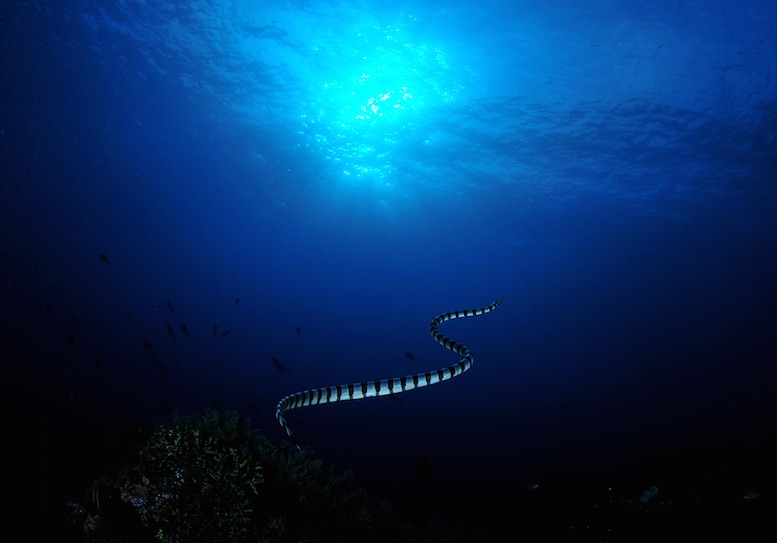
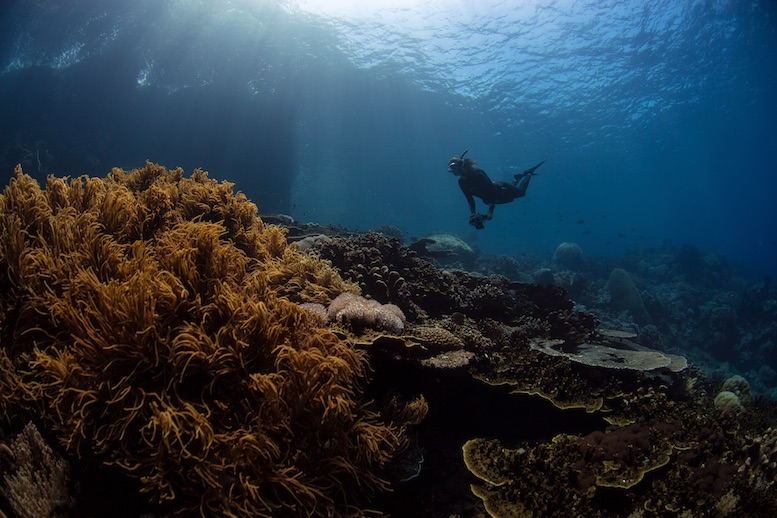
We start the next day diving the Amphitheatre at Suangi, which is carpeted with cabbage coral as far as the eye can see. Silver trevallies, a romantic pair of fire dartfish, a turtle, bumphead parrotfish, a banded sea snake and a rare rockmover wrasse, and this was the first dive of the day! We intersperse three dives today with whale patrol. Heading further into the Banda Sea, we encounter a huge pod of spotted dolphins, so sociable they make a beeline for the boat. You can see how muscular their bodies are as they leap again and again and bow ride as the Samambaia carves her way though the water. The lesser-known species of “Unhappy Chef” was also sighted, as we brave the downpour and dash back to the dive deck for yet another pod of dolphins, just as lunch is being served; absolutely everything stops for the cetacean sightings!
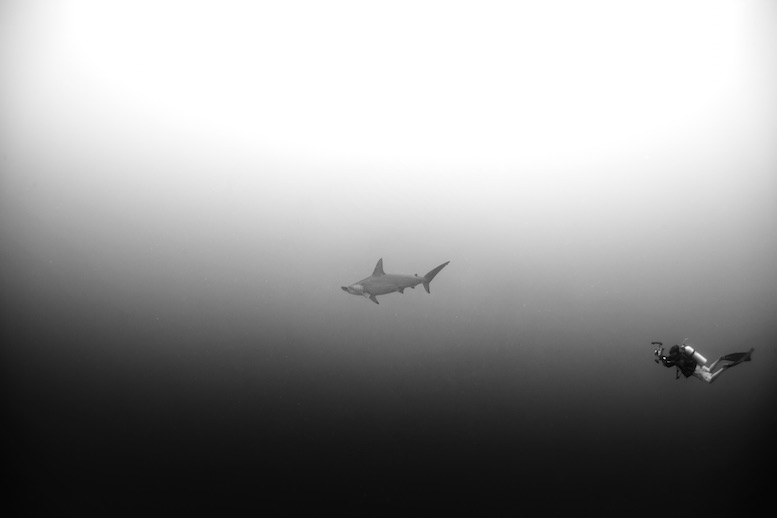
Each dive I find myself becoming more and more amazed by the coral. It’s staggering to me that I am seeing this for the first time and impresses on me more than ever the importance of this expedition. Gently drifting along as we dive Pulau Run, there is a sharp drop in temperature, a shiver also of excitement, and with that, in the gloom at the bottom of the wall at about 35 metres, we see a scout. Around three metres long, a hammerhead shark is lurking. We hope that there will be more to follow, but as gracefully as he weaved into view, he weaves away, leaving us wanting more!
The day is not yet done, and as we set sail again, we sit at the ship’s bow. Nikki “Spinner Dolphin” Friedli is in the bow netting just above the water for a bird’s-eye view of a chorus line of bottle-nosed dolphins and a calf weaving in and out of one another. Faster and faster they cling to the bow as if to race with us. It’s a mega-pod of 130 dolphins – they are everywhere. We are fortunate to briefly sight a pair of beaked whales too – they are extremely shy and sightings are rare.
Another day dawns with a clanging whale bell and the mad dash to the dive deck, toothbrush still in tow, to be greeted by about 100 melon-headed whales congregating. They stay with us for an hour, logging (resting) on the surface and “rooster tailing” – slapping their tails on the water signalling to one another.
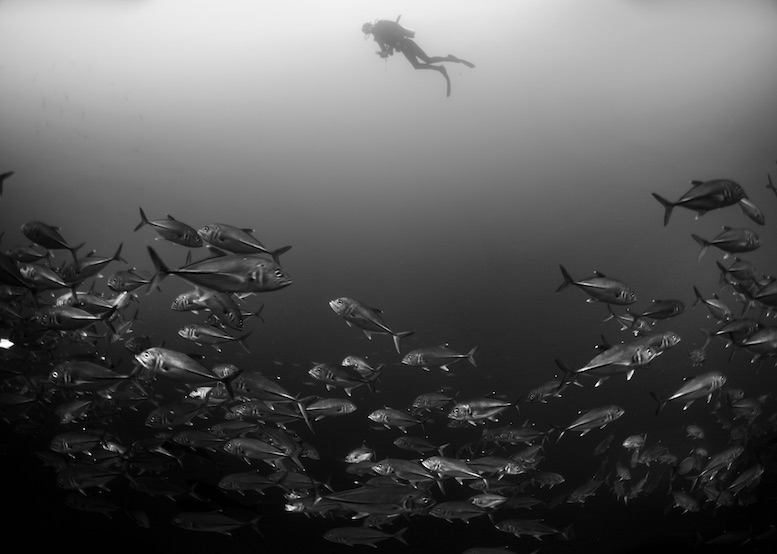
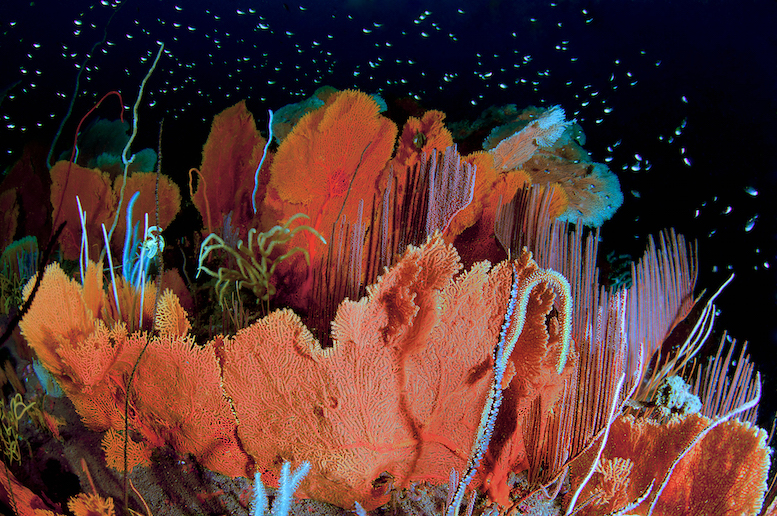
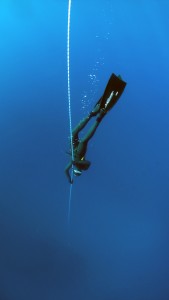
Immediately as you descend at Pulau Hata, there is a beautiful swim-through, with 50 metres visibility and teeming with life – the globe of azure invites you in. The esteemed underwater photographer and ADEX Ambassador, Aaron Wong, takes a stunning photograph from below, and as the sun beams through the void, it seems very apt that it resembles the shape of a heart. A stunning wall with huge barrel sponges and gorgonian fans, the colours and diversity of the coral and the fish is mesmerising. A vertical school of barracuda shimmering in the sunlight, the silhouette of freediver Dada Li against them leaves a striking image in my mind.
Five hammerhead sharks at Karang Hatta in the afternoon bodes well, whilst the water temperature is a bit chilly when they are imminent. The activity is definitely hotting up, but we are shocked and saddened to discover that the population of green and banded sea snakes at Gili Manuk is severely depleted and we only see a handful despite diving here all day.
Next week, we complete the series with part three:
“As if awaiting our arrival at ‘Hammer Island’, a solitary hammerhead shark almost immediately emerges from the gloom, scoping the scene, about five metres long, muscular and powerful. He dips away from sight, and, apparition-like, over 120 hammerheads appear, schooling their way through the blue…”
To hear the experience of witnessing 120 hammerheads pass by, watch this space!
Born in Varese, Italy, Isabella Maffei has recently burst onto the underwater photography scene. A strong passion for the ocean drove her to become a scuba diving instructor and manager at her dive centre, “Deep Avenue”, in Mendrisio, Switzerland. From there, she became an underwater photographer to capture the experiences of her students learning to dive, and then to capture the marine world.
Always diving with her Nikon camera in hand, Maffei has created a spectacular body of work that has impressed international publications and dive events. We caught up with her for a quick Q&A about her career and her evocative images:
What made you want to become an underwater photographer? I have always been attracted by photography, but what made me want to become an underwater photographer was a commercial necessity, a marketing strategy. I have a diving centre in Switzerland and usually dive with students and friends in our lake. To give something to my newly certified students, to capture a picture of that wonderful experience of their first breath underwater, this pushed me to become an underwater photographer.
Your first underwater shot? My first shot was made with an old Sea & Sea film camera in Portofino Marine Protected Area (Italy). The subject was a classic sea star on the seabed. When you start out taking pictures underwater, sea stars seem to be the most well-behaved subjects!
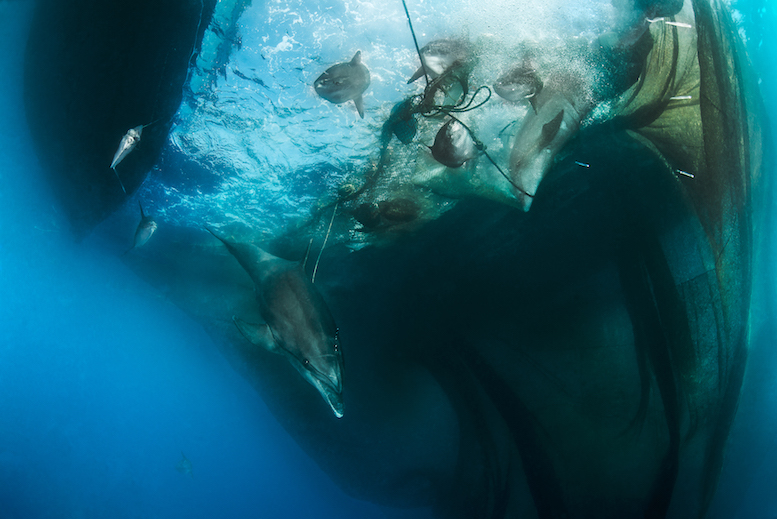
The story behind your most memorable underwater shot? 7.00 am, I was on the jetty of Camogli Harbour, Italy. I was going to dive in one of the oldest tuna fisheries in the Mediterranean Sea, the “Tonnara”. During the summer months, the Tonnara is full of trapped moonfish (Mediterranean sunfish). They are a shy species, hard to approach in clear water. I wanted to capture a shot in a school of moonfish.
After 15 minutes, we arrived at the destination. A fisherman called “Rais” commanded the operation – unfortunately, two dolphins were trapped in the fishing net. As the fishermen closed the net, we quickly jumped into the water, and this was to be the start of my most memorable adventure as an underwater photographer.
The dolphins were quiet and not scared, and we swam together for 50 minutes, and they played with each other and were intrigued by me. Time went by quickly, and their moment of freedom came. When I jumped out of the fishing net, they suddenly became a little nervous, but seemed sure they would soon be free. The bigger dolphin pushed the fishing net downwards with his nose and the little one was freed first, passing in front of me for the last goodbye. Immediately after, the big one freed himself and swam very fast to reach the other one.
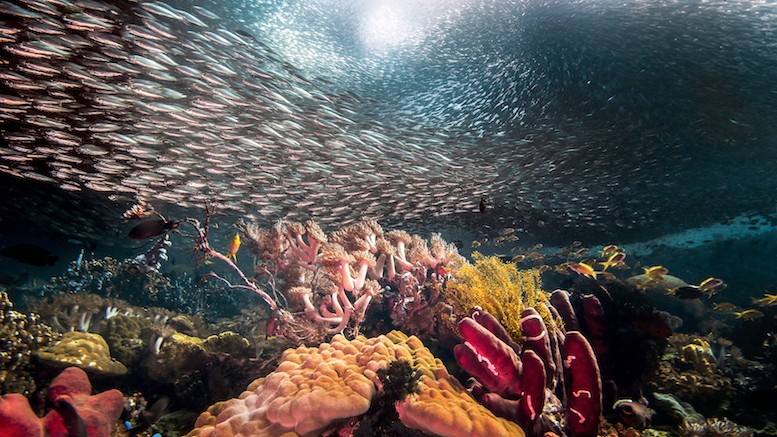
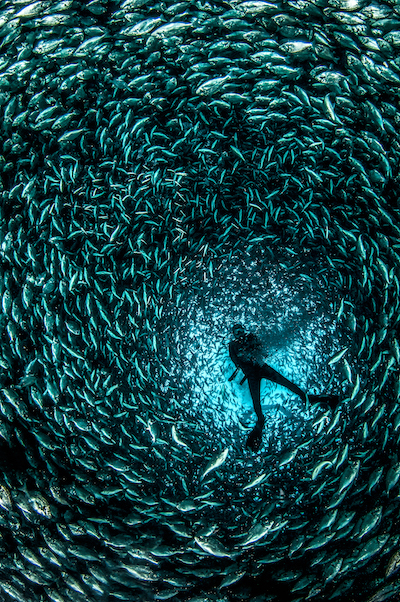
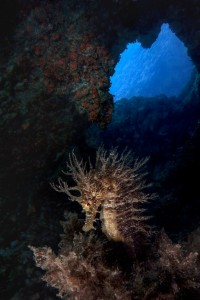
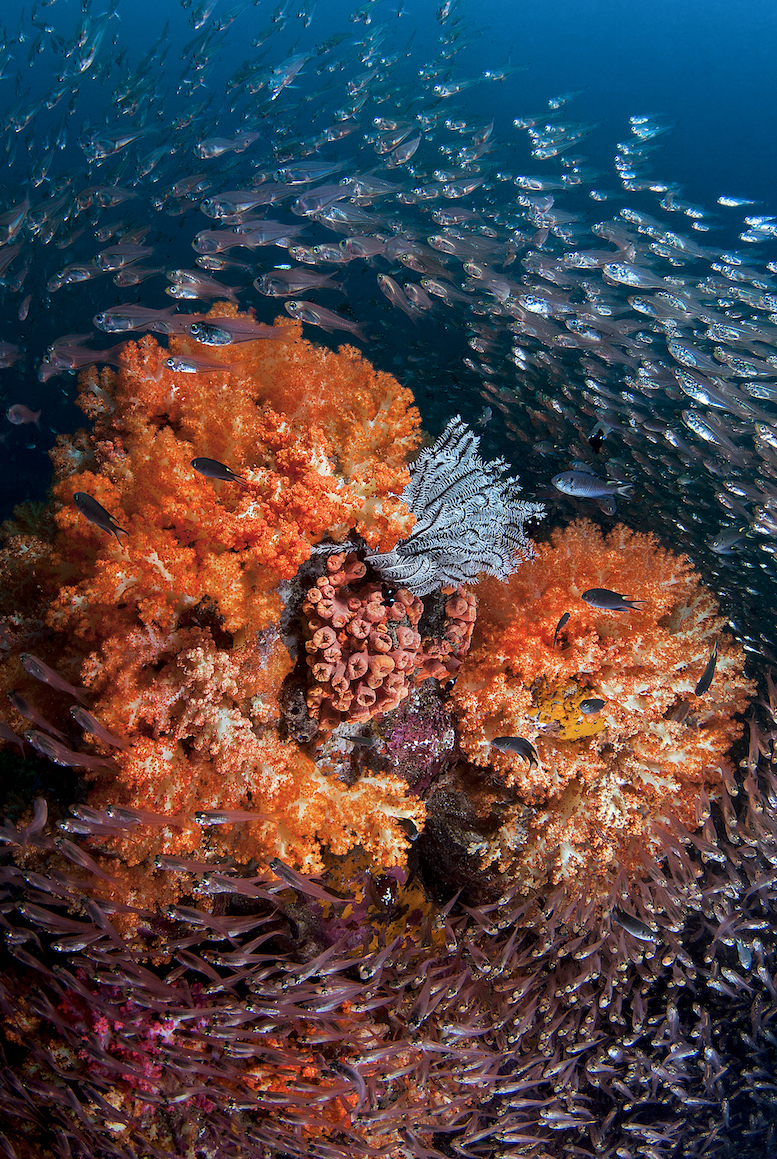
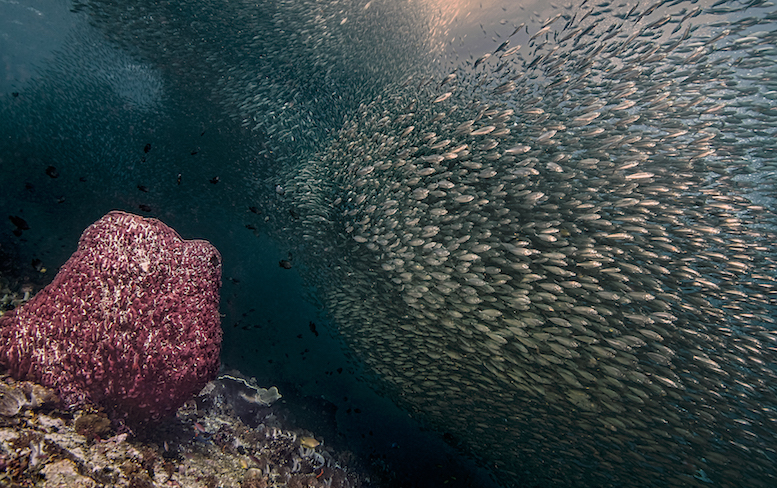
Where is your favourite dive destination? I love Raja Ampat. I love wide-angle pictures, especially of schools of fish. I can find everything I need there.
The site you’d most like to dive, but never have? Socorro Island, Mexico, without a doubt.
The weirdest thing you’ve seen underwater? I was in Raja Ampat, below an old jetty on an island. Not many people dive here. I think I am one of the few.
The island’s fishermen had told me that I would find something interesting. A school of fish called the place home, but there were also predators. I was in the water alone, shooting step by step with each movement of the school. The predators, species of trevally, were making inroads fast. At one point, the fish were trying to position themselves behind me, so the predators could not attack them because they were intimidated by my presence. What I thought was strange was what little time they have taken to adapt to exploit my presence – and people say that they are “only fish!”
What camera equipment are you currently using? I currently use a Nikon D8OOE in Nauticam housing. When shooting wide angle, I use the Sea & Sea YS-250PRO and Ikelite DS161.
What is the highlight of your career? This year when I was invited to TDEX in Bangkok. It was my first time outside of Italy to present my photography.
…And the low point? When I was a very inexperienced photographer, I was too sensitive to criticism and other opinions on my photography. My artistic sensibilities suffered, because I was trying to make my style too similar to others’. My pictures were just “nice images”, but my “soul” was missing.
Have you any advice that you’d like to give aspiring underwater photographers? Be yourself. Watch and learn from others, from the environment, but make your vision unique!
Is there any particular shot that you still want to get? Yes, there is! My dream is to swim with and capture pictures of whales.
Avid diver Rachel Mason recounts her incredible experience on the Underwater360 Expedition, where she came eye to eye with a school of hammerheads, face to face with dolphins and left in awe by the largest mammal to ever live, the blue whale. In this first part of a three-part series, Rachel introduces us to the ever-surprising world of the Banda Sea:
You always worry don’t you, when your baggage has been allegedly “checked through” multiple flight legs to reach your liveaboard start point, with the prospect of thereafter being at sea for 10 days. BCD and Regulator could end up MIA, and then what do you do when you have already committed to the diving version of BYOB (bring your own BCD)?! For DaDa Li, ADEX’s Freediving Ambassador this was a very real situation. We were extremely grateful to Gian Paulo Franchini, the owner of the Samambaia, who very generously extended an invitation for us to stay on the boat the night before we were supposed to embark on this epic journey, giving all errant belongings the chance to catch us up, and an additional opportunity to sample what we would come to know as the truly outstanding cuisine from the galley.
We are bookending this UW360 Expedition, meeting with provincial government representatives, the fisheries department, tourism boards, the Navy, universities, dive operators and the Coral Triangle Centre (CTC), all of whom are committed to putting dive tourism in the Banda Sea on the map, but we want to support them in doing this sustainably. Judy Lowe, ADEX Amabassador and PhD Student presents the culmination of what has been four years of research into dive tourism and its impact on the conservation of coral reefs and livelihoods of local fishers. She talks about how this could be achieved working with the local communities, respecting traditional marine tenure, ultimately securing the future livelihoods for local fishermen and their families, as well as the environmental future of the area for future generations. We are also in the thrall of Benjamin Khan of APEX Environmental, world-renowned cetacean expert, who regales us with tales of the “Banda Blues”; their destination is the Banda Sea but the reasons they come here is a mystery Ben has been trying to solve for many years, so the data we collect from any sightings will make a significant contribution to piecing the puzzle together.
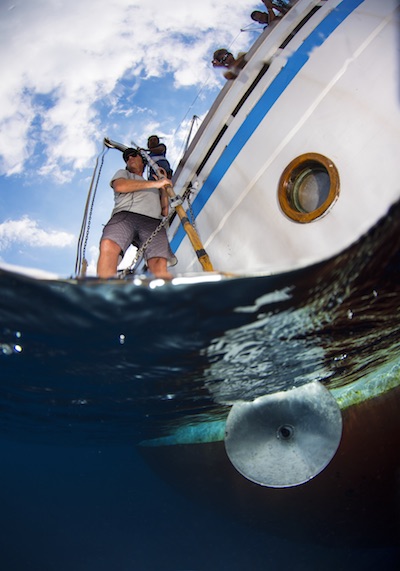
And so the stage is set. We race across the water of Ambon Harbour in the tenders sent to collect the cast and crew. We collectively take a breath as we round on the Samambaia, a traditional 40-metre, two-mast phinisi schooner. We are welcomed with open arms and a steady hand as we clamber down the stairs and drop onto the dive deck, which astonishes us with its size, the orderly pristine stations and gleaming tanks, nestled in the curved edges of the beautifully finished wood that surrounds us throughout this vessel. (You can find out more about the traditions and folklore of building these majestic ships in this edition of Asian Diver.)
I am startled awake the following morning with the metallic rumbling sound of the anchor being raised and engines roaring to life as we set out towards Nusa Laut, our first stop on what will be a 900-nautical-mile journey.
No sooner have we embarked upon our first leg, we hear, “BLOW! 11 o’clock,” shouted across the observation deck, and the clanging sound of the whale bell to let everyone know there has been a sighting. The cast and crew flood the dive deck and jostle for position to observe three blue whales foraging, the 10-metre-high blasts of water from their blowholes, mist bright in contrast to the advancing stormy skies and the depths into which they arch, fluke and then dive for 11 minutes at a time, in search of more krill. To see blue whales so close and so early on in our journey was extraordinary; Ben tells us they are usually not observed until much further away from Ambon, so already this is some new and very interesting information to contribute to the study.
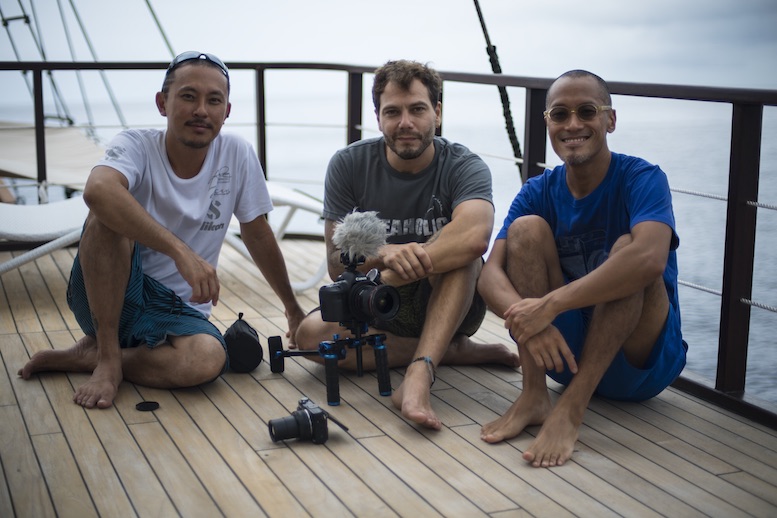
ADEX Ambassador of Photography Aaron Wong, underwater videographer Pepe Arcos, and underwater photographer Alan Lo, relaxing on the deck.
As we approach our first stop, the whale bell gives way to the dive bell, and we suit up for our check dive, Kampung Ahmed. The tenders zip over the water, and we can already see that the visibility is amazing. There is nothing like the feeling as we back-rolled into the blue, where the light spots of rain give way to a brand new world below, the intermittent hiss and sigh of my regulator, the squeak of my ears as we descend, and the wonder as I witness for the first time the prolific marine life in this part of the world. The fish are in abundance, busying about their lives; the coral is spectacular, and without pause. This would set the scene for nearly every dive of the expedition.
A sundowner at the back of the boat gazing into the middle distance, I thought I saw a dolphin. And then a sudden hive of activity; careering out of the water, splashes everywhere, these are spinner dolphins. Exclamations from the bow lead me forward, and there are four more, so close to the boat you can see t
heir faces. What an astonishing first day. Started with whales, finished with dolphins.
Watch this space for the next part of this incredible UW360 story
Diver Question: Recently I’ve seen many reports of downdraft currents on various online forums accompanied by debates about the best method for escaping them. Do any of DAN’s experts have an opinion or advice?
DAN Answer
As you will probably appreciate, there is no formal body of research addressing this specific question. The appropriate response and the degree of vigour required will be influenced by the depth, strength and volume of the downdraft, the distance from the eddy line (the edge of the draft), the topography, visibility, risk of entanglement or entrapment, the bulk of the diving equipment worn, the strength, power, buoyancy control, skill, decompression status (or obligation) of the diver and potentially other factors. What seems like a simple question quickly becomes impractical to study in a safe, controlled and still meaningful manner.
Even without quantification of the actual effort required, the question can be addressed conceptually. The priority is maintaining control — particularly vertical control — to avoid serious buoyancy and/or gas-space issues that could make the situation worse. Getting negative, hugging the reef and climbing out rock by rock might be workable if the strength and size of the current flow required it and the topography allowed it. The advantage of this approach is control. The diver is unlikely to have serious shifts in buoyancy or of gas in sensitive spaces (primarily the middle ears and lungs) when control is maintained.
Again, depending on the conditions, swimming perpendicular to the flow could be effective. An advantage of this may be a reasonable degree of control, with minimal need for fast changes in buoyant state or risk to sensitive gas spaces. Choosing to increase buoyancy probably represents the greatest risk of all. While it may be necessary in extreme situations, it is also possible that it could result in an overcorrection and the subsequent hazards of an uncontrolled ascent, the latter resulting in an elevated risk of barotrauma and decompression illness.
My fundamental recommendation is that divers think in advance and be prepared with a continuum of responses from which to choose and, when appropriate, to shift between. The progression of the graded response would be as follows: a mild downdraft could be ignored; a little more strength would prompt horizontal swimming to move out of the affected zone (with minimal or no addition of air to the BCD); even more strength or an uncomfortably large downdraft flow zone would prompt grabbing the wall for stability and, possibly, climbing out. A minor amount of gas might be added to the BCD at the hanging-onto-the-wall point, but not as a primary part of the solution. Adding too much positive buoyancy could create a situation more dangerous than the initial hazard. It could pull the diver off the wall, precipitate a runaway ascent or make what could otherwise be a mild case of entanglement extremely problematic.
Mental practice is an important way to improve skills and responsiveness. A critical part of this effort is to remember that every event has its own idiosyncrasies. Having multiple options and the physical skills and calm demeanour to employ them in a thoughtful, progressive manner will provide the best protection.

!["There is a beautiful swim through [...] and as the sun beams though the void it seems very apt that it resembles the shape of a heart." © Aaron Wong](http://staging.uw360.asia/wp-content/uploads/2016/11/DSC_7431.jpg)
 Where is your favourite dive destination?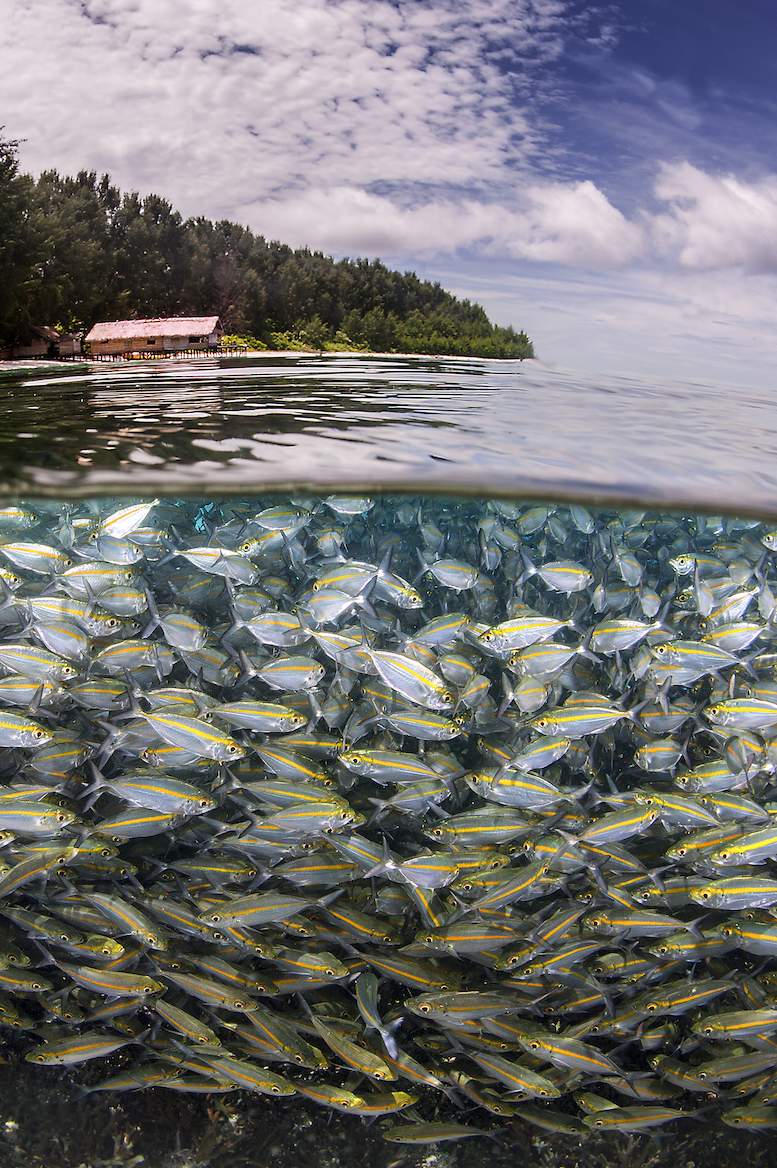
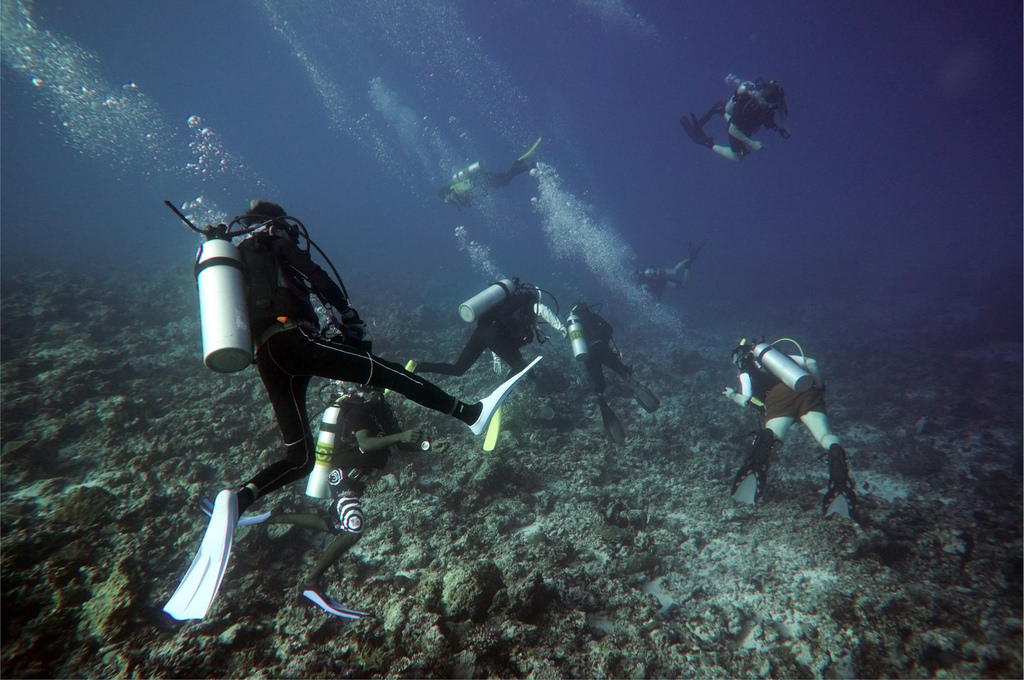
 As you will probably appreciate, there is no formal body of research addressing this specific question. The appropriate response and the degree of vigour required will be influenced by the depth, strength and volume of the downdraft, the distance from the eddy line (the edge of the draft), the topography, visibility, risk of entanglement or entrapment, the bulk of the diving equipment worn, the strength, power, buoyancy control, skill, decompression status (or obligation) of the diver and potentially other factors. What seems like a simple question quickly becomes impractical to study in a safe, controlled and still meaningful manner.