For centuries, humans have moulded and adapted to try and fit with the conflicting characters of their own people, in an effort to somehow negotiate their way through this grown-up playground that we call society. These combinations of qualities that form an individual’s distinctive personalities were traits we believed to be present in only a handful of species. But a groundbreaking study, led by Dr. Evan Byrnes of Macquarie University in Sydney, Australia, has revealed that members of a certain species of shark have individual personalities.
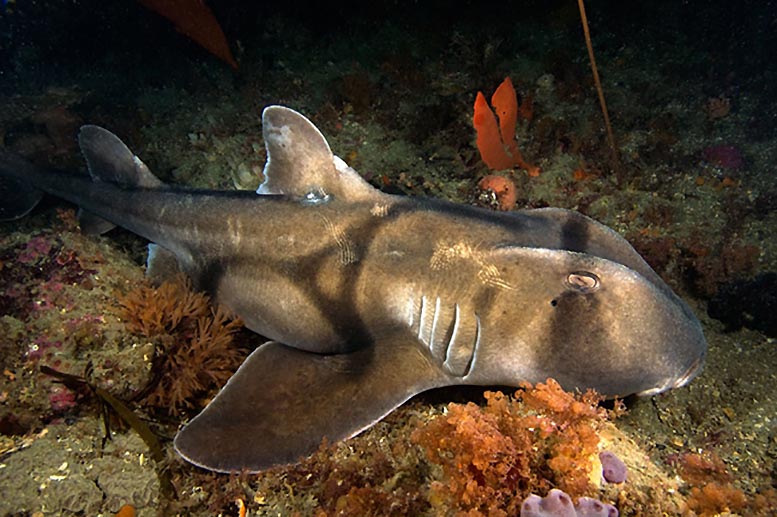
The shark species in question, Port Jackson sharks (Heterodontus portusjacksoni) – unknowing pioneers of the age of shark enlightenment – are common bottom-dwelling sharks of Southern Australia. Sometimes referred to as the “Oyster Crusher”, this unusual-looking species is one of the most well-studied sharks in the world.
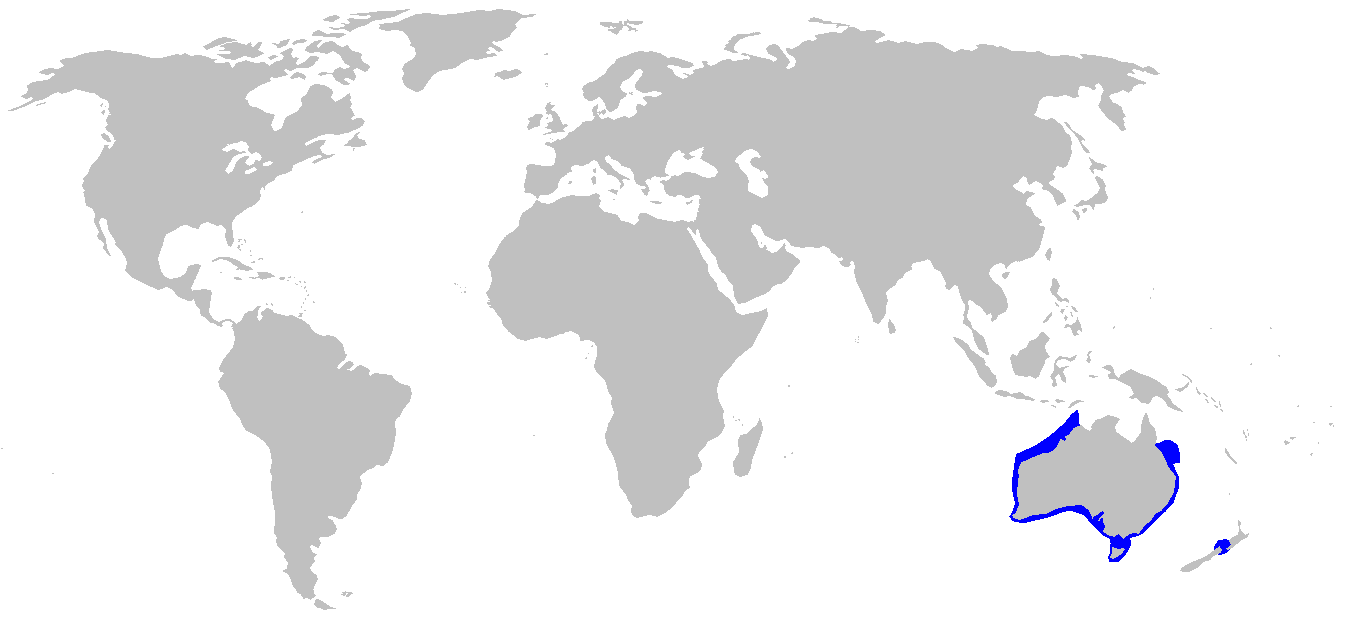
Distribution map of the Port Jackson shark, highlighted in blue
“Port Jackson sharks’ small size, hardiness, and large abundance in New South Wales waters made them an ideal shark to bring into captivity and test. Additionally, Port Jackson sharks belong to an ancient order of sharks called Heterodontus,or bullhead sharks, which diverged from other sharks nearly 240 million years ago, making them an ideal model to explore for the evolutionary roots of personality in animals,” Byrnes explains.
The study was conducted in captivity to provide each individual with identical testing conditions for multiple trials. The sharks were first introduced to a wide open inflatable pool and provided with shelter.
“I did one test that looked at individuals’ propensity to take a risk, or boldness, and did another test to look at individuals’ recovery from a stressful situation. To test boldness, I used a test called an emergence test, which looks at how long it takes for an individual to emerge from a dark acclimation box into a novel and potentially dangerous habitat. In reality, the dangerous habitat was just the wide open inflatable pool, but since the sharks had no experience in the pool they did not know if they were emerging from the box into a habitat filled with predators.”
Another test gave Byrnes a more hands-on approach: “To examine stress recovery, I measured sharks’ swimming rate after being handled out of water for one minute and then compared it to their normal swimming rate. Each of these tests were then repeated multiple times to see how consistent individuals’ behaviours were compared to the other sharks.”
But what Byrnes and his team discovered was that each shark’s behaviours consistently differed from one another. Some sharks were consistently bolder than others, and some sharks more easily stressed. It confirmed his earlier suspicion, that members of this species of shark do indeed have contrasting personalities – just like us.
“The most surprising find for me was that not only did sharks differ in the speed they recovered from stress, but there also seemed to be a difference in recovery style. While most of the sharks I tested increased their swimming rate after being handled, I observed two of the my 17 sharks decrease their swimming and sit on the bottom. This was quite surprising because it brings a whole second dimension of stress responses into the consideration when determining individual behaviours: An individual can either be reactive and or proactive, and at the same time be docile or panicky – for lack of a better word.”
Our own personalities are known to be influenced by both genes and past experiences, and these personalities often adapt and change over the course of our lifetime – due to individual experiences with different stimuli and social situations. With sharks, it’s a similar trend, but more with regard to how they deal with predatory threats and hunting strategies, than job interviews and next door neighbour’s errant barbecues.
“Sharks experience different stimuli over their lifetime, such as different predators and social experiences, and the number of times individuals encounter these stimuli and the type of interaction they have will influence how their personality changes. For example, if a bold individual swims up to inspect fishing gear and is captured, it will likely be more shy and cautious of fishing gear in the future.”
With this finding, the question is whether this individuality is unique to only Port Jackson sharks, or whether it is apparent in the wider underwater world. Byrnes certainly thinks it may be present in other sharks.
“The idea to study personality in sharks originated from my experience diving with great hammerhead sharks in Bimini, Bahamas, where I was able to recognise individual sharks based completely off how they behaved rather than off appearance. In fact, individual personality differences have also been demonstrated in catsharks and lemon sharks by researchers from Plymouth, UK and Bimini, Bahamas. Researchers are also beginning to discover that individual sharks of various species have different preferences and specialisations for particular prey or what type of habitat they live and hunt in.”
With these newfound personality differences and abilities to adapt their characteristics to suit certain social situations, there is a slim possibility that divers may be able build relationships with individual sharks. Although it is not advised to go out and seek “sociable sharks” to befriend – as this is work best left for shark diving professionals to avoid any injuries to both human and shark – there is that small opportunity to create unique diving environments and better understanding of individual creatures.
“If a bold, non-aggressive shark approaches a human and has a positive experience, it is likely to come back for more human interaction. On the other hand, I would expect that a shyer individual would be less apt to approaching divers and an aggressive shark would have a negative interaction, both leading to less future interaction with divers.”
For both divers and non-divers, this study’s conclusions, along with the many groundbreaking findings concerning the species in our oceans, simply reaffirms the reason why we should focus strongly on protecting our vast underwater world.
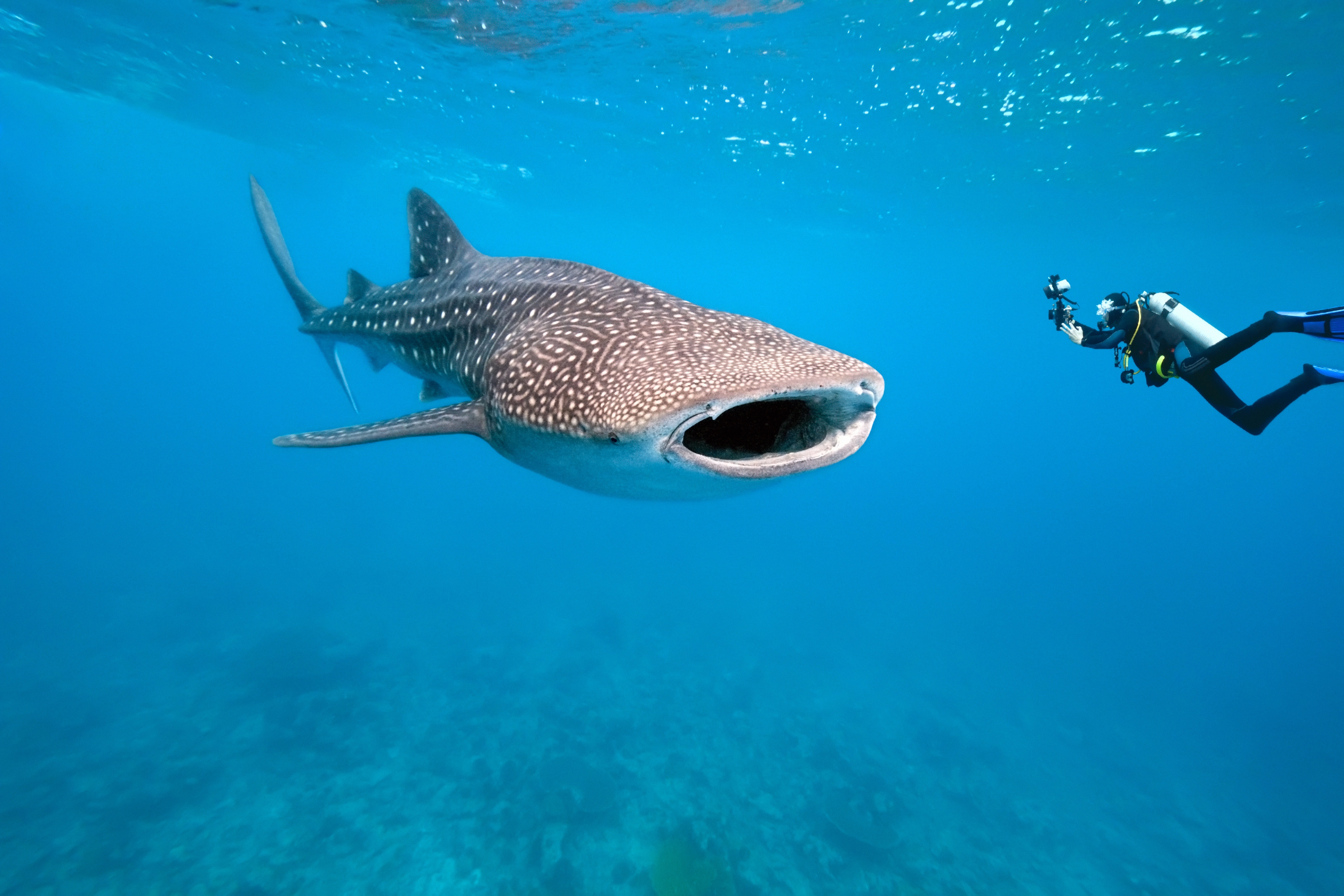
Whale sharks are not exactly born with a slick, streamlined body like their cousins the blacktip reef shark, blue shark or the bull shark. The world’s largest fish is a little awkward in appearance. Like many of the large marine animals, these gigantic sharks are not vicious; in fact, they are docile by nature. Hence, this cumbersome-looking fish needs some much-deserved exposure as this week’s Wildlife of the Week:
Species:Rhincodon typus
Class: Chondrichthyes
IUCN Status: Endangered
Diet: Using its modified gill rakers to separate food particles from seawater, they feed on plankton like krill, fish eggs, sea jellies, Christmas Island red crab larvae, small squids and anchovies
Size: Recorded size of up to 12.2 metres
Behaviour: Docile, travel great distances and dive down to at least 1,928 metres – though the reason why is unclear
Distribution: Strong preference for warm seas. Whale sharks are predominantly found around Queensland and New South Wales, Australia, the Philippines and most recently, Dibba Coast, east of the United Arab Emirates
Ecosystem: Whale sharks are ovoviviparous, where the embryos developing inside the eggs remain inside the mother’s body until the fully formed baby whale shark is born
5 Fast Facts:
The population of whale sharks is being threatened. They are hunted for their fins, flesh and liver oil for treatment of certain skin diseases and manufacture of shoe polish
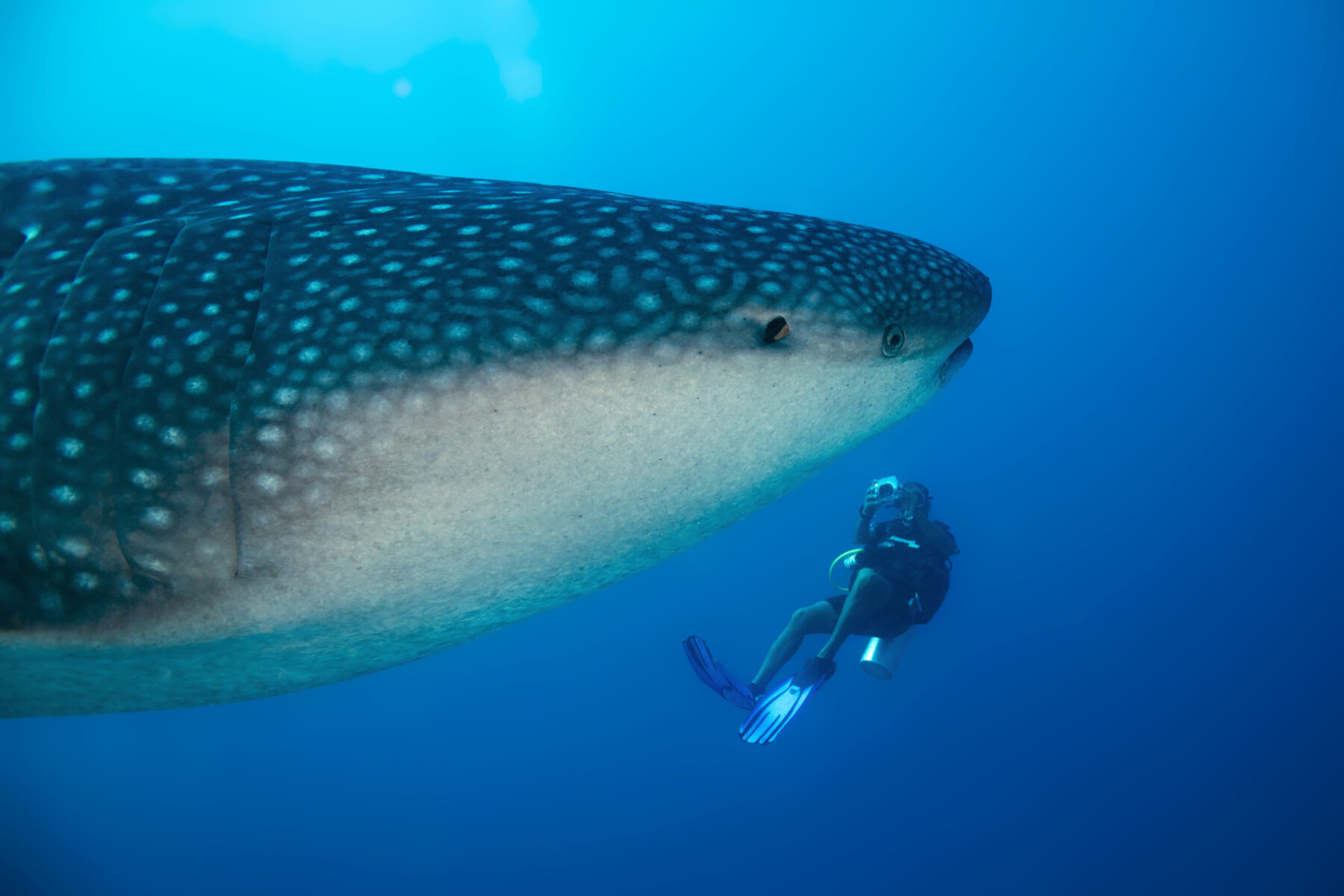
Like fingerprints, whale sharks have their own unique pattern of spots and stripes, which researchers use to track the movements of these enigmatic creatures
Besides being hunted, whale sharks are often victims of collisions from boats or boat propellers while feeding near the surface
Whale sharks cannot chew or bite, despite having 300 rows of teeth – that’s about 3000 teeth in total
Males and females can be differentiated by the presence of claspers (fin-like appendages under the abdomen of a male shark or ray) on the male’s body, used during mating. Also, the females are generally larger than the males
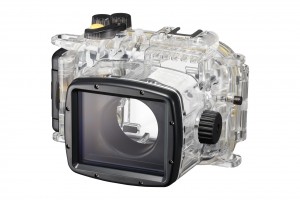
Stay inspired with the PowerShot G7 X Mark II camera, which combines exhilarating speed and performance with a smart, compact design. The PowerShot G7 X Mark II is ideal for travel, events and anywhere on the go, or as a secondary camera, and features a high-performance 20.1-megapixel, 1-inch CMOS sensor as well as a bright f/1.8–2.8 zoom lens to help capture impressive images whenever your creativity sparks, even in low-light conditions.
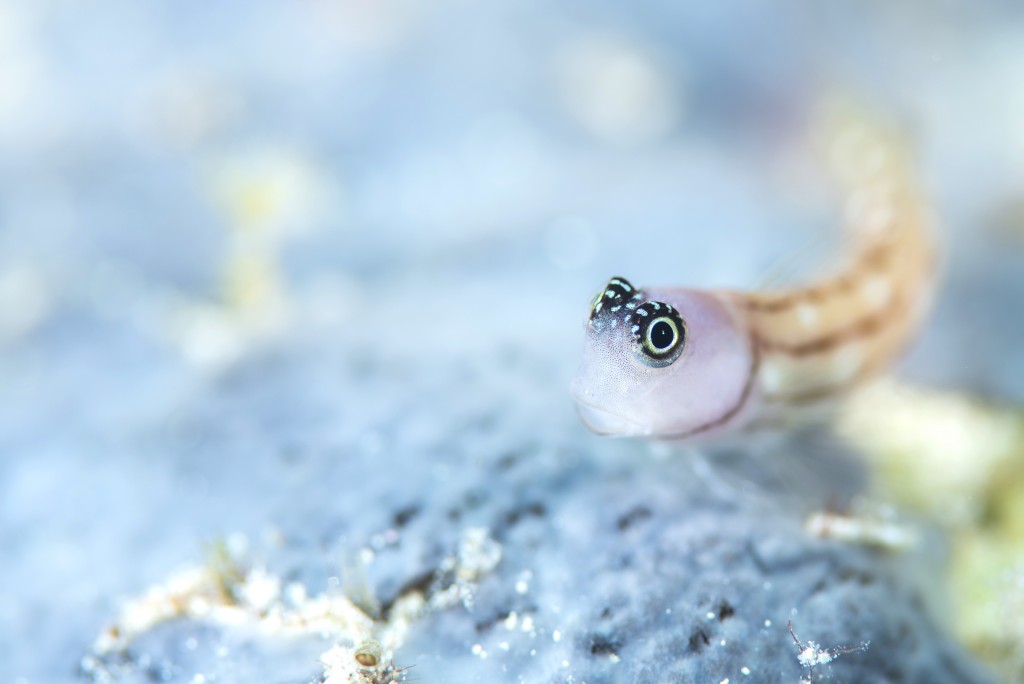
Asian Diver tested the PowerShot G7 X Mark II at Sisters’ Island, Singapore, and, although shooting in brackish conditions, found that the camera focused well on subjects with good contrast. The new DIGIC 7 image processor paid dividends with improved autofocus tracking, enhanced image stabilisation and superb image clarity even when we shot with a higher ISO. The zoom lens afforded impressive flexibility, with the ability to pull back for bigger subjects, and use the telephoto portion to maintain distance for skittish subjects like blennies.
A useful feature was the ability to transfer the images via Wi-Fi or NFC without having to open the housing, minimising any possible risk of flooding.
For increased flexibility, the PowerShot G7 X Mark II offers high-speed continuous shooting up to 8fps, and is equipped with Full HD video capability, and in-camera RAW conversion, giving you everything you need to capture inspiring images and video and share them with ease. For the novice and advanced beginner, the PowerShot G7 X Mark II can get close to rivalling images taken by a DSLR in low ISO shots.
• 20.1-megapixel 1.0-inch CMOS sensor (aspect ratio: 3:2) • Focal length: 8.8 (W)–36.8 (T) mm (35mm film equivalent: 24–100mm) • Maximum aperture: f/1.8 (W), f/2.8 (T) • Touchscreen LCD monitor: 3-inch tilt-type TFT colour liquid crystal, with biaxial tilt for low and high angle shooting
Canon Underwater Case (WP-DC55)
• ISO 125–6400, maximum ISO 12800 in P mode • Maximum video quality: Full HD 59.94 fps • Dimensions: 105.5 x 60.9 x 42.2mm
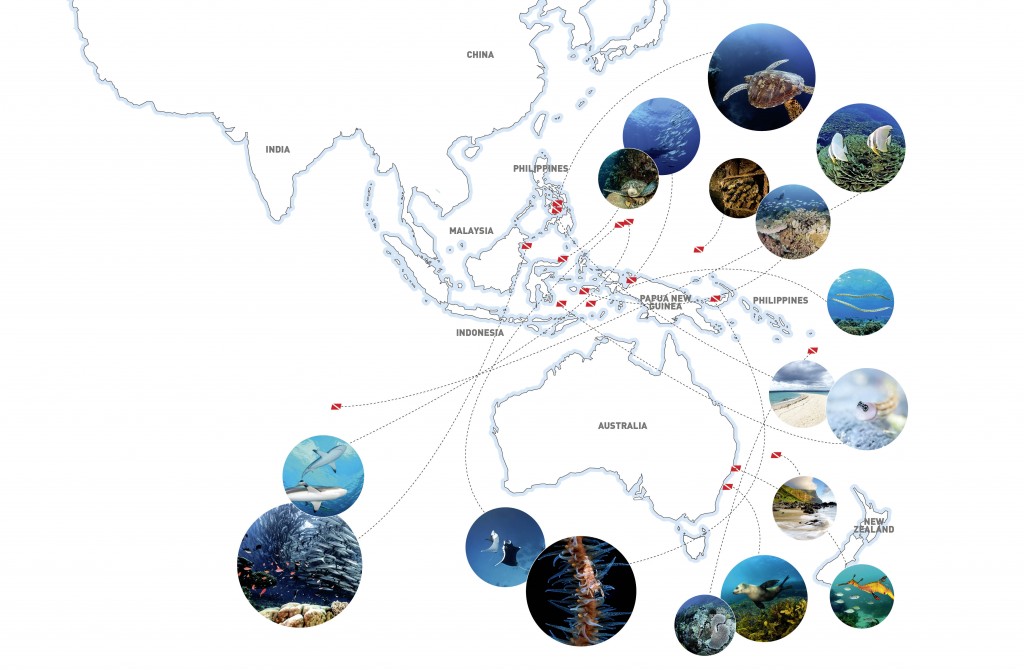
For some big experiences, you need to seek out some of the region’s tiny islands. From towering columns rising from the ocean floor, swept by huge currents and frequented by megafauna, to isolated sandbars wreathed with palms and colourful critters, isn’t it time you got “Castaway” from it all…?
Indonesia, The Forgotten Islands
By Ricard Buxo
Pioneer liveaboard operators recently stumbled upon the latest discovery in the Indo-Pacific region. Long ignored in favour of traditional, more-direct routes used for crossing the Banda Sea, this stretch of islands between the eastern tip of Timor and Tanimbar comprises the southern edge of the Malukus.
The Banda Sea has some of the deepest ocean trenches in world, some up to 7,500 metres deep in places, and the reefs here thrive on nutrientrich upwellings. The results are intact hard coral gardens climbing all the way to the surface, huge schools of fish, and the presence of large pelagics, from giant groupers to schools of giant trevallies, big tunas and large schools of hammerheads.
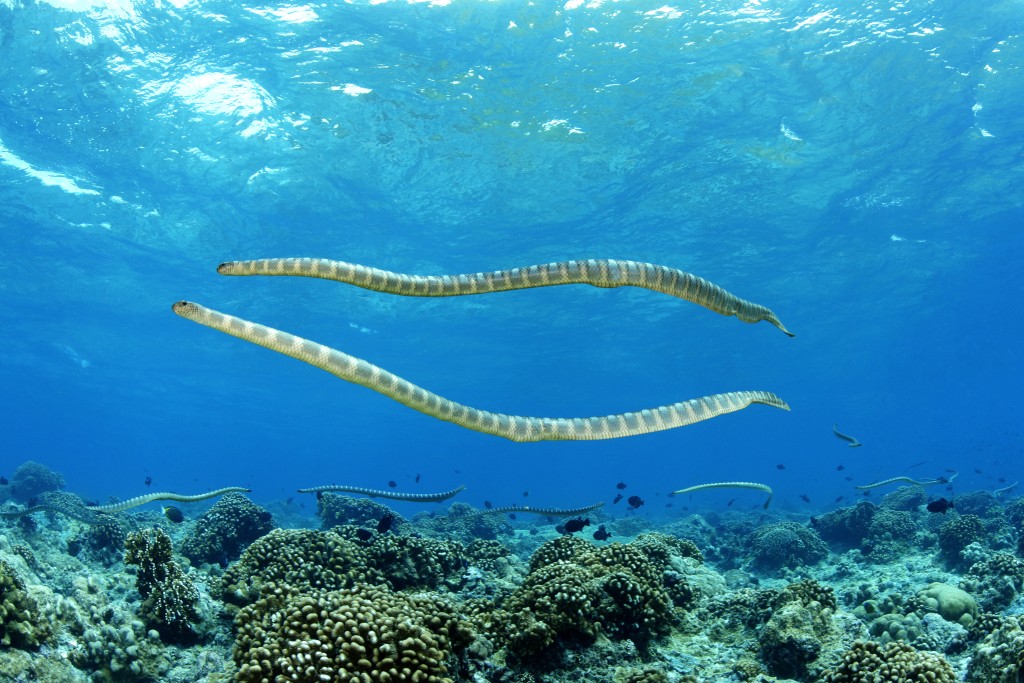
Gunung Api, or Snake Island, is one of the most isolated and rarely visited dive spots n the middle of the vast Banda Sea, one of the “Forgotten Islands”. This tiny island extends upwards from a depth of around 4,000 metres, ending in the 240-metre-high, perfectly cone-shaped summit of a partly active volcano. The first divers here, more than 20 years ago, where shocked by the exceptionally large population of sea snakes that inhabit the shallow water close to the rocky shore.
Today, the place almost guarantees a close encounter with more than 100 sea snakes on a single dive. They are curious and unafraid of divers, swimming up, brushing against you and swimming away.
Some will buddy up with you as you descend the wall to depths of more than 30 metres. Extraordinarily, these air-breathing reptiles have been recorded diving to up to 180 metres, breath holding for up to two hours.
Most are Chinese sea snakes, Laticauda semifasciata, an oviparious species. And this is probably the secret of their numbers – the rocky shore is full of tiny crevices and caves where the snakes can hide their eggs from greedy seabirds.
Four small, connected islands make up Yap proper with other tiny islands stretching for almost 1,000 kilometres beyond; this is one of Micronesia’s best-kept secrets.
A manta cleaning station inside the lagoon is probably one of the best shallow-water close manta encounter sites in the world. Divers post themselves at five metres around the edge of a large coral mound while mantas hover above to be cleaned by tiny wrasse. The mandarinfish mating ritual can be seen nightly at a reef just outside of Colonia’s harbour. These colourful fish emerge, cheek–to-cheek, to mate at dusk. To complete a perfect diving trifecta, an ocean-side shark dive site brings grey reef and blacktip reef sharks right to divers’ masks and cameras.
Despite the devastation of the slash and burn agriculture on land, the underwater world of Kimbe Bay remains an important biodiversity hotspot boasting more than 60 percent of the coral species of the entire Indo-Pacific.
Because of a massive die-off of coral worldwide due to pollution, human activities, and global warming, Kimbe Bay has become increasingly important, since it is seen as one of the last holdouts for coral should the degradation continue. In this amazing bay in the Bismarck Sea a pearl stands out more than others; Restorff island is a small island of fascinating beauty, and not just below the surface…
The emerald green water shines at dawn, the uncontaminated and virgin vegetation make the island look like something out of the movie Jurassic Park. But Restorff Island underwater is even more splendid, with a rich reef of colourful hard and soft corals, sea fans and giant sponges. Schools of different species of fishes surround you on every dive, and at night incredible critters welcome you to the deep blue…
Kalanggaman, an island of white sand, is a short boat ride from Malapascua and makes a very nice day trip. The island’s sand banks are formed between currents, extending dramatically outwards.
Dives here are mostly wall dives but there are shallow areas too, with coral bommies and a sandy bottom. On a sunny day the colours are amazing and the fish life is extremely impressive, with smaller fish, nudis, and shrimps great targets for the macro shooter.
Between dives, you can have your lunch served on this beautiful little island, resting in the shadow of the palm trees.
Vanuatu
By Christian Skauge
Far out in the Pacific, east of the Coral Sea, divers will discover a little slice of heaven. The tiny island nation of Vanuatu offers not just pristine coral reefs, but also one of the most spectacular wreck dives in the world: The former American luxury ocean liner turned troopship SS President Coolidge. The 200-metre giant rests from about 20 to 75 metres. after hitting two mines on October 26,1942, and is one of the largest diveable wrecks anywhere in the world. The captain beached the ship and all but two were saved, before she slid off the reef and sank.
SS President Coolidge offers several dives at various depths, with highlights such as a Madonna statue, a tiled swimming pool and many great swim-throughs with spectacular details. Dives, both technical and sport diver level, are offered by several dive shops in Luganville on the island of Espiritu Santu.
Another great dive nearby is Million Dollar Point. After the war, several trucks, bulldozers, excavators and other vehicles were dumped off the end of the runway, today offering a very unusual wreck dive with great photo opportunities. Two smaller ships have since been scuttled here, and this easy beach dive is very popular after visiting the Coolidge.
Malaysia, Sipadan’
By Matt Krumins
A short boat ride from Mabul Island, where the vast majority of resorts are located, Sipadan Island pokes its head above the horizon, a tropical paradise with white sands dividing the palm trees from the turquoise water. This must-dive site runs on a permit ticketing system, limiting diver numbers and making it a haven for fish life and pristine untouched coral walls.
From the moment your mask clears of bubbles after rolling off the boat, a vast city of underwater life opens up. Fish of every size and colour dart in schools like peak hour in a capital city. With bright fan corals and huge
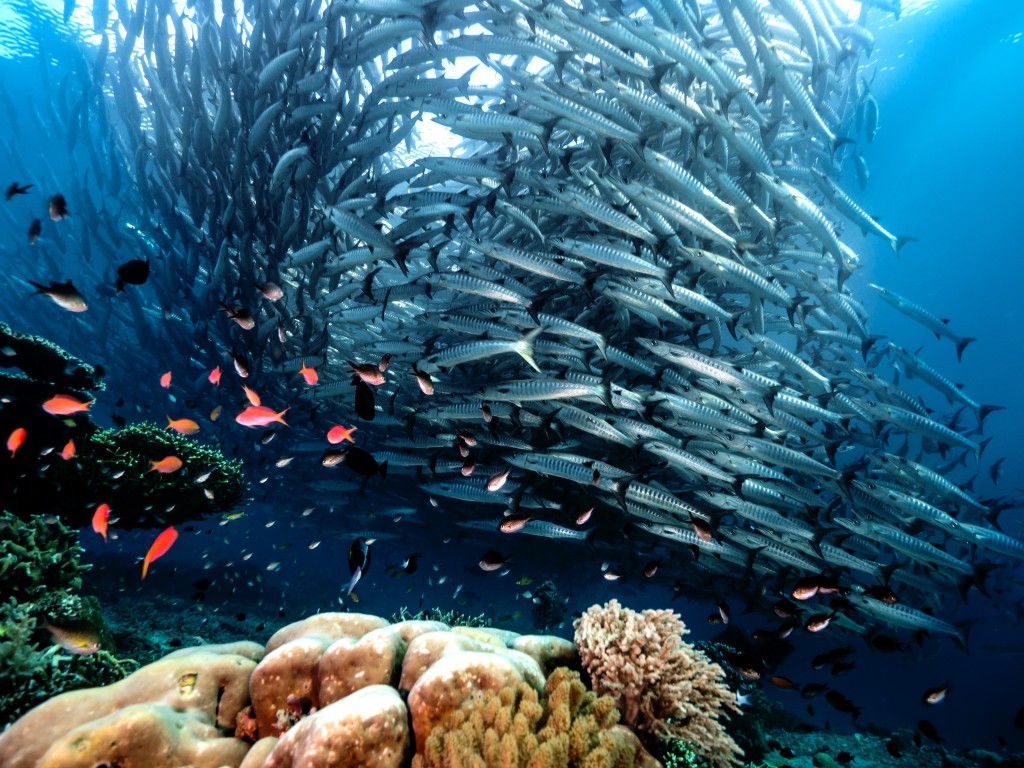
plates and branching coral clusters bustling with life, this dive site is a list topper for almost everyone who has the privilege of visiting it. The highlight of this site? The tornadoes of barracuda contrasting their silver blue against the Technicolor reef system and the morning train of bumphead parrotfish coasting across the shallow reef, right on schedule.
This isolated coral atoll located in the middle of the Indian Ocean offers a picture postcard island getaway. Comprised of a ring of 27 low-lying sandy islets covered in rustling palm trees and bright yellow sandy beaches, the most prominent feature of the dreamy destination is the electric blue waters that circle the outer island reefs and sheltered lagoon.
The diving here is dramatic: Walls drop away to 3,000 metres and are often vertical, the deeper parts are covered in forests of gorgonian seasons and sea whips, whilst hard corals dominate the shallow sections. Expect to encounter brightly coloured Cocos angelfish, which are only found in these waters, as well as grey reef, whitetip and blacktip sharks, manta rays, green turtles and reef octopus. And, if you’re lucky, a lone dugong occasionally visits groups of divers off the northern end of Direction Island.
Manado in the Sulawesi Sea is ranked as one of the best diving locations in Indonesia. The jewel in the Manado crown is Bunaken Island, protected within the Bunaken National Marine Park. On the reefs surrounding Bunaken Island, divers can experience some of the highest levels of biodiversity in the world, with outstanding fish variety and world-class reef walls. Situated in the Coral Triangle, these clear, warm waters contain an astonishingly high numbers of species. Oceanic currents sweep past the island and provide a steady supply of nutrients to thickets of gorgonian fan corals, sea whips and thriving hard coral growth in the shallows. During a single dive, the marine life can vary from tiny pygmy seahorses to several green turtles.
Other great Asia Pacific islands to try:
• Andaman and Nicobar, India • Laccadives, India • Solomon Islands • Fiji • French Polynesia • Sibuan, Malaysia • Manubuan, Malaysia • Pom Pom, Malaysia • Layang Layang, Malaysia • Malapascua, Philippinews • Green Island, Taiwan
Australia, Broughton
By Justin Gilligan
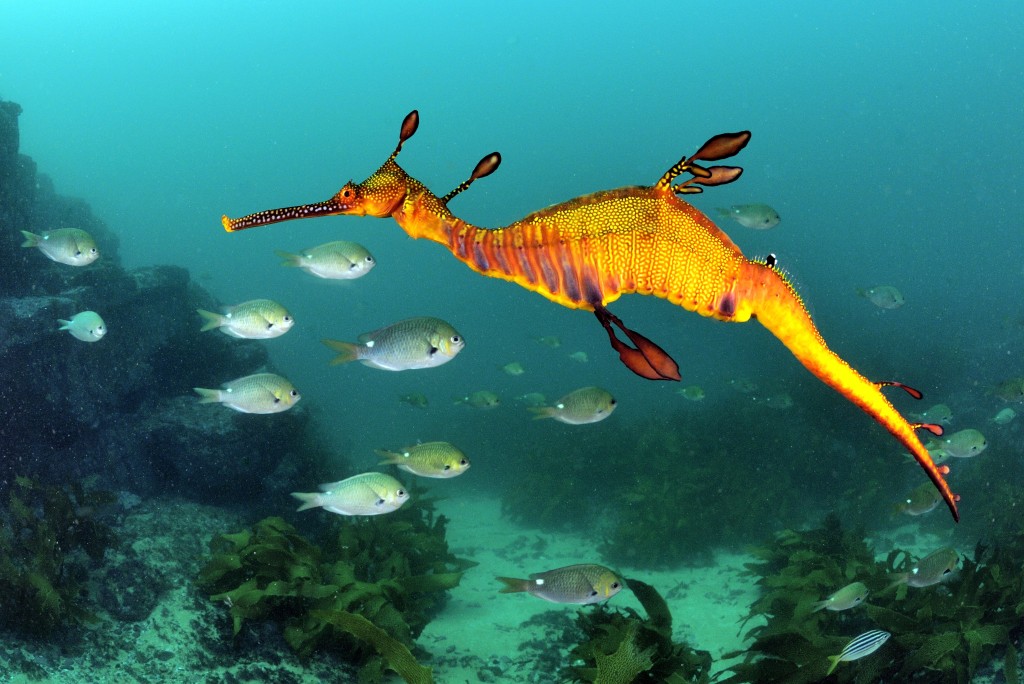
Surrounded by sprawling rocky reef inhabited by weedy seadragons, giant cuttlefish, blue devilfish, fiddler rays and grey nurse sharks, most of Broughton’s sites are great for new divers – easily accessible, relatively shallow, with no current. Grey nurse sharks are the major draw and occur here year round, though peak season is February to June. The sharks can be encountered regularly at sites like Looking Glass, Shark Gutter, East Head and North Rock. Highlights include the sharks amongst the shape-shifting schools of yellow-tail scad off North Rock, and the spectacular topography of the amphitheatre-like Looking Glass. When a day of diving is combined with topside encounters with migrating humpback whales and pods of common dolphins, a visit to this island is a must.
The tiny island of Balicasag is considered one of the best places to dive in the Philippines. Being surrounded by deep water and the Cebu Strait ensures plentiful currents and thus high biodiversity. It is always easy to dive a sheltered side of the island, or you can choose a nice drift dive on deep walls.
Balicasag is just 10 kilometres from Panglao’s Alona Beach, just by Bohol. It is famous for its turtles, with both green and hawksbill turtles spotted on almost every dive. Convict blennies and other schooling fish are also great to photograph. Walls covered with soft corals and anemones host all kinds of small critters. Don’t forget to check out whip corals for the gobies and crabs.
Indonesia, Wakatobi
By Richard Smith
This is the epitome of an island diving paradise. Turtles nest on these beautiful palm-lined white sand beaches and sunbirds twitter in the branches above. Only 50 metres from shore, the turquoise water gives way to shades of royal blue where the rich coral and seagrass shallows merge with the ocean depths beyond.
The small island, Onemobaa, is towards the end of the Tukang Besi chain of islands. The region is also known as Wakatobi, which is where the resort’s name originates. The name “Wakatobi” derives from the first two letters of each of the four main islands in the chain: Wangiwangi, Kaledupa, Tomia and Binongko.
The corals remain pristine and an extraordinary diversity of species can be found here. Some sites have bountiful fishes, turtles, schooling trevally and rays, whilst others are better known for the smaller critters: pygmy seahorses, an extraordinary palette of nudibranchs, ghost pipefishes (including the rare halimeda species) and crustaceans hiding away in or on almost any invertebrate host. This tiny island certainly punches above its weight in the biodiversity stakes.
Australia, Lord Howe
By Justin Gilligan
This exotic World Heritage site offers up some of the most unique and diverse diving within Australian waters. The island landscape itself is spectacular, composed of dramatic cloud-catching mountains, a quaint township and rolling hills that lead to picturesque beaches.
Surrounding the island is the southern most coral reef in the world. Sixteen species of fish found nowhere else on earth inhabit these reefs, along with an eclectic mix of tropical and temperate marine species. Lord Howe boasts over 60 dive sites, ranging from sheltered lagoon sites to the oceanic reefs off Balls Pyramid – the world’s tallest sea stack. Diving inside the lagoon offers sheltered, aquarium-like sites packed with diversity. Green turtles, rays and Galápagos whaler sharks can be encountered on a daily basis. The offshore reefs offer dramatic topography including drop-offs and caves with the perfect mix of amazing big fish action and macro encounters. There’s a variety of sites for the full range of beginner to advanced. The shallow sheltered sites within the lagoon can be snorkelled by the whole family, whilst the dramatic current-swept sites offshore are suitable for advanced divers.
Federated States of Micronesia, Chuuk
By Brandi Mueller
Internationally famous for its WWII wreck diving, Chuuk (formerly known as Truk) is a destination on every diver’s bucket list. Warships, merchant ships, a submarine, and aircraft have been sitting at the bottom of the lagoon for over 70 years turning into artificial reefs hosting an epic amount of marine life in the warm waters of Micronesia.
These wrecks have become both an underwater museum and the base of fantastic reef structure. Abundant pink and purple soft corals drape over t
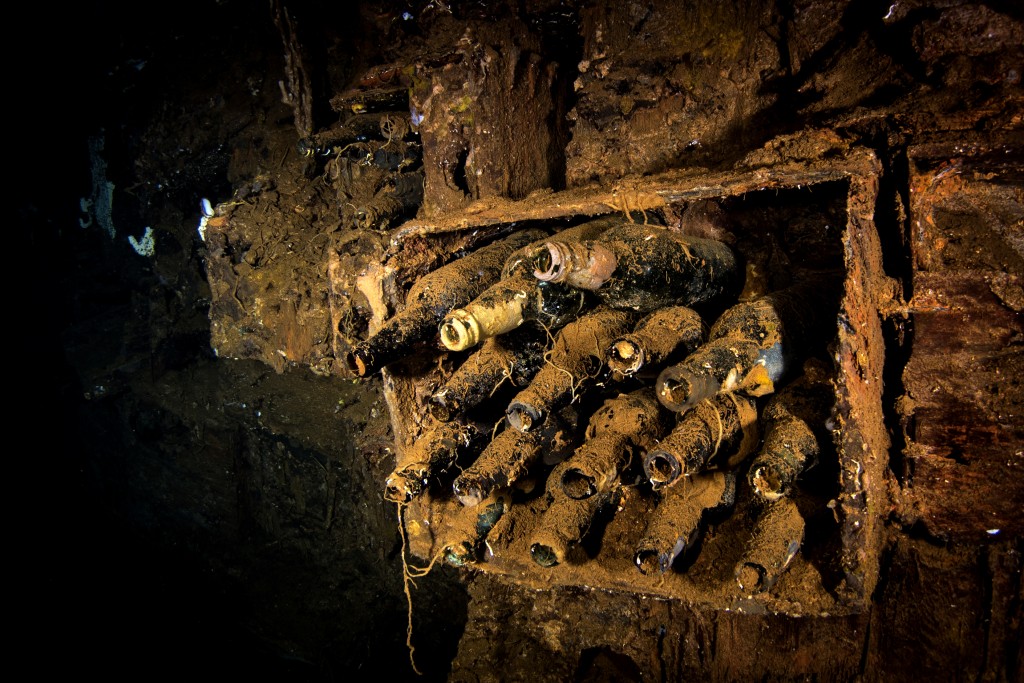
he wrecks and colourful reef fish buzz over these “ship reefs”. Experienced divers can take tours (by experienced dive guides) through the wrecks to visit engine rooms, galleys, and workshops still intact with artefacts from another time. A favourite spot is a cargo hold that held cases of beer or sake and the boxes of bottles can still be seen in the Rio de Janeiro Maru.
The beautiful but remote Ahe lies in Cendrawasih Bay, at the most eastern part of Indonesia close to Papua New Guinea. The island, accessible by liveaboard, is home to a locally-run resort, with a small restaurant and just 10 bungalows. The island is so small it only takes around six minutes to run one lap around it!
Ahe is a little tropical paradise with a wonderful house reef that boasts a plane wreck, and an ideal habitat for fish under the pier. The diving is easy with little or no current.
But the big draw at Ahe is the whale sharks. A boat ride away, fantastic dives are possible with the biggest fish in the world, and not just with the adults, but with the youngsters too, six- to seven-metre-long “teenagers”. The fishermen are superstitious and believe if they feed the whale sharks with small bait fish they will have better luck getting the bigger fish they are after.
Australia, Montague
By Justin Gilligan
Situated on the far south coast of New South Wales, off the quaint coastal town of Narooma, the Montague Island Nature Reserve is world renowned for its nesting seabirds and is a stronghold for nesting little penguins, crested terns and silver gulls.
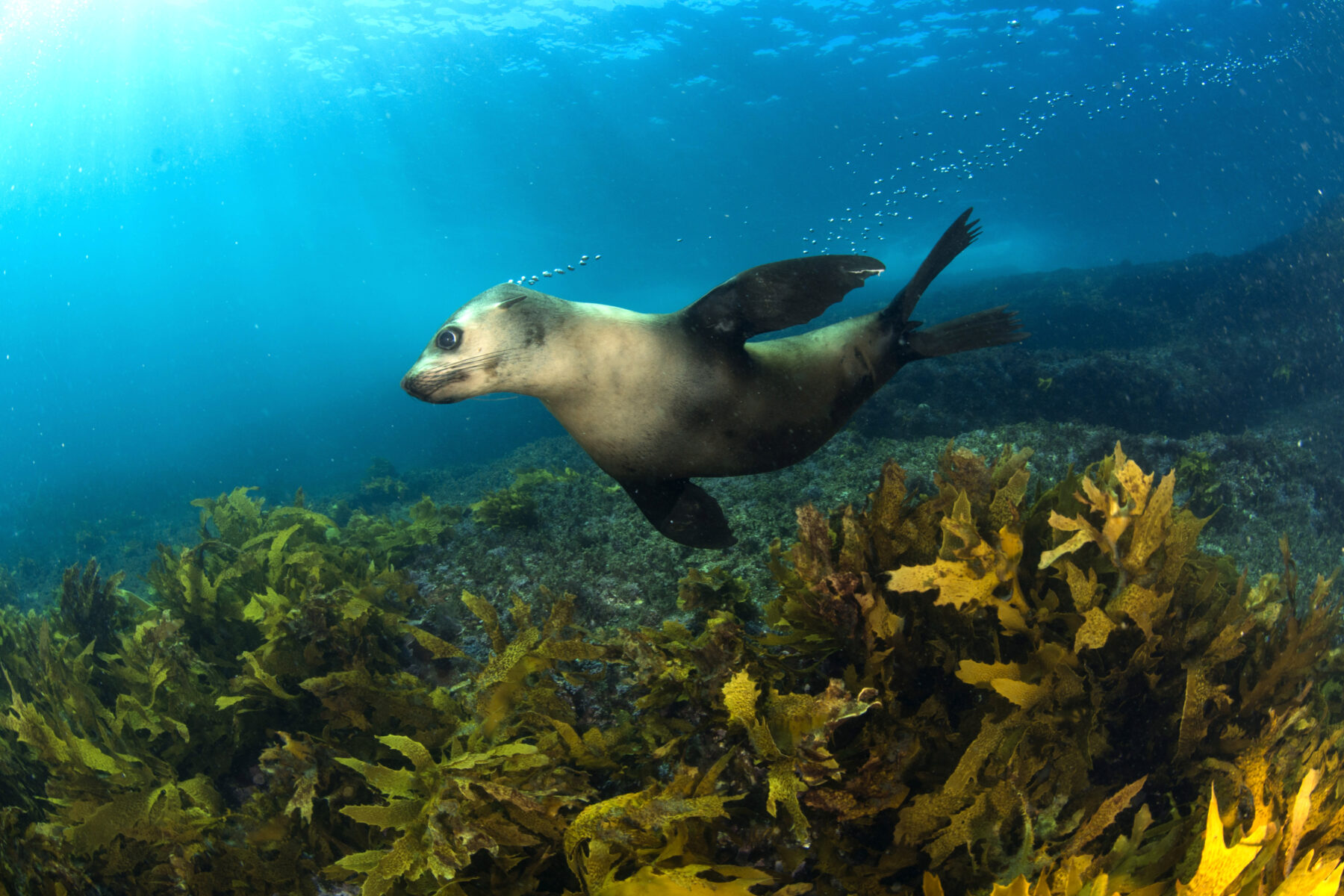
On the reef just offshore, the blue East Australian Current brings nutrients, baitfish and larger predatory fish and squid to the waters immediately around the island, which creates a feast for resident Australian and New Zealand fur seals. Endless time can be spent watching the playful antics of the seals in the blue shallow waters. During the summer months grey nurse sharks can also be regularly encountered off the northern end of the island; it was quite common to encounter a group of 10 during a dive this summer. Other sites around the island include a bubble cave and the amazing Aughinish Rock, located in current-swept waters to the south of the island.
Palau, one of the Pacific’s hidden gems, is made up of both volcanic islands and over 400 uninhabited mushroom-shaped limestone islands. Winding through its outer reefs to its inner lagoons lies an assortment of channels bringing with it food, nutrients and plankton. One of Palau’s most famous channels is German Channel, a 45-minute boat ride from Koror (Palau’s main island) in the southern lagoon.
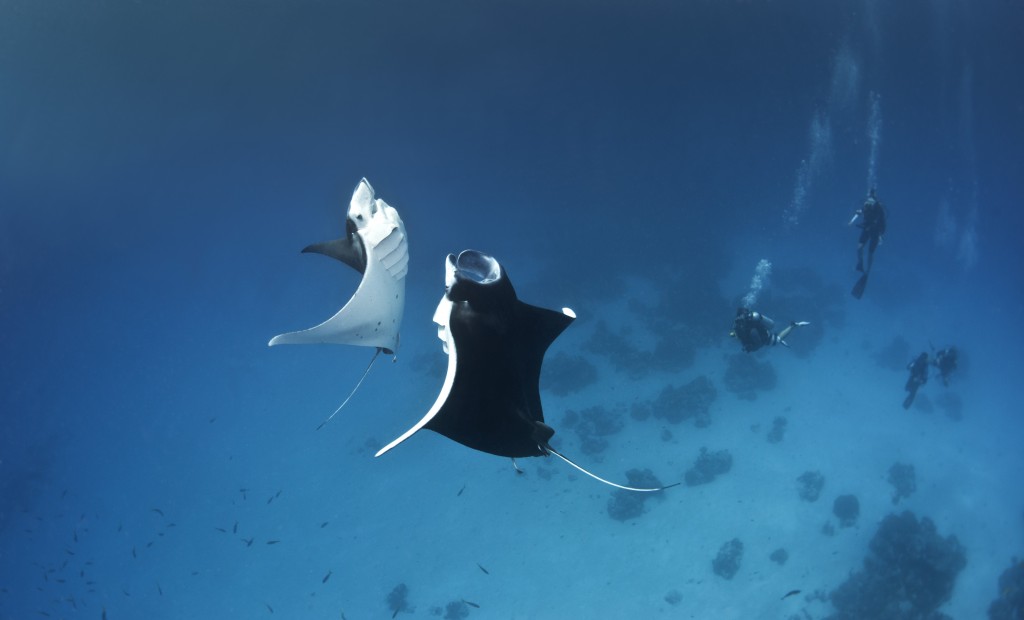
Here, during the months of November to December, aggregations of 10 to 15 mantas can be seen feeding on plankton in the late afternoon on incoming tides. Not only is this place special for witnessing this behaviour, it also has nearby cleaning stations, where mantas come to be rid of parasites.
Around April the mantas take advantage of the current and move to the northern islands, feeding and mating in large numbers. At certain times, at key sites, it is possible to see aggregations of anywhere from 25 to 50 mantas feeding in huge trains.
Amorgos, that long and narrow easternmost island of the Greek Cyclades, was immortalised as the place where the opening scenes of Besson’s cult classic, Le Grand Blu, or The Big Blue, were shot; starting with its sea’s sparkling surface, filmed in black and white, to the rocky east side with its steep cliffs, and then on to the flat rocks of Agia Anna and the movie’s first underwater scenes, all presented to the music of Eric Serra’s mesmerising soundtrack.
The “forgotten” island soon gained regular ferry links with daily afternoon departures, and smooth development of infrastructure for tourismfollowed; the island now offers many options for accommodation, while retaining its unspoiled, traditional Cycladic architecture.
When arriving in Amorgos, the first thing that hits you is the scent of herbs. Spring is prime time to visit the island, hillsides and gardens ablaze with the colour of wildflowers, Amorgian herbs, pharmaceutical aromatic plants, mint, basil, camomile, oregano, rosemary; the list of herbs and flowers is endless.
Today, Amorgos is still a quiet, laid-back destination where nothing could disturb its quietude and calm, except perhaps the joyful music and dancing at the high summer season’s traditional festival. Although the Agia Anna and Liveros Bay, the places that captivated film audiences with their magnificent scenery, are not actual scuba diving destinations, they are both must-visit places to admire, photograph and snorkel. Agia Anna, with the small chapel by the sea, boasts a little beach and the surrounding flat rocks are ideal for snorkelling and sunbathing. In Liveros Bay, the shipwreck of the Olympia still stands, as featured in the movie with Reno freediving in the engine room.
The northeast side is closer to Agia Anna and the “Big Blue spirit”. Dive the Small Sparti Caves with its narrow rocky passage to the entrance of the cavern at around 18 metres. Soft corals adorn the walls and the ceiling, and holes in the rocks are full of hidden critters. At the exit, amazing rays of Mediterranean sunlight reach the cavern, ideal for wide-angle photography. You might even encounter passing tuna.
From Agios Pavlos beach on the north side of Amorgos, it is just three minutes to the beautiful Northern Wall which slopes down to about 40 metres. It’s full of holes, little pockets hiding macro subjects and the visibility is amazing all the way down to the sandy bottom. The Cavern is nearby, with walls covered with bright purple, red and yellow sponges, false corals, scorpionfish, lobsters and more small critters – ideal for macro shooting. The Deep Blue Wall on the western tip of the island of Nikouria is a fascinating dive, on which you can encounter passing barracuda, tuna and even Mediterranean monk seals or dolphins. At 26 metres there is a dramatic cave.
The iconic Amorgos has plenty of diverse sites on offer, including Grambonisi, shallow or deep, a dramatic wall full of diverse macro life; or Marina Three, a cargo wreck with massive propellers just outside the island of Kinaros; or Aegiali Bay and Limenaraki.
With such beautiful sites to choose from, and easy diving, immersing yourself in the original Big Blue is a must for any lover of underwater cinematic history.
Nicholas Samaras is a passionate underwater photographer, whose dedication to the sea and its creatures drives him to bring the unique aesthetic beauty of the marine world to the surface. His photographs have received numerous awards in international underwater photography competitions and are regularly published in magazines worldwide. www.underwater-photography.gr
Subscribe to Scuba Diver Magazines now for just S$25
This article featured in the Scuba Diver OCEAN PLANET (Issue 2/2015)
Text by Nonette Royo and the Coral Triangle Center
Our story began with the awakening of one person in the quiet world under the water. But this would have remained a dream without the passion, dedication, and expertise of all those who have contributed to what we are today.
The personal epiphany
In 1989, Ms. Rili Djohani, a marine biologist and seasoned diver, had already logged long hours underwater in the North Sea, the Mediterranean, and the Caribbean. Still, the waters of the Coral Triangle were a revelation. Nowhere else is the underwater world so riotously colourful and rich, and no other place on the planet teems with such an abundance and diversity of life.
During her early dives back in Indonesia, Rili was reminded of how fragile this world is. Fishing with dynamite and explosives had left parts of the reefs gutted.
If unchecked, this tragedy would devastate the region and ultimately the whole planet. Ironically, local fishermen and their communities would be the first victims of the dying reefs.
Rili made it her mission to save the corals. But she also knew that to be successful, the effort to save the reefs had to be shared with those who depend on them; the local people needed to be enlisted.
The dream becomes reality
In 2000, while Rili was the Country Director for The Nature Conservancy’s Indonesia Marine Program (TNC-IMP), she took the first step – the Coral Triangle Center (CTC) was founded under the auspices of The Nature Conservancy (TNC). The idea was that the new department would narrow the organisation’s much broader scope and would concentrate on the region’s reefs.
An early champion was George Tahija, at the time a member of TNC’s advisory board for Indonesia. Mr. Tahija shared the conviction that the strengths of modern marine management and scientific approaches needed to be transferred to local actors. He was also one of those who recognised the need for CTC’s autonomy, when it became apparent that its goals could be better accomplished as an independent local organisation. This step towards independence was fully supported by TNC, who provided foundational funding support and transitional periods to enable the CTC to become a standalone entity.
With a small team in place, Mr. Tahija, together with Mr. Hasyim Djalal, an influential diplomat, widely respected scholar, and legal maritime expert who laid the foundation for archipelagic nations, and Mr. Made Subadia, a top Indonesian conservation official, founded CTC as an independent Indonesian foundation in 2010.
Riji Djohani, the inspirational driving force behind the CTC
The human connection
Even before its life as a new organisation officially started, CTC worked towards one of the most significant developments in the area: the sixnation agreement called “The Coral Triangle Initiative on Coral Reefs, Fisheries, and Food Security ” (CTI-CFF). Mr. Johannes Subijanto, our Deputy Executive Director, worked alongside Rili and others from across different organisations in the Coral Triangle countries to bring about this unprecedented partnership, which launched just one year before CTC itself. In 2014, CTC became the CTI–CFF’s first partner, the only locally-based organisation to join international giants such as Conservation International, The Nature Conservancy, and the World Wide Fund for Nature.
The future
Six years after CTC’s inception, and the the next big step is to build a state-of-the-art learning complex and conference centre, to be known as the Coral Triangle Center for Marine Conservation (Regional Learning Hub). It is here that we seek to build bridges: the centre will house an exhibition open to the public, where visitors can engage with in-depth knowledge about the Coral Triangle, its marine environment, and its people, and learn about the dangers that threaten them as well as the available solutions.
In 2010, when we began as an independent entity, we had just five employees. In 2016, we have 29 employees, have trained 2,500 individuals, and have a strong network of hundreds of collaborators from the Coral Triangle and beyond.
Since our work started, we have witnessed the power and beauty of human resilience, enthusiasm, and the strength of people connected by the desire to serve the sea that is the very foundation of life on our planet.
Subscribe to Scuba Diver AUSTRALASIA now for just S$25
This article was featured in the #conservation section of Scuba Diver AUSTRALASIA (Issue 3/2016)
Mohamed Abdulla is from the Arabian Gulf, the Middle Eastern sea renowned for pearl diving. Coming from a family of pearl divers and fishermen created a strong bond between him and the deep blue, and kick-started his passion for freediving at an early age, which then led to him taking up underwater photography in 2008. Mohamed has gone on to win several awards for his underwater photography and has been published worldwide. His eye-catching and distinctive style is aimed at pushing the limits of how photographers represent life below the waves. We caught up with him for a quick Q&A and to present him as our Underwater Photographer of the Week:
What made you want to become an underwater photographer? I used to dive every single day in Dubai and the beautiful islands of Abu Dhabi, and on weekends I would go to the magnificent Gulf of Oman, where I would get to see things that not everyone else gets a chance to see. Excited, I would immediately go to my friends and tell them: “I saw a thousand bigeye jacks”, or “ I saw a sun fish!”, or “A school of golden trevallies swam circles around me, and they were so close I could almost touch them!” Many times they wouldn’t believe me – clearly my story-telling method was not good enough – and that’s when I started saving for my very first underwater camera.
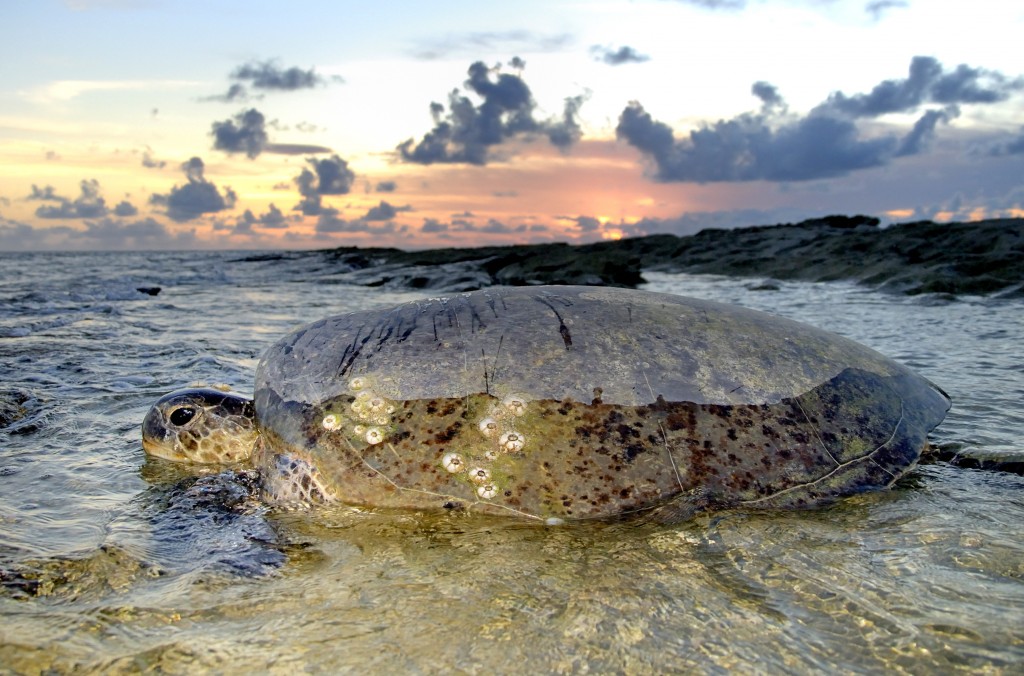
Your first underwater shot? The first 20 shots I took were a series of a glorious young green turtle that swam by me in the Gulf of Oman. I was freediving back then, and planning to shoot pictures of my friends making funny faces underwater when the turtle came close and ruined our plans. I dived down with one breath and kept shooting as I got closer and closer – until I was too close and scared her away.
The story behind your most memorable underwater shot? The shot that put my name in the first place winners of Ocean Art 2013. I was diving for nudibranchs on a famous wreck we have in Abu Dhabi called the MV Ludwig. I finished my third dive early because it was getting dark, and I already had enough nudibranch shots. On my safety stop I saw hundreds of jellyfish all over the place, so I went up – me and my buddy were the first divers out of the water. I told the boat captain that I will stay on the surface and he could pick me up when everyone was out of the water. I was so lucky that the water was super calm. It was getting dark so I was getting amazing reflections; the only problem was that I had to get below the surface for a metre and hold my breath so the bubbles wouldn’t break the surface. Fortunately I am a pretty good freediver so I was able to manage. The Gulf is quite warm in the summer, and I didn’t have a wetsuit on – no wetsuit in a sea full of jellies, it was not as fun as it sounds! I got stung over 50 times that night but it was totally worth it, and luckily our jellyfish are not very harmful.
Where is your favourite dive destination? To be honest I love to dive where divers don’t go. I mean places where I could tell unexpected stories of beauty and wonder. For example, I always accompany fishermen, dive in their fishing spots and get surprised that they always have the best spots! But to answer your question properly, right now I have to say Lembeh Strait – I just can’t get enough!
The site you’d most like to dive, but never have? The Arctic – but I know that sounds weird coming from someone who lives in the desert next to the hottest sea on Earth.
The weirdest thing you’ve seen underwater? A very long time ago I was fishing with my uncle in Oman, and when the fish in the first fishing spot were not cooperating, we decided to move to the next one. That’s when we noticed that the anchor was stuck! So my uncle asked me, or should I say “ordered” me, to freedive down to the anchor, release it and come back up. So I jumped in, dived down, released the anchor, looked up and I saw something as big as the 36-foot speedboat right above me. Something that was shaped like a shark and was white from the bottom! I was not sure if it was a great white but I hugged the anchor and stayed put until it passed. Then I slowly swam up and noticed the white spots on the back – thank goodness, it was a whale shark. In a split second my emotions shifted from absolute fear and thrill to extreme excitement! I rushed to the boat and yelled, “CAMERA!” and swam along with the gentle giant.
What camera equipment are you currently using? Canon EOS-5D Mark III, with various Canon and Sigma lenses, in an Ikelite underwater housing and a couple of Ikelite DS-161 strobes – plus a few custom lights and filters, SubSee wet lenses and CM diffusers.
What is the highlight of your career? I have won some awards through my “still fresh” career but the one I’m most proud of is our local underwater photography competition by the Emirates Diving Association. In 2013 I competed for the first time and placed last in the DSLR category. At the award ceremony I met the general manager of the Emirates Diving Association, so I said: “You should have bigger prizes next year, because I’m going to be first place!” He didn’t take me very seriously back then. In 2014 I did just that: I came in first place and my shot was printed on the local magazine cover, June issue, of “Divers for the Environment Magazine” (2014). Still, though, I believe the best is yet to come.
…And the lowpoint? Sometimes being so focused on the art makes me forget to stop, relax and enjoy the dive. When this happens every couple of years or so, I need to do a “camera-less” dive. It feels good at first; then of course you see something awesome and ask yourself, “Where is my camera?”
Is there any particular shot that you still want to get? The list is too long, and has many big, small, endangered, exotic marine creatures in it. But I guess right now I’m waiting for April to shoot coral spawning.

 Subscribe to Scuba Diver AUSTRALASIA now for just S$25
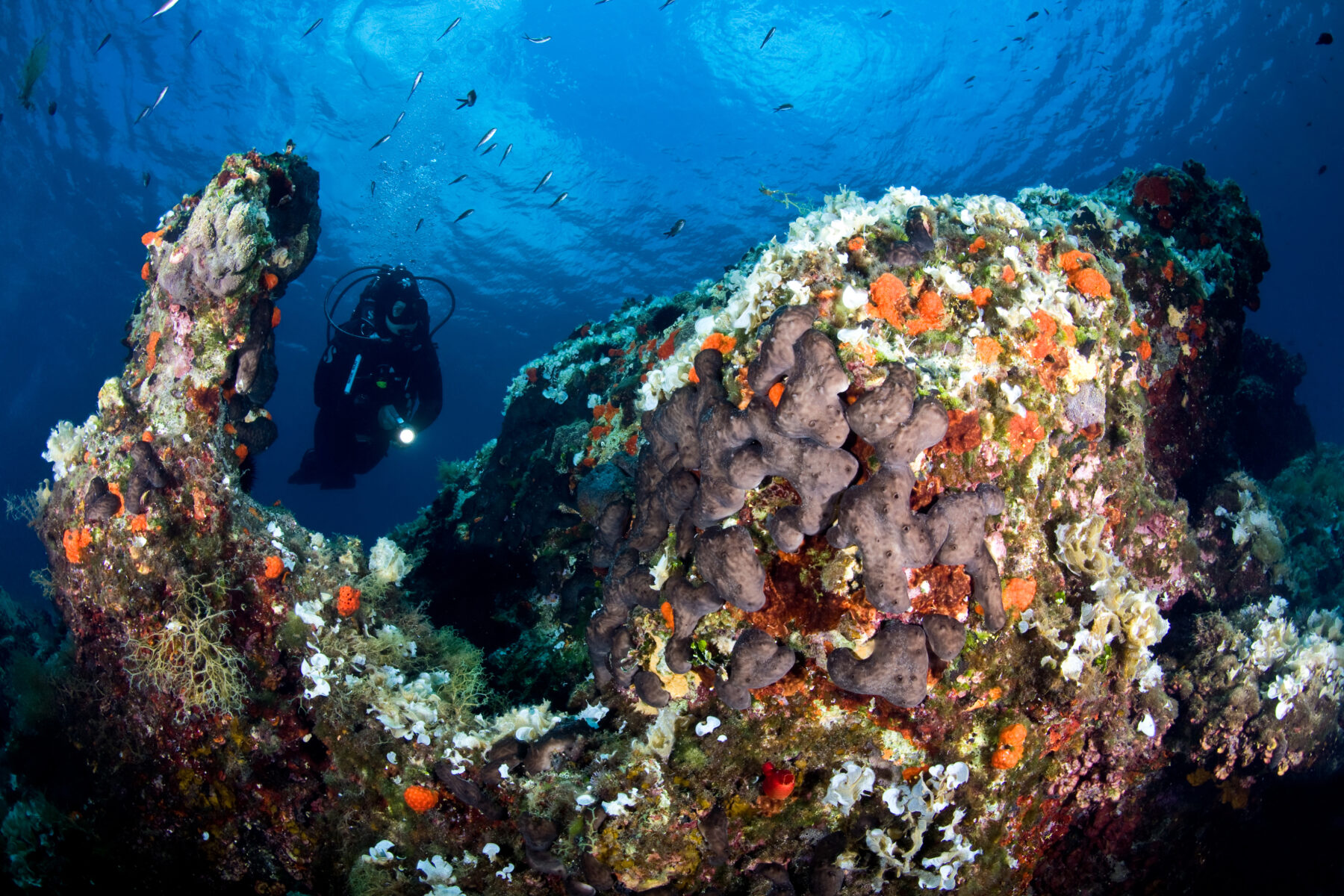
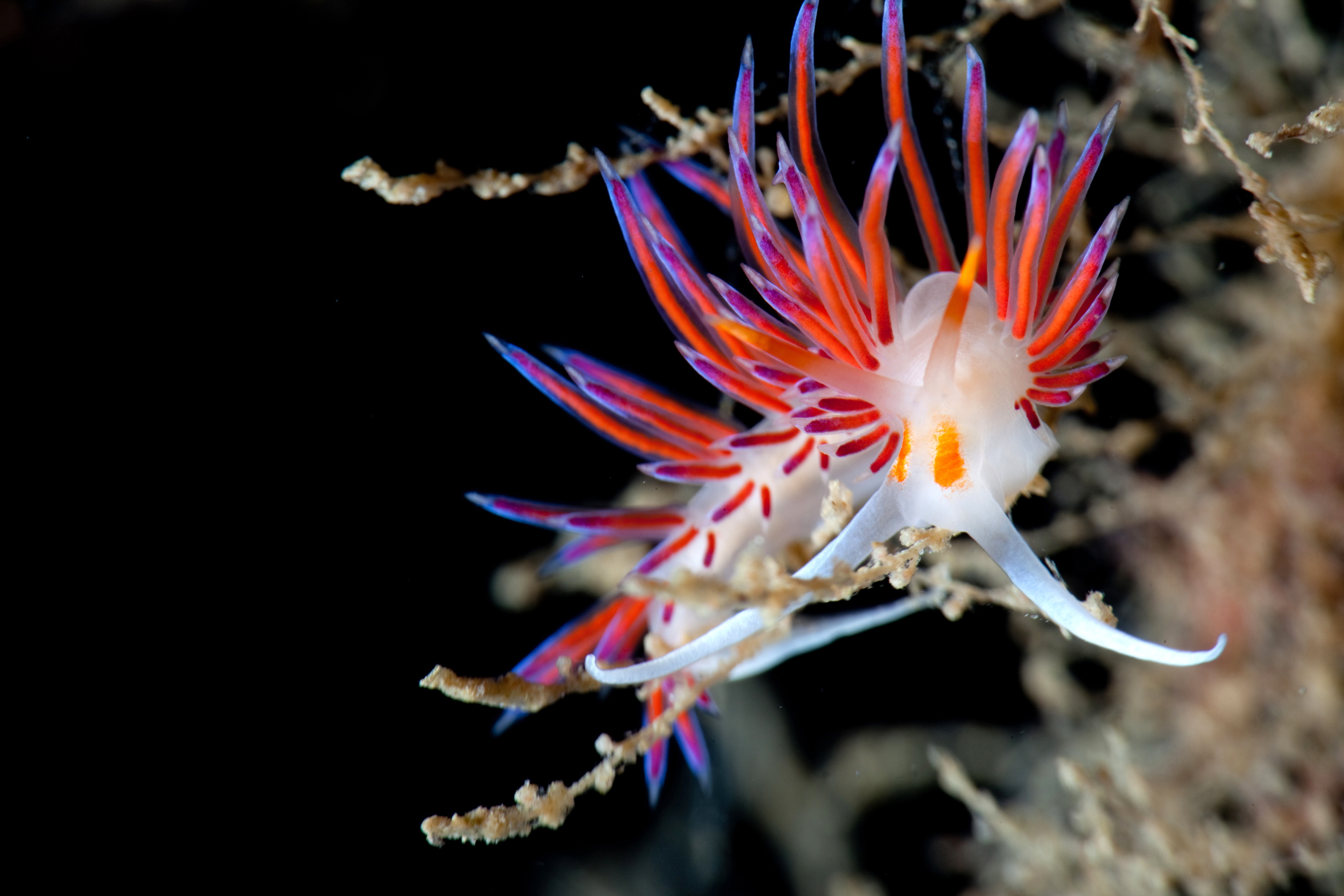
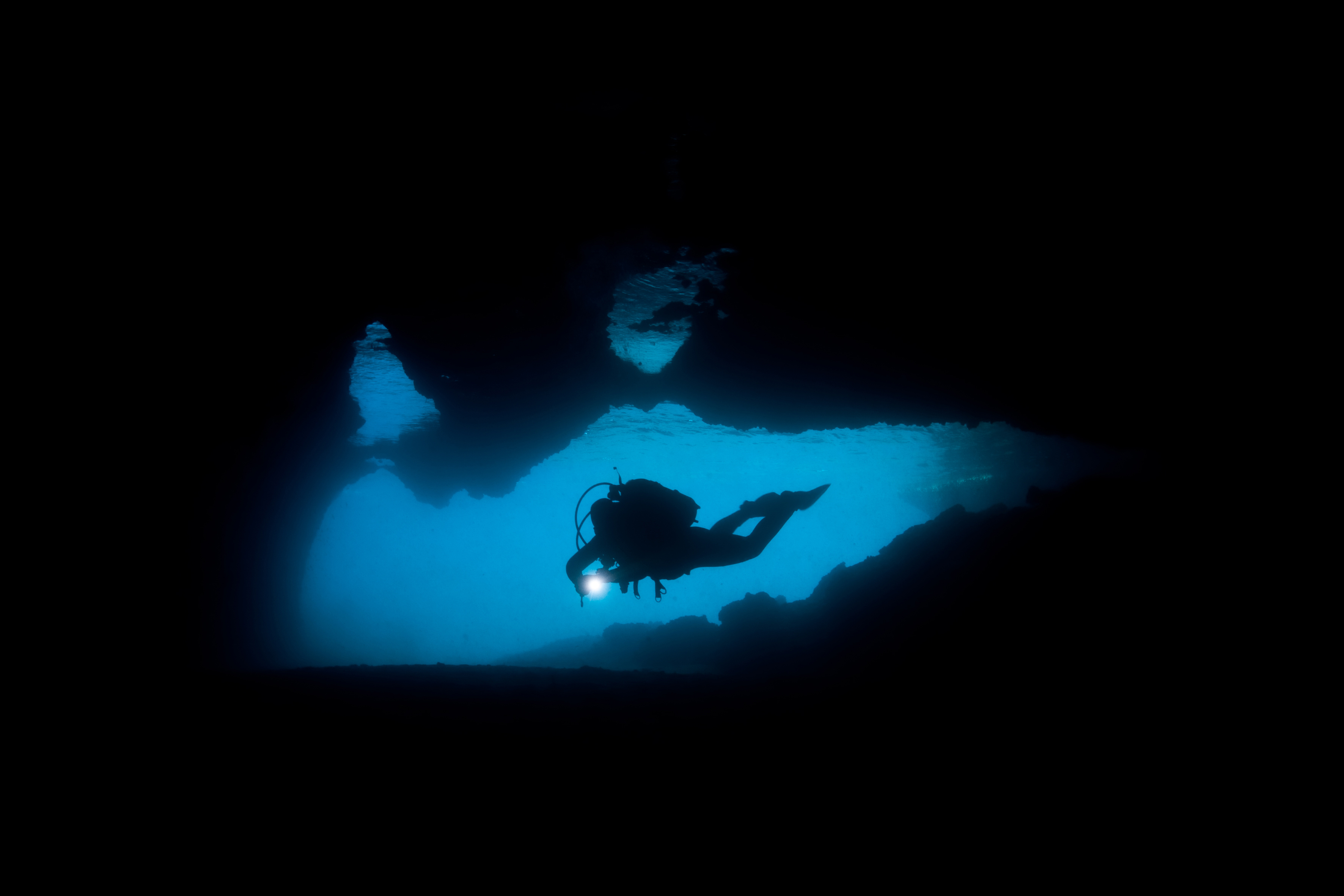
 Nicholas Samaras is a passionate underwater photographer, whose dedication to the sea and its creatures drives him to bring the unique aesthetic beauty of the marine world to the surface. His photographs have received numerous awards in international underwater photography competitions and are regularly published in magazines worldwide.