Home Blog Page 163

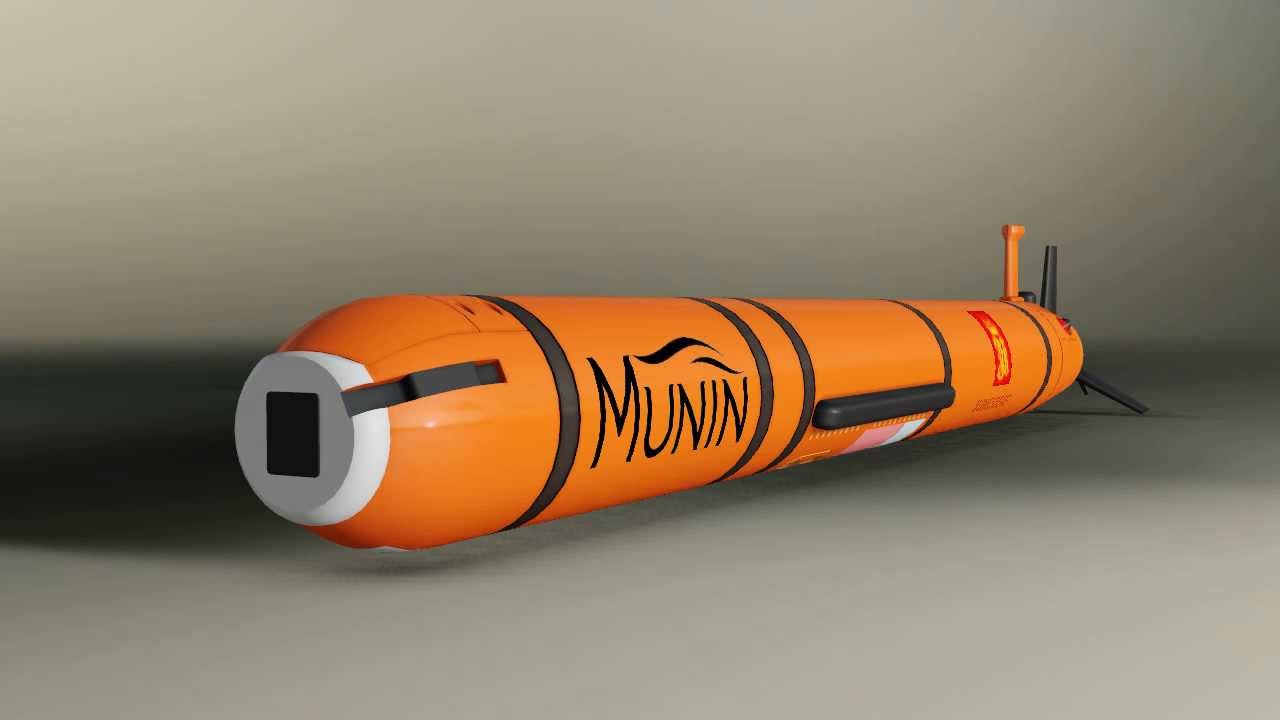
Kongsberg Maritime Ltd to Grow Rental Service with Munin AUV

0
Youtube.com

Kongsberg Maritime Ltd, the UK division of Kongsberg Maritime, has announced the expansion of its extensive subsea Aberdeen-based rental pool, with the addition of its sophisticated new MUNIN AUV (Autonomous Underwater Vehicle).

MUNIN is designed to collect high resolution payload data, geo-referenced by a survey grade positioning system. Capable of providing the same high-level performance and survey accuracy as the established KONGSBERG AUV range, MUNIN is a compact vehicle which enables effortless launch and recovery, as well as the possibility of using smaller launch vessels.

The AUV will be available from May 2016, and the announcement comes as Kongsberg Maritime is to exhibit at Oceanology International in London on March 15, 16 and 17.

In order to enhance the existing portfolio of Kongsberg Maritime’s rental equipment, which supports customers within the offshore oil and gas, environmental and renewable energy markets, a marine robotics lab was specifically created at the Aberdeen base. The marine robotics lab will also support customers of KONGSBERG’s Seaglider, providing routine maintenance, vehicle overhauls and spare parts. This means customers no longer have to ship the Seaglider vehicles to the United States for service, saving significant time, effort and money.

Keith Thomson, rental manager, Kongsberg Maritime Ltd, said: “The addition of MUNIN to our comprehensive inventory of rental products underlines KONGSBERG’s commitment to supporting our customer base, giving them the opportunity to utilize our latest cutting edge technologies without having to procure assets at the outset and finance any capital expenditure.

“Underwater robotics is an evolving technology which offers significant advantages over traditional methods, not only do they offer customers low utilization costs, high reliability and easy deployment, they also produce clean, quality data requiring little to no user processing.”

The rental service offers a vast range of other KONGSBERG products including portable hydro acoustic positioning systems and associated subsea transponders, shallow to medium water depth seabed mapping systems, vessel reference systems and sensors.

Source: Ocean News & Technology

Preparing Your Gear for a Dive Trip

0

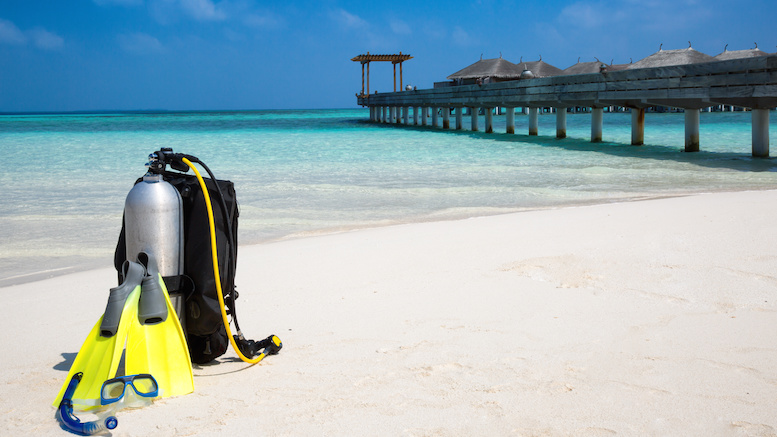
It makes sense to check that all of your gear is in good order before you depart on any dive holiday. This will help to ensure that gear failures do not lead to aborted or missed divers, or worse.

Some of these checks can be done by you. Others may require the services of a qualified technician if you do not have the skills and knowledge to do it yourself.

Perform these checks several weeks before any trip, so if maintenance or replacement is needed, you have plenty of time to attend to it.

OLYMPUS DIGITAL CAMERAMask: Is the strap OK? Look for signs that it is perishing, or likely to break. Replace if in doubt. Check that it seals onto your face by using the standard “fit” test of putting it on without straps, and inhaling.

Fins: Are the buckles intact? Are the straps damaged? Replace if in doubt.

Thermal Suit: Check for fit, especially if it has been a while since you dived, and the suit has shrunk (!!!) Check and lubricate zippers.

Buoyancy Compensator: Inspect the bladder for leaks by inflating it and immersing it into a bath. Check the dump valve for function. It should be airtight unless opened manually. Check the hose for perishing. The inflator mechanism should be checked for function, and freedom from leaks. If there seems to be a problem, unless you are sure of what you are doing, it might be time to find a qualified technician.

Computer: Check the strap for damage. Ensure the battery life is sufficient for your intended dive schedule.

Torch: Inspect O rings for damage, then clean and lubricate them. Clean seal faces thoroughly. Buy fresh batteries for the trip.

Regulators: If any of these tests give you cause for concern, and you do not possess the skills to sort it out, it is time to visit the experts again. Inspect all hoses for damage, looking especially at where hoses join fittings. Replace if you are in any doubt. Check all demand valves for ease of breathing. Next, check for leaks by immersing the entire regulator and valve while attached to a cylinder and turned on, and look for bubbles.

These basic steps are of special importance if you and your gear have been idle for an extended period.

Article by DAN AP Director and Instructor, Stan Bugg


Check out this incredible offer from DAN Asia-Pacific and UW360:

1 YEAR DAN Asia-Pacific Membership + 1 YEAR Subscription to Scuba Diver AUSTRALASIA + OCEAN PLANET Want to get your hands on this package? Click here.fd493c7d-1611-41db-b305-7f81ee2c24cc


6 Awesome Scuba Bags of 2016

0

Tired of carrying dive gear in different bags, some moth-eaten and tearing, others wedged shut with the regulator hoses clipping your ankles as you walk? Well look no further, we bring you six awesome scuba bags that will revolutionise your dive holiday experience, and make transporting gear as easy as a fin kick.

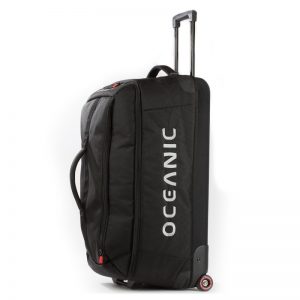
Oceanic Roller Duffeloc_rollderduffel_side3_web_1

MSRP US$240

  • Ultra-quiet nylon wheels
  • Reinforced base for heavy loads
  • Hypalon reinforced corners and ballistic nylon for toughness
  • 130-litre volume
  • Retractable carry handle
  • #10 YKK self-healing zippers
  • Easy-access storage pocket makes organising your gear easier

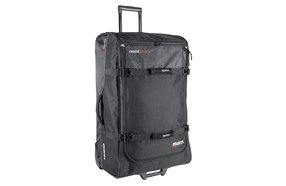
Mares Cruise System415500.43bd57f7

MSRP US$349

  • Three bags in one, a total diving equipment storage solution
  • Sophisticated storage, simple handling of full scuba kit
  • Gear is easy to access, rinse and dry
  • Features ventilation system and a detachable mesh bag with strap
  • Includes telescopic handle, front and lateral handles, and universal hangers
  • 122-litre volume

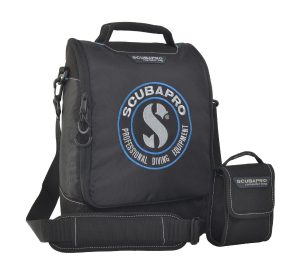
Scubapro Regulator & Instrument Bagregulator-bag-w-computer-ba

MSRP US$45

  • A dedicated regulator and computer bag made of rip stop nylon
  • Measures 35x26x10 centimetres
  • Weight 350g
  • 9-litre volume

Tilos Total Eclipse96149-Front

MSRP US$230

  • 600D & 420D nylon with foam padding
  • Velcro pull handle, extendable from 7.6cm to 19.7cm
  • Two fin pockets with drain holes
  • Padded exterior top regulator compartment
  • Smooth ball-bearing wheels
  • Folds up for compact storage
  • Metal YKK zippers
  • Size: 74x46x28cm, weight: 2.3kg
  • 94-litres volume

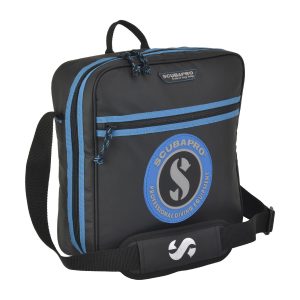
Scubapro Travel Reg Bag Vintagetravel-regulator-bag

MSRP US$52

  • Heavy-duty regulator bag in water resistant PVC
  • Dimensions: 32x32x10cm
  • 10-litre volume

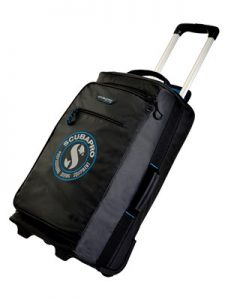
Scubapro Cabin Bagimagegen

MSRP US$167

  • Semi-rigid roller bag
  • Conforms to IATA airline regulations for carry-on luggage
  • Includes telescopic tow handle and reinforced wheels
  • 41-litres volume

For more incredible gear releases and recommendations, grab your issue of Scuba Diver Diveaholic (Issue 1/2016)

ADEX 2016: Marine Conservation Speakers

0

We’re excited to announce that various marine conservationists from multiple countries will be speaking at Asia Dive Expo (ADEX) Singapore 2016!

The following are the marine conservationists you will see at ADEX 2016!

 

AlbertLi


Albert Li (Australia)
Founder of Scuba for Change

Albert is the Founder of Scuba for Change (SFC).  Named as “B3000+ Social Enterprise of the Year” in 2015, SFC reinvests 100% of its net earnings to the benefit of local communities. SFC offers diving in Puerto Galera, Philippines, a location teaming with underwater diversity.
 

AlexAntoniou

Alex Antoniou (UK/USA)
Founder of Fins Attached. Marine Research and Conservation

Dr. Alex Antoniou has been working with and studying sharks for over 20 years.  He began his work by establishing a field station for the Shark Research Institute in the Honduran Bay Island of Utila and subsequently convinced the Honduran Government to enact protection laws for the whale shark in their territorial waters. He was the first to tag whale sharks in the Caribbean with satellite tags. 
 

AmandaVincent

Amanda Vincent (Canada)
Director and co-founder of Project Seahorse

Amanda Vincent has a PhD in marine biology from the University of Cambridge and was Darwin Senior Research Fellow at the University of Oxford from 1994 to 1996. She is considered the leading authority on seahorse biology and conservation, and in 2000 was named a Pew Fellow in Marine Conservation. She also serves as lead scientific advisor and chair of the seahorse working group for CITES. 
 

ChaiApale

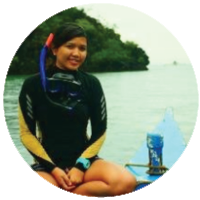
Chai Apale (Philippines)
iSeahorse Project coordinatorIn her role as iSeahorse Philippines coordinator, Chai manages outreach and communications for iSeahorse in the Philippines. She received a BSc in marine biology from Mindanao State University-Illigan Institute of Technology, where she studied the community structures of reef fishes. Before joining Project Seahorse, she was a coastal resource management trainer for the United States Peace Corps in the Philippines.
 

ChloeHarvey

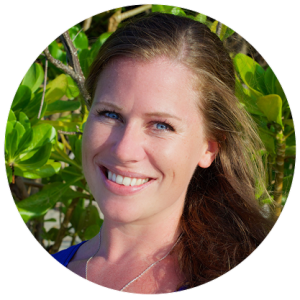
Chloe Harvey (UK/Philippines)
Green Fins

Chloë Harvey is a professional diver and Marine Biologist who became involved in Green Fins in 2008 after learning that it provided the only internationally recognised environmental standards for diving. Since then she has dedicated her life to developing Green Fins into the meaningful programme it is today, providing business owners and national authorities with the tools and support needed to drive a sustainable industry.
DaveHarasti

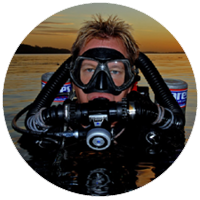
Dave Harasti (Australia)
Ambassador for Seahorse

Dr Dave Harasti is a Research Scientist for Fisheries NSW in Australia who specialises in threatened species (sharks, seahorses and turtles) and marine protected areas research. His doctorate study was on the biology, ecology and conservation of seahorses and he is one of the world experts in seahorses.
 

GaryStokes

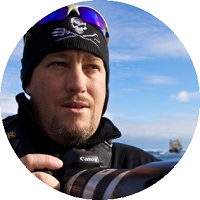
Gary Stokes (UK/HK)
Asia Director for Sea Shepherd Conservation Society

Gary Stokes is the Asia Director for Sea Shepherd Conservation Society. Based in Hong Kong, his main focus over the past 10 years has been on documenting, investigating and exposing the shark fin trade. Working with Sea Shepherd to raise awareness and effect change by directly challenging laws and the agencies that are supposed to protect species, but are failing to do so.
 

Hannah

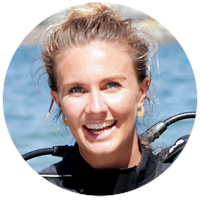
Hannah Pragnell-Raasch (UK/Australia)
Program Specialist at Project AWARE

Hannah Pragnell-Raasch has always had a deep connection with the ocean planet and a desire to protect it. Becoming a certified scuba diver, she became all too familiar with the various impacts affecting our underwater world, further developing her aspirations to work within marine conservation and drive positive change.

 

Heng Pei Yan
Heng Pei Yan (Singapore)
Volunteer at NParks

Pei Yan is a full-time school teacher. Moving out of the school setting, friends often read about her nature adventures around Singapore, from nature guiding to  exploring intertidal areas to scuba diving in local waters, through still images on her blog and Facebook.
 

JerkerTamelander

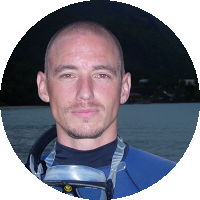
Jerker Tamelander (Sweden/Thailand)
Head of UNEP Coral Reef Unit

Jerker leads coral reef work at the United Nations Environment Programme (UNEP) focusing on resilience, ecosystem services, and strengthening use of science in reef management. He has been integral in the development of Green Fins, an approach for managing a sustainable diving industry. A keen diver since 1992 and trained to instructor level, Jerker recognises the need for collaboration with reef-dependent businesses and that a sustainable diving industry is a positive force for marine conservation around the world.

JoanneMarston

Joanne Marston (UK/Australia)
Campaign Manager at Project AWARE Foundation

Joanne has extensive and proven nonprofit campaign management experience coupled with a background in politics and public relations. She has worked in the nonprofit environmental community for over 12 years spearheading multiple diver engagement campaigns both in Asia Pacific and throughout the world. This includes the dynamic Extinction is Not an Option campaign which helped deliver shark and ray protection at the Convention on International Trade in Endangered Species of Wild Fauna and Flora as well as a ground breaking local community campaign called Ocean Action.
JonnLu

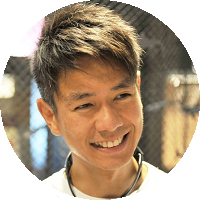
Jonn Lu (Singapore)
Regional Director of Shark Savers Singapore

Jonn Benedict Lu directs, produces and hosts content on social concerns and marine topics, also leading expeditions on exploration-themed productions. When not slacklining, running around climbing trees, rocks and urban structures, he’s in the water as a SDI / TDI and NAUIScuba Diving / NAUI Technical Diving Instructor and Freediving Instructor. He runs www.FINishedwithFINS.org the largest campaign ever organised for shark conservation, featuring over 700 of the most engaging, influential and powerful celebrities and personalities in the world.
JudiLowe

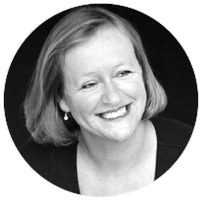
Judi Lowe (Australia)

Judi is an Accountant, Lawyer and PhD researcher who is passionate about the impact of dive tourism on coral reefs and the livelihoods of local fishers in less developed countries. Dive tourism must diversify the livelihoods of local fishers, reducing reliance on coral reefs. Her research builds a best practice model of dive tourism for marine conservation and livelihoods.

 

MaartenDeBrauwer

Maarten De Brauwer (Belgium/Australia)

Maarten is a marine biologist at Curtin University, Perth, Australia. His main interests are rarity and extinction risk in marine fishes. His current research investigates the ecology and socio-economic value of critters important to the muck dive industry. He is also a dive instructor who has worked and trained divers all across Southeast Asia.


RichardSmith

Richard Smith (UK)

Dr Richard Smith combines an in-depth academic knowledge of the marine environment with a unique skill for capturing stunning images. He aspires to promoting an appreciation for the ocean’s inhabitants and raise awareness of marine conservation issues through his images. A marine biologist by training, Richard’s pioneering research on the biology and conservation of pygmy seahorses, led to the first PhD on these enigmatic fishes.
 

SakinaSakerwalla

Sakina Sakerwalla (Sweden/Singapore)
Development Director for Conservation International’s Asia-Pacific Field Division

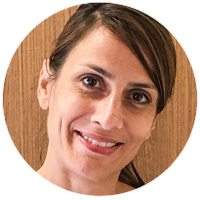
Sakina Sakerwalla is the Development Director for Conservation International’s Asia-Pacific Field Division, and an avid diver who believes in conserving nature for human well-being. She is responsible for developing new partnerships across corporations, academia, NGOs and government, in addition to driving fundraising activities across the region.

SallySnow


Sally Snow (UK/Philippines)
Media Director of Large Marine Vertebrates Project

Sally Snow is a Zoologist, Filmmaker and Shark Researcher. She heads the media team of the Large Marine Vertebrates Research Institute Philippines, an NGO specialising in Marine Conservation in the Philippines.

 

SharonKwok

Sharon Kwok (HK)

Born in Hong Kong of a Chinese mother and an American father of German decent who was one of the founding members of Ocean Park, Sharon began a lifelong love of animals during her youth when she was able to interact with numerous marine animals.

Over the years, she has supported numerous charities and is a member of The Society of Women Geographers, ambassador for SPCA H.K., Hong Kong Cetacean Research Project, and Bloom, Sharon is also the Managing Director of WildAid HK, on the board of Mission Blue, and the Executive Director of AquaMeridian and AquaSilva, which are companies that aim to raise awareness of conservation issues globally, starting with HK.
Yasmeen2

Yasmeen Smalley-Norman (USA)
Vice President and 3D modeler of The Hydrous

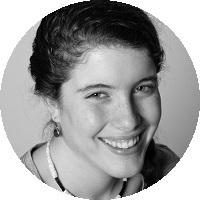
Yasmeen Smalley-Norman is an underwater photographer dedicated to using visual storytelling to promote awareness of our oceans. A published underwater photographer and videographer and Vice President of The Hydrous, Yasmeen uses 3D imaging and visual media to tell stories of vulnerable and endangered coral reefs. She is also an Associate Member of the Women Divers Hall of Fame, an Explorers Club Student Member and a PADI Divemaster.


For more information on ADEX, please visit www.adex.asia.

6 Things you Need to Know About Double Exposure

0

Mark Fuller guides us through everything you need to know about mastering double exposure:

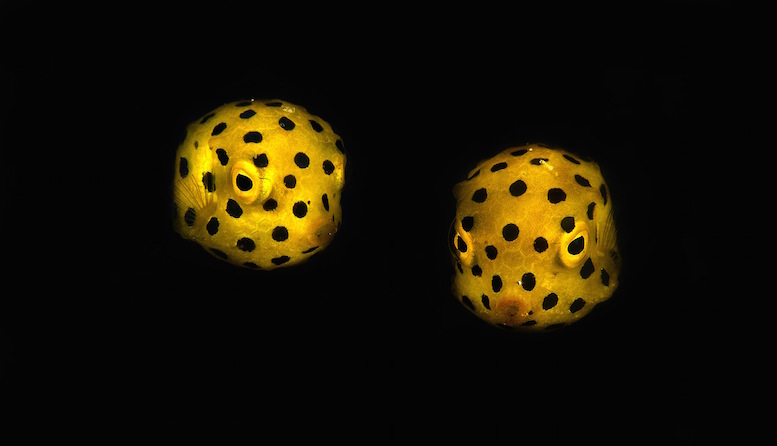
A DOUBLE (or multiple) exposure is when two or more captures are combined into a single image. Although this creative technique is more popular with terrestrial photography, underwater it can produce some truly special results.

In the days of film, this effect was achieved by a lever disengaging the advance mechanism; allowing the shutter to re-cock without advancing the film, thus allowing repeated exposures on the same frame. These days, most DSLRs – and even some point-and-shoot cameras – have an image overlay and/or multiple exposure settings, providing a far less technical method of achieving the same affect. Check your user manual.

What you will needDSC_7177 copy (1)

  • A housed DSLR with at least one strobe. The specific image you have in mind will determine the best lens or lenses to use. For simplicity, you can assume that both macro and wide-angle lenses are used in double exposures, either using a unique lens for each exposure, or just sticking with a single lens.
  • Accessories like a snoot or diopter can also be very helpful, as black backgrounds with minimal backscatter are ideal for creating double exposures.

Techniques

There are two popular techniques for double exposure – either two macro subjects, or the more orthodox macro foreground set in front of a wide-angle background. In both cases you will need to capture black backgrounds around the subject so the second exposure can be placed over the negative black space.

There are two key things to remember:

  • High shutter speeds and small apertures are imperative in eliminating any natural light and providing the necessary black background.  
  • Planning is crucial in composing two images to work as one. I prefer activating the grid in the viewfinder so I know what lines not to cross.

Macro on Macro

This technique requires the use of your camera’s multiple exposure mode setting, which can be found in the menus, and both shots can be taken on the same dive. Some tips for getting it right:

  • Exposure: Because the camera will be combining two images together there will be some light lost in the final image. I like to first test-shoot a single image until I am happy with the exposure and then slightly overexpose (maybe by 2/3 of an f-stop) when ready to attempt the double exposure.
  • Settings: Maintaining exact focus is extremely important in keeping both the exposures sharp – make sure your auto focus is set up to manually change the point of focus. Additionally, make sure you are not shooting on continuous mode as you don’t want an extra frame sneaking in.
  • Plan it: Taking double exposures can be time consuming and a missed second shot can be very frustrating. Therefore, make sure you plan your composition ahead of time.
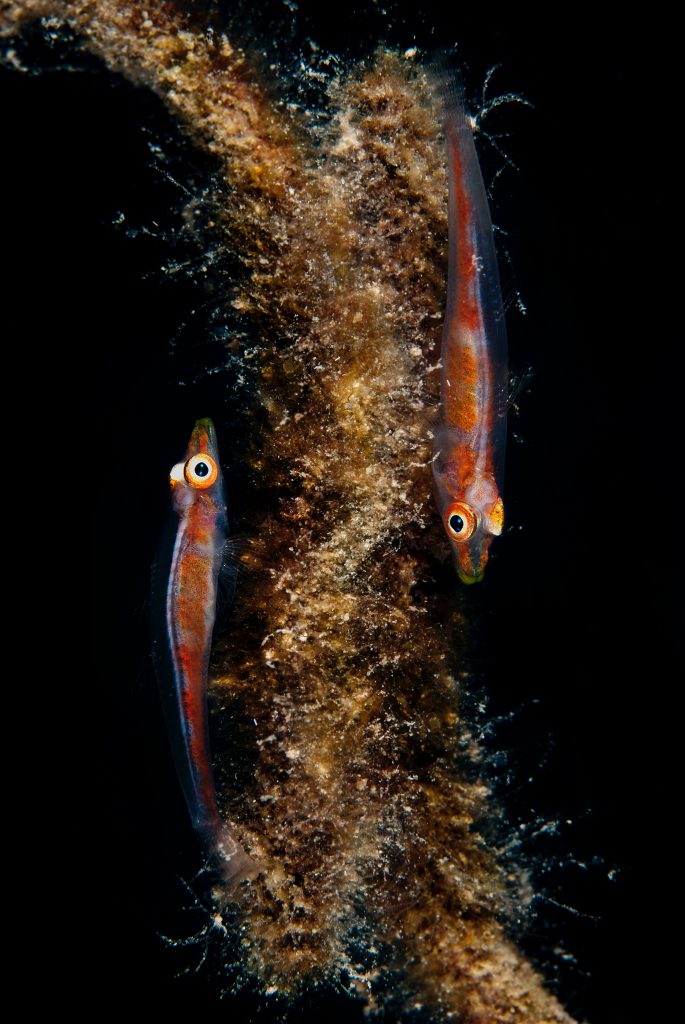
  • Composition: taking two consecutive shots of a goby on a whip coral side by side, composed in exactly the same way, will not produce a very interesting shot. Either move 180 degrees around the subject after the first capture and shoot the second frame, or if you are confident enough after moving 180 degrees, move the focus point to the opposite side and remember to also rotate the housing 180 degrees. This ensures that the two subjects’ heads will be facing each other and that corals will look more natural. The advantage of using this setting is that the raw files will automatically be combined to form a new raw file, so you can review your image right away and adjust your settings or composition as required.

DSC_7905

Macro on Wide Angle

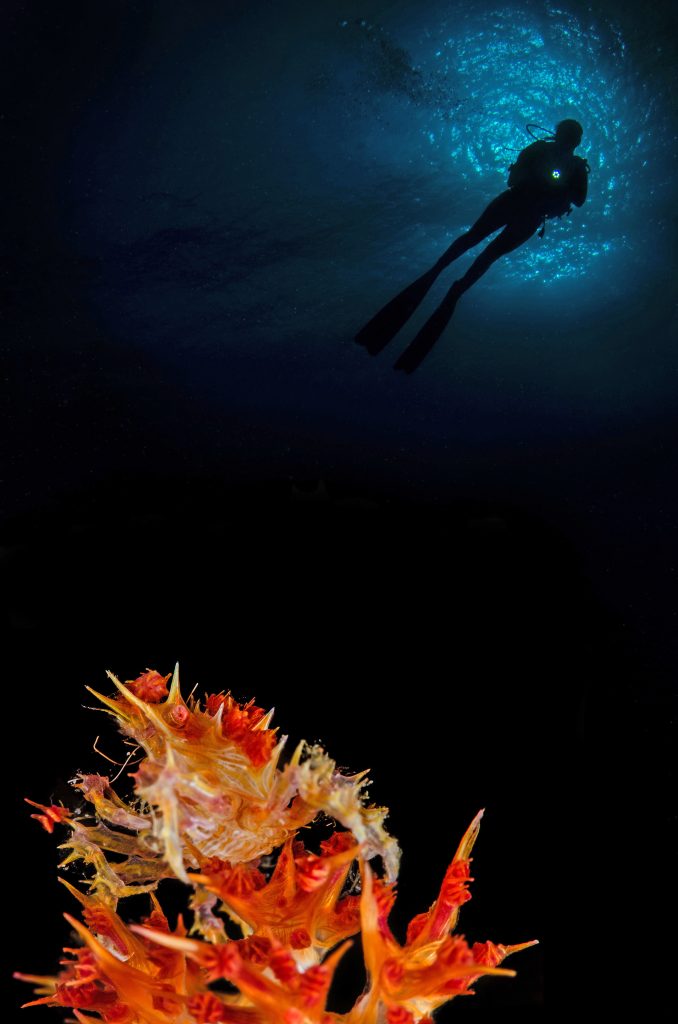
This technique requires using two different lenses on two separate dives: one wide angle shot and one macro shot and overlaying the photos during the editing process. There are endless combinations, so get creative!

  • SETTINGS: Instead of using your camera’s multiple exposure setting, you can use the image overlay setting, which lets you select the files to place over each other.
  • BE PREPARED: You will need two images with black backgrounds. It doesn’t matter which image to start with, just remember that later you will be combining the image with one from another dive. Try shooting “dark” sunbursts to create a black negative space for the macro exposure, while keeping some interest in the wide-angle background.
  • TOP TIP: A great way to always being ready for double exposure opportunities is to keep around 20 raw wide-angle files ready for double exposure on your memory card, so when you have a magical macro moment you can combine them together.

Moving Subjects

Once you get confident with the basics, it’s time to try shooting moving subjects. This can be difficult and needs a lot of practice and patience.

The best way to start is with a full frontal shot of the same subject. Move your focus point to the left half of the viewfinder, compose and shoot the subject, then move the focus point to the right side and shoot again, being careful not to overlap. Again this can be accomplished entirely using the double exposure setting on your camera.

This technique requires confidence in your skills and experience – your subjects won’t wait for you! You need to be thinking about exposures while moving around the subject, and planning your composition. It’s also important to remember to move your focus points and adjust your strobe position.

Double Exposures at Night

This is perhaps the most difficult technique of all, but you can make it easier on yourself.

  • Use your buddy as a spotter and a lighting assistant. Discuss your plans in advance and prepare for any subject you may encounter. I make sure my dive buddy knows exactly what I want to shoot, and how I want to shoot it, so when a subject moves quickly, we’re both ready. Planning and teamwork can really pay off!
  • Know your camera; adjusting it should be second nature in total darkness. The last thing you want is to be struggling to adjust your settings only to discover your subject is long gone by the time you look up.

There you have it! The options are endless, and so your potential creations are really only limited by your imagination.

This article feature in SD Through The Lens (Issue 9/2013)


What’s Being Done to Secure Justice for Southeast Asia’s Seafood Slaves?

0
© Wagner T. Cassimiro "Aranha"

Twenty-hour work days, savage beatings with stingray tails, years at sea with no way home.

Until the release of a thunderbolt Associated Press report in March 2015, these brutal features of Southeast Asia’s fishing industry were largely invisible to the world.

Today, governments, especially in Indonesia and Thailand, have been pressured to address the abuses, passing a bevy of new regulations and even prosecuting some of the worst offenders.

A new Al Jazeera documentary examines the pace of progress by asking a different question: What is being done to secure justice for the victims of trafficking and slavery?

To answer, a film crew travels to Ambon Port in eastern Indonesia to ask Burmese victims to tell their stories.

“The way they forced us to work was [actually] worse than slaves,” said one of the Burmese interviewed at the sprawling port, where a care center has been set up for men awaiting repatriation.

“Slaves would have their own time to eat, time to sleep,” he said. “We only had time to work.”

Since the AP report came out 11 months ago, the Indonesian government, in partnership with the International Organization for Migration (IOM), has been ratcheting up the repatriations of former slaves. As of early March, just 24 of the hundreds of men were still waiting to go home.

Most of them were rescued off boats in 2015, while others had fled years before and were already living in Indonesia. All were given the opportunity to negotiate backpay with their former captors.

The film found that despite this unprecedented effort to secure compensation, many of the former slaves were being duped into taking less than half of what they were owed. Others resigned themselves to the smaller sums in the hopes that doing so would get them home faster.

The filmmakers tracked down four such Burmese to their homes in Yangon, Myanmar’s capital.

Despite promises from embassy officials from Myanmar, Thailand and Indonesia, five months since their repatriation they’ve yet to see a penny of their backpay.

“They told us to fill out our names, the boat’s name and how much we were owed,” one of the men said in the film. “They said they would make sure we got our compensation. Now it seems very likely that we won’t, as we haven’t heard any reply from them.”

“If we don’t get our money, I will have to accept it. I can’t do anything,” said another.

“We are like water in their hands. They can do whatever they want.”

To compensate the 2,500 ex-slaves repatriated in the last five years, the documentary estimates it would cost $35 million dollars — a drop in the bucket compared to Thai fishing industry’s $7 billion in annual profits.

Daniel Murphy, a consultant who works with Greenpeace and Human Rights Watch, stressed that compensation must also be conceived in terms of justice and addressing the root drivers of maritime slavery, especially on the demand side.

“Western consumers and the international community have to accept some degree of responsibility [for maritime slavery],” he said in the documentary.

“The price we’ve been paying for those products does not reflect the true cost of their production, as It hasn’t taken into account that people have been exploited and abused to get that seafood onto the shelves of our local retailer.”

Last August, the European Union issued the Thai government a “yellow card,” giving the country six months to address rights abuses in its fishing industry or face a ban on its seafood exports.

In February, a team of investigators arrived in Thailand to assess the state of progress. A decision is expected in the coming weeks.

Article published by Philip Jacobson, source: Mongabay

Wildlife of the Week: John Dory

0

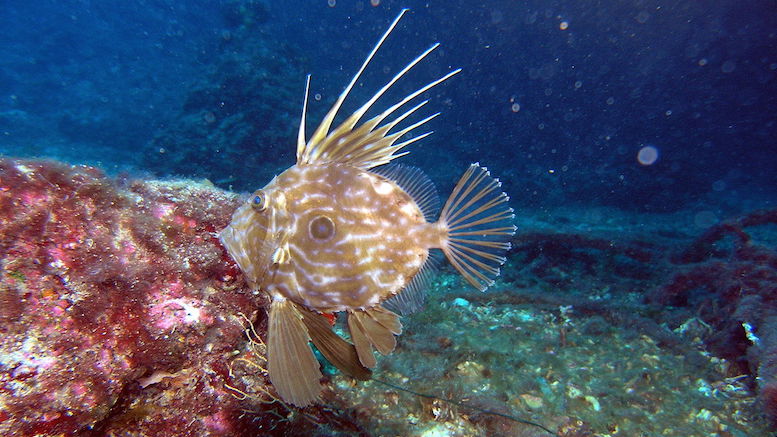
If there was ever a marine species that could stand as a frontman for a punk rock band, it would be the John Dory – wild eyes, grumpy lips and a spiky mohican make this aquatic animal only a Class away from John Lydon. We bring you all you need to know about our “Wildlife of the Week”, John Dory:

Species: Zeus Faber

Class: Actinopterygii

Status: Least Concern

Diet: Bony fish, squid, sardines

Size: Can grow up to 60cm but usually around 40cm

Weight: 3 – 4.5 kg 

Life span: 12 years in the wild

Behaviour: A solitary fish that can be found close to the seabed

Distribution: Eastern Atlantic, Indian Ocean, Western Pacific, Eastern Atlantic, Black Sea, Mediterranean

Ecosystem: Deep reefs and soft bottoms

5 fast facts: 

  • John Dory spawns by a behaviour known as substrate scattering, where females scatter their eggs, haphazardly, on the seafloor, and males release their sperm in the same location to fertilise them externally
  • The body features a large false eye which is to warn predators and confuse prey
  • There is some speculation over the origins of the name “John Dory”. Some believe its name is derived from the French word “Jaune”, meaning yellow, while legend describes the dark spot or false eye as St Peter’s thumbprint
  • They usually stalk on their prey, shoot out a tube on the mouth of its captive to get their food. They eat many varieties of fish, like sardines, squid, cuttlefish, but they mostly feed on schooling fish
  • The John Dory takes advantage of its slender body, which allows it to sneak up on its prey. Its large eyes at the front of the head provide it with bifocal vision and depth perception, which are important for predators