Home Blog Page 33

How could one improve education and awareness around protecting coral reefs?

0
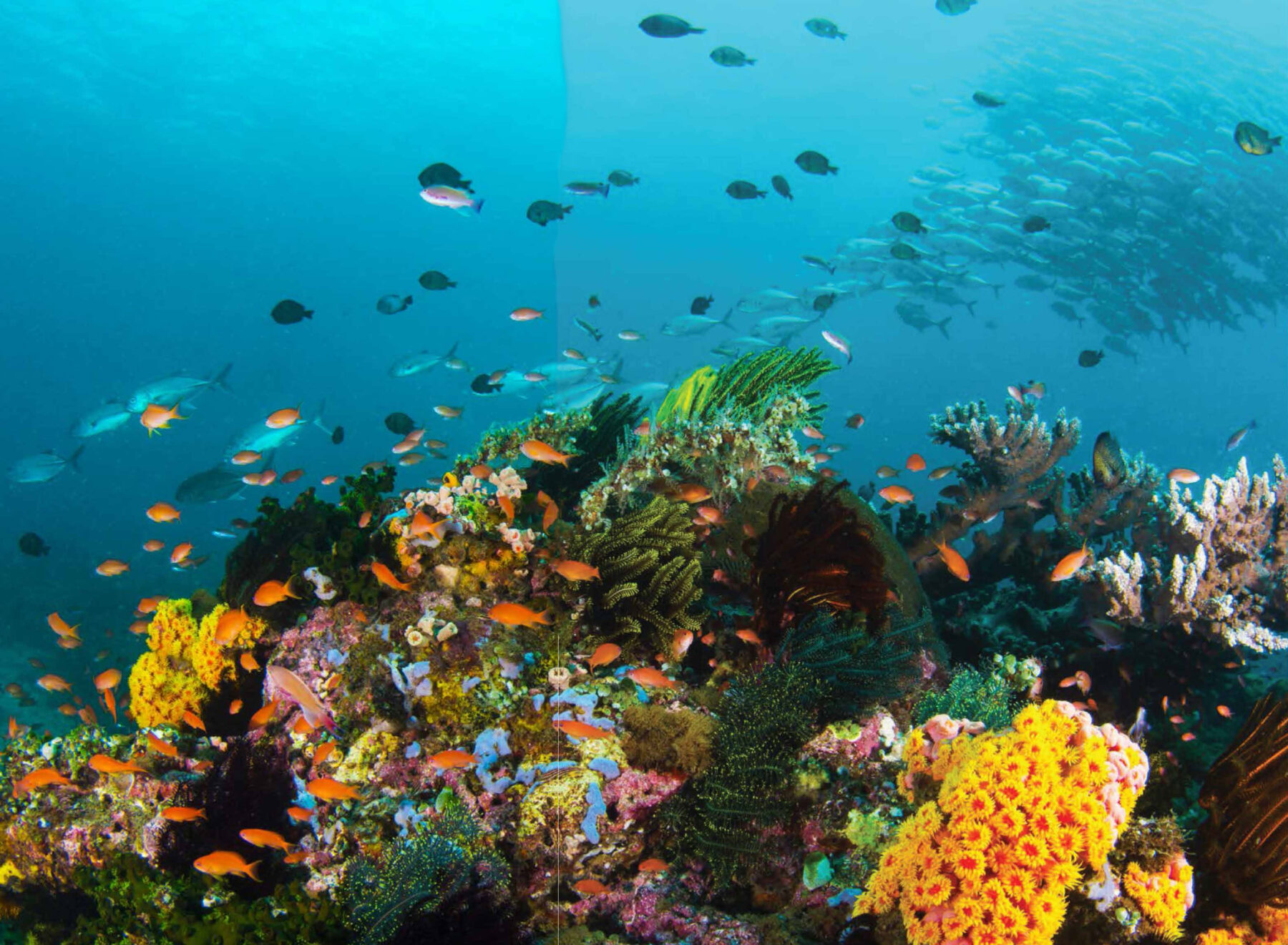
Holding the record for the highest number of shorefish species recorded, the Verde Island Pass is a place of stunning diversity (Photo by Mike Bartick)

All one needs to do is fill out this short survey about their media habits and views on learning more about the environment and sustainable diving practices.


Reef-World is working to make sustainable diving the social norm through Green Fins; an initiative it runs in partnership with UN Environment Programme (UNEP) and 11 National Governments to help dive and snorkel operators become more sustainable; as well as educating tourists about best environmental practice. The initiative also provides the only internationally recognised environmental standards for snorkelling and scuba diving and enables policy makers to identify areas of high environmental risk within the industry. This means they can work with business owners to find a suitable solution to local threats.

As part of its Green Fins initiative, Reef-World provides a suite of tools and materials to help educate dive operators, dive professionals and divers about how they can be more environmentally friendly when diving. This toolbox of materials has been developed based upon requests or suggestions from the diving industry and is always being updated to ensure it conveys the Green Fins message as effectively as possible. Reef-World is committed to creating the materials that will be most useful for the diving industry and, for that reason, is calling for input from divers as part of its latest review.


“The ethos at Reef-World – and of the Green Fins initiative – is to empower and educate the dive industry to
protect coral reefs. We’re continually reviewing our materials to make sure they’re as useful and effective as possible for Green Fins members (and non-members!) who can download and use them for free. We’re now in the process
of planning our next updates and we want to be sure our priorities fit with those of the wider Green Fins network by hearing from you: the dive industry. This activity was already in the pipeline for the Reef-World team and, while
we realise this is a challenging time for many of our network, we hope those staying at home will be able to spare
a few minutes to help. Completing the short survey will make a huge difference in our work to improve communications about sustainable diving and the protection of coral reefs. To everyone who is able to spare
the time to help us, thank you.”

– JJ Harvey, Director at The Reef-World Foundation


The survey can be taken online here: https://form.jotform.com/Reef_World/materials

For more information about Reef-World’s Green Fins initiative, please visit www.reef-world.org or www.greenfins.net. Dive and snorkel operators interested in signing up to Green Fins can find the membership application form at: https://www.greenfins.net/how-to-join.


Could Snorkel Equipment Save The World?

0

In light of the coronavirus pandemic that is submerging the globe at the moment, it actually might be able to.


[embedyt] https://www.youtube.com/watch?v=w4Csqdxkrfw[/embedyt]


Isinnova, an Italian startup specialising in 3D printing, is working on its next ingenious solution: a 3D printed adapter that could turn a snorkeling mask into a C-PAP mask for oxygen therapy — a crucial treatment for more severe COVID-19 cases.


This news comes in handy as the number of coronavirus deaths in Italy rise to 7,503 with 74,386 confirmed cases. According to reports, doctors in Italy have been told to save ventilators for the under-60s due to a major shortage.


Former head physician of the Gardone Valtrompia Hospital, Dr. Renato Favero, got in touch with Isinnova through a doctor from the Chiari Hospital, the health facility for they manufactured emergency valves with 3D printing process.


Doctor Favero shared an idea to fix the possible shortage of hospital C-PAP masks for sub-intensive therapy, which is emerging as a concrete problem linked to the spread of Covid-19. This was the construction of an emergency ventilator mask, made by adjusting a snorkeling mask already available on the market.


Partnering with Decathlon, the ideator, producer and supplier of the snorkeling mask, Easybreath, the product was dismantled, studied, and the changes to be made were evaluated. A new component was then designed to guarantee the connection to the ventilator. The link was named the “Charlotte valve”, and Isinnova then printed it.


The prototype has been tested on the staff of Isinnova at the Chiari Hospital, connected to the ventilator body, and has proven to work. Later, it was tested on a patient, and the results were successful.


Despite the early successes, Isinnova isn’t going into production just yet. “Neither the mask nor the link is certified and their use is subject to a situation of mandatory need,” the 3D printing business pointed out. Patients still need to sign a declaration to have the uncertified device used in their care.


Still, this is an extraordinary feat of creativity and innovation, especially in a time of great need.


Source: https://www.isinnova.it/easy-covid19-eng/

New Discovery: Two new species of the rarely seen six-gilled sawshark in the West Indian Ocean

0

An international team of marine scientists has discovered not just one but two new species of the rarely seen six-gilled sawshark, Pliotrema kajae and Pliotrema annae, in the West Indian Ocean.

The newly discovered sharks, affectionately known as Kaja’s and Anna’s six-gill sawsharks, were discovered during a research project aimed at investigating small-scale fisheries operating off the coasts of Madagascar and Zanzibar.

Details about their findings were published on Wednesday, 18 March, in the journal PLOS ONE, where the study team says that the discovery of two sharks highlights how little we still know about life in the ocean and our impact on it.


SHARKS FOUND NEAR AUSTRALIA

“Last year our team highlighted the massive underreporting of sharks and rays caught in the South West Indian Ocean and the urgent need to expand efforts globally to assess the impact of these fisheries on vulnerable species,” said Dr. Andrew Temple of Newcastle University in the U.K., who co-authored the paper, in a statement.

“The discovery re-enforces both how important the western Indian Ocean
is in terms of shark and ray biodiversity, but also how much we still don’t know.”
– Dr. Andrew Temple
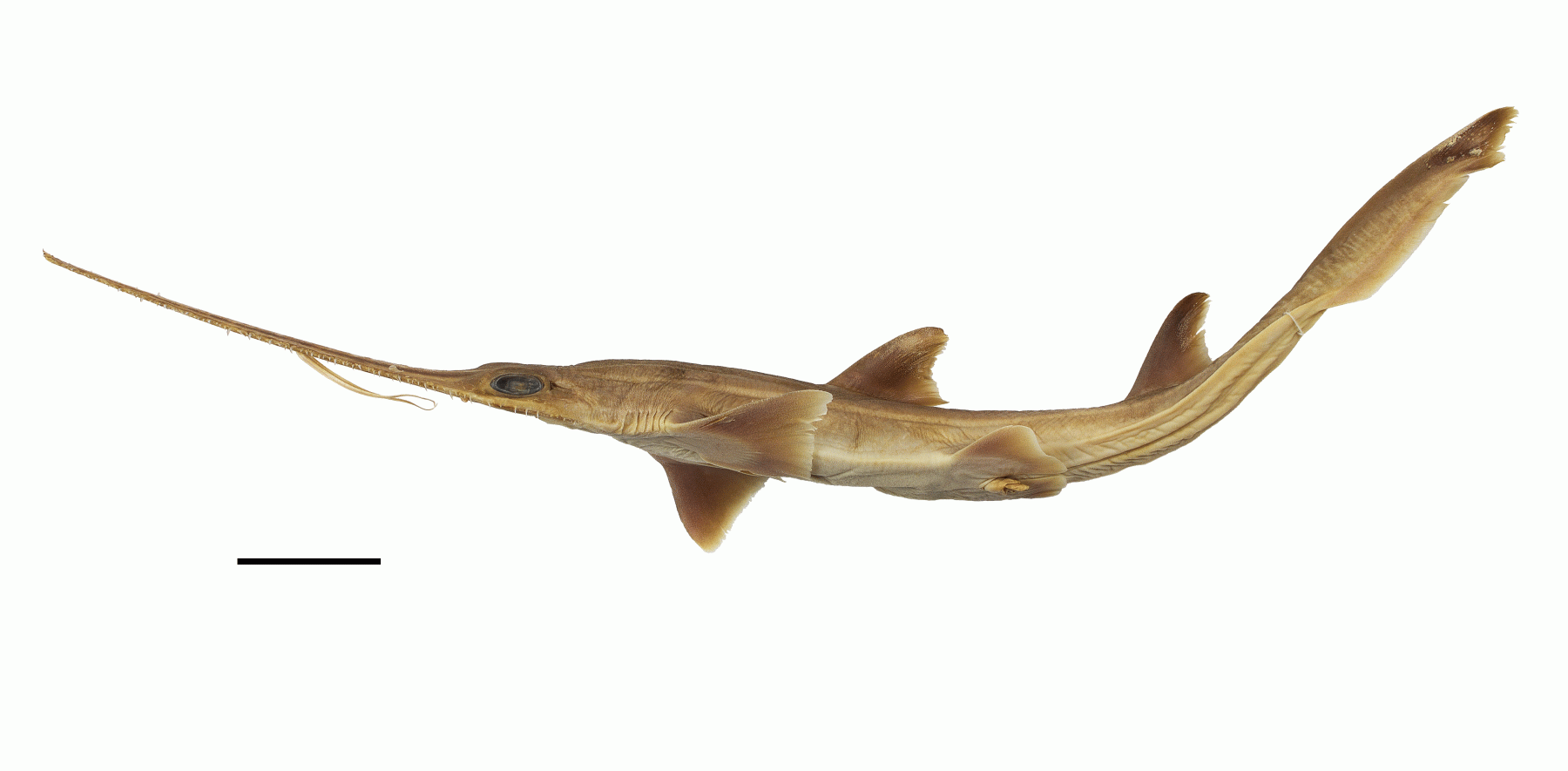
 

Pliotrema kajae. (Weigmann et al, Plos One, Newcastle University)


“The six-gill sawsharks are really quite extraordinary as most sawsharks have five-gill slits per side,” explained lead author Dr. Simon Weigmann, based at the Elasmobranch Research Laboratory in Hamburg. “So it was really exciting to find a new six-gill sawshark species, and to find two new species – well that was simply astonishing!”

The West Indian Ocean, off the coast of East Africa, is known as a biodiversity hotspot for shark and rays, with nearly 230 species identified here. Several of the species discovered in these waters are only found in this region.

While the West Indian Ocean is an important region for shark and ray conservation, the nearby populations rely on fishing for sustenance and income. The small-scale fishing vessels in this area use trawl nets, shrimp trawl nets, deepset gill nets, longlines, and purse seine nets, and either target or unintentionally capture these important species.

“Knowledge of sawsharks in the western Indian Ocean is generally still scarce. But considering their known depth distributions, both new species are likely affected by fishing operations. This assumption, combined with the limited range and apparent rarity of both new species, raises concerns that they are vulnerable to overfishing and might be in continuing decline,” Weigmann said. “This could be particularly alarming for Anna’s six-gill sawshark due to its very small known range, rarity and occurrence in shallow waters as the species is only known from depths of 20 to 35 meters (65 to 115 feet).”

These sharks are at further risk of overfishing as they become sexually mature much later in life than other fish, and only produce 5 to 10 offspring per year. Furthermore, sawsharks are one of the rarest species to be found in these waters, with several decades going by between sightings.
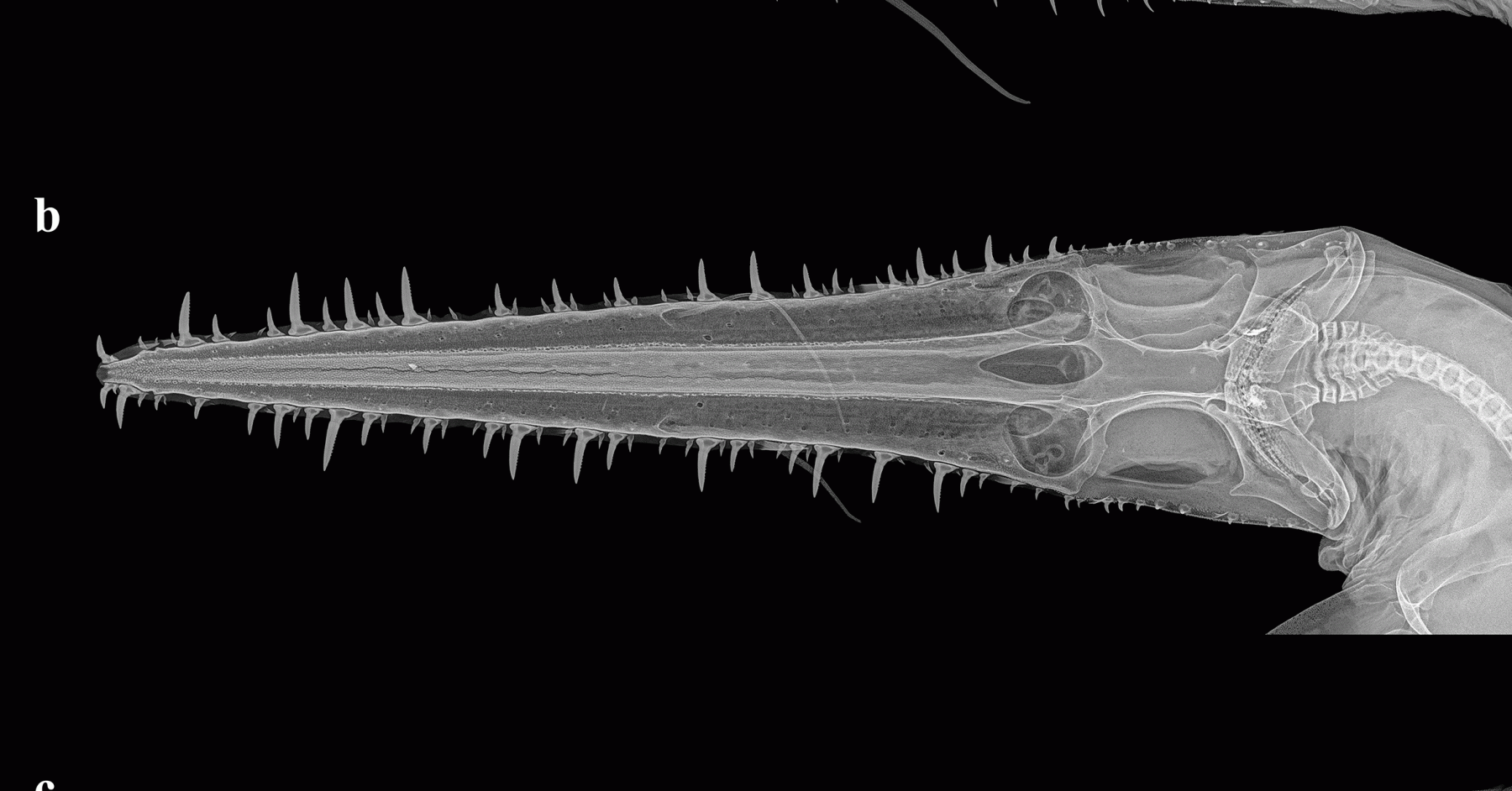
Radiograph of one of the new shark species. (Weigmann et al, Plos One, Newcastle University)


Sawsharks are best known for their namesake – its saw-like snout. They are found mainly in the temperate waters of all three major oceans and have a center of distribution in the western Pacific Ocean. However, the number of sawsharks has declined over the past couple of decades due to human activity and commercial fishing.

A sawshark can grow up to 5 feet long and boast a long snout edged with sharp teeth which alternate in size, with smaller teeth inserted between larger teeth. They also have a distinctive pair of barbels in the middle of their snout which functions as whisker-like sensory organs around the shark’s mouth that help them detect nearby prey.

The sawshark shares many physical similarities with the sawfish, but they differ greatly in many aspects. Sawfish are much larger, don’t have the sawshark’s barbels and their gills are located on the bottom side of the body as is typical for rays. Additionally, sawsharks are carnivores and live on a diet of fish, crustaceans, and squid. They use their serrated snouts to kill their prey with quick side to side movements that cut the prey into fine pieces to be easily swallowed.

The new species are different from the previously known six-gill species, Pliotrema warreni, in the position of their barbels. In P. kajae and P. annae, the barbels are situated approximately halfway from the tip of the saw – the rostral tip – to the mouth, compared to P. warreni’s barbel which is closer to the mouth. The P. annae also has a characteristically shorter rostrum than its counterparts.

“Last year our team highlighted the massive underreporting of sharks and rays caught in the South West Indian Ocean and the urgent need to expand efforts globally to assess the impact of these fisheries on vulnerable species,” co-author Andrew Temple of Newcastle University said. “The discovery reinforces both how important the western Indian Ocean is in terms of shark and ray biodiversity, but also how much we still don’t know.”

Co-author Per Berggren, leader of Newcastle University’s Marine MEGAfauna lab, added, “This project is also testament to the value of scientists working with local communities. Without the fishers help, we would not have discovered these animals,” said. “Their knowledge of their environment is unparalleled, and it is our mission to help them preserve the marine animals and ecosystems they rely on to survive.”

Story Source: Materials provided by Newcastle University.

Plastic Talks: One’s Role Towards the Plastic Conundrum with Mr Mohammad Reza Cordova, Indonesia Institute of Sciences (Part Three)

0

Our Weekly Podcast about the Ocean & it’s Plastic Conundrum

Interviewed by Nora Ismail
Video produced by Dorothy Clement


Underwater360 caught up with Mr Mohammad Reza Cordova, a scientist from Research Centre of Oceanography, Indonesia Institute of Sciences, micro-in on the effects of single-use plastic, microplastics and marine pollution on humans, marine life and the environment at the recent STEP Environment Camp 2019.


[embedyt] https://www.youtube.com/watch?v=xNmMGfQJ2t8[/embedyt]


Stay tuned for more stories on the conundrum with ocean plastic, look out for the upcoming Asian Diver – The Big Blue Book issue titled “Purge of the Plastic Pandemonium” coming to your newsstands soon.


In Singapore this May? Do not miss to attend ADEX Ocean Vision 2020, the largest and the longest-running diving, dive tourism and ocean conservation show in Asia, this May 29 to 31 at Suntec Singapore Convention & Exhibition Centre! Themed “Dedicated to a Plastic-Free Ocean (version 2.0)”, do not miss out on this opportunity to learn all about the various disciplines of diving, where’s the best dive spots in Asia, know more about the organisations that work on the conservation and the protection of marine life, marine waste and the ocean health, in general. REGISTER now for your free entry to the event – Click here!


Underwater360 would like to thank the STEP Environment organising committee for the arrangement of this interview.

STEP Environment Camp 2019 is a week-long camp where 92 participants from Brunei, Cambodia, China, India, Indonesia, Laos, Myanmar, Malaysia, Philippines, Singapore, Thailand, and Vietnam participating in various activities to learn about ‘Zero Waste’. STEP Environment Camp 2019 was brought to you by Temasek Foundation International for supporting the camp, and supporting partners: Lee Kong Chian Natural History Museum and our colleagues from SJINML for field-guiding the students, GearUp for the ice breakers, and Sustainable Singapore Gallery for the tour.


The Plastic Diet keeping Seabirds Quiet

0

Plastics are now being recycled into the bellies of Seabirds


Text: Sitaraah Joshi 

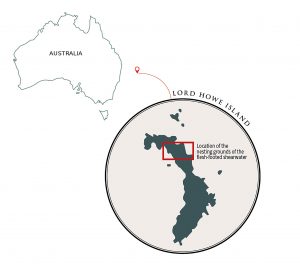
Lord Howe Island is located over six hundred kilometers home to the oceanic species of Fresh-footed shearwater birds. Their name expresses the elegant motion of cutting through the grooves of waves on tense, stretched wings. The dark grey, slender-billed birds range from twelve to thirty-three inches in size. Often times, they can be found nesting in the burrows of coastal hills and islands of the Northern Atlantic region, the Mediterranean as well as throughout the majority of the Pacific. 

Shearwater birds’ area of inhabitation

Each day, before dawn, the shearwaters make their way to feed at sea and return back to Lord Howe Island at dusk. They breed in great colonies on the floors of forests in the periods between September and May. Afterwhich, they migrate to different regions. Shearwater birds are ocean predators, primarily feeding on seafood. But when there’s plastic added into the water, it means that the birds cannot differentiate plastic from food. And thus, they end up eating it. 


It is revealed that 90 percent of all seabirds have eaten plastic (PNAS, 2015). Parent birds blindly feed little pieces of plastic to their young, often mistaking the floating particles for squid and fish eggs. Little chicks appear from their burrows, with meager levels of nutrition as their stomachs brim with plastic debris. Such a consistently poor diet has crippled the health and functionality of shearwaters, making the journey from home to sea an arduous one. 

Cross-section of a marine bird displaying the kind of plastic that they ingest

Enter Jennifer Lavers: a talented marine scientist working diligently to initiate change in this vicious cycle of disposable plastic affecting animals. Her job includes heading Adrift Labs and being a Lecturer of Marine Science at the Institute for Marine and Antarctic Studies in Tasmania. Her research at Adrift Labs pays attention to using wild species (like birds) as indicators of physical and chemical pollution chemical and physical pollution in marine and freshwater regions. Her work with the shearwater birds specifically has been recorded in several documentary films such as BLUE, A plastic ocean and Drowning in Plastic


On these feature documentaries, she presents the course through which shearwaters came to ingest the plastic. However, what was truly heartbreaking to witness, was the sheer amount of plastic stored in their bodies — all of which was regurgitated in a painful process. The method, called lavage, flushes out the stomach of the bird by sticking a tube down its digestive tract to ensure that all the contents resurface. She pulled out 90 pieces of plastic from a chick’s body at one shot. And this number is still relatively lower than that of the average. Some scientists have pulled out up to 200 to 250 pieces via regurgitation or from dead birds. 

Plastic and other forms of waste washed up on shores can also be found inside birds

If we continue to maintain the same careless attitude towards our plastic usage, by 2050, it is estimated that the number of these seabirds affected by plastic will rise to a staggering 99 percent. The outrageous amounts of marine debris originate primarily from human waste. Waste can range from anything to everything, including toothbrushes, bottle caps, lids, straws, matches, bags and all sorts of other tattered bits and pieces. In fact, the presence of plastic in our ecosystem is so monumental, that it can be found even in the very depths of certain parts of the ocean. Seabirds have been, and continue to be especially vulnerable to this kind of pollution. And consequently, their numbers too have shaken by the disastrous impact of plastic. 


So what can we do to help elevate the suffering animals in our ecosystem? Several of the following suggestions might seem familiar and redundant, having heard the same things over and over again. However, it cannot be stressed enough that these are also some of the easiest ways to cut down on waste. By starting small, we can induce a significant change in mitigating global plastic usage and disposal. 

Greener alternatives to plastic items

How about starting by cutting down on obvious pollutants in our daily lives, like plastic bags. Disposable bags can easily be replaced by stronger, more durable bags made from cloth. Not only will you be cutting down on unnecessary plastic waste, but you will also be saving your very own taxpayer money. For example, the state of California concentrates around 25 million USD moving plastic bags to landfill each year, and an additional 8.5 million dollars to discard scattered bags from streets. Your area’s budget and marine life, both prosper when plastic bags are not used. 


Another big culprit responsible for marine pollution is straws. You may think — straws that are thrown away as trash could not possibly enter the oceans, right? This is where we forget that there is still the careless littering of light plastic items. Due to their lightness, they are able to float and be blown away by the wind into drainage systems and marine areas. And all gutter and storm drains lead to our oceans. The initiative of using metal straws over plastic ones has taken the world by storm over the last couple of years. Not only are they more durable, but they are also safer, eco-friendlier and cost less overall. 


Lastly, a friendly suggestion that could help preserve marine life is to switch from current products to biodegradable ones. As mentioned, small items like toothbrushes often end up sinking to the bottom of Seabird’s bellies, hindering their digestion. By swapping out plastic handled brushes to bamboo or wood-based ones, they used materials that can easily be chucked into a compost pile instead of the trash after use. 

Hopefully, by pursuing one small measure by another, we can try to restore a more sustainable and environmentally friendly habitat for the fellow animal community.  


To read more exclusive content like this, check out the new issue of the ASIAN DIVER Magazine! 

5 Reasons Non Divers Should Learn To Dive

0

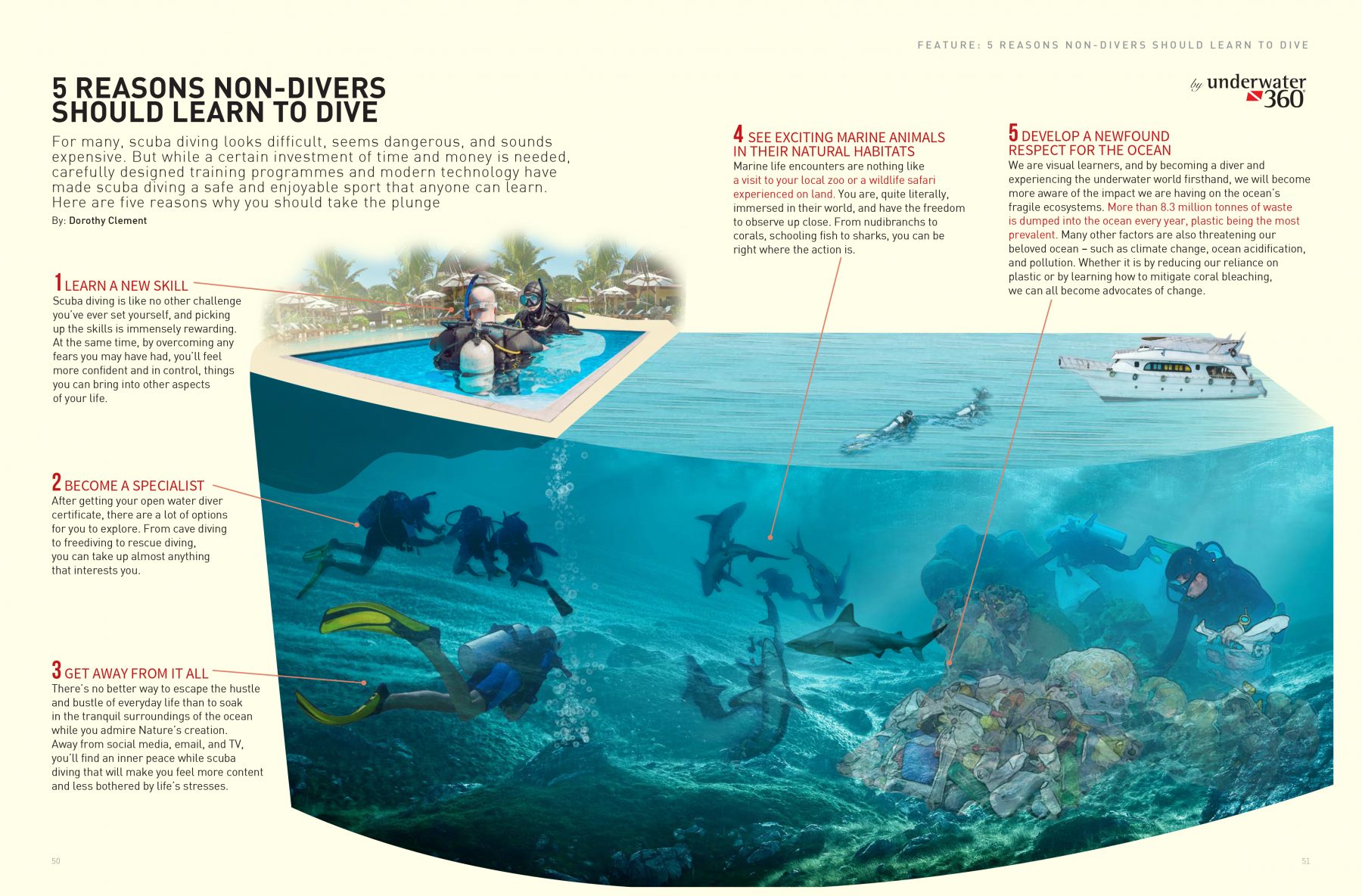
For many, scuba diving looks difficult, seems dangerous, and sounds expensive. But while a certain investment of time and money is needed, carefully designed training programmes and modern technology have made scuba diving a safe and enjoyable sport that anyone can learn. Here are five reasons why you should take the plunge


Text: Dorothy Clement
Art Direction: Justin Tin Hwte


Reason No. 1 – LEARN A NEW SKILL

Scuba diving is like no other challenge you’ve ever set yourself, and picking up the skills is immensely rewarding. At the same time, by overcoming any fears you may have had, you’ll feel more confident and in control, things you can bring into other aspects of your life.


Reason No. 2 – BECOME A SPECIALIST

After getting your open water diver certificate, there are a lot of options for you to explore. From cave diving to freediving to rescue diving, you can take up almost anything that interests you.


Reason No. 3 – GET AWAY FROM IT ALL

There’s no better way to escape the hustle and bustle of everyday life than to soak in the tranquil surroundings of the ocean while you admire Nature’s creation. Away from social media, email, and TV, you’ll find an inner peace while scuba diving that will make you feel more content and less bothered by life’s stresses.


Reason No. 4 – SEE EXCITING MARINE ANIMALS IN THEIR NATURAL HABITATS

Marine life encounters are nothing like a visit to your local zoo or a wildlife safari experienced on land. You are, quite literally, immersed in their world, and have the freedom to observe up close. From nudibranchs to corals, schooling fish to sharks, you can be right where the action is.


Reason No. 5 – DEVELOP A NEWFOUND RESPECT FOR THE OCEAN

We are visual learners, and by becoming a diver and experiencing the underwater world firsthand, we will become more aware of the impact we are having on the ocean’s fragile ecosystems. More than 8.3 million tonnes of waste is dumped into the ocean every year, plastic being the most prevalent. Many other factors are also threatening our beloved ocean – such as climate change, ocean acidification, and pollution. Whether it is by reducing our reliance on plastic or by learning how to mitigate coral bleaching, we can all become advocates of change.


Are you keen to pick up diving as a new skill or plunge into the underwater realm and explore the beautiful marine biodiversity? Learn more about “5 Reasons Non-Divers Should Learn to Dive”, “Dive Certification Agencies in Asia” and “The Science in Diving” on Asian Diver magazine Issue 3, Volume 154, 2019. Subscribe for your copy now – CLICK HERE!


Plastic Talks: The Effects of Plastic Waste on Human with Mr Mohammad Reza Cordova, Indonesia Institute of Sciences (Part Two)

0

Our Weekly Podcast about the Ocean & it’s Plastic Conundrum

Interviewed by Nora Ismail
Video produced by Dorothy Clement


Underwater360 caught up with Mr Mohammad Reza Cordova, a scientist from Research Centre of Oceanography, Indonesia Institute of Sciences, micro-in on the effects of single-use plastic, microplastics and marine pollution on humans, marine life and the environment at the recent STEP Environment Camp 2019.


[embedyt] https://www.youtube.com/watch?v=TMpsFj-JL2M[/embedyt]


Stay tuned to the last podcast of “Plastics Talks with Mr Mohammed Reza Cordova”, look out for the upcoming Asian Diver – The Big Blue Book issue titled “Purge of the Plastic Pandemonium” coming to your newsstands soon.


In Singapore this May? Do not miss to attend ADEX Ocean Vision 2020, the largest and the longest-running diving, dive tourism and ocean conservation show in Asia, this May 29 to 31 at Suntec Singapore Convention & Exhibition Centre! Themed “Dedicated to a Plastic-Free Ocean (version 2.0)”, do not miss out on this opportunity to learn all about the various disciplines of diving, where’s the best dive spots in Asia, know more about the organisations that work on the conservation and the protection of marine life, marine waste and the ocean health, in general. REGISTER now for your free entry to the event – Click here!


Underwater360 would like to thank the STEP Environment organising committee for the arrangement of this interview.

STEP Environment Camp 2019 is a week-long camp where 92 participants from Brunei, Cambodia, China, India, Indonesia, Laos, Myanmar, Malaysia, Philippines, Singapore, Thailand, and Vietnam participating in various activities to learn about ‘Zero Waste’. STEP Environment Camp 2019 was brought to you by Temasek Foundation International for supporting the camp, and supporting partners: Lee Kong Chian Natural History Museum and our colleagues from SJINML for field-guiding the students, GearUp for the ice breakers, and Sustainable Singapore Gallery for the tour.