Home Blog Page 38

Freediving for Food

0
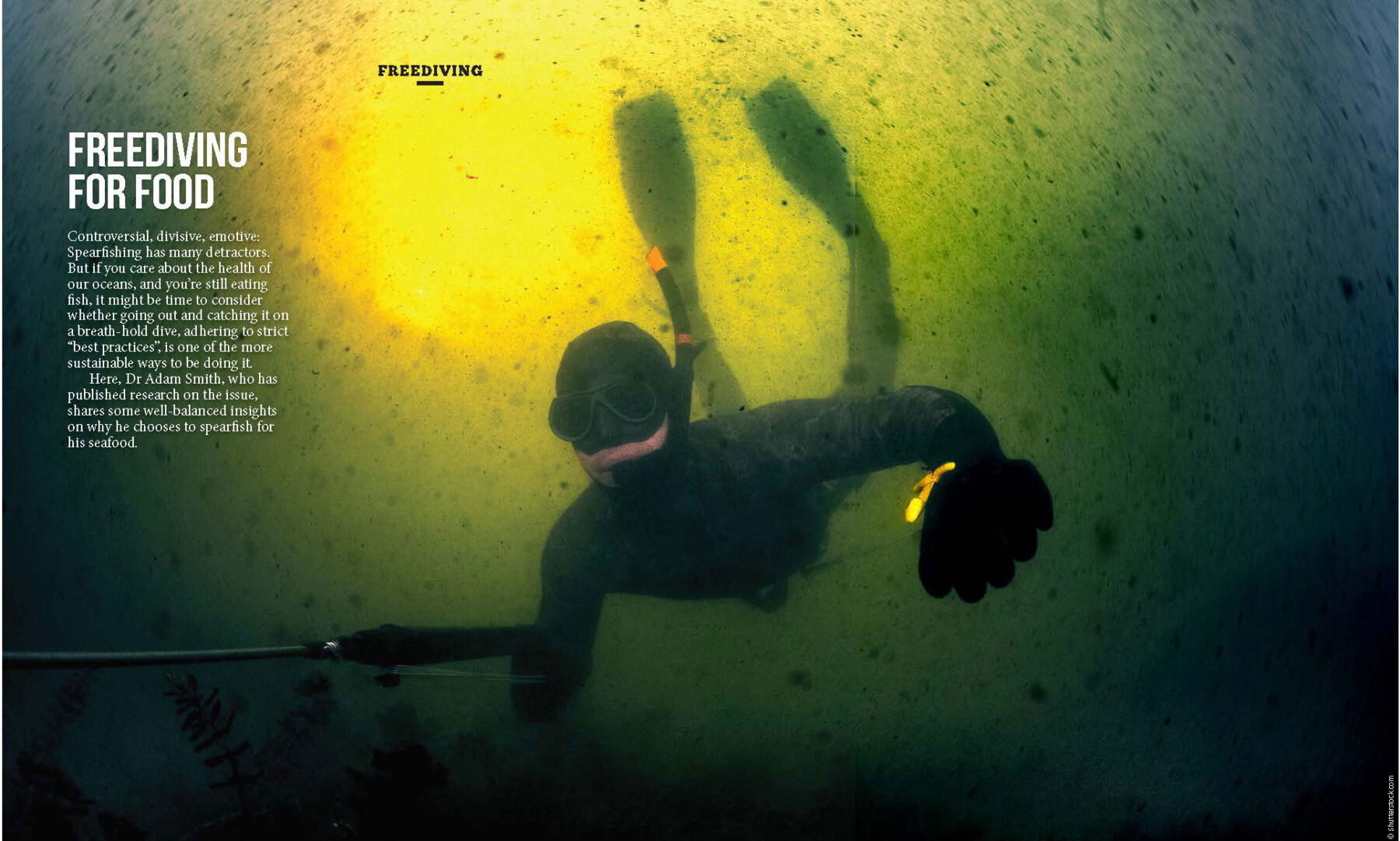
When strict guidelines are followed, could spearfishing be the most sustainable way to eat fish? (Photo by Shutterstock)

When strict guidelines are followed, could spearfishing be the most sustainable way to eat fish? Here, Dr Adam Smith, who has published research on the issue, shares some well-balanced insights on why he chooses to spearfish for his seafood.

LET ME TAKE YOU on my last perfect freedive. I am about 100 metres from the reef edge, in about 20 metres of water and I am floating on the surface looking at colourful coral reefs and abundant baitfish. The visibility underwater is approximately 30 metres, there is a slight current and the temperature is a comfortable 26 degrees Celsius.

There are several pelagic predators chasing the dense schools of blue and yellow baitfish. I know I am in the right location to potentially see a nice fish. My hunting technique is to be relaxed, scan the depths and occasionally dive to midwater (about 10 metres), then hold my position and breath and wait for a curious pelagic fish to investigate me. It may take 10 minutes or three hours of waiting for the desired fish to be in my vicinity. I am startled to see a school of three medium-sized mackerel.

They are moving quickly. I relax, dive silently, avoiding eye contact that may scare them, and wait…I hold my breath.
They circle closer.
I know I must continue to wait until I can be sure. Experience says it is right. I line up my speargun on the closest fish. It is a nice one of about 1.2 metres in length and weighs perhaps 12 kilos. It is when it’s about two-and-a-half metres away, I fire.

It is a lethal shot and the fish quivers and stops. A reef shark rushes over to investigate, but turns away. I quickly bring my catch to the surface. I admire the fish’s colour and form as I dispatch it and bleed it with my knife. I call the boat over to put my fish on ice. It will be very fresh sashimi tonight, with not a part of this incredible animal wasted.

THE CONTROVERSY
While many divers continue to eat seafood, spearfishing is still regarded by the majority of the diving community as highly controversial. However, as far as methods of catching fish go, research suggests it may be the most sustainable way of harvesting, and consuming, fish.

Scientific research supports the view that spearfishers catch a very small proportion of fish – less than one percent (Australia) to 20 percent (Hawaii) compared to recreational and commercial fishers.

Spearfishers generally target larger edible fish as well as lobsters and octopus. Larger predators are favoured targets of some spearfishers (tuna, mackerel, grouper) although in some areas of the Pacific these species are not targeted because of risk of ciguatera (poisoning as a result of eating toxic flesh) and the favoured targets are herbivorous fish. In some countries, parrotfish is a popular species to target at night because they tend to sleep in areas where they are easy to locate and approach. But targeting these species under these conditions is where spearfishing becomes less sustainable, and attracts a lot of criticism.

Spearfishing, like other forms of fishing, can have rapid and substantial negative effects on target fish populations. Overall, spearfishing is “efficient”, allowing divers to remove larger fish and more biomass per outing than fishers using other recreational techniques such as line fishing.

For example, three years after spearfishing was first allowed in a small marine park in Australia, there was a 54 percent reduction in density and a 27 percent reduction in mean size of coral grouper (Plectropomus spp).

Spearfishing is known to alter fish behaviour, and target fish species within areas that are regularly hunted with spearguns have been shown to exhibit avoidance behaviour when approached by spearfishers.

Issues
In my view there are eight common issues of concern raised by the community about spearfishing. These issues differ between geographical locations and individuals:

1. Sustainability: The catch is, or is not, ecologically sustainable (for more information see the infographic on page 23)

2. Safety: Breath-hold diving, and sharks attracted to dying fish and fish blood in the water, make the sport dangerous.

3. Impact on other ocean users: Spearfishers capture or scare fish that are valued by others, including scuba divers and line fishers. In many places, spearfishers may also be competing with people whose livelihoods depend on the fish that foreign/tourist spearfishers may be extracting.

4. Sport: It is wrong to catch fish just for sport. All fish should be eaten.

5. Day vs night: It is wrong to spearfish at night when the fish are sleeping.

6. Snorkel verses scuba: It is unfair to take fish while on scuba.

7. Reef vs pelagic: It is preferable to target pelagic fish rather than reef fish.

8. Conservation: Spearfishers support multiple-use marine parks and conservationists support no-take marine areas.

For the rest of this article and other stories, check out Asian Diver Issue 4/2016 Vol. 143) here or download a digital copy here.
The Conscientious Scuba Doing

0
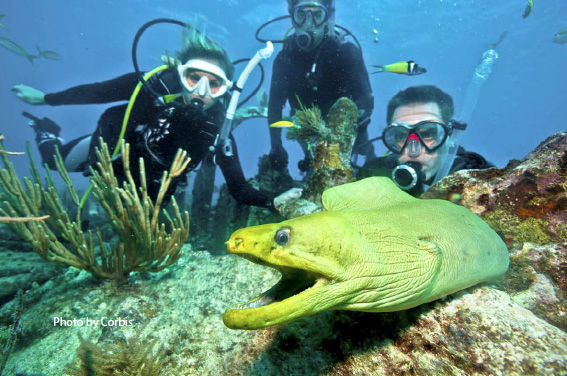
Photo by Corbis

THE ever-increasing number of scuba divers and snorkelers is leading to growing concerns about the amount of damage these plungers cause to coral reefs. Underwater recreational activities, including both scuba diving and snorkelling, allow us to explore the amazing underwater world and its huge variety of marine creatures. But what about the impact of these activities? It seems that we need to give serious attention to improve our diving – or snorkelling – skills and managing our behaviour underwater.

Generally, increasing reef contact and damage were highest among “unlimited diving” groups and unsupervised day and night dives. It was reported that divers using cameras have significantly more contacts with the reef than those without cameras (1.6 breaks per 10 minutes versus 0.3 breaks per 10 minutes). Imagine the damage done by a group of unsupervised divers with cameras, diving for about 50 minutes. How much more damage can our remaining coral reefs take?

Various studies have been conducted to assess diver impact by following divers, observing their underwater behaviour and recording reef damage. The studies identified the following major contacts made by divers and some snorkelers:

▶ Finning/kicking against the bottom
▶ Kneeling/standing on the bottom
▶ Clutching/holding corals
▶ Touching corals
▶ Dragging equipment

How do these activities cause damage? Fin kicking is the greatest threat as it causes breakage and abrasion of living corals and reduces visibility from the stirred up sediments. Even though these impacts may be unintentional, the impact to the coral reef can be lethal and the injured corals may take years to recover. The studies also noticed that some divers hold onto corals while diving in strong currents or to gain control of their movements.

But how much damage do divers really cause? The studies measured damage rate in “frequency of break/contact per minute”, and the amount of damage was found to vary widely among individuals. In a study conducted off the reefs of Redang, Malaysia, an average of 3.41 contacts were made per diver. This amounts to 11,000 contacts per year. Eighty-three percent of these contacts were made on living coral.

What can you do to save the coral reefs?

▶ Be a responsible diver and snorkeler – practice good buoyancy control, never harass or touch marine life
▶ Be a responsible underwater photographer and videographer – avoid contact with the bottom, check the surroundings before landing if you must, and land only on sand or dead corals but not LIVE corals
▶ Be an EcoDiver – take up the EcoDiver training course and participate in coral reef surveys
▶ Support marine conservation – report observations or environmental issues noticed to the relevant authorities (dive shop, marine park, Reef Check, etc)
▶ Participate in environmental awareness programmes to help safeguard our marine resources
▶ Always remember: “Take only photographs and leave only footprints”

For the rest of this article and other stories, check out our latest Asian Diver Issue 3/2012 Vol.120) here or download a digital copy here.
Born in Asia: Tracing the Paths of Scuba Inventions

0
Photo courtesy of Historical Diving Society Asia

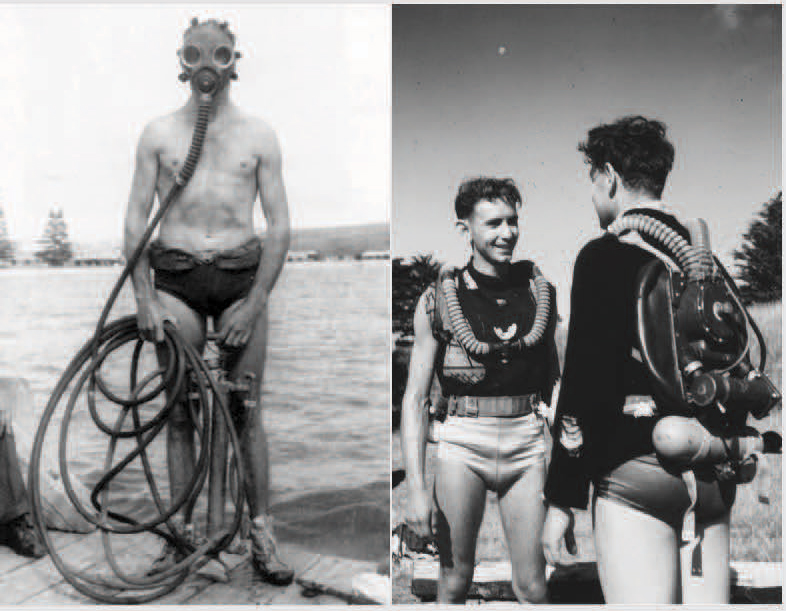
TOM ELDRED, born in Melbourne in 1920, invented the Porpoise – the world’s first single-hose open-circuit scuba set. Early prototypes of the Porpoise found international praise in Arthur C. Clarke’s 1955 book Coast of Coral. Clarke had replaced the two French Mistral systems he had bought to Australia with him, with two Porpoise systems loaned to him by Eldred, and these new inventions featured in his famous work. In 1954, Eldred developed the “Porpoise Universal”, which became his flagship model. It boasted a high supply rate of over 300 litres per minute, used the same demand valve as earlier models and was modular in design. He also designed a cheaper model called the “Sportsman” – a very compact regulator with innovative features that can still be found on modern regulators.

Eldred soon established Australia’s first scuba school, the first in the world to teach diving with the single-hose regulator. With the popularity of SCUBA growing, the Royal Australian Navy (RAN) soon became the first navy to be equipped with single hose scuba when it adopted the Porpoise Universal for military use.

Although he could not afford to patent his design, Ted Eldred was recognised later in his life by the Historical Divers Society (HDS) South-East Asia Pacific, as the inventor of the first successful commercially produced single hose SCUBA unit.

REGULATOR RECOLLECTIONS
Although it is hard to determine the date of the first scuba regulator imported into Australasia, evidence points towards the model being either a French or British version of the Cousteau Gagnan twin hose regulator. Evidence supporting the French model as the original are grounded in reports that the company Morris brought a 1947 La Spirotechnique Cousteau unit to the French Pacific Territories. When HDS Member Reece Discombe arrived in Noumea in 1947, he apparently realised the potential of this diving system and purchased an Aqua-Lung.

Sometime later in Sydney, Reece met up with Pat Williams, then Chief Diving Instructor for the Australian Navy. The latter was keen to see the new Aqua-Lung and a meeting was arranged at Rushcutters Bay, where the Navy Diving Unit was based. Pulling apart the system, numerous drawings were created of the design, in an attempt to reference this new marvelous piece of equipment.

Some historically interesting details in the Colonial Empire system had made an impact on the distribution of diving equipment. After the Aqua-Lung was successfully developed in Paris in 1943, a company known as Air Liquide used one of its branches (La Spirotechnique) to develop and market the scuba device. They jointly appointed Siebe Gorman as their agents in Australia and New Zealand.

Tom Byron’s book, History of Spearfishing and Scuba Diving in Australia, illustrates some significant details of the period. It attributes the introduction of the regulator in Australia to Michel Callaud, who moved to the country in 1949 and arrived with knowledge but no actual regulator. Together with Ted Baker and George McGann, they built three of the first available French-style scuba regulators in Australia. This “recollected” design was acquired by John Lawson who had a factory and produced twelve more units for members of the Underwater Explorer Club. However, Lawson’s product differed from the initial designs by mounting the regulator on the diver’s chest for easier breathing. Celebrated for their ingenuity, these units, innovated in Australia, were used during the filming of King of the Coral Sea in 1953.

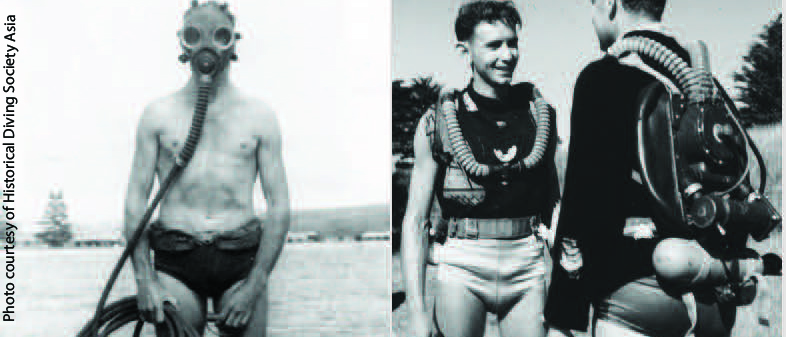
(Left) Leo Ducker wearing his own design of hose dive gear: Before the 1960s, it was difficult for many New Zealand divers to obtain gear from overseas. The solution was often to make equipment from materials to hand (Right) Ivor Howitt and Tom Eldred donning their Porpoise rebreathers. They were designed so the diver’s oxygen would be restricted should he go too deep (Photo courtesy of Historical Diving Society Asia)

SKIN DIVING
BREAKS THE SURFACE
Leo Ducker from New Zealand was one of the first people to polularise recreational skin diving, and he secured a place in history as a highly prominent diving pioneer. When he started experimenting with diving at the Poor Knights Islands as part of a course of physiotherapy, he made use of homemade diving equipment, such as an old MK4 Survival gas mask and the legs of some old gumboots for flippers. Together with his brother Clarry, they tried using a hand-pump and a hose to deliver air underwater, but had no success. Later, Clarry produced a refined mask made from the inner tube of a car wheel fitted with a Perspex visor, held in place with a metal clip. They patented it and named it “Dukka Diver”, selling the device for 10 shillings and six pence each.

Leo never stopped working with homemade equipment; in 1948, he used a mask derived from a floor polish tin with a perspex faceplate. Then in 1952, he created an oxygen rebreather that enabled him to dive as deep as nine metres. With the “formal” introduction of scuba diving to New Zealand in 1955, Leo and his group of dive enthusiast friends were able to add a whole new dimension to their underwater experiences at the Poor Knights Islands. Leo’s infectious passion for diving started drawing more people to the sport – his involvement with diving was so deep-rooted that his last dive occurred shortly before his 90th birthday.

For the rest of this article and other stories, check out our latest Asian Diver Issue 1/2014 Vol.130) here or download a digital copy here.
Murky Magnetism: Through the Eyes of a Dive Guide

0
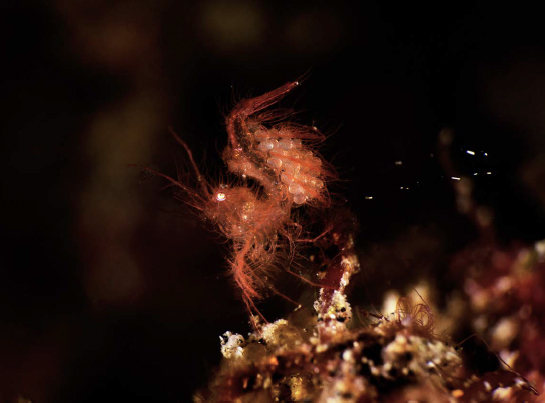
Lembeh: Simply the best place in the world for macro photography (Photo by James Mamoto)

WHY WOULD ANYONE WANT TO DIVE AT NIGHT? For some divers, it’s a strange or even intimidating idea. You don’t know what you’re missing, as night diving has certainly garnered some fascinating aspects you probably never knew way back when it was a mere necessity for an Advanced certification.

Years later, perhaps it’s time to give it a second chance, as you are probably a different diver now than you were 10 years ago. So what’s the best advice you’ll ever get when it comes to night diving? Go with a local dive guide. They are the ones that truly know the sites.

At a popular muck dive destination like Lembeh, the local dive guides know not only where to see the critters that you wouldn’t normally see during the day, but also their behaviours come nightfall.

The guides here will evaluate the dive site and carefully plan your time and depth limits, entry and exit points, and other considerations. All you need to think about is that award-winning photo you want to capture.

Lembeh at Night
Stay close to your guide during the dive – right behind him or not too far from his side – because when he spots a rare critter that might not hang around for long, you don’t want him to have to frantically signal for you to come over.

For the rest of this article and other stories, check out Asian Diver Issue 4/2015 Vol. 139) here or download a digital copy here.
Thailand’s Big Three

0
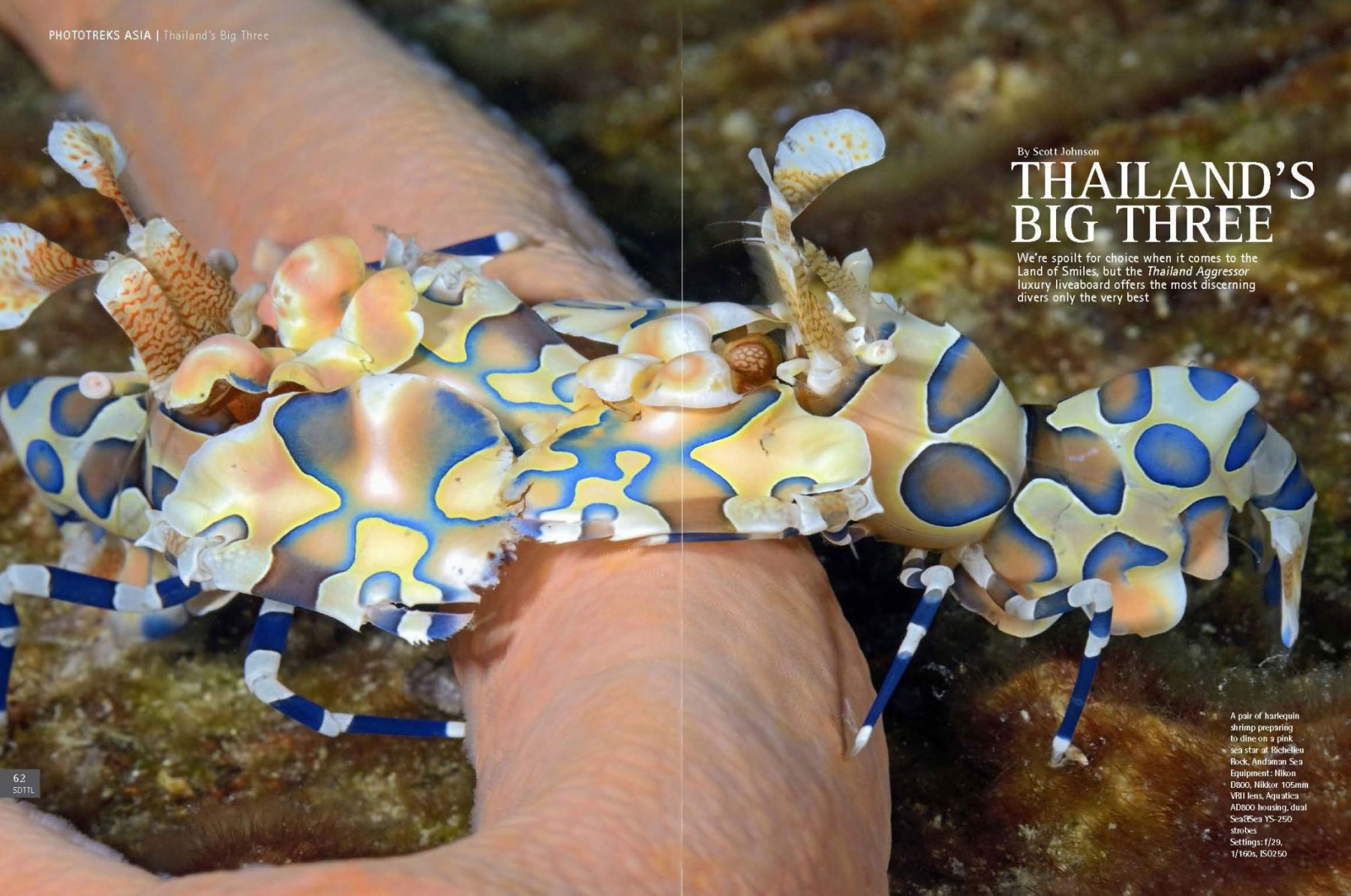
A pair of harlequin shrimp preparing to dine on a pink sea star at Richelieu Rock, Andaman Sea Equipment: Nikon D800, Nikkor 105mm VRII lens, Aquatica AD800 housing, dual Sea&Sea YS-250 strobes Settings: f/29, 1/160s, ISO250 (Photo by Scott Johnson)

THAILAND’S IDENTITY IS an intoxicating blend of warmth, originality, colour and variety. These attributes permeate the friendly Thai people, their storied culture, their tasty cuisine and their abundant natural resources. From thrilling safaris under the jungle canopy to potentially nerve-racking tuk-tuk rides along Bangkok’s bustling streets, Thailand offers unique adventures for even the most jaded travellers.

Beach lovers, snorkellers and divers can choose between the Gulf of Thailand to the east and the Andaman Sea to the west. While there are good spots for divers to hit in the Gulf, those seeking world-class sites eventually find their way to the island of Phuket and the treasures that lie within the Andaman Sea.

Crème de la Crème
Phuket, the nation’s largest island, is rife with dive shops that cater to tourists who simply want to try scuba diving and those determined to get certified. The plentiful day boats often mean the sites closest to Phuket can be a bit claustrophobic. Liveaboards allow you to avoid the crowds, minimise your in-transit time and focus on the very best areas.

The healthiest and most productive reefs are located in Thailand’s 22 national marine parks. Approximately 500 fish and 200 coral species have been identified in these protected sanctuaries. Of these parks, Mu Koh Similan National Park (mu koh means “group of islands”), Mu Koh Surin National Park and Mu Koh Lanta National Park are the crème de la crème. Likewise, the Thailand Aggressor is the luxury liveaboard of choice for exploring these Andaman jewels.

Diving in Style
The Thailand Aggressor is a 35 metre (115 feet) long luxury dive yacht designed specifically for divers who prefer individualised service, superior amenities and room to breathe. Nine staterooms accommodate 18 guests and feature an en-suite bathroom, climate control and a wardrobe. The salon/lounge is often the hub for big fish tales between dives as it offers a computer workstation, an entertainment centre and charging stations, in addition to being where the gourmet meals and snacks are served.

Four to five dives per day are made either directly from the mother ship or a tender. You can dive with a buddy or with one of the knowledgeable guides. The attentive crew especially pampers to underwater photographers and videographers by making sure each camera system is thoroughly rinsed and then safely stored on the convenient dive deck camera table after each dive.

Mu Koh Similan National Park
The Similan Islands National Park is 90 kilometres (56 miles) northwest of Phuket and includes the nine islands of the Similan group [from north to south: Ba-ngu (No. 9), Similan (the largest, No. 8), Payu (No. 7), Miang Sam or Hin Pusar (No. 6), Miang Song (No. 5), Miang (No. 4), Payan (No. 3), Payang (No. 2), and Huyong (No. 1)] and two nearby islands, Koh Bon and Koh Tachai. Most dive operators refer to the Similan (the Malay word for “nine”) Islands by a number, rather than a name, but they do not necessarily agree on which number goes with which island! You are also very likely to see a variety of spellings for the same island. The key is to enjoy the diving regardless of the location’s fluctuating designation.

These impressive granite islands are covered in lush vegetation and adorned with lonely white sand beaches and massive boulders. The annual southwest monsoon that usually impacts this region from May through October has sculpted two distinct undersea topographies around the islands with sloping coral reefs on their eastern flanks and rocky seascapes to the west. Thus, divers are treated to two unique environments though they surface to the panoramic beauty of a single island.

Mu Koh Surin National Park
The Surin Islands National Park is situated 100 kilometres (62 miles) north of the Similans and less than 20 kilometres (12.5 miles) southof the Myanmar border. The park encompasses the two namesake islands of Koh Surin Nua (North Surin) and Koh Surin Tai (South Surin), as well as the smaller satellite islands of Koh Ri, Koh Kai and Koh Klang. The main attraction for divers – and one of the most impressive sites on the planet – lies just 18 kilometres (11 miles) to the east.

Richelieu Rock (Hin Plo Naam in Thai, which means “rock protruding from the water”) is an isolated seamount with a series of pinnacles that appear to form the upper half of a padded armchair. The tall central pinnacle barely clears the surface at low tide. Currents continually bathe the reef with nutrients and serve as conduits that carry pelagics, such as manta rays and the occasional whale shark, and free-floating larvae to the seamount. Richelieu Rock’s remote location limits the number of visitors and the impact of human-related contamination.

For the rest of this article and other stories, check out our latest Scuba Diver Issue 6/2013 TTL No.8) here or download a digital copy here.
Your Essential Freediving Gear Guide

0
Photo by Stephen Frink

Photo by Stephen Frink

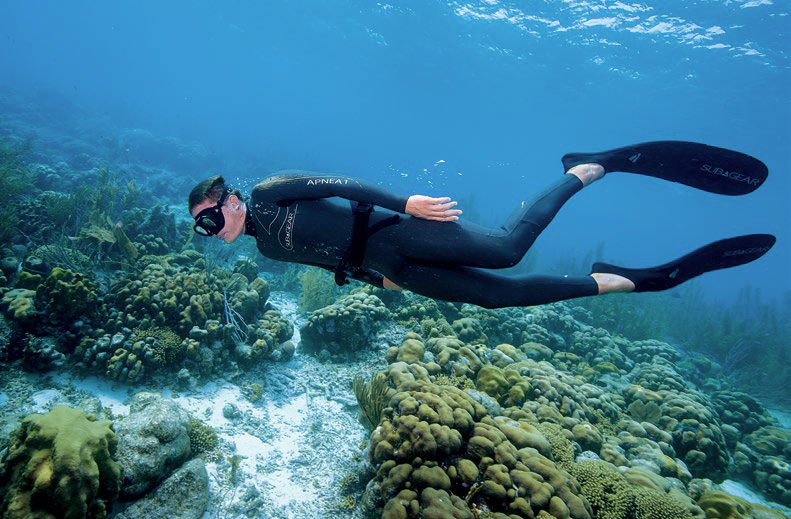
Freediving is the fastest-growing segment of the dive industry today. Robert King, vice president of AIDA International (Association Internationale pour le Développement de l’Apnée/International Association for Development of Apnea) estimates an annual growth rate of 20 percent. Notwithstanding this recent popularity, freediving is the oldest form of diving. The core gear hasn’t undergone any major revisions lately — it still consists of a mask, a snorkel, fins, a wetsuit and a weight belt — but there have been subtle changes that have led to exponential evolutions in the sport. Most notable among these are the design and materials of the fins.

Fins

The most recognisable element of freediving gear is those crazy long fins. Long blades are very efficient with a slow, steady kick. The length adds to the flex and responsiveness of the blade, creating a perception of propulsion with less effort. Many freedivers believe long fins offer the best balance between low effort and high thrust. Less effort means conserving energy and oxygen and, thus, extending dive time. While long-blade fins could be used in scuba diving, they can be unwieldy and aren’t designed to maximise torque, which can be a handy feature to scuba divers for starting, stopping and manoeuvring while wearing their much bulkier equipment. Long fins offer the greatest potential benefit to streamlined freedivers, who often seek to cover long vertical distances relatively quickly compared to gear-laden scuba divers.

Fin blades are made of plastic, fibreglass or carbon fibre. Plastic blades are easy on the wallet and extremely durable, but they are heavier than and typically not as responsive as the others. Fibreglass blades are more responsive and lighter, and they are in the middle of the road in terms of price. Carbon-fibre blades are superior in performance and are the most lightweight of the three, but they are also the priciest.

There are also options for blade stiffness. In most cases these are classified as soft, medium and hard. The desired stiffness will be a product of individual fitness, body weight and the type of freediving that suits you. Most long blades on the market come with full foot pockets. A full-foot pocket that fits correctly will transfer energy better than an open-heel design. Some fins feature interchangeable foot pockets that allow you to replace a broken blade or match the best-fitting foot pocket with your favourite blade. Fin rails are another feature to be aware of — rails help keep the blade straight through your kick cycle, improving efficiency.

Some freedivers choose to channel their inner mermaid and use a monofin. As with bifins, monofins are available in a range of materials and degrees of stiffness. Manoeuvrability is greatly compromised with a monofin, however, making these best suited to either competitive diving or recreational depth diving.

MASKS AND SNORKELS

The masks and snorkels used in freediving are designed to maximise breath-hold performance. A low-volume mask is preferable for breath-hold diving because it takes less air to equalise at depth, which conserves oxygen. The lower profile also means improved hydrodynamics. Some divers prefer low-volume masks simply because having the glass closer to your eyes can make for great peripheral vision.

With regard to a snorkel, a basic “J” style with no purge valve tends to work best. They are simply less bulky, and more streamlined means more efficient. See a trend here? In freediving the snorkel is spat out before descent to prevent it from keeping the airway open in the event of a blackout.

OPEN-CELL WETSUITS

Most wetsuits are neoprene with a nylon or Lycra liner on the inside and outside. Open-cell suits, which are favoured by freedivers, don’t have a liner on the inside, which increases flexibility. This enhanced flexibility allows divers to “breathe up” with less restriction on the diaphragm. Breathing up is the process of preparing yourself for a dive while breathing through your snorkel at the surface. Steady breathing from your diaphragm will help you relax and slow your heart rate before you take your peak inhalation and make the dive. Because they lack an inner lining, open-cell suits stick to you like glue and keep you warmer than fully-lined suits. Open-cell suits are more fragile, however, and require lubrication to put on. Don’t be intimidated by the lube; it actually makes donning an open-cell suit even easier than putting on a conventional suit. Most open-cell suits are two pieces, including a top with an attached hood and a bottom. The hood enhances both warmth and hydrodynamics.

For the rest of this article and other stories, check out our latest Scuba Diver Issue 3/2015 Vol.82) here or download a digital copy here.

Asia Pacific’s Diving Evolution

0

As people have discovered the breath-taking beauty beneath the waves in this magnificent region, our relationship with the ocean has evolved, and the spread of scuba has been something of an unstoppable force. Here are some of the milestones that have brought diving in Asia Pacific to where we are today.

100BC

Japanese ‘Ama’, female freedivers, wear loin cloths diving for pearls.

1500s

Sama-Bajau people employed as navigators and divers in the Tausug Kingdom of the Sulu Sultanate. Other sea-dwellers of the time include the Moken people around modern Thailand, and the Orang Laut around Southern Malaysia and Singapore.

EARLY 1800s

68,000 people employed as pearl shell divers around the Sulu and Celebes Sea. Divers harvest giant clams in Taiwan.

1839

Diving gear is invented that eventually allows pearl divers off the Aru Islands, Mergui Archipelago and Sulu Archipelago to go 54 metres deeper than freediving.

1863

A diver in New Zealand is employed to investigate an Otago Harbour shipwreck using oxygen supplied from the surface.

1875

Part of the Mariana Trench, to eight kilometres deep, is discovered.

1917

Alex Wickham, from the Soloman Islands, son of a shipwrecked English sailor, freedives in Sydney Harbour, inspiring the launch of the sport in Australia.

1918

The Ohgushi Peerless Respirator passes field tests at almost 100 metres. The Japanese device, invented by pearl divers Watanabe Riichi and Ohgushi Kanezo, combines modified false-lung style closed-circuit rebreather technology with
a compressed air reserve. It supplies air to the diver through a manually controlled on/off valve (25 years before Aqua-lung). It is tested by Riichi himself, who dived in the Yokosuka Harbour in front of the Japan Naval force.

1920

South Sea Coral Collecting Company founded in Japan, as a supplier for Ohgushi equipment. The apparatus never becomes commercially successful outside of Japan.

1934

First recorded amateur attempt in Australia to breathe underwater by Keith Vagg and Godfrey Gapp, who construct a diving helmet out of an oil drum and garden hose.

1942

US Army transport ship, the USAT Liberty, torpedoed by a Japanese submarine off the shore of Tulamben, Bali. It eventually becomes an incredible dive site, attracting over 100 divers a day.

1944

US bombs the Japanese fleet at Chuuk Lagoon, creating the biggest ship graveyard in the world.


For the rest of this article and other stories, check out our latest Scuba Diver Issue 5/2015 Vol.83) here or download a digital copy here.