Home Blog Page 39

World’s Weirdest: Enter the Octopus

0

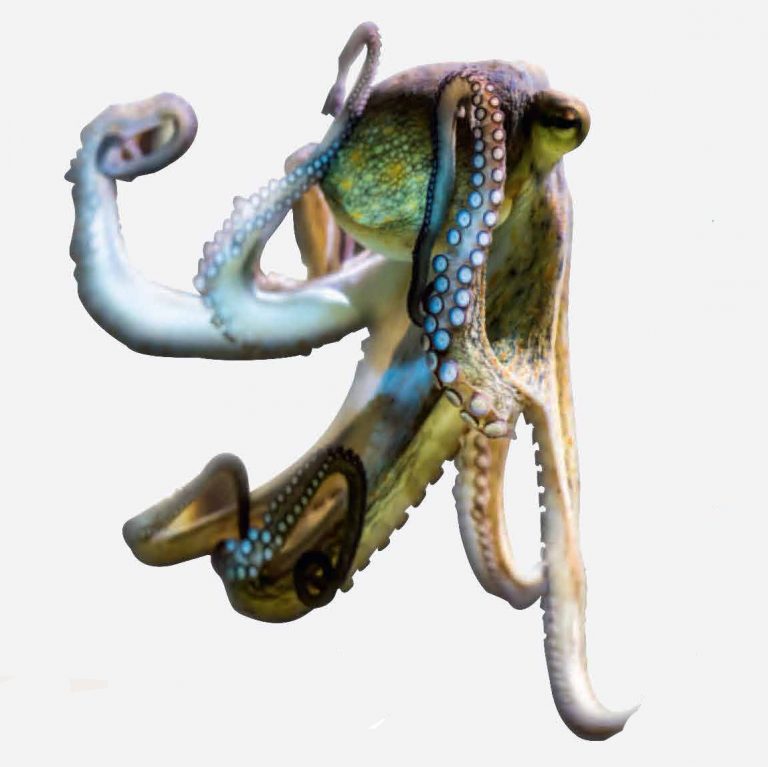
Easily the most bizarre creature in the sea, the humble octopus is a cephalopod of many talents, with DNA like that of no other animal (described by one scientist as looking as though it had been rearranged in a blender). An octopus also holds the record for longest brood period of any creature, with one octo-mum tending her eggs for 4.5 years!

There are thought to be 289recognised species of octopus, and allspecies have distinct characteristics,from the giant octopus, which cangrow up to 9 metres across, to theWolfi, the world’s smallest octopus,which measures only 1.5 centimetresand weighs less than a gram.

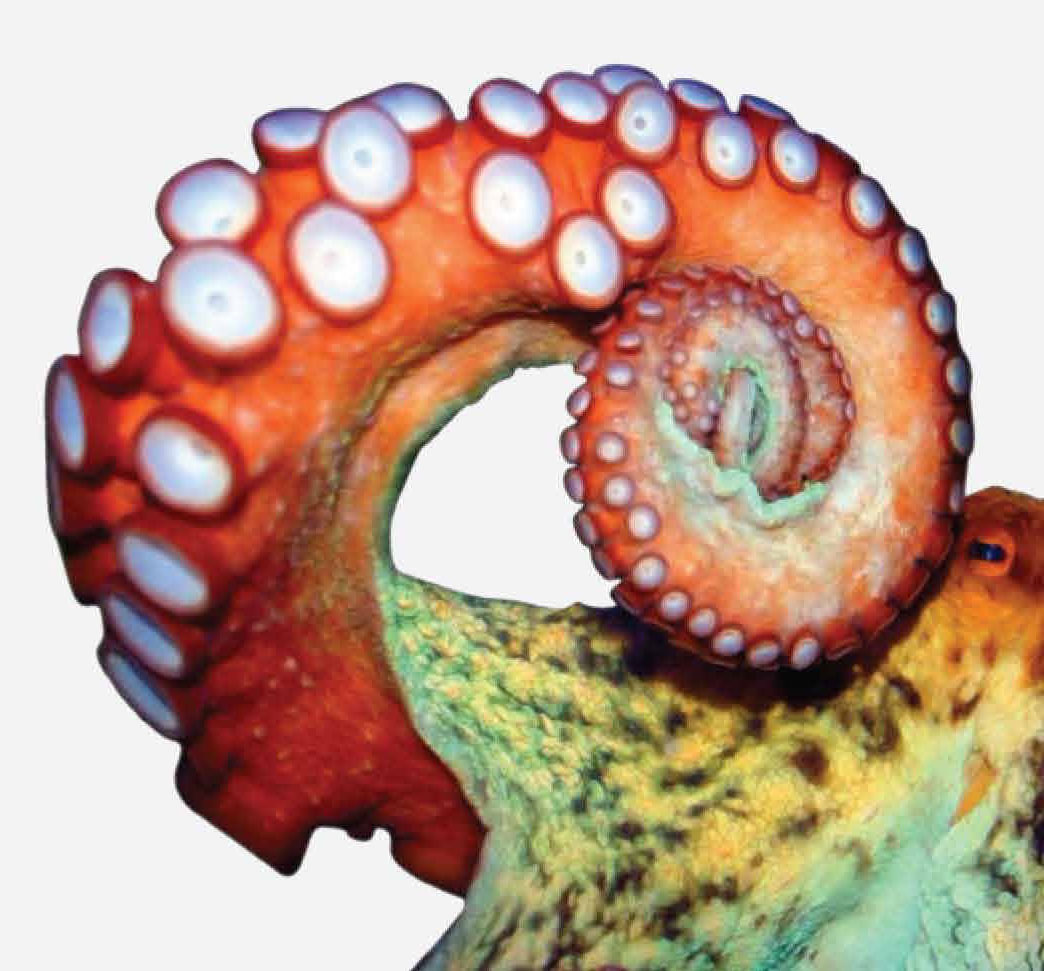
They disorientate predators with dark, toxic ink. The average octopus has eight arms with 240 suckers per arm. That’s about 1,920 suckers in total. that reduces visibility, interferes with the sense of smell and taste, and irritates the eyes.

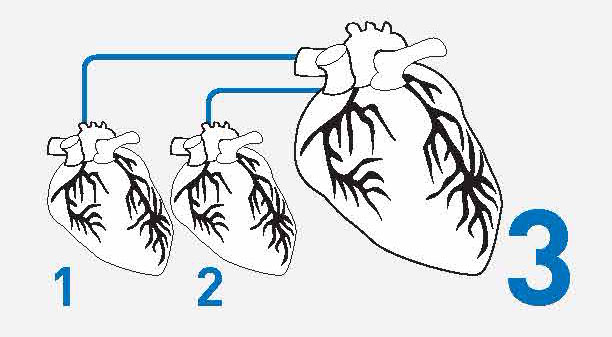
Octopuses have 2 small hearts located close to each of their gills that enrich the blood with oxygen before transferring it to 1 larger heart, which then pumps it around the rest of the body.

Unlike our red, iron-based blood, octopus’ blood is blue because it is copper based, and more efficient at transferring oxygen around the body in the cold.

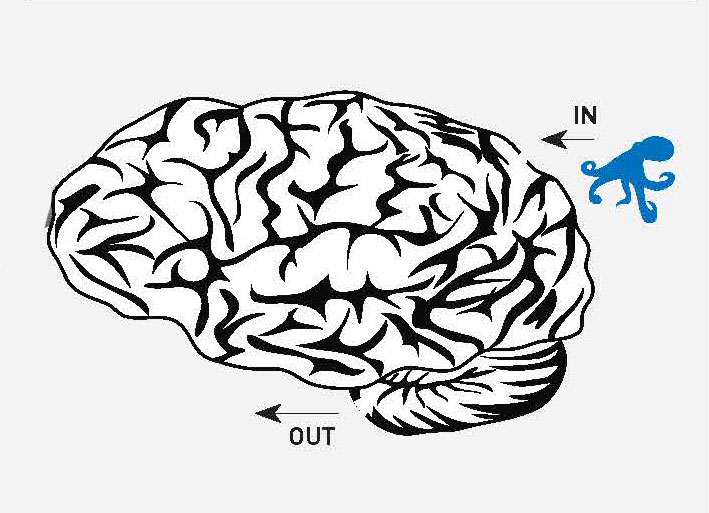
Octopuses have the largest brain of any invertebrate, and 2/3 of all their neurons are actually in their tentacles. As a result they are excellent problem solvers, can learn to navigate mazes, unscrew jars, and use “tools”.

In a fraction of a second, octopuses can change the colour and texture of their skin to blend perfectly with their surroundings.

Pacific octopus suckers are so strong that each one can lift a weight of almost 16 kg! The average octopus has eight arms with 240 suckers per arm. That’s about 1,920 suckers in total.

For the rest of this article and other stories, check out our latest Scuba Diver Issue 7/2015 Vol.84) here or download a digital copy here.

Rethinking Rebreathers: Pros & Cons of Rebreathers for Photography

0

PROS OF DIVING WITH A REBREATHER

There are quite a few reasons why rebreathers are helpful to serious photographers looking to take the next step. I’ve been diving on closed circuit rebreather (CCR) for eight years and it’s dramatically changed the way I can shoot.


A few benefits include:

1. Time: This is the biggest game changer

2. Stealth: No bubbles to scare away marine life, or get in the shot

3. Optimum mixture: Rebreathers maintain the best nitrox mix for every depth, giving you better profiles


CONS OF REBREATHER DIVING PHOTOGRAPHY

While there are benefits for photographers diving on rebreather, there are other considerations to think about and be aware of if you choose this route.

1. Task loading: Gain experience before taking a camera with you

2. Maintenance: Servicing and setup time

3. Awareness: Safety is important; be aware of distractions that take attention away from the rebreather for too long


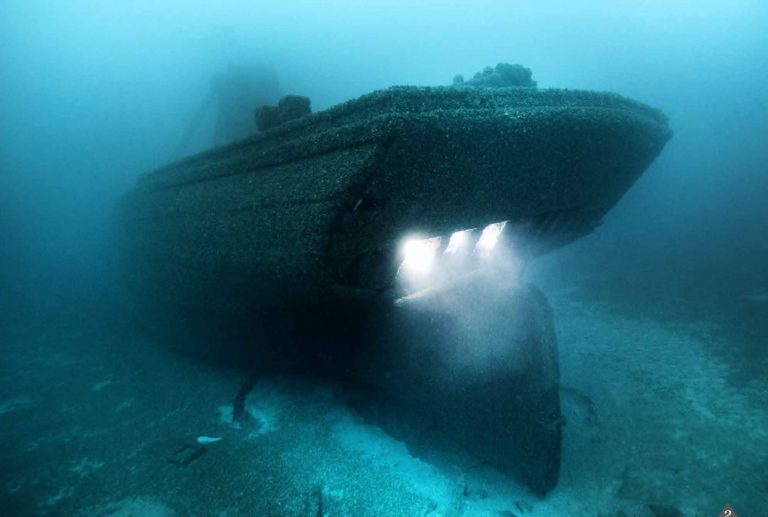
The stern of the MV Emba, a Soviet Russian motor tanker, lit up from within Settings: f/6.3, 1/40s, ISO 800 (Photo by Becky Kagan Schott)


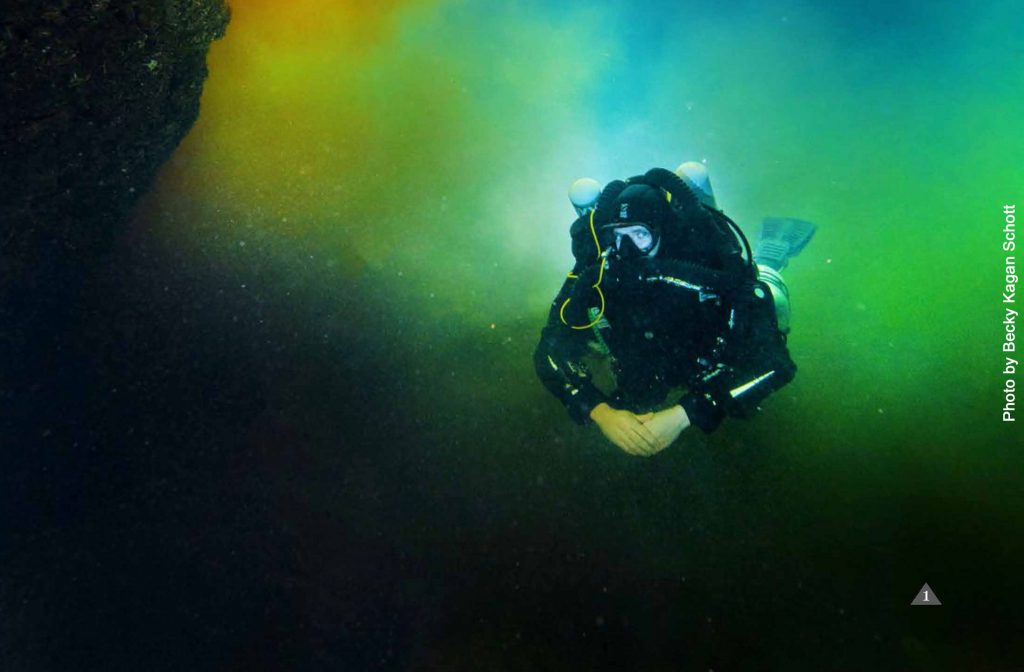
A rebreather is a tool; it’s a life support machine that should be taken seriously. It requires a bit more maintenance than traditional scuba, about a week of training learning the unit inside out. It helps to know your camera system well before taking the plunge into CCR diving. It also helps to spend a lot of hours on the unit in order for it to become second nature before taking the camera back in the water. I personally like to take a safety diver with me on dives. That person can help with lighting, model, or just watch out for small mistakes that could be dangerous. I find it extremely comforting to have a competent dive buddy that dives the same unit in order to help let me focus more on my shots. This person can keep track of the boat, navigation, marine life, and help with the camera if needed.

TIPS AND TECHNIQUES

• Slow down and think creatively – because you have the time. Take the time to tweak the lighting in your shot. You don’t have to settle for a shot that you know you’ll look at later and wish you took the time to perfect. Try new things and experiment with old techniques.

• Being bubble-less is helpful for getting close to shy marine life like certain species of sharks. Find a location and stay still. It will be like you’re not even there, allowing the marine life to come closer. Be one with the reef, move slowly and non-aggressively. Being silent makes a big difference.

• Think longer dives. Most of the work when diving is getting on and off of a boat or walking to and from the dive site. I prefer to do one longer dive if possible and stay in the water versus getting in and out. I find I’m less tired and I’m a much happier photographer because I wasn’t stressed out about time and in a hurry. Oh, and have I mentioned that you can talk really easy through a rebreather loop?! There is a large airspace there, so if you speak slowly your models can hear you.

For the rest of this article and other stories, check out our latest Scuba Diver Issue 6/2015 OP No. 5) here or download a digital copy here.

Asia’s Unesco Marine World Heritage Sites

0

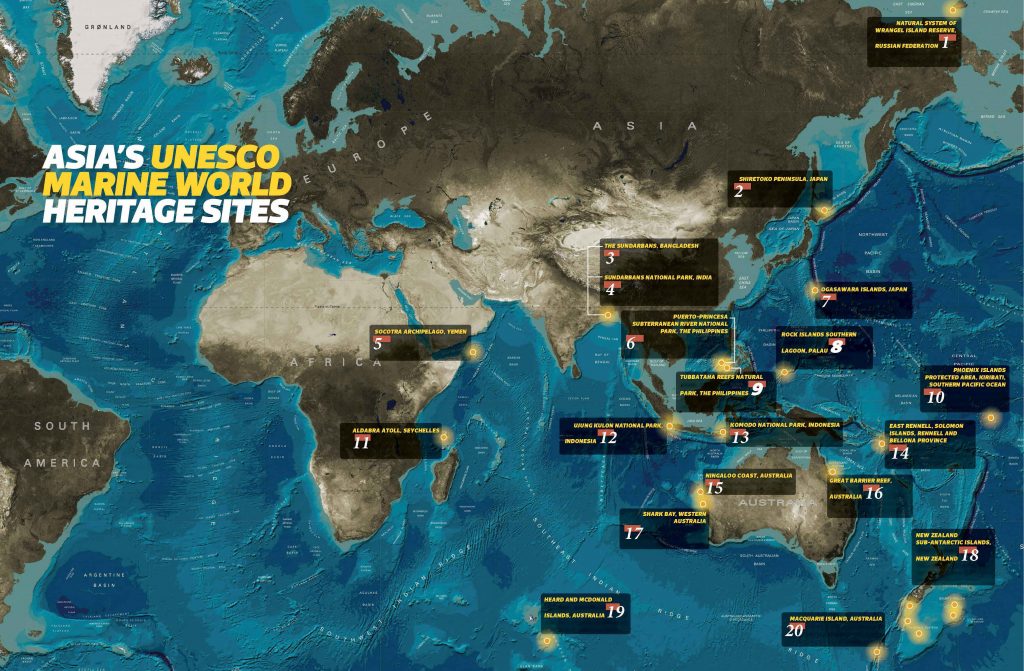
When a natural marine site garners the status of being of superlative aesthetic importance, or one that records Earth’s history, or even a spot that can demonstrate ongoing evolution, or a place that have become a habitat for species conservation, it attains the prestigious title of being a UNESCO Marine World Heritage Site.

With this title comes a decree that aims to establish effective conservation of these marine areas. Known as the “Outstanding Universal Value” (OUV), it refers a site’s exceptional cultural or natural significance that transcends boundaries and impacts both present and future generations. It is the central concept of a site on UNESCO’s World Heritage List.

In order to be considered, countries that have signed the World Heritage Convention can submit official nomination proposals. Besides making an inventory of its most important heritage sites, they must also include a comparison of the property to the features of others’ worldwide, thereby demonstrating its OUV.

After evaluation by independent Advisory Bodies, the Committee convenes once a year to decide which sites will be inscribed. Natural sites must meet at least one out of four selection criteria of OUV to be inducted.
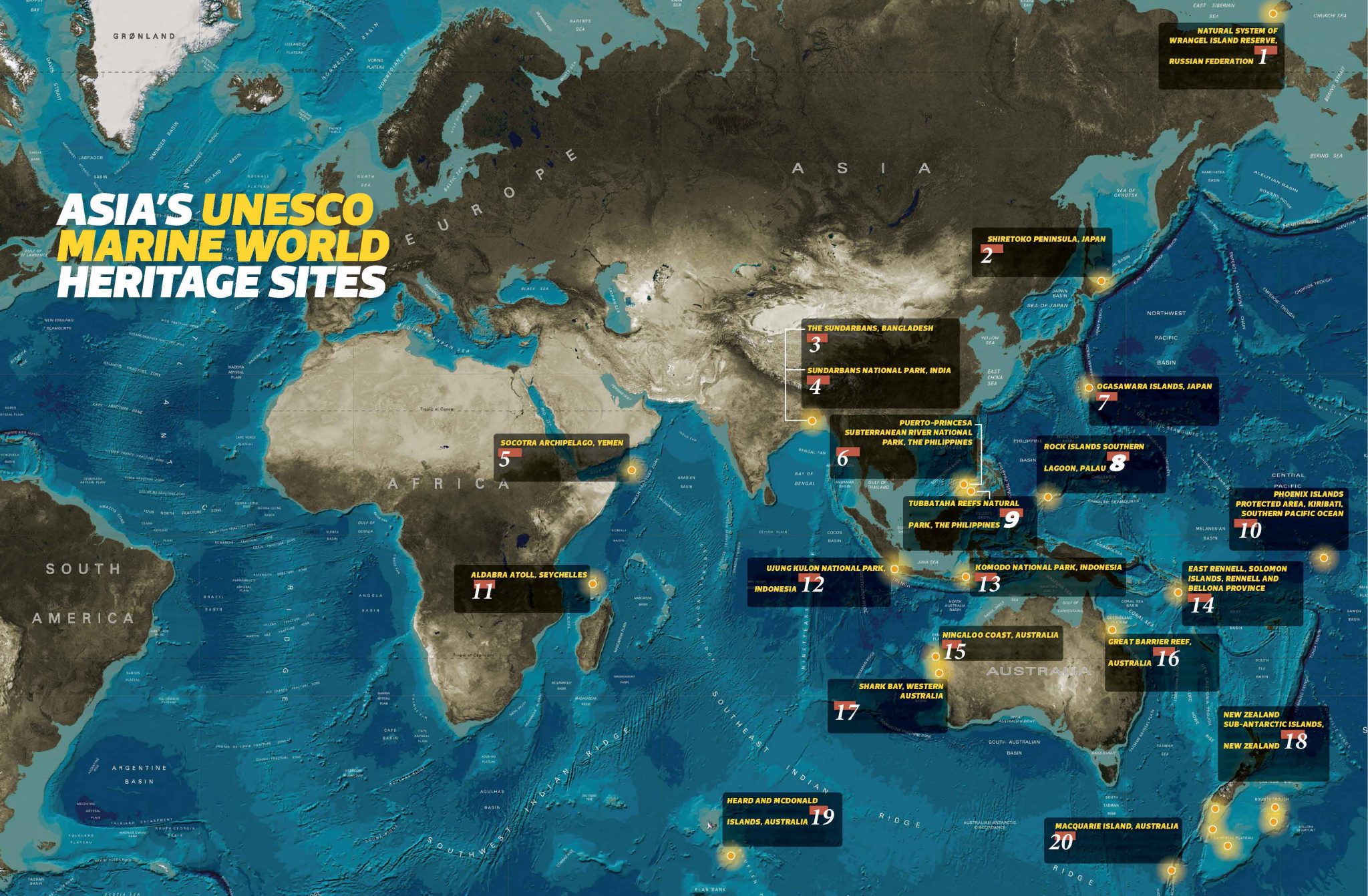
 

1. NATURAL SYSTEM OF WRANGEL ISLAND RESERVE, RUSSIAN FEDERATION 2004

This site is a major feeding ground for the grey whale migrating from Mexico.

2. SHIRETOKO PENINSULA, JAPAN  2005

The site is globally important for marine mammals including Steller’s sea lion.

3. THE SUNDARBANS, BANGLADESH 1997

The site is knows for threatened species such as the estuarine crocodile.

4. SUNDARBANS NATIONAL PARK, INDIA 1987

The Sundarbans support threatened mammals such as the Irrawaddy and Ganges River dolphins.

5. SOCOTRA ARCHIPELAGO, YEMEN 2008

The marine life here includes 253 species of reef-building corals and 730 species of coastal fish.

6. PUERTO-PRINCESA SUBTERRANEAN RIVER NATIONAL PARK, THE PHILIPPINES 1999

The site includes a subterranean river system that flows directly
into the sea.

7. OGASAWARA ISLANDS, JAPAN 2011

The islands demonstrate evolutionary processes and feature many endemic species.

8. ROCK ISLANDS SOUTHERN LAGOON, PALAU 2012

The complex reef system features over 385 coral species and different habitats.

9. TUBBATAHA REEFS NATURAL PARK, THE PHILIPPINES 1993

The site is a pristine coral reef with a 100 m perpendicular wall, lagoons and coral islands.

10. PHOENIX ISLANDS PROTECTED AREA, KIRIBATI, SOUTHERN PACIFIC OCEAN 2010

The site conserves one of the largest intact oceanic coral archipelago ecosystems.

11. ALDABRA ATOLL, SEYCHELLES 1982 is protected from human influence and is home to some 152,000 giant tortoises.

12. UJUNG KULON NATIONAL PARK, INDONESIA 1991

The site is home to amphibians including the vulnerable estuarine crocodile.

13. KOMODO NATIONAL PARK, INDONESIA 1991

Marine species richness is very high, including the blue whale and sperm whale.

14. EAST RENNELL, SOLOMON ISLANDS, RENNELL AND BELLONA PROVINCE 1998

Rennell, 86 km long and 15 km wide, is the largest raised coral atoll worldwide.

15. NINGALOO COAST, AUSTRALIA 2011

Annual gatherings of whale sharks occur at Ningaloo Coast.

16. GREAT BARRIER REEF, AUSTRALIA 1981

This site contains the world’s largest collection of coral reefs, including 400 types of coral.

17. SHARK BAY, WESTERN AUSTRALIA 1991

The site’s rich marine life includes a large population of dugongs (sea cows).

18. NEW ZEALAND SUB-ANTARCTIC ISLANDS, NEW ZEALAND 1998

The site features a close inter-dependence of marine and land environments for many species.

19. HEARD AND MCDONALD ISLANDS, AUSTRALIA 1997

The islands are virtually free of introduced species modification, providing an intact ecosystem.

20. MACQUARIE ISLAND, AUSTRALIA 1997 

The site is home to thousands of penguins and elephant seals during breeding season.

For the rest of this article and other stories, check out our latest Asian Diver Issue 2/2014 Vol.131) here or download a digital copy here.

Dos and Don’ts: Live, To Dive Another Day

0

THE DIVE had just begun. The three divers Paul, Bill and Johnny had dropped quickly down the sheer cliff wall to the seabed at a depth of 50 metres. Their plan was to cruise the foot of the wall for 30 minutes then ascend and do their decompression on the wall face.

They had just reached the bottom when Paul looked for Bill and saw that he was swimming away from the wall, his fins kicking up the sand in clouds behind him. He swam over and touched him on the shoulder. Bill spun round as if he had been shot and stared at Paul with wide, confused, uncomprehending eyes. Paul gave him the OK signal and gripped Bill’s upper arm to reassure him.

There was no response and, thinking fast, Paul reached a decision. He summoned Johnny, who had been watching concerned from a distance, and thumbed the UP signal to both his buddies. Johnny nodded and returned the signal, Bill still looked confused, but did not resist when Paul gently guided him upwards with pressure on his arm.

The team ascended slowly to the top of the wall and at a depth of about 15 metres, Bill pulled away from Paul’s grip and looked at him with clear eyes. He pointed to himself, gave the OK signal and suggested they go back down and continue the dive. Paul and Johnny both shook their heads and they completed their ascent without further incident.

COMMENT

Paul’s decision to abort the dive immediately and not wait to see if Bill would shake off the narcosis that had claimed him on their fast descent made absolutely sure that the dive did not turn into a tragedy. Had he waited, Bill might have panicked, threatening the whole team’s safety. Immediate action was important as the[

DOS AND DON’TS

DO follow the cave diver’s rule that anyone can terminate a dive at any time for any reason at all with no explanation required and once a dive is aborted it is, “One Up, All Up!”
DON’T underestimate narcosis. Use TRIMIX for deep dives if it is available or, if you must use air, descend slowly and focus intently on your dive.
DO dive defensively: live to dive another day.

For the rest of this article and other stories, check out our latest Asian Diver Issue 1/2014 Vol.130) here or download a digital copy here.
On the Sea Shores: A Diver’s Guide to Tides

0

SHORE DIVING can be one of the most rewarding and cost effective ways of getting your scuba fix. While some sites are ideal for instructors wanting a sheltered spot to take their students, others can be much more challenging and suited to experienced divers. Tides and currents are important considerations for any diver, but this is especially true for shore divers. An understanding of tides and their associated currents allows shore divers to enter the water at exactly the right time to get the best out of the site and marine life.

HOW TIDES WORK
The gravitational pull of the sun and moon are a major influence on the sea level’s rise and fall. Without the influence of any celestial bodies, the level of Earth’s oceans would remain at more or less static due to our planet’s own gravitational pull and the centrifugal force produced as it spins on its axis. Centrifugal force is often overlooked as another major influence on tides.

The moon’s gravitational pull is strong enough to draw water towards it creating a ‘bulge’, which moves with the moon as it orbits the Earth. The regions of the Earth where these bulges occur experience a high tide, and other areas experience a low tide. Interestingly, however, water on the opposite side of the planet, furthest away from the moon, also experiences a high tide at the same time as a result of the centrifugal force created as the Earth spins.

The sun’s effect is comparable to that of the moon, exerting similar forces on our planet’s oceans. The gravitational force exerted by the sun, however, is less strong than that of the moon due to the sun’s relative distance from us. Considering that both the sun and moon have an influence on the tides, it is logical that their combination can also have profound effects. When the sun aligns with the moon and the Earth, during a full or new moon, the effect on the tides is intensified, resulting in spring tides. The term “spring” does not relate to the season, rather it is named due to the tides springing higher than usual. Conversely, when the moon is in its first or third quarter, the sun counteracts some of the pull from the moon with gravitational forces coming from opposing directions and a lower than expected high tide results. These smaller high tides are known as neap tides.

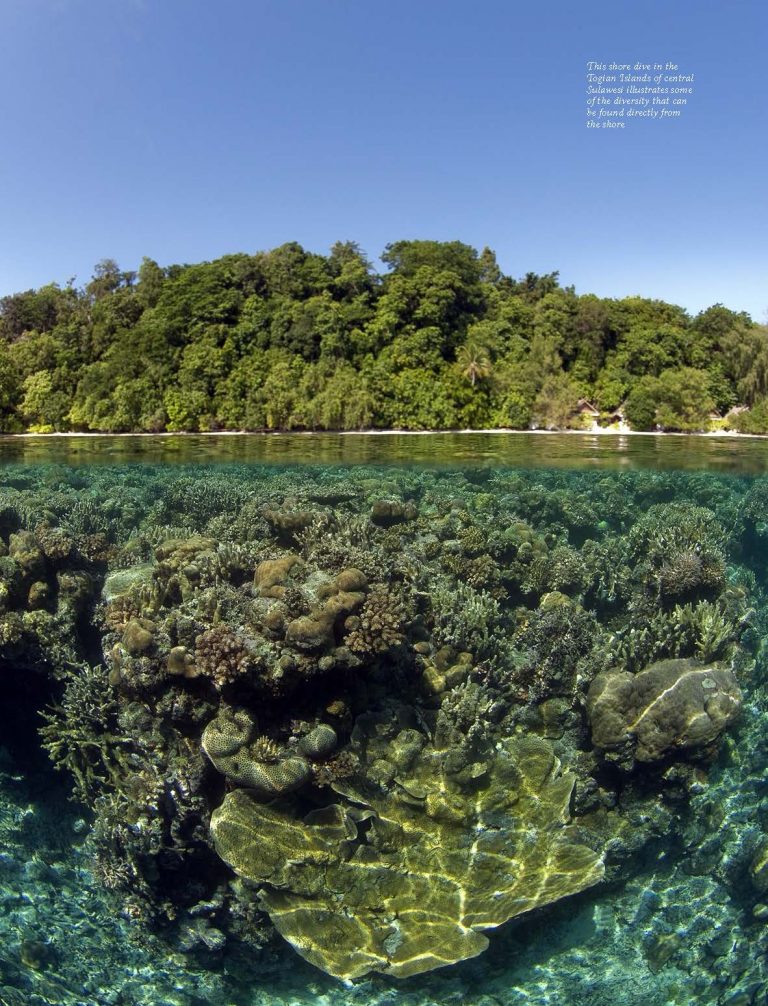
This shore dive in the Togian Islands of central Sulawesi illustrates some of the diversity that can be found directly from the shore


TIMING IS EVERYTHING
Tides can heavily influence our experience as divers. During spring tides, currents tend to be much stronger, as the difference between high and low water is at its greatest, and a larger than average volume of water moves from one part of the ocean to another. Animals also react to these changes and many fish spawn on a full moon to exploit these strong currents. Strong currents help to carry spawn over greater distances, helping a species to colonise new reefs and genetically mix its populations.

Tides generally rise and fall twice each day, which accordingly affect both visibility and the currents experienced on a dive site. Correctly evaluating the tides is vital for many shore dives. Usually, the best time for a tidally dominated site is high slack. This is the short period of time when the height of the tide has been reached and before it starts to fall again, providing a window of opportunity when there should be very little water movement. Visibility is also usually at its best during the high slack, due to the abundance of fresh, unagitated waters.

For the rest of this article and other stories, check out our latest Asian Diver Issue 1/2014 Vol.130) here or download a digital copy here.
The Delicate Problem of Eliminating Plastic Straws

0

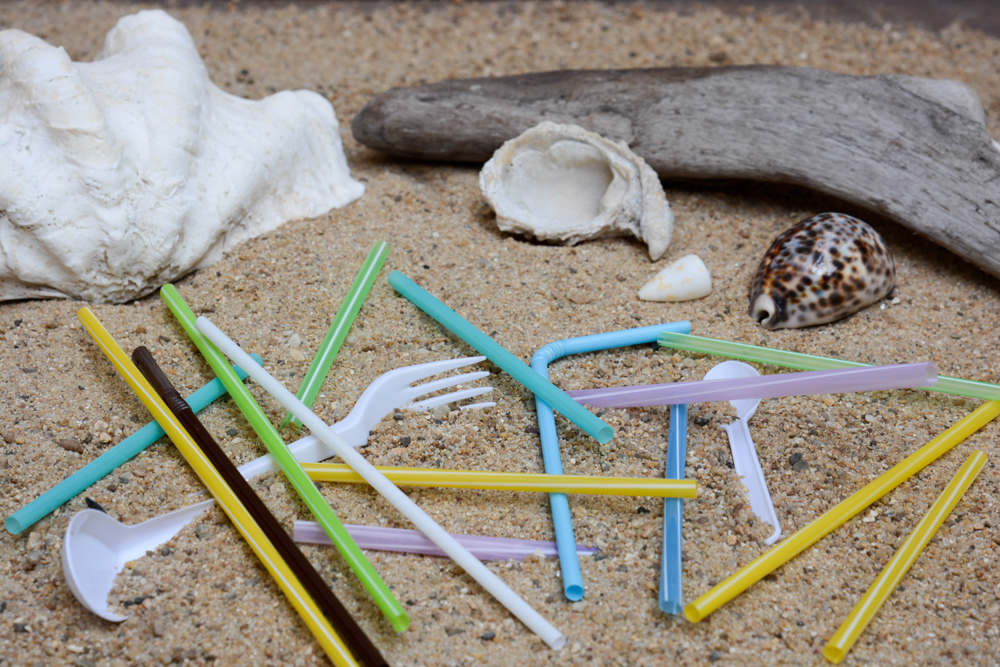
The plastic straw has a lifespan of centuries. Used once and thrown away, its continued existence in the depths of our oceans is a deadly menace to marine life such as sea turtles. With governments across the globe now stepping up to ban the use of single-use plastics, many restaurants and bars have replaced plastic straws with reusable metal ones.

The Origin of the Straw

5,000 Years Ago: Ancient Sumerians

One of the first brewers of beer, the ancient Sumerians were probably the first to use straws.  Using long thin tubes made from precious metals, these metallic straws were used to reach the tasty brew that resided below fermentation byproducts.

1888: Marvin Stone

A manufacturer of paper cigarette holders, Marvin Stone filed the first patent for a drinking straw made out of strips of paper glued together. His company, Stone Industrial (now part of Precision Products Group), started mass producing straws by 1890.

1930s: Joseph Friedman

Inventor Joseph Friedman invented the bendable straw by inserting a screw into a straw, wrapping floss around the straw, then taking out the screw. The Flex-Straw Company started mass producing his design after Friedman patented his invention. Hospitals were among the first to widely employ the use of Flex-Straws as they allowed patients to drink while they were lying in bed.

The Post-WWII Plastic Boom

The invention of plastic and the mass production of plastic items being churned out by plastic factories during World War II meant that there was a massive excess of production capability at peacetime. Turning their attention to the consumer market, plastic household items started to be churned out by these plastic factories, including the plastic straw.

At first glance, this solution seems simple and straightforward enough – swopping out an unrecyclable material with a sustainable, recyclable one. In practice, however, many business owners have discovered that the implementation of this solution has ignored one key aspect of the problem: human habitual behaviour.

More Than a Cost Issue

A lot of business owners have discovered that many customers have the habit of taking their metal straws home with them. With the high unit cost of the metal straws, some establishments have resorted to charging customers for the straws once the customer’s glass comes back to the kitchen with no metal straw in it.

On the surface, this problem appears to be a cost issue that can be easily resolved by including the price of the straw into the drink. However, just charging for the metal straw does not resolve the issue that most consumers do not reuse the metal straw that they have taken from their favourite restaurant. Most of the time, these metal straws end up in a showcase or a forgotten drawer, never to be reused again. Most people simply do not have the habit of carrying around a personal metal straw everywhere they go in case they get thirsty. The carbon footprint of producing a metal straw is enormous. Between the mining of the metal to the smelting and shaping of the metal, the environmental cost of producing increasing amounts of metal straws is just too high to justify its usage as a band-aid to our habit of using disposable straws.

The Influence of Habitual Behaviour

Another habitual behaviour that is not often discussed when it comes to straws is the tendency of some people to chew on their straws. While advocating for the use of metal and even bamboo straws, I have come across several friends who fear for their teeth and insist on using plastic straws as they are compulsive straw chewers. For these quirky human habits, the metal straw solution is a non-starter.

Looking at these human habits, it is apparent that the plastic straw needs to be replaced with a low-cost product that can be single-use, pliable and yet not harmful to the environment. Fortunately, there is such a solution that fits all three conditions – the edible, biodegrable LOLISTRAW straw made by LOLIWARE. Made of a zero-calorie seaweed-based material, the LOLISTRAW does not disintegrate in your drink but can last up to 24 hours in your beverage and has a shelf life of up to two years. In fact, straw chewers might be tickled to find out that LOLIWARE have come up with flavour profiles such as “citrus” and “vanilla dust” – making straw chewing a decidedly tasty experience.

Of course, non-straw chewers can also choose to simply throw the straws away and the LOLISTRAW will turn into soil in a couple of months. The biggest problem now is availability. I don’t have hard figures readily available to see where LOLISTRAW is being used but the penetration rate of the product is easy to see as I’ve not met heard of anyone eating their straws let alone see one. With Asia being one of the hot spots of plastic pollution, more bio-manufacturing firms need to jump onboard the edible straw trend in order for plastic straws to be stamped out effectively for good.

Kedah’s Coral Propagation Programme

0

SINCE ITS establishment a quarter of a decade ago, Pulau Payar Marine Park has been a favourite year-round hotspot among tourists with an interest in eco-adventure. But human activities such as unregulated tourism and illegal fishing have had an adverse effect on the coral reefs surrounding the park and its sister islands.

While the Asian tsunami of 2004 also did some minor damage to the reefs, it is the flood of visitors over the years that has done the most serious harm to this fragile ecosystem. Indeed, after the park opened in 1990, the stream of tourists flocking to the site was poorly regulated, and as a result, all the popular sites assessable to snorkellers are now damaged.

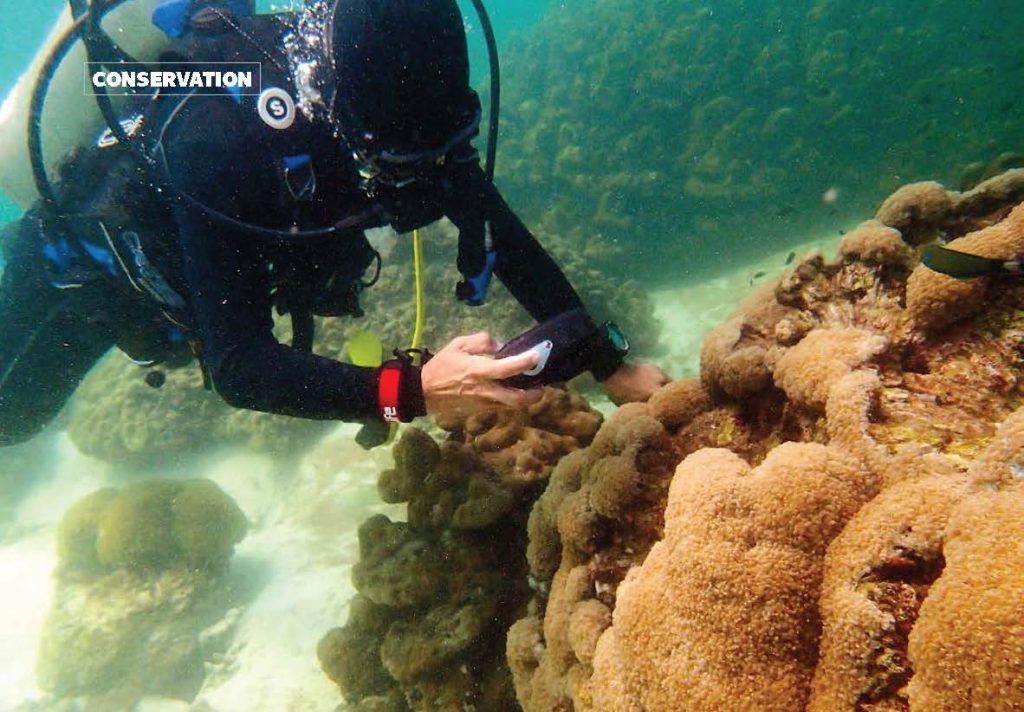
Sponsor investment holding company Bina Darulaman Berhad (BDB) invited local conservation group Ocean Quest to survey the damage and take the necessary steps to help rehabilitate the reef at Pulau Payar. With records dating back to 1998, Ocean Quest was able to make observations pertaining to the degradation of coral species and establish a comparison between the earlier state of the reef and the current situation. Density and diversity observations that were conducted gave an indication of the general state of health of the reef system. As well as noting the degradation of the reef, the potential recovery of important species was also recorded.

PULAU PAYAR MARINE PARK Pulau Payar is located 24 nautical miles to the southeast of Langkawi, off the northwestern coast of Peninsular Malaysia. The park is at the northern proximity of the Malacca Straits facing the Andaman Sea, and as such, its marine biodiversity approximates that of the Andaman. This makes Pulau Payar the only assessable island in Malaysia that hosts marine species similar to those of the Andaman Sea and the Indian Ocean, such as the collared butterflyfish and the schooling bannerfish. These are species that cannot be found off the east coast of Peninsular Malaysia.

The Pulau Payar group of islands consists of Pulau Lembu, Pulau Kaca, Pulau Segantang and Pulau Payar. With the exception of the marine park rangers, there are no inhabitants on the islands, but every day visitors to the park, who arrive in the morning and leave in the afternoon, number more than one thousand on average. Lately, visitor numbers have been lower than usual following the recent unfortunate incidents involving Malaysian Airlines passenger planes, but on the day Ocean Quest conducted its reef survey, an estimated 600 tourists were still coming to Pulau Payar daily. There is little doubt that the park is one of the key attractions for visitors to Langkawi.

BIODIVERSITY
Due to its unpredictable water visibility, Pulau Payar is not a popular diving destination for local scuba enthusiasts. But the diversity of marine life here more than makes up for this lack of water clarity. Divers will find more critters on a single dive at Pulau Payar than anywhere in the clear waters off Peninsular Malaysia’s east coast. An entry in a dive log during an exploration of the reefs in 2005 describes the riches of Pulau Payar. By comparison, while the diversity of marine life at these sites is still high today, the density of species has dropped significantly.

Efforts are in place to record the possible recovery of less common marine species


THE PROGRAMME
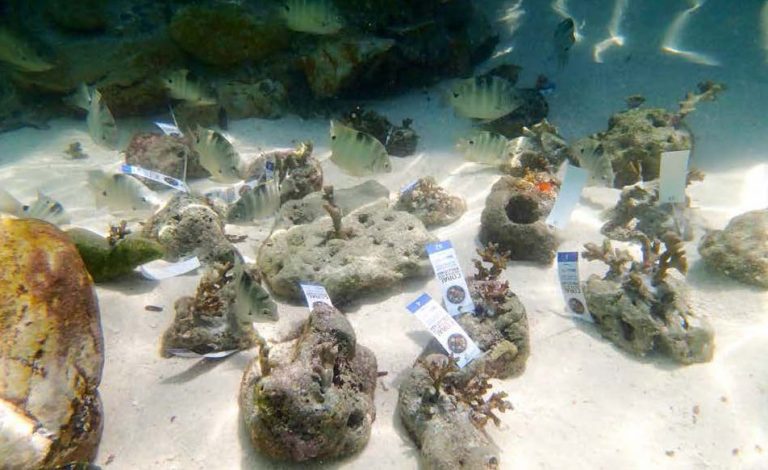
The effort to rehabilitate Pulau Payar is centred around the BDB-sponsored coral propagation programme, officiated by Director of Marine Parks for Kedah, Mohd Nor Ashri bin Haji Basari. Some 65 participants, led by the company’s managing director, Datuk Izham Yusoff, are involved in the programme, including media, crew and employees.

For this programme, four coral propagation trainers from Ocean Quest assisted by members of the diving community from within the state carry out the necessary underwater tasks, while BDB employees and the media help with tasks on shore under the supervision of the trainers. Diving equipment and logistics are provided by Iskandari Dive Center, based in the Kedah state capital Alor Setar. Thus, just as it was designed to do, the Ocean Quest coral propagation programme involves the local diving community and all the relevant stakeholders.

CORAL PROPAGATION
The health assessment carried out in prominent parts of the reef reveal that the corals are healthy despite the appearance of physical damage in shallow areas. Coral growth indicates that the staghorn corals (Acropora formosa) are gradually recovering. This species was almost totally wiped out from 1999 until the last observations were made in 2005. Now small patches of branching corals can be seen along the reef front.

For the rest of this article and other stories, check out our latest Asian Diver Issue 5/2014 Vol.134)  here or download a digital copy here.