Home Blog Page 59

Andaman at Night

0
The Andaman: Among the last places in the world with a minimal human footprint

Text by Vandit Kalia & photos Vikas Nairi Subba

After chasing wrong leads on night diving in the Andaman, Asian Diver finds one of the only legit sources of information and plunges into a rather unknown destination to discover sleepless bliss.

While the diversity of marine life and the high biomass on the reefs of the Andaman Islands are making this jewel of the Indian Ocean a popular choice among the diving community, night dives remain a very underrated speciality in the region. For a variety of reasons, it has almost been an afterthought, which is unfortunate, as night dives here present opportunities to see and photograph “cool stuff” for divers and underwater photographers of all experience levels.
Diving off the beaten path: This region is one of the last unexplored diving frontiers in the world

One of the most accessible dive sites for all levels is The Wall. A ledge running northwest to southeast – with its top at nine metres, sloping gradually on its westerly side and dropping sharply down to 60 metres on its easterly side – The Wall is located at the mouth of a channel between Havelock and Peel Islands. It has nutrient-rich water flowing through it, which has resulted in a very high density of both fish and various macro species.

Popular during the day, it is also a very enjoyable night dive and accessible to divers of all levels. A nice strip of sand running along the western side allows student divers to rest on the bottom while watching the marine life. This is a boon for photographers too. Given the dimensions, one doesn’t need to do a lot of finning in order to cover the entire site. Indeed, some of the best dives to be had here are ones where divers hardly move at all!

Typically, descents are done at dusk, so that divers get to watch the packs of bluefin and giant trevally hunting the huge schools of fusiliers, and if you’re lucky, you may get to see passing bumphead parrotfish as they rush to settle in for the night.
The Andaman: Among the last places in the world with a minimal human footprint

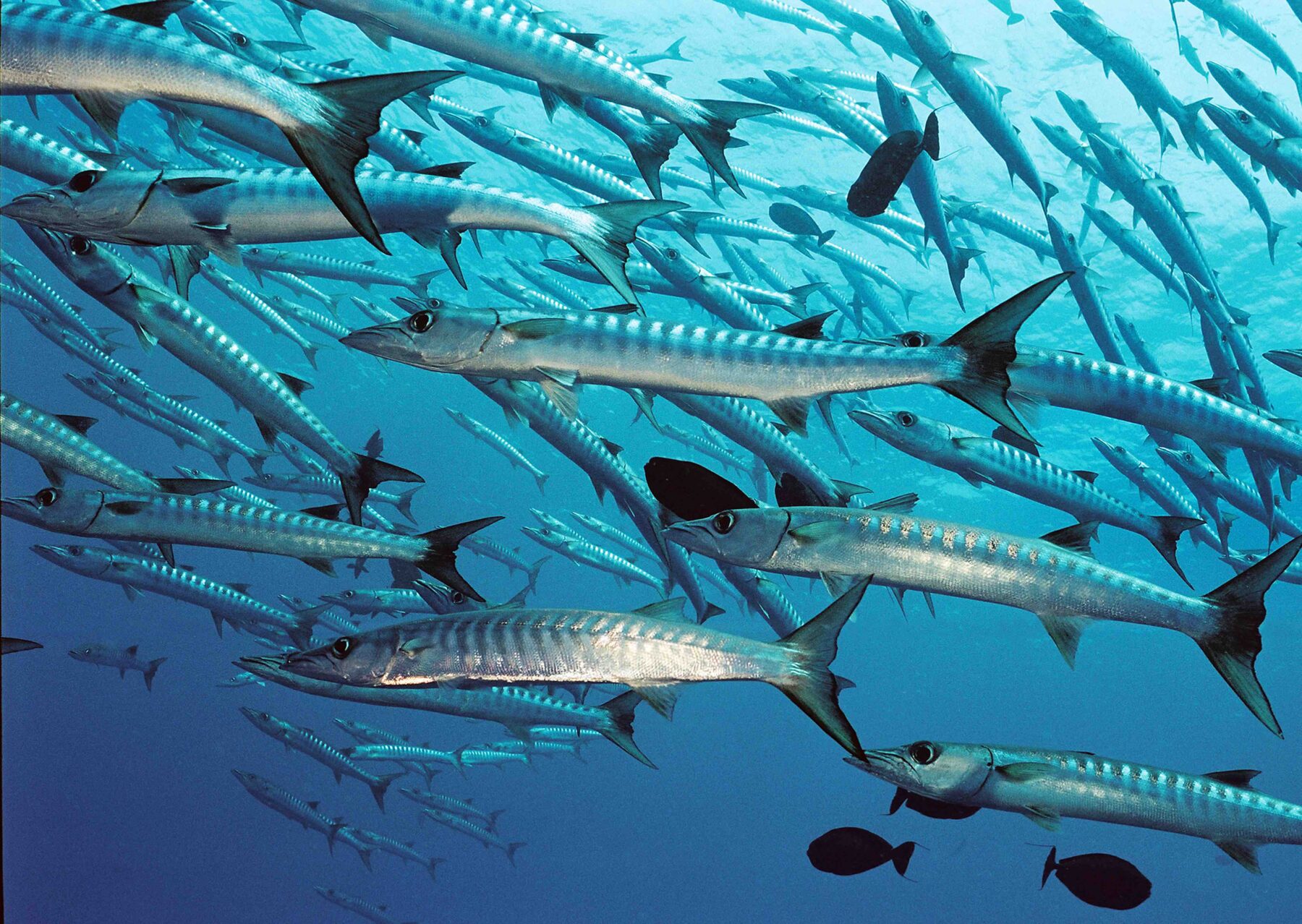
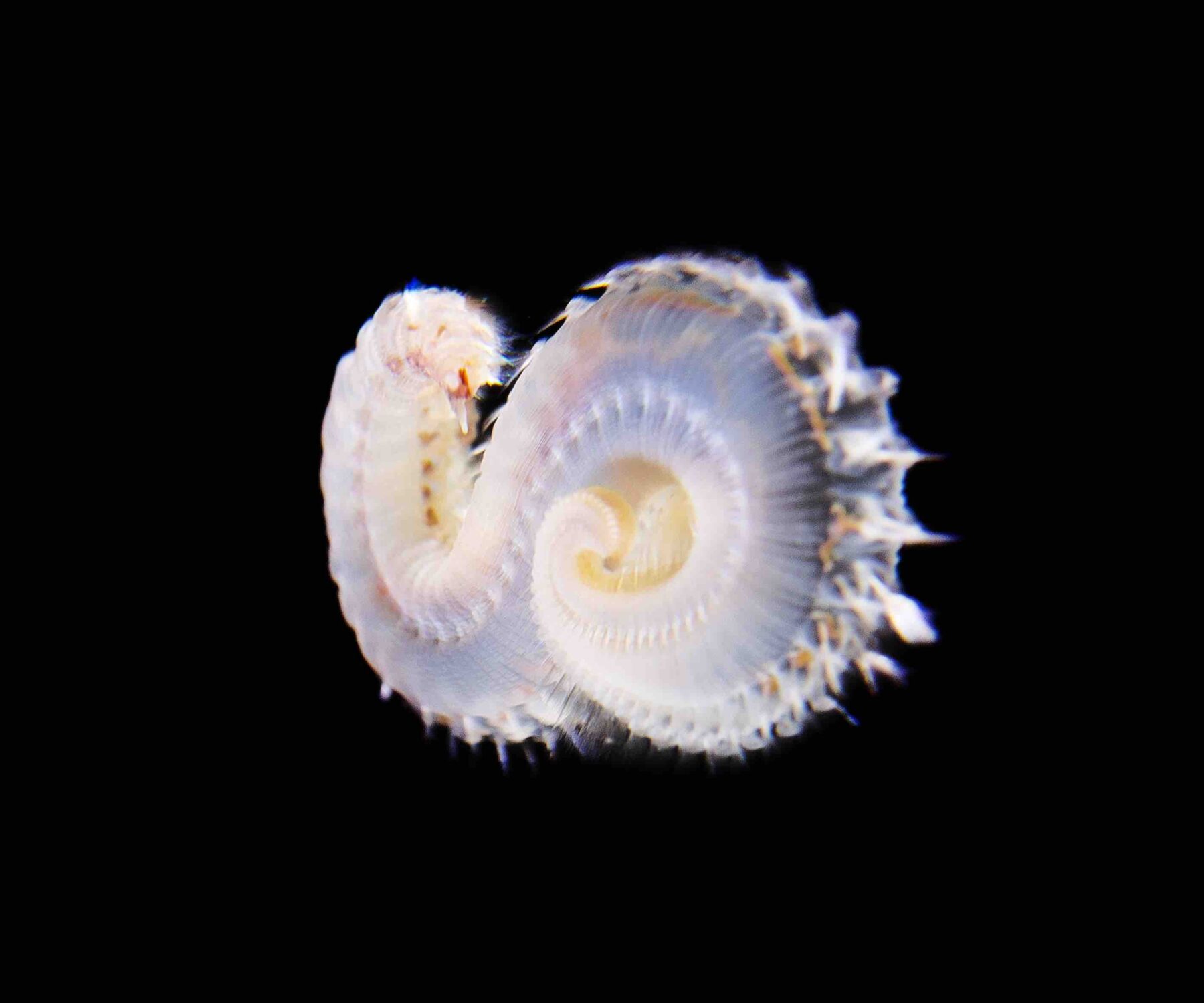
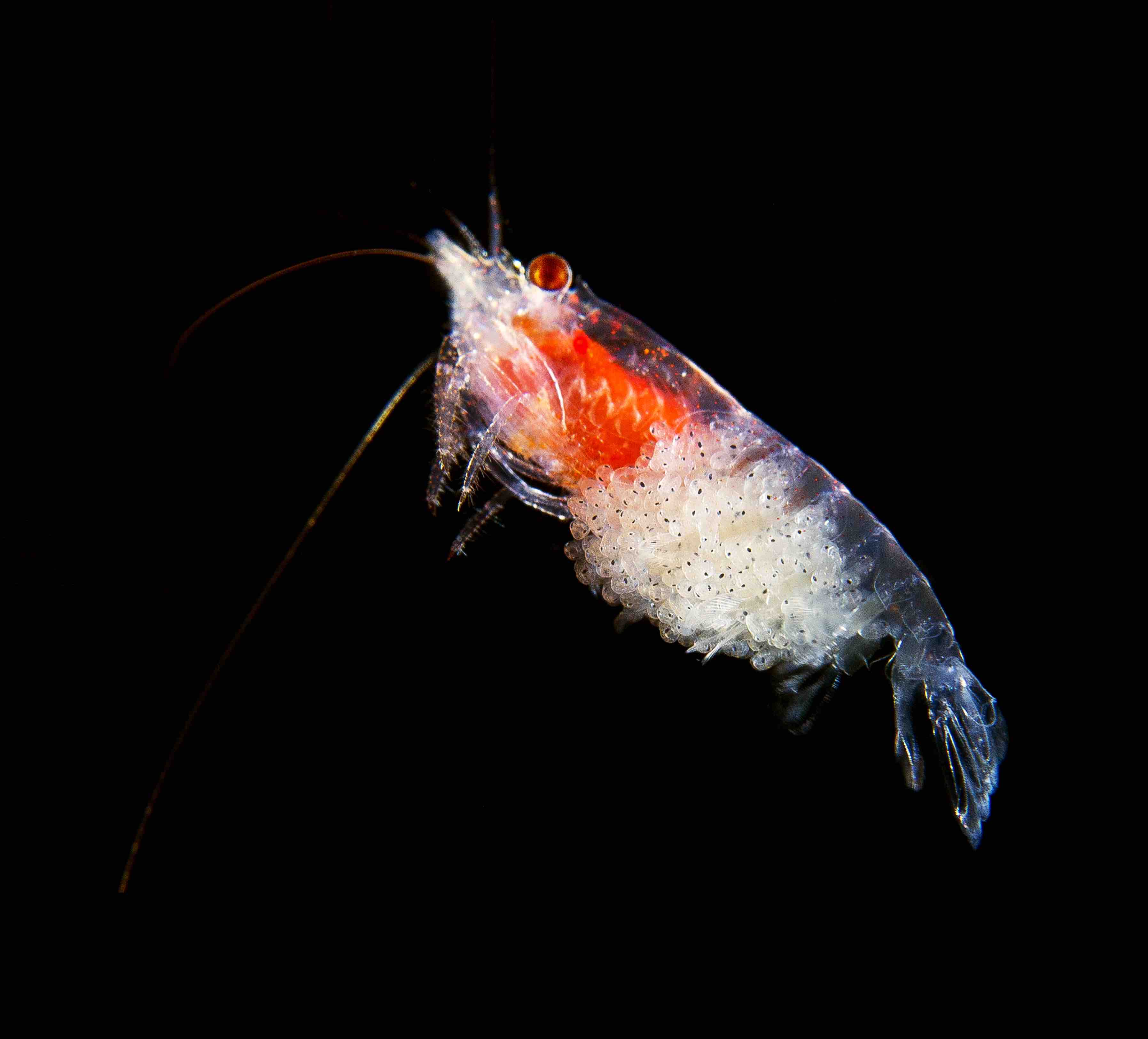
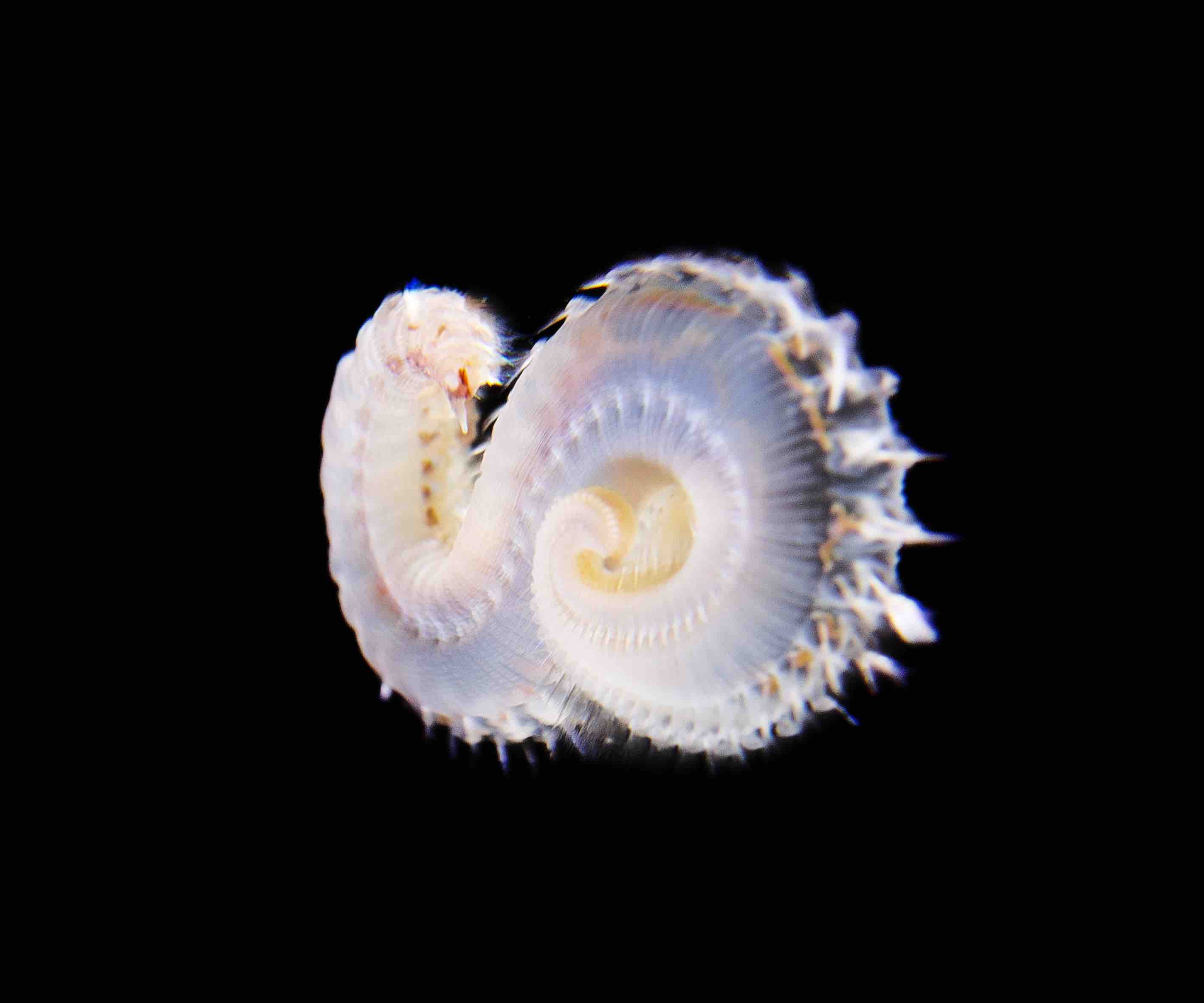
Once darkness sets in, divers can expect to see plenty of scorpionfish, lionfish and parrotfish sleeping in a cocoon made of their mucus, the odd giant barracuda, giant moray eels, resident stonefish, filefish, cuttlefish and octopus, groupers, multiple species of snapper, pipefish, and various crustaceans, as well as a variety of nudibranchs, feather and basket stars, and a plethora of sea urchins. The lucky ones who plunge in at the right time/season have come back having spotted the odd frogfish, ornate ghost pipefish, pygmy cuttlefish, and harlequin shrimp, just to name a few.

Depending on the interest of the diver, it is possible to get the opportunity to watch mating and spawning behaviour of select species such as the octopus and sea cucumber. For those who are interested in the extremely tiny, you can simply float in darkness over the reef marvelling at the different species of plankton.

For the rest of this article (Asian Diver 2015 Issue 4 No 139) and other stories, check out our past issues here or download a digital copy here.

The 25th anniversary of the largest and longest running dive show, Asia Dive Expo (ADEX) is set to occur on the 11-14th April 2019. Centred on the theme – Plastic free Future, ADEX is more than just a dive show with its commitment to the environment. Among an exciting lineup of programs, attendees can look forward to a Future Forward Series of Panel Discussion on the Single-Use Plastic Conundrum in Asia, on 13th April.

So join us at the event, get inspired and for all you know, you might just liberate the inner diver in you! More details of the event here

Phenomenal Fisheyes

0
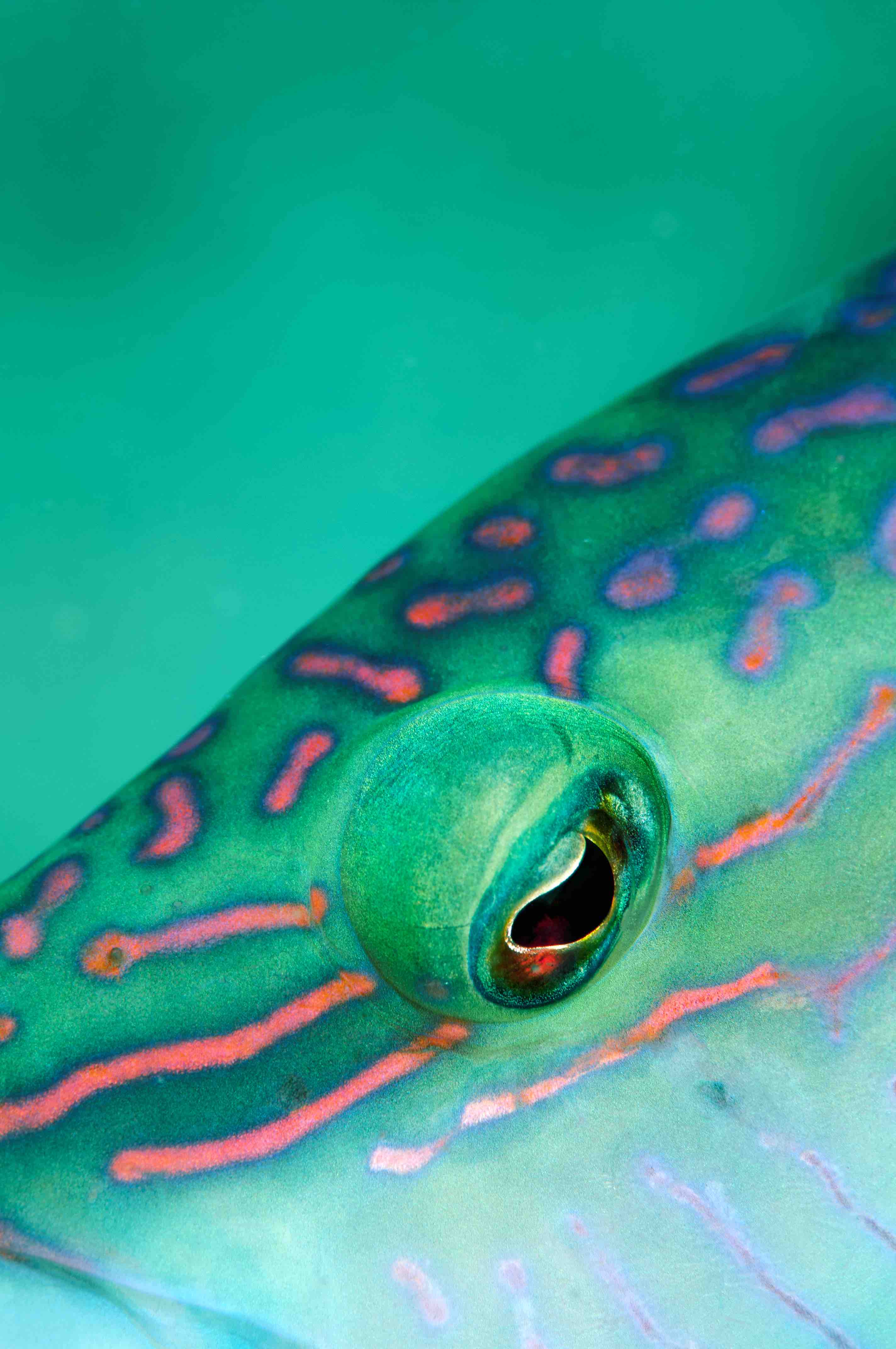
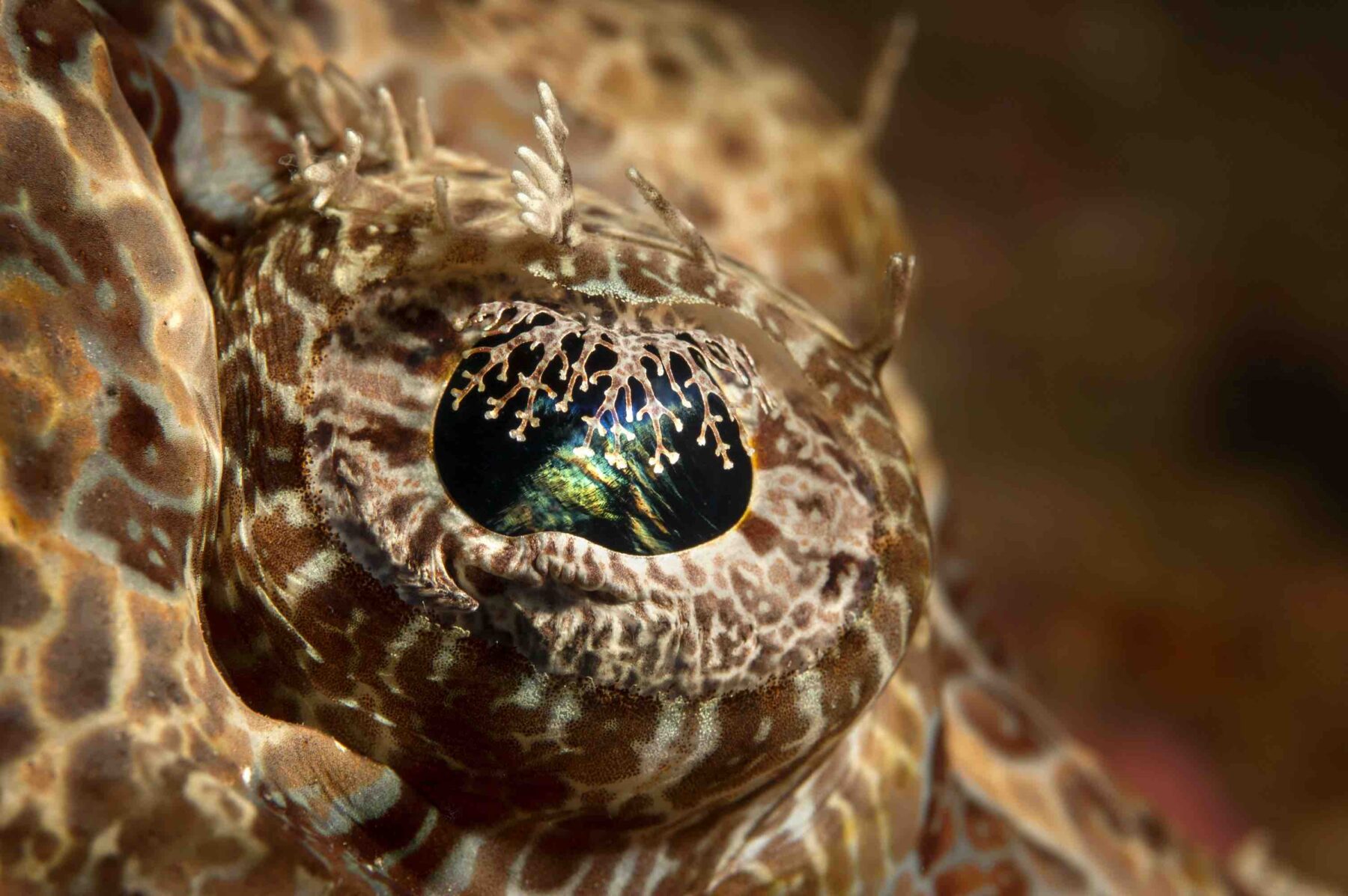
The eyes of the crocodilefish, Cymbacephalus beauforti, have frilly iris lappets, which help break up the black pupil of the fish, and thus improve its camouflage

Text by Chetana Purushotham & Images by Umeed Mistry

The ways of light in the ocean

  • The light spectrum comprises a rainbow of different wavelengths (400nm to 700nm) that are perceived as different colours.
  • Light operates in the ocean differently than on land.

  • Most of the light hitting the water surface is reflected back into the atmosphere. The rest is absorbed or scattered by the seawater and creatures living in it (such as plankton). Different wavelengths are affected to different degrees with increasing depth or horizontal distance.

  • Longer wavelengths of light are absorbed and scattered quickly and lost within tens of metres (like red and orange), while shorter wavelengths attenuate less and travel much further and deeper in the ocean (blue)
  • Despite being scattered easily, ultraviolet light accounts for a substantial number of the light particles near the water surface and sometimes up to 18% of the light available even as far as 100 metres deep in the ocean

  • Practically no light can reach beyond 400 to 700 metres deep, where fish produce their own source of light (bioluminescence) or utilise heightened senses other than vision.
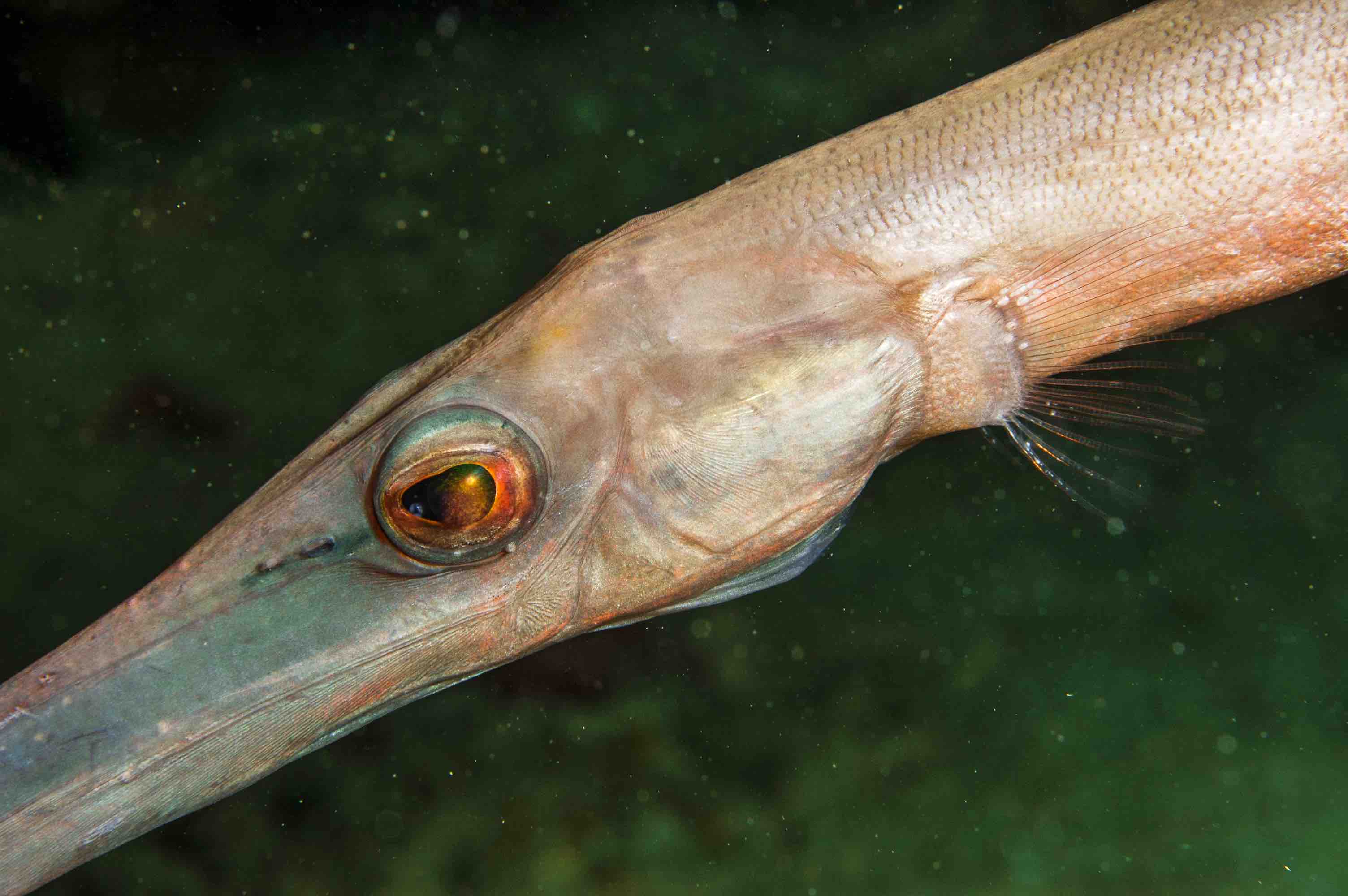
Trumpet, or cornet, fish have incredibly good eyesight which assists them in capturing their prey

The wonders of UV

  • At least 100 species from 26 fish families can detect UV light. Several species are adorned with colours and patterns that reflect UV and can only be seen by fish equipped with eyes possessing the necessary light-sensitive pigments. Some examples are thread-fin butterflyfish, Chaetodon auriga (on its dorsal fin-edge) and coral grouper, Plectropomus leopardus (markings on the flank).
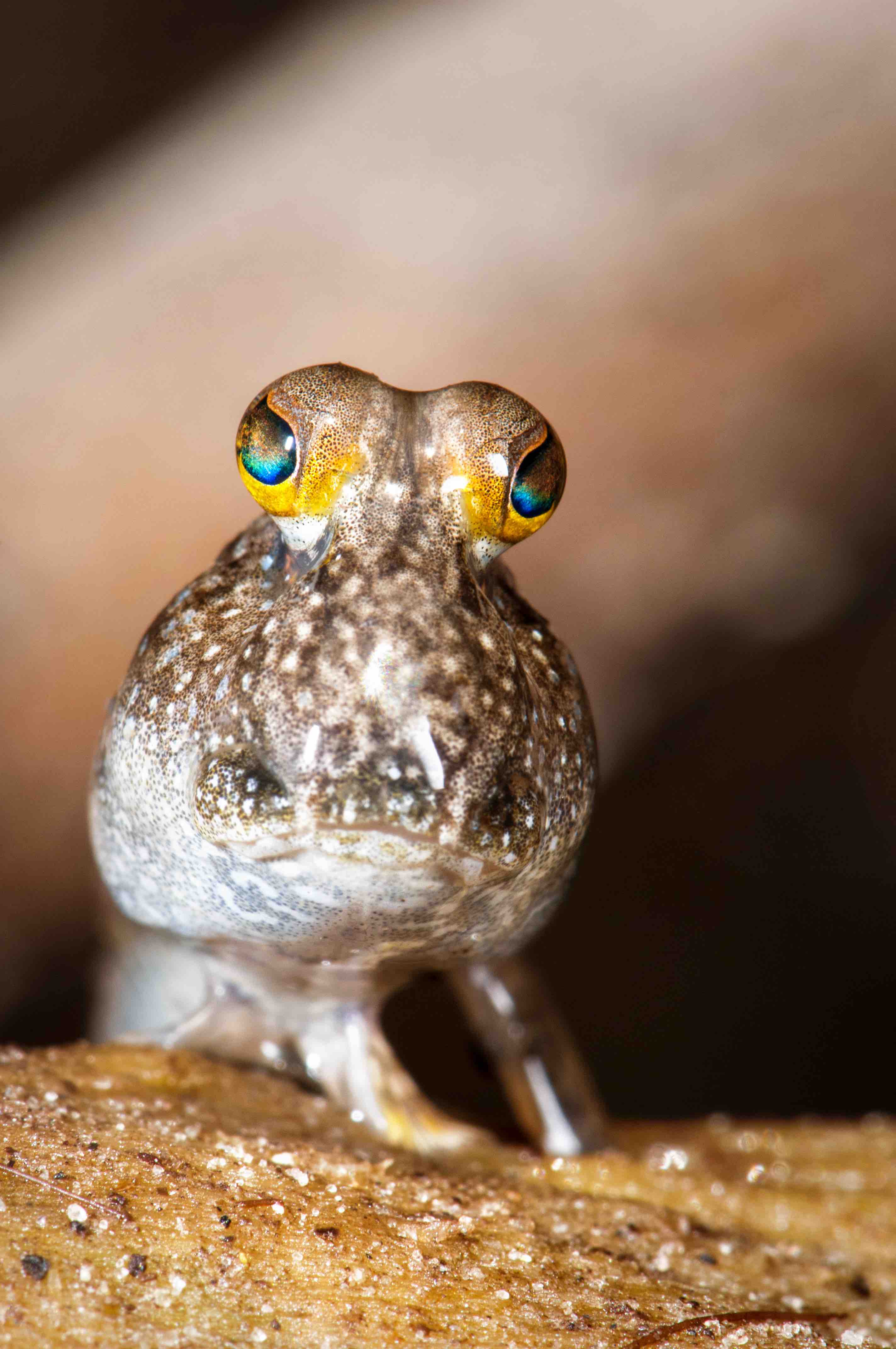
The eyes of the mud skipper are actually better adapted to see in air than water
  • Colour vision helps fish communicate with competitors, allies and mates, hide from predators, and search for prey. UV vision is thought to enhance these functions further:
    1. Detecting predators and prey, since objects appear in much higher contrast against their backgrounds when seen in UV

    2. Identifying others of the same species (two-stripe damselfish, Dascyllus reticulatus)

    3. Coordinating with neighbours while schooling (green chromis, Chromis virdis)

Some creatures, such as this splendour wrasse, may seem conspicuous, but to other fish their patterns appear to blend in with the background

For the rest of this article (Asian Diver 2016 Issue 1 No 140) and other stories, check out our past issues here or download a digital copy here.

The 25th anniversary of the largest and longest running dive show, Asia Dive Expo (ADEX) is set to occur on the 11-14th April 2019. Centred on the theme – Plastic free Future, ADEX is more than just a dive show with its commitment to the environment. Among an exciting lineup of programs, attendees can look forward to a Future Forward Series of Panel Discussion on the Single-Use Plastic Conundrum in Asia, on 13th April.

So join us at the event, get inspired and for all you know, you might just liberate the inner diver in you! More details of the event here

Lap of Luxury

0
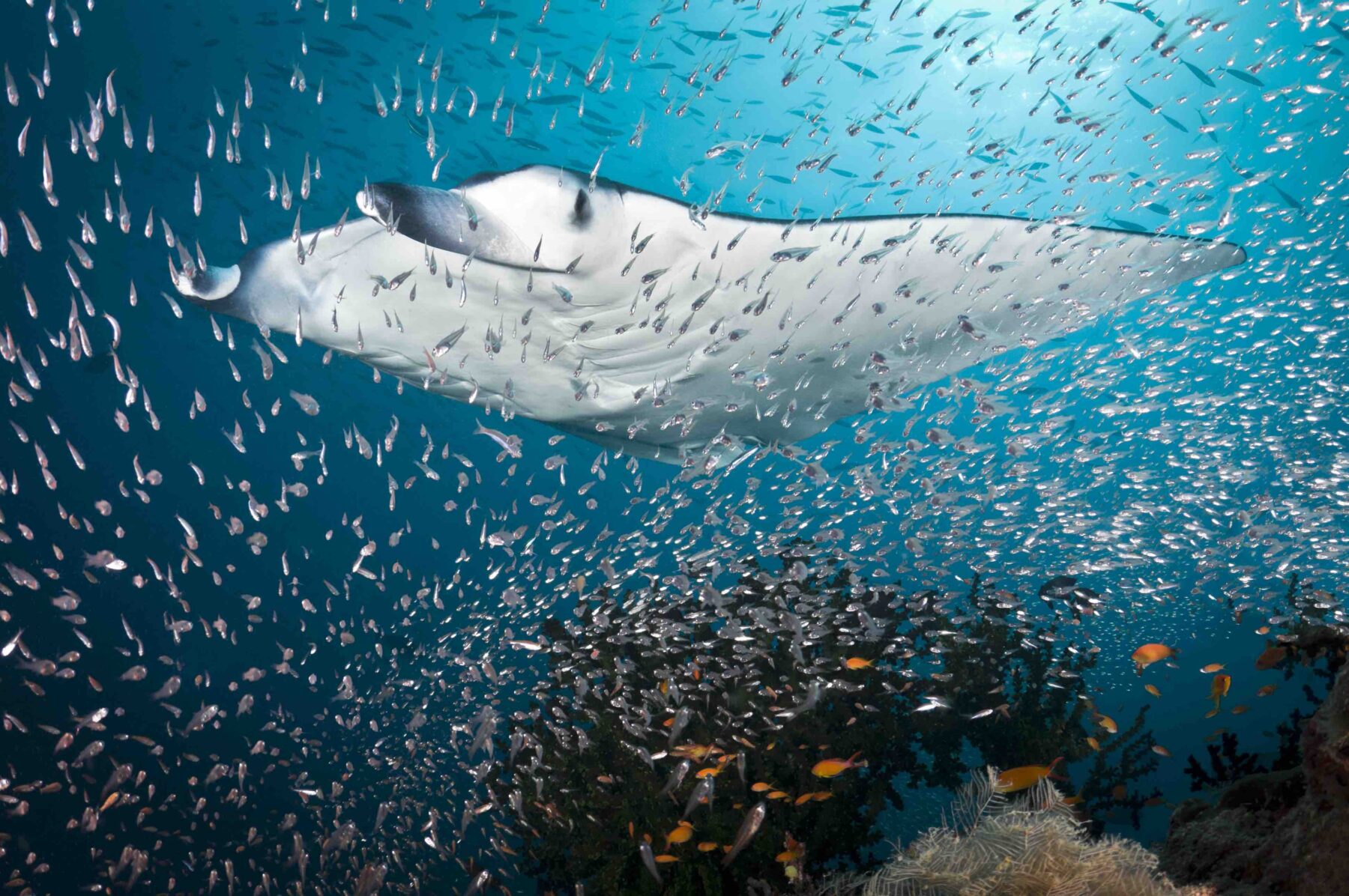
Glassfish crowd a manta at a cleaning station

Text and Images by Erin Quigley

Situated southwest of India and Sri Lanka in the Laccadive Sea, the Maldives is comprised of 26 natural atolls that envelop almost 1,200 islands. Ninety-nine percent of the nation is covered with water, and what little land there is barely breaks the surface, averaging an elevation of only three feet above sea level. As such, this one-of-a-kind archipelago is a mecca for underwater photographers dreaming of dramatic manta aggregations, abundant fish life, and vivid soft-coral seascapes.

Diving in MALDIVES 

The two most common types of dive sites in the Maldives are channels (kandu) and pinnacles (thilas). Because of the unique topography, currents sweep from the outer reefs of the atolls (dhuni) through channels and passages, carrying with them the nutrients that support the vast numbers of fish and dense assortment of sponges and soft corals that decorate almost every dive site.

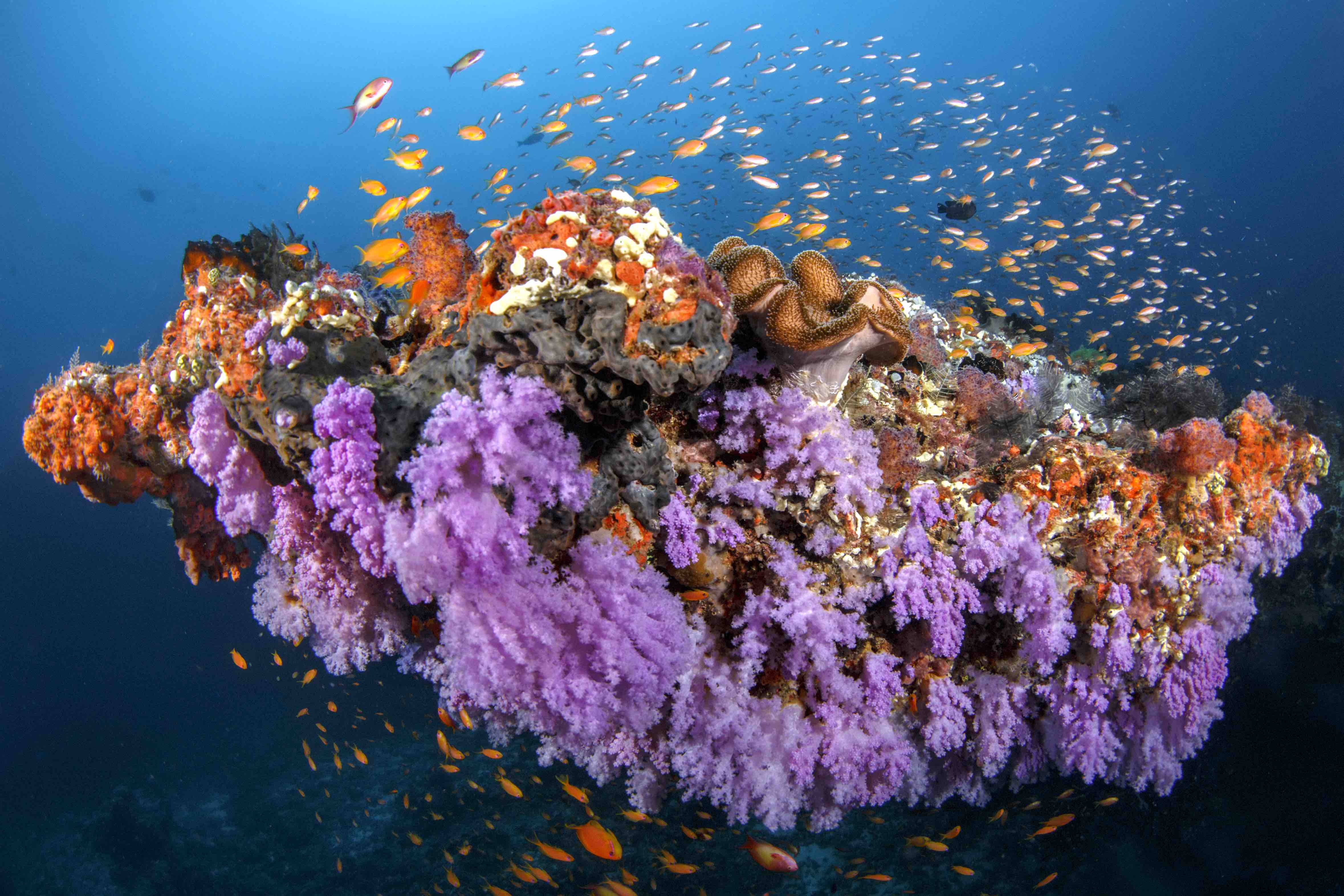
A purple soft coral bommie is crowded with anthias

The northern half of the country is characterised by pinnacles and internal reef structure (faru), covered in clouds of colourful reef dwellers, while in the south, pinnacles are less common, instead giving way to current-swept channels full of sharks, making it more suitable for more-advanced divers. Though there is, of course, macro life on every reef, it’s surprisingly sparse photographic fare, especially in light of the tremendous wide-angle opportunities that abound.

The Maldives is a great place to shoot behaviour, not just on the operatic scale of the feeding aggregation in Hanifaru, but because of the many schooling fish and cleaning stations, where colourful smaller species add an interesting element to any shot of a larger animal. Most dives are drifts, and many are relatively deep; spending a large part of a dive between 20 and 30 metres is common.

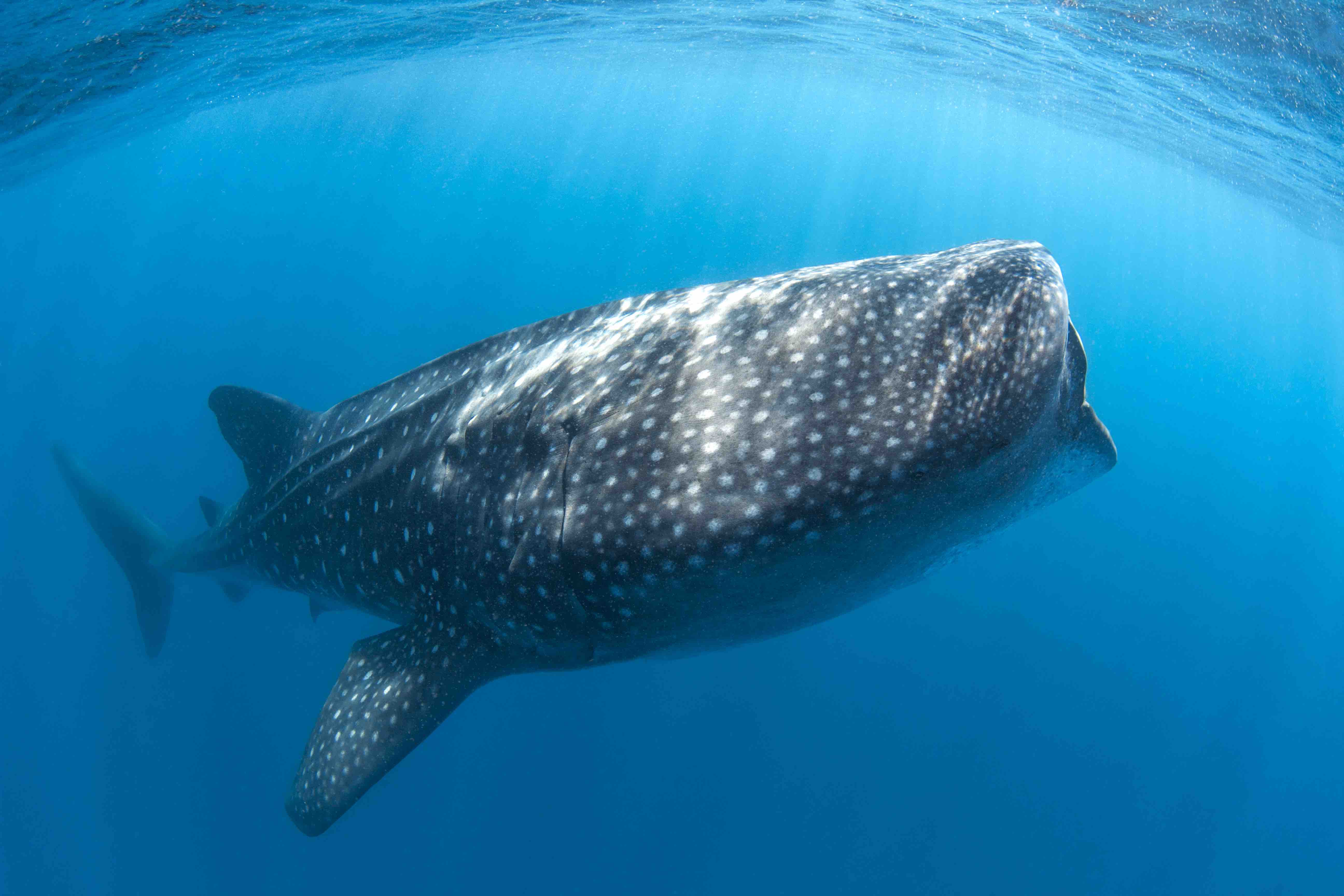
Whale sharks are found all year round in the Maldives

Macro Subjects:

The Maldivian reefs have an abundance of small reef dwellers. Crustaceans and eels, gobies, blennies, frogfish, pipefish and nudibranchs can be found on many dives. DSLR users, cross your fingers that “Mr. Big” doesn’t arrive on the scene while you’re set up for the small stuff!

Wide-Angle Subjects:

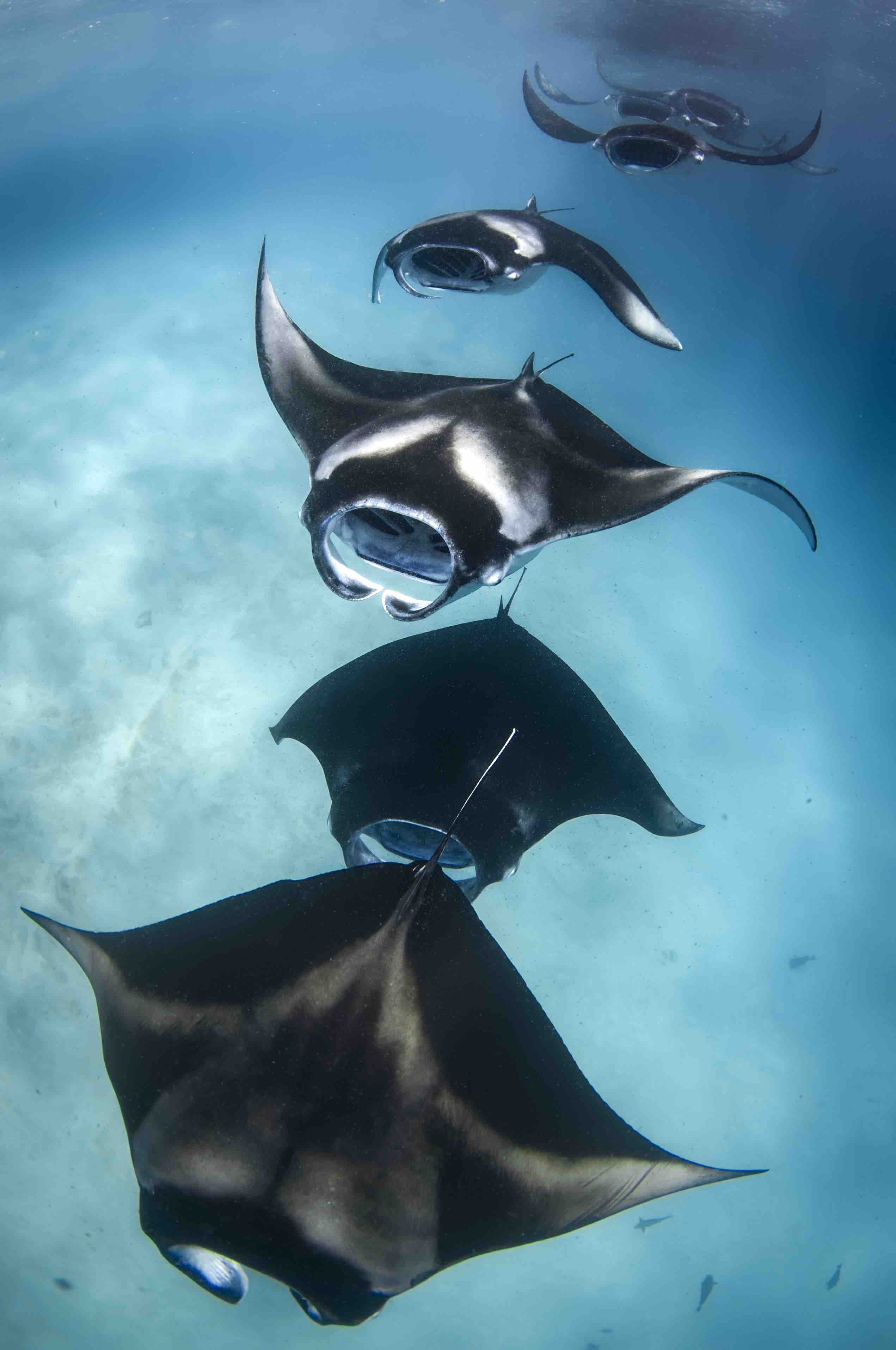
The Maldives provides epic opportunities for wide-angle shooters. Dozens of mantas in a column, somersaulting backward as they feast on krill, make for dramatic stills and jaw-dropping video. Walls of bannerfish, whale sharks, guitar sharks, spotted eagle rays, mobula rays, dolphin, turtles and even sailfish are common sights. Reefs covered with multihued soft corals and teeming with vividly coloured reef fish are also perfect subjects for a wide-angle lens.

A classic manta feeding “train”

Tips and Techniques

Novice
MANTAS AT CLEANING STATIONS

Stay back from the cleaning station until the mantas feel comfortable, and always stay below a manta’s flight path. Don’t chase them – let the mantas come to you, and don’t forget to look behind you from time to time. Agree in advance to keep your whole group on one side of the cleaning station, and choose the side with the sun at your back for easier exposures. Upward angles and strobes work well in shallow cleaning stations, especially if the animals get close. Change your diving schedule if other boats are on a station. Too many people may spook the mantas, making good images difficult.

SOFT CORAL

Soft coral needs current to bloom, so even though it’s a stationary subject, decide on an approach strategy. Set your camera to f/8 and about 1/160s, ISO100–200. Pull the strobes back and up, behind the handles and above the midpoint of your housing. The strobes should be as far from the housing as the subject will be from the port. Swim a little way upstream and fire off a few shots as you drift back towards the subject. Review and adjust your settings, and repeat the process.

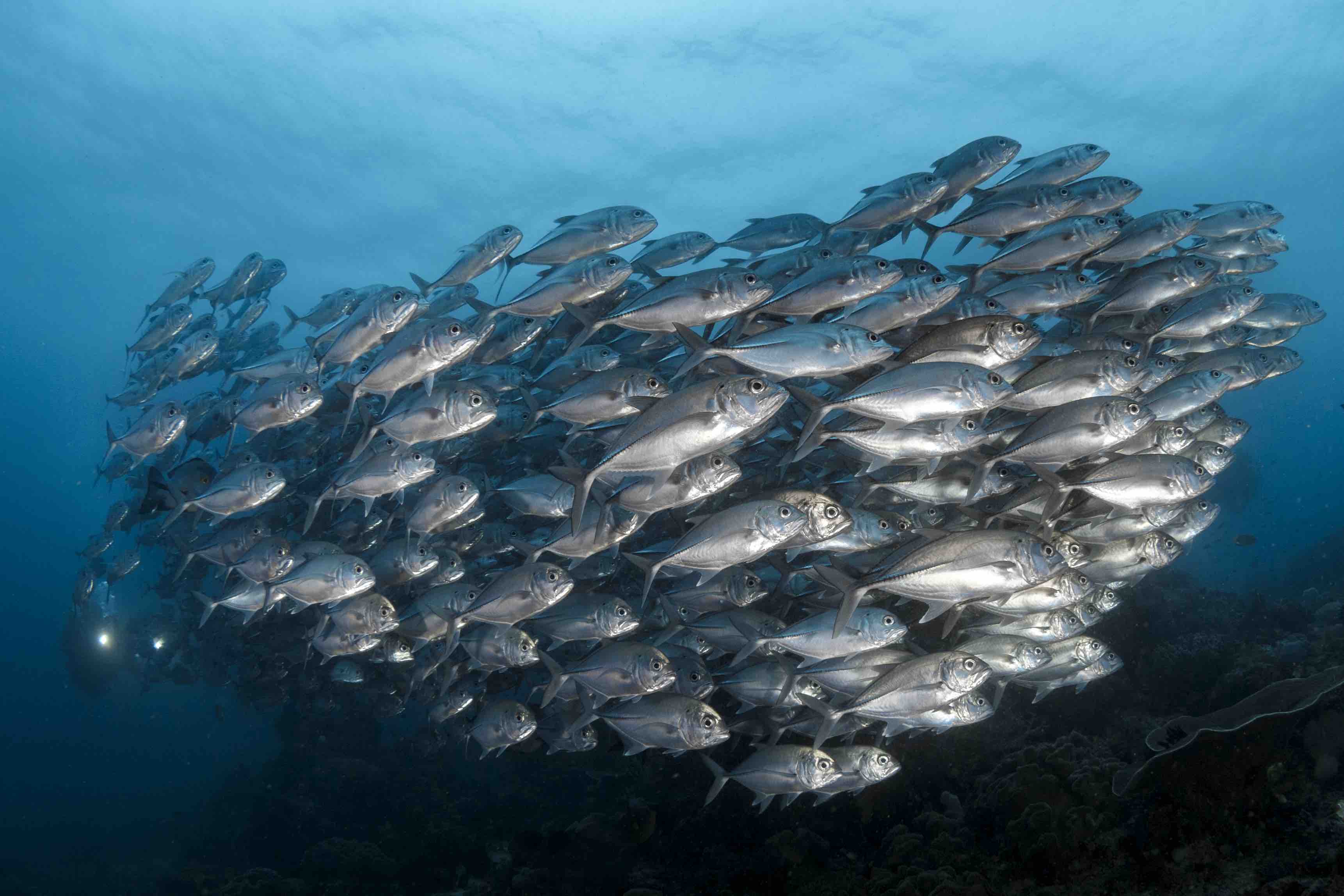
Photographers follow a large school of jacks

For the rest of this article (Asian Diver 2013 Issue 6 No 129) and other stories, check out our past issues here or download a digital copy here.

The 25th anniversary of the largest and longest running dive show, Asia Dive Expo (ADEX) is set to occur on the 11-14th April 2019. Centred on the theme – Plastic free Future, ADEX is more than just a dive show with its commitment to the environment. Among an exciting lineup of programs, attendees can look forward to a Future Forward Series of Panel Discussion on the Single-Use Plastic Conundrum in Asia, on 13th April.

So join us at the event, get inspired and for all you know, you might just liberate the inner diver in you! More details of the event here

Newborn

0
As the giants congregated, I realised that I was fully accepted

Text and images by Kurt Amsler

American whalers came to the Azores, a distant 1,564 kilometres off the coast of Portugal, in the early 19th century. Although they did not initially operate in these waters, the islands were used for provisioning and supplementing crews with young men from the archipelago. In time, Azoreans took up whaling themselves, establishing their own whaling stations along the coast.

Whaling in the Azores significantly declined in the 1970s and officially ceased with the International Whaling Commission (IWC) ban in 1986. Instead, a lucrative business now thrives where visitors hunt whales with cameras rather than harpoons.

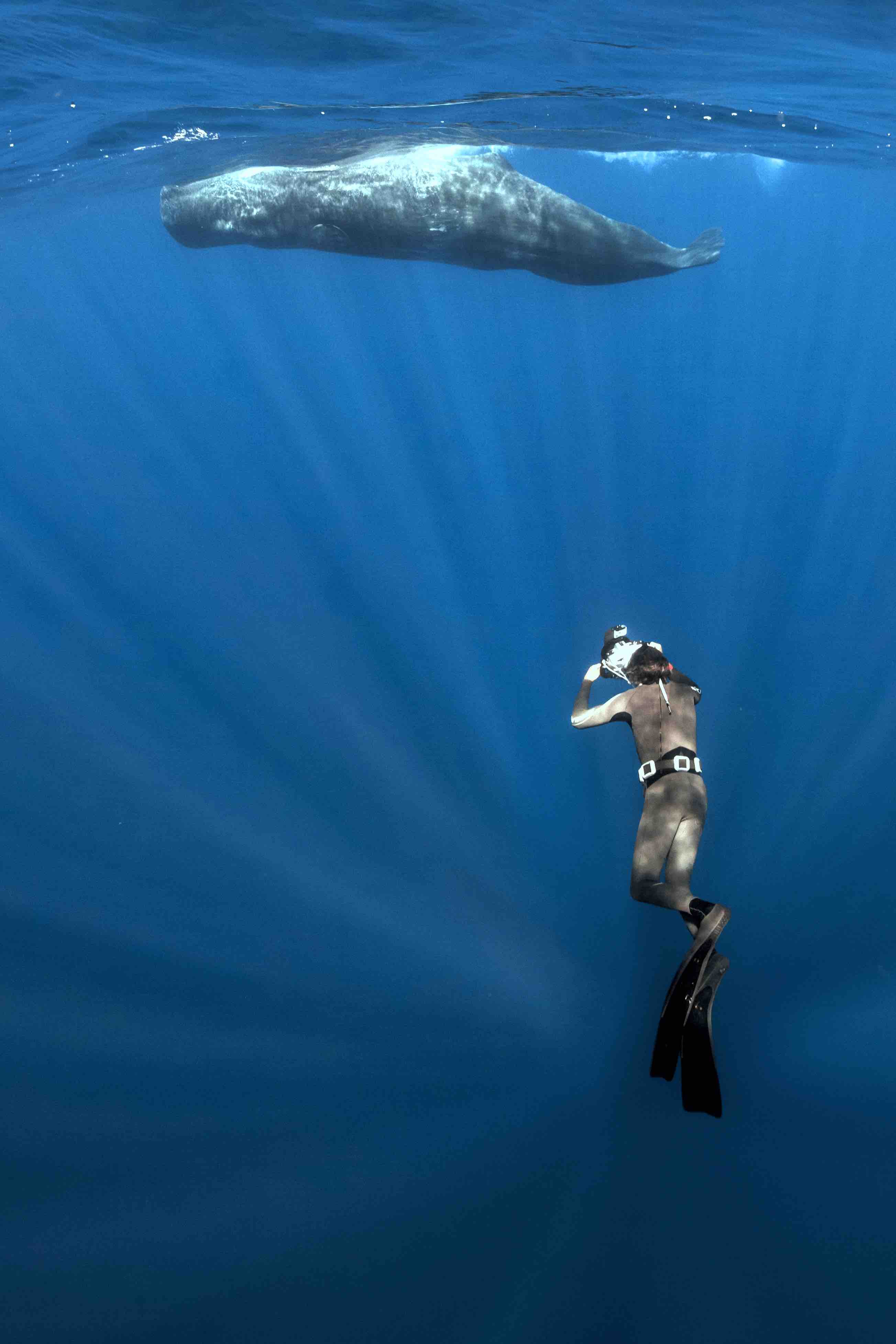
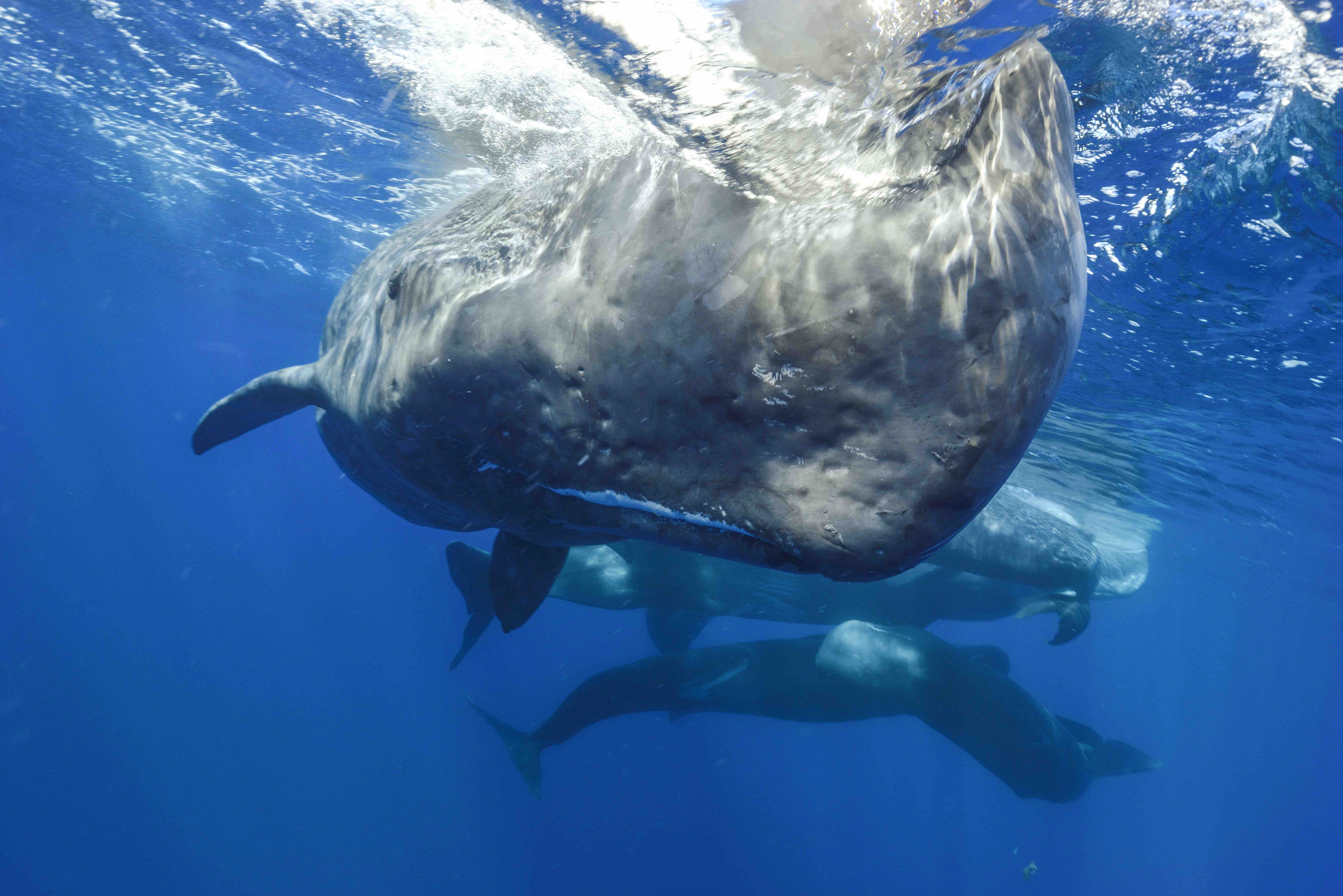
Both technically and physically, sperm whale imagery poses some of the greatest challenges to the underwater photographer. In addition to being extremely shy, sperm whales use echolocation to detect sound and movement for up to several kilometres. To avoid scaring them away with engine noise and bubbles, boats must remain far from the whales, and freediving is the only practical way to approach them.

For five, long days we cruised the islands of Faial and Pico in the Azores. Nine hours a day in a small boat gets extremely tiresome, but it is a necessary experience in order to gain close encounters with the magnificent giant sperm whales of the Atlantic.

Freediving is the only practical way to approach sperm whales

The day started promisingly with three sightings and an underwater encounter to within about 14 metres. From a small boat like ours, it was not possible to see whales from the surface. Therefore, we worked with two vigias da baleia who watch out for whales from hillside observation towers, remnants from commercial whaling days. The boat’s radio suddenly crackled, and from the driver’s reaction I could tell it was a good message. A group of about six animals had been spotted about one nautical mile to the south.

Courtesy of twin 150-horsepower motors, we reached the spot quickly and there was our prize. The pod was swimming in circles very slowly, which was decidedly unusual behaviour. We cut the motors to avoid scaring them away, and kept to a safe distance of about 150 metres. With a last look at the pod’s position, I gently slid into the water.

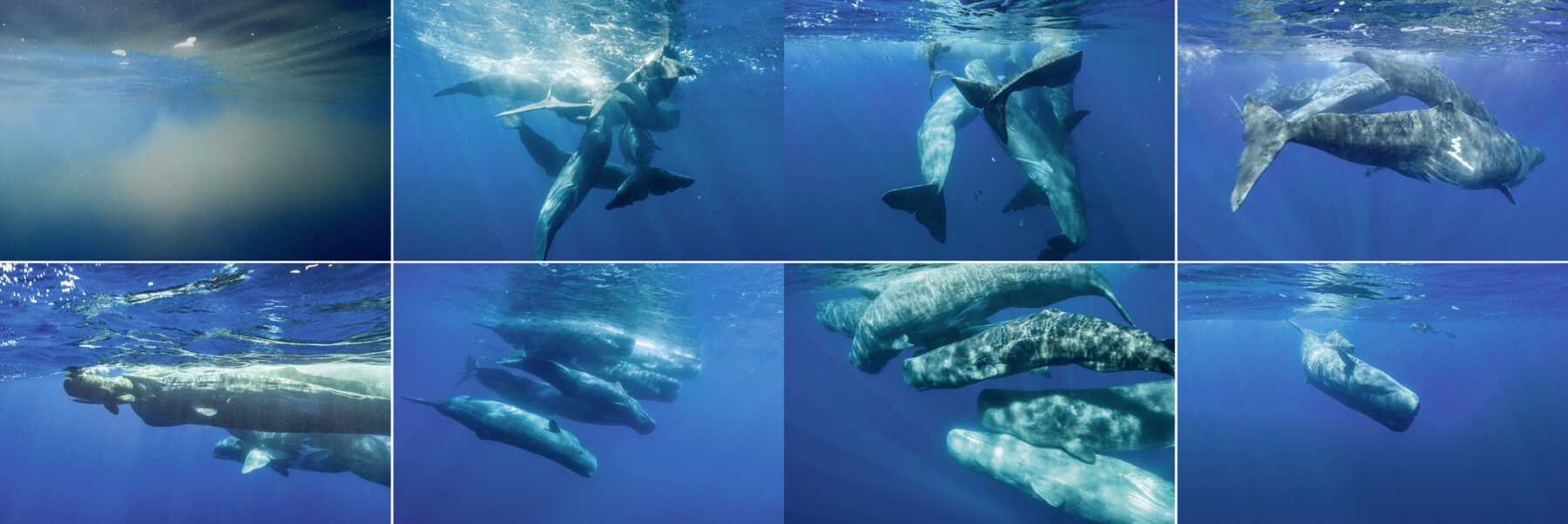
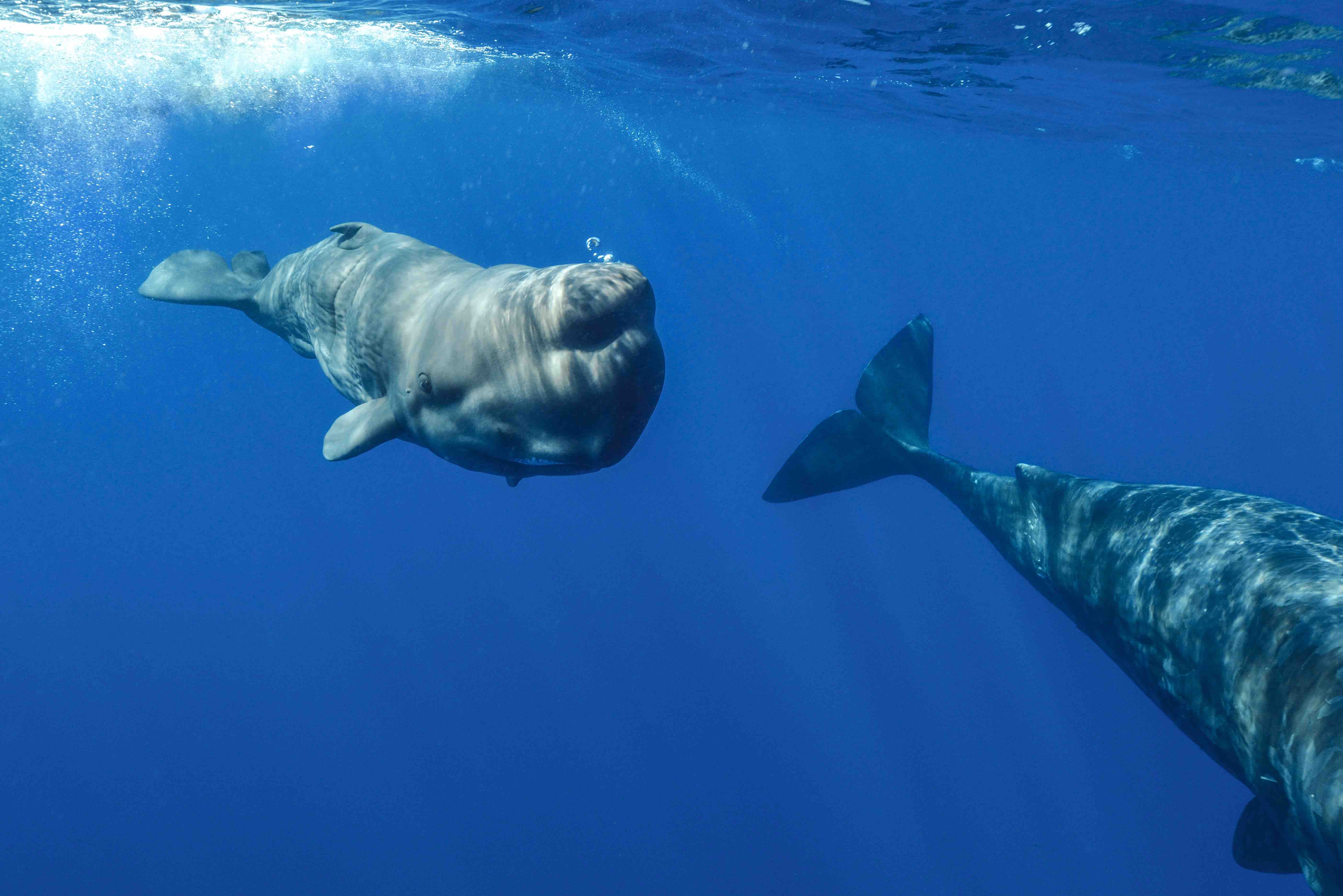
The mother’s massive head got bigger and bigger

For the first 80 metres I swam as fast as possible, scanning the blue to get a glimpse of the animals, but there was nothing but a big murky cloud. I soon realised that the cloud was blood, which appeared greenish because of the loss of red light underwater. This explained the pod’s strange behaviour. I thought they must be watching over a wounded member.

Soon the calf could swim independently for short distances

Female sperm whales are famously social. They form networks with their young and live in groups of 15 to 20 animals. Sexually mature males leave the pod and form associations with older males but travel alone. I assumed, correctly as it turned out, that this was a pod of females. As the whales’ communication sounds intensified and I got nearer, I could discern the group about 30 metres in front of me, huddled just below the surface. But with the sun directly in front of me it was difficult to see exactly what was going on.

I descended to about 15 metres to pass carefully beneath them. My descent revealed that my initial assessment was wrong. There was no wounded animal;  it was a mother giving birth. The placenta and pieces of skin were floating in the water around the calf, which had left the womb only seconds earlier.

For the rest of this article (Scuba Diver 2016 Issue 6 No 9) and other stories, check out our past issues here or download a digital copy here.

The 25th anniversary of the largest and longest running dive show, Asia Dive Expo (ADEX) is set to occur on the 11-14th April 2019. Centred on the theme – Plastic free Future, ADEX is more than just a dive show with its commitment to the environment. Among an exciting lineup of programs, attendees can look forward to a Future Forward Series of Panel Discussion on the Single-Use Plastic Conundrum in Asia, on 13th April.

So join us at the event, get inspired and for all you know, you might just liberate the inner diver in you! More details of the event here

Europe to Ban Single-Use Plastics by 2021

0

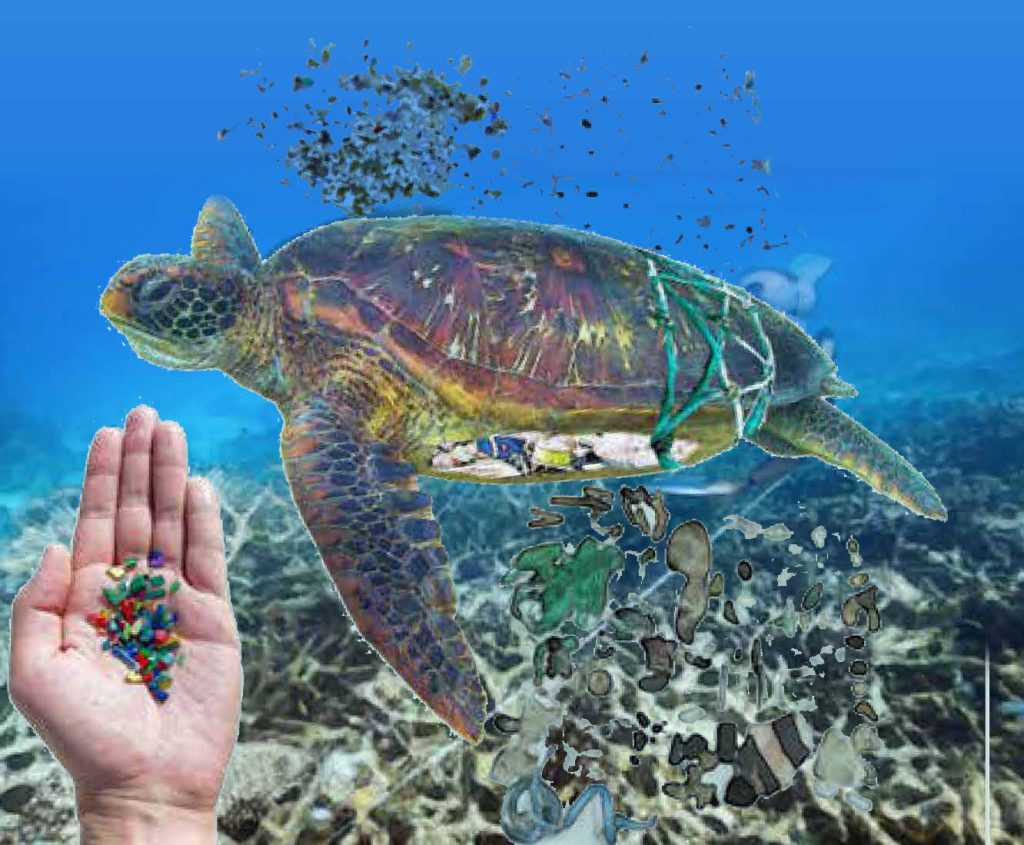
The European Union Parliament has voted to ban single-use plastics such as straws, cotton buds and disposable cutlery and crockery by 2021. Members of European Parliament (MEP) voted 560 to 35 for the ban to come into effect in all European Union (EU) member states to stop the use of single-use plastics as they make up the bulk of plastic pollution in the Earth’s oceans. In the case of the United Kingdom, it would have to comply with this new ruling if the Brexit transition is delayed or extended.

The directive will be published in the EU rulebook after clearing some formalities. EU member states will then have two years to carry out the directive after its publication in the EU rulebook.

Each EU member state will be required to establish new measures to cut down on the use of single use plastics such as plastic food containers and drink lids, oxy-degradable plastics, disposable crockery and cutlery and paper cups and wet wipes which contain a layer of plastic to make them waterproof.

Unlike biodegradable plastics which will break down and decompose into carbon dioxide, water and other naturally occurring minerals, thereafter mixing seamlessly back into the earth, oxy-degradable plastics merely fragment into smaller plastic particles and finally microplastics. There is also no evidence that these microplastics will biodegrade “within a reasonable timeframe”.

Besides requiring EU member states to switch to biodegradable alternatives by 2021, the directive also requires plastic bottles to be made of 25 percent recycled material by 2025 and 30 percent recyclable material by 2030. The directive also sets a target for 90 percent of all plastic bottles to be gathered for recycling by 2029.

The directive was spearheaded by Frans Timmermans, a European commission vice-president, who expressed his views after the vote in Strasbourg on Wednesday, March 27, 2019.

“Today we have taken an important step to reduce littering and plastic pollution in our oceans and seas. Europe is setting new and ambitious standards, paving the way for the rest of the world,” said Timmermans.

The directive will also target fishing companies to pay for fishing nets that are lost and dumped in the ocean and tobacco companies to pay for the costs of collecting waste cigarette stubs that are thrown away.

A Palauan vision

0
Not for the faint of heart: The world-famous dive site is, without a doubt, the most requested dive in Palau

Text and photos Francis Toribiong

I grew up in Palau after the end of World War II; traditionally, every kid went spearfishing with his dad or uncles to bring home our next meal.

Swimming underwater with my WWII Japanese pilot’s goggles, I suddenly realised that I was not looking at the fish as my next dinner. I was fascinated by the richness of Palau’s underwater beauty.

Palau’s Blue Holes offer some of the best and most diverse dive sites on the planet

My goal was to stay as long as possible underwater on a single breath and explore it. In early 1960s, some of the pioneer divers came to Palau, including Jacque Yves Cousteau aboard his boat, the Calypso, leaving a great impression on me. They taught me how to dive and I made up my mind to become a professional diver.

From early days, I realised that the ocean has no limitless resources and we have to protect it. Fortunately, Palau’s traditional leaders and government were instrumental in declaring Palau a marine sanctuary and later, a shark sanctuary.

It took us, the diving community, half a century to convince the world that sharks need our protection and I hope it is not too late.

Get ready for the ride of your life: Strong currents upwelling from the depths attract some pretty awesome sealife

Blue Corner is one of the world’s most known dive sites and often divers ask why “Blue Corner”? After all, most corners in Palau are blue…

The story is that during the early diving days in Palau, we used to dive the magnificent Blue Holes and always turned right after exiting the cavern. One day, I decided to swim against the current and follow the reef to the left. A short swim underwater brought my divers and I to a corner with an explosion of marine and pelagic life. When I explained to my Fish ‘n Fins guides about the dive I explained, “From Blue Holes, swim left to the corner…” Shortly after that, the site got its name, Blue Corner.

Wreck in the midst: Blue Corner is a site that can be different every time you dive

One of my best memories underwater is of the WWII wrecks in Palau. We knew that on March 30, 1944, during operation Desecrate 1, more than 60 Japanese ships were sunk. With documents from the war and calculated guesswork, we managed to find them all. Diving for the first time on an unexplored wreck is a unique experience; you are in a territory no one has explored before you. From the beginning, we made sure that no one removed artefacts from the wrecks, so they can be preserved for future generations.

For the rest of this article (Asian Diver 2013 Issue 6 No 129) and other stories, check out our past issues here or download a digital copy here.

The 25th anniversary of the largest and longest running dive show, Asia Dive Expo (ADEX) is set to occur on the 11-14th April 2019. Centred on the theme – Plastic free Future, ADEX is more than just a dive show with its commitment to the environment. Among an exciting lineup of programs, attendees can look forward to a Future Forward Series of Panel Discussion on the Single-Use Plastic Conundrum in Asia, on 13th April.

So join us at the event, get inspired and for all you know, you might just liberate the inner diver in you! More details of the event here.
Pearl of the Banda Sea

0
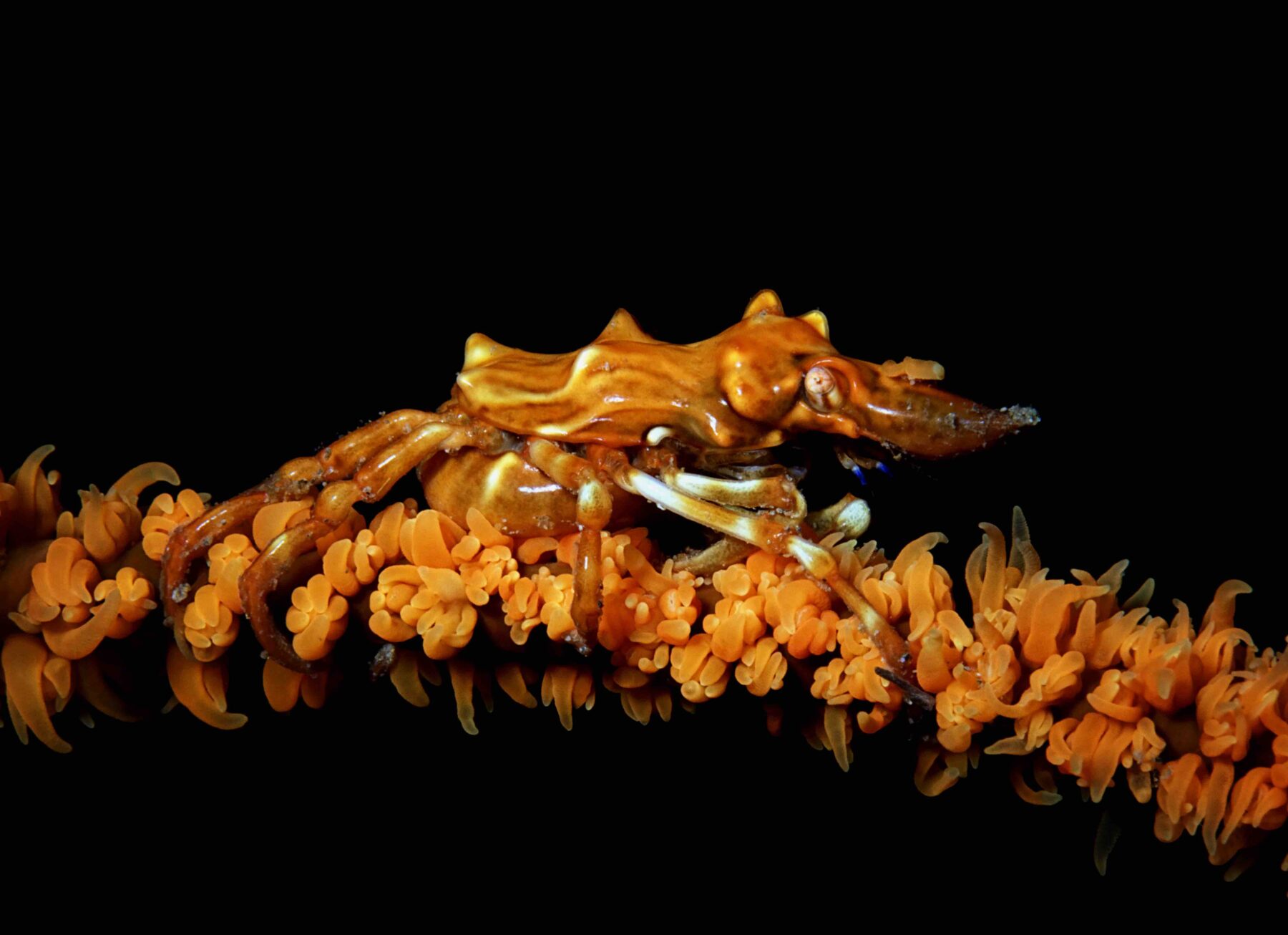
Always a nice find: The Tuberculatus Xeno crab (Xenocarcinus tuberculatus)

Text and photos Markus Roth

When looking for a destination that offers everything, from endless drop offs to a shallow house reef, from the smallest shrimps to a dugong, where the paradise-like landscape above the water is mainly jagged limestone islands, white sandy beaches and a mix of rainforest giants and palm trees that immediately evoke the South Seas, then the place where the Europeans first discovered pepper is the place to be. This is the Indonesian island of Saparua, the Pearl of the Banda Sea.

The way to paradise

The Moluccas island chain is located in the eastern part of Indonesia between Sulawesi and West Papua. Ambon is the largest city and the most important port of this eponymous island. It is also the capital of the Indonesian province of Maluku. East of Ambon are the Lease Islands, with the main island of Saparua.

Kurt Gross and his wife Eliane were the first foreigners who came to Ambon shortly after a stretch of religious unrests ended, which drastically affected the tourism industry. Their aim was to find a piece of land for their resort. The two experienced divers and Indonesia experts finally found what they were looking for on Saparua and started to build their Cape Paperu resort on a small peninsula, a perfect place that made visitors feel like they were in paradise.

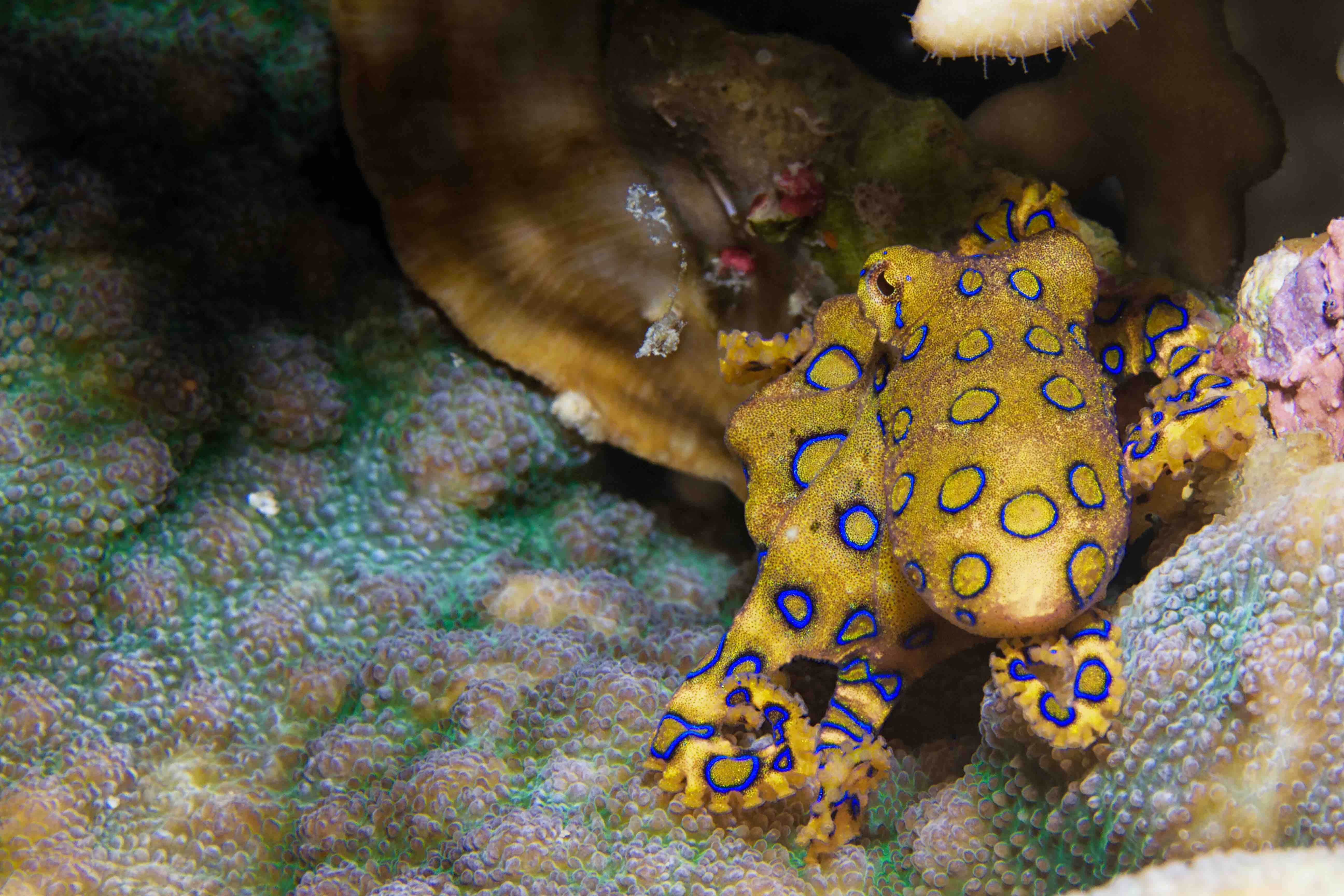
The blue-ringed octopus (genus Hapalochlaena) wears some fascinating hues with delicate curling arms, but this small cephalopod is also deadly.

It is the combination of emerald-blue water, a beach with its pearl-like sand and tropical vegetation that created this beautiful atmosphere. Only a long jetty interrupts the idyllic scenery, which is needed because the tidal range almost drains the entire lagoon at low tide. It was on this very jetty where my hosts Eliane and Kurt, together with resort dog Cyrah, welcomed me from afar.

When good things are so close

The high temperatures and inviting sparkling water made me think of only one thing: Get into the tide as quickly as possible. The scuba gear and the camera were assembled in record time and off I went into the cool water.

I didn’t have to go far because the extensive, approximately two-kilometre-long house reef stretches right in front of the resort. With a maximum depth of 12 metres, it is inviting for extended dives providing a mixture of sandy bottoms, individual coral blocks and a dense collection of antler coral, a thrilling marine landscape  competing for the heart of any diver. Night dives in particular are highly recommended at this diverse dive site.

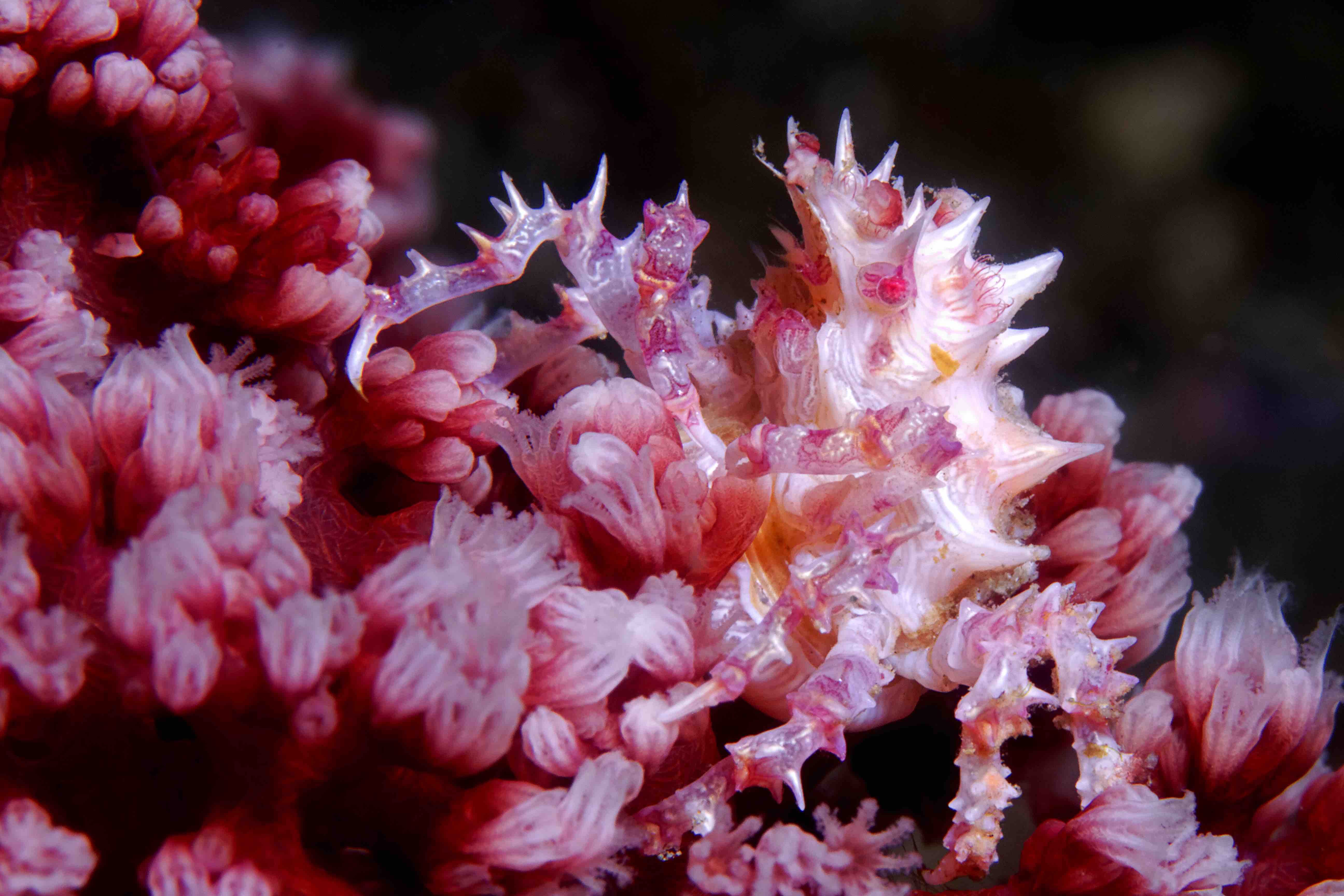
Hey sugar: Found on coral and rocky reefs mimicking the soft coral in the Dendronephthya genus it sits on, the candy crab (Hoplophrys oatesi) is a precious find

During my stay, harlequin shrimps were found for the first time. Regular inhabitants include a wide variety of fish, snails and octopuses. Even dugongs were observed grazing on the sea-grass meadow.

The dive sites of Walo 1 and Walo 2 is just a short, five-minute boat ride away. They are characterised by a good number of fish and score particularly high on account of their biodiversity. Hard coral gardens alternate with white sand surfaces, on which great bommies are to be found again and again.

The third dive site in close proximity to the resort, Pombo Bool, is like an enormous aquarium. Even on the surface, this dive site is incredibly beautiful. Surrounded by crystal-clear blue waters, a mushroom-like limestone rock covered with lush greenery rises from the Banda Sea.

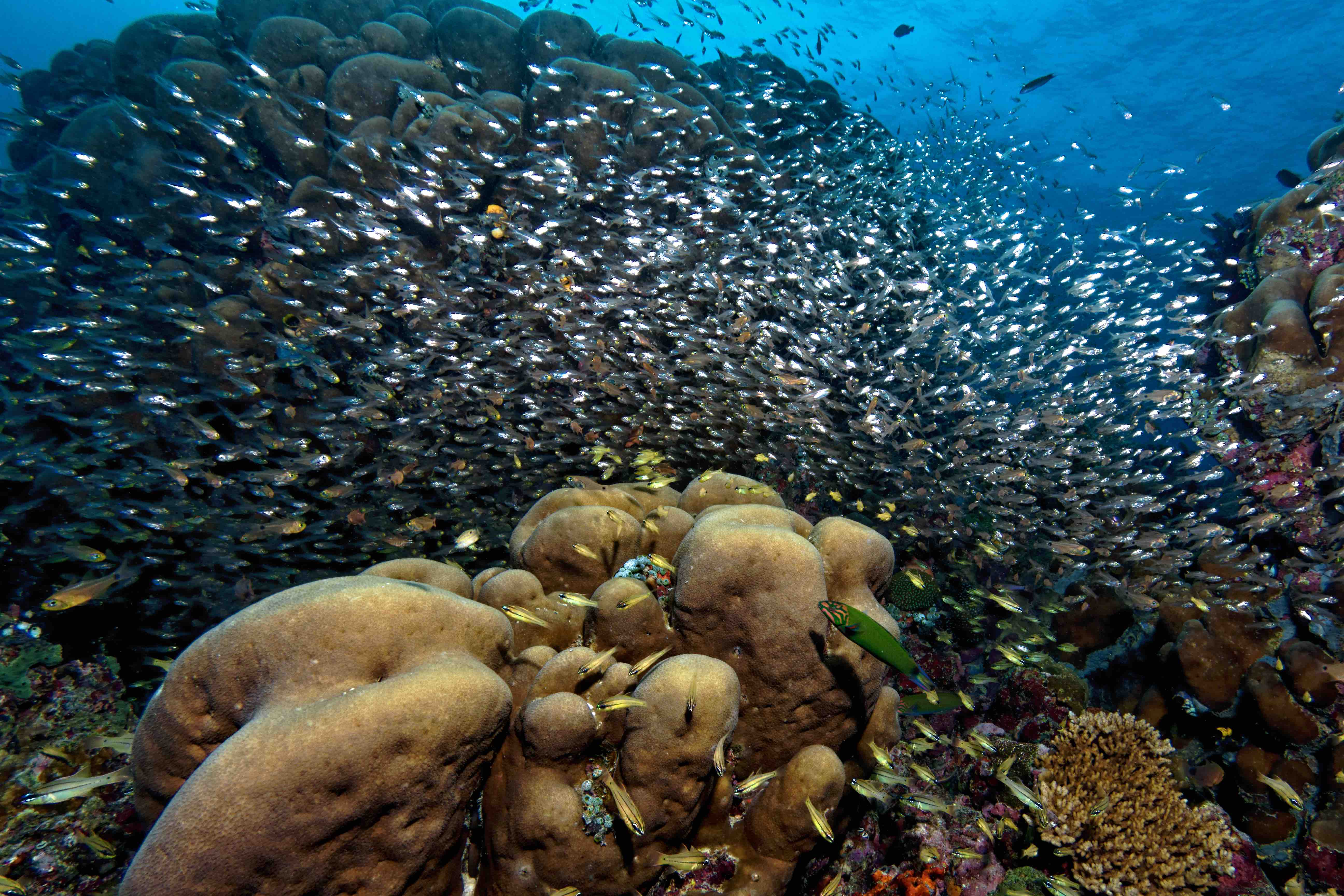
Bustling with life, the glory of a healthy reef system here in Saparua

Without exaggerating, I can say that I was extremely impressed by the vibrant life in this fairly shallow dive site. If the nearby dive sites were already this exciting, what could I expect from the advertised highlights of this isolated diving area?

Life pulsates off Molana

The actual reason for my trip was the endless dropoffs of the islands of Nusa Laut and Molana.The next morning, Kurt first sent me to Molana. With a broad smile on his face, he simply wanted to raise the excitement. Seeing my slightly flabbergasted expression, he told me not to go crazy. But there was more to come in the following days.

After a 30-minute boat ride, again, a beautiful setting appeared in front of me, an extensive hard coral garden reaching as far as you could see. Here, not only did the water sparkle, I could easily discern the different colours of the coral from the boat. This sight made me smile and I quickly found myself in the tropical warm waters.

Alfi, my truly outstanding guide, signalled me to follow him and we slid through a relatively narrow chimney-like gap in the reef into the depths. With the sun exactly on our backs, the infinite blue appeared to be even more fully illuminated.

The 25th anniversary of the largest and longest running dive show, Asia Dive Expo (ADEX) is set to occur on the 11-14th April 2019. Centred on the theme – Plastic free Future, ADEX is more than just a dive show with its commitment to the environment. Among an exciting lineup of programs, attendees can look forward to a Future Forward Series of Panel Discussion on the Single-Use Plastic Conundrum in Asia, on 13th April.

So join us at the event, get inspired and for all you know, you might just liberate the inner diver in you! More details of the event here.
For the rest of this article (Asian Diver 2013 Issue 6 No 129) and other stories, check out our past issues here or download a digital copy here.