Goggle-eyed “dogs” of the ocean, seals and sea lions receive much playful attention from divers who travel the world to see them. Often treated much like their topside doppelgängers, pinnipeds are able to demonstrate an understanding of transitivity and simple syntax, and have been taught simple tricks by travelling circus trainers and zookeepers for centuries. To help you fin-kick your way to finding your very own underwater companion, we bring you eight of the best places to dive with them:
Cape Town, South Africa
Cape Town hosts many sites where divers can get up close to seals. Often a must for every scuba enthusiast, diving with seals can be an enchanting experience; searching the kelp forest around Duiker Island, Partridge Point and Strawberry Rock for an encounter. Sight-seers from above the surface on the boat deck can see the seals in their thousands resting upon the large granite boulders that stick out of the ocean.
La Paz, Mexico
They say “to truly appreciate the beauty of La Paz, you have to look beneath the surface.” Below the blue blanket you’ll find large pelagics; juvenile whale sharks, mobula rays, and rafts of sea lions that will playfully swim up to you and then skittishly swim away as if simulating a game of “fetch”.
Monterey, California
Frequent visitors of the destination are the northern elephant seals in breeding colonies; sometimes dormant on the shore, other times lively in battle. The shores of California are a multi-species enclave, with many types of seals and sea lions, including the harbour seal and Steller’s sea lion.
Hornby Island, British Columbia
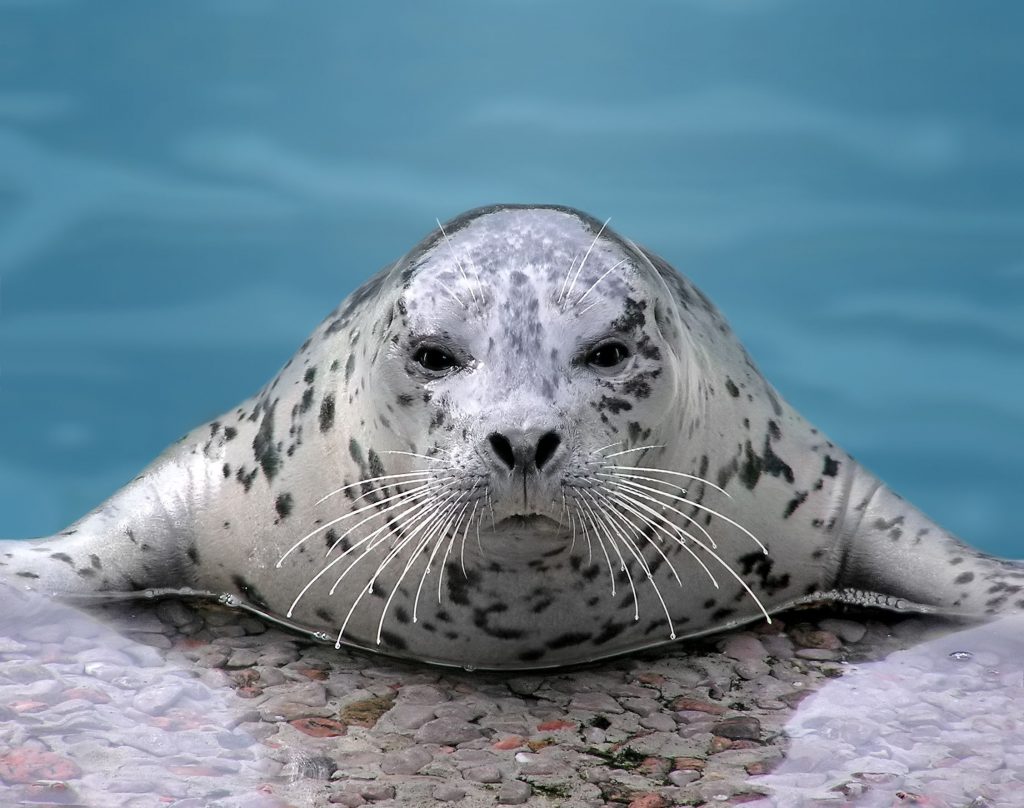
Like an evergreen shrub, Hornby Island’s diving remains relatively similar year-round. Harbour seals are year round patrons, whilst Steller’s and California sea lions arrive at the dawn of winter to feed on the huge school of herring that pass through. The clear visibility and gentle currents make Hornby Island the perfect place to watch these pinnipeds pull off incredible acrobatics.
Galapagos Islands, Ecuador
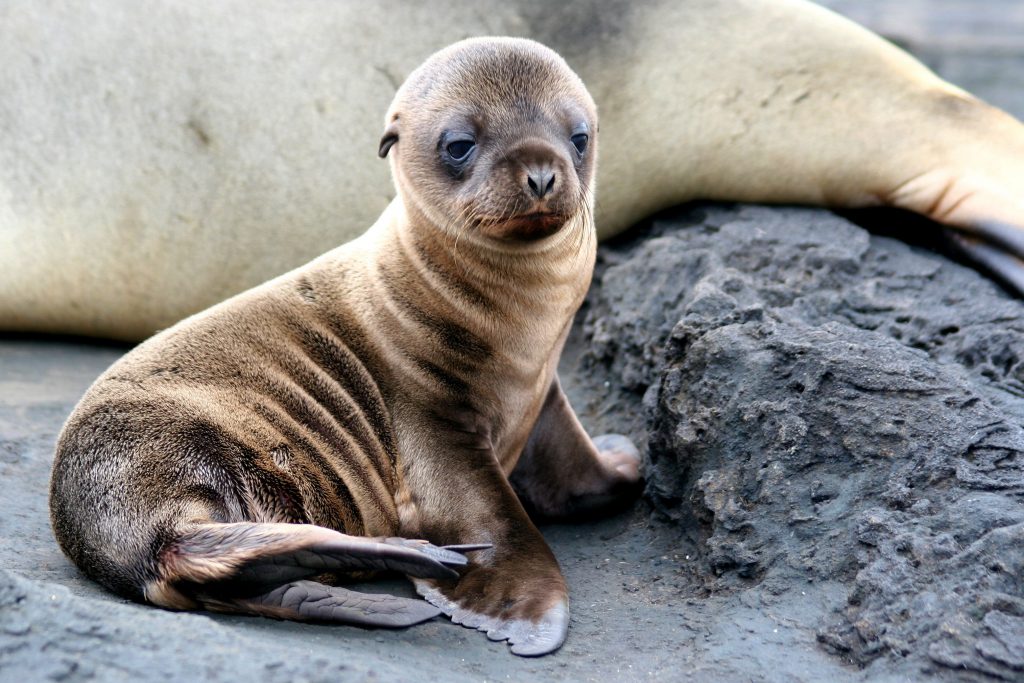
The pinnacle for many divers of their dive careers, the Galapagos Islands are home to both sea lions and seals – as well as plenty of other large animals that would feature on many diving bucket-lists. Since the Galapagos are volcanic oceanic islands, unconnected to the continent, deep sea upwellings make the waters rich in nutrients and therefore thriving with life.
Farne Islands, UK
The shore is often filled with grey seals lounging on the rocks at low tide. But when the tide is high, the waters are crowded by seals squeezing through the portholes of early 20th century wrecks. Come whisker-to-whisker with a mature bull seal – 300 kilograms, notoriously clumsy on land, yet incredibly balletic when their fins touch water – and it will be unforgettable experience.
Marlborough Sound, New Zealand
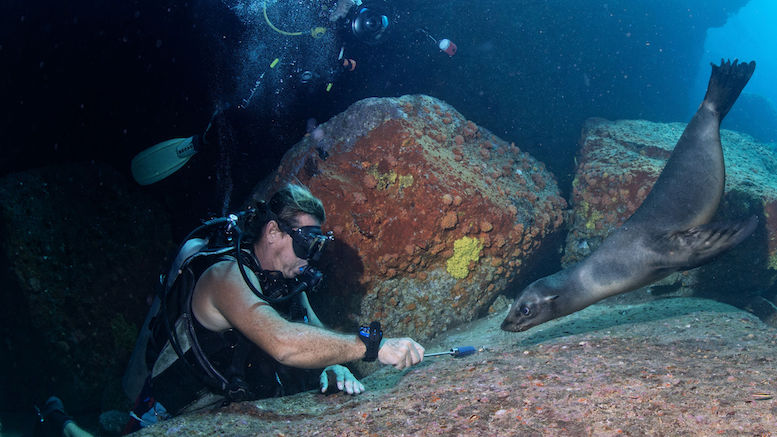
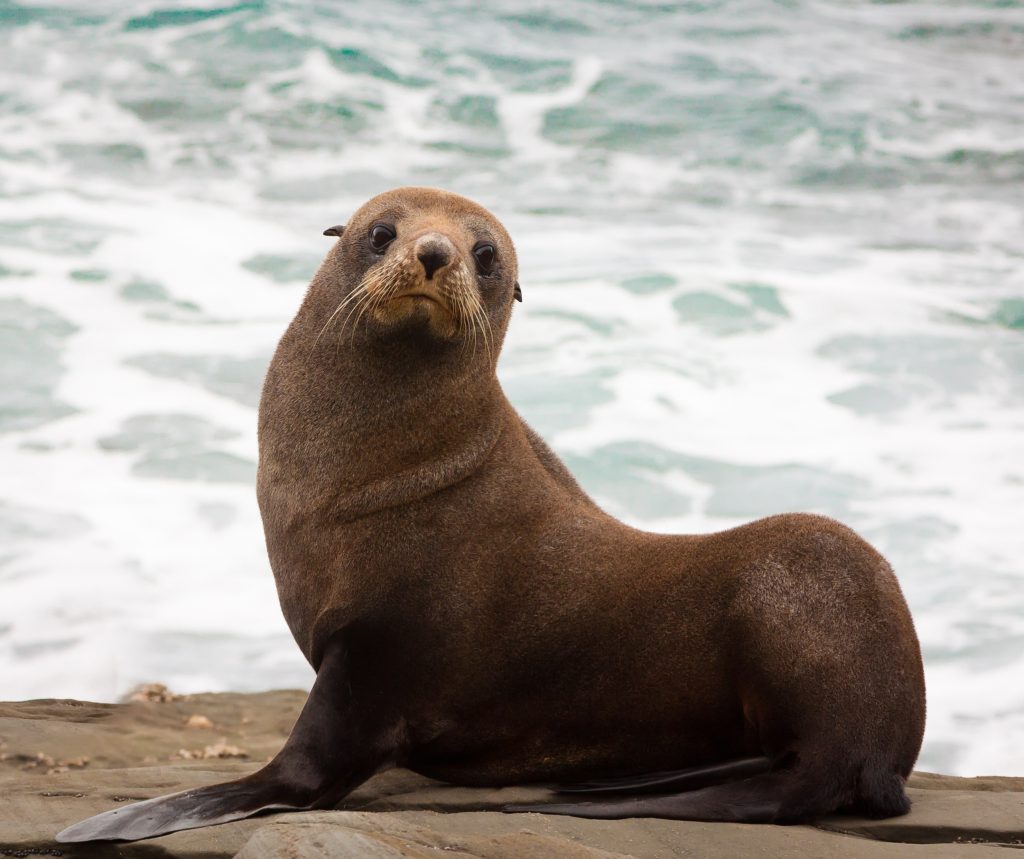
The headline act of many of the area’s eco tours, the New Zealand fur seals are found in large colonies on the waterside. There are many ways to experience these pinnipeds up close, from the sea-soaked seat of a kayak, to diving below the waves with your BCD.
Cocos Island, Costa Rica
Referred to, by those who have dived here, as the “Little Galapagos”, Cocos Island National Park houses a rich diversity of marine life. Its ideal climate, exposure to a variety of ocean currents, caves, volcanic tunnels and reefs make it an undisputed underwater haven for marine life.
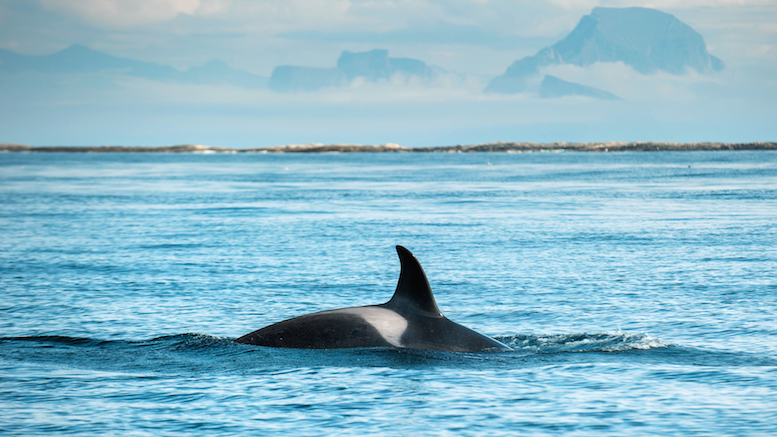
The largest of the dolphin family, growing up to 10 metres long, and weighing as much as 10,000 kilograms, orcas are found in all the world’s oceans, but mostly in the colder waters of Antarctica, the North Atlantic and the Pacific.
These charismatic cetaceans can dive for more than 10 minutes at a time, conserving oxygen by slowing their heartbeats from 120 to 30 beats a minute. They communicate using clicks, squeaks and whistles, like other dolphins, and each pod has their own dialect. Orcas have also been discovered to be able to learn other languages, speaking “dolphin” when kept captive with them.
With the second largest brain of all marine mammals, orcas are complex, social creatures, living in pods with established, matriarchal social hierarchies. Fast, orcas can swim up to almost 50 kilometres per hour to catch prey, of which they eat about three to four percent of their body weight, around 100 kilograms, each day. They hunt like wolves, in packs, working together to encircle and herd prey into a small area before attacking. They have also been known to intentionally beach themselves when hunting sea lions and pups in coastal areas.
The Red List classifies orcas as a Data Deficient group, but the reality is that some specific populations are already threatened.
In the Pacific Northwest, along the Washington, British Columbian and Alaskan coasts, orcas fall into two distinct groups: transient and resident. Physically, the two are very similar but there are some differences.
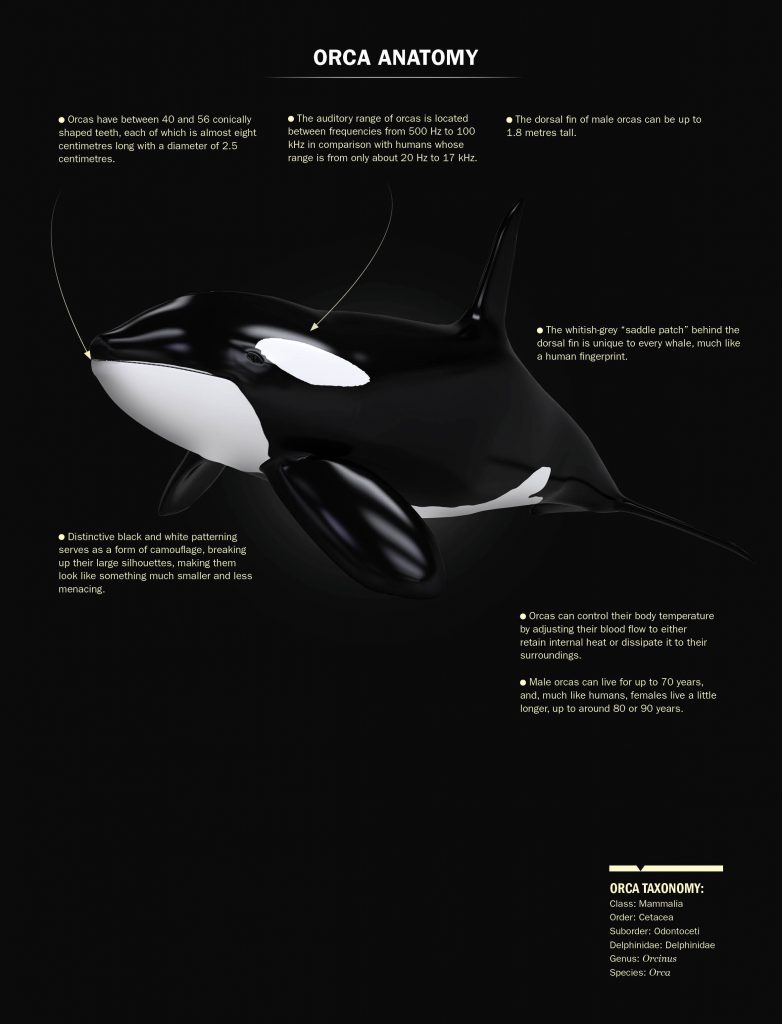
The top of the dorsal fin of transient orcas tends to be more pointed than that of residents. Less obvious, the saddle patch is further forward in transients. Resident whales prefer a diet of fish, and in the summer months almost exclusively salmon. Transients, however, prefer to eat marine mammals.
A lot of the time transients travel around silently in small groups. This perhaps enables them to listen intently, lessen their presence in the water, and sneak up on their prey. This is in contrast to the resident pod, which tends to be more vocal, sociable and live in extended family groups.
Known for its incredibly rich culture, globalised national dishes, affable locals and tourist-grabbing natural beauty, Vietnam is one of the most talked about destinations of the century. Whilst the world has had its eyes on the beauty of the country’s topside, few have ever peeked below the waves. To get you ready to breach below these relatively untouched waters, we introduce you to the top seven sites you should try:
Moray Beach, Nha Trang
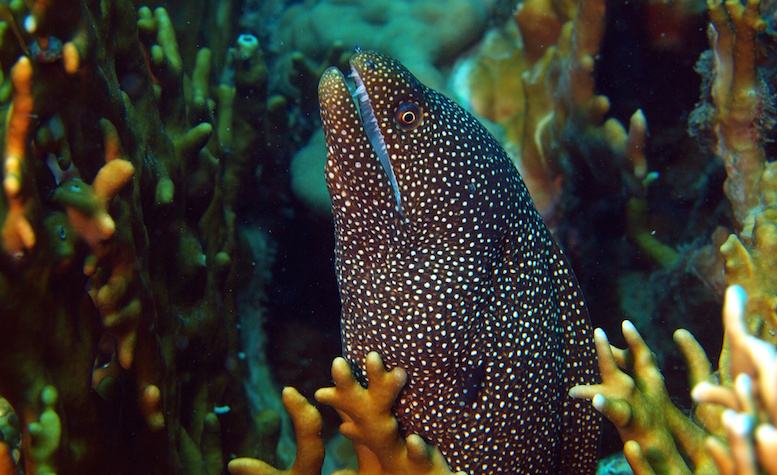
Glide down to critter heaven and ride the current through an abundance of nudibranch species and corals. A far-flung hidden gem of the South China Sea, Moray Beach hosts many species such as scorpionfish, clownfish, and black frogfish. For divers that dare to enter the Moray Cave, they will be rewarded with seeing pipefish, razorfish and the beautifully odd-looking devil scorpionfish.
Ho Trau Nam (Three King Island), Whale Island
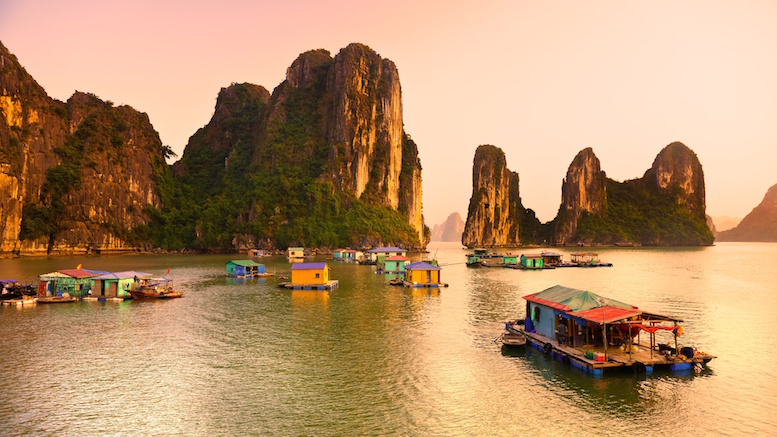
Named from the three rock pinnacles that break the water’s surface, Ho Trau Nam is frequently visited by manta, eagle, and sting rays. Look down and you’ll see the bottom coloured in yellow, white and purple soft corals and gorgonians that intertwine like pipework on the ocean floor.
Nudibranch Gardens, Phu Quoc
Tucked away on the East Coast of Phu Quoc, Nudibranch Gardens is a great dive for those fascinated with seeking out the smaller marine creatures. You’ll find nudibranchs and bamboo sharks hiding under rocks, and many hard coral species and sea anemones standing like mini-mountains on the ocean floor.
White Rock, Whale Island
One of the furthest sites from Whale Island, White Rock offers grand walls that drop from the surface down to the depths of 40 metres with several huge pinnacles emerging from the depths. The bottom of the site is a forest of black coral and gorgonian, haunted by huge black rays.
Madonna Rock, Nha Trang
There are several caverns situated at various depths, providing shelter for many fish species that breed here. In the caves and swim throughs you can find millions of small glass fish, flatworms, shrimp species, and ornate ghost fish.
Hon Nhan, Hoi An
A fantastic place to capture large schools of fish and thousands of nudibranchs that are scattered all over its 40 metre deep seabed. Find pipefish, seahorses, clownfish, barracudas, ribbon eels, crabs, triggerfish and lionfish weaving through the high-rise coral skyline.
Hon Ko (Dry Island), Phu Quoc
From above the surface, the few rocks sticking up out of the water may not look like the pillars of an incredible reef system below. But peeking beneath the waves will reveal a home of mitre shells, rays, bamboo sharks, nudibranchs, catfish and scorpionfish – all calling Hon Ko their abode.
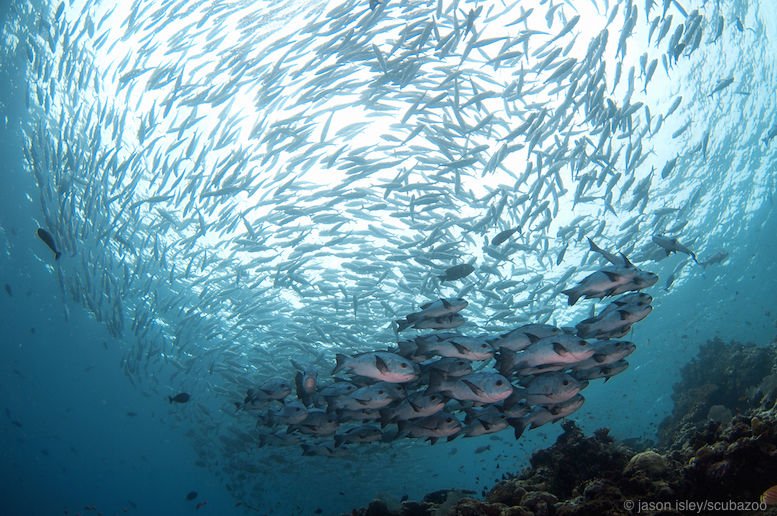
Black snapper and a school of big-eye trevally swimming in the sunlight above the shallow reef.
With its ancient rainforests, rugged, granite-peaked mountains, idyllic lagoons and pristine beaches, Borneo is a wild place and perfect for a Nature lover like myself; I am fortunate enough to live and work in the Malaysian state of Sabah, which straddles the northern tip of this enormous island.
Sabah lies at the heart of the Coral Triangle and is home to some of the world’s greatest marine biodiversity; it is this hidden beauty below the surface of the sea that draws divers and snorkellers from around the world. One of the greatest attractions for these visitors and locals alike are the huge schools of fish that can be found at some of Sabah’s diving hotspots. However, this is not the same for me. During my dives, I usually adopt the position of a razorfish, hovering vertically with my nose an inch from the seabed looking for critters, oblivious to anything in mid-water.
Some of the highest marine biodiversity on the planet
The Coral Triangle is considered the global epicentre of marine biodiversity. The entire area represents one of the richest marine habitats in the world and an estimated 3,000 different species of fish, more than 600 reef-building coral species and more than 30 percent of the world’s coral reefs can be found here. Understandably, Sabah – lying at the heart of this extraordinary region – can claim to have some of the highest marine biodiversity on the planet. For a recent book project, myself and two other Scubazoo photographers travelled around the coast of Sabah documenting the highlights of the underwater world. It was during this trip that I began to leave my trusty macro set up on the boat and started to stare into the blue.
The first fish school that caught my attention was pretty tame – a small army of banded catfish stalking their away across the sand, devouring anything edible in their path in the local marine park near where I live in Kota Kinabalu. It was the way they moved as one in an ever-churning ball of stripes that got me though. How do they decide who goes in front and when to switch? Who gets the unlucky position at the edge of the pack where you could get picked off and how long do they have to stay there?
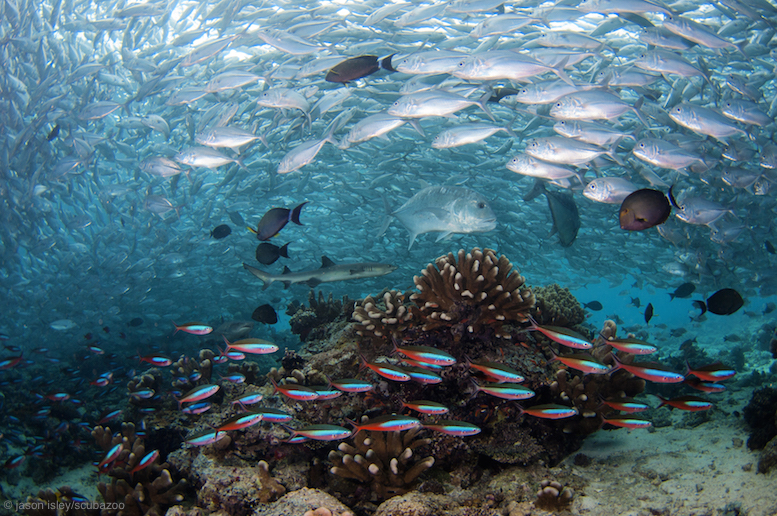
Blue-streak fusiliers swim close over the reef, with a whitetip reef shark, giant trevally swimming above.
Home of the hammers
We travelled further up the coast to Malaysia’s only atoll, Layang Layang, or Swallow Reef, which rises 2,000 metres from the floor of the South China Sea approximately 300 kilometres northwest of Kota Kinabalu. The atoll’s almost total isolation means stunning visibility and pristine reefs, along with an abundance of pelagic marine life. In recent years, Layang Layang has been the site of many special encounters, including with whale sharks, orcas, melon-headed whales and even sperm whales.
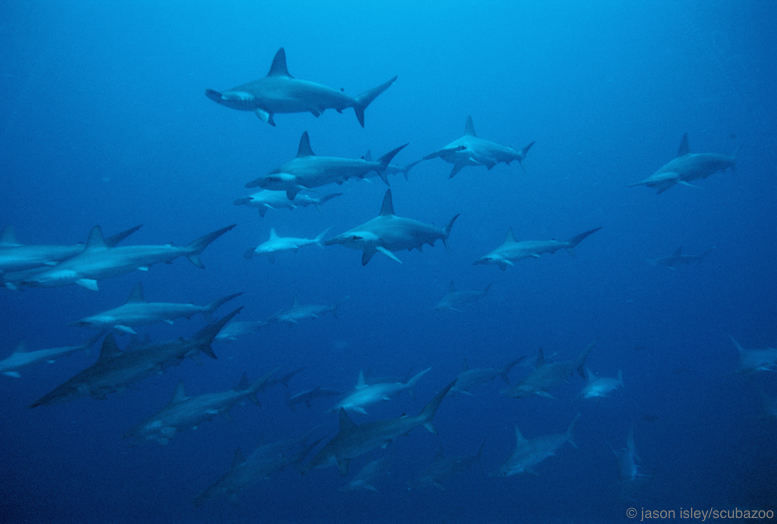
Along with the huge schools of reef fish that thrive in these pristine waters, it is the hammerheads that people flock there for and huge schools can be seen in the blue. During the daylight hours, the schools of sharks, mostly females, are actively engaged in social interactions and jockey for prime social position in the centre of the school, before breaking up at night to hunt alone. Who knew that sharks were so sociable and how do they interact during this period when gathered together?
School of scalloped hammerhead sharks.
Because Sipadan is sensational
Continuing the journey along the coast, we eventually ended up on the western side of Sabah. Consistently voted one of the top dive destinations in the world, Pulau Sipadan is a must for any passionate diver. Sipadan is Malaysia’s only oceanic island. This tiny speck of land, located 40 kilometres south of Semporna, is in fact a needle-like pinnacle of rock and reef surrounded by 600-metre-deep water – a constant source of nutrientrich upwellings. These nutrients provide the basis for a remarkable food chain that culminates in the many large animals commonly encountered in Sipadan’s waters. In recognition of this unique and productive ecosystem, the area is now carefully protected, with limits on the number of divers that can visit every day and a ban on resorts on the island itself. Consequently, life there is flourishing.
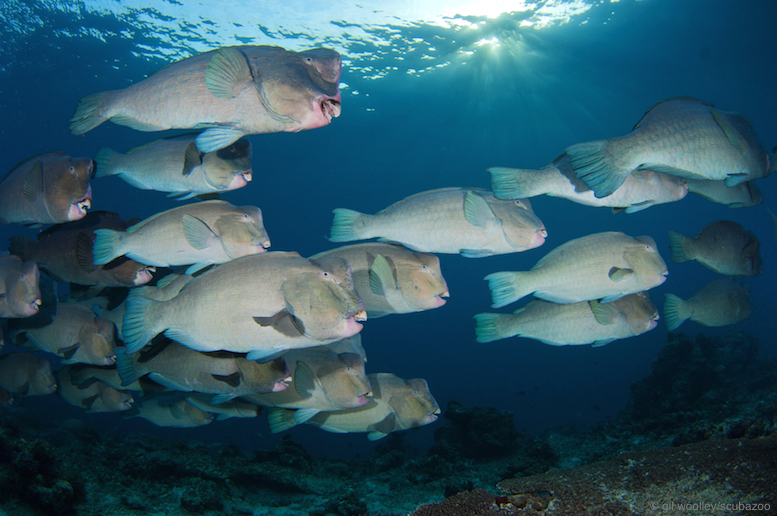
Bumphead parrotfish swimming together as a school.
As you descend into Sipadan’s clear waters, the first things that greet you are the sheer walls dropping down into the abyss; the pristine, colourful reefs; the green and hawksbill turtles, too numerous to count; and the dense schools of fusilier, batfish and anthias. Then you notice the intimidating mass of jacks and barracuda, the napoleon wrasse and whitetip and grey reef sharks, and your eyes are drawn out into the blue, as tales of whale sharks, mantas and hammerheads run through your mind.
Diving around Sipadan can be a dizzying experience as the variety of fish schools that encircle you is immense. It is hard to believe that when I first dived Sipadan many years ago, the most exciting find for me was a frogfish hidden in a channel. I now gazed in awe as barracuda, sharks and turtles cruised by. Why was I sticking my head in the sand all the time?
As soon as you exit the dive boat and start to dive at the famous Drop Off dive site of Sipadan, you are confronted by an immense school of jacks. The thousands of shimmering fish rotate like a massive glitter ball, and you notice the various sharks piercing in and out, and it is hard to drag yourself away and remember you have a dive to continue! It would be easy to spend the whole dive encircled by this mass of fish as they constantly shift and rotate as one.
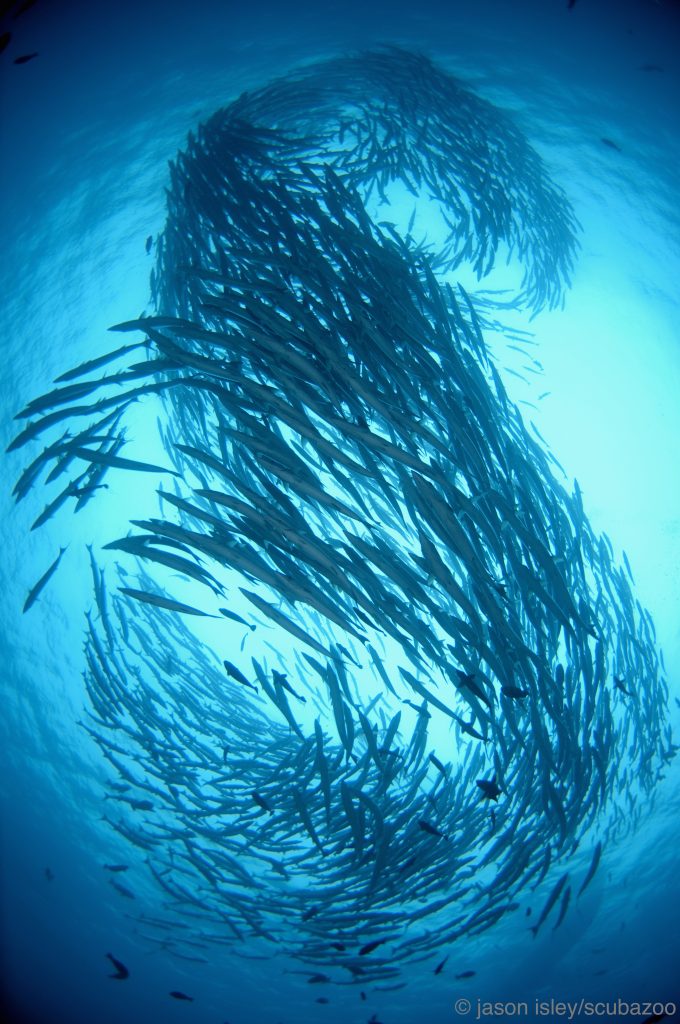
Large school of chevron barracuda.
A mention has to go to the number of turtles it is possible to see on a dive here. During the mating season, you can see a string of males, sometimes up to 10 in number, frantically chasing a female. Even without the clamour of the mating season, if you time the tide right then huge numbers of turtles can be seen as they head towards their feeding grounds.
Bumpheads at dawn and barracuda tornadoes
One of my favourite dives at Sipadan starts very early in the morning, which means you get to witness the sunrise on the journey out – a magical way to start the day. A truly impressive sight, if you can drag yourself out of bed in time, is the procession of bumphead parrotfish. They have strong beaks to feed on live corals and algae, and a single adult will ingest tons of coral each year, which is excreted as white sand. Their feeding activity is important for the production and distribution of coral sand within a reef, and to prevent growing algae from choking coral. In the early morning light, these huge fish make for a wonderful sight in the shallow water as they head out to deep water during the day.
In terms of shear numbers, it is hard to beat a massive school of barracuda, which can form a swirling “tornado” from the sea’s surface down to a depth of 30 metres. These spectacular schools, which may contain thousands of individuals, will break up at dusk as the barracuda head off to hunt for food, and convene again at dawn. Trying to get shots of this magnificent spectacle and control my mid-water buoyancy in a ripping current was one of the most challenging yet rewarding experiences of the whole trip.
I still love to hunt for critters and can’t resist a good muck dive, but it is never long before I take my eyes away from the sand to look up and have a good look around for what might be out there, schooling around in the blue.
A hodgepodge of laws protects roughly 15 percent of Earth’s land, but safeguards for the ocean lag behind. Today, laws shelter a meagre 3.6 percent of the planet’s liquid blue surface. But a recent position paper in Science says lawmakers are beginning to close the gap.
Marine protected areas have mushroomed in the past decade to curb overfishing and hunting, the report notes. If global leaders embrace conservation science, the authors claim policymakers can further accelerate the ocean’s recovery.
International leaders are advancing toward 10 percent global ocean protection by 2020, a goal set in 2010 by the Convention on Biological Diversity. Most recently, Palau President Tommy Remengesau, Jr., signed a law on Oct. 28 fully protecting 83 percent of the nation’s marine territory. The measure catapults the Pacific island country to first place globally for its fraction of national waters strongly or fully protected.
Similar initiatives elsewhere have created more reserves, enabling scientists to study which approaches are best for rejuvenating wild populations.
“There are as many flavours of marine protected areas as there are of ice cream,” said lead author Jane Lubchenco, an environmental scientist at Oregon State University and former administrator of the U.S. National Oceanic and Atmospheric Administration.
Lubchenco and Kirsten Grorud-Colvert of Oregon State University reviewed the existing literature on marine protected areas. They compiled a list of traits that make reserves successful and a second list translating those lessons into policy guidelines.
The authors divided marine protected areas into three classifications: lightly protected zones allowing significant commercial fishing; strongly protected zones allowing non-commercial fishing; and fully protected zones banning fishing. The report extols “fully protected” zones because they support significantly more life, measured by biomass, than “lightly protected” zones. Just 1.8 percent of the world’s oceans are strongly or fully protected, the paper notes.
Lubchenco said policymakers may not understand the scientific distinctions between those types of protection, but there’s an ocean of difference. In a fully protected zone, for instance, a 40-centimetre-long coral trout can grow to 60 centimetres, boosting its spray of beadlike eggs from 350,000 to 3 million.
“When you protect these areas, you get increased social, economic, and environmental benefits,” Lubchenco told Mongabay. She noted that both developed and developing countries reap these benefits. Chile, the United Kingdom, and the United States now rank second through fourth for percent of marine area strongly or fully protected, behind Palau.
The report of accelerated protection pleasantly surprised Mark Carr, a marine biologist at the University of California, Santa Cruz. He blamed lagging ocean conservation on overtaxed coastal areas and unsupervised open oceans.
The paper addresses these challenges. Protected zones should form a connected chain to accommodate fish migrations and invigorate populations that spill into fishing zones, the authors maintain. “Bottom-up” planning that engages ocean users early in the process can benefit fishing and tourism economies. Though climate change also plagues reserves, the paper states that protected areas increase genetic diversity and resilience in the face of ecological challenges.
The call for cooperation resonated with Dan Laffoley, an IUCN principal advisor on marine science. “The scale of the issue is no longer in anyone’s eyes ‘us and them’ …we are all in this together,” he told Mongabay.
Rod Moore, executive director of the U.S. West Coast Seafood Processors Association in Portland, Oregon, also supported cooperation. But he warned against arbitrary top-down goals like a 10 percent global protection target, which he said encourages one-upmanship among politicians. “It’s like an auction,” Moore said. “‘I’ll raise you ten.’”
Carr acknowledges that global targets have political value, but he also says reserves must be thoughtfully located and that plans must involve local marine users to succeed. For example, Carr witnessed how bottom-up planning catalyzed the success of California’s network of marine protected areas. Now he travels internationally sharing California’s approach. “The extent to which science informed what policy did is exceptional, compared to the norm,” he said. “Everyone is looking at California as a model.”
Seven scientific findings from marine protected areas
Fully protected areas almost always achieve the goal of more species in greater numbers and larger sizes.
Reserves linked together beyond coastal waters protect animals moving from one habitat to another.
Linked reserves can support species enough to allow fishing outside protected zones.
Involving marine users—like fishers—leads to plans that advance conservation and fisheries
Reserves make ecosystems more resilient in facing challenges like climate change
Smart planning minimizes unnecessary costs later and may even increase a zone’s ultimate economic value
Thoughtful approaches to fishing, energy generation, and other marine uses can help protect the ocean beyond reserves
Six policy recommendations
Combine top-down and bottom-up approaches in ocean protection
Involve marine users in all planning stages
Create transition phases and incentives that encourage marine users to protect reserves, (e.g., turn reserves into a business with investors and shareholders)
Use new technologies like satellite tracking to identify illegal fishers
Complement reserves with effective policies to address challenges like ocean acidification and climate change
Monitor progress and create contingency plans for unexpected changes
Citation:
Lubchenco, Jane, and Kirsten Grorud-Colvert. “Making waves: The science and politics of ocean protection.” Science 350.6259 (2015): 382-383.
Natalie Jacewicz is a graduate student in the Science Communication Program at the University of California, Santa Cruz. Other Mongabay stories produced by UCSC students can be found here
This article was published by Rhett Butler, source: Mongabay
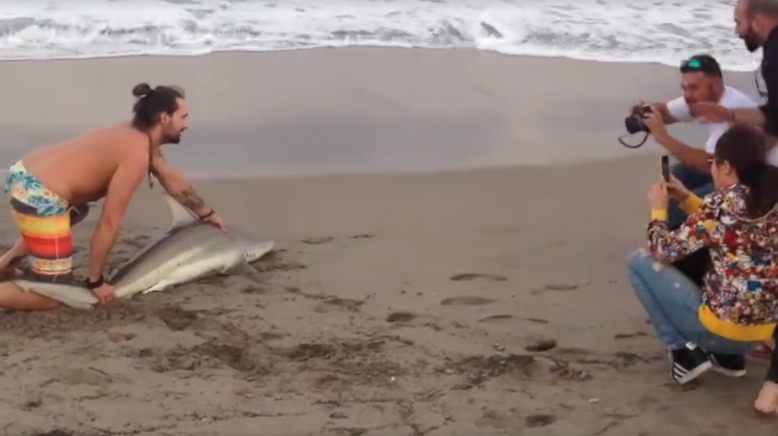
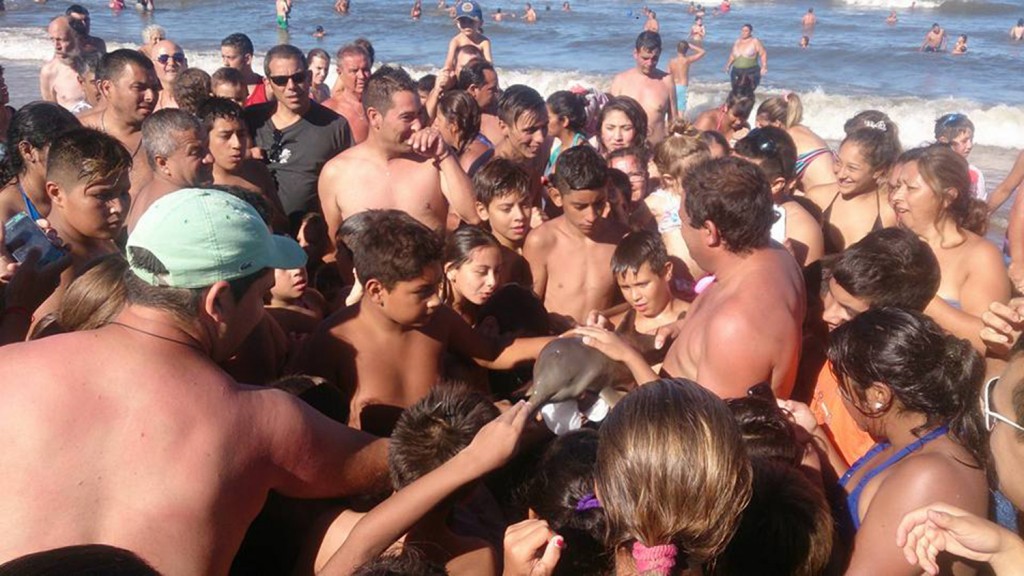
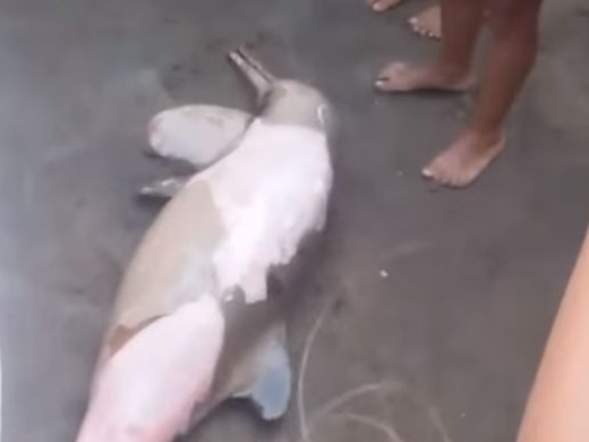
Days after a Franciscana dolphin was pulled from the ocean and paraded around by a man for selfies, a similar incident has emerged of a man being filmed taking photos with a helpless shark after dragging it out of the ocean in Florida.
The unidentified man was seen pulling the poor animal out of the water and pinning it down for people to take pictures. Despite the shark writhing around underneath his arms, the man continued to hold it down and even lifted its tail to get a better angle.
After this incident, and the Franciscana dolphin incident, we explore why people feel that it is okay to strip marine life from the ocean and treat them like objects:
An obsession with animals as decoration
From bathroom windowsills littered with dried up starfish and triton shells, to soi-disant tropical aquariums full of rare fish, we have an obsession with using marine animals for decoration. Perhaps their unfamiliarity attracts us to them, their near-alien appearance that, for some reason, goes well with our pale-blue bathroom wallpaper. This objectification of living creatures and using them for house decorations is the potential foundation of the feeling that it is okay to use marine animals as props in pictures, or to be pulled from the sea.
A photographic opportunity like no other
Selfies with washed up whales on beaches, or macro shots of distressed seahorses up close appear desirable for some nowadays. It’s a photographic opportunity like no other, to capture a glimpse of this alien world that few ever get the chance to. However to get some of these shots, sometimes people may manipulate marine life; kicking up seahorses to capture the creature with a clear background, or prodding an octopus to snap it face-on. The desire to capture something beautifully bizarre may cause the photographer to momentarily forget the harm that they are potentially causing to the animal, completely unaware of the consequences of their actions.
A complete disregard for marine life
Dragging a marine animal from the ocean and leaving it to suffocate, or overheat, on the golden sand of some “paradise” beach may cause your hair to stand on end. In a day and age where any display of cruelty to animals is a publicised sin, it comes as quite a shock that anybody would ever feel that it is okay to do such a thing. A lack of education on the endangered status of many marine species, and a complete ignorance to animal life, is most likely the cause.
All we can continue to do is spread awareness of the importance of marine life, and hope that these acts do not continue in the future.
It’s the worst feeling, to feel incredibly peckish when you’re 20 metres below the blue surface. Like any physical activity, you need to put food into your body to keep your engine running, and keep you alert and strong during your dive. Here are six foods to eat before diving:
Bananas
Excellent for calories and cramps, Bananas provide your body with essential nutrients that benefit your health and muscle function. They are the perfect pre-dive snack, providing your body with sufficient carbohydrates to support your entire athletic performance during the dive.
Spinach
The king of power foods, this leafy green has multiple benefits for divers. Easily digestible and filling, spinach contains magnesium which prevents any unwanted cramps when underwater.
Brazil nuts
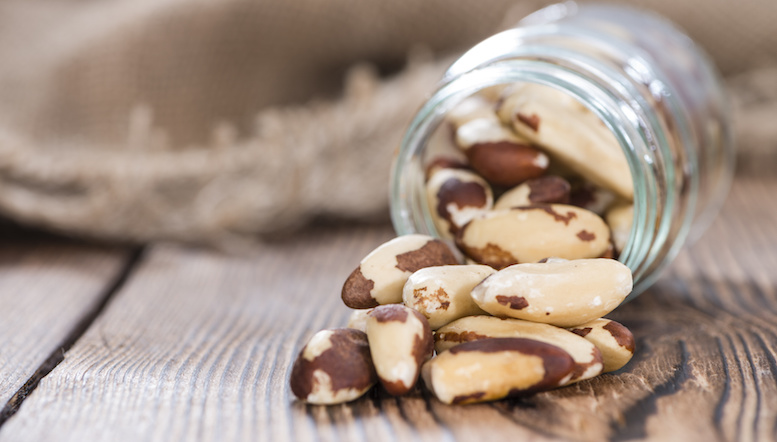
The fat and high protein in Brazil nuts will give you the energy you need to fin kick against the current. Containing good qualities of vitamins, anti-oxidants and minerals, we suggest bringing a bag of these with you on your next trip.
Brown rice
A brilliant source of carbohydrates, brown rice is known for its fibre and “superfood” qualities and is ideal fuel for your body to burn throughout the dive.
Grass-fed beef jerky
Since you can’t pack a steak into your dive bag, beef jerky is a great high-protein substitute. Grass-fed jerky guarantees to give you more omega-3 fatty acid and grain-fed beef.
Egg
Scrambled, poached, or boiled… no matter how you eat them, they’ll provide protein and power that will help you last through the dive.

 Marlborough Sound, New Zealand