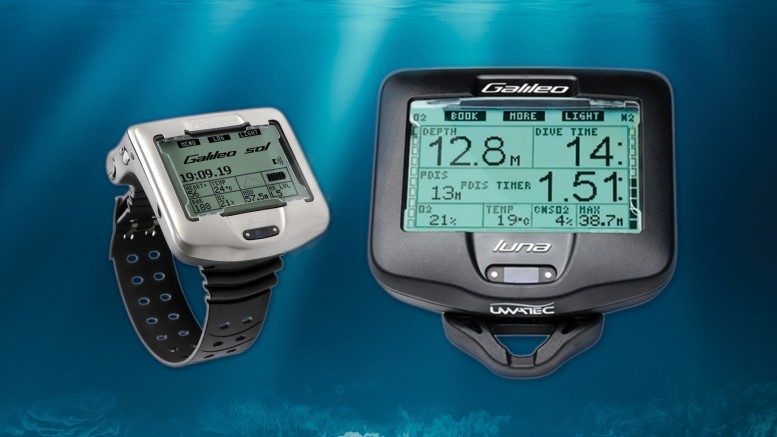
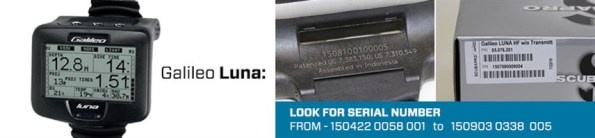
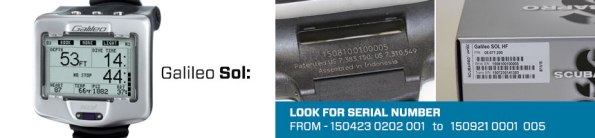
ScubaPro have announced a voluntary recall on 1486 UWATEC Galileo Luna and Sol Dive computers sold since May 2015 due to screen freezing issues:
International Press Release
A limited number of recent models of the UWATEC Galileo Luna and Sol dive computers are being recalled because the screen may freeze. There have been no reports of any injuries.
Consumers with dive computers Galileo LUNA with serial numbers from 150422 0058 001 to 150903 0338 005 and Galileo SOL with serial numbers from 150423 0202 001 to 150921 0001 005 should immediately stop using them and return the computer to an authorised SCUBAPRO dealer or to Scubapro Asia Pacific Ltd directly. Free replacement units will be shipped to consumers in early 2016.
Consumers can also go online at www.scubapro.com and click on “Galileo Recall” for more information. If you have any questions, please call us at Scubapro Asia Pacific Technical Services at +852 25567338 between 9am and 5pm or email us at recall@scubaproasiapacific.com
The serial number is stamped on the back of the computer, and printed on labels affixed to the product packaging. All other versions and serial numbers are unaffected.
There are two big reasons why compact cameras lag behind in wide-angle photography when compared to their more expensive DSLR cousins. First, compact cameras’ built-in flashes set at their highest outputs are not able to illuminate a specific area at any respectable distance. And second, their built-in lenses at their widest ends are not sufficient to cover large subjects when shooting at close proximities.
As far as lighting is concerned, one can’t overemphasise the importance of external strobes when shooting wide-angle images underwater. When placed at a strategic angle, strobes allow the camera to capture colour-accurate images that are (hopefully) backscatter-free.
Getting close to wide-angle subjects with your compact is a trickier prospect. Unlike the numerous high-quality and affordable close-up dioptres on the market, there are relatively few dedicated wide-angle wet lens attachments. These wet lenses range from the sophisticated but too-expensive-to-own, to the poorly designed ones that leave unsightly ghost flares all over your images.
However, a good wide-angle attachment that matches your camera, housing and pocket is an essential investment if you want to shoot bigger subjects closer. With a smaller water column between your camera and your subject, you’ll be able to have a more colourful and clearer image.
Choose your subjects wisely
Compact cameras have built-in lenses that provide versatility topside, but don’t provide a wide angle of view underwater to capture many larger subjects and scenes. When you’re shooting with a compact camera’s built-in lens only, you’ll need to choose subjects of an appropriate size. For instance, smaller sponges and gorgonians shaped like their giant forms will fit nicely into your frame at close working distances to give you comparable image qualities.
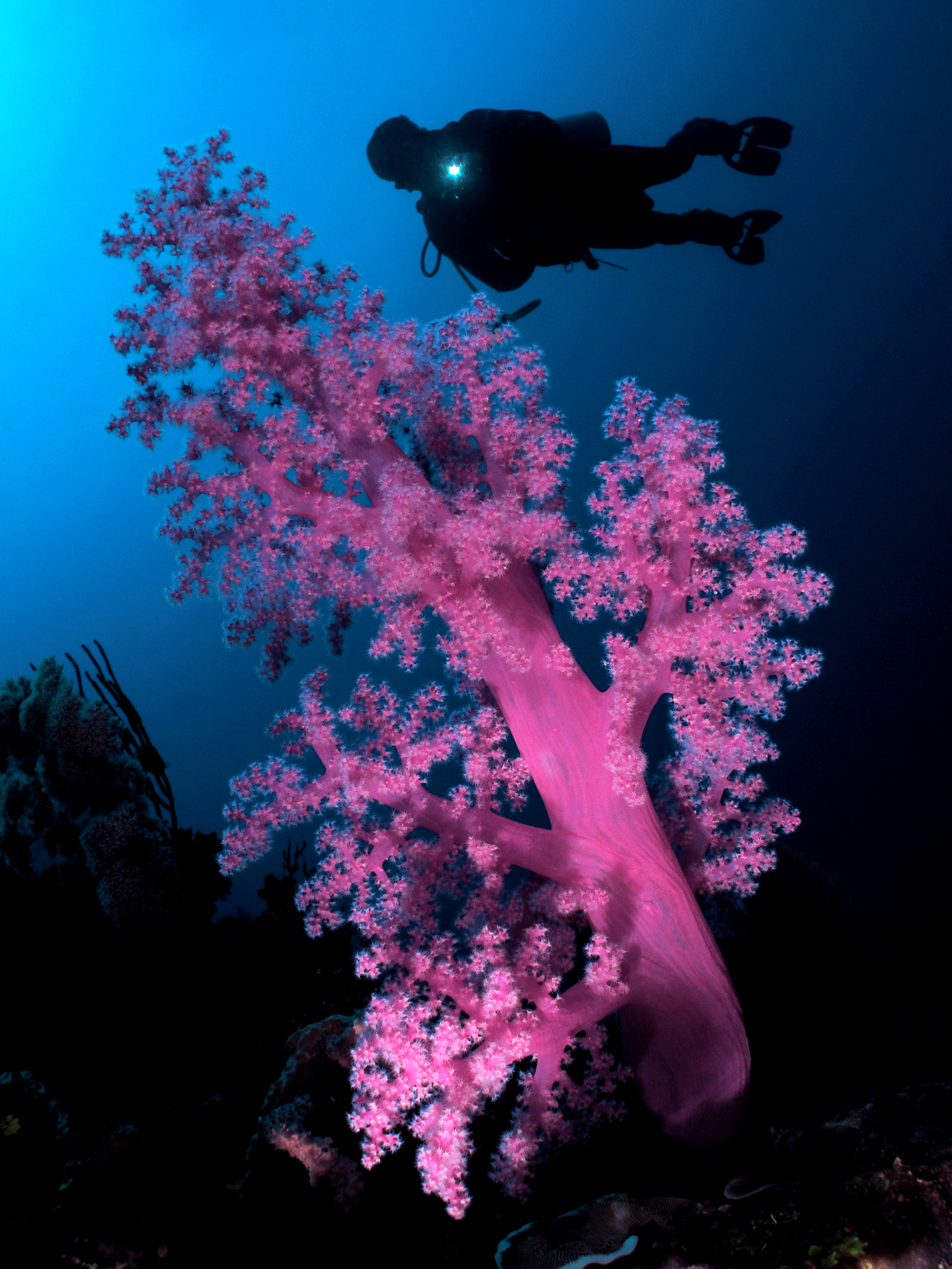
Are you encountering fish too large to fit into the viewfinder’s frame? Or is your dive buddy bugging you to take his picture? Again, there are things you can do to work with the limitations of your camera. Two options worth considering, in this case, are shooting silhouettes from a distance against the sun or simply getting in closer to get partial body shots.
Close-focus wide angle
By adding a wide-angle or fisheye wet lens to your compact, you will be able to focus quite close to your subject, allowing you to capture what’s known as a close-focus wide-angle shot. You can also select the macro mode and move your camera even closer should you come upon a particularly friendly fish, or find some interesting corals or invertebrates.
Of course, having a fisheye wet lens this close to your subject will cause it to distort. But this isn’t necessarily unfavourable. The distortion will ensure your image gives a fresh perspective – something different from what we are used to seeing. Keep in mind, though, that some strobes will give you a yellow hue when shooting at such close distances. The easiest solution to neutralise this effect is to set the camera’s white balance slightly towards blue.
If your compact camera has a special “fisheye effect” function, make sure you steer well clear. Contrary to what you might want to believe, this function will not make the lens optically wider. The fisheye effect is only an electronically distorted version of the wide-angle image captured by your camera’s sensor.
Get sharp, get focused
Most marine animals are coloured to merge with the water column. Thus, switching the camera’s focusing point to the largest available size will allow the camera’s autofocus system to better detect these camouflaged creatures. The use of a proper target light will also help a confused autofocus system to differentiate dully-coloured subjects from the background.
For compact cameras boasting of big maximum apertures, such as f/1.4 or f/2, unless you are a diehard “Japanese pastel blue” fan, you will notice such apertures give you a depth-of-field so shallow, a big part of your image will be out of focus. A more sensible choice of apertures for compact users shooting wide angle will be between f/4 to f/11.
All camera lenses have a sweet spot where they capture images with a maximum level of sharpness. This can be estimated by stopping your lens aperture down 2.5 to 3 stops from its largest aperture. That means a lens with a maximum aperture of f/1.4 will be critically sharp when you shoot between f/2.8 and f/4, and an f/2.8 lens will peak in sharpness from f/5.6 to f/8.
The compact compromise
Now that you’ve chosen your subjects carefully, and decided what lens attachment and lighting works best for your camera, you’ll need to concentrate on getting the exposure right. A correctly exposed image is an educated compromise between aperture, shutter speed, and ISO; whether you shoot using a semi-automatic mode or prefer going manual, make sure you’re comfortable with the mechanics behind proper exposure (see “Compact User” on shooting in Manual mode).
Understand the inherent technical limitations of the sensor and the lens, you will be able to squeeze the maximum performance out of your humble compact camera. You may be surprised at what kind of wide-angle images it can produce.
Burt Jones is one of the many unsung heroes of underwater photography. Since the 1970s, Burt has been dedicated to exploring both dive sites around the world as well as his own artistic expression. Diving Mexico’s Yucatán Peninsula long before it was a world-renowned dive destination, Burt and his wife were later instrumental in putting Indonesia’s incredible underwater world on the map with their pioneering books, Secret Sea, Diving Indonesia’s Raja Ampat, and Diving Indonesia’s Bird’s Head Seascape.
For those that are unfamiliar with Burt and Maurine’s lengthy and impressive tenure in the field, read on and consider yourself schooled.
On Cancún, Mexico, back in the day
I grew up in a small town north of Austin, Texas, and became a certified diver in 1969. But it was the early 1970s, during breaks while attending college in central Mexico, that I began exploring the Yucatán coast. At the time I was into breath-hold spearfishing and Mayan ruins. After graduating, a buddy and I opened the first dive shop on the coast, in a little town named Puerto Morelos. At that time, Cancún was just an idea; Cozumel diving was in its infancy; Playa del Carmen was home to three families of fishermen; and it would be decades before the baitballs and whale sharks off Isla Mujeres were discovered.
Having the coast virtually to ourselves, Maurine and I lived an idyllic, stress-free life of adventure. By the early 1980s, the coastline was beginning to be developed, so we constructed a small bed and breakfast and opened a second dive shop. As Cancún’s development impacted the entire coast, we stopped spearfishing and started photographing. Finally, in 1987, frustrated with the changes in our paradise, we sold up and headed to the Solomon Islands, an undeveloped place where we could teach ourselves underwater photography while indulging our passion as “adventure junkies”.
On mapping Yucatán’s cenotes
Weather, especially strong winds, during the prime tourist (winter) months, caused our Mexico dive business to suffer, so we began diving in the cenotes. You cannot imagine what it was like in those days. It literally was a new world, undiscovered, completely untouched and magical. But, unlike today, getting to the cenotes was not easy. We had to hack our way through the jungle, carrying our heavy gear.
We quickly hooked up with divers like Mike Madden, who was serious about cave exploration. As our photographic skills improved, Mike asked us to be the “photographers of record” on the mapping and exploration of the Nohoch Nah Chich system (now a part of Dos Ojos), which was named the “world’s longest underwater cave” by the Guinness Book of Records.
On discovering new destinations
Although at the time, the term never occurred to us, we were beginning to develop the skill set to become, as we now refer to ourselves, “destination developers”. We got a job helping to refit and eventually manage the first liveaboard in the Solomons, the Bilikiki, which is still in business today. We “discovered” most the sites the boat still dives. This is where our photography developed in earnest and we began to document the interconnectedness of the reef as we started to discover the small stuff. What we were essentially doing was “critter diving”, but that term wasn’t coined until Larry Smith popularised it in the mid-90s.
After the positive reception of our first published piece on the Solomons, we realised the quickest path to getting published was reporting on places no one had ever dived. Our first stop was Sipadan Island. We arrived on New Year’s day 1990. What a place! A 3,000-foot drop-off was literally a few fin-kicks from shore and the marine life was off the scale. We were some of the first photojournalists to report on Sipadan.
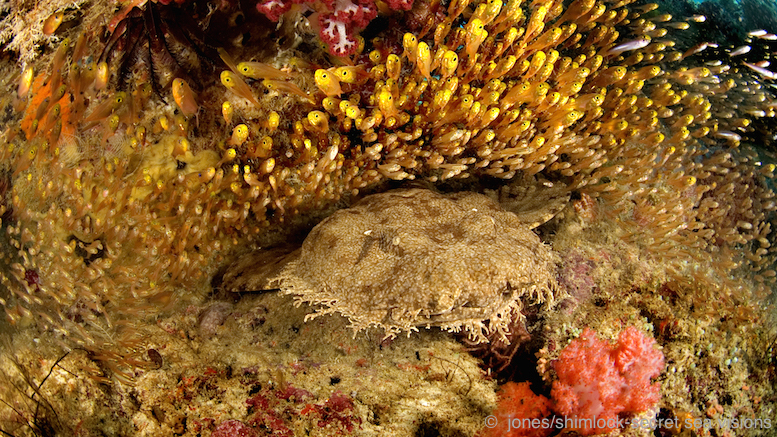
“Mioskan”, Dampier Strait, Raja Ampat, Indonesia: Wobbegong sharks are common throughout Raja Ampat but rarely seen on other Indonesian Reefs
On naming Cannibal Rock
In 1992, Dr Kal Muller, a travel writer who was researching the first book about diving in Indonesia, invited us to accompany him on an exploratory trip to Komodo National Park to determine if it was worth developing as a dive destination. On arrival, we saw a dragon on the beach and rushed ashore with our cameras. The dragon ran along the beach and began climbing a 100 foot-high rock. (This was before anyone had ever been to Rinca and the dragons were still fearful of humans.) We cautiously followed, and at the top we saw the dragon swallowing a juvenile. We immediately named him Hannibal!
While taking shots, we noticed a piece of reef protruding into the bay from the base of the rock. We decided to dive it, and found a place like nothing any of us had seen. We knew this site alone would put Komodo diving on the map. Naming the site was easy. Hannibal had done it for us: Cannibal Rock.
On the birth of “Muck Diving”
In 1995, we joined Larry Smith for a journey through the Banda Sea. Starting in Ambon, we worked our way east, then south, diving spots that Larry knew and exploring new sites. During the trip Larry kept mentioning a fish he had seen while working under the ship where it moored in Ambon. He had no idea what it was, but described it as looking like something the “cat coughed up”. Even though we had never seen one either, his description sounded like a Rhinopias scorpionfish. Together we made a decision to return to port early so we could dive the pier.
What a gold mine! We found two Rhinopias, every pier piling seemed to harbour a frogfish, and the mucky bottom was covered with other bizarre species. We all saw our first flamboyant cuttlefish – even though we didn’t know what it was – and our first fire urchin with commensal zebra crabs and Coleman shrimp. Needless to say this was the birth of “muck diving” in Indonesia. After the Banda trip, in 1996, our first book, Secret Sea, was published. It received numerous awards, including the Benjamin Franklin prize for “best book” published that year.
Meanwhile, Larry’s liveaboard operation was floundering and he relocated to a resort in a then unheard of backwater – Lembeh Strait. As soon as he had the operation rolling we visited, and the discoveries followed. We showed Larry his first pygmy seahorse, which we had first seen in Komodo, and we found a lot of other Lembeh “firsts”, like two species of Rhinopias, the Ambon scorpionfish, another flamboyant cuttlefish, not to mention about a zillion nudibranchs. By this time we were full-on muck fanatics.
On charting the Bird’s Head Peninsula
In 2007, Larry Smith introduced us to a man who has become a constant in our lives, our “boss” Dr Mark Erdmann. At the time, Mark was senior advisor for Conservation International-Indonesia’s Marine Program. In 2008, he hired us for the “dream job”. We were given a budget and the support to dive, explore and create content to promote sustainable tourism initiatives in, first, Raja Ampat and now, the entire Bird’s Head Seascape.
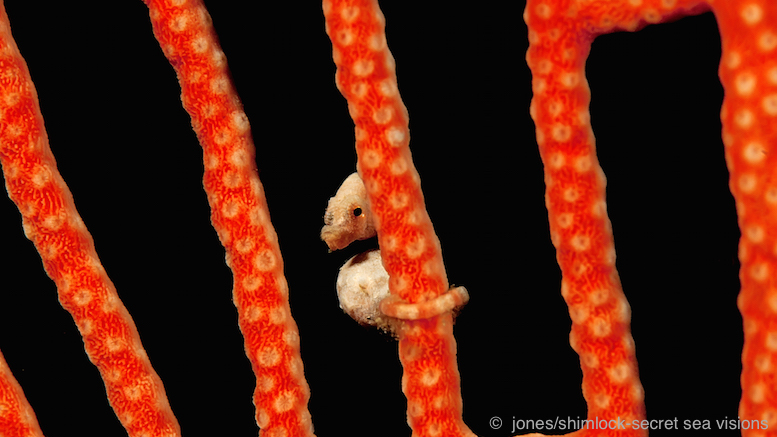
Raja Ampat, Indonesia: A tiny and delicate pygmy seahorse takes refuge in a vibrant coral
Mark knew that the only way to protect the area’s unprecedented marine resources was to engage the locals. One method was to build a sustainable tourism infrastructure that offered direct benefits to the natives in lieu of their overfishing the reefs, clearing their forests, or mining. In order to build this infrastructure Mark knew he had to spread tourism throughout the entire region. More dive sites had to be found and promoted so that liveaboards would branch out and dive beyond what was known at the time.
Our book Diving Indonesia’s Raja Ampat was released in 2009. Tourism increased by 20 percent in Raja the year after the guidebook was released, and the numbers are still increasing. Even though Raja Ampat is the epicentre of marine biodiversity and the heart of the Coral Triangle, it is only part of the much larger Bird’s Head Seascape. So Mark and Conservation International commissioned us to produce a more comprehensive update. In 2011 we released Diving Indonesia’s Bird’s Head Seascape, which includes much better maps and many more sites.
We finally realised that printing a book every few years is unsustainable, so we set about creating a website for the Bird’s Head, www.birdsheadseascape.com. As well as being a guide for divers, the site contains a library and a research database for all the scientific and conservation work ever done in the region. The idea is for the site to be the “go to” place before getting on a plane or for anyone doing research on the area.
Getting your hands on everything ADEX this year has never been easier! Take all the deals and the dish on your favourite ADEX speakers wherever you go and never lose out on some of the best experiences ADEX offers every year!
Here is a breakdown of what the ADEX APP will be all about:
ADEX Scan
ADEX Scan works exactly like the AR Scan. Scan the areas of the Asian Diver‘s The Big Blue Book where you see the ADEX Scan logo and watch inspirational videos and more!
Deals/Coupons
Find out all the deals on offer at ADEX! The app will inform you what are the best deals around and even which booth to head straight for! If you are simply looking for cheap offers around you in the expo hall, the app gets that information for you as well!
Activities
Unsure what’s going on at ADEX? Check out our activities page. We will be giving you a breakdown on what’s available at ADEX!
Speakers/Programmes
Check out the latest programme schedule for the ADEX segments, all through the ADEX mobile app.
You are also able to set reminders so that you won’t miss a thing!
Lucky Draw
All visitors get a chance to participate in our Daily Lucky
Draw by simply registering through the ADEX App! Do look out for your name as winners will be announced through the app every 2 hours! From dive packages to gears, the ADEX Lucky Draw is a huge attraction for all visitors!
Exhibitors/Floor Plan
Find out the list of exhibitors we have at ADEX 2016. This year, the number of exhibitors has grown exponentially!
Navigate around the halls easily with an overview of the venue!
Official Store
You can find everything from books by renowned divers to UW360’s merchandise like mugs, bags and many more!
The ADEX App will give you all the information you need, as you make ADEX your weekend dive playground.
All you need to do is download the app from the Apple Play Store or Google Play and start your multimedia journey and jump from Asian Diver’s The Big Blue Book into the digital realm of instant updates, information expansion, great deals and details on the mostamazing lucky draw prizes that will be given away at ADEX every day!
So what are you waiting for?
For more information on ADEX, please visit www.adex.asia.
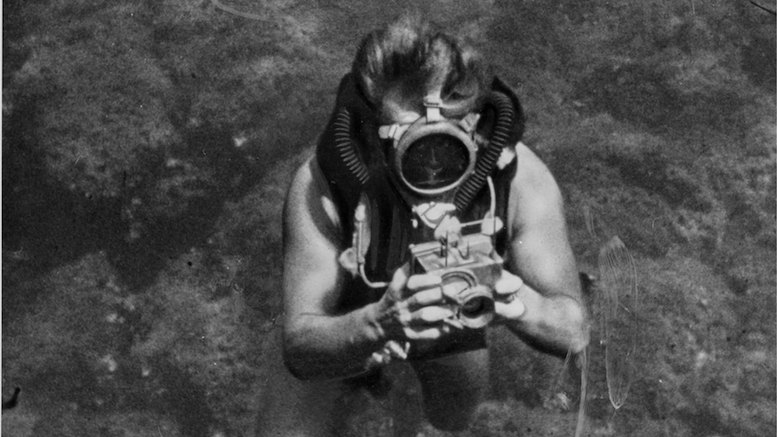
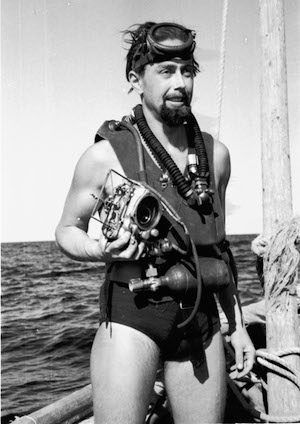
Professor Hans Hass, who died in 2013, was the last of the pioneering European divers, whose exploits laid the foundation on which today’s scuba diving and free diving activities are built. Fortunately for us, the adventures of Hans and other early divers, Jacques-Yves Cousteau, Captain Philippe Tailliez, Frédéric Dumas, Dr. Gilbert Doukan, Philippe Diolé, and Bernard Gorsky were recorded in books and on films, published and released in the English language.
All of these divers started out spearing fish, which was the prime activity in the 1930s and 1940s, prior to the development of free-swimming self-contained diving equipment. Among these early divers, Hans was the most prolific writer, publishing six books on his diving adventures before 1953. It was in that year that the book The Silent World, by Jacques-Yves Cousteau and Frédéric Dumas, and crafted by American writer James Dugan, was published in America. Cousteau had the support of the National Geographic Society and was therefore able to make a larger impact on the American public than did Hans Hass. Thus, American divers got to learn far more about Cousteau than they did about Hans Hass, whose popularity and credibility were far higher in Europe than in America.
Recognised in diving as the “Pioneer of the Pioneers”, Hans Hass’ career was marked with numerous diving milestones, which were often the first of their kind to be achieved and recorded.
Discovering the ocean
Hans was born in Vienna, Austria, on January 23, 1919, into a family of means. His father was a respected attorney and Hans’ educational path eventually placed him in the University of Vienna, where he studied law. His main interest was zoology but parental pressure did not allow him to pursue this path. Later events would though, as his career would be continually driven by exploring the science of the sea.
The Hass family was sufficiently well off to be able to take summer vacations from land-locked Austria, and travel south to the Côte d’Azur on the Mediterranean coast of France. It was here in 1937 that the 18-year-old Hans would encounter the man who would change the course of his life and propel him on one of the greatest ocean adventures of all time.
One day, during his French vacation, Hans wandered onto the rocks along the shoreline of the Eden Rock Hotel at Juan-les-Pins. Below him in the water he noticed a tanned athletic man swimming and free diving with a spear. Much to his amazement, as Hans watched from above, the man surfaced from one dive with a fish on the end of his spear. Hans was immediately smitten by this new system of fishing and when the diver came ashore Hans immediately engaged him in conversation. Of that meeting he later wrote, “He conjured up before me, for the first time, that new world that was to become so familiar to me later. (He) imparted to me not only his enthusiasm as an underwater hunter but also advised me how I might conquer this world for myself.”
The diver was not, however, a European, but an American, Guy Gilpatric, who was a columnist for The Saturday Evening Post, and who periodically wrote about his adventures spearfishing. Gilpatric’s term for the sport of spearfishing was “goggling,” as participants of the era wore goggles, not masks. He lived in Antibes and influenced several early pioneering divers along the Mediterranean coast. By 1938 he had compiled his goggling columns into a book, which he titled The Compleat Goggler, in acknowledgement of Sir Izaak Walton’s book on fishing, The Compleat Angler, published a few centuries earlier in 1653.
Generally regarded by historians as the first book on recreational diving, The Compleat Goggler was published in the USA and England, but surprisingly no French edition was published. This may have been due to World War II looming, as the interest, development, and participation in spearfishing was far greater in the south of France than anywhere else in the world.
From their first meeting at Eden Rock, Gilpatric became a form of diving mentor to Hans, who enthusiastically took up the new sport, quickly acquiring all the necessary equipment. Appropriately, Hans makes his first appearance in print as a diver in The Complete Goggler, when Gilpatric refers to him as “a young and very tough Austrian goggler who fishes our territory with a ten foot spear.”
Hans spent the summer of 1937 hunting fish on the Côte d’Azur but eventually had to return home to Vienna. “When, on my return from the Mediterranean, I told my friends and acquaintances of my new sport and my exciting adventures, I found that no one would believe me. Most of them accused me of an excessively lively imagination. This annoyed me so much that I conceived the idea of taking photographs underwater. Thus all the photographs I was to take in later years ultimately sprang from my injured vanity,” he later wrote. Although he had the idea of taking photographs underwater, no such equipment to do so was on the market, and he would have to design and build his own.
For more of the life and achievements of Hans Hass, please read SD OCEAN PLANET (Issue 6/2014)
A painting of a taniwha (dolphin) based on eye-witness account: In 1892, a surveyor employed three Māori from Taumarunui - Wārahi, Pita Te Aitua and Piki – to assist him in his work at the Rētāruke river. They were allegedly attacked by the ferocious resident taniwha, but later survived.
Legends anchored within the blue have always been a mainstay of coastal communities, sustaining a poetic sentimentalism about the ocean. Little wonder then, after more than 50 million years in existence, the dolphin holds a particularly special place in the whimsical realm of such folklore. One of the few marine creatures that has enjoyed a close connection with human beings, the dolphin has remained a lovable icon for hundreds of years, etched in local traditions and oral legacies over generations.
Taiwan
An Estuarine Legend of Love
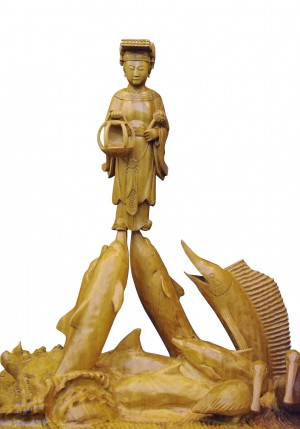
Since time immemorial, the Chinese white dolphin has been reverently referred to as the Mazu fish, lauded for their exceptional intelligence and rare intuition imparted by the Goddess of the Seafarers. An aboriginal tale passed down orally by the Paiwan tribe speaks of an oceanic dolphin, guided by its sentimental instincts, that once helped to reunite a pair of tragic lovers forced to reside on different islands. Hearing the desperate pleas of the couple who was separated by a large body of water, it carried the woman to her beloved, where they abided in eternal marital bliss. From then on, the much-adored animal – believed to be able to join two hearts that belong – became known as the quintessential guardian of love.
India/Pakistan
From Vengeance to Intelligence
Local folklore adds to the elusive Indus river dolphin’s mysticism. This species, specially designed for freshwater environments, was once a woman who incurred the wrath of a holy man by forgetting to feed him milk. One day, she was transformed by his curse into what it is today – a gentle, blind mammal, who has inhabited the mighty river for thousands of years.
Cambodia
Smiling Faces of the Mekong
According to an enduring Cambodian myth, the Irrawaddy dolphin was a fair maiden endowed with the body of a fish. Unfortunately, a forced attempt by her parents to make her marry a magical python saw her proudly casting herself into the Mekong river. Her suicide bid failed and instead, she was transformed – her enchanting contentment forever immortalised in the Irrawaddy dolphin’s trademark upturned mouth. Exuding timeless affability, it is hugely revered by the Khmer and Lao people.
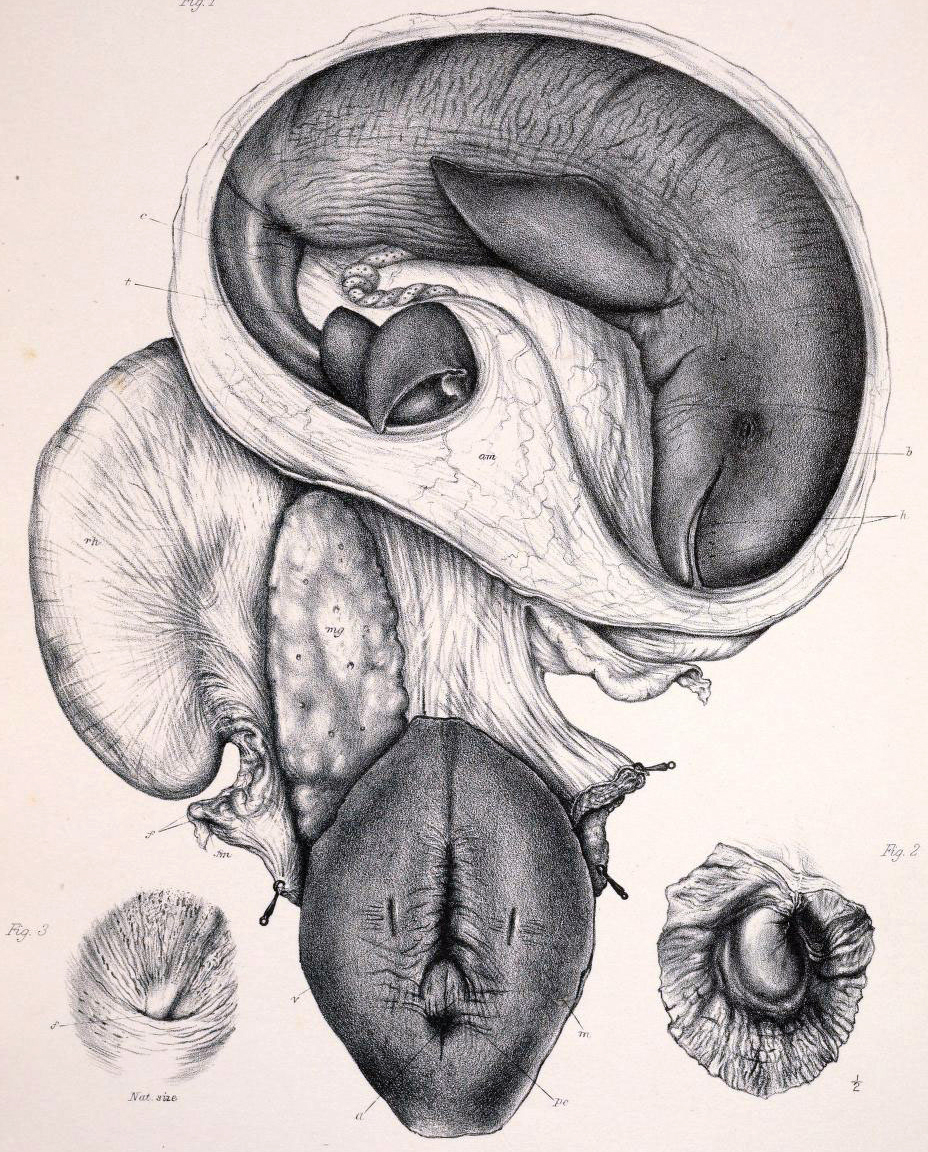
An 1878 drawing of an Irrawaddy dolphin in its mother’s uterus details the smile of this Mekong river wanderer – celebrated as the metamorphosis of a beautiful, dignified maiden.
Aotearoa (New Zealand)
The Taniwha Tautology
The Maori share a traditional relationship with marine mammals, in particular, dolphins, which they refer to as taniwha, or water spirits. According to the Ngati Wai people, who inhabit islands off Auckland’s eastern coast, dolphins acted as messengers in times of need, carrying news from the islands to the mainland. An ancient tale tells of a special taniwha named Tuhirangi, who guided Kupe, the legendary Polynesian explorer, to New Zealand. Subsequently, Kupe placed Tuhirangi at French Pass in the Marlborough Sounds, entrusting it the noble mission of guiding canoes through treacherous waters.
Egypt
Villains Turned Heroes
In ancient Greco-Roman Egypt, it is said that the dolphin was responsible for carrying the souls of the dead to the “Islands of the Blessed”. In the course of many adventures and misfortunes, Dionysus asked some pirates to carry him from Argos to Naxos, but alas, he discovered their heinous plot to sell him into slavery. To punish them, he turned their oars into snakes, enveloped the ship in a curtain of ivy and paralysed it with vines, until the pirates, driven insane, jumped into the sea and were transformed into dolphins. Since then, it was believed that dolphins were friends of man, who sought to save them from the waves, an act of repentance on behalf of the pirates from which they descended. Pirate lore also hails the dolphin as a symbol of protection.
Amazon
The Bufeo Colorado
Along the banks of the mighty Amazon river lived 18-year-old Rosita. One evening, Rosita went for a swim, when she suddenly noticed a young man watching her. Entranced, Rosita drew close while the stranger, claiming to be a fisherman, declared his love for her and eventually married her. The pair spent every dusk to dawn together, while the man mysteriously disappeared during the day. One morning, the fisherman failed to leave before sunrise. Waking to find a pink river dolphin beside her, Rosita screamed out loud. Her father rushed in with a gun and the dolphin, far from the water, was unable to escape the fatal gunshot. The fisherman was never seen again. Rosita, pregnant with his child, died during childbirth. The baby survived, but to everyone’s shock, it was not human, but a dolphin. Only then did they realise that the fisherman was the Bufeo Colorado, who had taken human form at night to seduce the young Rosita.
Micronesia
Island of the Dolphin Girls
A tale from Losap Island, Micronesia, describes how Anoun Farrang, the Lugenfanu clan chief ’s son, once fell into the water from a canoe when a dolphin swimming by with its pod accidentally knocked into him. The boy was unafraid and used his magic, which directed him to a lush island on the sea floor. Soon after, the dolphins arrived on the island and took their skins off, transforming into human girls. Delighted to find the boy, they offered him raw fruits and vegetables. Over many days, the boy taught the dolphin girls how to make a fire and cook food, and how to use plants to cure illnesses. One day, the boy decided to take leave of his hosts, as his family would be extremely worried about him. The dolphin girls, sad to see him go, sent gifts of food with him and swam with him back to Losap’s lagoon, where everyone was enthralled to see the chief ’s son again and thanked the dolphin girls for their gifts.
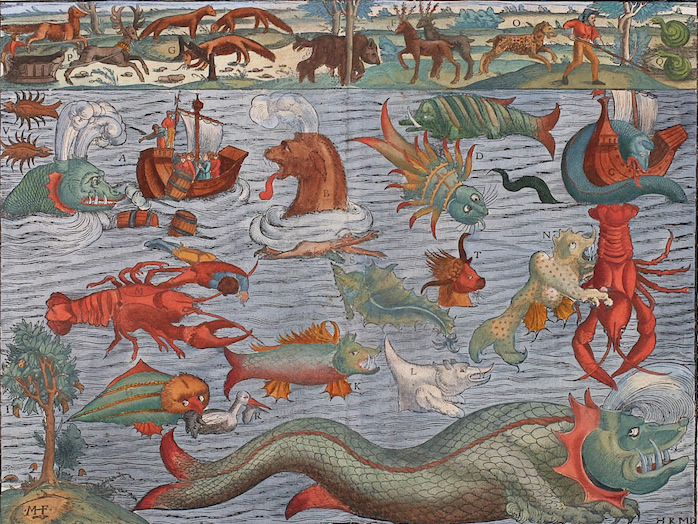
Historically, decorative drawings of heraldic dolphins from the Pacific Islands were frequently used to illustrate maps, such as the Carta marina, or Map of the Sea, created between 1527 and 1539. They highlight sightings of sea monsters often catalogued and studied by folklorists.
China
Goddess of the Yangtze
The baiji dolphin’s distribution historically covered much of the grand Yangtze river – also known as the River of Life – and its meandering tributaries from Yichang to Shanghai. According to legend dating back more than 2,000 years, this elegant, intelligent dolphin was worshipped as the Goddess of the Yangtze by the Chinese, the fabled reincarnation of a beautiful princess who refused to marry a man she did not love and was drowned by her father for shaming the family.
By Selina Tan and Shreya Gopi, with Lulu M
This article feature in Asian Diver The Big Blue Book (Issue 2/2015)
From the planet’s most colourful fish to its largest animal, Asia Pacific plays host to many of the world’s record-breaking species! In the full spirit of Wildlife Wednesday, we bring you the marine life that has pushed limits to the extreme. Some are deadly serious, others are just for fun.

 wide-angle images underwater. When placed at a strategic angle, strobes allow the camera to capture colour-accurate images that are (hopefully) backscatter-free.

 Hans was born in Vienna, Austria, on January 23, 1919, into a family of means. His father was a respected attorney and Hans’ educational path eventually placed him in the University of Vienna, where he studied law. His main interest was zoology but parental pressure did not allow him to pursue this path. Later events would though, as his career would be continually driven by exploring the science of the sea.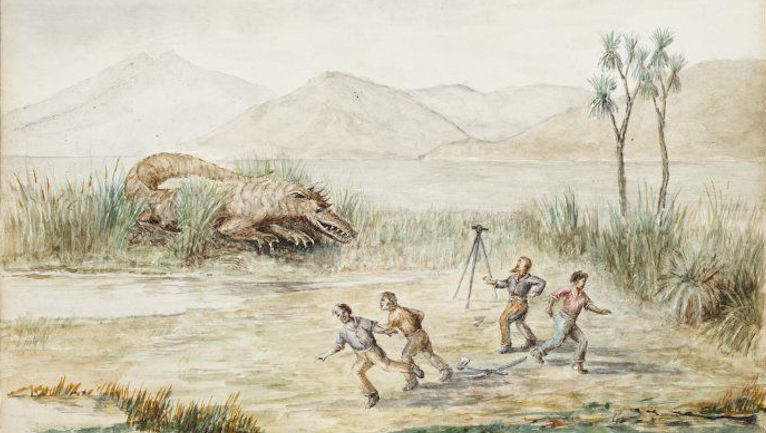
 Taiwan