Home Blog Page 30

The Land of Fire and Ice

0
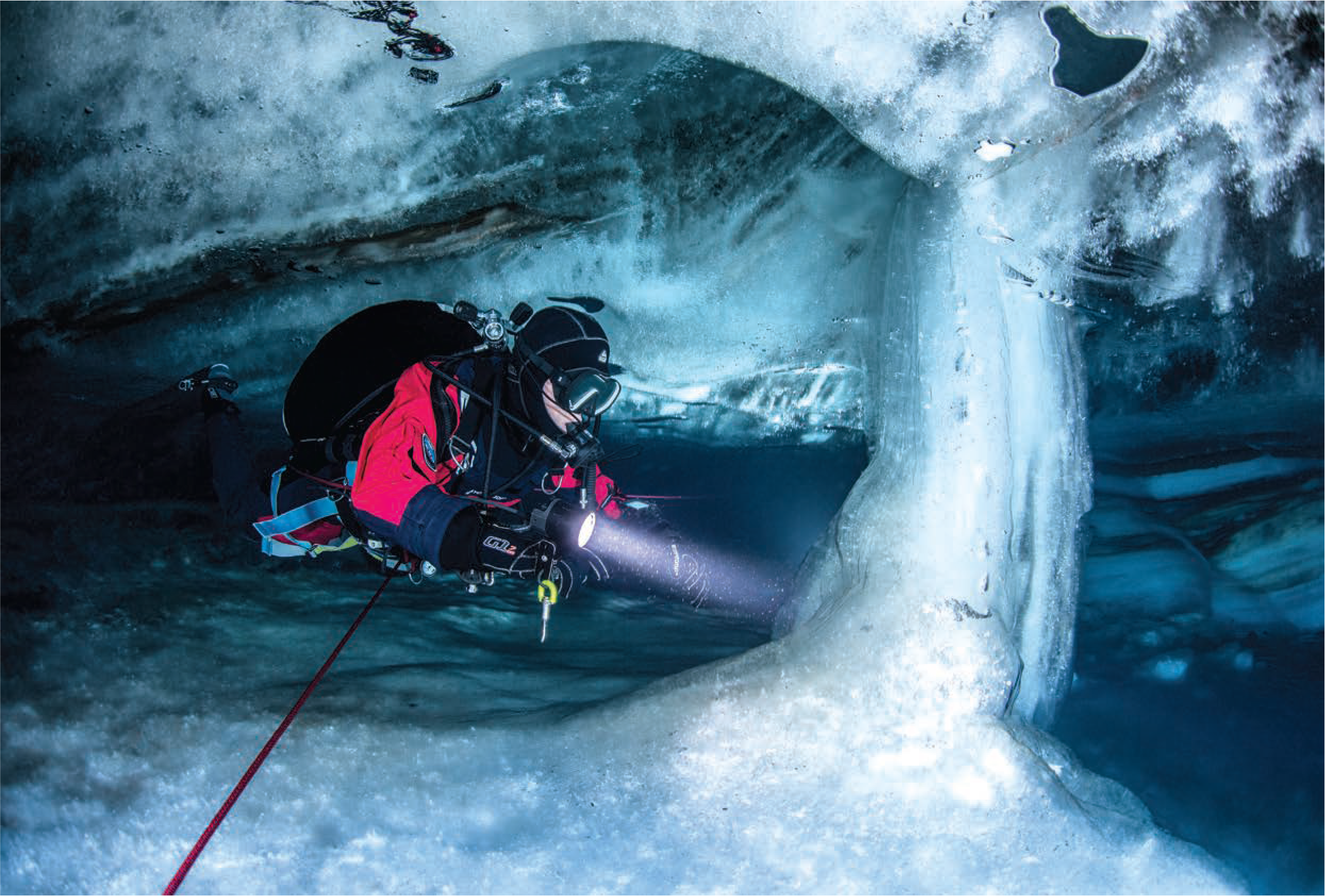
A diver observing the frozen waterfall in the flooded Langjökull glacier
Diving in Iceland is unlike any other dive trip. Here, hot and cold water collide, creating pillars of life from the depths of the sea; ice freezes to a blue hue, trapping frozen waterfalls within. Welcome to the land of fire and ice! 


By Byron Conroy

Sixteen million years ago, in the northern-most region of the Earth, a land of fire and ice first appeared after a fissure in the Mid-Atlantic Ridge created a volcanic hotspot that gave birth to this landmass. Here, the North American and Eurasian tectonic plates meet, continuously diverging and expanding the land area by five centimetres each year. Active volcanoes, geysers, glaciers and geothermal areas populate the island. Because of its dramatic topography and geographical location, almost 80 percent of the country is uninhabited, with only 330,000 people living in Iceland today.

Inspiringly, all of Iceland’s energy is produced via geothermal and hydroelectric power, with 90 percent of households heated by geothermal water. The land offers plentiful natural resources that Icelanders have harnessed to produce renewable energy.

Iceland’s underwater sights are no less enchanting than its topside scenery. Flooded ice caves and hydrothermal underwater cones are just some of the unique dive sites that the land of fire and ice offers.
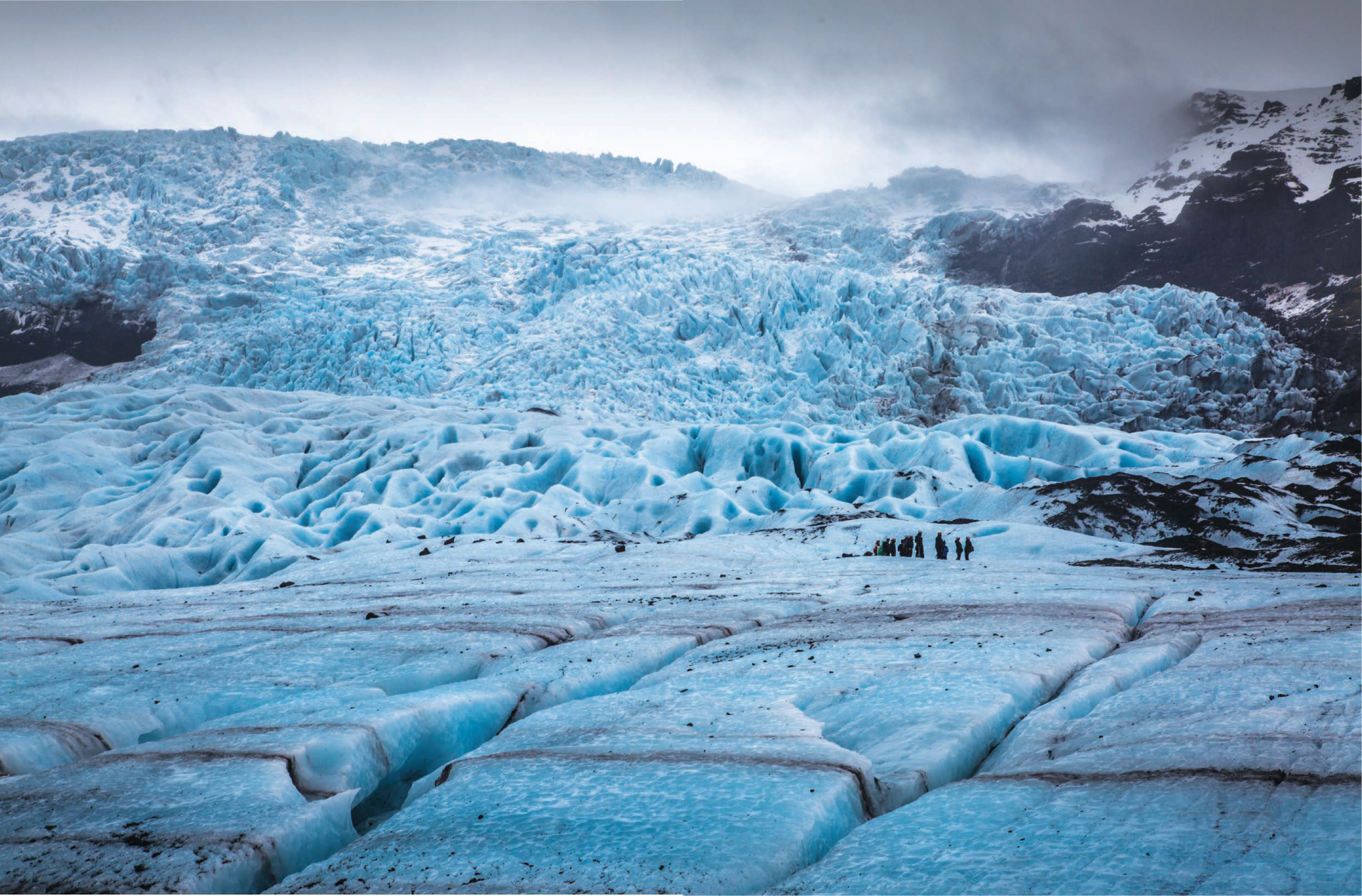
Vatnajökull National Park, located on the southeast coast of Iceland, encompasses Europe’s largest glacier


ICE

One-third of Iceland is covered with glaciers – bodies of densely-packed ice that accumulate over centuries from snowfall. Every summer, the glaciers undergo melting, and the meltwater forms rivers on the glacier surface that flow into the glacier itself. These rivers usually run from around April and freeze when the cold winter arrives in November. This leaves behind large caves under the glacier surface. In recent years, these caves have become a popular attraction for adventurous tourists, as their blue ice roofs are a mesmerising sight to see, especially when light enters.

Last April, when the glaciers began to melt and the rivers started flowing, Magmadive heard of a cave found high on the Langjökull glacier that had begun to flood, so we set off to see if it could be dived. The expedition itself would be difficult, with the cave at an altitude of 840 metres that was very difficult to access, especially with all of our dive equipment.

Stage one of the expedition involved getting from Reykjavik, the capital of Iceland – which is located   200 kilometres inland – to a snowmobile base elevated at 400 metres. To get there, we needed to use a “super jeep”, a modified vehicle with one-metre tyres that can be inflated and deflated while riding the rough terrain. We loaded the jeep and drove until we arrived at the foot of the glacier.

At this point, we unloaded all of the dive equipment onto sleds and strapped them in for the final leg of the journey. The sleds were attached to high-performance snowmobiles that allowed us to travel a further 10 kilometres up to an elevation of 840 metres, where we found ourselves at the top of the glacier.

We looked down into the entrance of the ice cave, where the water level could be seen 10 metres below. With no time to waste, we donned our drysuits and descended down to investigate before the actual dive. When we reached the waterline, we shone a torch into the water and were amazed to find it crystal clear. With the excitement building, we quickly returned to the surface to prepare for the dive.

To perform the dive, we adopted the standard ice diving practice of having a surface team and an underwater team. A surface line connected to the first diver’s harness was used, which was looped through and tied to the second diver. This allows the divers to decide how much line to let out and the maximum distance between them. The line is also used as a tool for communication: The diver feeding the line can communicate with the surface team through a series of different tugs.

Magmadive lead guide Kuba and I were the first to enter. As an underwater photographer, I was keen to be the first to see the cave in all its glory. As Kuba and I descended into the water, we were met by a tight passage that could only be passed through a single file. As we reached the end, the cave opened up and we could see straight into the clear water. 

I had brought some pretty powerful, wide video lights, so I switched one on to light up the cave. Once on, I was blown away by the shear blue ceiling of the ice roof. We continued to swim to the widest and most open part of the cave, and reached the far end to find a frozen waterfall. At the start of spring, the snow on the glacier begins to melt and then freezes. Over time, this repetitive cycle creates a frozen waterfall inside the cave. It was incredible to see: the pure-white frozen column of ice surrounded by the blue ceiling of the cave.

After the second team had their turn, we packed the kit up onto the snowmobile and had a fun ride back to the super jeep. It turns out that drysuits are the perfect outfit for snowmobiling! 
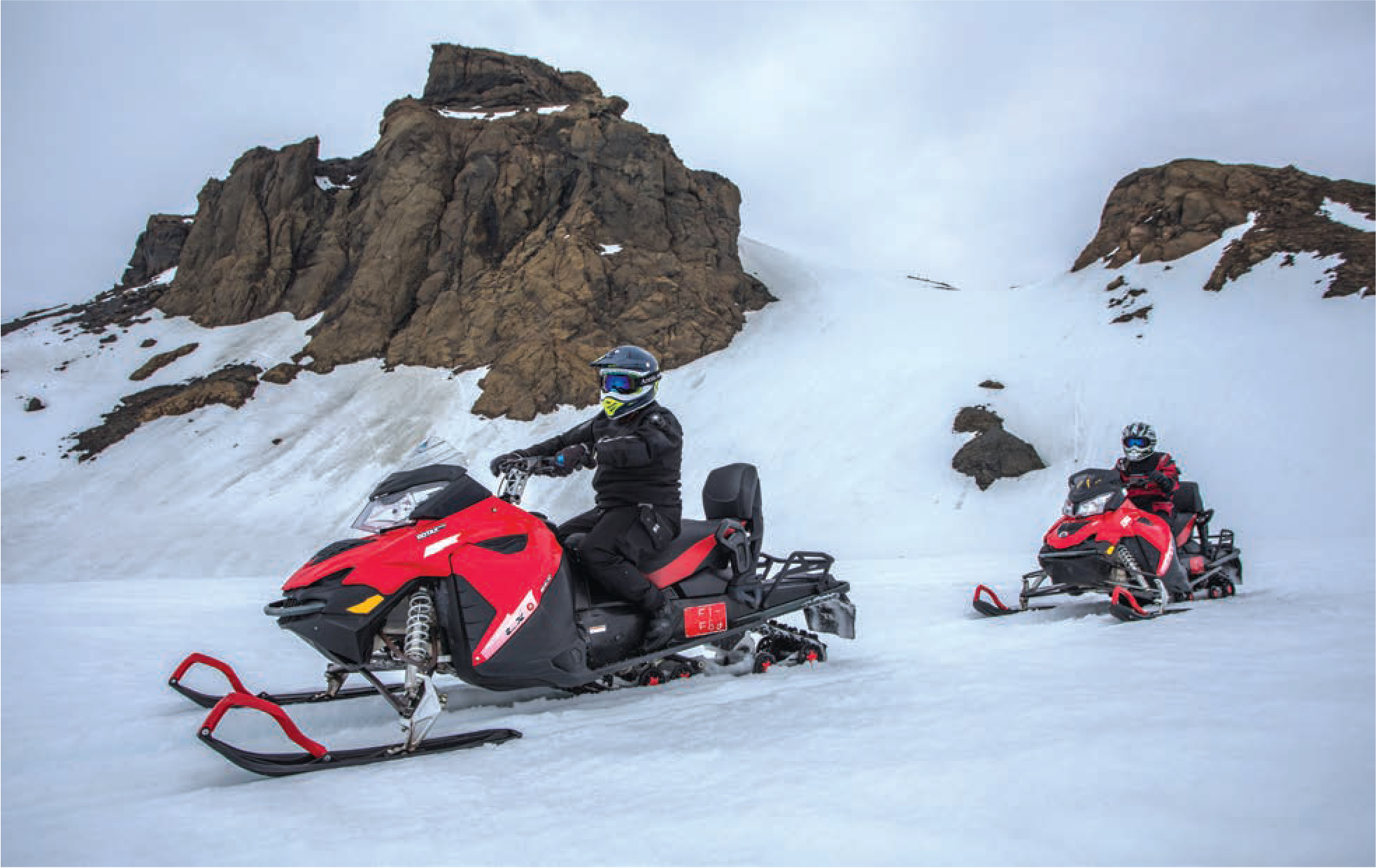
 

Snowmobiling is a fun and efficient way of getting around in Iceland


FIRE

In the far north of Iceland lies a small village called Hjalteyri. The village is located on the shore of Eyjafjörður and is home to the famous dive site Strýtan, the world’s only hydrothermal cone that is within recreational dive limits. The Strýtan dive site was formed when warm, mineral-rich

fresh water was heated underneath the ocean floor and seeped into the ocean. As the mineral-rich fresh water wells up from the ground at a temperature of 80 degrees Celsius, the minerals coagulate upon contact with the cold ocean water, gradually building a tall cone of fragile limestone over the last 11,000 years. The cone itself starts at a depth of 65 metres and rises upwards to 15 metres below the surface. Thousands of litres of warm fresh water are still pouring out of the cone and you can even take off your gloves to warm your hands. 

The area itself is home to a great deal of marine life including large schools of pollock, lumpsuckers, wolffish, cod and a wide range of nudibranchs and other macro life. To get to the dive site, a 10-minute boat ride from the shore is required. When entering the water, a short descent will take you to the top of the cone. Further down, thermoclines and haloclines can be felt as the hot fresh water mixes with the surrounding cold salt water of the ocean. This dive site has been carefully studied by scientists, as it is thought that the mixing of hot fresh water and cold salt water may have been the starting point of life on Earth. 
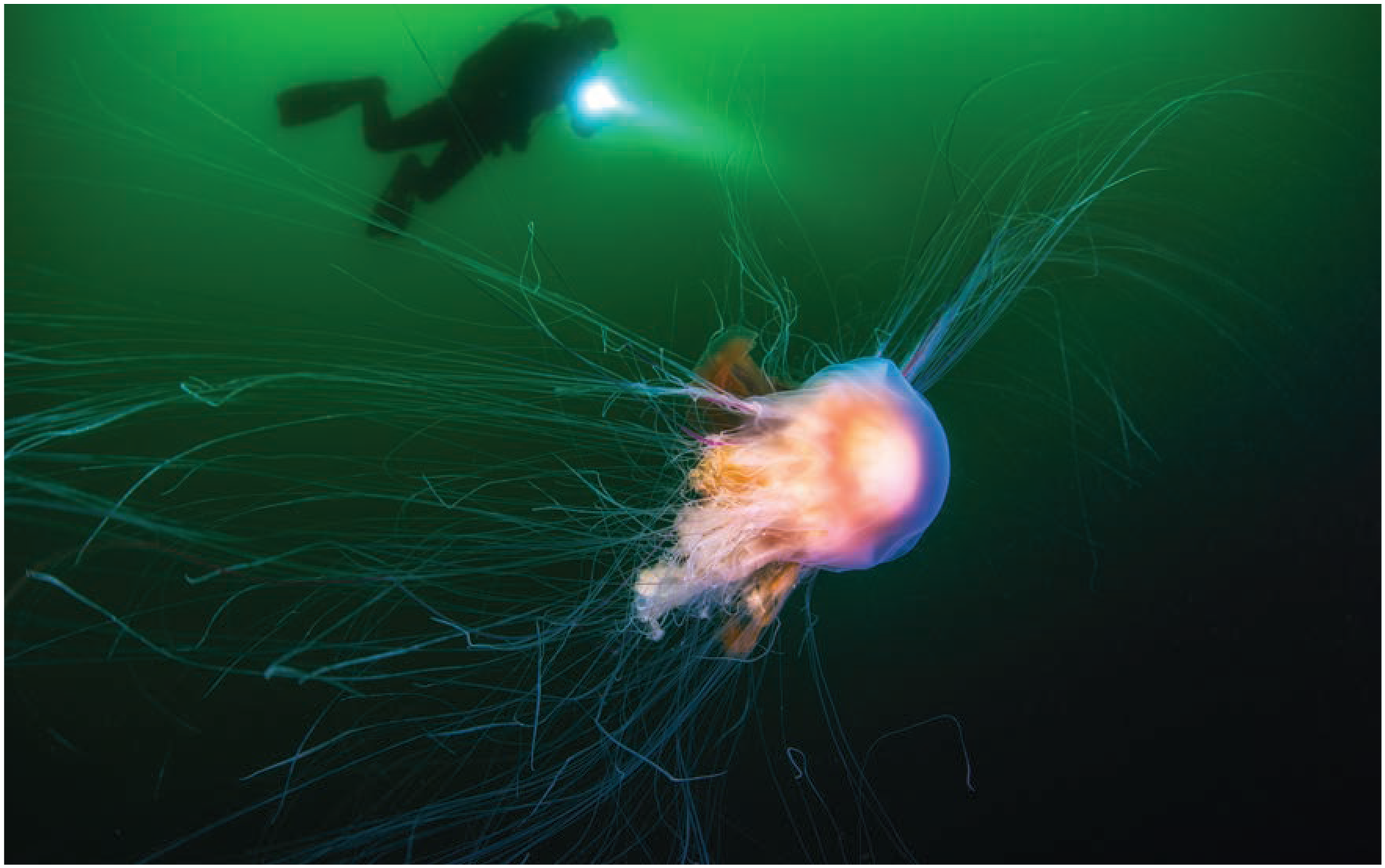
 

A jellyfish swimming in the waters of Strýtan


Read the full story and more by downloading a digital copy of Scuba Diver Australasia + Ocean Planet No.113 Issue 3/2018 here! And for a limited time only, get the best e-magazine deals at USD7.99 for 6 issues* (Usual rate: USD29.94) 

Science of the School

0
It’s a hypnotic, awe-inspiring sight– thousands of fish moving in sync, as if with one mind.

Schooling fish is a phenomenon that arises from something known as “swarm intelligence”, in which independent units spontaneously form organised structures or patterns. But how exactly does it work? The process is far simpler than you might imagine.


THE BENEFITS OF LEADERLESS GOVERNANCE

It’s a form of aquatic anarchy – in a school of fish there is no single leader, no one individual controlling or determining the direction or structure of the collective. In a school, decisions are made according to the collective behaviour of self-organised systems. Self-organisation is when structures appear at the global level of a system as a result of the interactions of its lower-level components (Bonabeau et al., Swarm Intelligence, 1999); these patterns on the global level emerge as intelligent ones but are probably unknown to each individual agent.

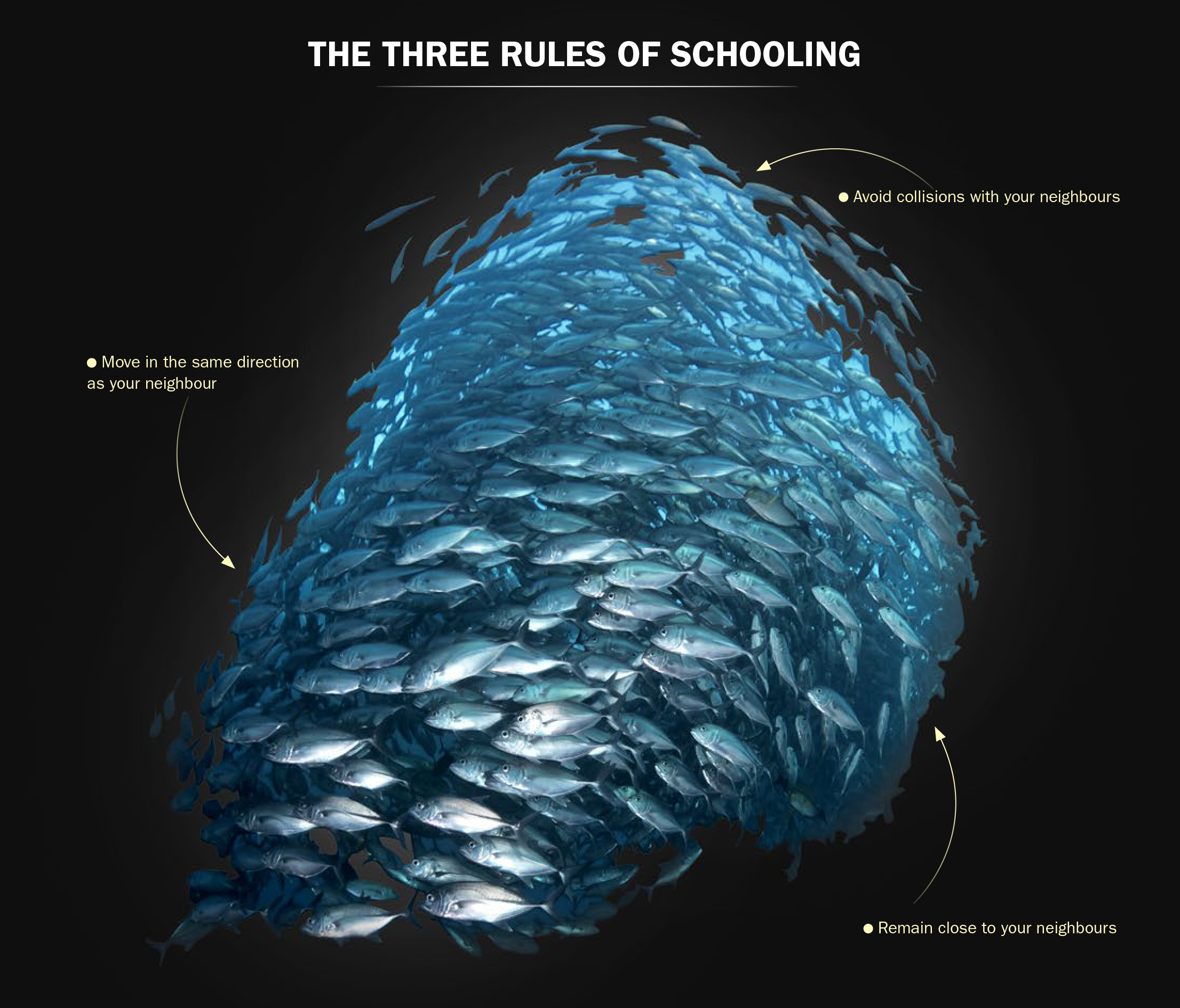
It has been found that each fish is only responding to the behaviour of its nearest neighbour at any one time. Research published in the journal Proceedings of the National Academy of Sciences shows that fish coordinate their movements according to a simple set of rules, using mainly visual clues, and adjusting their position based on that of their neighbours.

According to the lead researcher, James Herbert-Read of Sydney University’s school of biological sciences, the rules include accelerating towards neighbours that are far away and decelerating when neighbours are right in front. They also found that a fish only responds to a single nearest neighbour at any one time. So, when any fish finds itself close to a predator, it naturally moves away from it, its neighbours then follow suit, and the information is passed, fish to fish, between the whole school.


WHY FISH SHOULD STAY IN SCHOOL

Not only does swimming with the crowd minimise the chances of an individual being picked off by a predator, but a study published in the journal Current Zoology suggests that hundreds or thousands of creatures moving in sync also has a physical impact on the environment, generating waves of sound and pressure and that these vibrations are thought to confuse the senses of predators, specifically affecting their lateral line receptors, electrosensory perception and auditory ability.

SCHOOLING BY NATURE

Schooling has also been shown to be a genetic predisposition, rather than learned behaviour; it makes sense that fish would evolve to swim together to better protect themselves from predators. Research also shows that most fish species will school at some point in their life cycle. 

The gene identified for the schooling instinct is connected to the gene for the lateral line – a strip of sense organs along the side of the fish’s body that picks up vibrations in the water much like the tiny hairs in our ears pick up vibrations and interpret them as sound. Interestingly though, fish navigate and school based on visual information, with the information they receive through their lateral line playing a secondary role.


To read other stories, download a digital copy of Scuba Diver Ocean Planet No. 4 Issue 4/2015 here! And for a limited time only, get the best e-magazine deals at USD7.99 for 6 issues* (Usual rate: USD29.94) 
6 Useful Finning Techniques to Master

0

Finning techniques come in a few different forms, and opting for a certain technique is up to the diver: After all, each diver has their favourite style like they do their own mask. Finning techniques can be used in different environments, to conserve energy or save air, and even to escape a territorial titan triggerfish. We bring you six finning techniques that are good to know, and great to master.


1. FROG KICK

Many divers find the frog kick relaxing, seeing it as an ideal cruising kick that they can alternate to between the flutter kick. It’s great for general cruising when close to delicate coral, silty/sandy seabed or marine life (providing you look where you’re kicking), and also when you’re exploring large caves

2. BENT-KNEE CAVE DIVER KICK

The bent-knee cave diver kick works well in small areas such as wrecks and caves, and when close to silty/sandy seabed and marine life. We don’t recommend the bent-knee cave diver kick when in strong currents or when you need to get away from something, quickly

3. FLUTTER KICK

The flutter kick works best with long and gentle strokes – any erratic kicking can prove ineffective and has more chance of disturbing nearby seabed and marine life.

The flutter kick is easy to use and can provide a good forward thrust. It’s best used on the surface during a descent or ascent, when you’re well clear of the seabed and when swimming into a current

4. SCISSOR/SPLIT KICK

A lot of thrust can be generated by a long, lazy kick. The thrust comes when both legs come together, just like scissors, and this can propel a diver forward whilst saving energy. Scissor/split kicks are great for powerful cruising as an initial kick to get you going forward and to rest groups of leg muscles. We don’t recommend using it when close to silty or sandy seabeds, in confined spaces inside a wreck or cave, or when apex speed is required

5. HELICOPTER TURN

The helicopter turn allows you to pivot or rotate whilst in the horizontal and trimmed diving position – beneficial for quickly changing direction. It enables you to turn and look behind you without changing water position. Slowly move your fins apart horizontally in an opposing back and forth motion, whilst rotating your ankles and fins

6. REVERSE OR BACK KICK

The reverse or back kick is a top skill to master. The ability to move away from a subject whilst still being able to face it is perfect for underwater photographers, instructors and for divers who are fixated on a subject. It’s almost a complete reverse of the frog kick, and requires your fins to scoop water to start you moving backwards


Want more tips to help you grow as a diver? Subscribe to Asian Diver here or download the digital copies of our magazine here

Get Hooked

0
When the currents are strong, using a reef hook can be an exhilarating way to enjoy them. Here’s how you can get hooked.

By Joseph Tepper

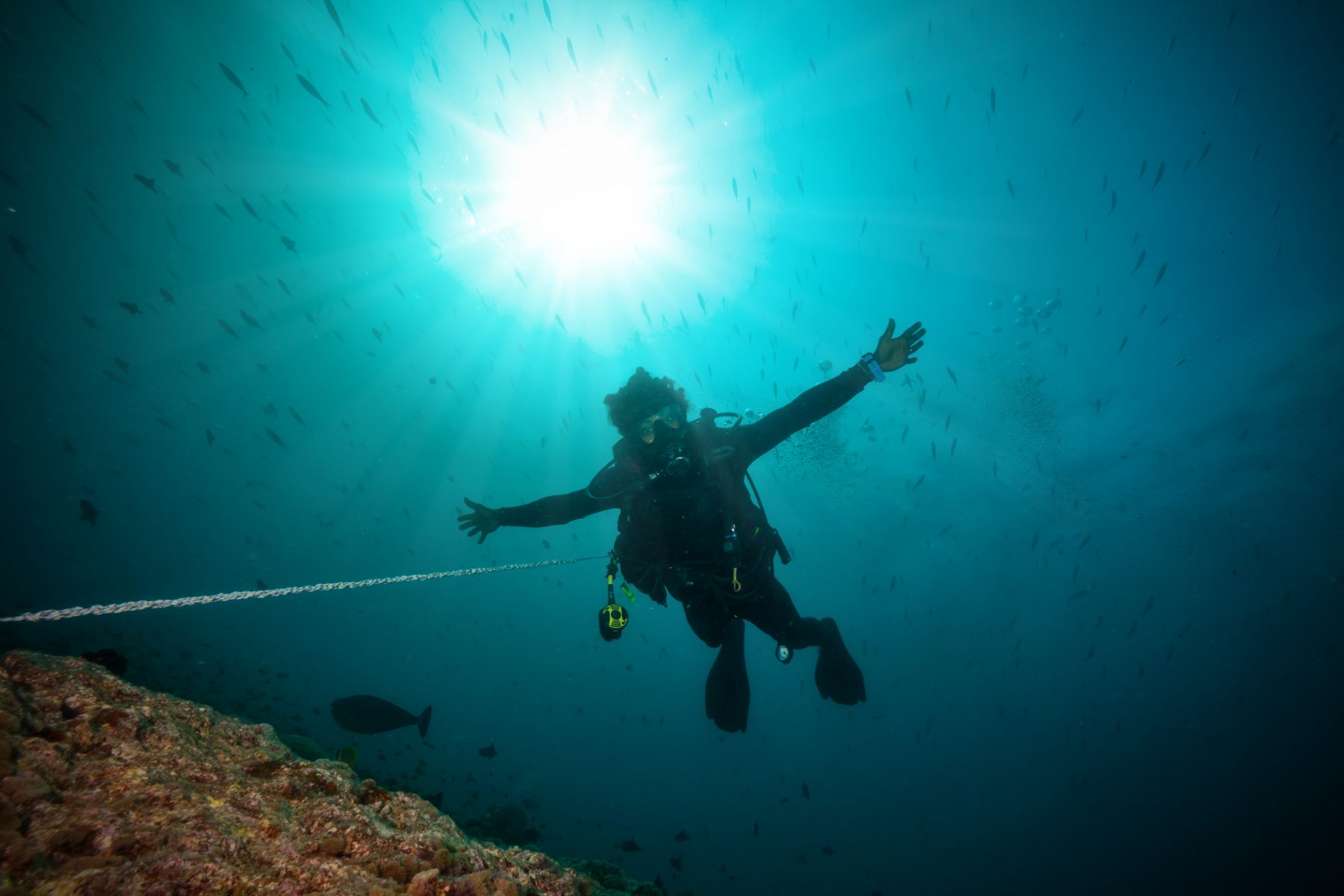
Using a reef hook to lock into a rock in the midst of a massive current while dozens of pelagic animals drift by is an ethereal experience: Close your eyes and the passing rush of water gives the sensation of skydiving.

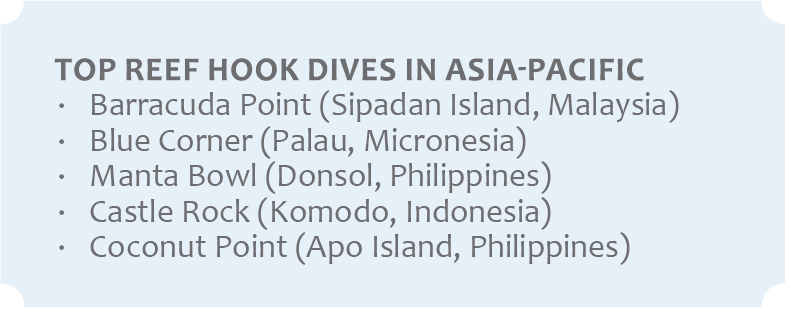
Reef hooks are a necessary tool for diving current- ridden destinations such as Sipadan in Malaysia, Komodo in Indonesia, Palau in Oceania, and Donsol in the Philippines. But if you’ve never used one before, deploying a reef hook in current-coddled conditions can be a bit challenging.


WHAT IS A REEF HOOK?

Dive lore has it that the reef hook has humble beginnings in the Micronesian nation of Palau. Dive guides were looking for a way to decrease exertion and increase safety on the famed Blue Corner dive site, which features a seemingly endless rush of water. They began using hook-shaped scraps of steel attached to a rope to secure divers to a non-living part of the reef.

The modern-day reef hook remains essentially unchanged. At one end you have a hook: This can vary in form from a single hook to multiple curved fingers. This is attached to a line ranging in length from an arm’s length to several feet. Finally, a clip at the other end easily attaches the hook and line to a D-ring of the diver’s buoyancy control device (BCD). Some models come with a self-containing pouch or retraction option, but keeping your reef hook stored in a BCD pocket is perfectly acceptable.


WHEN SHOULD YOU USE A REEF HOOK?

Essentially, the reef hook is designed to keep the diver in one place with minimal kicking effort – if any. For this to work, there are two conditions that must be met. First, there should be enough constant current on the dive so that there is tension in the rope between where the hook is in place and the diver. If the current is slight or strong but constantly changing directions, then it’s best to rely on your fin kicks to keep in place.

Second, you’ll need a place to “hook in” safely and responsibly. A reef hook will do you no good in an open water dive without rocks or reef. Even if there is a reef, it’s important that you only use your hook in a spot that doesn’t have any living coral. In many destinations, there are designated spots to hook in and watch the action unfold. If you’re questioning whether or not to use a hook on a dive, make sure to ask your dive guide.

Reef hooks also make photography much more manageable in crazy currents. Rather than having to grasp at a rock, your hands will be free to operate a camera and capture amazing images of the dive.


HOW TO USE A REEF HOOK

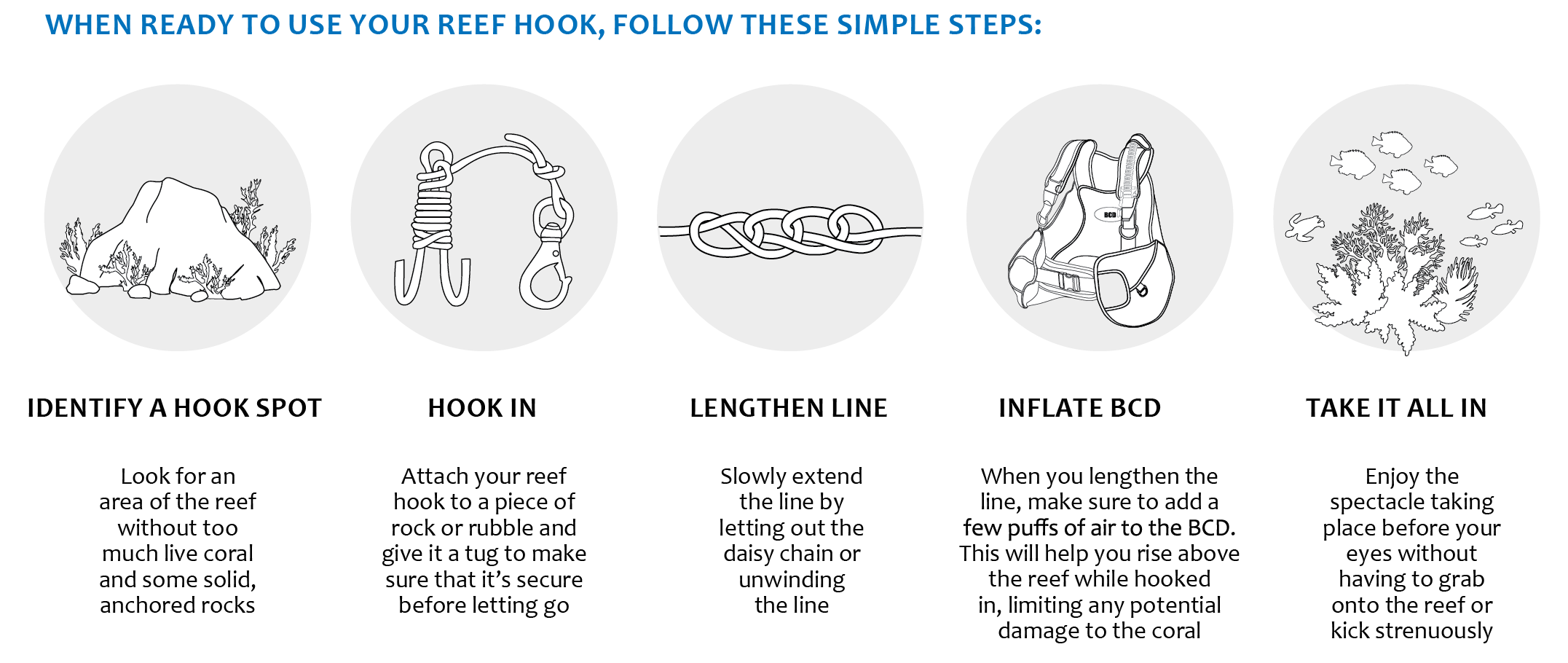
When used properly, a reef hook allows the diver to stay in one place without having to constantly kick or grab onto the reef with their hands – a danger to both the diver and the environment. However, if you’ve never used a reef hook before, we suggest bringing it on a dive with minimal or no current to get accustomed to its operation. Ideally, you’ll want to be able to deploy your reef hook without having to take your concentration off the dive.

There are a variety of methods to prepare your reef hook before the dive, but here is one approach used by experienced divers. Begin by “daisy-chaining” your reef hook: This will shorten the length of the line so that it’s more compact. When you’ve completed your daisy chain, “lock” it in place by threading one of the last loops through the clip and securing the clip on your BCD’s central D-ring. Tuck the hook itself into the pocket prior to the dive.


To read other stories, download a digital copy of Scuba Diver Australasia + Ocean Planet No. 113 Issue 3/2018 here! And for a limited time only, get the best e-magazine deals at USD7.99 for 6 issues* (Usual rate: USD29.94) 

10 Tips for Dive Gear Safety

0
Keeping your gear in good condition and being familiar with it is vital to helping you stay safe when you go diving – it could even save your life. Kenneth Tan from 300BAR.Asia provides 10 tips for dive gear safety.


1. GET FAMILIAR

Using a rental set or borrowed equipment? Get familiarised with it before jumping into the water


2. REGULAR CHECK-UPS

Check your equipment is functioning and have a buddy run through it before getting into the water


3. STORE IT SAFE

Dry your gear in a cool and ventilated area away from the sun! It prolongs the life of your gear and prevents it from becoming worn


4. CATCH IT EARLY

A slight hissing sound coming from your regulator? Don’t risk it – use another set. A small hiss always leads to bigger problems


5. KEEP IT FRESH

Only rinse your gear with fresh water or cleaning solutions for diving equipment. You never know what other cleaning agents may do to those O-rings in your regulator


6. TEST IT FIRST

Testing out new equipment or taking a buddy for their first dive? Test your gear in shallow water first and work out safety procedures with your buddy


7. DON’T FORGET OR NEGLECT

Don’t neglect your dive computer – service it regularly and make sure that the batteries are fresh


8. KEEP IT STREAMLINED

Streamline your equipment! Prevent entanglement and inadvertent harm to marine life


9. GEAR UP

Carry a cutting device, a light and a high-visibility marker buoy whenever possible. You never know when you might need it


10. BACK TO BASICS

Haven’t dived for a while? Go for a refresher course!


Kenneth Tan is the founder of 300BAR.Asia, a dive gear distributor striving to be the leading distributor for affordable scuba diving equipment in Southeast Asia. They aim to provide customers with value-for-money scuba diving equipment and have an emphasis on safety.


Want more tips to help you grow as a diver? Subscribe to Asian Diver here or download the digital copies of our magazine here

Reef-World Announces 2020 Green Fins Award Winners

0
Image by Bo Mancao
The Green Fins Award recognises the world’s most environmentally friendly dive centres


The Reef-World Foundation – the international coordinator of the UN Environment Programme’s Green Fins initiative – is delighted to announce the winners of the coveted 2020 Green Fins Award are:

  • Bubbles Dive Centre, Pulau Perhentian, Malaysia
  • Flora Bay Divers, Pulau Perhentian, Malaysia
  • Tioman Dive Centre, Pulau Tioman, Malaysia

The prestigious annual award recognises the Green Fins member with the lowest environmental impact. This year, the competition was so tight there was not one, but three winners all tied in first place. What’s more, all three of the winners and seven of the global top 10 centres are based in Malaysia!

The winning dive operators were chosen from the 600-strong network of Green Fins members by a rigorous assessment of business practices. To be eligible for the award, the operator must have had its latest assessment conducted within the last 18 months. In 2019, the proud winner was Tioman Dive Centre: a PADI dive centre which has been a Green Fins member since 2009 and had managed to hold onto the title again in 2020.

 As 2020’s Green Fins Award winners, Bubbles Dive Centre, Flora Bay Divers and Tioman Dive Centre are recognised as the world’s most sustainable dive or snorkel operator, as verified by the globally-recognised Green Fins environmental assessment. Their steps to improve sustainability practices, which have resulted in this recognition as the most environmentally friendly Green Fins dive centres in the world, have included:


  • Switching to eco-friendly products and improving waste management practices

Kelvin Lim, Flora Bay Divers, said: “We switched from normal detergents to eco-friendly detergents, we are encouraging divers to bring their own water bottles to reduce plastic and came up with a general waste bin and a bin for plastic bottles in front of our dive centre. This helps tourists and locals to place trash that’s been found on the beach easily and conveniently since there are no proper bins along the beach.”


  • Training staff in why environmental practices are important

Peisee Hwang, Bubbles Dive Centre, said: “Green Fins has helped my crew understand more about the importance of looking after the environment. Less-educated members of staff would throw cigarette butts in the sea without thinking but they are now keeping their trash to dispose of in the bin when they are back.”


  • Upgrading boat engines

Rosie Cotton, Tioman Dive Centre, said: “At the beginning of 2020, we upgraded our last remaining boat engine and now we run 100% with 4-stroke models. The benefits are not only to the environment but also a huge reduction in petrol usage. It’s a win-win situation!”


“Competition between the Top 10 is always tight but the fact that there are three winners this year, when usually one centre takes the title, shows how much sustainability is being put at the forefront of the agenda across the dive industry. This win is testament to their hard work and ongoing sustainability efforts and they should be very proud.”

– Chloe Harvey, Director at The Reef-World Foundation


Alvin Chelliah, Green Fins Assessor Trainer from Reef Check Malaysia, said: ”Most dive centre managers and owners that I have come across in Malaysia care and want to do what they can to help protect coral reefs. I think Green Fins has been the right tool to guide them towards practical actions they can take. Over the years, we have seen these dive centres put in a lot of effort and work hard at following the guidelines and they have improved steadily as a result. We hope others will follow their example.”

Peisee Hwang, Bubbles Dive Centre, said: “We are thrilled to know that we have won and we are glad that our effort is being recognised. We hope that more operators aspire to join us in pledging for the environment.” Bubbles Dive Centre will also be part of Reef-World’s panel at this weekend’s Scuba.Digital show to share some insights from their sustainability journey.

Kelvin Lim, Flora Bay Divers, said: “We are proud to be acknowledged for our efforts to inspire sustainable diving. Our focus remains on cultivating informed and conscious divers with good diving skills and habits..”

Rosie Cotton, Tioman Dive Centre, said: “Receiving the news that we have made the top spot of Green Fins members is a fantastic feeling. Thank you so much to the Green Fins team for your ongoing support! This year has obviously been slightly different from previous years. I hope that something we can all take away from this year is that changes in our daily habits can create shockwaves of positive change around the world in a relatively short period of time. From TDC, we hope you are all safe and well at this time and are able to find some positives despite these difficult circumstances.”

Chloe Harvey, Director at The Reef-World Foundation, said: “We’re thrilled to recognise Bubbles Dive Centre, Flora Bay Divers and Tioman Dive Centre as joint winners of the 2020 Green Fins Award. Competition between the Top 10 is always tight but the fact that there are three winners this year, when usually one centre takes the title, shows how much sustainability is being put at the forefront of the agenda across the dive industry. So, we’d like to say a big well done to Bubbles Dive Centre, Flora Bay Divers and Tioman Dive Centre. This win is testament to their hard work and ongoing sustainability efforts and they should be very proud. It’s an incredibly tight race to be named the best of the best!”

The Green Fins Top 10 list is comprised of the world’s most sustainable dive operators, as determined by the Green Fins assessment process. In 2020 they are:

  1.     Tioman Dive Centre, Flora Bay Divers and Bubbles Dive Centre (all in Malaysia)
  2.     Ceningan Divers (Indonesia)
  3.     Scuba Junkie Mabul (Malaysia)
  4.     Sea Voice Divers (Malaysia)
  5.     Evolution (Philippines)
  6.     Orca Nation Rawa (Malaysia)
  7.     Equation (Philippines)
  8.   The Barat Perhentian Beach Resort (Malaysia)

In Malaysia, Green Fins is run by Reef Check Malaysia in partnership with the Department of Marine Parks Malaysia (DMPM) on the Peninsula and Sabah Parks in Sabah. Membership is not yet available in Sarawak. 

For more information, please visit www.reef-world.org and www.greenfins.net.

If you’re interested in supporting The Reef-World Foundation in its work to protect coral reefs around the world through the Green Fins initiative, consider donating now. To keep up with our latest news and developments, please follow Reef-World on Facebook, Instagram and Twitter. 

Dive and snorkel operators interested in signing up to Green Fins can find the membership application form at: https://www.greenfins.net/how-to-join.

The Blue Mind

0
Research shows that diving and snorkelling can enhance your mental well-being

By Karen Stearns, Wakatobi Resort

Are we healthier and happier when we are around or in the water? There is an emerging school of scientific thought that supports this idea and the concept of the “blue mind”. This phenomenon is described as a mildly meditative state of calm unity, and a sense of general well-being that is created when humans are near or in water. This hardly comes as a surprise to those of us who dive and snorkel, especially when we do so at beautiful locations such as Wakatobi in Southeast Sulawesi, Indonesia.

The phenomenon known as the blue mind was first popularised by marine biologist Dr Wallace Nichols. After devoting much of his career to sea turtle research and conservation, he shifted his focus to the study of what he feels is a deep connection between humans and water – especially blue water. “We are drawn to water, because we come from, and are still largely made of water,” says Nichols. “In fact, the human body is about 60 percent water, and the brain is 75 percent water. When you see water, when you hear water, it triggers a response in your brain that you’re in the right place.”

Scientists have long known that the atmosphere at a beach or on the ocean contains elevated levels of negatively charged ions. These ions cause the brain to release mood-enhancing serotonin and to reduce blood lactate levels. Now, as neurologists and psychologists turn their attention to the effects of water environments on the brain, they are finding scientific evidence that validates Nichols’ concepts of the blue mind. Using imaging techniques such as CT, PET and MRI scans, researchers have shown that proximity to water will increase the levels of certain “feel-good” hormones such as dopamine and oxytocin within the human brain. At the same time, levels of the stress hormone, cortisol, drop significantly. Equally interesting are indications that the human brain seems to prefer the colour blue to all others, and that proximity to water increases the brain’s ability to focus. Additionally, being in or near the water amplifies the calming effect that is associated with all human contact with the natural world. 

The underwater world, in general, provides a predictable, calming setting, which induces a state of relaxed blue mind. Image by Marco Fierli/Wakatobi

THE PLEASURES OF RED AND BLUE

In contrast to the relaxed condition of the blue mind, brain study has also identified an alternate state known as the red mind. When a person is in a state of red mind, they produce higher levels of stress hormones and place the brain on a higher state of alert. There are times when the red mind state is desirable, as it heightens survival instincts, and provides the motivation needed to address demanding and difficult situations or to adapt to new and unfamiliar environments. What Nichols and other researchers find most interesting is that the interplay between blue mind and red mind states can occur when a human enters the water.

In general, the underwater world provides a predictable and calming setting, which induces a state of relaxed blue mind. But as all divers and snorkelers know, the underwater realm is also an ever-changing realm where the unexpected can appear at any given moment. Even in a relaxed state, some part of the brain continues to look for the unexpected. Unexpected events will trigger a brief surge of the red mind, causing the brain to release dopamine, which creates a sense of surprise and novelty.


“The human body is about 60 percent water, and the brain is 75 percent water. When you see water, when you hear water, it triggers a response in your brain that you’re in the right place”

Dr. Wallace Nichols 

In a recent interview, Nichols described the interplay of red and blue mind that takes place near water. “In or near water, there’s a high degree of predictability,” he said. “The background we see

is fairly controlled, which allows part of the brain to relax. Against that consistent background, the brain continues to search for something that wasn’t there before, since the essence of survival is the correct interpretation of things that don’t fit in the landscape. This is regularity without monotony,

the perfect recipe for triggering a state of involuntary attention in which the brain’s default network essential to creativity and problem-solving gets triggered.” 

Views like this one from Wakatobi’s jetty – at any time of day or night – can trigger cognitive and emotional responses that suggest “you’re in the right place”, according to Dr Nichol’s research. Image by Warren Baverstock

BLUE MINDS AT WAKATOBI

Can a visit to locations such as the reefs surrounding Wakatobi Resort create a state of blue mind? The comments and memories provided by the resort’s guests in many ways mirror Dr Nichols’ findings. “When I’m drifting with the current on a reef at Wakatobi, I feel relaxed and at peace with the world,” says Kathy Beech. “The reef and fish come in all colours of the rainbow, and surrounding it all are the blues in every shade of the deep. More than just blues, I am surrounded by the indigos of the depths, the cobalt of the sky, and the turquoise of the shallows. That’s what comes to mind when I close my eyes and think back to a dive,” she says. Kathy has travelled to Wakatobi three times, most recently on her honeymoon with husband Jim, who also shared memories that mirror the mixture of red and blue mind. “At Wakatobi, you can switch off mentally and relax in an aquarium-like environment, but then there’s also the excitement of seeing an unusual creature you’ve never seen before, or one behaving in a memorable way.”

In addition to the mental relaxation of diving at Wakatobi, Kathy says she enjoys an enhanced sense of physical well-being. “I feel fitter and more flexible after diving,” she says. “Though it’s not strenuous, diving and snorkelling is a great form of exercise for toning both body and mind. It also allows me to indulge in the wonderful food at the resort and not put any weight on.” In fact, she says, “I returned home a couple of pounds lighter – and that’s after having the famous Pelagian liveaboard’s ‘two breakfasts a day’ for a week.” The exercise and fresh air also promotes restful sleep, Kathy says.

For Lisa Carroll, the blue mindset began even before she arrived at Wakatobi. “Looking over the ocean while flying in, and realising we would explore this vast area, gave me an adventurous yet peaceful mindset for our trip,” she says. “Being in the ocean allows me to disconnect and focus on the surroundings. This feeling allows me to wonder, and creates a sense of freedom. It’s not just the weightlessness of being in the water, but the total peace below, watching marine life going about their daily activities and not being engulfed in your own.” Lisa has many lasting memories of Wakatobi, ranging from seeing dolphins frolic in the bow wave of the Pelagian to witnessing the mating rituals of the mandarin fish at Magic Pier. Most of these memories are couched in shades of blue, she recalls. “Everything from the deep crystal blue hues at the drop-off, to the pastels at the reef’s peak is what has stayed in my mind and often comes back to me, sometimes when I most need to chill out,” Lisa explains.

In the coming years, neuroscientists and psychologists are likely to continue their study of the blue mind. Meanwhile, those of us who know and love the ocean don’t need research to confirm what we’ve already experienced. Spending time in the blue will not only allow you to relax and put your mind at ease, it can also revitalise your spirits and leave you with an enhanced sense of clarity and purpose. This may very well be the best therapy of all. 

To read other stories, download a digital copy of Scuba Diver Australasia + Ocean Planet No. 113 Issue 3/2018 here! And for a limited time only, get the best e-magazine deals at USD7.99 for 6 issues* (Usual rate: USD29.94)