Home Blog Page 42

Photographing Pelagics

0

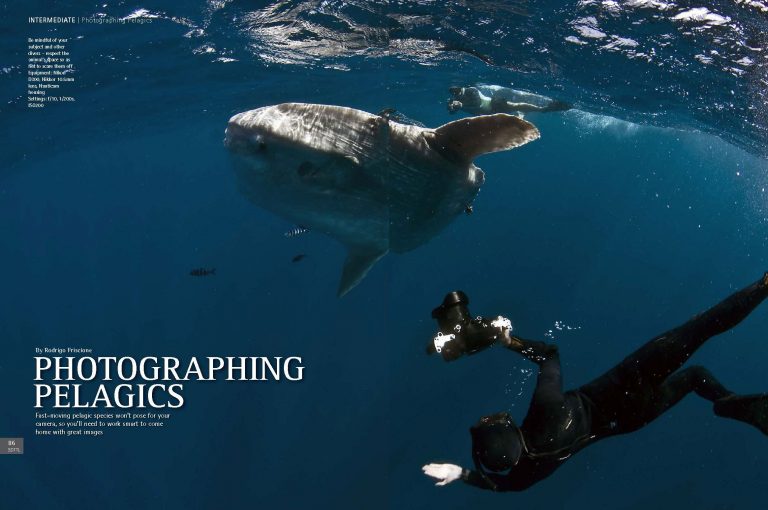
Be mindful of your subject and other divers – respect the animal’s space so as not to scare them off Equipment: Nikon D300, Nikkor 10.5mm lens, Nauticam housing Settings: f/10, 1/200s, ISO200


IF YOU’RE AN underwater animal lover, pelagics are the ultimate goal: Nothing compares to facing a wall of silky sharks, being checked out by a mola mola or swimming side by side with grey whales. Chasing after pelagic wildlife is extremely exciting and also very demanding physically. Subjects are usually big animals, which makes them fast and elusive. The pursuit is as thrilling as getting the shot.

Pelagic photography is key to conservation because it offers a vision of a fragile ecosystem not exposed to the wider public very often. Every single image you bring back helps to create awareness, and therefore encourages others to appreciate and protect the wonders of the open ocean.

Pelagic Pickings
Most popular subjects are always migrating and/or feeding. The best approach is to stay close to the food source, whether that’s chum, a giant bait ball or infinitesimal krill. Baitballs are a guarantee for pelagic shoots and my personal favourites. Sailfish and striped marlin, for example, chase sardine baitballs, herding them from the bottom to the surface, and then taking turns to hit the ball with their bills. They are neither curious about nor scared of divers, but always focused on the baitball. They move extremely fast – and to keep up, so should you! Keep an eye out for tuna, sharks and birds hitting the baitball – they will always spice up your frames.

Sharks are often curious about divers. You can get some good passes if you wait patiently in one spot. Whale sharks, in the Mexican Caribbean, are the ideal first encounter. These gentle giants gather by the dozen – sometimes hundreds – to slowly feed on the surface. Water is usually Caribbean-blue and whale sharks are forgiving when it comes to missing the shot; you will most probably get another ten chances at the exact same framing. You have plenty of room to play with different settings, split shots and counter light shots.
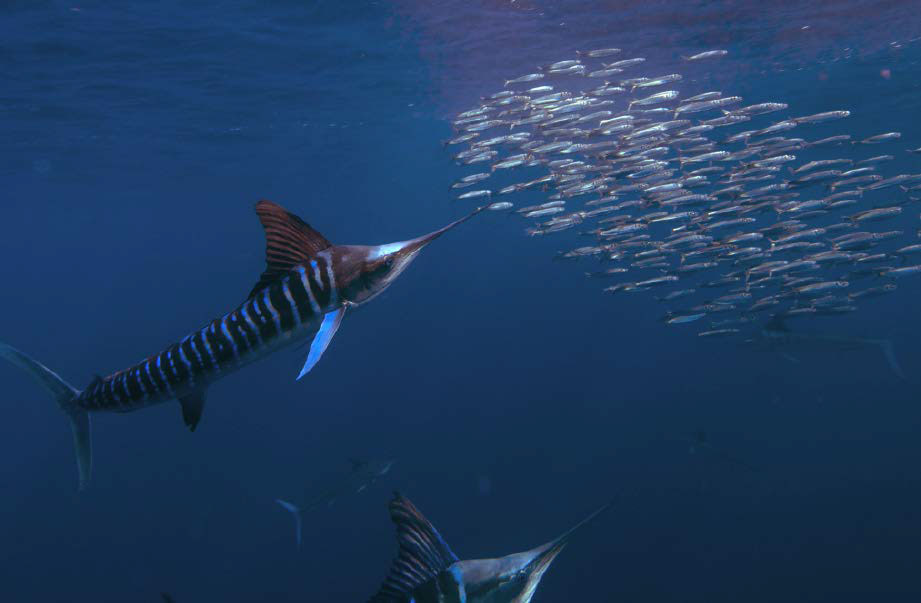
With fast-moving subjects, being in the right spot is essential Equipment: Nikon D300s, Nikkor 10-24mm lens at 10mm, Ikelite housing, dual Ikelite 160 strobes Settings: f/8, 1/125s, ISO200


Whales are shy and skittish, especially if they have calves around. Try jumping way ahead of their path and diving down immediately. Don’t move: let them come to you. I’ve found this to be the hardest subject to capture. Other than in waters of the Dominican Republic or Tonga, whales avoid both boats and floating divers. Still, with patience it can be done.

Many other surprises can pop up out of the blue, literally. Great examples are mola molas. Sometimes they take off immediately and other times they will play for hours. Remember to always approach any animal slowly and calmly. Don’t get in their way and try not to touch them or bump into them. You don’t want to hurt them or scare them off.
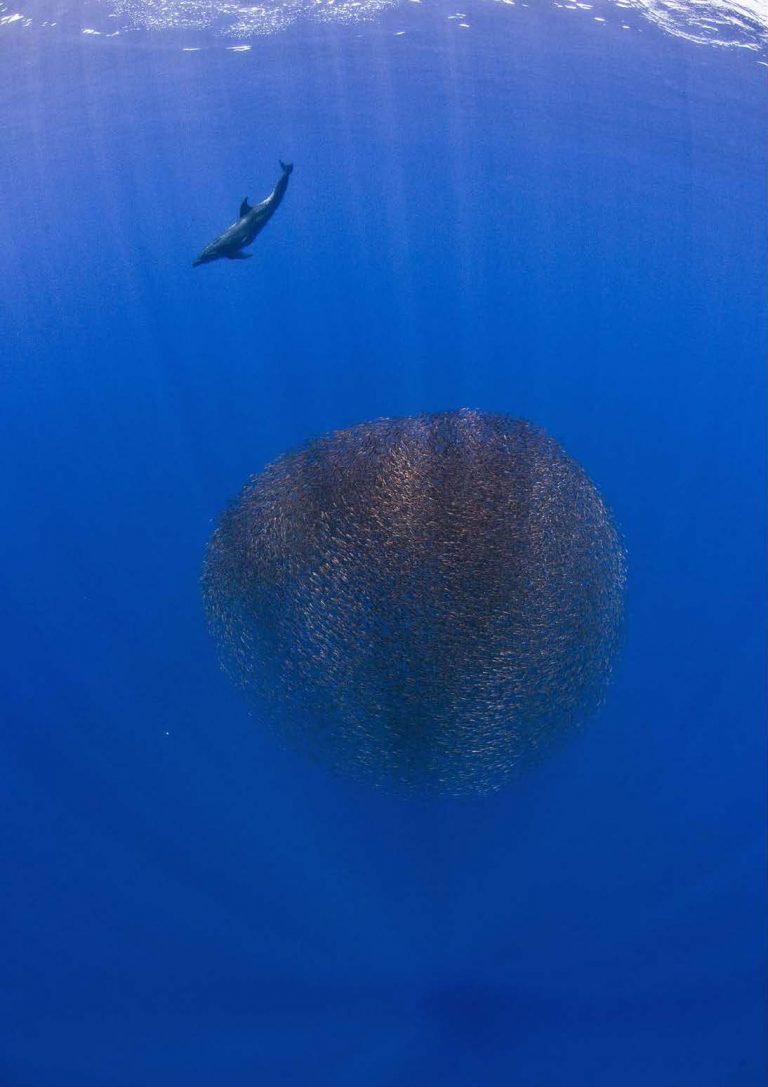
Stay close to baitballs even if you don’t see any predators – you never know what’s around the corner Equipment: Nikon D300, Nikkor 10.5mm lens, Nauticam housing Settings: f/8, 1/160s, ISO200


Many other surprises can pop up out of the blue, literally. Great examples are mola molas. Sometimes they take off immediately and other times they will play for hours. Remember to always approach any animal slowly and calmly. Don’t get in their way and try not to touch them or bump into them. You don’t want to hurt them or scare them off.

Essential Gear
DSLRs are vital for proper pelagic photography because the action usually happens so fast – too fast for the shutter lag common in compacts. If you use a compact, try to predict the animal’s movement or behaviour, and shoot before it happens. With practice, you’ll be surprised how many times you can nail a good shot. Consider also wider framing, in case the subject makes a sudden turn.

Another great advantage of DSLR cameras is burst shooting. All models now offer some kind of burst mode, which is a real boon when you only have one good pass. Strobes are not the rule; rather, they’re the exception. Most probably, you’ll have a pelagic encounter whilst snorkelling, so the power of the sun is on your side. Strobes and arms also generate noticeable drag, which will slow you down.

For the rest of this article (Scuba Diver Issue 6/2013 TTL No.8) and other stories, check out our past issues here or download digital copy here.
The Moon Phenomenon

0

IT HAS BEEN SAID that we know more about the moon than we know about our own oceans, but just how connected are the two? We all know that the moon and sun control our tides, but we are only just starting to understand how the moon controls fish aggregations and spawning events.

It’s no new fact that the fish follow the moon phases; fishermen have been timing this for centuries. Having to fish for three or four consecutive days at the exact time to catch the most fish is far more economical than going out every day to catch a few fish, and so diaries were kept of locations and timings around the moon phases to make life easier, passing down from generation to generation around the planet. But why are huge aggregations of fish timing their reproductive stages to the moon cycles?

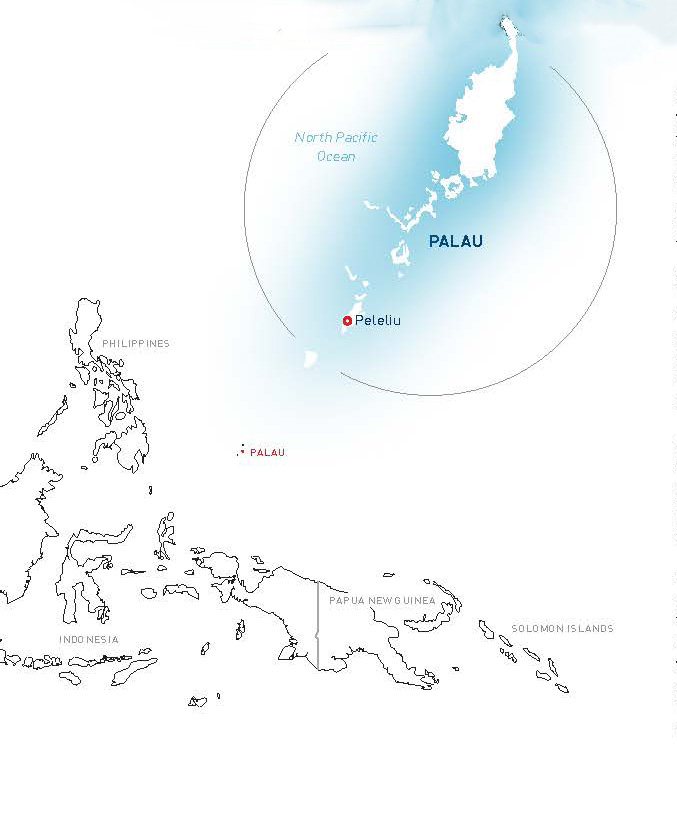
Over the last few years, the moon phenomenon and spawning aggregations have become an addiction of ours in Palau. For years, we would see huge schools appearing at regular times of the year at regular sites and months like clockwork.

A diver records this strange phenomenon that fishermen use to their advantage


The first real attraction to us was the Moorish idols (Zanclus cornutus) and Orangespine Unicorn fish (Naso lituratus). During the months of January and February, gathering at half moon and schooling until full moon, these fish, which are usually solitary or hang around in small schools, gather at certain sites, usually corners, in their thousands to reproduce.

Forming such large schools has its obvious advan-tages: females can find the fittest, strongest males from the group giving their offspring the best advantage to survive and continue the cycle. But gathering in such large numbers also attracts predators. Giant trevally (Caranx ignobilis), grey reef sharks (Carcharhinus amblyrhynchos), white tip sharks (Triaenodon obesus ) and Napoleon wrasse (Cheilinus undulatus) are among the list of predators ready and waiting for a quick meal, chasing the school up and down the reef attacking at every opportunity. Most will never see another year’s spawning cycle.

The most recent phenomenal spawning event to be discovered based around the moon is the bumpheads parrotfish (Bolbometopon muricatum). As an avid diver, you would have heard of large schools of bumphead seen grazing in Sipadan, but no one knew that more than 2,000+ can been seen continuing their existence here in Palau.

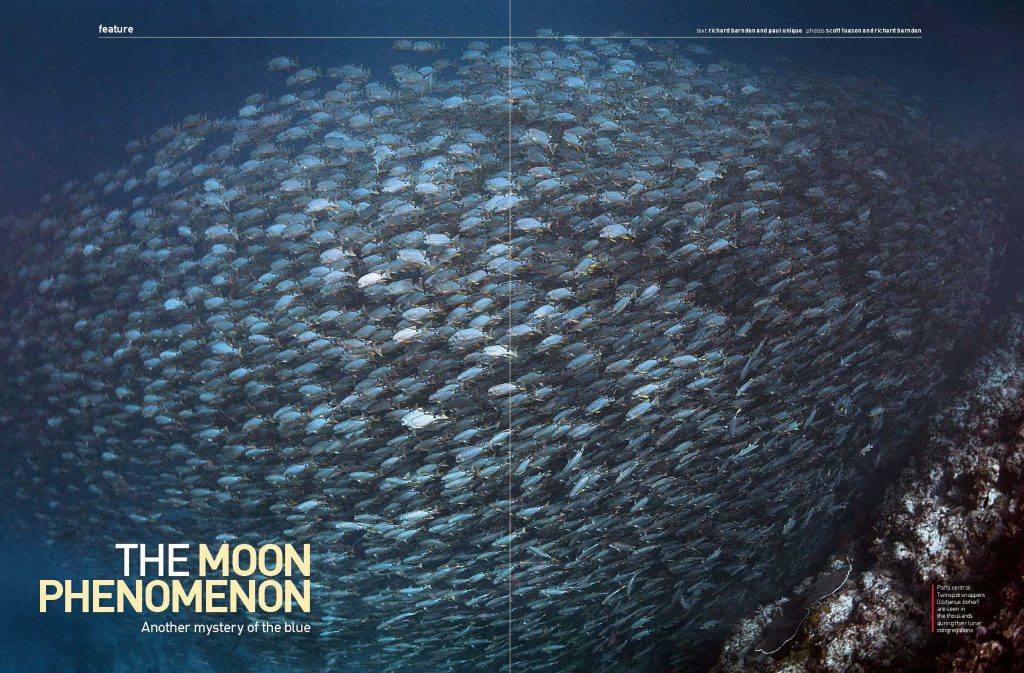
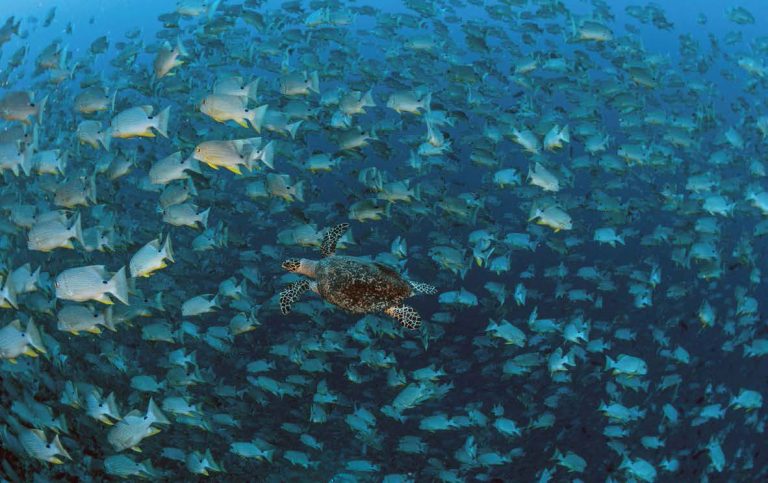
A lone turtle swims slowly amongst the company of thousands of snappers


Timing is the key – the moon phase or the light phase is taken into account for these fish know the exact time when their unborn young will have the best chance of survival. Early in the morning, as the moon approaches its new moon phase thousands of bumpheads gather together in their herds waiting for that exact moment.Once ready, the huge school will spill out into the blue, where a dance like ritual begins. Sexual dimorphism takes place, heads change white, bars are displayed, males are showing off their dominance and then like a firework display, the action begins. Females shoot to the surface with eager males in hot pursuit wanting to be the fastest, wanting to be the one to continue their existence. The slowest ones are out run by the strongest ones and some females can be engulfed by 10 or 15 males at once in a tight ball of fusion and excitement releasing their cloud of sperm and eggs into the blue water. Once the event has taken place, the school breaks up returning back to their resident homes and the show is over, leaving nothing more than a few bumpheads grazing on the reef like a regular day in Palau.


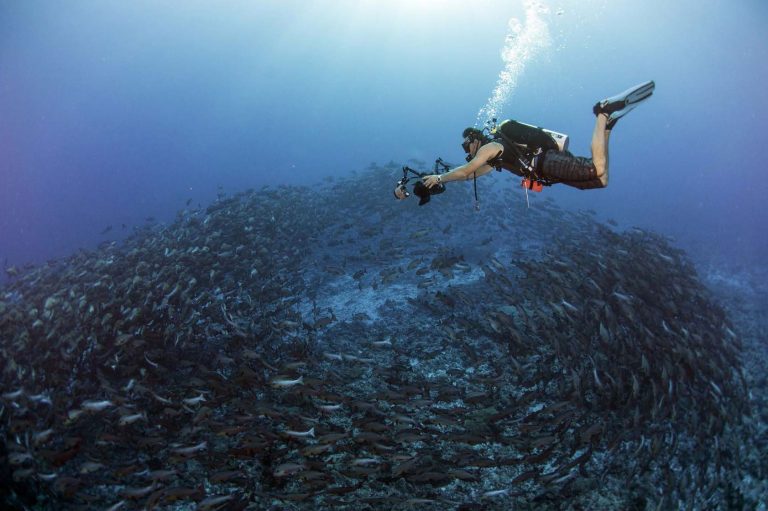
The full moon brings the twinspot snapper (Lutjanus bohar) together, here on one of the outer reef corners schools of up to 20,000 snappers can be seen aggre-gating in Peleliu, one of Palau’s most southern islands. Famous for its WWII history, Peleliu also has some hidden underwater secrets.

For the rest of this article (Asian Diver Issue 3/2013 Vol.126) and other stories, check out our past issues here or download digital copy here.
ADEX Shanghai Ocean Fiesta Kicks Off with a Splash!

0

The ADEX Shanghai Ocean Fiesta


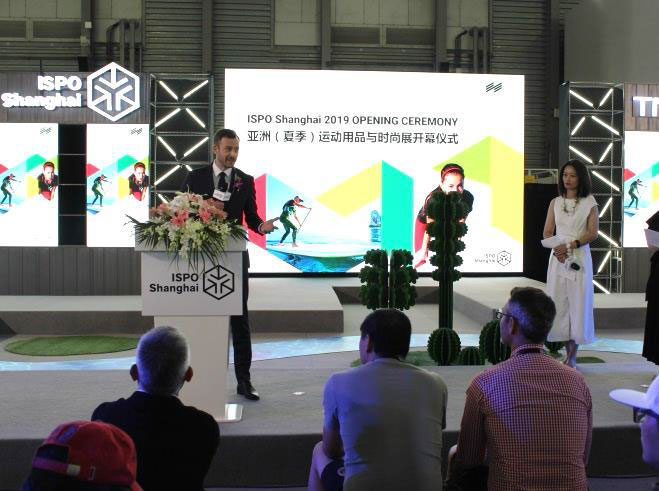
ADEX Shanghai Ocean Fiesta officially kicked off on 5 July 2019 at the Shanghai New International Expo Center in conjunction with ISPO Shanghai, multi-segment summer trade show that provides a platform for innovation, marketing, networking and communication for China’ sports market. Lovers of all kinds of sports gathered in Hall N2 for the opening ceremony that sees sports stars such as the football star Fan Zhiyi and sports industry leaders convening together to make the opening speeches on the massive growing popularity of outdoor sports in China as well as ribbon cutting. The opening ceremony ended with a “ISPO X Tmall Sports fashion show”, showcasing renowned brands such as Columbia and The North Face.

Patrick Stueber speaking at the ISPO Opening Ceremony


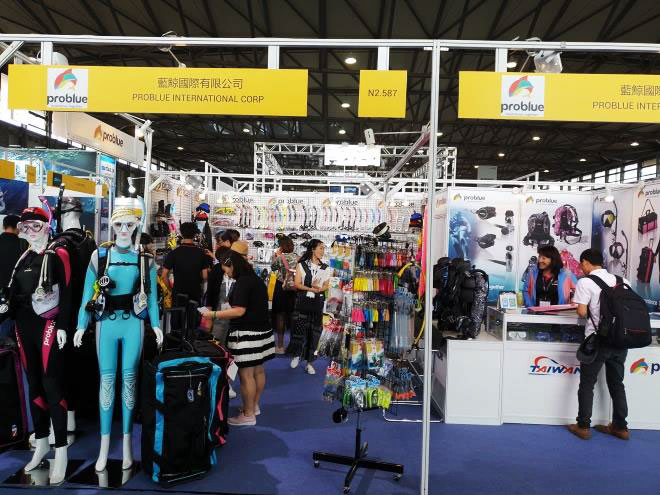
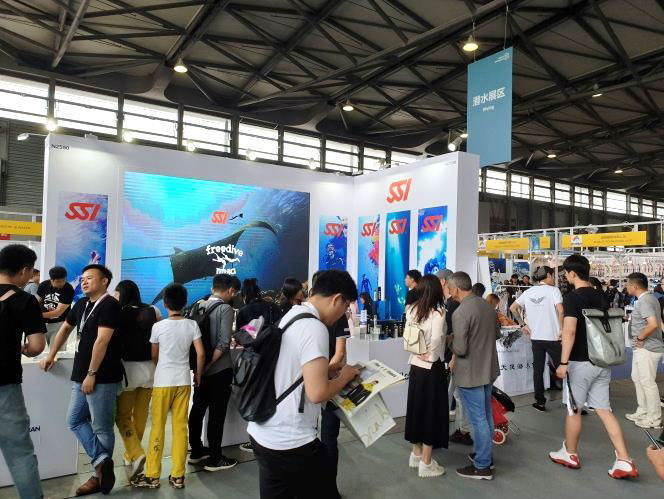
ISPO has strong presence in China for 15 years now, and ADEX Shanghai Ocean Fiesta partners for the first time with ISPO on its 5th run in Shanghai to promote diving as summer sport in China. Renowned international brands in the dive industry such as PADI, SSI, SDI TDI EDI, DAN, Problue, Mola Mola Liveaboard, Infiniti Liveaboard, Sea Safari Cruises, Leaderfins and more are present at the Diving Section to promote the latest diving courses, diving gears and liveaboard experiences in this B2B-centric platform.

The PADI China booth at ADEX Shanghai Ocean Fiesta


The Problue International booth at ADEX Shanghai Ocean Fiesta


The SDI-TDI-ERDI booth at ADEX Shanghai Ocean Fiesta


The SSI booth at ADEX Shanghai Ocean Fiesta


Here are some words from diving brands on why they choose to join ADEX Shanghai Ocean Fiesta. Stay tuned for more.

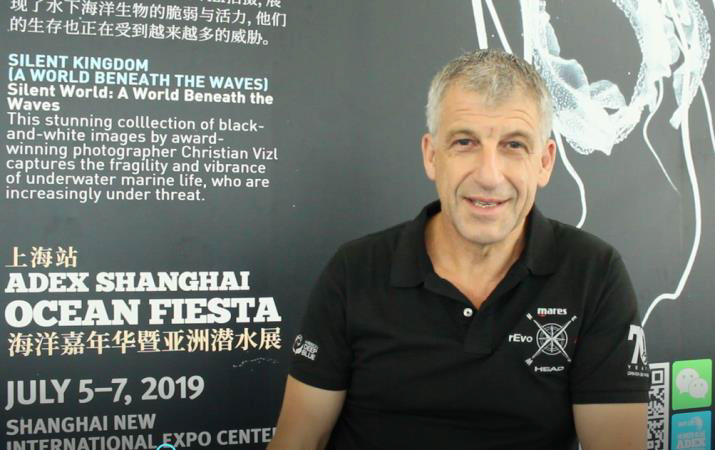
Jean-Claude Monochon from SSI

“I always heard Chinese people are not swimming. Well I think there are more swimmers in China than there is a population in Switzerland. Having said that, I see a very positive trend in the professionalism of Chinese instructors, I see a lot of people interacting in the diving industry, and also the snorkeling and mermaid programme.” – Jean Claude Monachon, SSI

“In Bunaken Island, we have many European people coming. So it’s very funny sometimes because the people from far they come to Bunaken, but the people from Asia, some of them don’t know Bunaken at all. So I want to follow ADEX, when I follow ADEX I got more benefits, like I got more guest and travel agents who want to work with me also.” – Elryc Mosal, MC Bunaken Dive Resort

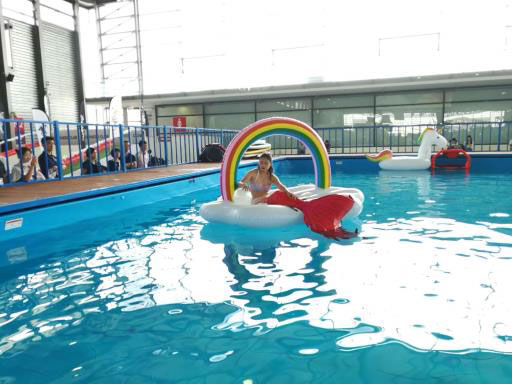
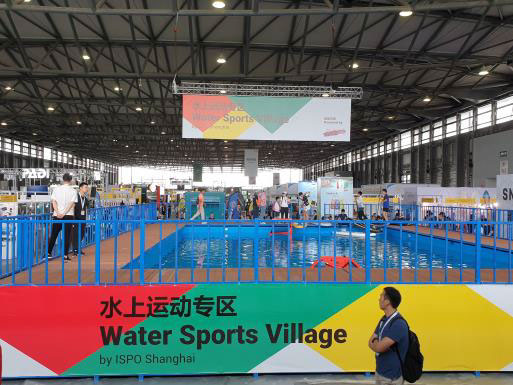
Throughout the day, the activities and performance by SSI Mermaid and ADEX Mermaids at the Water Sports Village garnered a lot of attention from diving and non-diving visitors who came from Shanghai, Hong Kong, Malaysia, and more around the region.

SSI Mermaid Performance


The Water Sports Village

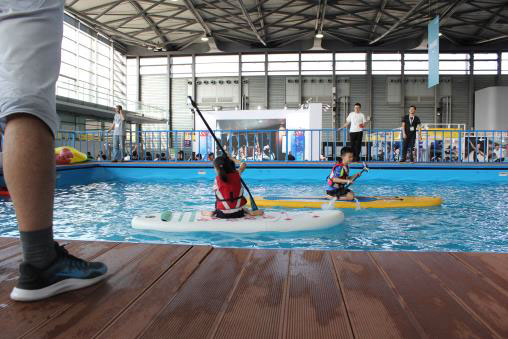
The Children Row Tryout area was full of participating future water champions!
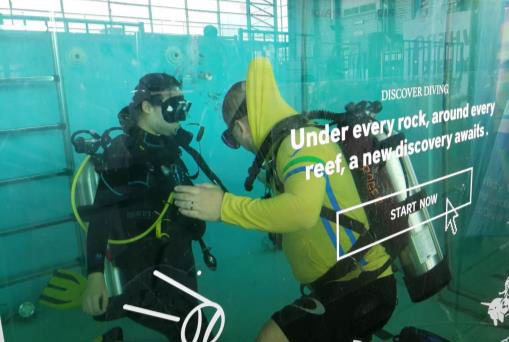
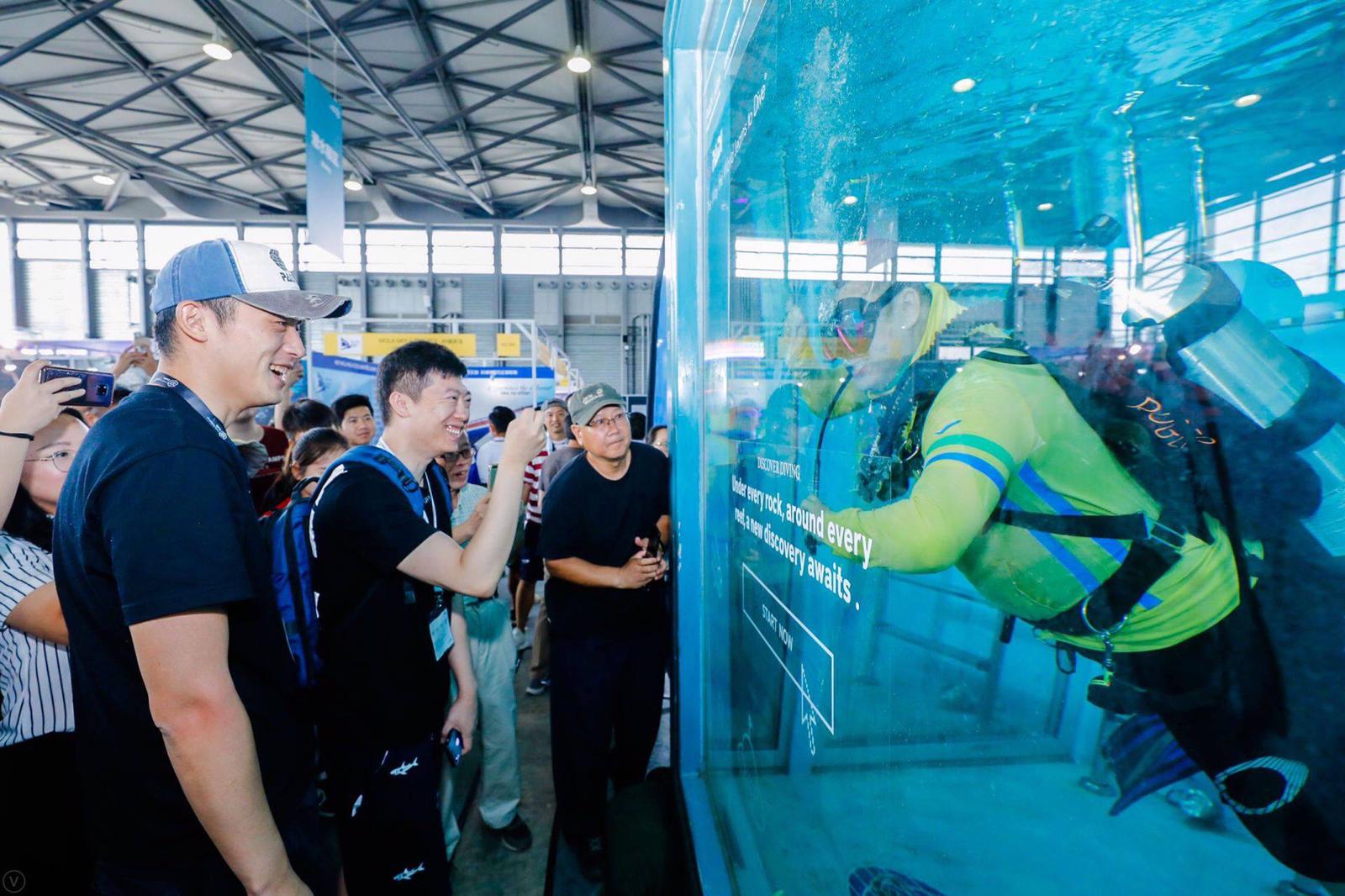
The PADI Dive Demonstration saw a plethora of participants try their hand at diving

The second day of ADEX Shanghai Ocean Fiesta on July 6th will see the start of diving seminars on stage, by representatives of diving industry leading brands such as Lou Yan from PADI China, Jean Claude Monachon from SSI, Andrea Salomi from CETMA Composite, as well as underwater photographer James Zhu.

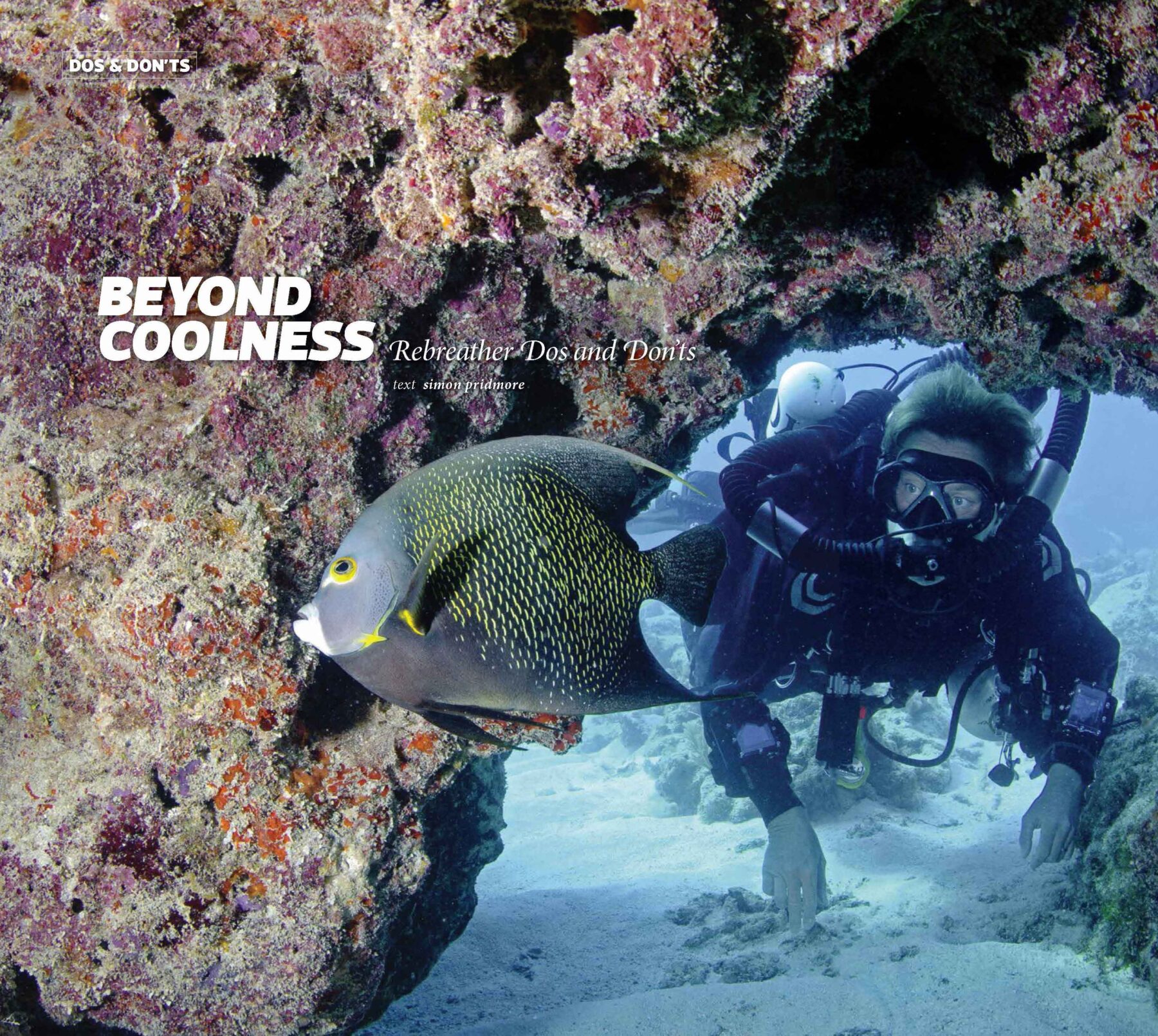
Beyond Coolness: Rebreather Dos and Don’ts

0

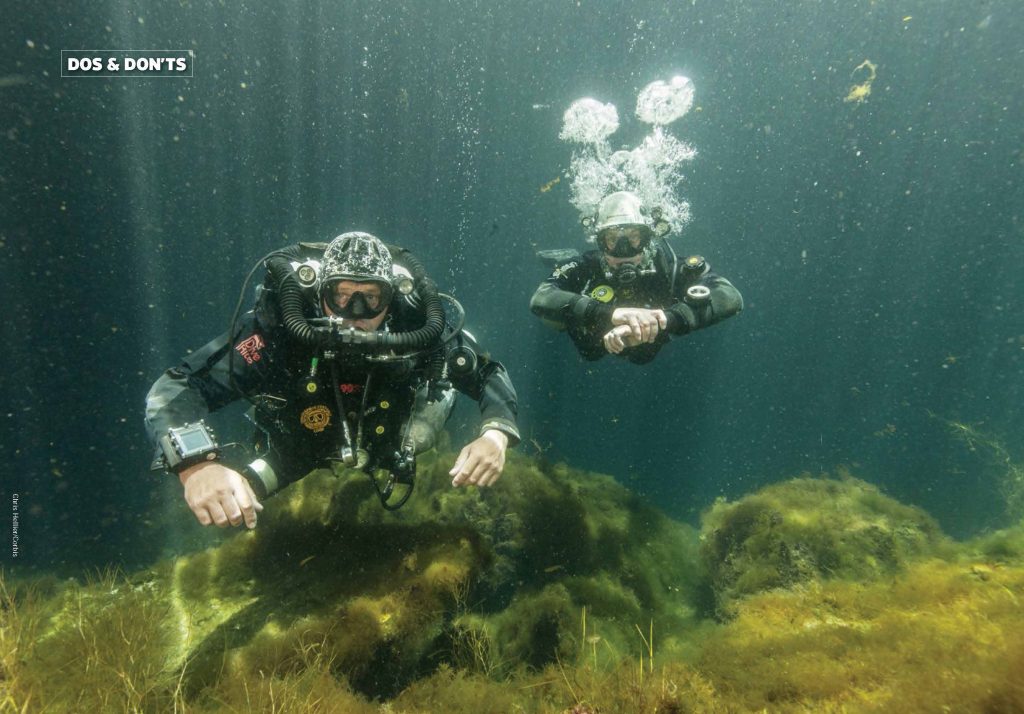
IN today’s diving world, electronic closed-circuit rebreathers (CCRs) are the ultimate big boys’ toys. But they are much, much more than cool status symbols.

On a CCR, a three-hour no-decompression dive is within the scope of any diver with reasonable skills. The diver’s open circuit breathing rate is irrelevant on closed circuit as the unit is designed to ensure that you are breathing the optimum gas mixture at every depth. Typically, at 30 metres, you will be breathing a low Nitrox mix, around 32 percent. At 16m or so, your breathing gas will be Nitrox 50 and by the time you are doing your safety stop, the mix will be close to 100 percent O2.

However, there is a price to pay for these rewards. You must respect your unit, maintain it meticulously and understand completely all the ways in which the CCR can hurt you.

Here are eight Closed-Circuit Rebreather Dos & Don’ts

DO always know your PO2. Always!

DON’T trust your brain more than the laws of physics. DON’T trust your electronics more than your brain.

DO use a physical checklist when setting up your unit. DO calibrate your oxygen sensors as if your life depends on them. It does.

DO change your CO2 absorbent frequently and before you have to.

DON’T give-in to peer pressure. It’s YOUR life, nobody else’s. Finally…

DO know that you are certainly less capable than you think you are.

For the rest of this article (Asian Diver Issue 3/2014 Vol.132) and other stories, check out our past issues here or download digital copy here.
Going Up Nice And Slow: Ascending for Tek Divers

0

A well-executed ascent is crucial for a successful technical dive. Here are a few tips.

DON’T ascend at a speed faster than 9 metres per minute. If your decompression table has no deep stop built in, DO deduct 1 minute from your bottom time and plan for a 1-minute stop midway between the bottom and the first decompression stop required on the tables

DO add a further 1-minute stop at the level below the first required stop

DO open the valve on your decompression gas and deploy the regulator on ascent or at the stop below your planned switch depth

DO start breathing from your decompression gas immediately on arrival at your planned switch depth

DO add 1 minute or 25% of the required stop time (whichever is greater) to all stops between 18 metres and 6 metres

DON’T go directly to the surface on completion of your final required stop at 4.5 metres Instead, DO ascend to 3 metres and perform a 5-minute-stop there

Then, DO take 1 full minute to ascend from 3 metres to the surface

Finally, DO continue to breathe from your final deco gas on the surface and until you take your gear off

For the rest of this article (Asian Diver Issue 4/2014 Vol.133) and other stories, check out our past issues here or download digital copy here.
Through The Lens: Uncramp Your Style

0

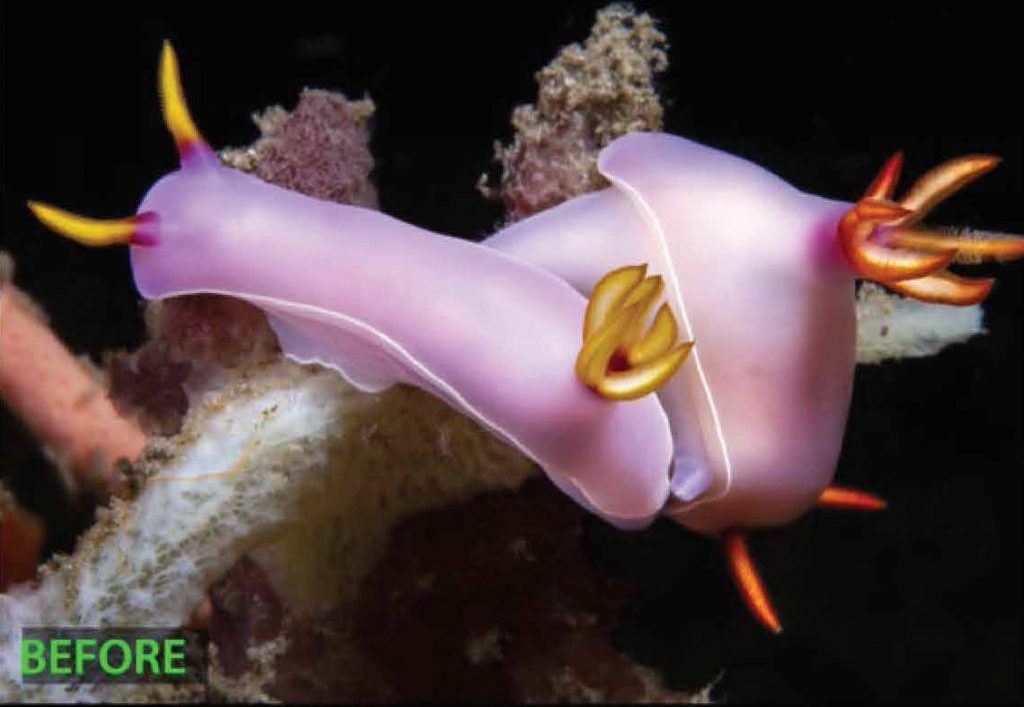
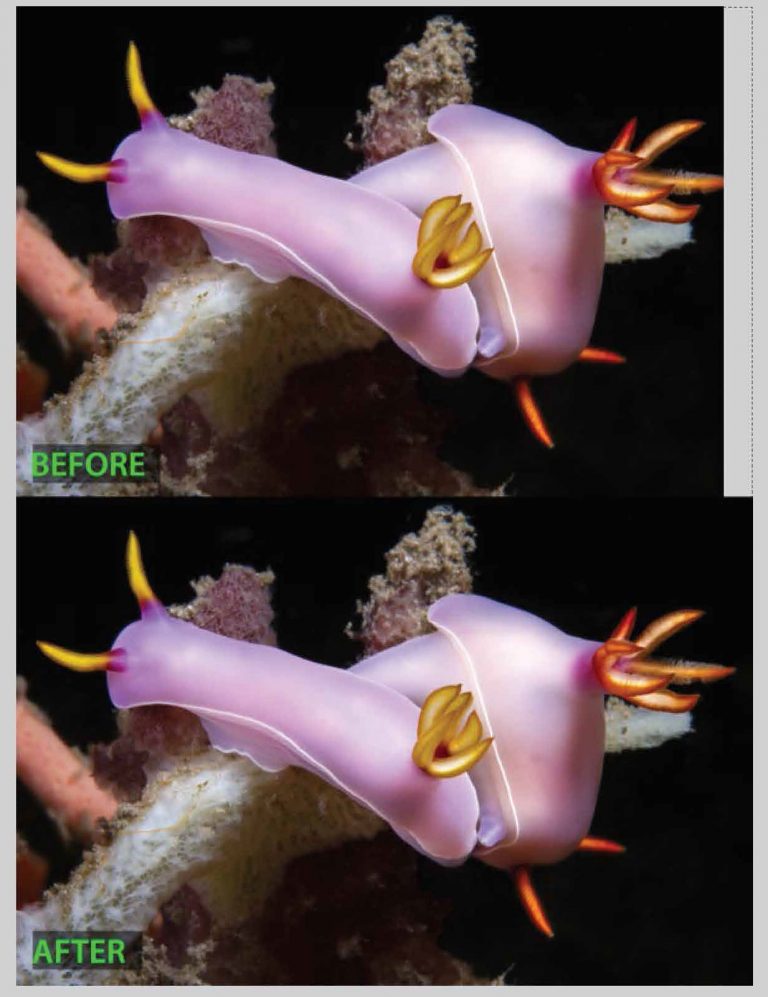
Introduced back in 2010, Adobe Photoshop’s Content Aware Fill promised some revolutionary functionality: repair or replace a large area of a photo with content that could or should have been there but wasn’t. Sounds far-fetched? Well, it actually works! Sometimes, anyway.

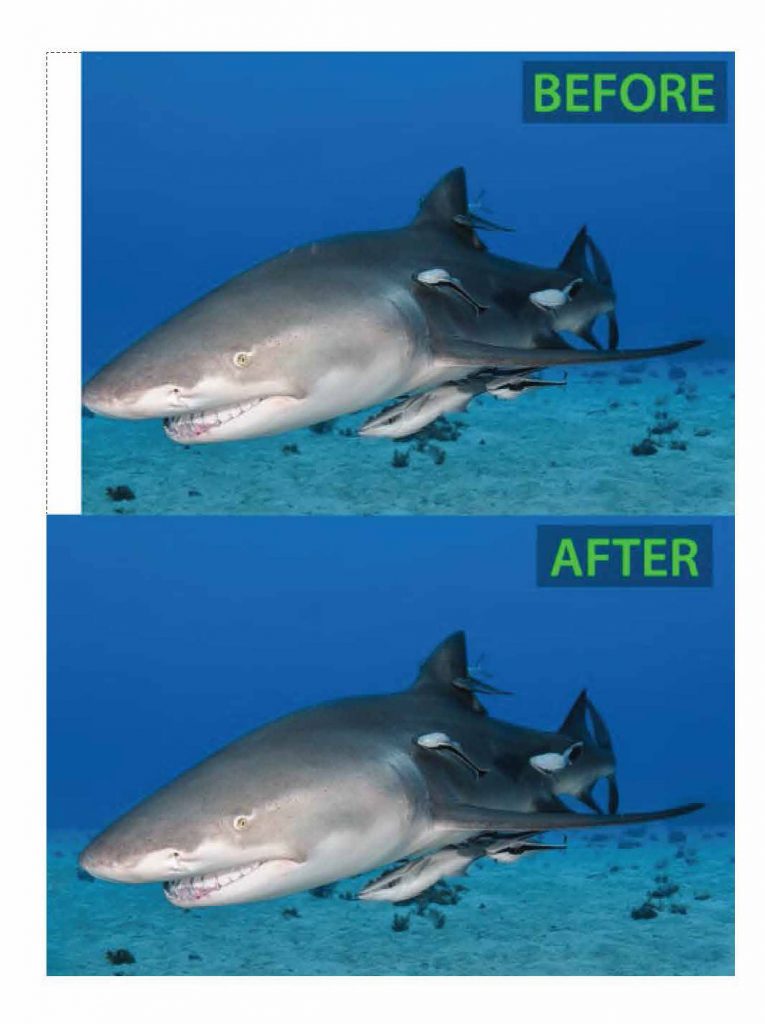
Let’s look at an example where it typically works brilliantly: a shot of an animal subject on a clean background, but one that is a little cramped – in fact, some of the subject got cut off by the edge of the frame.

Before starting this technique, finish as much of your usual editing workflow as possible.

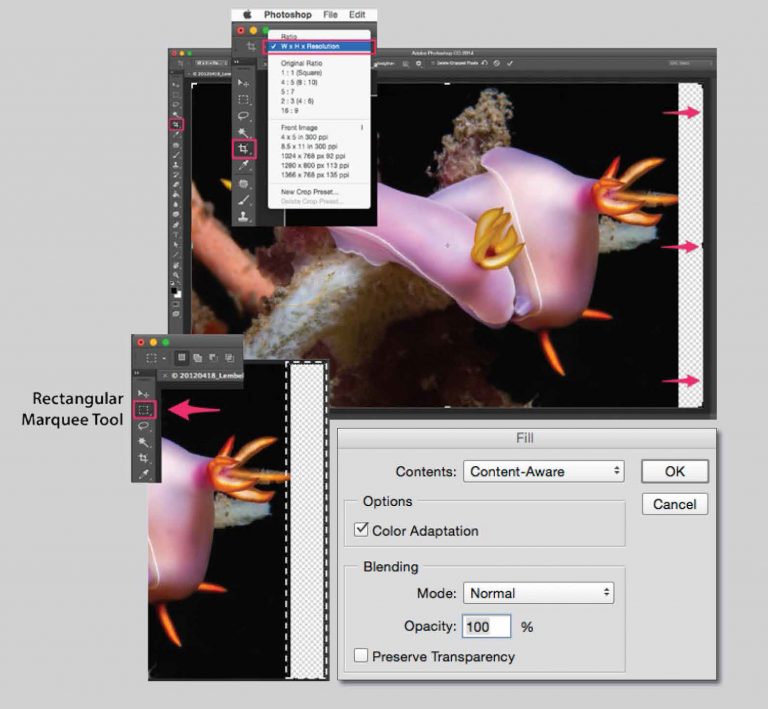
1. Open your image in Photoshop and grab the Crop Tool. The Crop Tool doesn’t only let you clip off part of the picture; it also lets you add area to the canvas.

2. Choose W × H × Resolution from the Tool Options bar dropdown menu to unlock the aspect ratio. Grab the middle crop handle on the edge you want to extend and pull the side of the crop rectangle away from the image to tack on some additional space.

3. Hit Return, Enter, or the Done button to set the crop.

4. Choose the Rectangular Marquee Tool (keyboard shortcut M) to create a selection that includes not just the newly added canvas area, but also a narrow strip of pixels from the original image. This gives Photoshop some image information to work with.

5. Go to Edit > Fill and choose Content Aware from the drop down menu in the dialog box. If you see a colour adaptation checkbox, make sure it’s ticked on. Hit OK.

Now comes the fun part. Photoshop analyses the pixels in your image and tries to guess what you want to fill the selected area with.

For the rest of this article (Scuba Diver Issue 4/2015 OP No.4) and other stories, check out our past issues here or download digital copy here.
The Greatest Shoal on Earth

0

The sardine run happens in the winter months from May to August, when millions of sardines, Sardinops sagax, leave the southern Cape waters of the Agulhas bank, to follow the cold, nutrient-rich body of water up the African coast to Kwazulu Natal. This belt of cold water in which the sardines travel is formed by the winter storms of the Cape, pushing the cold water north, while the warm Agulhas current that runs from the north to the south traps this cold water against the coast.

Along the Transkei coast, the continental shelf pushes this cold water into its narrowest strip, concentrating the sardines and the predator load at its highest, creating  the conditions for some high-octane action. Film crews, amateur photographers, and ocean enthusiasts all flock to Port St. Johns, Mbotyi and the surrounding areas to get a space on the charter boats that provide the best opportunity for witnessing this event.

Port St. Johns is a small, rustic town on the Wild Coast, a 250-kilometre stretch of coastline which gained its name from its inaccessibility and treacherous shoreline. Although this makes for risky surf launches on the semi rigid inflatables, and hair-raising adventures at the crack of dawn with high-end camera equipment, it makes it all worthwhile when your skipper drops you right in the middle of a feeding frenzy. From the skies to the depths below, predators line up to feast on the protein-rich baitfish.

SCHOOLING TO SURVIVE
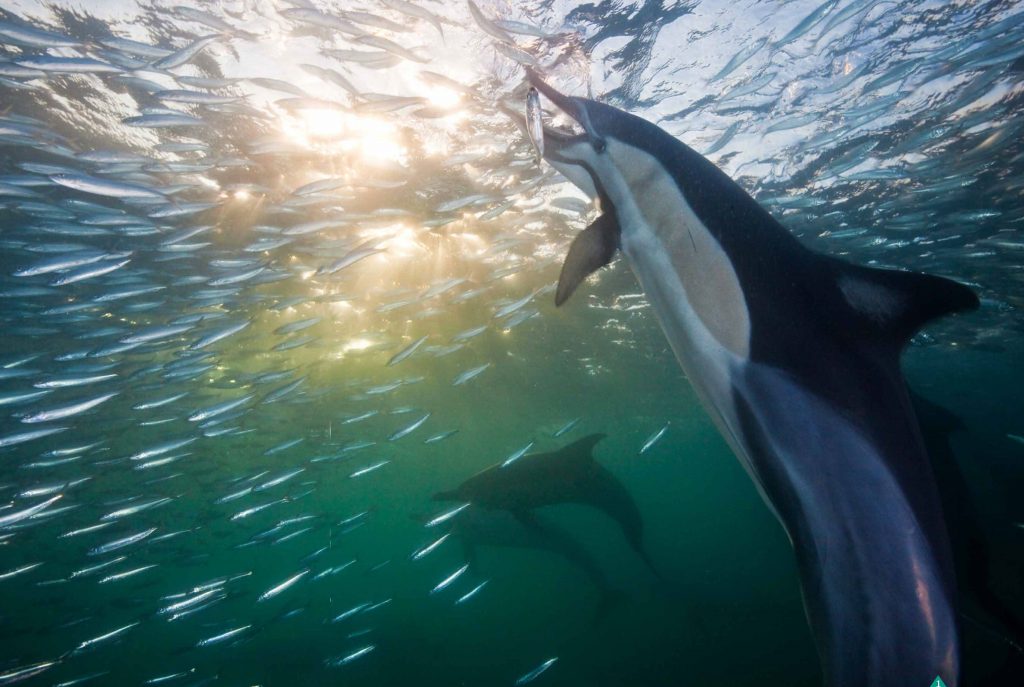
These bait balls form when common dolphins separate a small pocket of fish from the main shoal, and push it up to the surface. The dolphins circle the bait ball for a while, blowing bubbles from below, herding the little fish into a tight swirling mass. They then dart through together in a group to grab as many fish as they can. They will repeat this pattern over and over, until the last sardine is gone. These sardines know, if they lose the group, they are an easy target.

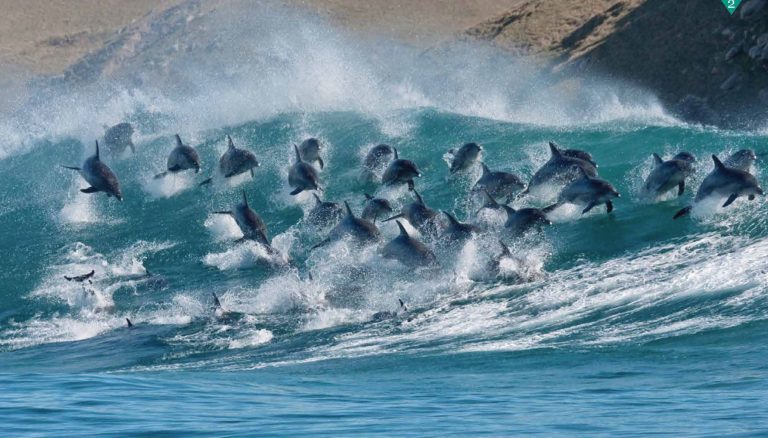
A large pod of bottlenose dolphins having fun in the large breaking waves, as they make their way northwards up the coast Image © Mark Van Coller


The sharks on the other hand, have no such skilled and organised feeding plan in place. Their strategy is to simply swim through the bait ball, mouth agape, consuming as many mouthfuls of fish as they can. That is why we, as divers, never hang around inside the bait ball! Sometimes that proves difficult, as the sardines often try to use divers as protection.

BATTERED FROM ABOVE
Once the bait ball is visible to the birds in the air, Cape gannets bombard it from every angle, raining down like bullets. When each gannet hits the water, it’s like an explosion below the surface, and one of my favourite moments of the sardine run. These gannets, with their wings folded back, tight as torpedoes, can easily dive to a depth of 15 metres to reach the bait ball, and sometimes grab up to three fish, before returning to the surface. Gannets have been recorded hitting the water at more than 85 kilometres an hour, which has often made me wonder: should I be diving with a helmet…?

For the rest of this article (Scuba Diver Issue 4/2015 OP No.4) and other stories, check out our past issues here or download digital copy here.