This week we pay tribute to the incredible work of Dr Leanne Armand:
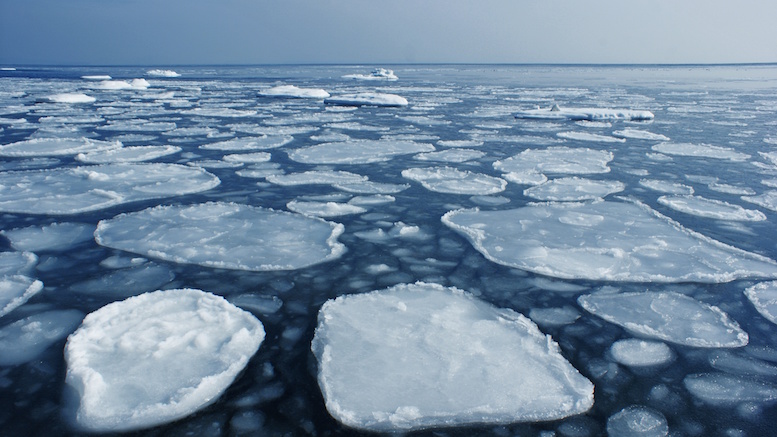
Australian marine scientist Dr Leanne Armand is an expert in the field of diatoms and their distribution in the Southern Ocean. Diatoms are a major group of algae, and are among the most common types of phytoplankton. Understanding the diatoms’ distribution and how it is preserved in the fossil record contained within sediment cores taken from the ocean floor can provide information about past climate regimes, including ocean temperatures and sea ice extent.
Dr Armand received a PhD in geology from the Australian National University. Her thesis work focused on the use of algae remains as an indicator of sea surface temperature changes and sea ice estimation; her research has also provided valuable date and insight as to how sea ice helps drive the circulation of the ocean.
Now working in the Biogeochemical Cycles Program at the Antarctic CRC, she investigates biogeochemical cycles using algae collected in sediment traps at certain ocean sites between Australia and Antarctica and also continues her sea ice research. Her work is important in gaining an understanding of how sea ice and sea-surface temperatures vary naturally over time, and how this natural variation influences climate.
Dr Armand was born in 1968 in Adelaide, South Australia. She spent a large amount of her childhood rambling along nearby beaches, collecting seashells and using them to set up soi-disant “museums” at her home along with other bits and pieces.
Her interest in biology was nurtured by excellent high school teachers at St Mary’s College, Adelaide, where she won the Green Biology prize for best student. In Year 12 she was selected to participate in a Rotary exchange to a high school in Arkansas, U.S.A.
She is an award-winning scientist and is planned to be the Chief Scientist on the Marine National Facility’s research vessel, RV Investigator.
About two years ago a whole nation was stunned after experiencing the strongest typhoon to ever make landfall. Super Typhoon Haiyan, or Yolanda as the locals called her, passed over the Philippines on November 8, 2013. Its path of destruction left thousands dead and millions homeless, changing lives forever.
Since then, many of those affected have been struggling to resume their lives and continue their livelihoods. Over the past year the support from the rest of the world has been enormous, but even with all this help, it has been very hard for people and economies in the Philippines to recover.
Resilience from Monad Shoal
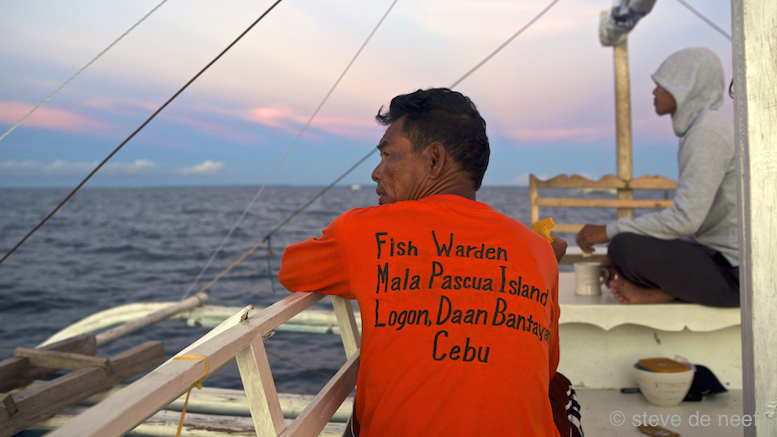
One place that did manage to rebuild quickly is Malapascua Island, even though most houses and boats were reduced to rubble after the super typhoon passed. Just one year later many locals have managed to pick up their lives and thrive once again. Part of the reason for this rapid recovery can be found in an unusual place just nine kilometres offshore, at a submerged seamount called Monad Shoal.
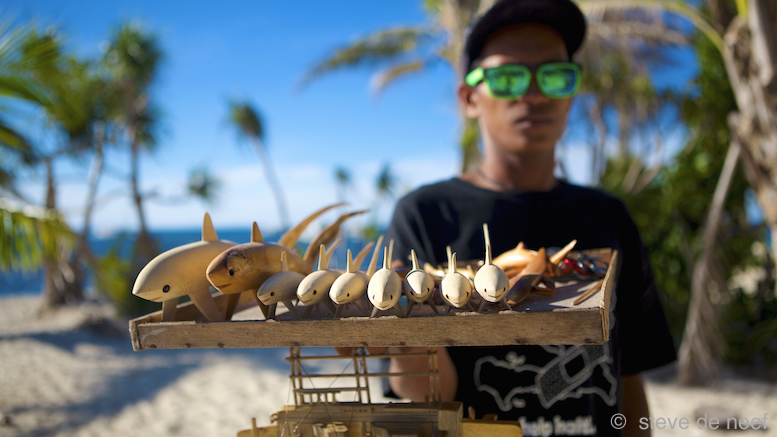
Monad Shoal is a place like no other. Every morning at dusk, pelagic thresher sharks (Alopias pelagicus) come up to the shallower parts of this shoal. Divers from all over the world visit this place in the hope of seeing these graceful sharks with their distinct scythe-like tails. These nocturnal oceanic sharks come here for one reason only, to be cleaned by cleaner fish like the cleaner and moon wrasses (Labriodes dimidiatus and Thalassoma lunare) that inhabit the multiple cleaning stations found at Monad Shoal. Nowhere else in the world can you reliably see thresher sharks on a daily basis and observe them up close. It’s exactly this phenomenon that makes Malapascua famous, and eco-tourism based around these sharks has played a major role in the island’s recovery.
A few days after Typhoon Haiyan, Malapascua had already received huge support from the local dive industry and tourists who were in love with the island. One year later almost everyone has managed to rebuild their homes and livelihoods. Some locals even say they have better homes now than they did before the typhoon. Tourists are still coming to see the pelagic thresher sharks, which, considering that 80 percent of income on Malapascua is directly related to this industry, means that Malapascua’s economy is stable.
Sustainable thresher-based tourism is proving that sharks are worth vastly more alive than dead.
Threshers under pressure
In 2002 Monad Shoal was declared as a marine reserve. While this was a step in the right direction, it hasn’t been able to stop illegal fishing – even today Monad Shoal still falls victim to destructive methods like dynamite and longline fishing. The income derived from tourism and the associated marine park fees don’t trickle down to all the fishermen who use these places. Furthermore, in the Philippines thresher sharks are still directly targeted and caught as by-catch on a regular basis. It’s sad that within the same country these sharks are both adored and killed. Currently thresher sharks are not a protected species in the Philippines.
According to the Thresher Shark Research and Conservation project, the value of one live thresher shark per day at Monad Shoal can be in excess of USD 135,000 per year. This same shark at a local fish market would only sell for USD 180. The meat sells for two to three and a half US dollars a kilo while the fins can go for as much as USD 22 per kilo, still only a fraction of what the sharks are worth alive.
Currently all three species of thresher sharks (bigeye, common and pelagic) are listed as “Vulnerable” according to IUCN’s Red List. This means if no active measures are taken to protect them, considering that they are one of the global shark fisheries’ most in-demand species, their status will quickly deteriorate to “Endangered” or worse. As these sharks are pelagic in nature, protecting them in just one place like Monad Shoal is a good start but won’t do much in the long run since they can still be caught while travelling out of protected waters. To make sure thresher sharks (and tourism in places like Malapascua) survive, broader protection is necessary. All thresher sharks are prone to unsustainable fisheries and by-catch, and with their low fecundity (two to four pups per litter) and long gestation period, their populations can decline quickly. In most places thresher shark populations are already down by more then 75 percent when compared to the 1980s.
A community mobilised: With threshers still on the IUCN Red, community-driven conservation and enforcement is key to ensuring their survival.
One for all
It does seem like things are moving in the right direction in the Philippines. People are slowly becoming aware of the fact that sharks are essential in maintaining healthy ocean ecosystems and are worth more alive than dead.
Since September 2014 the province of Cebu amended an ordinance that protects various marine resources to now include the protection of all shark species. While this is only applicable in one province, it’s certainly an encouraging sign.
Enabling fishermen to tap into the shark tourism economy will be the real challenge, as, without an alternative income, it’s hard to stop people from fishing when they rely on it for their livelihoods. It is possible though – in Malapascua many of the boatmen and even dive guides used to be fishermen. Tourism on the island is going strong, the sharks’ popularity is still growing and the associated industry is providing ever more jobs. Shark tourism has proven to be a viable conservation tool and a profitable business.
Researchers from the University of British Columbia published a paper in 2013 that estimates global shark ecotourism brings in USD 314 million annually and is expected to more than double in the next 20 years. If this is the case then it would exceed the current profit made by shark fisheries.
Monad Shoal serves as a great example for shark tourism and has proven to be invaluable in ways no one could have foreseen. Hopefully this success will continue to inspire people and governments to protect rather than exploit this important species, so that for many generations to come people can enjoy the magic of encountering one underwater.
No offshore oil exploration will be permitted along the Belize Barrier Reef or within the country’s seven World Heritage Site areas, the government of Belize announced this month. The UNESCO World Heritage Committee and national environmental groups applauded the announcement as a step in the right direction.
At a December 1 meeting, the Belizean Cabinet approved a policy that legally bans offshore exploration in what amounts to 15 percent of the country’s marine territory. The measure protects 1,316 square miles along the Central American country’s section of the Mesoamerican Barrier Reef System, the second longest in the world. A moratorium on all offshore drilling remains in place.
According to the new policy, offshore oil exploration is banned within one kilometre on either side of the Belize Barrier Reef System, and within the seven protected reef areas that comprise the UNESCO World Heritage Site. The site has been on the UNESCO World Heritage Committee’s List of World Heritage in Danger since 2009 due to the sale, lease, and development of mangrove islands and the lack of a solid regulatory framework for the site’s conservation. Offshore oil activity was added to the list of concerns in 2010.
“The World Heritage Committee has taken a very clear position that oil and mining exploration and exploitation are incompatible with World Heritage status,” the committee wrote in a statement responding to the government announcement. “The decision is a major first step forward in the government’s efforts to remove Belize Barrier Reef from the List of World Heritage in Danger.”
The World Heritage Site — comprised of Bacalar Chico National Park and Marine Reserve, Blue Hole Natural Monument, Half Moon Caye Natural Monument, South Water Caye Marine Reserve, Glover’s Reef Marine Reserve, Laughing Bird Caye National Park, and Sapodilla Cayes Marine Reserve — contains a unique array of reef types, and hundreds of sand and mangrove cayes. It provides important habitat for threatened species, such as the West Indian manatee (Trichechus manatus), green turtle (Chelonia mydas), hawksbill turtle (Eretmochelys imbricata), loggerhead turtle (Caretta caretta), and American crocodile (Crocodylus acutus).
“Cabinet further agreed that areas that fall outside of the large acreages banned, would not automatically allow for seismic activities and exploration drilling without conducting the existing stringent environmental studies to determine critical habitats and sensitive zones,” a statement issued by the Belize Press Office on December 1 asserted.
The Belizean government has come under fire in the past for granting offshore exploration concessions to oil companies without first requiring environmental impact assessments. In 2013 the country’s Supreme Court ruled in favour of Oceana and other non-governmental groups that had filed suit against the government for failing to assess the environmental impact of offshore contracts. The ruling rendered six existing offshore concessions issued in 2004 and 2007 null and void.
No offshore contracts have been awarded since the ruling, and reports earlier this year that the government intended to open up iconic marine protected areas to offshore drilling met with widespread opposition.
Environmental groups in Belize welcomed the government’s announcement of the new ban on offshore exploration.
“The Association of Protected Areas Management Organizations, APAMO, applauds the decision by Cabinet demonstrating government’s resolve to ensuring the continued protection of the Belize Barrier Reef System and in particular the World Heritage Site,” APAMO declared in a statement. Five of the association’s 13 non-governmental members have co-management responsibilities over marine protected areas.
Not all marine protected areas are covered by the ban, however. For example, the Port Honduras Marine Reserve and Turneffe Atoll Marine Reserve are both significant, large marine reserves that are not covered.
But the new policy does not entirely remove the threat to the country’s reef system. Should the existing moratorium be lifted, “any oil spill within Belize’s waters would have a devastating effect on the reef, including the Barrier Reef System World Heritage site,” the World Wide Fund for Nature (WWF) noted in a response to the government’s announcement.
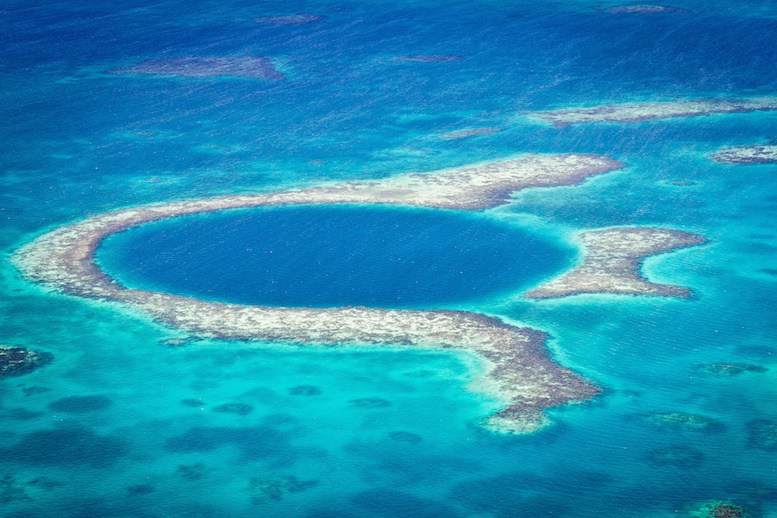
Environmental organisations have campaigned against offshore drilling in Belize for years. News that offshore concessions included the Great Blue Hole atoll and other iconic marine protected areas galvanised many Belizeans, prompting environmental, tourism-industry, and other groups to form the Belize Coalition to Save Our Natural Heritage. The coalition advocates for a full ban on oil and gas activity in all offshore waters as well as in mainland protected areas, and participated in the suit that led to the nullification of existing concessions in 2013.
Prior to the success of their legal challenge, the coalition and Oceana Belize organised a “People’s Referendum” initiative in 2012 with dozens of polling stations throughout the country. Ninety-six percent of the nearly 30,000 people who participated — almost one-tenth of the country’s population of 350,000 — opposed offshore drilling.
Oceana Belize and other groups continue to monitor the issue closely, but view the new ban as an important step.
“This progress should be seen as a major accomplishment by and for the people of Belize,” said Janelle Chanona, head of Oceana Belize, in a statement responding to the government’s decision.
“We remain confident that the future will continue to reveal reasons why Belizeans should never risk our outstanding and globally unique resources with this type of activity,” the statement reads.
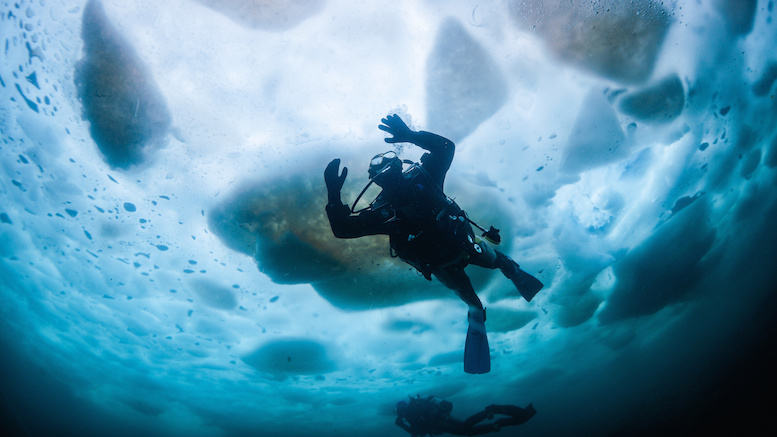
For some, cold water diving is a refreshing change from the cerulean waters of the tropics, offering once-in a-lifetime encounters with some of Nature’s largest, rarest and downright weirdest. Many that take the plunge down narrow holes in the ice or leap into polynyas (open water surrounded by ice) may be seen by others as insane, but to those who know – diving below the ice or through narrow canyons in cold water is one of the greatest thrills a diver can ever experience.
At just 10 metres, I can already see the bottom, more then 50 metres below me. I drop slowly, controlling the on-board computer of my rebreather, keeping the partial pressure of O2 under close surveillance. Suddenly, the ambient light dims and in an instant I am surrounded by hundreds of almaco jack, Seriola rivoliana, that form a tight mass around me.
I continue the descent and reach the top of the rocky reef. Here is a compact school of whirling fish, individuals swirling together in pairs, one dark, and one lighter. These are Pomatomus saltatrix, also known as the marine piranha, anchova, or bluefish; another large predator that usually forms big schools in this dive spot.
I look at the steep slopes of this rocky peak, in the typically intense blue of the Azorean waters. Swimming around the top, at between 50 and 55 metres, I come across some big greater amberjack, Seriola dumerili, some of which are surely more than a metre long, swimming in a powerful formation close by. Some metres away, a clenched school of small red Caprus aper, swim in a synchronised manner, like a cloud of insects, trying to escape to the alternating attacks of some jack.
All is a whirring, writhing, schooling mass of pulsating life of different forms. But already it’s time to start the ascent back up the rope. However, unlike many other dives, even as we start to ascend, this one is far from over. In fact, this excursion to greater depths is completely optional and, for many, of no interest. Why? Because this site’s main attractions are not those schools of powerful predatory fish amassed in the deep – the main draw of this dive is much closer to the surface, so close that sometimes we can see it from the boat.
Devils of the not-so-deep
Great dark masses gently fly through the shallows, so close to the surface that occasionally the tips of their wings break the water, making them look like sharks. These are devil rays, Mobula tarapacana, and, here at the Ambrose seamount, off the Island of Santa Maria, they gather in concentrations of several dozen individuals during the warmer summer months (July–September), when the waters normally reach temperatures of around 25 degrees Celsius.
While I ascend quietly up the rope, three of these large rays, in squadron formation, quietly pass me a short distance away. I quickly evaluate the current and notice it is very weak, so I let go of the cable and wait for them to make another pass, and give me a second photo opportunity.
At Baixa do Ambrósio, Santa Maria island, balls of boarfish seek protection in numbers from predatory jacks and devil rays.
I barely have time to adjust the camera before another small group approach. I try to keep as still as possible, unnoticed thanks to the absence of bubbles from my rebreather. They pass so close to me, and I fire off some shots. Then I look at my computer and see that I am still at more than 30 metres, and I have drifted about 30 metres from the descent line.
Swimming calmly but at a determined speed, I head for the cable. This is not the place to be drifting away from the boat; we are more than three miles from the shore, a group of islands right in the middle of the Atlantic, with strong and unexpected currents and strong surface winds, which can make it very difficult to find a diver adrift.
Expect the unexpected
These islands are the westernmost part of the Portuguese territory, located right in the middle of the Atlantic, on the mid-ocean ridge, where the tops of their seamounts form the nine islands that make up the Azores. These mid-ocean ridges are, of course, a magnet for marine life.
Diving here is always a challenge with a good deal of uncertainty. Even in mid summer, there are days when it is impossible to dive, or a tropical storm rolls in. This location in the middle of the Atlantic, subject to ocean currents and atmospheric air circulation systems, can lead to unexpected surprises, further increasing the sense of adventure.
It may be that over a long period of good weather, with sunshine and no wind, the waves pick up, heaving strongly for no apparent reason. Such conditions may be due to some distant tropical storm on the shores of the US, with the swell travelling hundreds of nautical miles before it dissipates. If that happens, the best option is to spend time reviewing your images on the computer, and getting know the countryside and people of this little corner of Portugal.
Diving between dozens of devil rays is a wonderful experience, possible in the Azores, particularly at Baixa do Ambrósio.
Mounts of magnificent marine life
But when the conditions are right, there are underwater marvels to discover. Each island has its main attractions: large dusky groupers, Epinephelus marginatus, more concentrated on Corvo Island; mobulas and whale sharks in Santa Maria; the great arches of lava in Pico; blue sharks off Faial; and shipwrecks in San Miguel. Each island has a good range of dive sites to offer the most demanding and adventurous diver. But nothing is guaranteed.
Some of the species that can be found in the Azores are particularly difficult to find and require many hours of navigation, and journeys of many miles in the RIB. This is the case with the whale sharks, which can sometimes be found off the coast of Santa Maria, when the water temperature rises above 25 or 26 degrees Celsius. They, they are often found in close proximity to beautiful shoals of skipjack tuna.
These Portuguese islands are also visited by more than 20 species of cetaceans, from different species of dolphins to the largest mammal in the world, the blue whale. However, the most emblematic of the Azores, usually associated with the islands of Pico and Faial, is undoubtedly the sperm whale, Physeter macrocephalus. Of course, diving with whales in the Azores is regulated and only possible by freediving or snorkelling, and with a special permit from the regional government. But that’s a story for another time…
Before you dive in, you might want to think seriously about the gear that’s going to get you there. For most divers, a decent mask is an absolute must, and these days there are some sweet options – low volume, soft-as-butter-neoprene, and snazzy colour options.
But don’t just pluck the first one that takes your fancy, you need to make sure it properly fits your face. Follow these five steps to find the perfect mask for you:
Flip the mask strap over, in front of the lens or lenses, leaving the skirt clear.
Brush any hair away from your face.
Place the mask skirt gently over your face, looking through the lenses with your nose in the nose pocket (seems obvious, but you’d be amazed at how many people don’t twig that their nose needs to be involved in the process…).
Inhale through your nose. This should create a vacuum seal, sucking the mask against your face.
Start breathing through your mouth only (this might take a bit of practice!). If you make sure not to breathe out at all through your nose, and the mask is a good fit, it should stay suctioned to your face. Waggle your head a bit to make sure it’s not going anywhere. When you exhale through your nose it should pop off.
Once you’ve found the most comfortable fit for your face, then find the one that makes you feel like a dive don.
For a run-down of the best masks on the market right now, click HERE to get your copy of SDAA’s 2016 Diveaholic Buyer’s Guide
On December 31, 2015, Peru’s Ministry of Production passed a resolution banning fishing of manta rays, according to a release by WildAid, a nonprofit organization. The regulation also mandates, among other requirements, that all mantas caught as bycatch be immediately released back into the ocean. According to WildAid, the text of the resolution was published in Peru’s official daily newspaper El Peruano.
Peru and Ecuador waters have the world’s largest known population of giant manta rays, according to conservation nonprofit Manta Trust. In 2010, Ecuador agreed to protect Manta rays, and Peru’s new regulation will strengthen protection for the manta ray populations in the South East Pacific.
“My team and I are extremely proud to have generated legal action for the protection of giant oceanic manta rays in Peru through this Ministerial Resolution,” Jesús Eloy Barrientos Ruiz, Director of Supervision and Fiscalization of the Ministry of Production, said in a statement. “We thus highlight our commitment to promote positive change within our fisheries sector. Our ultimate goal is to achieve sustainable fisheries and sustainable consumption in benefit of future generations.”
Manta rays (Manta alfredi and Manta birostris), typically found in tropical, sub-tropical and temperate waters of the Atlantic, Indian and Pacific Oceans, are closely related to sharks and rays. These species are migratory in nature, and are severely threatened by entanglement in fishing lines and gill nets. In April 2015, for instance, a fisherman in Peru accidentally caught a massive manta ray weighing around 2,000 pounds, drawing criticism from conservationists and scientists.
Chinese traditional medicine trade also threatens manta ray populations. Local Chinese retailers believe that manta ray gill plates can cure diseases like chickenpox, increase breast milk, detoxify blood, among other benefits, according to the New York Times. But a save-the-mantas-campaign by WildAid seems to be garnering support from the Chinese government, and conservationists are hopeful that the government will ban the trade of gill plates soon.
Over the last decade, manta ray populations have severely declined, conservationists say. These animals are listed as Vulnerable under the IUCN Red List of Threatened Species, and listed on Appendix I and II under the Convention on Migratory Species (CMS).
“Manta rays reproduce very, very slowly, and can be impacted by even limited fishing. Peru’s new level of protection is vital to their survival and paves the way for the development of a sustainable manta ray tourism industry, which globally generates $140 million every year,” WildAid CEO Peter Knights said in the statement.
Several other countries have passed regulations for the protection of manta rays, including the Republic of Maldives, Mexico, Philippines, Yap, Hawaii, and Ecuador.
Peru’s new regulation does not protect mobula rays that belong to the same taxonomic family as the manta rays.

 Dr Armand was born in 1968 in Adelaide, South Australia. She spent a large amount of her childhood rambling along nearby beaches, collecting seashells and using them to set up soi-disant “museums” at her home along with other bits and pieces.