There is no question that art is a powerful tool of expression during times of environmental and social injustice, which are often related.
Today, visual artists of various mediums are pushing boundaries, joining forces with conservation organisations, and leveraging social media, to raise awareness about plastic pollution and its toll on the ocean. Many are even calling themselves “artivists” (artists+activists) as their pieces aim to achieve large–scale, societal awareness and change. This increase in ocean art has helped galvanise people around the world to curb their plastic consumption and demand changes in their communities.
Benjamin Von Wong
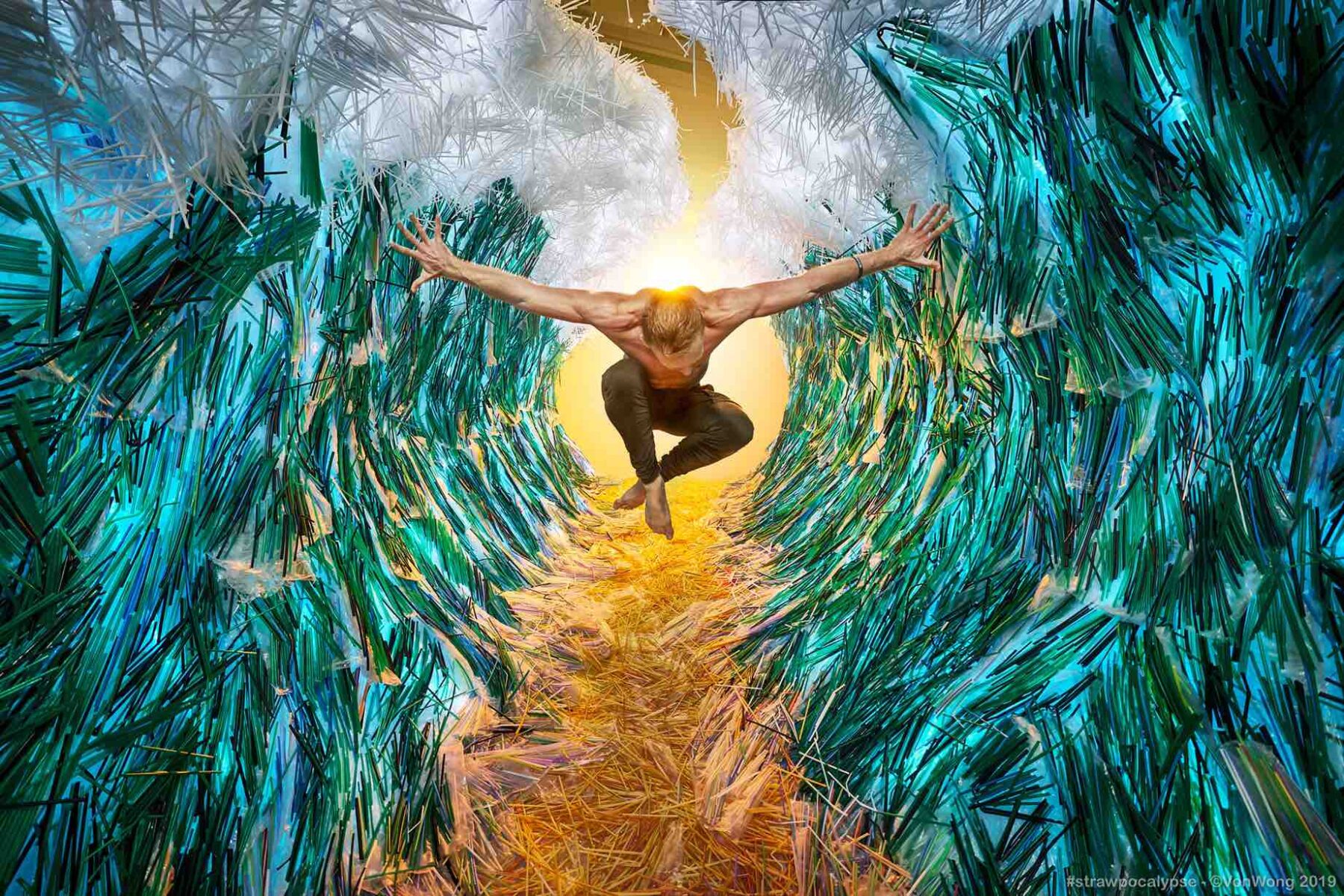
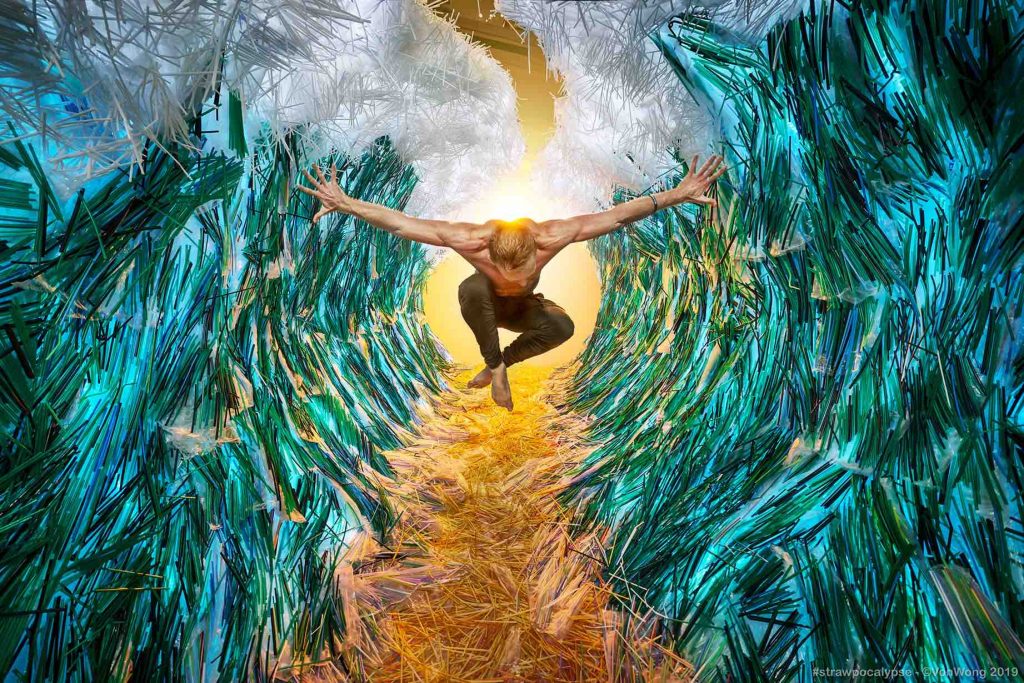
Benjamin Von Wong is a Chinese Canadian conceptual photographer currently focused on conservation and social impact projects. Through the years, Von Wong has mastered the art of bringing his imagination to life by staging beautiful and complex installations, and using hyper-realistic photography to capture them. His most recent artwork “The Parting of the Plastic Sea” was made possible with the help of Zero Waste Saigon and Starbucks Vietnam, and is currently exhibited at Estella Palace Shopping Mall in Vietnam. Since its completion on January 20, 2019, it has been recognised by Guinness World Records as the largest straw installation, and its viral status is amplifying people’s concerns with single-use plastics around the world.
See more at www.vonwong.com
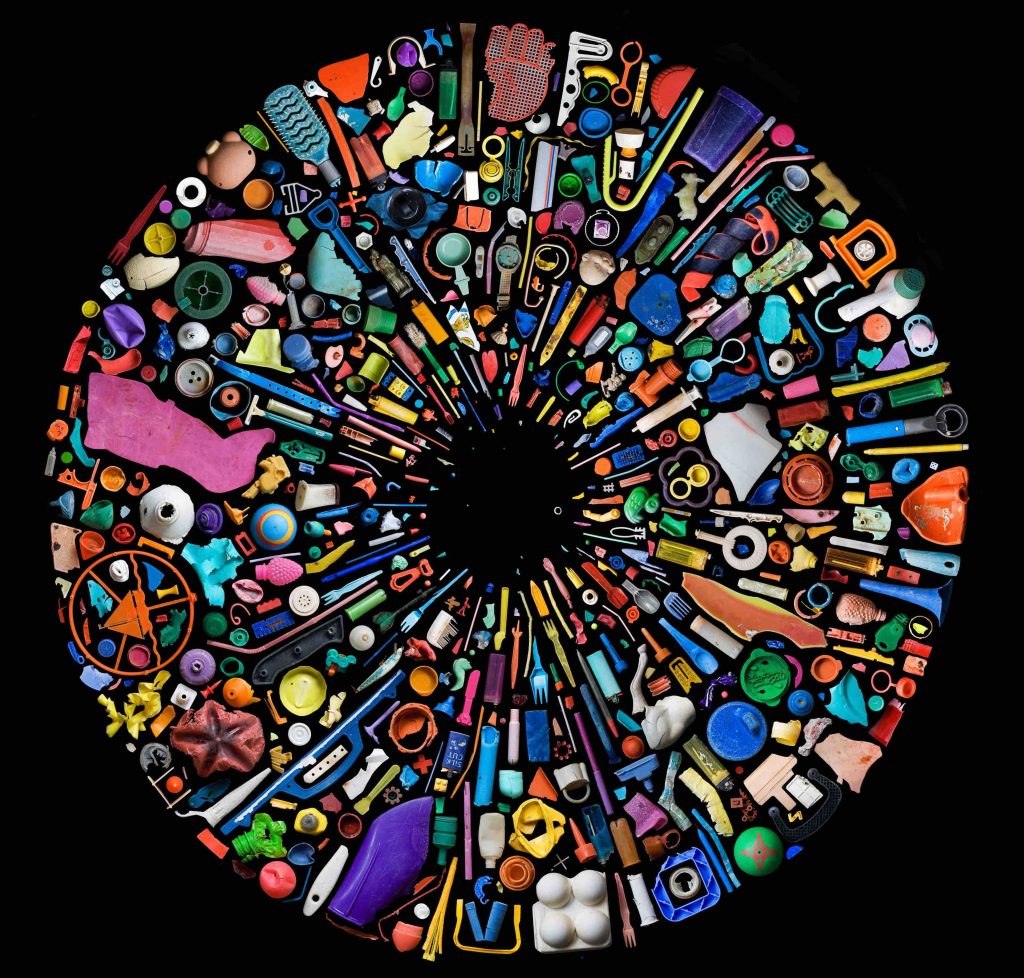
Mandy Barker’s “SOUP: 500+”
In this image from Mandy Barker’s “SOUP” series, the artist compactly arranges and photographs more than
500 pieces of plastic debris found in the digestive tract of an albatross chick in the North Pacific Gyre.
See more at www.mandy-barker.com
Washed Ashore
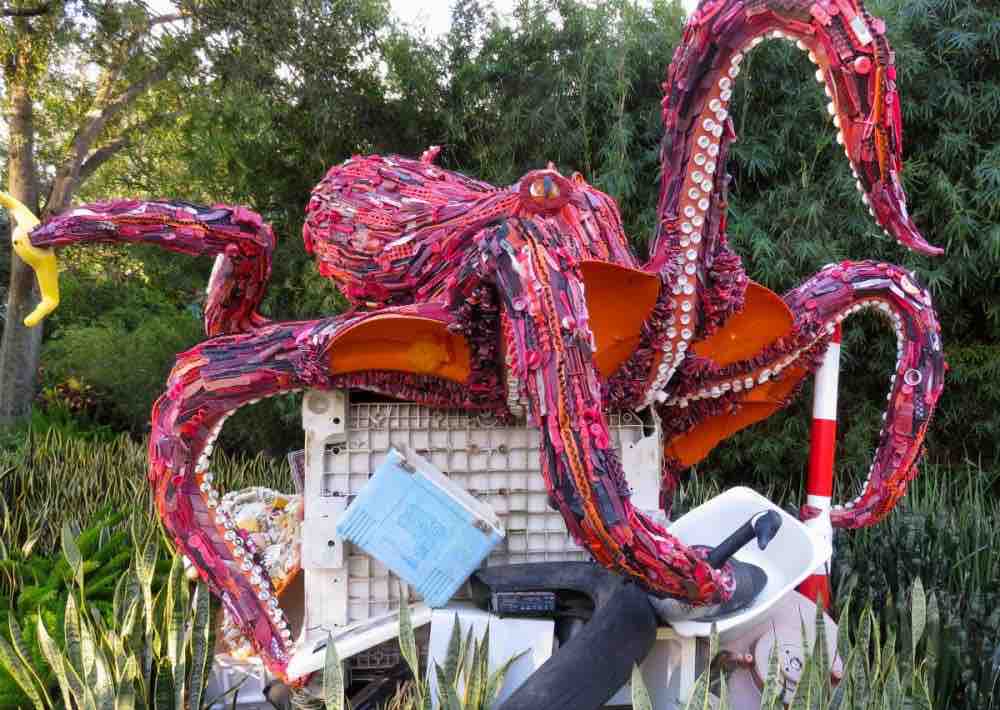
Founded by the visionary artist Angela Pozzi, Washed Ashore creates large-scale sculptures of sea life with plastic marine debris collected along coastlines. These unique pieces are used as powerful education and outreach tools and have been exhibited at various high impact areas including the United Nations, the Smithsonian Museum of Natural History, and many zoos and aquariums across the US.
See more at www.washedashore.org
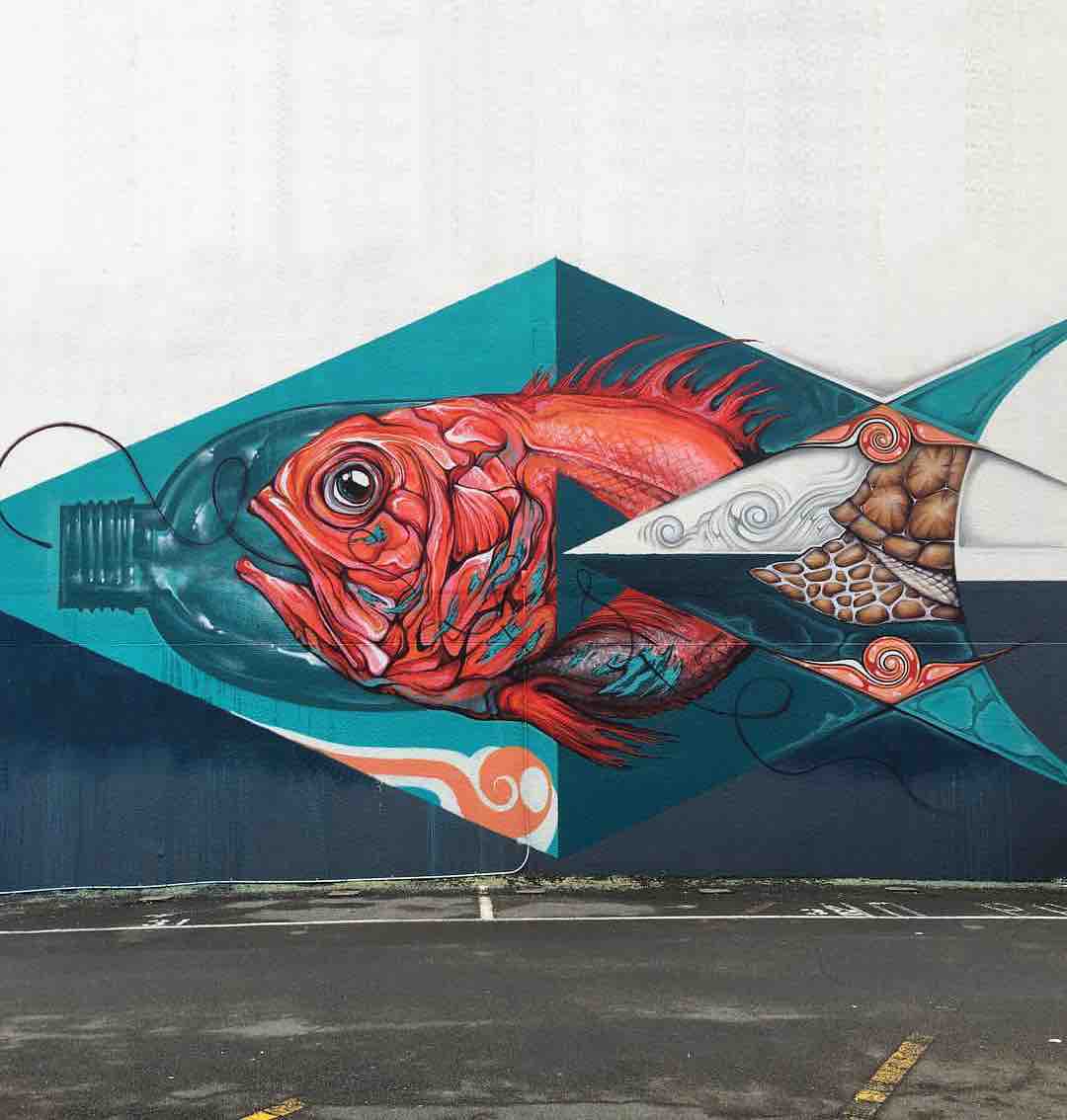
PangeaSeed’s “Sea Walls”
“Sea Walls: Artists for Oceans” is PangeaSeed Foundation’s public art programme initiated in 2014. Its objective is to bring the message of ocean conservation into streets around the globe through large-scale and breathtaking mural paintings. To achieve this level of awareness, PangeaSeed has established an ever-growing community of 200 artivists and has created nearly 300 murals in 12 countries around the world.
See more at www.pangeaseed.foundation
For the rest of this article (Asian Diver 2019 Issue 1 No 152) and other stories, check out our past issues here or download digital copy here. The 25th anniversary of the largest and longest running dive show, Asia Dive Expo (ADEX) is set to occur on the 11-14th April 2019. Centred on the theme – Plastic free Future, ADEX is more than just a dive show with its commitment to the environment. Among an exciting lineup of programs, attendees can look forward to a Future Forward Series of Panel Discussion on the Single-Use Plastic Conundrum in Asia, on 13th April.
So join us at the event, get inspired and for all you know, you might just liberate the inner diver in you! More details of the event here.
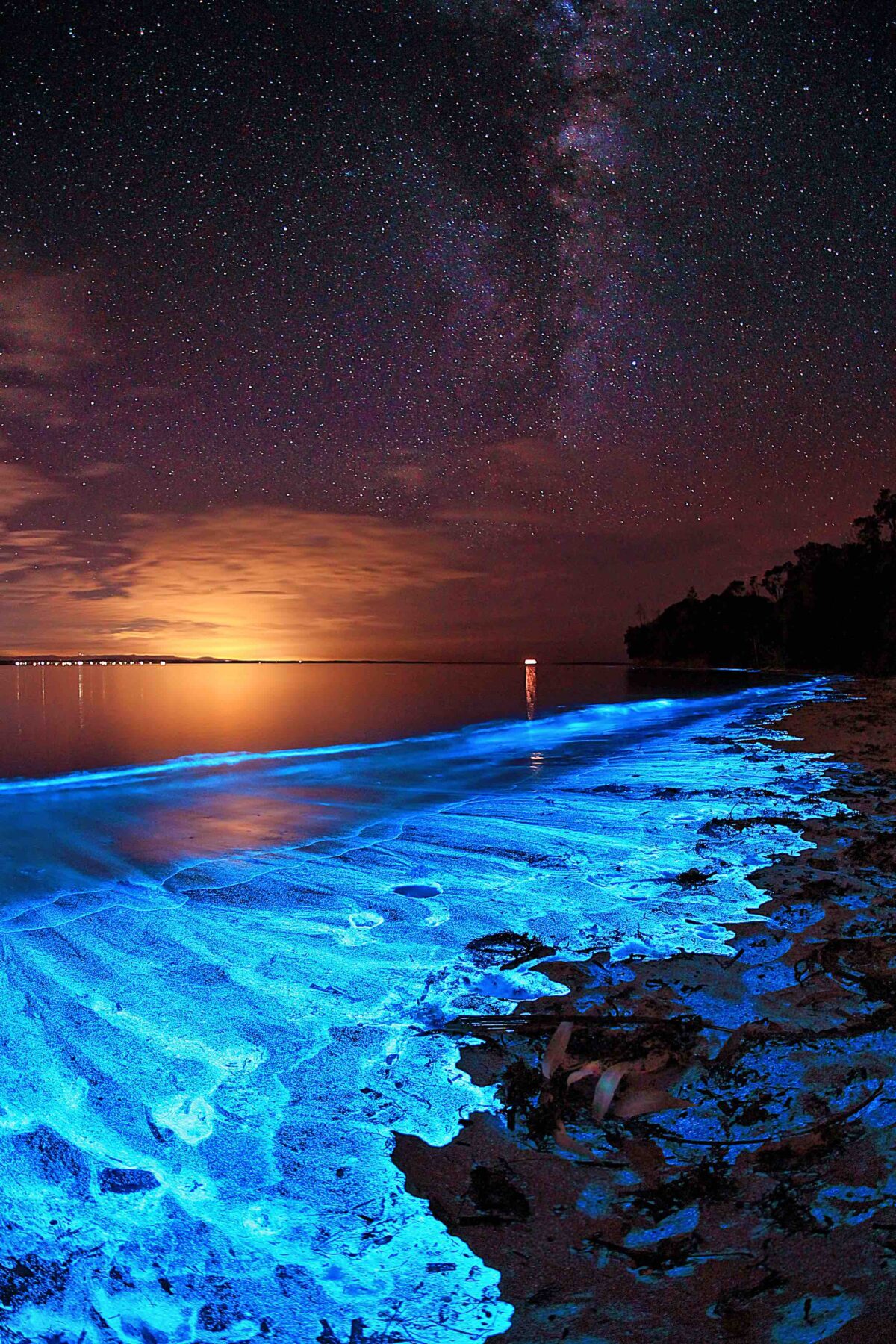
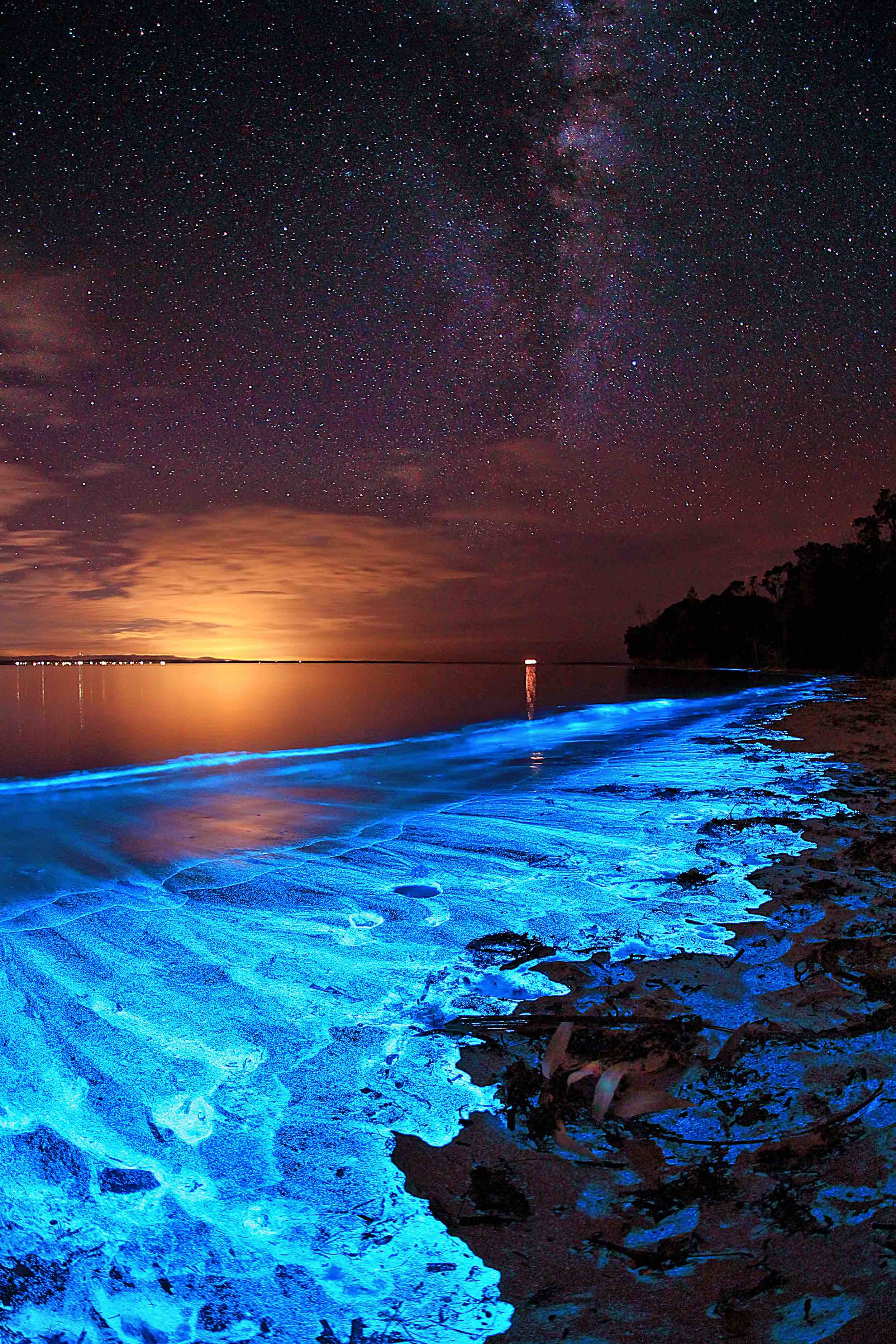
Bioluminescent plankton, dinoflagellates, off the New South Wales coast, line the beach at Plantation Point, Vincentia, with a glow that rivals that of the stars
By Lindsey Dougherty
Sea creatures like to show off. Whether it’s to attract a mate, scare away a predator, or blend in with the sometimes equally flamboyant surroundings, there’s no shortage of wow factor in the sea: Divers are delighted by mesmerising cuttlefish, alluring anglerfish, and the undeniably flashy “disco” clam. When we think of creatures lighting up the oceans, bioluminescence might FLASHY be the first thing that comes to mind. What many people don’t realise, though, is that you don’t need to make light to be flashy – animals put on thrilling underwater shows using structural colouration, pigmentation, and fluorescence. Here are just a few examples of the science behind this conspicuous behaviour.
Bioluminescent plankton, dinoflagellates, off the New South Wales coast, line the beach at Plantation Point, Vincentia, with a glow that rivals that of the stars
BIOLUMINESCENCE
1. BOBTAIL SQUID DISTRIBUTION:
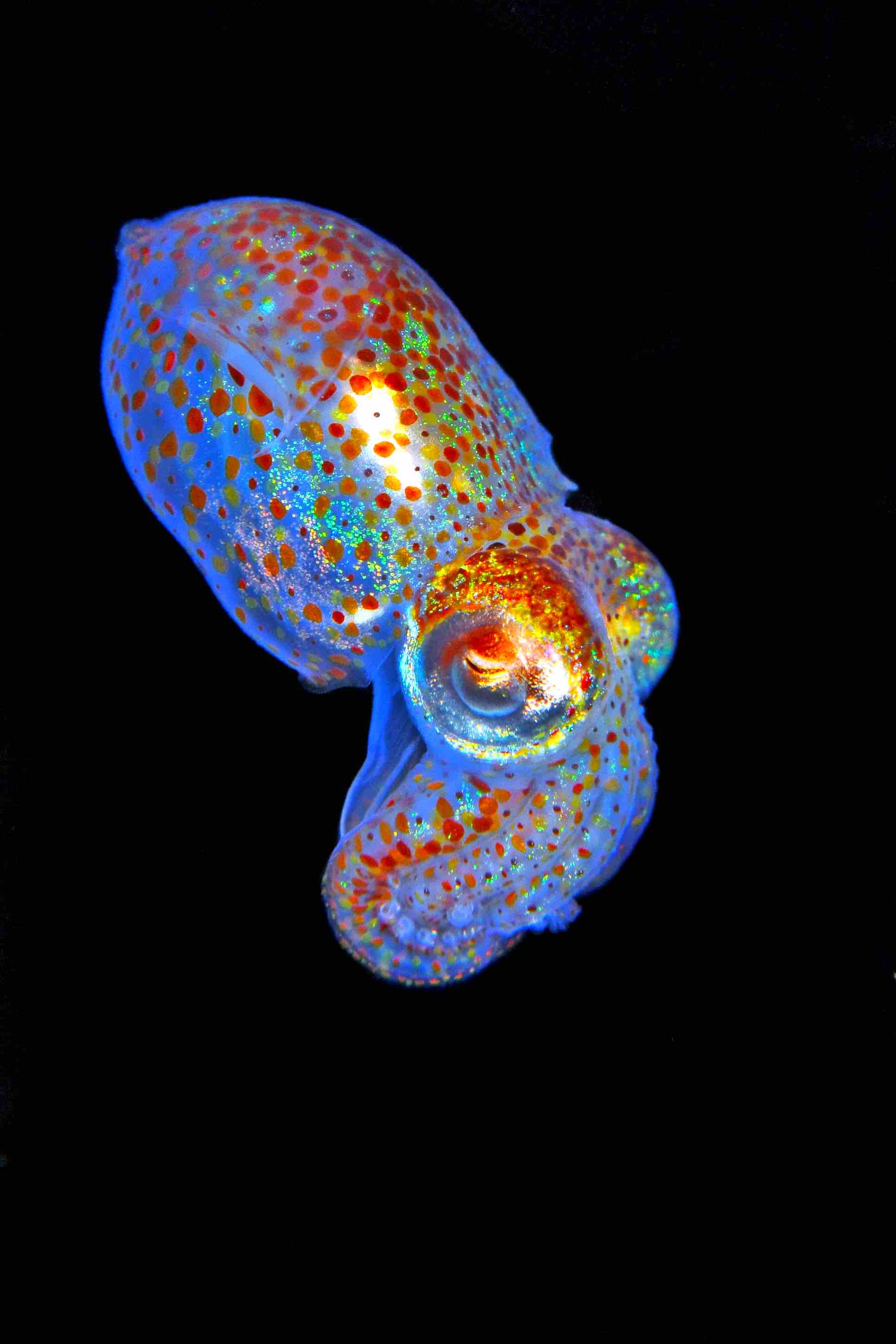
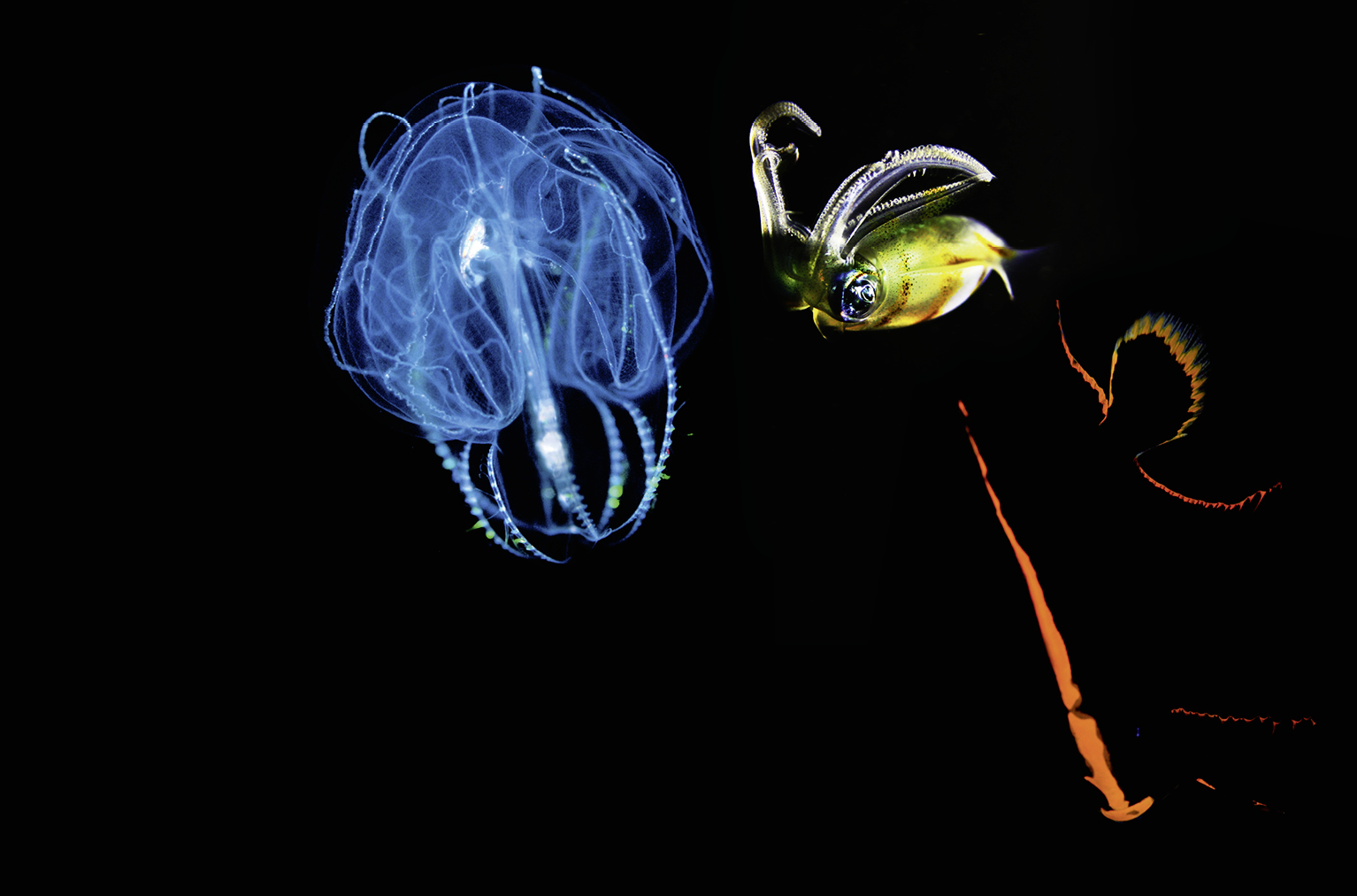
INDO-PACIFIC This tiny squid is off the “cute factor” charts. Watching these miniscule squid hide from predators by placing pieces of sand on top of their head with their tiny arms may very well make them your new favourite animal. Bobtail squid have a unique symbiotic relationship with bioluminescent bacteria that inhabit a special light organ in their body. The bacteria are fed nutrients by the squid, and in return, produce light through a chemical reaction. This light – when viewed from below – hide the squid by matching the amount of light that hits their mantle from above. The light organ even has a filter that can slightly alter the wavelength of light produced to match the squid’s body.
2. PLANKTON – DINOFLAGELLATES DISTRIBUTION:
GLOBAL (BOTH MARINE AND FRESHWATER ENVIRONMENTS) Dinoflagellates – small, single-celled marine plankton – can be toxic, but are also often bioluminescent. Watching a surfer at dusk during an algal bloom is a very memorable show, as dinoflagellates produce light when they are disturbed, and therefore light up the board’s movement through the water. If you’ve ever looked down at the wake the boat creates on your way to a night dive and seen bioluminescence, you should probably thank dinoflagellates. It is hypothesized that dinoflagellates create brief flashes of light when disturbed to act as a “burglar alarm”. This way, whatever potential predator disturbed them will now be in danger of an even larger predator that was attracted by the light and en-route to 1 get its own dinner!
3. ANGLERFISH DISTRIBUTION: GLOBAL, SOME SPECIES ARE DEEP-SEA DWELLERS
The deep-sea dwelling anglerfish is not, shall we say, the prettiest fish in the sea. With its lucifer-esque appearance, it isn’t too surprising that the enzyme that speeds up the reaction to create its bioluminescent light is called “luciferase”. These teeth-centric animals use their light lure to draw in prey and attract mates. In some species, the female can be 60 times the length and 500,000 times the weight of the male, who becomes permanently attached as a parasite after mating. In the case of the anglerfish, therefore, it’s probably best not to go “towards the light”.
The bobtail squid, Sepietta oweniana, have a symbiotic relationship with the bioluminescent bacteria that give them their flash Image
STRUCTURAL COLOURATION
1. BLUE-RINGED OCTOPUS DISTRIBUTION: INDO-PACIFIC, BEST SEEN IN INDONESIA
The deadly blue-ringed octopus is a favourite villain in various crime stories, including James Bond’s Octopussy and Michael Crichton’s State of Fear. The flashing blue rings are produced by an interesting mechanism: multiple tiny layers reflect blue-green light, and dark pigments below each ring enhance their contrast. In order to hide the rings, the muscles above the ring contract. To expose the rings, those muscles relax and muscles outside the ring contract. Structural colouration such as the tiny layers in the blue rings interfere with the wavelengths of light and can dramatically alter what they look like. Organisms use all kinds of structures, such as spheres, gradients and crystals to interfere with light. For the blue ring, between the flashy warning and the impressive muscle show, predators are keen to stay far away from this small but potent creature.
(L)The lobed comb jelly, Bolinopsis infundibulum, gathers zooplankton with its large oral lobes, while flashing reflected rainbows from its cilia (R) Juvenile pinnate batfish, Platax pinnatus, have a striking colouration that helps deter predators
2.DISCO CLAMS
DISTRIBUTION: INDO-PACIFIC, BEST SEEN IN INDONESIA, JAPAN, THE PHILIPPINES AND AUSTRALIA
The newly crowned king of flashing is also sometimes the queen, as disco clams are thought to start out as small males and mature into large females. They have a highly reflective strip on the edge of their mantle that is filled on one side with tiny silica nanospheres. Silica is an ideal reflector and scatters ambient light, so one side of the tissue appears a brilliant white, while the other side appears dark red. Rolling the two sides back and forth two times a second creates a “flashing” appearance that’s quite dramatic, and amazingly, is not producing any light (just reflecting what ambient light is already there). Whether the clams are trying to lure prey, attract a mate, or scare away predators still remains to be seen, but their flashy display is quite a treat – if you can find them!
For the rest of this article (Scuba Diver 2014-2015 Issue 8 No 2) and other stories, check out our past issues here or download digital copy here.
The 25th anniversary of the largest and longest running dive show, Asia Dive Expo (ADEX) is set to occur on the 11-14th April 2019. Centred on the theme – Plastic free Future, ADEX is more than just a dive show with its commitment to the environment. Among an exciting lineup of programs, attendees can look forward to a Future Forward Series of Panel Discussion on the Single-Use Plastic Conundrum in Asia, on 13th April.
So join us at the event, get inspired and for all you know, you might just liberate the inner diver in you! More details of the event here.
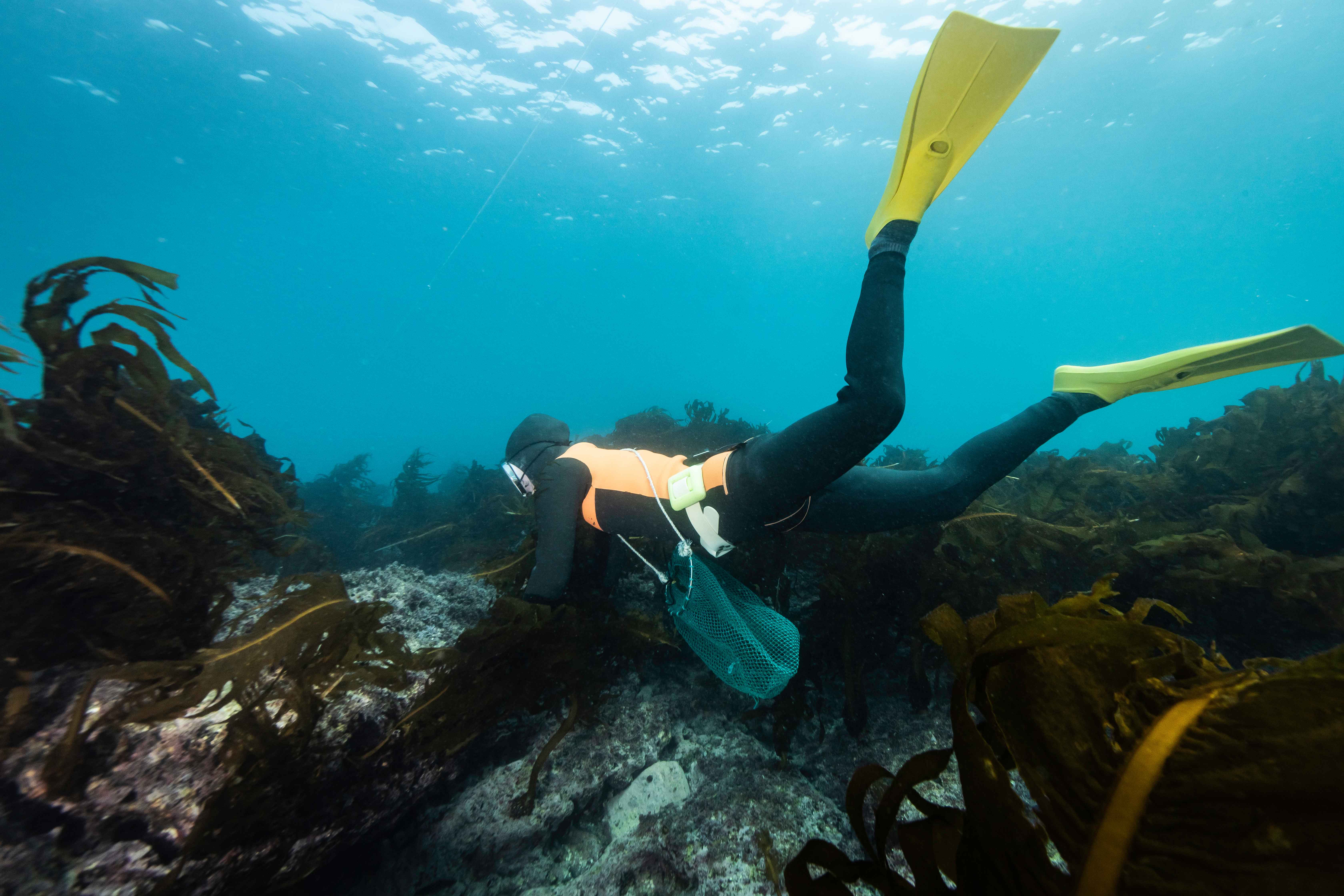
A Korean Haenyeo diving in the sea collecting shellfish
The Primordial Form of Underwater Diving
Mention underwater diving and images of compressed air tanks, air regulators, wet suits and snorkels inevitably come to mind. With the constant innovation of diving gear enabling us to go deeper and longer underwater, it’s easy to forget that underwater diving began as a simple act of holding your breath and diving into the depths of the ocean. Indeed, with the advent of modern underwater breathing apparatus, this most primordial form of diving now has to be differentiated from its more mainstream cousin by being renamed as freediving. Underwater360 reveals how underwater diving began more than 8,000 years ago and charts its evolution through the centuries to its present-day status as the extreme sport of competitive freediving that has been rising in popularity over the past three decades.
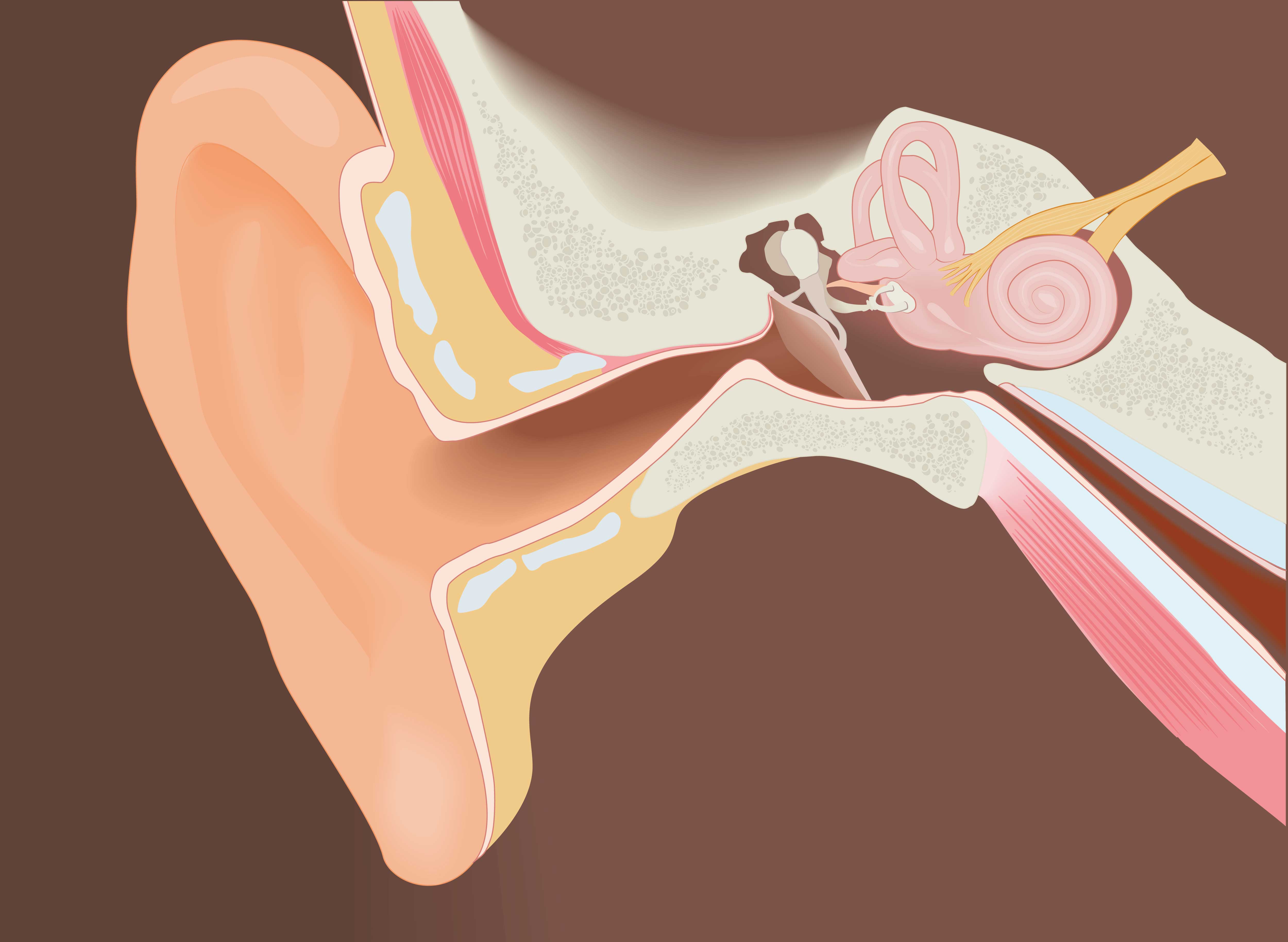
An illustration of Exostosis, or surfer’s ear, where the constant diving in water causes structural changes in the inner ear to occur.
Freediving in Ancient Times
The first recorded evidence of freediving humans can be traced back more than 7,000 years ago to the Chinchorro[1], an ancient people from 5,000 BC who lived along the coast of the Atacama Desert in what is present day northern Chile and southern Peru. In a study of Chinchorro mummies, archaeologists discovered that the bones of their ear canals had started to grow across the ear canal’s opening to protect their eardrums from recurrent exposure to water – a telltale sign of exostosis, a condition that afflicts people whose heads have been frequently dunked underwater. Exostosis is a common condition among people who surf, dive and kayak. The Chinchorro were a people who freedived for seafood. Shell midden fossils and bone chemistry tests on the mummies have proven that their diet consisted of 90 percent seafood. Besides the Chinchorro in South America, seashell fossils found in the coast of the Baltic Sea also revealed an ancient people living approximately 7,000 to 10,000 years ago who freedived for clams for sustenance.
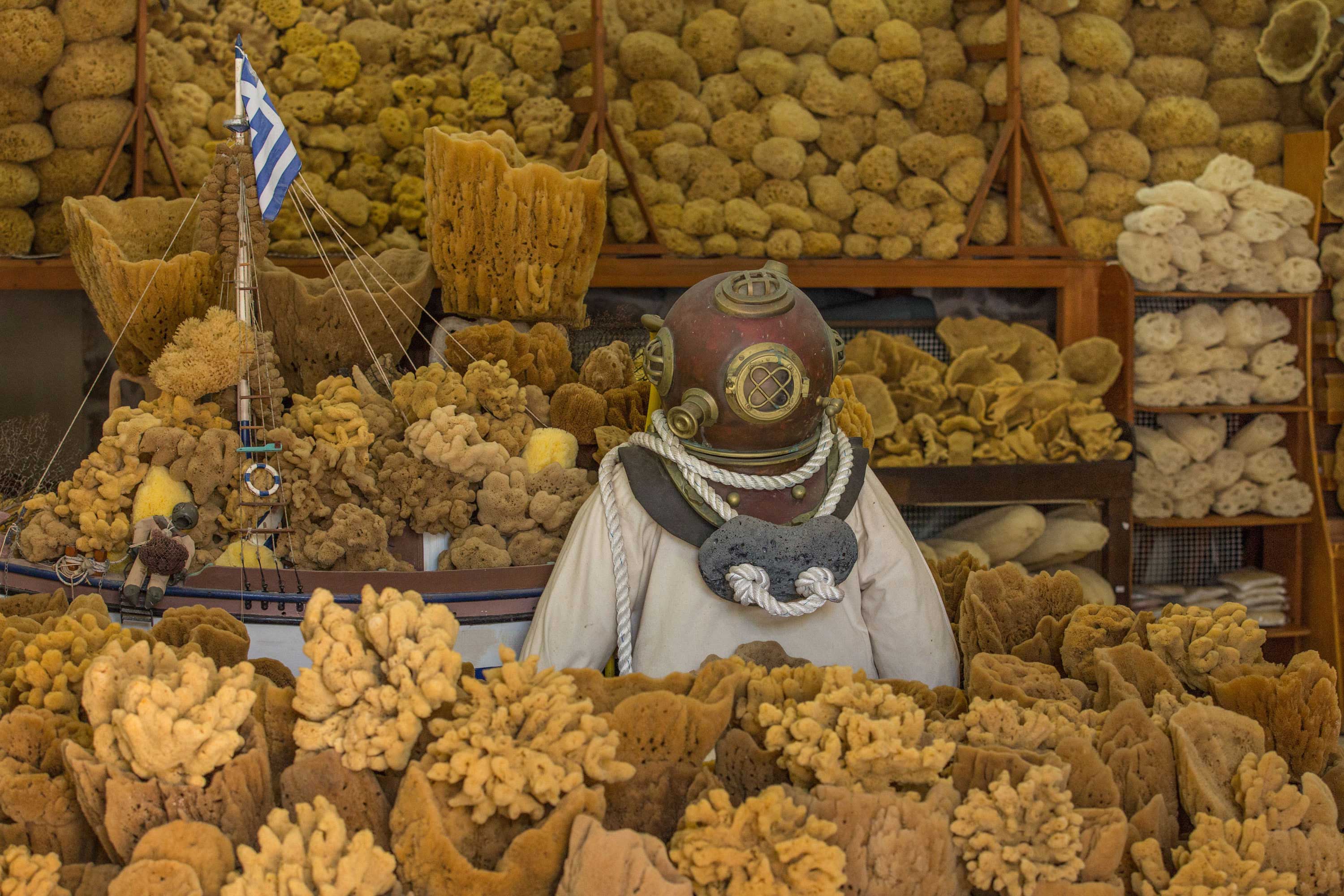
Plato’s writing mentioned sponges being used in Greek bathhouses. Here we see a picture of Greek sponges harvested in from the Aegean.
Freediving in Ancient Egypt, Greece, Mesopotamia & Persia
There have been plenty of archaeological evidence of diving in Mesopotamia (West Asia – present day Iraq, Kuwait, Saudi Arabia) which dates back to 4,500 BC and in ancient Egypt in 3,200 BC.The Greeks have been freediving for more than 4,000 years. Artefacts and scripts from the Minoan civilization, which flourished from 2,700 BC to 1450 BC on Crete and other Aegean islands, include figures of seashells as well as colours produced by seashells in Minoan ceramic art. The Greek sponge trade can also be traced to as far back to Plato and Homer who mentioned the use of sponge for bathing in their writings. The Greeks would dive for sponges at Kalymnos island, using a skandalopetra (the Greek word for stone) like granite or marble weighing eight to 15 kilograms as a weight to descent quickly to up to 30 metres underwater to collect sponges. There is no exact date of when the Greeks started the sponge trade but Plato would have been 40 years of age at around 388 BC.
A sample of Minoan pottery illustrating their diving exploits
Divers have also been used by the Greeks in war. According to Thucydides, the famous Athenian general and historian who recounted the Peloponnesian War[2] (431– 404 BC) between the Delian League led by Athens and the Peloponnesian League led by Sparta until 411 BC, divers were used to infiltrate past underwater barricades that were set up to defend against invading ships. Messages would be relayed by these divers to allies or troops blocked by these barricades. These divers would also be used to scout the seabed for ship barricades to dismantle them.
The Persians have also been recorded to have used divers in warfare. Having conquered Phoenicia (now Lebanon) in 539 BC, King Cyrus the Great of the Archaemenid Empire used divers during the Siege of Tyre (now Lebanon) in 332 BC against Alexander the Great to cut the anchor cables of Alexander’s ships which were using battering rams against Tyrian defences.
Freediving in Sri Lanka (Ceylon)
For thousands of years, the Gulf of Mannar along India and Sri Lanka was known for the pearls and chanks (large spiral shells) harvested from the waters off Mannar island by Sri Lankan and Indian freedivers. According to the Mahawamsa, the historical chronicle of Sri Lanka, King Vijaya, a Kalinga (now Orissa, a state in India) Prince, landed in Sri Lanka in fifth century BC and sent a gift of a shell pearl worth twice a hundred thousand pieces of money to the Pandu King upon upon taking the hand of his daughter. The ancient Greeks, specifically Megasthenes, the Greek ambassador to the Mauryan royal court in India, also wrote in third century BC about the brilliance of the pearls from the island of the Taprobane in Sri Lanka. In ancient Greece, Sri Lanka was known as “Palaesimoundu”.
Literature from the Sangam-era (third century BC to fourth century AD) such as the Agananuru, an anthology collection of classical Tamil poetic work dated around the first and second century BC, talked about a community named Parathavar which fished but also dived for pearls and chanks. Arab traders and divers from the Persian Gulf also entered into the pearl fishery trade in Sri Lanka between seventh and 13th century AD.
Research shows that the divers would go out to sea in crews as large as 23 in a boat. On each boat would be a tindal or steersman, a saman oattee who was in charge of the boat, a thody who was tasked with bailing out water in addition to cleaning it, 10 divers including the adappanar or lead diver and 10 munducks or operational assistants who pulled up the oysters and the stone counterweights the diver uses while also pulling the divers up from the seabed into the boat.
The boats would go out late at night around midnight. The tindals (steersmen) would’ve started getting ready to hoist the sails more than an hour or so before with the adappanar (lead diver) hoisting a light at the masthead as a signal to set off. The divers in the boat would then get ready in the early hours of the morning by attaching the safety ropes around their waists which would be used to haul them up. Stones would also be tied to ropes to act as counterweights for the divers to do a fast descent to the seabed. As the ropes with the weights are released into the water, the diver would take a deep breath and descend rapidly by stepping on the weights. They would then start collecting oysters into the nets around their waists the moment they reached the seabed while the weights are pulled up into the boat. After about a minute, the diver would tug on the rope tied to him to signal the completion of his task, upon which he would be pulled upwards with the oysters he collected.
Ama: Freediving in Japan
The Ama(海人)are coastal people in Japan who make their living diving underwater to depths of up to 25 metres to harvest abalone, turban snails, oysters and pearls. Many ancient Japanese references[3] have stated that the Ama have existed for at least 2,000 years. One of the oldest references which refer to the Ama is the Gishi-Wajin-Den (魏志倭人伝) one of the oldest historical texts in Japan, which is believed to have been published in 268 BC. Some of the oldest archaeological evidence from Japan has shown that the Japanese have always depended on seabed resources. According to an ancient Chinese chronicle containing sporadic references to Japan, the northwestern part of what is now Kyushu has a lack of arable land to enable its people to survive on agriculture, which has compelled them to depend on the sea to barter for staples such as rice.
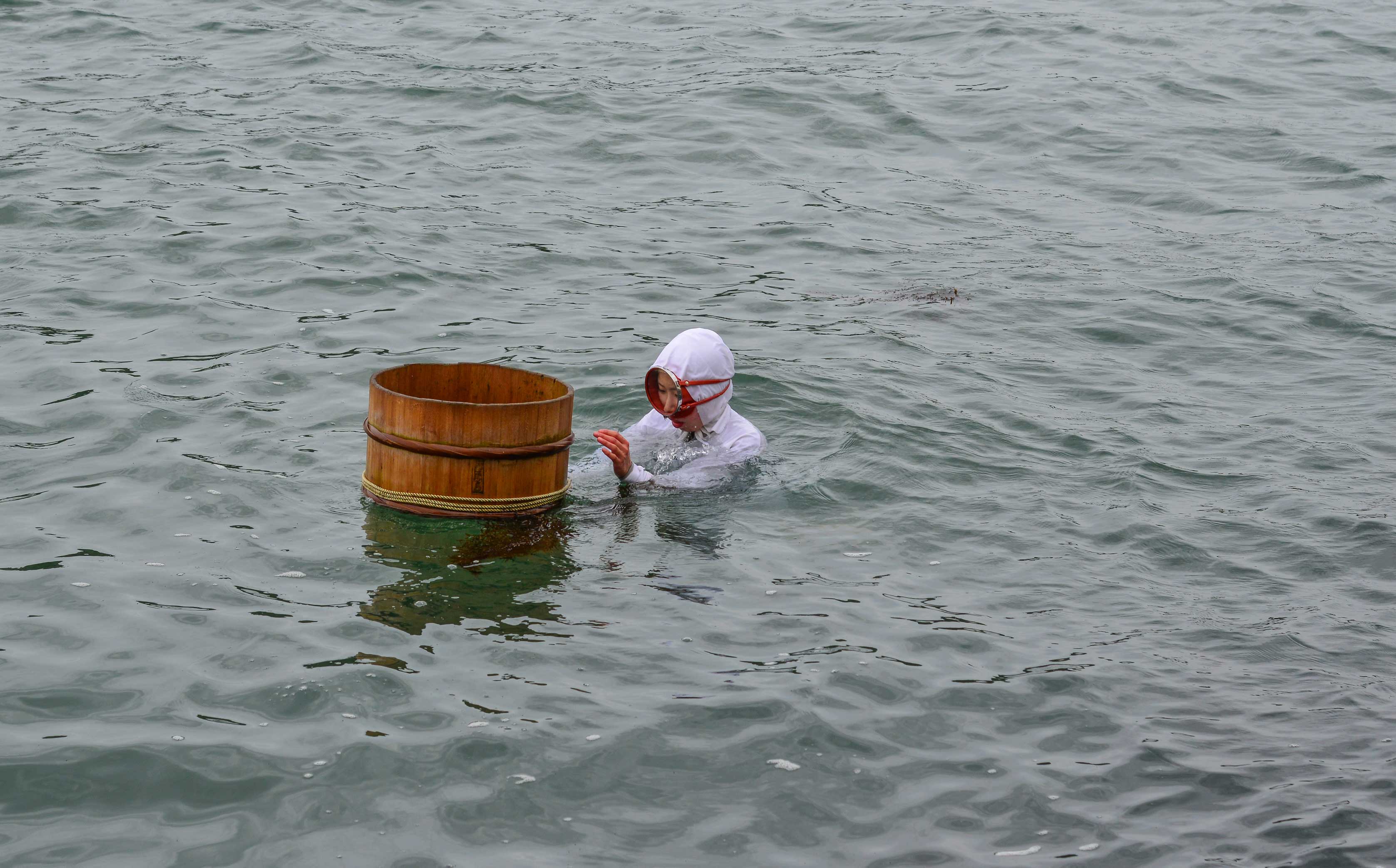
Woman Ama divers preparing to go to sea with their wooden barrels in tow.
According to Minoru Nukada from the Department of Health and Physical Education at Toho University[4], male and female Ama engage in different activities. Male Ama (海士) usually catch fish, either by hand or with a spear, whereas the female Ama (海女) will dive to the bottom of the seabed to collect seaweed and shellfish. Through time, the men engaged in off-shore fishing or became sailors on ships while the female Ama stayed at home and dived to supplement the farming harvest.
The Ama divers in Japan use a wooden barrel as a float.
Usually females, the Ama traditionally dive in only a fundoshi (loincloth) for ease of movement with only a tenugui (bandanna) covering their hair. These headscarves are sometimes adorned with symbols in order to bring luck to the diver and ward off evil. They also use a safety rope attached to a wooden tub or barrel that serves as a buoy which they can rest on in between dives. The barrel is also used to hold their catch. Their most important tool, however, was the tegane or kaigane – a spatula-like tool used to pry out abalone from between the rocks on the seabed. In the early 1900s, goggles were introduced and adopted by the Ama. In the decades after World War II, the Ama started wearing a white sheer garb for modesty while others started wearing rubber wetsuits in the 1960s.
There are various theories about why the Ama are mostly female. One is that the Japanese consider women to be more biologically capable of withstanding cold due to the distribution of fat in their bodies. They are also believed to be more adept at holding their breaths. The Ama are trained as early as 12 or 13 years old by elder Ama. At this stage of their training, they are known as Koisodo or Cachido and dive in shallow depths of only two or four metres from the beach. After they have been trained a few years (15 to 20 years old), they graduate to being Nakisodo, Okazuki or Funedo and are allowed to dive to four to seven metres in groups from a boat controlled by one or two boatmen who also act as watchmen for their safety. The Koisodo and the Nakaisodo both use the wooden tub as a buoy. A fully trained Ama is known as an Ooisodo, Okiama or Ookazuki. Usually more than 20 years old, the Ooisodo can dive to a depth of 10 to 25 metres and usually operate alone on a boat with a boatman for assistance. They use counterweights like a lead belt or a counterweight (haikara) connected to the boat with a rope and a pulley for a fast descent and are then pulled up quickly after harvesting the shellfish.
Hae-Nyeo: Freediving in Korea
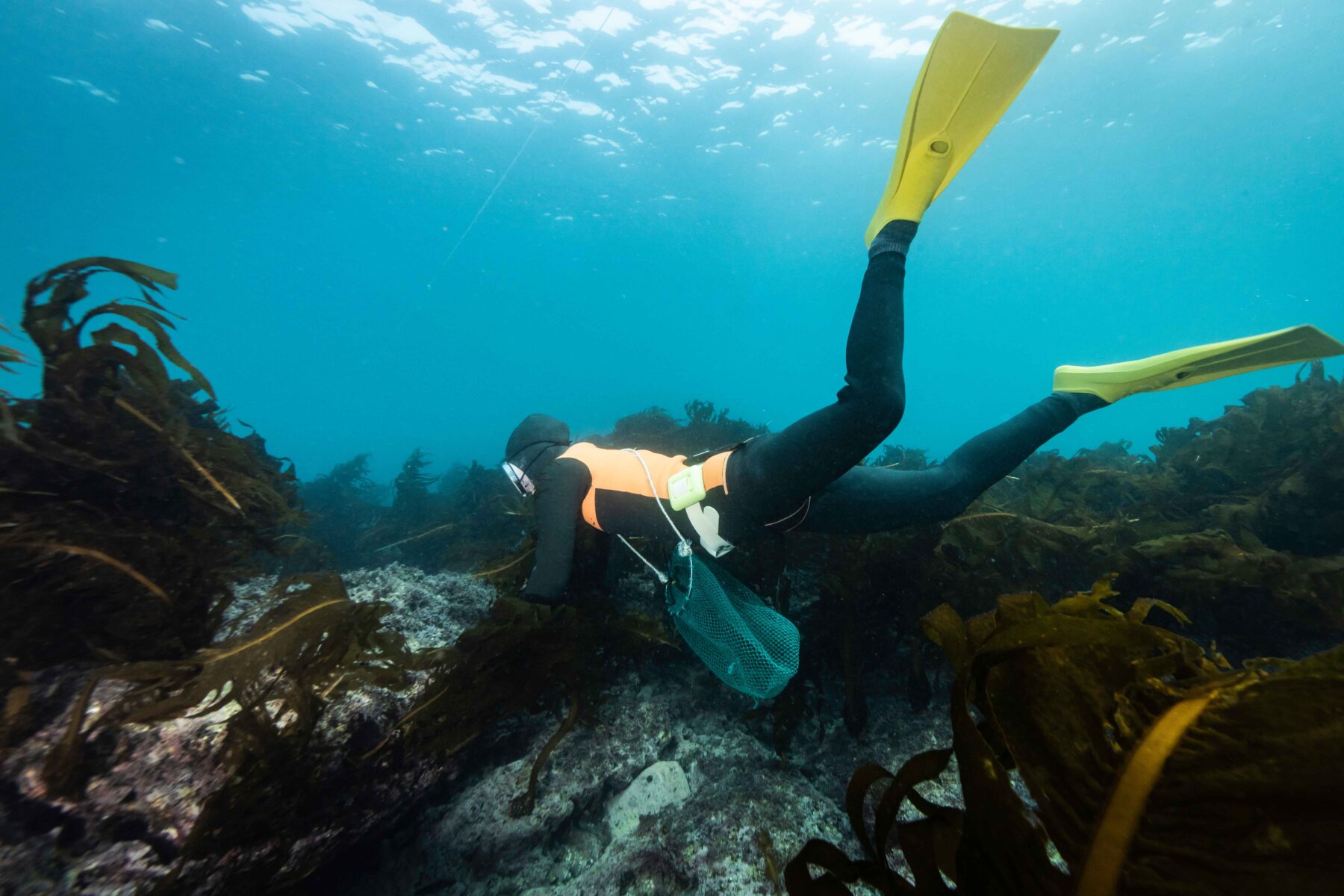
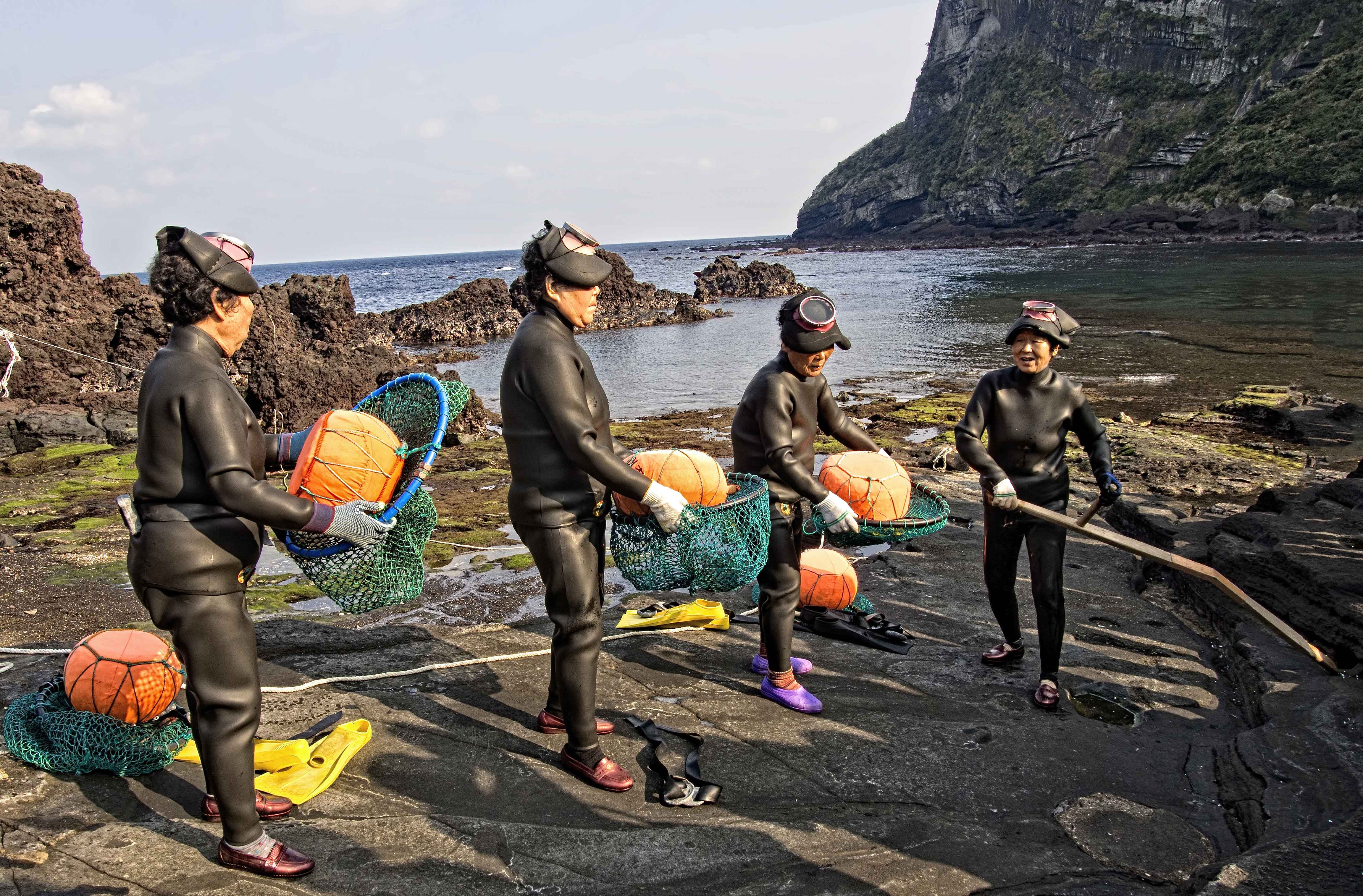
Like the Ama of Japan, the Hae-Nyeo(해녀; 海女)or Jam-Nyeo are women freedivers who make their living from diving and harvesting shellfish and seaweed from the seabed. They are found in the southern part of the Korean Peninsula, especially Jeju island. Although the exact beginning of freediving in Korea is not known, Korean history experts agree that Jeju was the place where the Hae-Nyeo were first found. Historical records reveal that as early as 434 AD, pearls were found in the Shilla Kingdom.
A Korean Haenyeo diving in the sea collecting shellfish
It is not known when the men dropped out of the diving work. The only explanations we have is the physiological advantage that women have – greater subcutaneous fat and an ability to withstand the cold better.
The Haenyeo women freedivers in Korea operate out of Jeju Island.
Like their Japanese counterparts, the Hae-Nyeo start learning to freedive in shallow waters at age 11 or 12 and as their skill level progress, they graduate from being a lower level diver to intermediate and finally to an advanced level when they turn 17 or 18.
The Hae-Nyeo wear a black swimming trunk and a white cotton jacket. Diving goggles were introduced during the 1930s, with eye glasses used for almost two decades before diving face masks became available. They also use hollowed-out gourds around 12 inches in size as floats.
Sama-Bajau: Freediving in Southeast Asia
All freedivers are familiar with the “mammalian dive response” – when your heart slows down, blood vessels constrict and your spleen contracts because your body is trying to keep you alive while you are holding your breath underwater. For the Sama-Bajau – a group of sea nomads of Austronesian ethnic group from Southeast Asia who live off the sea in waters around the Philippines, Malaysia, Indonesia and Borneo – a study about human hypoxia tolerance published by the journal Cell[5] has revealed that a genetic DNA mutation has given them larger spleens which allows them to be able to freedive underwater to harvest shellfish and food at depths of up to 60 metres for as long as 13 minutes.
Sama Bajau are nomads who have an unnaturally large spleen which allow them to hold their breaths for up to 13 minutes at a time.
In the human body, the spleen recycles red blood cells and helps to support your immune system. After previous studies revealed that diving mammals like elephant seals, otters and whales have disproportionately large spleens, Melissa Llardo, the author of the hypoxia study in Cell was eager to find out if the same was true in humans. Her studies revealed that the median size of the spleen of a Sama-Bajau person was 50% larger than that of the Saluan people, a related group of people on the Indonesian mainland. The Sama-Bajau also had a gene called PDE10A (which the Saluan did not have) that is thought to control a certain thyroid hormone that in mice is known to be linked to spleen size.
Modern Freediving
The Legend of 1913
Most freedivers cite the legendary retrieval of the missing anchor of the Italian navy ship, Reggina Margherita, by a Greek sponge diver on 16 July 1913, from an estimated depth of about 88 metres underwater, as the first incidence of modern freediving. While the exact name of this Greek sponge diver has varied from Stotti Georghios, Stathis Hatzis, Stathis Chatzi to Haggi Statti and Chatzistathis, what is not in dispute was his pulmonary emphysema, his perforated eardrum from years of diving without proper equalization and the fact that he tied a safety rope to his waist and proceeded to descend quickly to the seabed using the primitive Greek “Skandalopetra” method of holding onto a giant rock as a counterweight. He is also consistently described as being a man of average height (1.7 metres), weight (65 kilograms) and age (35 years old). And it is unanimously agreed that he successfully retrieved the anchor by freediving and was rewarded for his efforts with £5 and the lifelong permission to fish with dynamite.
The Race to the Bottom Begins
In the years after the legend of 1913 grew, freediving started to evolve as a sport with some notable people setting and breaking records as the motivation to be record breakers in freediving led to divers developing techniques and discovering natural physiological responses like blood cooling, our diving reflex and blood cooling among others.
Freediving Tools Take Shape
In 1927 Jacques O’Marchal invented the first diving face mask that enclosed the nose.
In 1933, Louis de Corlieu patented fins you could wear on your feet. Calling them “swimming propellers” they were later mass produced by Owen Churchill, an American
In 1938, Maxime Forjot improved upon O’Marchal’s design by using a compressible rubber pouch to cover the wearer’s nose, thus enabling divers to pinch their nostrils shut to make it easier to equalise the pressure in the ears
Britain and the United States purchased huge quantities of Owen Churchill’s flippers during World War II
In 1951, Hugh Bradner, diver and physics student came up with the first diving wetsuit made out of neoprene, which the US Navy snapped up for US Marines in the Korean War
Competitive Freediving Begins
Like the one-minute mile, the 30-metre freediving mark was an important milestone that kickstarted the modern competitive freediving movement. Although scientists had openly predicted pressure-crushing death at that depth, in 1949, the era of Italian domination of competitive freediving kicked off in earnest when Raimondo Bucher, an Italian air force captain (and an avid spear fisher) born in Hungary, officially became the first man to dive to a depth of 30 metres. Using a large rock as a counterweight, Bucher dived to the bottom of the sea at Naples without breathing apparatus. He was met at that target depth by Ennio Falco, a fellow Italian diver, who had staked 50,000 lire against him completing the feat. Bucher won the 50,000 lire but Falco would take his record two years later.
The Italian Job
Bucher’s freediving record fired up the competitive freediving scene in Italy and the next two decades saw the Italians dominate the freediving record books with freediving legends like Alberto Novelli and Enzo Maiorca spearheading the sport of deep freediving. Together with Brazilian freediving Americo Santarelli (who retired in 1963) and later Jacques Maol, the famous French freediver who used yoga techniques and mediation to calm his body, freediving records were taken to ever greater depths. Mayol would achieve 11 world records and was the first freediver to go past 100 metres. Despite the fears of scientists who believed that high pressure in deep depths would collapse human lungs, Enzo Maiorca broke the 50 metre barrier in 1962 and would go on to achieve 17 world records. Maiorca and Mayol’s rivalry was immortalised in Luc Besson’s 1988 film, The Big Blue, a fictionalised take on the two freedivers’ rivalry. Angela Bandini of Italy would shock the freediving community in 1989 by become the first human to freedive to 107 metres underwater, breaking Mayol’s world record by two metres.[/vc_column_text]
Women Freediving
In the 1960s, women freedivers such as Gilliana Treleani (Italy) and Evelyn Patterson (Great Britain) had flown the flag successfully for women freedivers by diving deeper than 30 metres. Treleani achieved the mark of 35 metres in 1965. Constant Weight Apnea, one of the three disciplines of freediving recognized by AIDA was pioneered by women freedivers Francesca Borra and Hedy Roessler, both from Italy in 1978. [Constant Weight Apnea (CWT) is a freediving discipline whereby a freediver descends and ascends with the help of their fins or monofin and/or their arms without pulling on the rope or changing their ballast. Only a single hold of the rope, either to stop the descent of start the ascent is allowed] During the 1980s, Enzo Maioca’s two daughters, Patricia and Rossana Maiorca were also responsible for furthering women’s freediving as Patricia freedived to 70 metres while Rossana freedived to 80 metres.
Modern Freediving in USA
One of the pioneers of freediving in the United States is Robert Croft, a US Navy diving instructor who taught navy personnel how to escape from a stricken submarine. Croft could hold his break for more than six minutes and was studied by US Navy scientists for signs of “blood shift”. Croft set three depth records in a one-and-a-half-year period and in 1967, he overcame what scientists believed to be the human physiological depth limit for freediving by becoming the first person to dive deeper than 64 metres. Croft also developed the Glossopharyngeal Breathing Technique, a technique of forcing more air into your lungs before a dive called lung packing. He would go on to become to first freediver to dive beyond 70 metres by achieving a freediving depth of 73 metres before retiring from competitive freediving in 1968.
The flagbearer for US freediving after Croft is Tanya Streeter. Streeter reached 113 metres with a No Limits dive in 1998. She broke world record that surpassed the men’s apnea record with a No Limits dive of 160 metres in 2003 and a Variable Weight record of 122 metres that lasted for seven years.
No Limit Freediving
With the retirement of Mayol and Maiorca, a new freediving rilvary was born with Italian Umberto Pelizzari and Cuban Francisco Rodriguez (better known as Pipin Ferreras) both appearing on the scene around 1990. With advent of new freediving disciplines such as Constant Weight and Variable Weight Apnea (a discipline where the freediver descends with the help of a counterweight and ascends using his own strength, either by pulling or not pulling the rope), the traditional form of freediving, i.e to dive as deep as possible on one breath, going down with weights and coming up with a buoyancy bag, was now renamed as No Limit. Pelizzari and Rodriguez pushed No Limit Apnea to new depths, going to 110, 120 and 130 metres and beyond. The current no limits world record holder is Herbert Nitsch who dived to 214 metres on June 14 2007 in Spetses, Greece. An Austrian freediver, Nitsch has held 32 world freediving records across every freediving discipline.
The Founding of AIDA
Freediving continued to grow and develop internationally in the 1980s and 90s and in 1992, the Association Internationale pour le Developpement del’Apnée (AIDA) was founded by Frenchmen Roland Specker, Loic Leferme and Claude Chapuis in Nice, France, with Specker serving as its first President. Set up to organise clinics to grow the sport of competitive diving, the International Association for Development of Apnea, aka AIDA, is the worldwide body responsible for keeping the records and rules of competitive freediving events worldwide. AIDA establishes the safety standards and the ratification of official freediving world record attempts and freediving education. AIDA International is the parent organization for national clubs of the same name.
Besides Constant Weight, Variable Weight and No Limit Apnea, another discipline of freediving that has captured the public’s imagination is Static Apnea, which measures how long a person can hold their breath (apnea) without swimming any distance. The current record for Static Apnea is held by Aleix Segura Vendrell, who set a record of 24 min 3sec on February 28, 2016.
Iconic Modern Freedivers
One of the most iconic freedivers who was considered as “possibly the world’s greatest freediver” was Natalia Molchanova. A Russion champion freediver, Natalia was the most decorated freediver at the time of her death. She was the holder of 41 world records and had won 23 gold medals when she went missing on 2 August 2015 while giving a private dive lesson near Ibiza, Spain. The first woman to go past 100 metres (she freedived to 101 metres in Sharm El Sheikh, Egypt) while freediving with constant weight, Natalia could hold her breath for nine minutes. On the fateful of her accident, she had dived to about 40 metres in Ibiza, and was believed to have been caught by a current and never resurfaced.
Her son Alexey Molchanov is the current world record holder in the constant weight apnea category for men with a world record of 130 metres achieved in 3 min 55 sec.
[1] Arriaza, Bernardo T. Beyond Death: The Chinchorro Mummies of Ancient Chile. Washington: Smithsonian Institution, 1995. Print.
[5]Cell journal at www.cell.com/cell/fulltext/S0092-8674(18)30386-6_returnURL=https%3A%2F%2Flinkinghub.elsevier.com%2Fretrieve%2Fpii%2FS0092867418303866%3Fshowall%3Dtrue
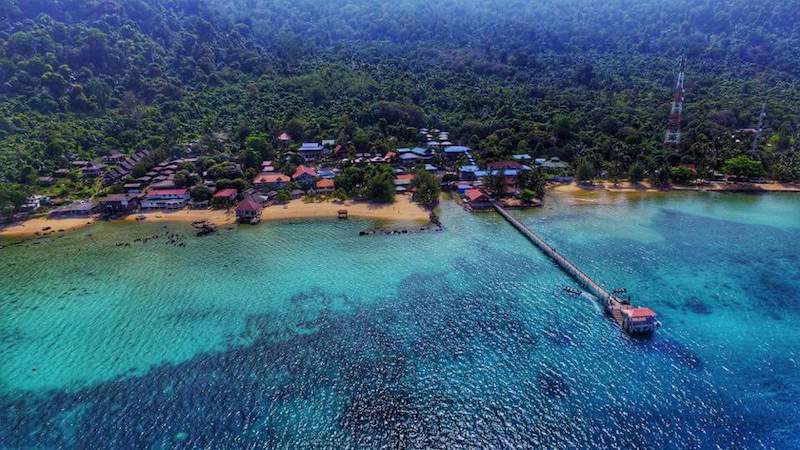
An aerial view of Sun Beach Resort in Pulau Tioman (Photo courtesy of Simply Scuba)
Christopher Lee has always loved the outdoors so when it came time to decide what he wanted to do in life, the decision was exceedingly simple.
“Sitting in an office was never my plan for life. So when I first plunged underwater in 1988, I knew that was what I wanted to do for a living.”
Christopher Lee
With his love of the outdoors and his independent nature, Chris knew deep down that running his “own business was always the plan”. And when he discovered his passion for diving, turning what he loved into a livelihood was essentially a no-brainer.
After spending three years as a scuba instructor, Chris founded Simply Scuba in 1994, first in Singapore and then in Pulau Tioman. Now celebrating his 25th year in the diving industry, he shared with us his secret to his longevity.
“Lots of hard work, consistency and always looking forward to common trends. My passion to educate people about diving is the main driving force for me to be able to run my dive business for so long.”
His journey, though, has not always been smooth sailing, especially in the face of global epidemics and recession.
“Many years ago, when SARS hit us, the economy was doing very bad globally. We were badly hit as a business as not many people were keen to learn how to dive. They had more important things to do with their monies. The sport of scuba diving itself was never a mainstream need for most. It was something people did to pass time with spare cash. We had to come out with different ideas to entice customers and we also had to downsize for a while to keep the company running.”
As he looks forward to the future, Chris sees an evolution in how people view underwater diving.
“I see people wanting to learn scuba diving not so much as a sport, but as a lifestyle. With so much emphasis on saving the world, learning scuba diving lets the people see what the other 70 percent of the earth is like, and in turn changes their mindset on their every day lives.”
With so much experience accrued from a quarter century of hard graft in the diving industry, Chris had some valuable pearls of wisdom to pass on to all young divers out there.
“Continue to educate the people about this wonderful sport of diving. Share your passion for the underwater world with sincerity and constantly work hard to keep yourselves consistent. And always look ahead for future changes and adapt!”
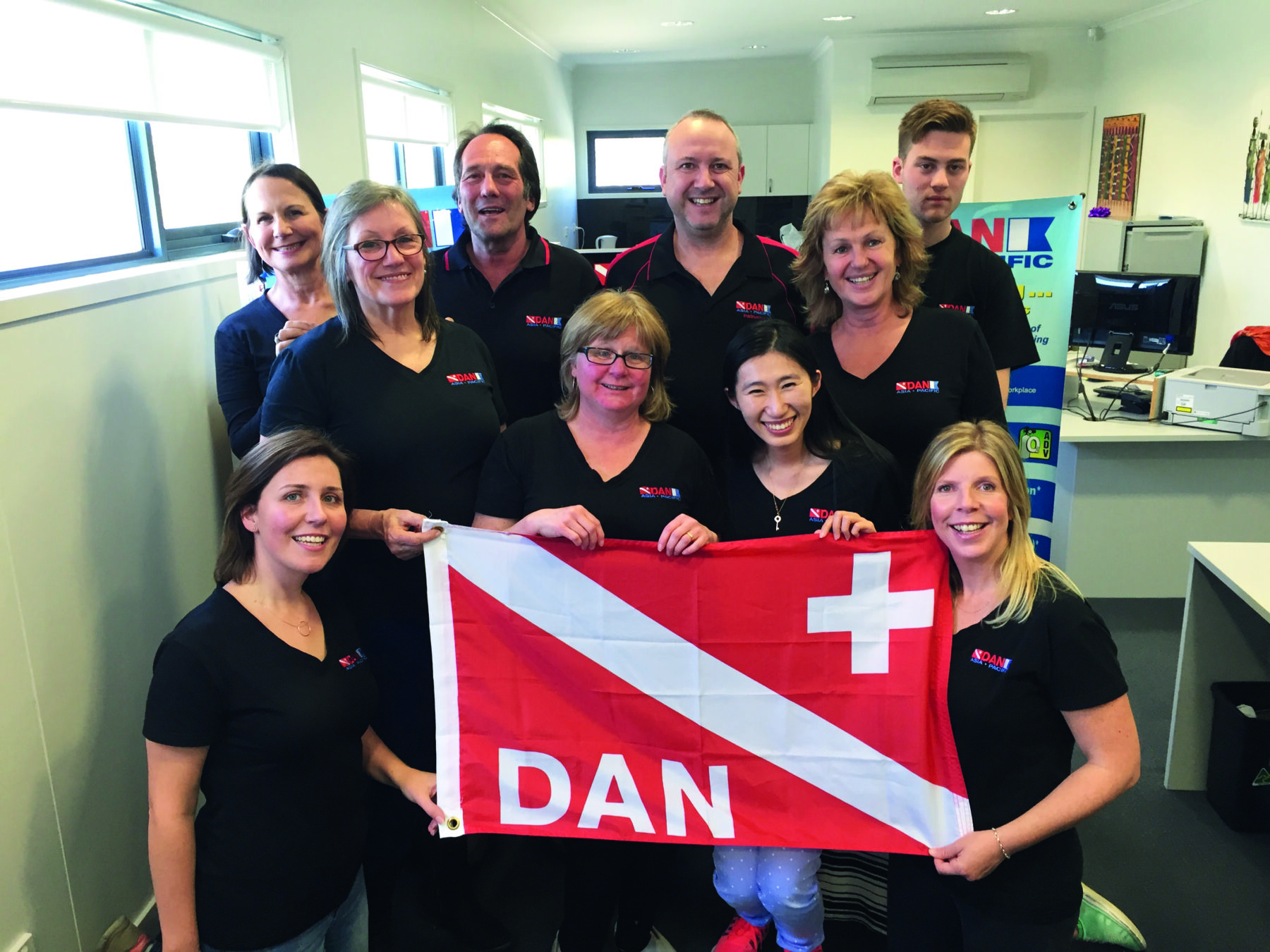
With diving becoming a popular recreational sport in the United States by the 1970s, the Undersea Medical Society (which eventually became the Undersea and Hyperbaric Medical Society) decided that a national organisation was needed for divers to call for a medical specialist by telephone at all hours of the day. In September 1980, the Divers Alert Network (DAN) was founded as a not-for-profit organisation dedicated to improving safety for all divers after Dr. Peter B. Bennett was awarded a two-year grant from the National Oceanic and Atmospheric Administration (NOAA) and National Institute for Occupational Safety and Health (NOSH) to form America’s first “National Diving Accident Network” at the Frank G. Hall Hyperbaric Center at Duke University Medical Center in Durham, North Carolina, United States.
DAN offers medical advice for all divers and first aid training for diving accidents to the public while providing a diving accident hot-line, diving accident and travel insurance to its members. It also maintains databases on diving accidents, treatments administered for diving related ailments and fatalities including databases crowd-sourced from volunteers, which are used for research programmes.
In 1981, DAN published its first “Underwater Diving Accident Manual and received 305 calls for help and information. In 1982, DAN implemented a medical/safety telephone helpline to assist recreational divers nationwide with non-emergency queries and officially changed its name from “Diving Accident Network” to “Divers Alert Network”. DAN also hosted the “first annual Diving Accident and Hyperbaric Treatment continuing medical education course at the Duke University Medical Center”.
U.S. Federal grant monies decreased by half in 1982 and then to 25% in 1983. Today, DAN is the largest association of recreational scuba divers in the world that is supported by membership dues and donations.
Dr. Alessandro Marroni founded what would become DAN Europe in 1983 by setting up the International Diving Assistance (IDA) as an all-hours diving emergency assistance service with members receiving insurance benefits. In 1987, Professor Yoshihiro Mano of the University of Tokyo Medical School started helming the Civil Alert Network (CAN), which began assisting diving emergencies in Japan. The CAN would eventually become DAN Japan. With DAN Europe and DAN Japan within its fold, DAN membership reached 32,000 in 1988.
In 1990, DAN was granted its non-profit status by the IRS and DAN introduced the “Oxygen First-aid Training Programme” and DAN Travel Assist the next year.
As the popularity of diving took off around the globe with divers everywhere needing medical advice, International DAN (IDAN) was set up in February 1991 to support the regional IDAN members – DAN America, DAN Europe, DAN Japan and DAN Asia-Pacific.
DAN Asia Pacific was founded 1994 as DAN Australia by John Lippmann OAM, an Australian diver, after DAN America and Dr. John Williamson of the Australian Diver Emergency Service (DES) approached him to set up a DAN in the Asia Pacific region. In 1996, DAN South Africa was inducted into the IDAN family with Frans Cronjé as CEO.
For his contribution to the dive industry, Dr Bennett received the 2002 Diving Equipment and Marketing Association Reaching Out Award. He retired on June 30, 2003 and was succeeded by Dan Orr. William Ziefle is the current President and CEO of Divers Alert Network.
The Citizen watch story started in 1918 with the founding of the Shokosha Watch Research Institute by Tokyo jeweller Kamekichi Yakamazi. Using Swiss machinery, they started producing pocket watches and had begun the commercial production of the first 16 Calibre pocket watch by the end of 1924. Yakamazi’s ambition was to make watches affordable so that every CITIZEN could afford to own a watch. The company began selling pocket watches under the name “Citizen” and in 1930, they took their name of their brand and renamed the company as Citizen Holdings.
Since its founding, Citizen has held to the belief of “Better Starts Now” – that “no matter who you are and what you do, it is always possible to make something better, and now is the time to start doing it.”
In 1970, Citizen introduced to the world the first watch made from titanium. From there, they invented the Super Titanium watch, a material that is five times harder than stainless steel. Made from processing solid titanium with Duratect, Citizen’s surface-hardening technology, the Citizen Super Titanium watch is light, scratch- and rust-resistant and is hypoallergenic and gentle on the skin. Citizen created the world’s first analogue light powered watch in 1976 with the Eco-Drive. Citizen’s Eco-Drive watches generate energy even from dim indoor light and can keep running for than six months even in the dark.
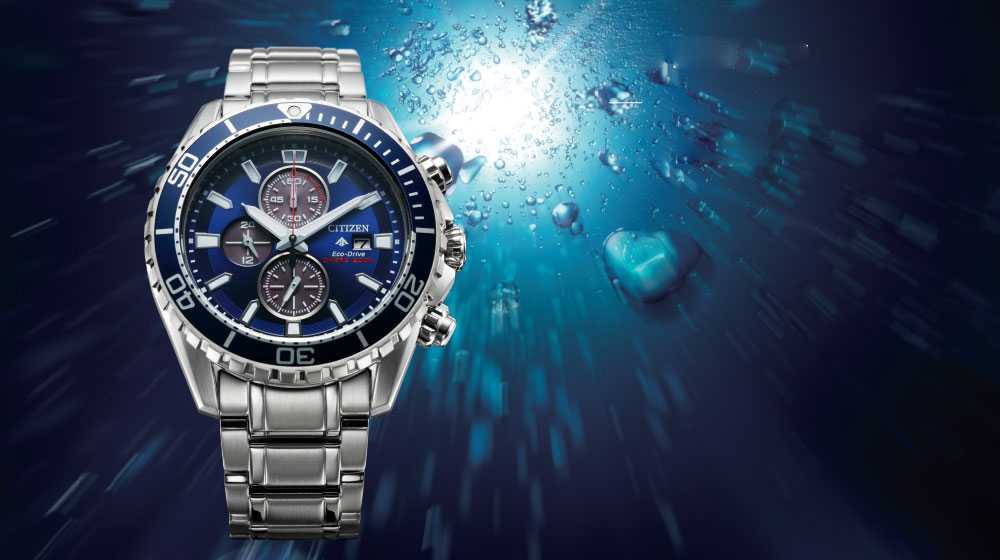
Launched in 1989, Citizen’s Promaster range of watches is 30 years old this year. Aimed at the toughest environments in the ocean, land and sky, Citizen’s Promaster range has a proprietary shock counteraction function which sends an electrical signal to the motor to momentarily lock the rotor to prevent the watch hands from moving out of place within one-thousandth of a second when the watch experiences a shock or strong vibration.
The Promaster Eco-Drive Professional Diver 1,000 metres watch, equipped for 1,000 metre saturation diving, is the first diver’s watch with Eco-Drive powered movement. The Promaster Eco-Drive Altichron is Citizen’s land explorer range, sporting an altimetre (functional up to 10,000 metres), a compass and Eco-Drive. The Promaster Eco-Drive Global Radion-Controlled is a pilot’s watch equipped with an aviation scale, world time functionality and an Eco-Drive.
Citizen is celebrating its 101th anniversary this year and it remains at the forefront of innovation and precision with its revolutionary Eco-Drive – light powered timepieces, the proprietary Super Titanium technology and the Promaster sports range. Still at the forefront of innovation and precision, Citizen sees the world as a work in progress, a place to be improved and a place where time is measured in steps forward.
Do you know how technical diving got its name, its history and evolution to its present status as the vanguard of diving? Read on to find out.
Though still regarded as crazy by some in the military and commercial diving circles, technical diving, which just turned 32 years old, is no longer considered the radical fringe and has taken its rightful place as the vanguard of sport diving. The history of diving is the story of the quest to go deeper and stay longer. Mixed gas is one of the technologies enabling divers to do that. The U.S. Navy was the first to develop mixed gas (specifically helium) diving protocols in the 1930s to rescue sailors from downed submarines. Commercial divers in the 1960s then developed their own protocols and methods as oil field diving pushed beyond reliable air diving limits[1].
This need to “go where no one has been before” was a driving force in the 1980s. It wasn’t uncommon for underwater explorers to conduct unsanctioned, relatively long 61-122 metre dives on air using oxygen for decompression, at their own peril. Even in the cave diving community, there weren’t any guidelines for diving beyond 40 metres.
In the mid-to-late 1980s, small groups of experienced divers led by pioneers such as Dale Sweet, Jochen Hasenmayer, Sheck Exley, Bill Gavin, Parker Turner, Bill Main, Lamar English, Billy Deans and others, began experimenting with helium mixes to push the limits of self-contained diving further. Diving physiologist Dr. R.W. “Bill” Hamilton and others such as former U.S. Navy medical officer Dr. John Zumrick and anaesthesiologist John Crea aided them by providing special mix decompression tables.
It seems remarkable today that explorers like Exley were conducting mixed gas cave dives as deep as 189-274 metres in the mid-to-late eighties. Cave environments offered confined water and ample areas for staging cylinders (and decompressing) which made it a more accessible proving ground for mix technology than open water.
The wreck diving community was also pushing air limits with 15-25 minute dives to 61-79 metres, mostly conducted on air using U.S. Navy tables or dive computers. Few were using oxygen for decompression. Billy Deans, owner of a Key West Florida dive shop, began developing mix protocols after losing his best friend on an air dive on the SS Andrea Doria in 1985. That year he helped Captain Steve Bielenda install an oxygen decompression system on Bielenda’s boat, the RV Wahoo, based in Montauk, New York, that got divers out of the water faster and with fewer bends. Soon everyone was decompressing with oxygen. Deans went on to create the first technical diving training centre and trained many Northeast wreck divers to dive with mix gas.
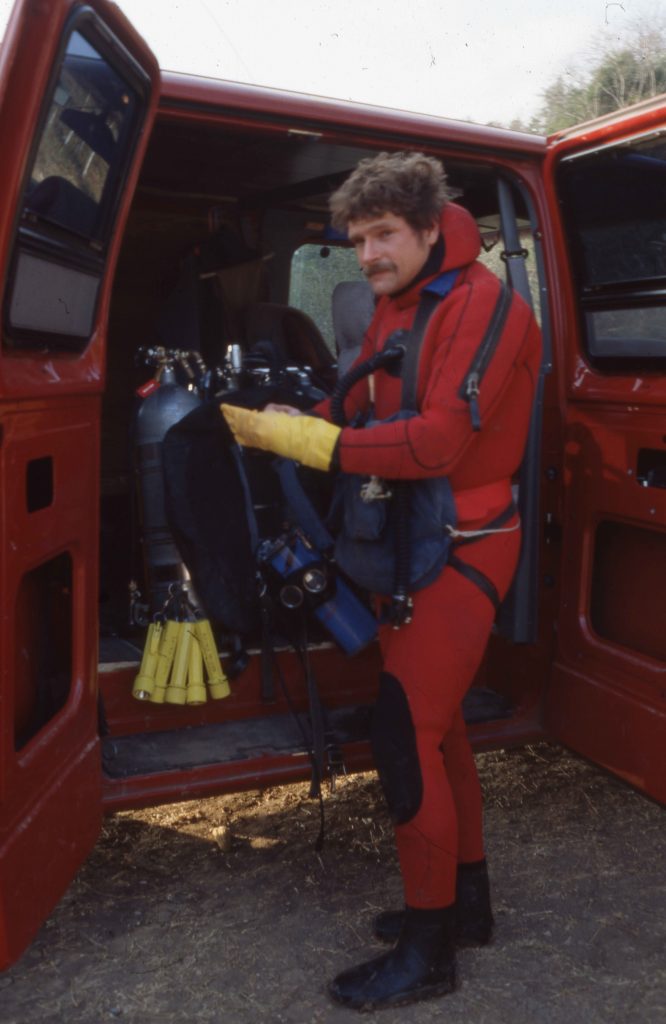
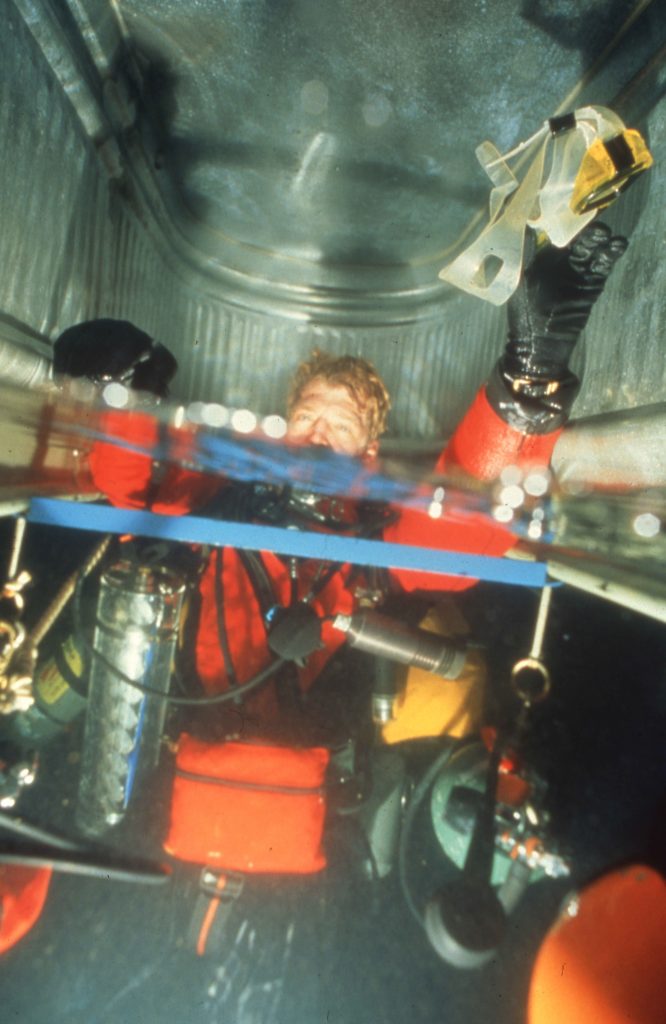
1987: The Wakulla project decompression habitat, where divers conducted most of their decompression. On board controls permitted up to six divers to ascend from 70 feet depth to the surface. Twelve-hour missions were not uncommon during the project. (Photo courtesy of US deep Cave Diving Team)
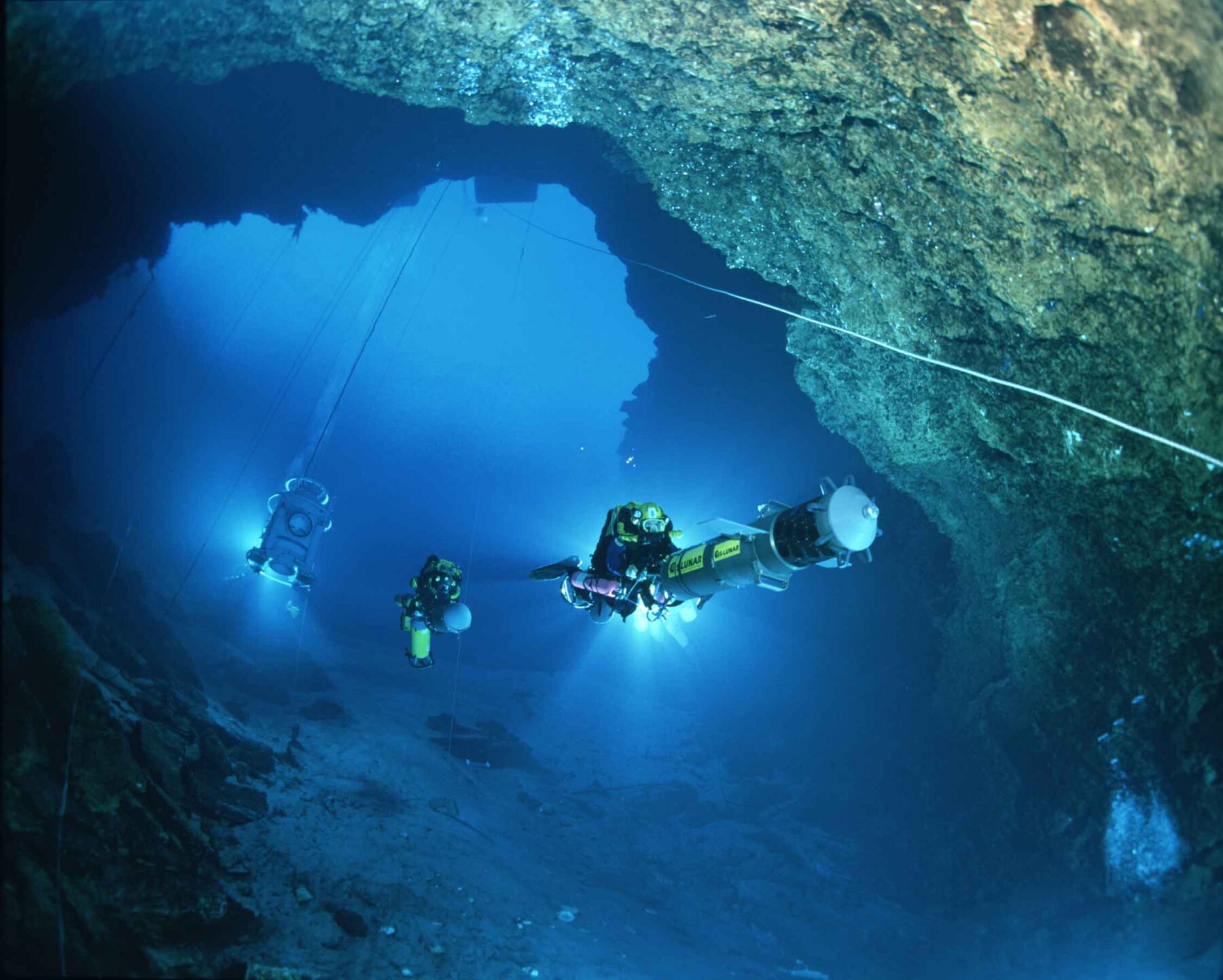
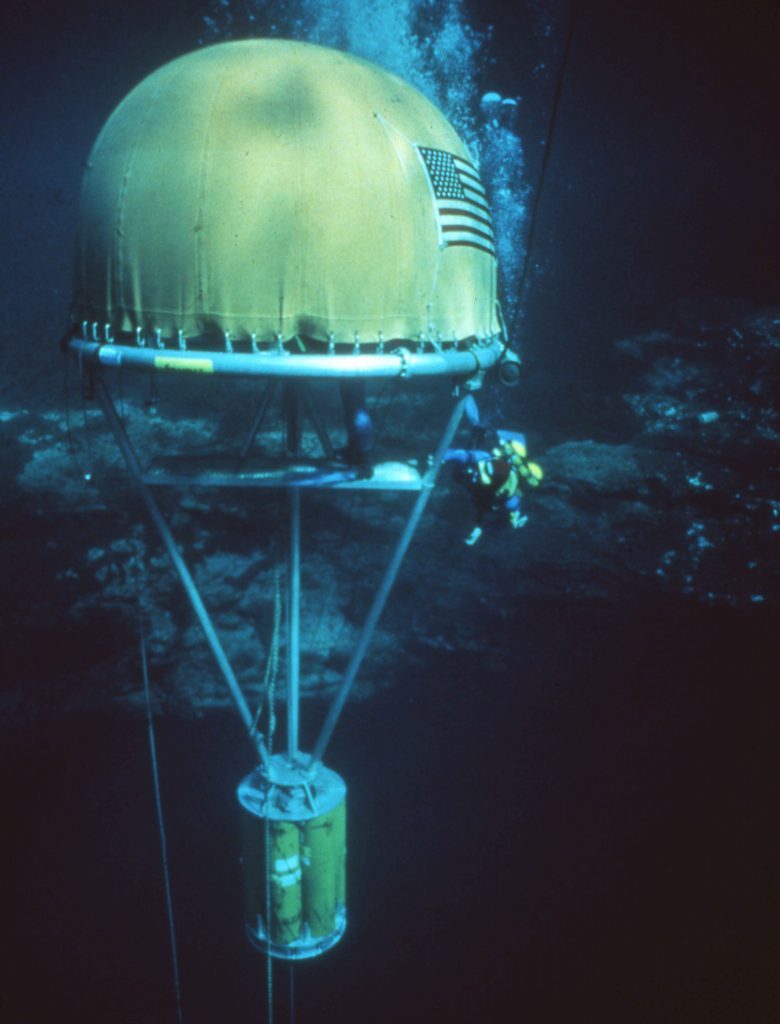
Arguably the poster child for mixed gas diving was the Wakulla Springs Project, organised by caver and engineer Dr. Bill Stone in the fall of 1987. In two and a half months, Stone and company mapped 3.7 kilometres of underground passageway at depths of 79 to 98 metres, using new technologies and techniques such as open circuit heliox with nitrox and oxygen for decompression, high pressure cylinders, long-duration scooters and an underwater decompression habitat. This was the first large-scale mixed gas expedition of its kind and marked the emergence of tech diving.
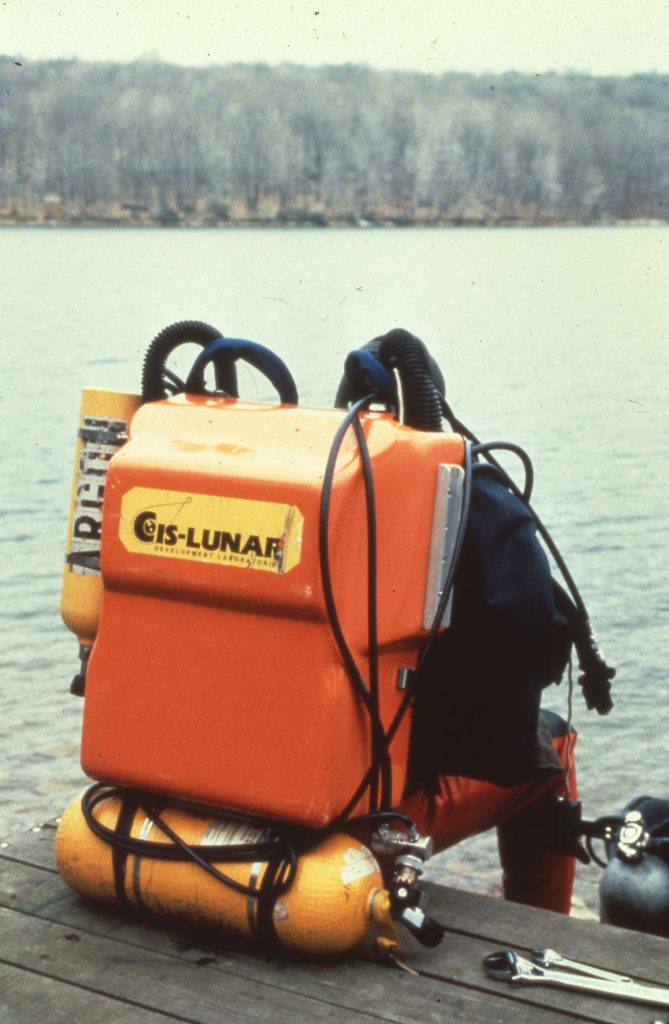
1987: Dr. Stone inspects the habitat at 60 ft/18 m during second test dive of the Cis-Lunar MK 1. (Photo by Noel Sloan)
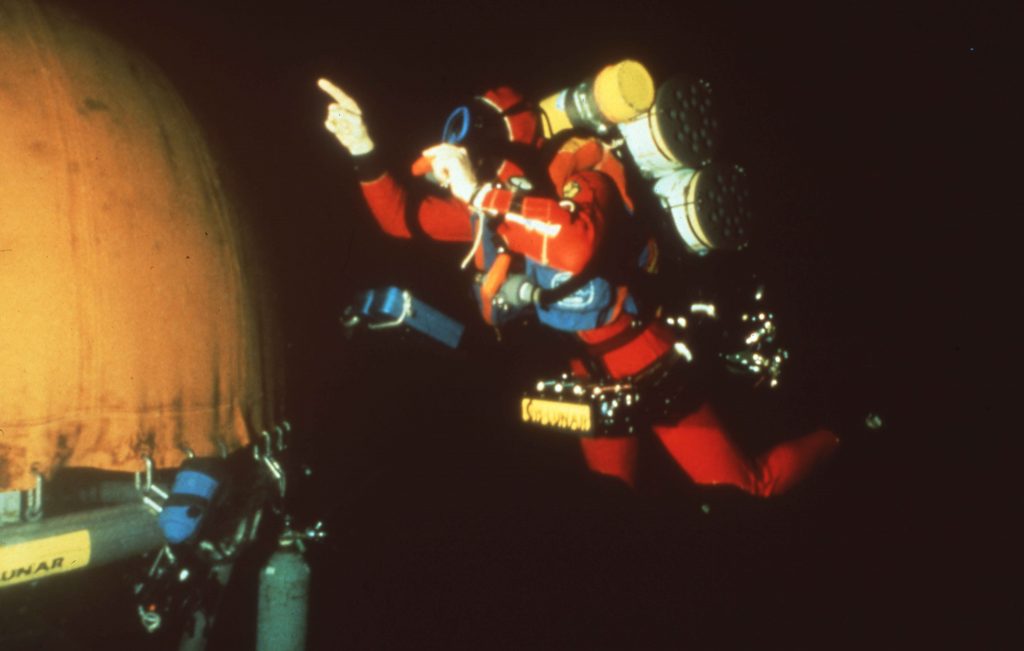
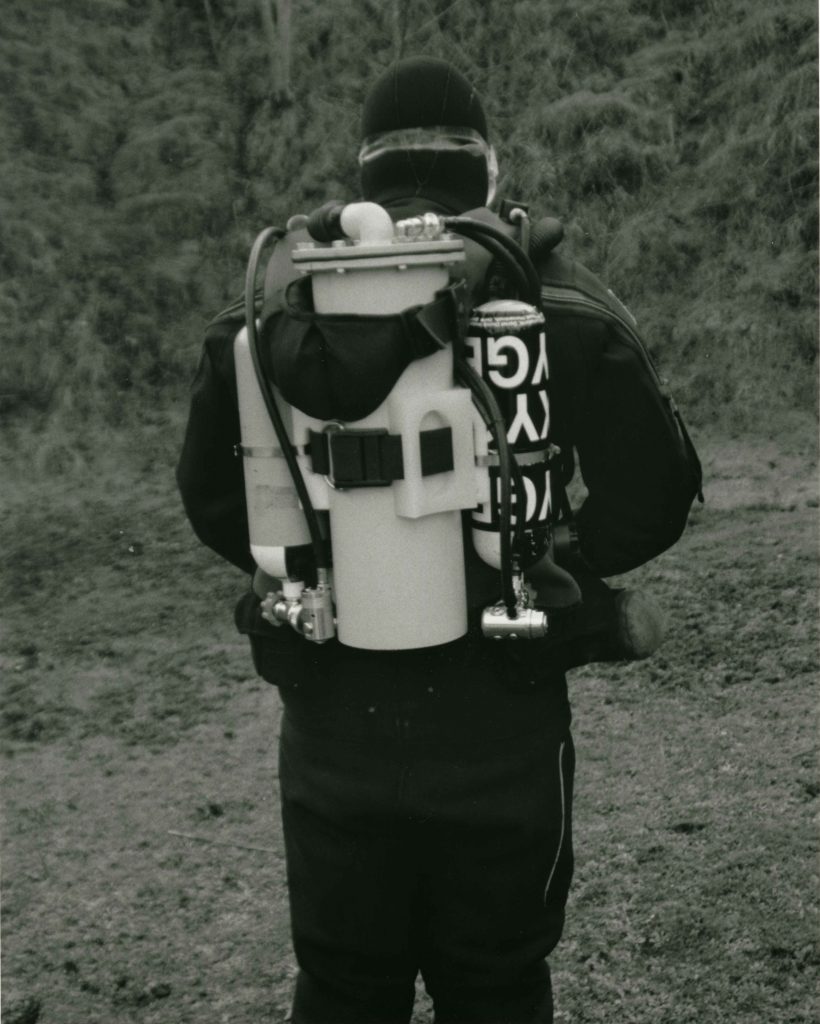
Although they used open-circuit scuba, Stone knew rebreathers would eventually be needed to overcome the limitations of open circuit gas logistics for deep cave diving. With his team, Stone built a 165-pound prototype, the MK-1 fully redundant rebreather, trialling it in a 24-hour long dive.
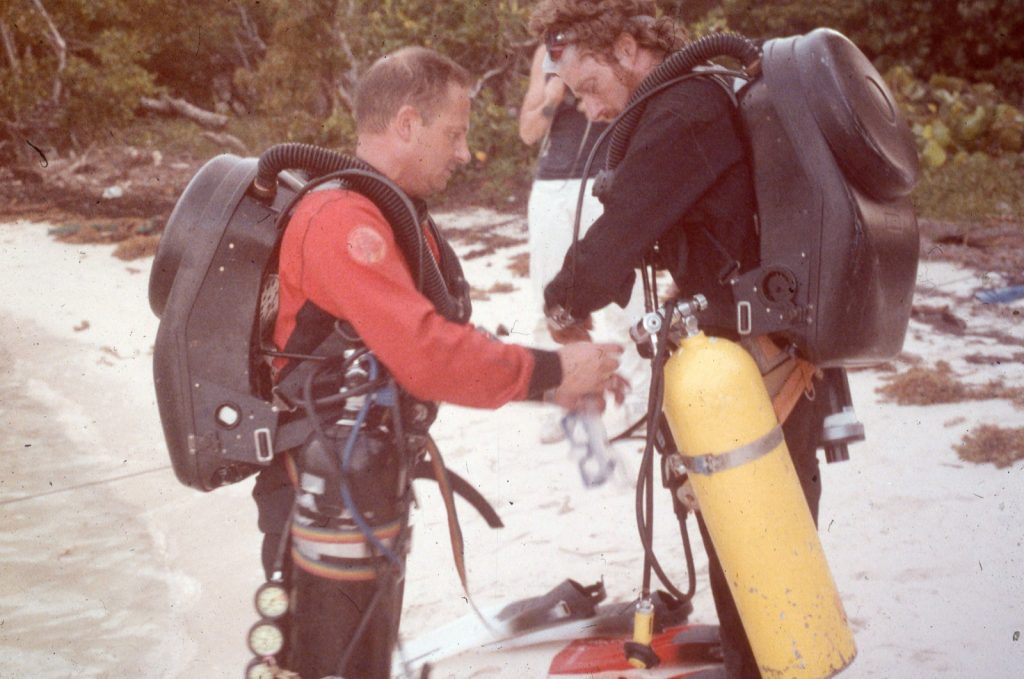
In 1987, engineer Kevin Gurr (the future president of VR Technology Ltd.) began helping Carmellan Research Ltd. principal Stuart Clough, and British explorer Rob Palmer, with the electronics for their modified Mk-15 military rebreathers. The rebreathers combined with open circuit heliox, enabled Clough and Palmer to explore the Andros Blue Holes.
1987: British rebreather pioneer Stuart Clough instructing Rob Palmer on the use on the Carmellan Research CR155 rebreather (a modified Rexnard MK15.5 capable of maintaining a 1.4 atm set point) on Andros Island, Bahamas. Bill Stone in the background. aquaCORPS archive. (photo courtesy of Michael Menduno)
Clough then teamed up with British engineer Peter Readey (who later formed Steam Machines Inc. and designed the PRISM rebreather). In Europe, cave explorer Olivier Isler teamed up with engineer Alain Ronjat to build the RI 2000 semi-closed rebreather, which he used to push the La Doux de Coly siphon in 1989.
1989: Olivier Isler entering Doux de Coly with his fully redundant RI 2000 semi-closed rebreather. (Photo by Gavin Newman)
What’s In A Name?
In the early days, tech diving wasn’t widely talked or written about in the press or at dive industry forums like the Diving Equipment and Marketing Association (DEMA) show and there were no training courses. This lack of information made divers less safe!
1989: Sheck Exley preparing for his Manté expedition to 867 ft. (Photos by Randy Bohrer)
I started aquaCORPS Journal in January 1990 to change that. Our first tag line was The Independent Journal for Experienced Divers. In that first issue, we featured a Dr Bill article titled, Call It High-Tech Diving. At the time, I had a few rock climber friends engaged in what was then called, “technical climbing”, where individuals used ropes and protection to tackle rock faces that couldn’t be climbed. The word “technical” had all of the right connotations. So, I pinched the term for diving, using “technical diving” for the first time in aquaCORPS #3, DEEP (Jan 1991). In the next issue the tagline became The Journal for Technical Diving and technicalDIVER, a companion newsletter, was launched.
1990: Woodville Karst Plain Project (WKPP) co-founder 1990 Parker Turner decompressing at the Habi-trough in Cheryl Sink. (photo from aquaCORPS archives courtesy of Michael Menduno)
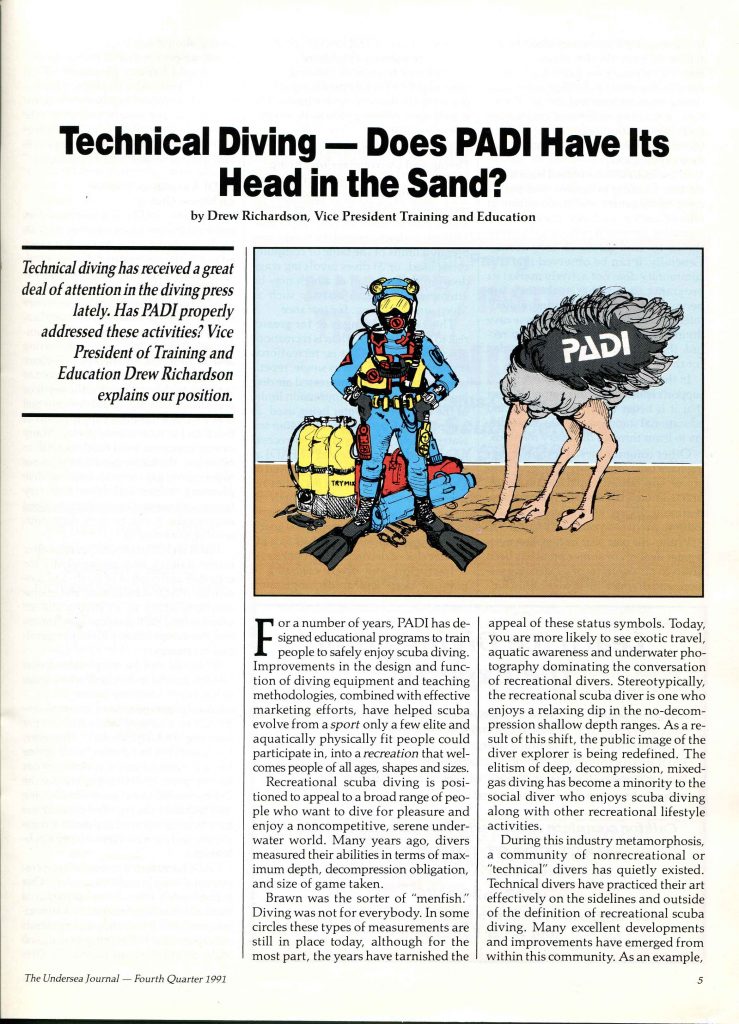
Later that year, Drew Richardson, then a vice president of the Professional Association of Diving Instructors (PADI), penned Technical Diving – Does PADI Have Its Head In The Sand?, an editorial for PADI’s Undersea Journal, which helped legitimise tech diving as distinct from recreational diving. And the name stuck!
Nitrox: The Devil Gas
The “technical diving revolution” was really about adapting mixed gas technology to the consumer market. Mixed gas could improve divers’ safety and performance and enable them to extend their depth and bottom time by optimizing their breathing gas for the planned exposure. This meant you could, a) Maintain efficient and reliable oxygen levels over the course of the dive, b) Reduce/eliminate undesirable inert gas effects such as narcosis and HPNS and to facilitate off-gassing and, c) Reduce breathing gas density to minimise the work of breathing and prevent CO2 build-up.
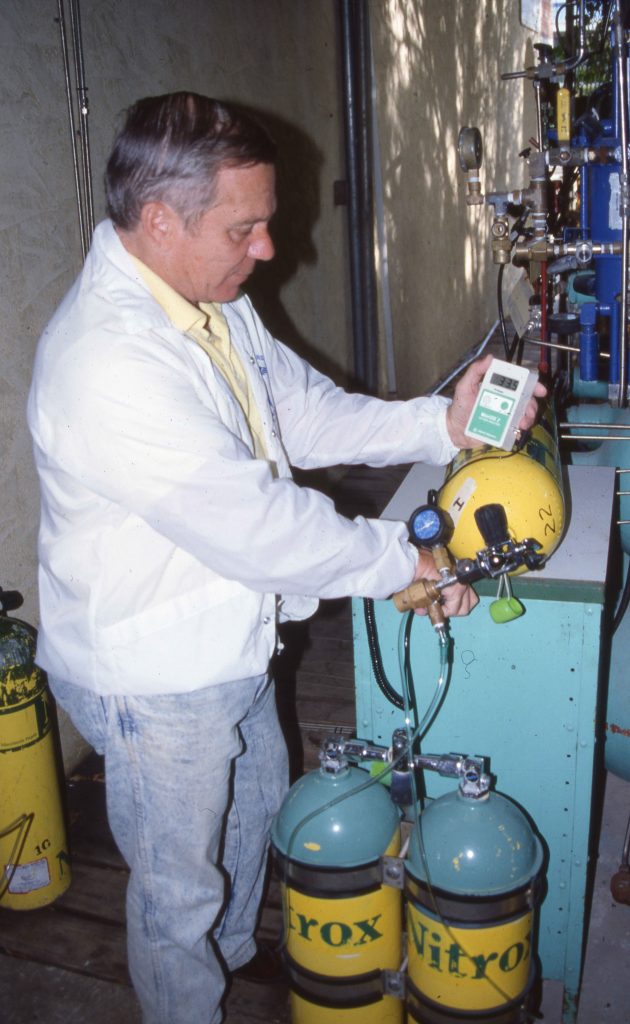
With the 40-metre depth limit of PADI “deep divers” serving as merely the first decompression stop for most tech divers, recreational diving instructors no longer represented the apex of the sport diving food chain. In addition, while once considered the mark of the elite, diving beyond 67 metres on air was now considered increasingly foolish. Dick Rutkowski, a former aquanaut and deputy diving director for the National Oceanic and Atmospheric Administration (NOAA), founder of the International Association of Nitrox Divers (IAND), and co-founder of American Nitrox Divers Inc. (ANDI), was also promoting nitrox for recreational diving.
Dick Rutkowski analysing his nitrox. (Photo by Bret Gilliam)
Not surprisingly, there was pushback from the recreational diving industry, which had little knowledge of nitrox or mixed gas technology and was concerned about safety. In the Fall of 1991, Bob Gray, the executive director of the Diving Equipment and (then) Manufacturing Association (DEMA), decided to ban nitrox vendors and training agencies like IAND and ANDI from attending the DEMA annual trade show.
With the help of Dr. Bill, Diving Unlimited Inc. founder and CEO Dick Long with his Scuba Diving Resources Group, and Richard Nordstrom, then CEO of Stone’s company Cis-Lunar Development Labs, we organised the Enriched Air Nitrox (EAN) Workshop in January, 1992 in Houston, Texas, days before the DEMA show was to be held there. Our goal was to bring all the stakeholders together to discuss nitrox and its uses. In light of the workshop, Gray agreed to rescind the ban on nitrox vendors attending the show.
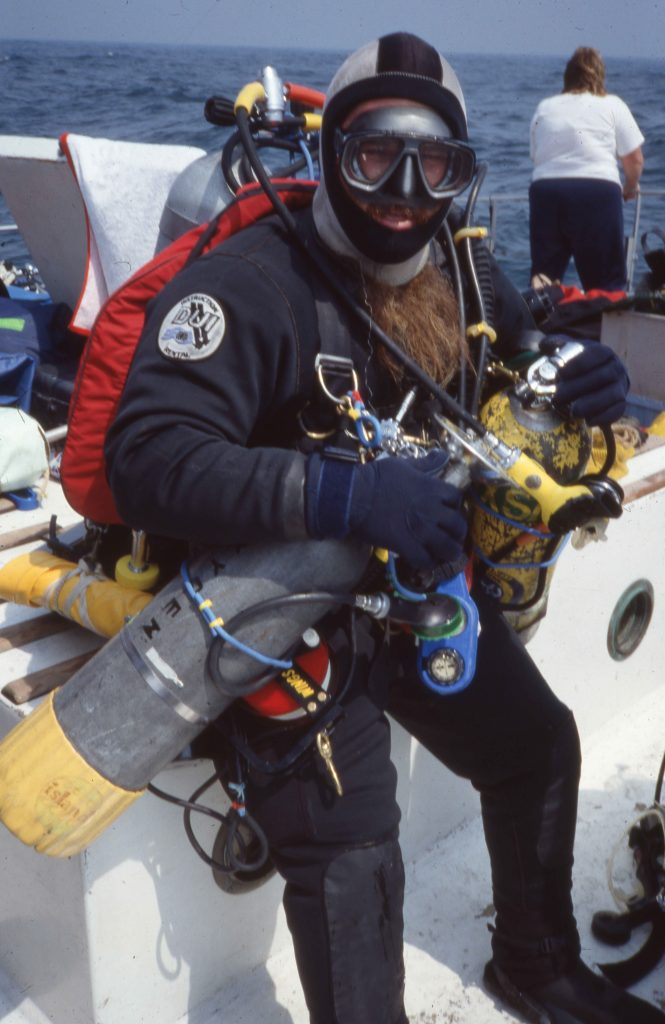
1994 Diver sporting the Cis-Lunar Development Laboratories MK-IV rebreather (Photo courtesy of Michael Menduno)
As a result of the EAN workshop, the sports diving community established the first set of policies addressing for the use of nitrox, and that nitrox could be used by all sport divers. We published the findings from the workshop written by Dr. Bill in aquaCORPS’s sister publication technicalDIVER Vol. 3.1, published in July 1992.
That year, the first page of the DEMA Exhibitor’s Guide offered a warning about using nitrox with scuba equipment. Ironically, that highlighted nitrox to attendees and proved to be great advertising for mix gas technology and the training agencies.
Developing Community Standards and Best Practices
The summer of 1992 was a tragic one for the fledging tech diving community. There were eight high-profile diving fatalities, including two on the Andrea Doria, and one at Ginnie Springs cave system in Florida, along with a number of close calls that resulted in injury. Many feared that these deaths would bring on government regulation and effectively shut down technical diving.
1991: “This is Not Recreational Diving!” Tech pioneer Wings Stocks preparing to dive the Doria during the first mixed gas expedition on the Andrea Doria organized by Bernie Chowdhury. (Photo courtesy of Michael Menduno)
Over the last quarter of 1992, Skin Diver magazine repeatedly called for an end to deep diving and nitrox use. These editorials sometimes confused nitrox usage with deep diving[2], showing their lack of knowledge about the technology. The Cayman Water Sports Association even warned that divers bent while diving nitrox wouldn’t be treated.
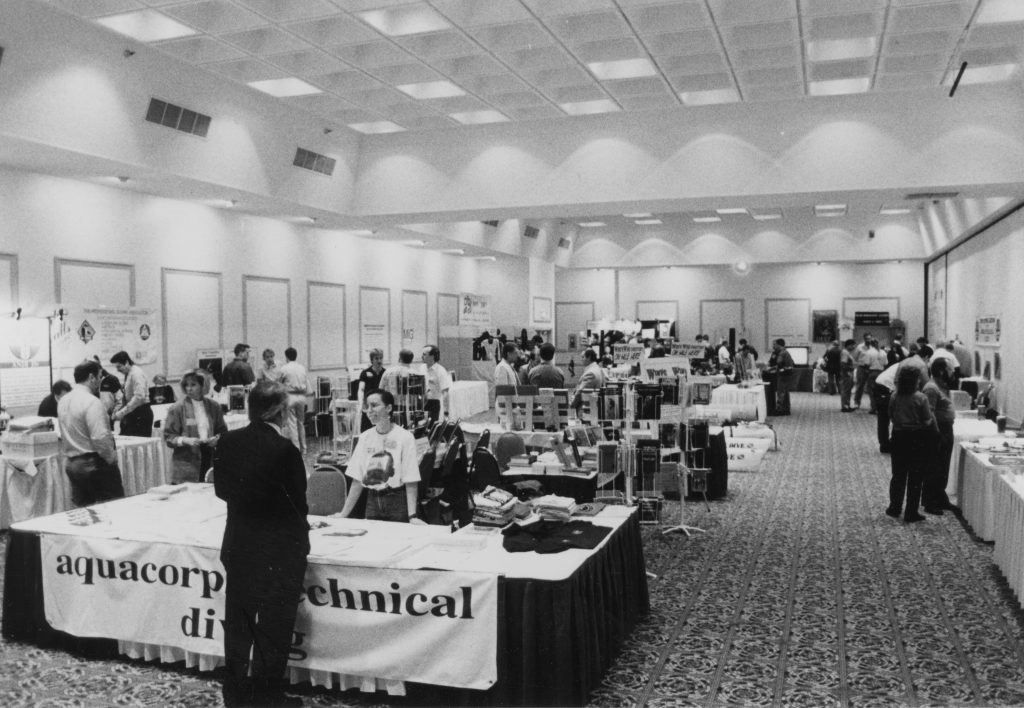
The tek.93 exhibit hall (Photo courtesy of Michael Menduno)
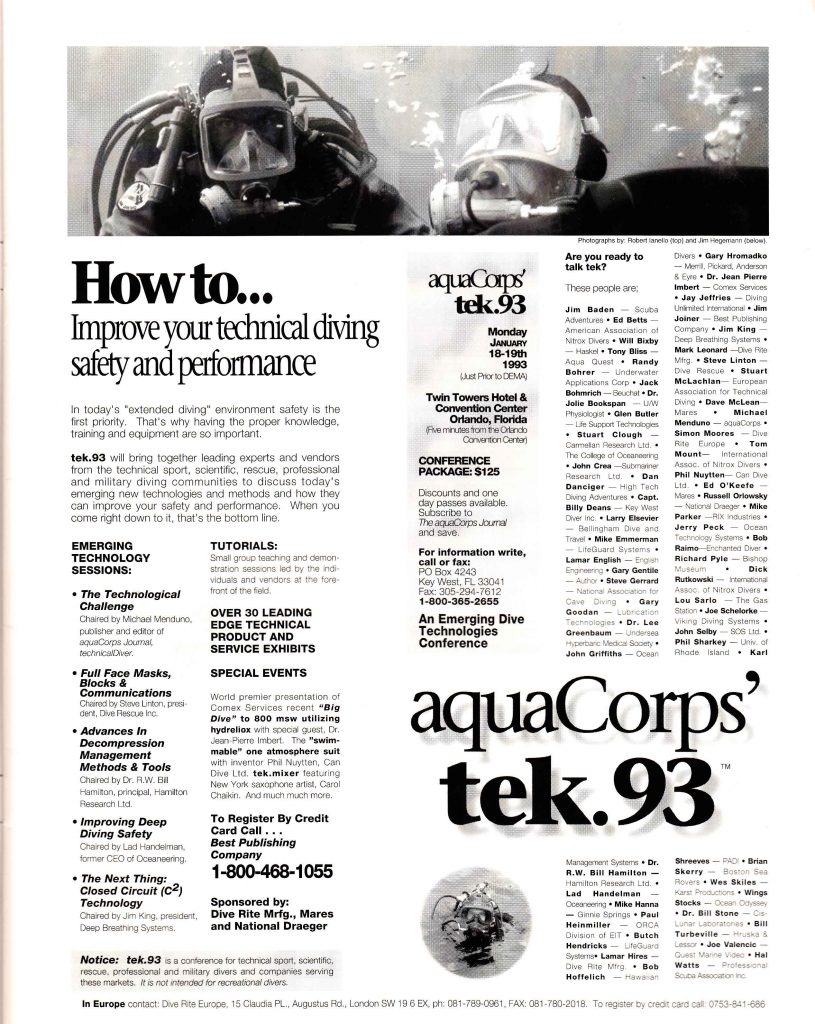
In January, 1993, aquaCORPS organised tek.93, the first annual tech diving conference, in Orlando, Florida, just prior to the annual DEMA show. As a result of the conference, a group of us including Deans and Gurr put together Blueprint for Survival 2.0 – the first set of “best practices” for technical diving that was published that June (1993) in aquaCORPS #6 “Computing.” The 21 recommendations covered training, gas supply, gas mix, decompression, equipment and operations and were based on the 10 principles Exley developed from a thorough analysis of cave diving accidents (Basic cave Diving: A Blueprint for Survival) which helped reduce fatalities. We also started Incident Reports, a popular new section featuring detailed analyses of tech diving accidents.
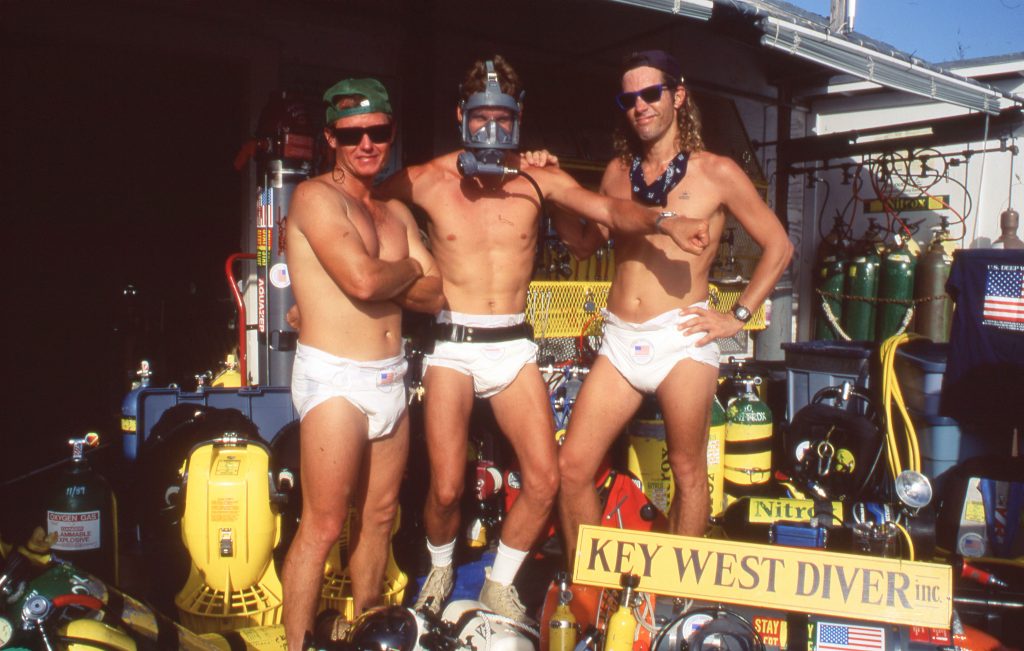
1993: aquaCORPS Journal organizes the first tek.Conference (TEK.93) for technical divers just prior to the annual Diving Equipment and Marketing Association (DEMA) tradeshow. (photo courtesy of Michael Menduno)1993: Technical diving pioneer Capt. Billy Deans with Mark Nease and author Michael Menduno in diapers at Key West Diver, the first technical diving training center in the world. Note this was before condom catheters were used. (Photo courtesy of Michael Menduno)
Over the next few years, as tech training agencies developed solid training courses and safety records improved, technical diving began to establish itself as a legitimate branch of sport diving, and mix technology such as nitrox was gradually adopted by the recreational side of the diving business.[3] By 1995, PADI along with the British Sub-Aqua Club (BSAC), National Academy of Scuba Educators (NASE) and Scuba Schools of America (SSA), joined other recreational and technical diving training agencies to offer enriched air nitrox training. The era of single mix technology, i.e. air diving, was dead.
The establishment of tech diving and nitrox use helped fuel the development of a mixed gas infrastructure at the retail dive store level, a necessary step for the emergence of rebreather technology.
Thirdly, it was clear that training requirements for rebreather diving were significant. But semi-closed rebreathers were likely to be the first adopted by sport divers because of their relative simplicity and lower cost. Unlike nitrox, there were few concerns about the technology. We continued to offer rebreather workshops and “try-dives” hosted by manufacturers at our annual tek conference, however product was slow to materialise.
Bring on The Breathers!
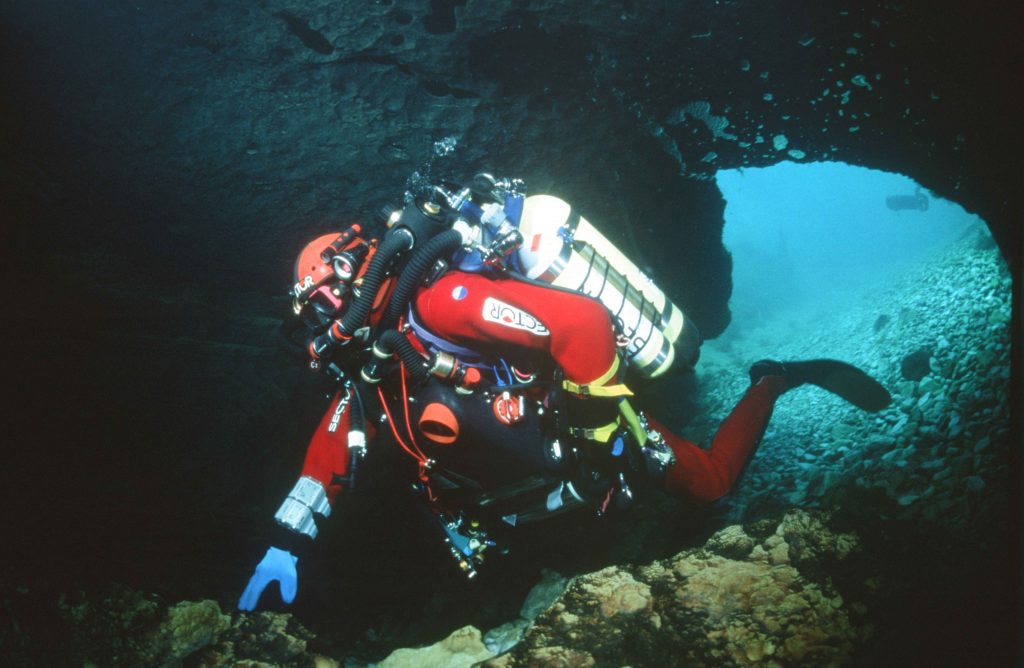
Viewed as the ultimate in self-contained diving technology and the future of tech diving, rebreathers could greatly extend bottom times independent of depth, while providing near optimal decompression in a small package. However, as it wasn’t readily available, we didn’t how much discipline and attentiveness were required for rebreather diving.
We started reporting on rebreathers in June 1990. Over the next few years, rebreathers articles increased in our issues. We also featured several rebreather sessions at tek93.
It was clear there were many myths and misunderstandings surrounding rebreathers at that time. Few in the sport diving community owned a rebreather, so I teamed up with Robinette, who had built the ShadowPac rebreather in the 1970s, to organise the first Rebreather Forum at Key West, Florida, in May 1994. We featured special guests Dr. Ed Thalmann, the U.S. Navy’s diving physiology guru who oversaw the development of the Navy’s mixed gas decompression tables, and inventor Alan Krasberg – arguably the grandfather of mixed gas closed circuit rebreathers.
That first Forum had 90 attendees, including five rebreather manufacturers, numerous training agencies and representatives from sport, trainers from the military and commercial diving communities. It was the first time such a group had been assembled.
The findings from the forum were several-fold. Firstly, there was clearly a market for rebreathers but nobody could get one. Secondly, the military, through strict discipline and massive support, was the only diving community successfully using rebreather technology but those two conditions weren’t easily found in sport diving. Commercial divers rejected rebreathers for its complexity and unreliablility.[4] Thalmann cautioned during the forum about the very real problems with rebreathers potentially causing fatalities to ill-prepared divers compared to the proven reliability of the scuba regulator.
Rebreather Forum 2.0
In 1995, Dräger, who had been building rebreathers since the 1940s, launched the Atlantis, a semi-closed unit rebreather designed for recreational divers. With such an established manufacturer in the sport market, sport diving rebreathers gained great credibility. In Japan, Grand Bleu began selling the Fieno, a semi-closed unit. However, although the tech diving community was booming, it seemed likely that rebreathers were going to be adopted by the recreational community before tech divers.
In September 1996, Robinette and I organised Rebreather Forum 2.0 in Redondo Beach, California with PADI publishing the forum’s proceedings through their Diving Science & Technology (DSAT) subsidiary. Although there were more than 100 attendees along with 15 rebreather manufacturers, only five are building rebreathers today.
1996: Ambient Pressure Diving’s managing partner Martin Parker wearing an Inspiration rebreather prototype (Photo courtesy of Michael Menduno)
At the time, the U.S. and British navies were the largest users of mixed gas rebreathers, with 240 units in service out of a total of 600 in inventory. There were at most 25-50 units in the tech community. Most of these belonged to small groups like Stone‘s team, boutique manufacturers such as Steam Machines and explorers and filmmakers.
The conclusions from the forum were manifold: Although there was universal interest and everyone knew the risks, no one was worried rebreathers could be problematic for sport divers. The thinking was that semi-closed systems such as the Dräger units would be more suitable for sport divers even though they had no rebreather experience.
Although technical training agencies actively promoted rebreather instructor courses, there was no standardised training yet. The sport diving community had no supporting infrastructure like the military’s, nor any retail support. They were starting from scratch.
With regards to decompression, the only validated constant partial pressure of oxygen (PPO2) tables at the time were the US Navy 0.7 atm constant PPO2 for nitrox and heliox rebreather diving. Note that a closed circuit rebreather is designed to maintain a constant PPO2, called a “set point” throughout the dive. It was unknown at the time, if simply reprogramming a dive computer to calculate decompression based on the oxygen levels supplied by a rebreather would work effectively.
The Forum also noted that the development of on-board CO2 monitors could greatly improve diver safety, and the community was advised to adopt a maximum constant PPO2 of 1.3 atm similar to the U.S. Navy. Dr. Bill and others argued that a diver’s PPO2 should be kept at 1.4 atm during the dive and boosted to 1.6 atm for decompression, which eventually became the standard.
Safety was viewed as the biggest challenge in adopting rebreathers for sport diving. Deans hoped “the challenge to bring the technology to market” wouldn’t kill too many divers.
It would be another decade before rebreathers became common tools among technical divers. Unfortunately, Deans was correct about the challenge. There were 200 reported rebreather fatalities worldwide between 1998 and 2012 when Rebreather Forum 3 was held. There were about 10 fatalities a year from 1998-2005, and an average of 20 a year from 2006-2012. By comparison, there are about 100-120 scuba diving fatalities a year in the U.S., Canada, U.K. and Europe combined – the majority of the worldwide market.
Later in 2012, Dr. Andrew Fock, head of hyperbaric medicine at The Albert Hospital in Melbourne, Australia, estimated that rebreather diving was likely five to 10 times as risky as open circuit scuba diving, accounting for about four to five deaths per 100,000 dives, compared to about 0.4 to 0.5 deaths per 100,000 dives for open circuit scuba. This makes rebreather diving riskier than sky diving at .99 deaths/100k, but far less risky than base-jumping at 43 deaths/100k. Since 2012, the evidence suggests that rebreather diving safety has continued to improve.
You’ve Come Along way Baby
Despite controversy and initial high incident rates, technical diving significantly improved its safety record and has found its stride. As Dr. Bill suggested in his prescient article, Call It High Tech Diving, that ran in that first issue of aquaCORPS: “With all these warnings issued, and all the described parameters met, advanced high-tech diving offers the prepared knowledgeable diver a chance to experience a realm not previously accessible to humans. And there is every reason to think—as our technology and knowledge advance—that we will be able to push the envelope even farther,” he wrote.
And we did.
[1] Lad Handelman, co-founder of Oceaneering told me that before mixed gas diving, commercial air dives were limited to about an hour or less bottom time at 250 ft/76m. Note the nitrogen in air (21% oxygen, 78% nitrogen, 1% trace gases) becomes increasingly narcotic beyond about 4 atm or 100 ft/30m, and divers are at risk of CNS oxygen toxicity beyond about 187 ft/57m.
[2] Nitrox is typically used as a bottom gas on relatively shallow dives (less than 130ft/40m), and also used by technical divers as a decompression gas following deep helium dives.
[3] Bret Gilliam and Mitch Skaggs formed Technical Diving International (TDI) in 1994 after splitting from IANTD, which went on to become the largest tech training agency. In 1998, Jarrod Jablonski and Todd Kincaid formed Global Underwater Explorers (GUE).
[4] Rebreathers are now used in the North Sea as a diver bailout device as part of contractor’s saturation diving systems.
“This story was originally published in “The Journal of Diving History,” Second Quarter 2018, Volume 26, Number 95.